Tag: forwardness

  • What Comes First When Training Your Horse?

    What Comes First When Training Your Horse?

    [fusebox_track_player url=”https://op3.dev/e/traffic.libsyn.com/dailystridespodcast/1292_What_Needs_to_Come_First_When_Training_Your_Horse.mp3″ title=”What Comes First When Training Your Horse” social_linkedin=”true” social_pinterest=”true” social_email=”true” ]
    I remember the excitement I felt when I began working with my pony ‘alone’ at home in the fields when I was younger.  The feeling that anything was possible if I was only willing to put in the consistent effort and work.
    And the feeling that there was just so much to do and so little time to do it!
    My mind was racing with thoughts of ground pole exercises, schooling movements, jumping grids, fitness training, etc., etc., etc.  All of the ‘exciting’ stuff I had seen other riders get up to in the pony magazines I got as a treat a couple of times a year.
    And after speaking with thousands of adult riders over the years, I think they also experience those same feelings.  Except as an adult, when training your horse alone, those feelings of initial excitement can often turn into overwhelm pretty quickly!
    In this episode of the Daily Strides Podcast, I want to chat about the very first concept I believe all horses and riders should work on in their training.  And I want to help you begin to think of this as the absolute foundation of everything else you do with your horse. Especially if you are training your horse alone.

    The concept? Forwardness…

    There are so many reasons why this is overlooked if you are a rider training your horse. Maybe the belief that it’s ‘boring’ or unimportant.  Or not correctly understanding what it is.  Sometimes riders don’t even know it is a ‘thing’ that needs work.
    Forwardness is a very real ‘thing’.  And it requires both you and your horse to understand and work this way.  Mentally and physically. 
    Without forwardness, none of the other principles or concepts (steps) of the training scale can exist.  And I realize this sounds like a bit of an exaggeration, but it is not.  Frowardness is absolutely essential to everything you do with your horse.

    What is Forwardness?

    One of the most useful ways of describing forwardness is to imagine the feeling when you have a sense of purpose.  There is a focus and quiet determination to it.  It’s not rushed, it’s certainly not wandering.  But rather it is moving towards something or some outcome with focus, clarity, and energy.
    This ‘sense of purpose’ can be applied to how you and your horse both think and take action.  Mental and physical forwardness.
    Having this combined ‘sense of purpose’ means that you are working together towards a single goal or outcome.  And this is absolutely key when training and working your horse.
    Some horses naturally tend to have this (a little like some people), while for others, it must be learned. And this is where, I believe, your training should begin with your horse.

    Training Your Horse to Work Forward

    I often feel that the physical aspects of this trait are a little easier to instill and build in both horses and riders.  There are many ways you can encourage your horse to move forward.  From your body language to your voice.  To use your position and other driving aids.
    However, if you have to keep ‘reminding’ your horse (via your aids) to ‘work forward’, he is not actually working forward!
    True physical forwardness is when your horse begins to accept responsiblity for his own level of purpose.  When your horse begins to ‘take you there’.  And just like anything in horse riding, you can do this by clear and timely correction when working together.

    Making Timely Corrections

    As you feel your horse beginning to ‘slow down’ or ‘meander’, you can encourage him to refocus and work forwards again.  It will take some consistency on your part, but the results are well worth it.  Similarly, if you feel your horse begin to rush or run, you can remind him to channel the energy into focused and rhythmic work.
    What’s key to remember and understand is that your horse will probably need you to correct, encourage, or remind him often initially – but will slowly begin to take over the responsibility for himself soon.

    Thinking Forward

    Isn’t it strange how some things, when you learn they exist, begin to shape how you see everything in your day-to-day life?  Thinking forward was one of those things for me.  Once I learned it was a ‘thing’, I began to look for it everywhere.  And where it existed – compared to where it did not – was blatantly obvious.
    Thinking forward is essential for both horses and their riders. The lack of it in training is what causes everything to become ‘stuck’.  Often physically stuck!
    So a horse who plants himself in one spot and is unwilling to move forward.  Or a horse that needs constant ‘chasing’ to get to move anywhere at all! And with regards to the riders; a lack of forward-thinking allows them to become distracted by everything during each ride.  They struggle with consistency and actually doing what they set out to do.

    Rider’s Mental Forwardness

    Luckily, thinking forward is a little like concentration – it can be improved and strengthened over time.
    And this must begin with the rider being committed to developing this in themselves first.
    I will list more resources below about how you can begin to think this way…
    And, if you are looking for some ‘hand-holding’ while you are learning how to train your horse, make sure you get on the VIP list for my brand new program where I will be helping a small number of riders train their horses at home, alone, without a trainer or coach… Get on the list HERE
    Happy Riding
    Lorna

    Seeking Founding Riders…

    If you are considering training your horse at home or alone (boarding at a barn, but don’t have a regular coach or trainer), make sure you check out the details of my upcoming brand-new program.

    I’m looking for a limited number of riders to work in-depth with me and my team as we go through this program for the first time.  Get on the waitlist to be the first to find out all of the information… We start in early September. Join the Waitlist HERE (no obligation to join the program, just be the first to know all of the details :) )
    More Training On This:-

  • Getting into Canter on Your Easygoing or Lazy Horse

    Getting into Canter on Your Easygoing or Lazy Horse

    [fusebox_track_player url=”https://op3.dev/e/traffic.libsyn.com/dailystridespodcast/1253_Getting_From_Trot_to_canter_on_an_easygoing_or_laidback_horse.mp3″ title=”Getting into Canter on an Easygoing or Laidback (lazy) Horse” social_linkedin=”true” social_pinterest=”true” social_email=”true” tweet_text=”Check this out to help make getting into canter easier for you!” hashtag=”lazyhorse #horsepodcast” twitter_username=”strides_success” ]

    Getting into canter on an easygoing or lazy horse can be exhausting!  And while we do love our laidback equines… Can we all be honest in admitting how, sometimes, just a little more enthusiasm would change everything?  The good news is that you can quickly begin to change this in your horse.

    You see, often, the trot to canter is often a symptom of a bigger issue – a lack of responsiveness.

    Increasing your horse’s responsiveness is possible. It will take a consistent approach from you – and the transformation can be instant… 

    So, rather than scrubbing, pushing, and shoving into the canter each time, begin working on increasing overall responsiveness first.  Be strict or disciplined with both yourself (it all starts with you) and your horse.  Oh, and did I mention that you also need consistency ;)

    Your Training Goal

    Before you begin working on this with your horse, it is important to have something to aim for.  My suggestion is to have the goal of being able to ask a question with the lightest of aids, and have your horse instantly respond. However, I get that, right now, this may seem impossible.

    Training your horse to respond to light aids immediately is your focus over the coming few rides. And you will also review this regularly going forward in your riding as well. 

    But, in order for your easygoing or lazy horse to begin changing, you must first take responsibility for your actions.  How things are now is a reflection of what you have continued to allow to happen in your training.  A more responsive horse starts with a more responsive rider…

    Your Leg Aids

    Just like most ways we communicate, you can use different methods with your horse to ask similar questions.  So if you have been just asking one way and not seeing results, maybe it’s time to begin experimenting with a wider range of aids?

    Easygoing or lazy horses need to learn to go forward without constantly being encouraged to do so by the rider’s legs. 

    Think of your leg aids now.  How are they being used to ask your horse to step into the canter?  A slight squeeze?  Maybe a squeeze and a small ‘nudge’?  Or do you have to give a few solid ‘kicks’?  Your aim for your training is to have your horse respond to the slight squeeze.

    However, in order to do that, you may need to apply a little more pressure initially using the ‘kick’.  Although, I would rather strongly suggest the correct use of a schooling or long whip. This is because I believe a ‘tap’ behind your leg to bring your horse’s attention to your leg is often a much ‘nicer’ solution than kicking the sides off your horse!

    Moving from Obvious to Subtle

    As you work towards the ‘light touch’, it will be so important to remember that consistency is key when working on responsiveness. So getting on and wandering around for 10 minutes not really focusing on anything while ‘warming up’ will not help your situation! From the moment your bum enters the saddle, your focus will be on responsiveness.

    Most riders overlook the very first transition that happens when begin riding. The one from halt to walk. Rather pay attention to it. This is where you can set the tone for the conversation going forward. 

    Aim for the whole conversation to be ‘I, the rider, ask a question and then you, the horse, respond in a timely fashion’. Ask followed by a quick response.  Repeat this over and over, throughout the ride.  Start in walk and trot.  And only when your horse is truly ‘going forward’, begin to work on the canter.

    Stop Nagging Every Single Stride

    The final key to this is to change the habit of nagging.  When you have ridden an easygoing or lazy horse for any length of time, certain habits can creep into your riding.  Kicking or squeezing every single stride is one of those habits. Now, the irony is that you may feel like you MUST do this to keep him going forward, right?

    It is important to remember that, when riding, the goal is for you to ask a question, and your horse responds until you interupt and ask a different question

    Part of your responsibility, as a rider, is to allow your horse to take responsibility for his role in this conversation.  Your horse must begin to take responsibility for ‘going forward’.  And if you are reminding him of this every single stride, he simply can’t.

    Learn to ask a question.  Repeat if necesary with more pressure.  Let your horse respond. Then wait until you need to make a correction…

    The correction in this situation is asking again for more energy when you feel that he has stopped working forward himself. And going forward is not ‘working forwards’.  True forward feels like moving with a sense of purpose.  Keep that in mind as well.

    Your Easygoing or Lazy Horse

    As you begin working on this the next time you’re in the saddle it is really important to remember one thing.  The struggle you are experiencing while getting from trot to canter with your more easygoing or lazy horse is merely a symptom.  The root cause is a lack of responsiveness.

    Responsiveness is one of the easiest things to correct in your riding.  And it is something you have almost 100% control over the outcome.

    Keep in mind that the key to overcoming this challenge is to be consistent with your training, and how you ‘show up’.  I would suggest short, extremely focused sessions of 20 to 30 minutes initially and then build from there.

    You will be amazed at what you can transform in just one ride!

    Happy Riding
    Lorna

    More About Canter Transitions:-

    Get Support & Guidance in Your Riding

  • Establishing Fowardness in the Trot

    Establishing Fowardness in the Trot

    [fusebox_track_player url=”https://op3.dev/e/traffic.libsyn.com/secure/dailystridespodcast/1225_Establishing_Forwardness_in_the_Trot.mp3″ title=”Establishing Forwardness in the Trot” social_linkedin=”true” social_pinterest=”true” social_email=”true” tweet_text=”Make Your Trot Better Starting Today…” hashtag=”equinepodcast #trotting” twitter_username=”strides_success” ]

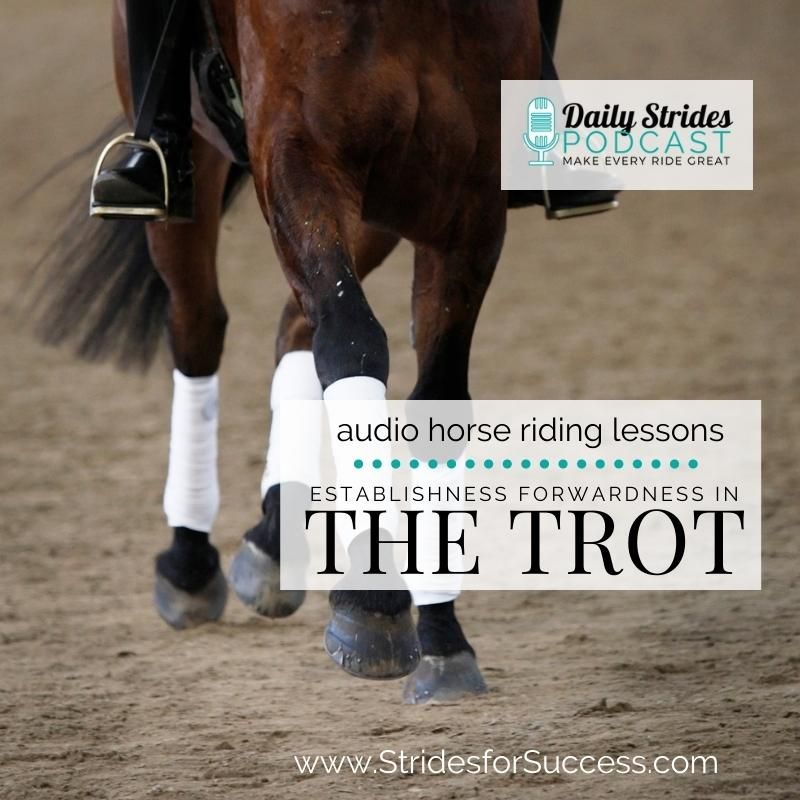
    The key to a good quality trot is to remember that your horse must be moving forwards at all times. I call this forwardness in the trot.  This is not to be mistaken for running, rushing, or jig-jogging.  True forwardness requires that you, the rider and decision-maker, must be thinking forwards throughout your ride… And, in this case, in the trot itself.

    And yet, forwardness in the trot is often one of those ‘easier said than done’ things – especially when we become stuck trying to improve that same trot!

    This episode of the Daily Strides Podcast has been plucked from a week of lessons from Daily Strides Premium called “The Basics for Establishing a Good Quality Trot”. The full week of lessons are available right now when you join Connection

    Why Forwardness in the Trot…

    Many riders accept their trot as being a ‘filler’ in their riding.  Something that they do pretty often between other, more important, things that they do!  And the often monotonous rhythm, the 1,2,1,2,1,2, can often have the effect of lulling riders into a false sense of ‘all being well’ within the gait. Trotting can be so much more…

    When you begin paying attention to how much space you and your horse can create inside of the trot itself, you can begin transforming the whole ride. 

    Shuffling about, using each iteration of trot in each ride as a means to an end, can similarly do the same.  But in the completely wrong direction as far as progress and development are concerned.

    Improving the trot itself starts with becoming aware of the energy inside of the trot. Are you truly moving forwards with a sense of purpose? Or shuffling along?

    I truly believe that before you can do anything else inside of your trot, you must first have the energy to work with.  Creating forwardness in the trot will give you this energy.

    The Half Halt

    Is there anything in riding that truly is ‘stand alone’? I have yet to find it if there is and forwardness in the trot is the same.  There are many different elements that must come together in order to make this happen for you and your horse.

    By correctly engaging the half halt you can begin better directing the energy being created within the trot itself. 

    Your half halt can be used for a few different purposes.  To bring your horse’s attention back to you.  Then, to prepare him that you are going to ask a question or something different. And finally, to help establish, balance, or maintain before, during, and after your horse’s response.

    Combining the half halt, with energy, and then adding thoughtful transitions can, over time, transform your trot. 

    And, just like most things in horse riding, the onus will be on you to maintain consistency.  You must become committed to the idea of gradually, day by day, developing each ride.

    And I believe that forwardness in the trot is a great place to start doing just this.

    Happy Riding!
    Lorna

    The Basics for Establishing a Good Quality Trot

    This episode comes from a full week of audio horse riding lessons on this topic. In this particular group of lessons, I help you work on identifying where your horse’s propulsion and thrust is coming from and how to begin not only influencing this but actually channeling it into a good quality ‘working trot’.

    After all, once you have achieved forwardness in the trot, it must then be harnessed.

    When you join Connection; my monthly online membership for equestrians, you will the full week of lessons on this topic.  You will also get weekly audio horse riding lessons (5 per week – each 12 minutes long) to use in your riding. 

    Guided audio horse riding lessons, weekly bonus live training, personal accountability, monthly challenges, and so much more… And all of your training is available on a private podcast feed so you can listen while you are with your horse :)

    Find out all the details and join today HERE

    Extra Resources for Riders

  • [Training Scale] Part 1 – Finding Rhythm in Your Training

    [Training Scale] Part 1 – Finding Rhythm in Your Training

    [fusebox_track_player url=”https://op3.dev/e/traffic.libsyn.com/secure/dailystridespodcast/1205_Have_You_Good_Rhythm_in_Your_Riding.mp3″ title=”Finding Good Rhythm in Your Riding…” social_linkedin=”true” social_pinterest=”true” social_email=”true” tweet_text=”How do you know if you have ‘good rhythm’ in your riding?” hashtag=”equestrianpodcast #horseriding” twitter_username=”strides_success” ]

    Rhythm is often a funny thing when riding.  The reason for this is that rhythm, in the true sense of the word, is any beat that is on repeat… And, most horses tend to have a beat or two that they repeat.  This leads many riders to struggle with rhythm.  Their question is “if there already is a rhythm, why is it something to work and develop?”.  And that is a mighty fine question…

    All rhythm is not made equal when it comes to horses, riding, and a general way of going. As riders, we need to find the correct rhythm that we want to repeat; and then make that happen regardless of what questions we ask…

    What is ‘Good Rhythm’?

    I often find that it is easier to begin explaining what ‘good rhythm’ is not. Have you ever been on a horse that feels like they are ‘sliding’ rather than walking?  It kinda feels like their legs are moving so quickly, that they might be moving together? But they’re not jig-jogging or trotting? They are also not gaited…

    The challenge here is that instead of being able to clearly identify a distinct 4 beat rhythm in each stride of the walk, the ‘beats’ are overlapping a little.  The left legs feel like they are almost moving together, and then the right legs.  Resulting in that ‘sliding’ feeling we just spoke about.

    Any rhythm is not a good rhythm when working your horse.  The indistinguishable beat produced by the horse ‘sliding’, while it is a rhythm – it continuously repeats itself – is not the rhythm we want in the walk. 

    A ‘good rhythm’ in the walk will have a clear one-two-three-four, one-two-three-four, one-two-three-four, on repeat.  Clear, distinctive beats that repeat consistently over a period of time.  This applies to the one-two, one, two, one-two, one-two, of the trot.  And the one-two-three, one-two-three, one-two-three, of the canter.

    Can Rhythm Be Improved?

    Okay, so once we can see what a basic ‘good rhythm’ sounds like in walk, trot, and canter, the next question often divides people.  Some riders believe that no, we cannot improve rhythm.  Doing so, or trying to do so, is asking the horse to do something unnatural for their unique abilities and as a unique individual.

    Similarly, there are other riders who believe the exact opposite; yes, you can totally change and ‘reform’ your horse’s rhythm to be different and better.  I’m not a huge fan of absolutes and ‘cookie cutter’ approaches when it comes to horses.  I tend to land somewhere in the middle of this debate…

    I believe that we can ‘enhance’ the rhythm each horse naturally has, particularly when it comes to helping them develop balance and strength through correct training methods, consistency, and time. 

    This means that, yes, each horse has their unique way of going.  However, through correct training, riders can ‘polish’ what is already there so that it becomes both more apparent and more beneficial to the horse’s way of going in general.

    How Do You ‘Develop’ Rhythm?

    I think that it is first of all important to understand the essential relationship that exists between rhythm and relaxation.  In my experience, when one is lost, the other will follow suit very quickly soon afterward!  In fact, many times the reason the rhythm is not ‘good’ to begin with is because of a lack of true relaxation in the horse and rider. I have written and spoken a lot about relaxation previously HERE, HERE & HERE (with more links at the bottom of each of those posts).

    Relaxation, in horse riding, is a word we use to describe how well the tension is being managed in both horse and rider in direct relation to the movement or task being performed at that point in the ride. 

    This means that the relaxation involved in walking to the arena and while warming up will look very different from the relaxation required to jump a 1.4m jump. Neither is better, neither is more correct.  They are different based on the question begin asked.

    To begin working on developing rhythm, it is first essential to identify if there is true relaxation present.  From there, depending on what you are doing (the question you are asking), simply allow your horse to move forward. As he moves forward, a pattern or beat will become noticeable.

    The rhythm that you experience when your horse is walking, trotting, or cantering while relaxed is the rhythm you can begin working with to enhance as you move forward. 

    And What is Tempo?

    Now, this is where I need you to pay close attention…!  So many riders think that rhythm and tempo as the same thing.  And that those words can be used interchangeably.  They are not and they shouldn’t! Rhythm and tempo are related to each other, but they are different.

    Tempo is how often a single rhythm occurs in a given measured space.  This can be measured using time or distance. 

    How often did the one-two-three-four, one-two-three-four, one-two-three-four, of the walk occur between two set poles for example or two points in the arena.  Or how often it repeated in a 15-second duration of time.

    When the tempo increases, or decreases, the rhythm remains the same.  It will just happen more or less often in a given time or space. 

    Maintaining as You’re Working

    Once you have a baseline, the next part of really developing your horse’s rhythm is to notice how this baseline changes when you ask different questions. For many riders, they may notice that the beat remains the same, however the tempo increases or decreases.

    An example of rhythm remaining the same but tempo increasing is often seen when a rider asks their horse to transition into canter through trot.  The one-two, one-two, one-two, of the trot begins to repeat itself far more quickly.

    Similarly, this can go the other way when a rider rides through a corner or bend.  The one-two, one-two, one-two rhythm of the trot decrease in how often it repeats.  The pattern or beat itself remains, but the tempo (how often that rhythm occurs) becomes less.

    I think that noticing where there are changes to both rhythm and tempo when you ask different basic questions of your horse is where you can begin when it comes to working on this. 

    Putting All the Pieces Together

    Again, the true rhythm will only really be there when there is also true relaxation and forwardness.  As you begin working with your horse, look for where any of these are being lost and really notice the effect it has on the rhythm.

    Many horses will become unbalanced, literally taking an ‘odd step’ that feels different to the others.  This will cause the one-two-three-four, one-two-three-four, to change.  Maybe it will feel like one-two—-threefour, or something else.

    Also keep in mind that the bigger the questions, the more likely it will be that this basic will be lost. 

    However, coming back to the basics again of relaxation, forwardness, and rhythm will allow you to begin working on developing the necessary strength in your horse to sustain a truly consistent beat throughout the ride.

    Happy Riding
    Lorna

    Find in the Gaps In Your Horse’s Training

    If you are interested in learning more about where you might be missing pieces in your riding, sign up for my new free training “ FIND THE GAPS IN YOUR HORSE’S TRAINING.  This audio training can be listened to, via podcast app, to help you figure out where to begin working with your horse.

    You can sign up and get it, for free, HERE

    More, More, More… To Help You :)

  • Riding a Laid Back or Lazy Horse

    Riding a Laid Back or Lazy Horse

    Working and Riding a Lazy or Laid Back Horse

    Some days does it feel like a mammoth task just to get your horse to put one foot in front of the other? He has no motivation whatsoever to do anything with any hint of enthusiasm or energy…

    [smart_track_player url=”https://op3.dev/e/traffic.libsyn.com/dailystridespodcast/1110-Riding-a-Laid-Back-or-Lazy-Horse.mp3″ title=”Working & Riding a Laid Back or Lazy Horse” social_linkedin=”true” social_pinterest=”true” social_email=”true” tweet_text=”Is your lazy horse leaving you feeling exhausted after every ride? Here are a few helpful ideas to get things moving forwards…” hashtag=”equestrian #horseriding” twitter_username=”strides_success” ]

    But first, I want to be clear; the term ‘lazy’ is not one that I enjoy using when it comes to horses. I believe that there are horses out there who are just more laid back than others. Lazy always sounds so derogatory. And often, those ‘lazy’ horses are actually wonderful trusty steeds.

    We need all sorts of horses in the world to suit all sorts of riders…

    However, if your horse is more laid back than most, I also understand how you may just want him to show a little more enthusiasm where his work is concerned.

    Lazy or Unresponsive?

    First, let’s look at the difference between a ‘lazy’ horse (yes, there is that word – again!) and an unresponsive horse. Often these two terms are used interchangeably. People feel that they are the same thing. I don’t agree. Yes, often there is a cross over, however, for the most part, they are different. Figuring out which your horse is is the first thing I would suggest you get clear on.  The reason being that one can be ‘changed’ and one has to be worked with or around. 

    An unresponsive horse is, in my opinion, often created or trained that way due to rider error. 

    I have spoken a lot about this before HERE and the great news is that, with a lot of mindful riding, it can be undone.  The simple truth of the matter is that your reactions or responses are always training your horse.  For good or for bad.  It is a good concept to keep in mind as you work with and ride your horse. 

    A laid back horse, on the other hand, is usually just that way inclined.  His personality and temperament is such that he tends to naturally just take all situations as they come.

    Once you are clear that your horse is indeed just a laid back soul, you can begin being mindful of how you can work ‘with’ him in each ride…

    It All Starts with Your Position

    I know, I know; it seems like a bit of a cheap tip – work on your position – but it is so important! Remember, if your horse’s natural inclination is to do as little as possible, he will look for ways to make that happen.  He will look for ways out!  

    He will also, when feeling confused or conflicted, rather stop and wait than take action and hope it is the right action!

    A good position will ensure that you are clear on what you are communicating in the first place.  This is the first hurdle when it comes to motivating him to go forwards. There is a direct correlation between how frustrated a rider becomes and how well (or badly!) they ride.

    Pay Attention to Lower Leg

    In my experience, riders who are becoming a little frustrated with a lazy horse tend to have ‘wandering’ lower legs. Their lower leg can end up too far back. Almost close to the flank somewhere; okay that is a slight exaggeration, but you get the picture! Either way, if we snapped our fingers and made the horse vanish, the rider would land on their face!

    The other extreme is the lower being too far forward; up at the horse’s elbow and shoulder.

    This is often caused by the rider trying to push and shove the horse forward using their seat.

    Whatever the reason, again, if we snapped our fingers and made the horse vanish, the rider would land on their bum!

    The ‘Click Your Fingers Rule’ is always a good way to access how well your position is at any point in the ride.

    Being in the Right Place Consistently

    While being lazy (that word again!) and being unresponsive is different, if you are riding a ‘laid back’ horse you will have to up your game where responsiveness is concerned.

    You have to first improve your riding and how you are showing up before your horse will improve his performance.

    Showing up means being in the right place to ask the right questions. Having a solid position means that you will be clear when you apply your aids.

    There is less chance of your horse becoming confused about what you are asking; or how he should respond to each question.

    Be Prepared for the ‘Skip’

    If you have ever ridden a lazy or laid back horse, you will know exactly what I am talking about here. Imagine that you are on your wonderfully chilled steed. By some miracle, you actually get him to move forward; to put more energy into his way of going.

    Rather than transitioning smoothly from one gait to the next, he ‘skips’ or hops into the new gait. If there was a sound to describe it, it would ‘Hup’!

    If you are not prepared for this ‘skip’ it can be very unbalancing. To the point where you end up falling backward and then stopping or blocking the forward energy.

    The big issue when the rider becomes unbalanced is that the contact is often lost. Either the rider pulls on the reins in order to try and re-balance themselves. Or the rider throws the contact at the horse in an attempt to avoid catching him in the mouth.

    Either way, as soon as the contact is lost, the forwardness is also lost. Which means returning back to square one.

    Riding into Downward Transitions

    The final key element of riding a lazy or laid back horse is being able to actually work through a downward transition. Horses who are inclined not to really go forward, to begin with, are surprisingly quick to change down gears!

    Your job is, again, to remain balanced by having and maintaining a good position all the way through the transition. This good position will help you to keep your leg on, therefore keep the energy flowing,

    Allowing your horse to fall into downward transitions will make the next gait also lack forwardness and energy.

    Make sure you are setting each transition up correctly and then riding the horse through it. Ask bigger questions and expect more from him.

    Shift Expectations & Have Patience

    I really think that it all comes down to your position first and foremost. I also feel that as the ‘team leader’ you are all the time looking for new ways to keep your horse inspired.

    Simple things like getting out of the arena and riding out with others are often enough to begin seeing the energy move.

    Keep in mind that in order to move forwards, in the true sense of the word, your horse must engage his core. His core is going to take time to develop, so have patience and look for a few strides at a time initially.

    Using natural slopes is a great way to help him get started. However, once again, you being in the right position is essential in order for you both to then capitalize on this.

    Happy Riding

    Lorna

    Some other resources to help with this topic:-

  • The Basics when Working a Young or Green Horse

    The Basics when Working a Young or Green Horse

    The Basics when Working a Young or Green Horse

    The opportunity to work with a young or green horse comes with great responsibility. You have the potential to place a lasting imprint on this horses riding career; and his opinion of being ridden in general.

    [smart_track_player url=”https://op3.dev/e/traffic.libsyn.com/dailystridespodcast/1109-The-Basics-When-Working-a-Green-or-Young-Horse.mp3″ title=”The Basics when Working a Young or Green Horse” social_linkedin=”true” social_pinterest=”true” social_email=”true” tweet_text=”Are you starting on your journey with a young or green horse? Here are a few helpful ideas…” hashtag=”equestrian #horseriding” twitter_username=”strides_success” ]

    In order to produce a well rounded riding horse, there are a few basic principles that you should pay attention to. Things that, when your horse understands and develops in each element, will lay a solid foundation for him going forwards.

    1. Forwardness

    It seems so basic that it is not even worth mentioning, however you would be surprised how many riders fail to develop this simple yet absolutely vital principle in their young horse from the beginning.

    So often I see riders on young horses and they are just not going anywhere. They may be physically moving forward, but really, there is no energy there. No ‘sense of purpose’.

    Forwardness is not just physical; as in moving. It is also mental. The ability to think forward is vital to your horses successful development.

    Riding a horse who has to be reminded to move forward every . single . stride . is exhausting. Having to continuously encourage your horse to show up is not ideal. However, when your horse learns how to ‘think forward’, the whole feeling of the ride changes.

    2. Relaxation

    When working with a young or green horse, relaxation is so important to begin establishing early in their training. I feel that there are two different types of relaxation when it comes to working with a young or green horse.

    The first is how we think about relaxation ourselves. We are ‘chilled’. There is no anxiety present. He is ‘carefree’ regarding what he is doing. This can often seem to cause issues when we work on being relaxed while moving forwards.

    With horses, there is always a balance that needs to be found. In this case it is the balance between moving forwards and also remaining relaxed.

    The second is relaxation that forms part of the actual training scale. A better name for this type of relaxation is ‘tension management. Excess tension does not have to show up as anxiety. It often shows up in the horses back. Almost like a stiffness.

    Your job is to make sure that as the horse is moving forwards, the tension is being managed. Especially through the horses back, in order to connect the energy from back to front.

    3. Rhythm

    All horses have a natural rhythm. The true aim of the game when it comes to riding is for your horse to display his ‘natural rhythm’ with us on his back, while remaining in perfect balance. No easy feat!

    Becoming aware of the rhythm is the key to helping your young horse develop his natural rhythm while you are in the saddle.

    A great way to do this is by correctly lunging your horse. It allows him to begin really ‘working’, but also learning how to balance himself; without a rider to worry about as well.

    Your horse has to develop. This will take time, as all development does. It is important to allow your horse the time he needs to develop correctly. In doing so, he will become more confident in his abilities.

    I believe that rhythm and confidence are related. As confidence grows, the rhythm becomes stronger, or less fragile.

    4. Suppleness

    Many riders think that suppleness is all about doing carrot stretches with horses. I don’t. Yes, stretching helps, that is without a doubt. However, suppleness is more about your horses ability to use his body while his body is moving. It is an active ability. As opposed to a stationary one.

    Obviously, suppleness is a physical aspect of your horses development. However, suppleness is also a mental element.

    It is the ability to shift and change mentally to the challenges as they present themselves. To remain confident when working through a challenge. Being able to course correct in order to move forwards again.

    5. Contact

    Contact is where things really begin to get serious when training a green horse. This is the first part of the journey where you ask the horse to take some responsibility.

    Contact is almost like an unwritten agreement between horse & rider that you are both willing to show up. You are ready and committed to participating and contributing to the conversation.

    In order for true contact to be present, all of the other elements must be developed to varying degrees first. It is the culmination of the other training elements. Unfortunately many riders try to establishing a contact too soon with their young or green horse.

    Allowing Your Green Horse Time

    Time is the final element that must be considered when training or working with a young horse. The horse needs time to develop, both physically, mentally and emotionally.

    Following a loose training program consistently over time will produce a solid young horse who someone will enjoy for years to come.

    Happy Riding

    Lorna