Tag: forwardness

  • Engaging Your Horse’s Hind Quarters

    Engaging Your Horse’s Hind Quarters

    Have you ever looked at photos or videos of your horse and it looks like his hind quarters are, literally, being left behind? They are dragging out behind him, rather than working underneath him. Or perhaps you have gotten the feeling that when you ask for ‘more’ when in the saddle, there is just no way he can provide ‘more’ without speeding up and becoming long…

    Knowing how to activate and then engaging your horse’s hind quarters is vital to his long-term training and development. However for many riders, it can be a little daunting trying to figure out if he is truly in ‘rear wheel drive’ rather than ‘front wheel drive’ while they are working or schooling their horse.

    [smart_track_player url=”https://op3.dev/e/traffic.libsyn.com/dailystridespodcast/631-Engaging-the-Hind-Quarters.mp3″ title=”Engaging Your Horses Hind Quarters” social_linkedin=”true” social_pinterest=”true” social_email=”true” tweet_text=”Struggling to get the back end working? Engaging the hind quarters – step by step..” hashtag=”equestrian #dailystrides #horseriding” twitter_username=”strides_success” ]

    However taking the time to begin asking your horse to work correctly from back to front will be a key factor in his overall development and training and also, the deciding factor between him becoming stronger when being ridden, or just remaining where he is, effectively capping his progress.

    So, first and foremost when we talk about engaging the hind quarters, we are speaking about activating them or getting them to work while we are riding our horse and then connecting the energy produced to the front of his body. Engaged in this sense means to bind or interlock, so engaging the hind quarters is literally interlocking it with the rest of his body. Like I mentioned earlier, your horse being in rear wheel drive, means that his all the time pushing from behind, using his hind quarters. This is far more favourable when being ridden than pulling from the front with his front legs and shoulders.

    Before we go any further it is also worth mentioning that your horse will need time to develop the necessary strength to truly activate and then engage his hindquarters when being ridden. It is up to you, the rider, to make sure you do not push him beyond what he is capable of for his level of training or schooling. Slow and steady wins the race when working with horses…

    Pushing from behind requires your horse to be moving forward in the first place. Many riders seem to think that their horse merely moving is going forward, but in truth, going forward can more be described as your horse moving forward with a sense of purpose. They must have a little ‘pep in their step’ so to speak, rather than ambling along, hooves shuffling and dragging on the ground, each step looking like a momentous task

    Responsiveness is part of the key to having your horse moving forward. A simple ‘You ask; he responds’ system in place which both you and your horse understand that there is a mutual responsibility from all parties if it is to work effectively. You are responsible for making sure that you are clear in what you ask. Your aids and also where you plan on going from that point are well thought out and executed. Your horse must then become responsible for adhering to your aids and directions in a willing and cooperative way.

    If either side of the team, horse and rider, reneges on their individual responsibilities the result is a lack of forward movement, which will result in an inability to engage the hind quarters

    Once your horse is moving forward, it is then up to you to allow that energy being created from behind to connect with the front of the horse, thus actually ‘engaging’ the hind quarters. There are a few different aspects to allowing this to happen, but again, if any are missing it will result in the hind quarters being ‘disengaged’ and left to their own devices, separate to the rest of the horse’s body working with the forward movement.
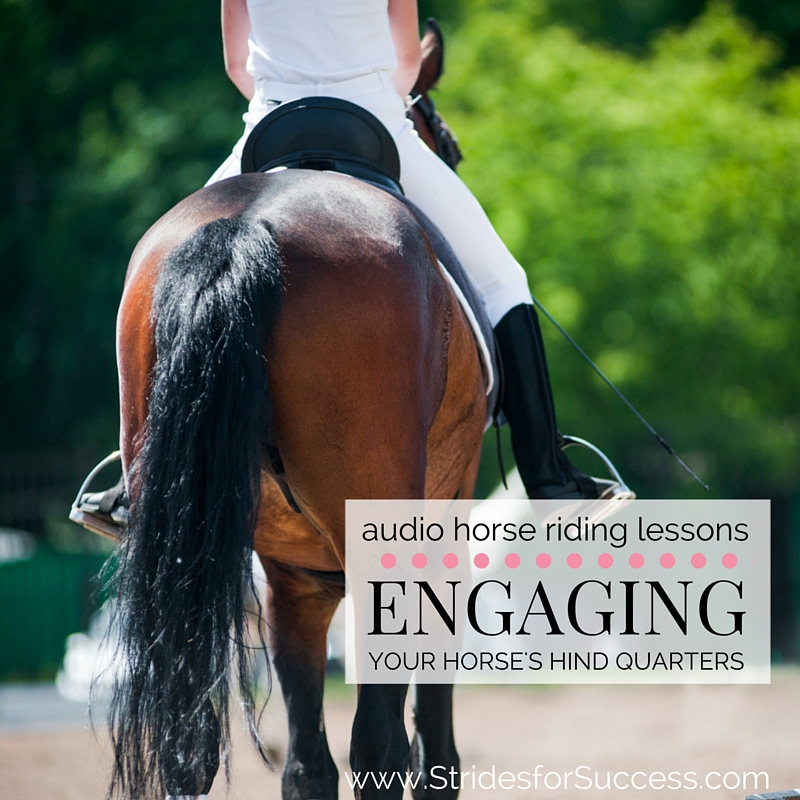
    Engaging Your Horse's Hind Quarters

    Think of energy as being a little like water or electricity. It will generally always try to find the shortest and easiest route. If you allow your horse to become crooked through his body, the energy will not flow where you want it and rather ‘shoot out the side door’. An example of this is on a circle, the hind quarters being allowed to swing out wide of the tracks the front feet have created. When this happens the energy, rather than pushing forward from behind and connecting to the front of the horse, will be lost out the side door of the horse, resulting in the horse going into ‘front wheel drive’ again.

    When riding you should think of your aids, particularly seat, legs and arms, as being the banks of a river or canal. They will channel the water / energy that is being created in the hind quarters where you want it to go. This will continue to keep the energy moving forward and connecting, from back to front

    This is why straightness is so important when training a horse and rider. Many times we focus on how straight the horse is, but ignore the obvious twisting or tilting of the rider’s body. Any crookedness in either horse or rider will again result in a disengagement of the hind quarters, which will see the energy dissipate and eventually be lost.

    Another important factor to consider when thinking about this engaging of the back to the front of your horse’s body is the idea of ‘allowing’ that energy to flow underneath you through your horse’s back. Some riders really work hard at activating the hind quarters and getting them to work, but then due to a heaviness or tightness in their body, block this energy from connecting through or engaging with the front of the horse

    When we learn to ride initially, we are often told to ‘sit up’, however we are rarely told why; other than the whole falling off aspect of collapsing through your body. But let’s assume you have indeed mastered staying on, however you are still finding it difficult to truly connect the hind quarters to the front end of the horse (through your contact), it may just be because you are blocking this.

    Just as water can be dammed up, blocked or diverted, so too can energy. Sitting heavy in the saddle is the most common culprit here, but so too are shutting things down with your thighs. They can have a vice like effect on your horse if there is excess tension in your body. Also, leaning forward over your horse’s shoulders or withers will be highly effective in shutting down any engagement of the hind quarters.

    Make sure that when you are riding, you are all the time encouraging your horse to use his back by being ‘light’ in the saddle. This is often as simple as sitting up through your rib cage, carrying your upper torso. This simple change is often enough to allow your pelvis to begin moving with the horse, which will in turn allow your horse to use his back.

    Once you have managed to get your horse moving forward from his hind quarters or from behind and then are allowing that energy to flow underneath or through you in the saddle, the final piece of the puzzle is ready to happen…

    To truly engage means to connect, bind or interlock. In the case of the hind quarters, we want to connect them to the rest of the horse like a gear cog. This allows you to truly direct the energy being created there. We do this through our contact with the horse

    The unfortunate part of this is that most people look at the contact part as Step 1, rather than the final piece of the puzzle, or in this case for simplicity sake, Step 3. Contact is just like the responsiveness, there is a responsibility on both horse and rider to fulfil their end of the contract in order for it to work correctly and be effective.

    If either horse or rider try to force it, it will be lost. Similarly, if either side try to evade it, it will be lost. Many times we blame the horse for evading the contact, but I see many riders who also ‘evade’ through reins that are too loose, or fingers that are wide open and look better suited to playing a piano rather than holding their reins.

    Only when all three steps are in place can your horse truly engage his hind quarters and can you then begin to feel the difference between rear wheel drive and front wheel drive. The difference? Night and day! It feels like there is always energy there to perform what is asked. It feels like your horse moving forward with purpose. It looks so much more pleasing to the eye, as both horse and rider are in true agreement with each other, both maintaining responsibility for their individual part in keeping things together.

    There are many exercises you can do to begin asking your horse to use his hind quarters but none will really be successful until you truly understand what it means to engage and connect the back to the front.

    Happy Riding
    Lorna

    This is the first of 5 audio programs on this topic. In the rest of the programs you can listen to while riding for step by step instructions on how to effectively begin engaging your horse’s hind quarters. The exercises are suitable for all levels of riders and can be worked into your usual schooling routine with your horse.

    For more information on how to download the rest of the lessons and gain access to over 600 audio horse riding programs on a whole range of different topics, visit https://stridesforsuccess.com/join/
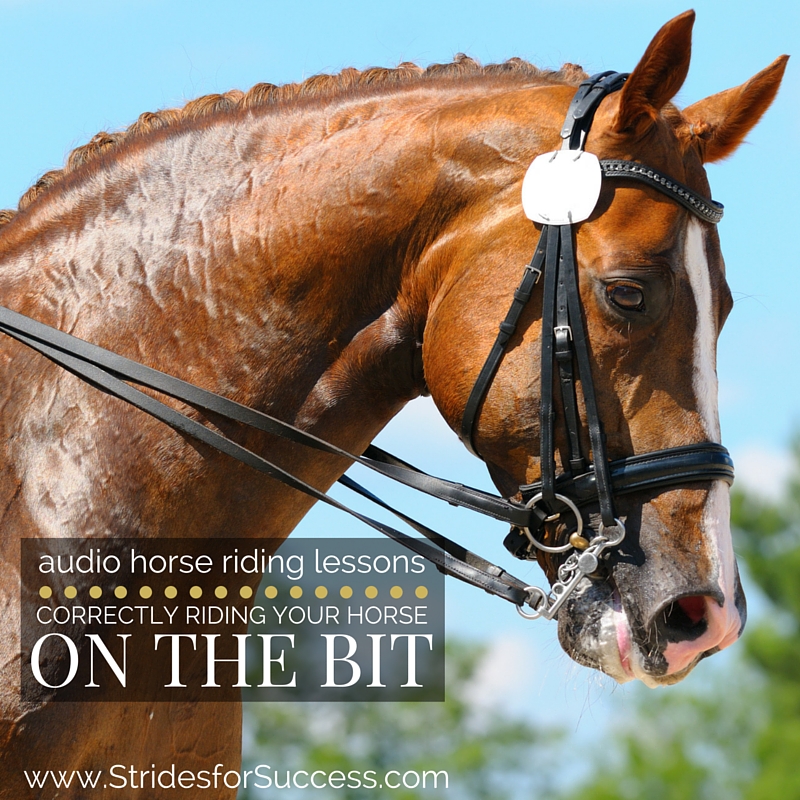
  • Assessing ‘On The Bit’ While Riding

    Assessing ‘On The Bit’ While Riding

    [fusebox_track_player url=”https://op3.dev/e/traffic.libsyn.com/secure/dailystridespodcast/576-Correctly-Riding-Your-Horse-On-The-Bit.mp3″ title=”Correctly Riding Your Horse ‘On the Bit’” social_linkedin=”true” social_pinterest=”true” social_email=”true” ]

    Left – Right – Left – Right – Left – Right…  The horse’s head turning one way and then back the other.  Every single stride.  A misguided attempt by the rider to achieve ‘on the bit’.  Have you ever seen this?   The horse looks like he is auditioning for the role of the bobblehead in the back window of someone’s car.  The rider looks like they are trying to get a ‘swinging’ upper body workout in with their riding… Left – Right – Left – Right – Left – Right…

    On the bit is a little like the holy grail of horse riding.  It is an ideal that most riders aspire to.  However, because it is more a result that is achieved through the culmination of hours of consistent riding; many riders will never truly achieve it because they are not willing to put the work in.

    Unfortunately, just like most highly desired outcomes, the eagerness to obtain it leaves the door wide open for endless counterfeit reproductions being passed off as the real thing.  One of those being that many riders are merrily sawing away at their horse’s mouths thinking they are indeed ‘on the bit’.

    What is ‘On The Bit’?

    It almost becomes easier to define ‘on the bit’ by what it is not, rather than what it is.  However I think we should always try to see the correct picture first and then hold those above-mentioned ‘counterfeits’ against it so we can see the differences.

    ‘On The Bit’ is when your horse is creating energy with his hind quarters, that is being funnelled along, through his back to the front end of his body, where it is ‘channelled’ into the contact with the reins and bit.

    What is vitally important to note is that the reins and bit part can only happen after the energy has been correctly manifested.  After it has been connected through the back.  Reins and bit are the final pieces of the puzzle rather than the starting points. This is what generally trips many riders up.

    No Sawing Required!

    Being ‘On The Bit’ has nothing to do with sawing your horse’s mouth, or pulling his head in (or up, or down, or anywhere for that matter!).

    It has everything to do with your horse using himself to the best of his ability and learning to carry both himself and you.

    The Pre-Requisites for ‘On the Bit’

    So before we even begin discussing how to achieve this contact and connection, let’s first begin by making sure all the prerequisites are in place. This will ensure both you and your horse have the best possible chance of correctly working on the bit.   It goes without saying that your horse must be moving forward.  However, moving forward correctly off your leg, rather than just running aimlessly around the arena is also a vital disparity to make.

    Moving off your leg will ensure that your horse is responsive to your aids and traveling with rhythm and balance.

    You ask, he responds.  If you are having to push for every stride, or if your horse has a little ‘think’ about actually doing what you want each time you ask, I would highly suggest working on his responsiveness first, before you begin anything else in your training.

    Connecting the Energy

    Once you have established forwardness, you can then begin working on allowing that same energy to connect through from the back to the front.  

    Horses should work in rear wheel drive, meaning that they push from behind rather than pull from the front

    However, this energy then needs to connect or move through the horse in order to ‘lift’ and carry the front half of his body along with him.  What a lot of riders don’t realize is that they are the actual cause or reason that connection or transference of energy is not happening.  Simply sitting heavily in the saddle, or slouching through your shoulders or upper body, is enough to shut down that flow of energy.

    Correctly Working Your Horse On the Bit

    Self Carriage for Riders First…

    To prevent this, I want you to think about sitting up through your waist and ribs.  Think of trying to elongate your torso.  Use your muscles to carry your upper body so it does not collapse on your pelvis and hips.

    Once you are carrying yourself, I also suggest paying attention to the distance between the point of your shoulders across your chest.  Notice how when you draw your shoulders together – and shorten this distance – it affects your whole body.  Be aware of keeping your chest open all through your riding.

    Many instructors will teach this as ‘Shoulders Back’, but I find that simply pushing your shoulders back rather makes your body rigid.  Opening your chest is a softer and more flexible movement.

    The Final Piece of ‘On the Bit’

    Once you have your horse moving forward in a responsive fashion, and the energy flowing underneath you connecting the hindquarters to the front end of your horse, you’re ready.

    The final piece of the puzzle is gathering or channelling that energy to where you want it to go. You do this using your contact

    Establishing and maintaining consistent contact with your horse is key to riding on the bit.  The contact should be elasticized and ‘stretchy’; your elbows being pliable and supple enough to literally hold your horse’s mouth in your hands.  Pulling, forcing, sawing or any other use of physical force will not allow the correct use of the contact.

    Developing Over Time

    Through working correctly, your horse will begin to become stronger through his body, and assuming you are carrying yourself while in the saddle, he will begin to lift his back as he works.  This lifting of his back will allow him greater connection from the back-end through to the front end.

    It will also begin to free up his shoulders a little more.  The less the shoulders are ‘pulling’ the more they can begin ‘swinging’ and from here your horse will begin seeking out the connection with your contact.

    It will feel like holding a one end of a skipping rope with another person.  Not gripping or pulling.  There is a mutual understanding. Both are willing to do the necessary to maintain the connection and move the rope where they want it to go

    Don’t make the mistake of becoming obsessed with your horse’s head carriage.  Remember, being on the bit is the result of working correctly over time in order to build and develop the necessary strength and trust with your horse.  Where and how he carries his head will be the result of both of you carrying yourselves correctly.

    Reestablishing On the Bit when Necessary

    Also remember to use your half-halt, both to set up your transitions or different movements.  And also to rebalance and regroup when things fall apart, which they will quite often initially.

    Be consistent with your contact through the outside rein, and soft – almost offering – of your contact through the inside rein.

    As your horse begins to spend more time working on the bit, you can use your inside rein to see his he is truly carrying himself.  Does he continue to move forward when you soften your inside rein?  If so, he is truly moving and working ‘On The Bit’.

    Happy Riding
    Lorna

    Connection for Equestrians

    I have created 5 audio horse riding programs on this subject.  They will take you step by step through working your horse correctly in order to achieve a consistent ‘On the Bit’.

    If you are interested in listening to these programs (and hundreds more) you can visit https://stridesforsuccess.com/join/ to find out more.
    Other Info On this Topic

    Additional Resources To Help Equestrians:-

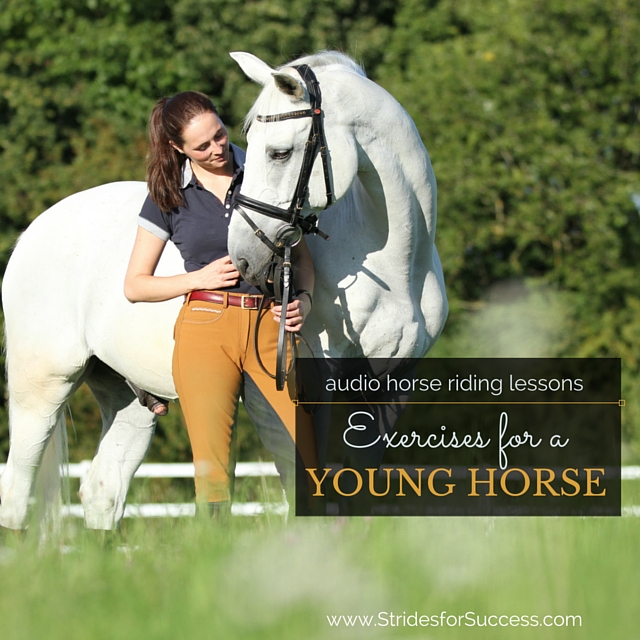
  • Exercises for a Young Horse

    Exercises for a Young Horse

    Young horses!  It is such an honour as a rider to be one of the first people they get to work with, however can sometimes feel like you are riding an eel!  They are moving up and down in the rhythm and if there is a dance that you are both moving to, it quickly becomes evident that no one is really sure of the correct moves or steps!

    Horses need to be allowed the time and space to begin working out how they can carry themselves, with all this new equipment and also, how they can then carry the added weight of a rider on board their backs as well.  When given the necessary time and when the correct guidelines are there to help, your horse will soon become more confident in his abilities to carry you and confidence is key for balance.

    The reason the ‘dance’ seems so staggered is due to the lack of true balance.  So, in saying this, balance is first and foremost for young horses.  However very often riders try to do this job for their horse, rather than allowing the horse to figure it out on their own.  This usually results in a horse that insists on holding on to or grabbing the contact and being unable to relax enough through their backs to truly use themselves correctly.  This, as I am sure you can imagine, will inevitably lead to all sorts of trouble and problems further down the line.

    [smart_track_player url=”https://op3.dev/e/traffic.libsyn.com/dailystridespodcast/541-Exercises-for-Working-with-a-Young-Horse.mp3″ title=”Exercises for a Young Horse” social_linkedin=”true” social_pinterest=”true” social_email=”true” tweet_text=”Do you have a young horse? Here’s a couple of useful exercises to try today ” hashtag=”horseriding #younghorse” twitter_username=”strides_success” ]

    Before we go any further, it is important to stress that the rider must be experienced, sympathetic and patient. Young horses should not be ridden by riders who lack a balanced and independent seat.  It will only make the horse’s job much more difficult and very often results in a loss of confidence, that will have repercussions all through their riding career.

    When working with a young horse, remember it is the quality of the work, rather than the quantity that is important.  Ride for shorter periods and rest often throughout each ride

    Many factors will influence how quickly your horse progresses, such as age, breed, build, confirmation, groundwork, consistency and even his upbringing.  Remember, even if your horse is the ‘ideal age’ to start, he may still not be physically or mentally ready to begin work.  Again, slow and steady will win out over pushing your horse to do things he is not ready for.

    So assuming that you have assessed the situation and have deemed it the right time in your horse’s life to begin introducing him to a more ‘structured’ training program, I suggest by starting off on a long rein.  You can begin teaching your horse this on the lunge initially and then, when you’re on his back.  The long rein will allow him to stretch out his back muscles and overall body, which will encourage relaxation and rid him of any excess tension

    Start at the lunge.  This will allow your horse to loosen up, and also work out any excess energy that he might be ‘storing up’.  It also gives you a great opportunity to assess him further which will then help you to create a more structured plan.  Which gait is the most balanced and comfortable for him?  Which rein, if any, does he prefer?  You can then use this information when you mount up to help relax him and start by doing something he enjoys and working on the side he goes better on.

    Keep in mind that lunging is not just chasing him around the ring; he must begin with relaxing, just like he would if on a long rein and then slowly beginning to work into a contact, with emphasis on moving forward at all times.  You can also use the time on the lunge to reinforce the voice aids.

    Exercises for a Young Horse

    When riding a young horse, the focus should begin on rhythm and balance within that rhythm.  As I mentioned before, you as the rider must be balanced in your seat and able to move with your horse as he works forward.  At no point should you begin trying to ‘shorten’ him or force him into a ‘frame’.  If he is to develop correctly he must learn to balance himself and from there, then look for your contact and accept it happily while moving forward all the time.

    Another thing to keep in mind when riding a young horse is that he will be naturally a little ‘downhill’.  His body must strengthen, over time, before he can begin to transfer that weight back onto his hind quarters, and during this period it is your responsibility as the rider not to add to the weight being carried by his front end by leaning or slouching

    When working in the arena, vary the work and sprinkle breaks or rest periods throughout the ride, which will allow him to relax and stretch out on a long rein again.  This will help to make sure he does not become stiff or tense which will in turn, ruin the work you are trying to achieve.

    Work on basic school figures such as large circles, all the time trying to establish the rhythm in the gait.  You can also work in some transitions, however I find that it is better to work in a chosen gait for a few minutes, allowing him to become confident in his balance and rhythm, rather than chopping and changing gaits.  Transitions are a wonderful tool when schooling horses but I have found that if too many are incorporated into the early rides, the horse can tend to become a little choppy, short and tense through his work, rather than moving forward in a relaxed  and loose fashion.

    Keep in mind that you are there to guide; he must learn to balance himself.  So correcting him is important, but it should be only that, a correction, rather than a constant support or aid

    After a few weeks or months, depending on your horse, and once he is happily carrying you around the arena you can begin introducing ground poles into his schooling sessions.  You will know the time is right when he has found a certain rhythm and balance to his way of going, which he can adjust in and out of with ease.  Like everything else, incorporating the poles too early will only serve to do more harm than good, so proceed with caution and only when you are confident that he is confident!

    Start with a single pole on the ground, which you can allow him to walk over.  Walk over it, from both directions quite a few times until it becomes a non-event in your horse’s head.  Keep in mind that your horse might just jump the pole on the first few occasions and take the precautions to avoid any discomfort for him or you if this happens!  Make sure that you do not punish him when he successfully navigates the pole by catching him in the mouth or becoming heavy on his back.

    Once he is happily walking over the single pole, you can then begin trotting up to and over the pole.  Again, we want him working over the poles happily and relaxed before you move on to anything more complicated.  This may take a few rides, however your patience while he is finding his way here will be worth it later.

    Poles can be used in all sorts of ways when riding a young horse, as both obstacles to navigate over and also guiding rails to ride between or around.  Depending on your horse, you can use them to help reinforce a concept and also, to ask for more flexion and a way of asking him to ‘use’ himself more.

    Riding young horses can be a challenge, but when done with patience and kindness as well as consistently, it pays off as both a rewarding for the rider and it sets the horse up for a happier, healthier working life as well.

    Happy Riding!

    Exercises for Riding a Young Horse

  • Retraining a Horse that Evades Your Contact

    Retraining a Horse that Evades Your Contact

    [fusebox_track_player url=”https://op3.dev/e/traffic.libsyn.com/dailystridespodcast/526-Retraining-a-Horse-that-Evades-Your-Contact.mp3″ title=”Retraining a Horse that Evades Your Contact” social_linkedin=”true” social_pinterest=”true” social_email=”true” ]

    Are there days where your horse’s camel impression is worryingly accurate?  He lounges along, his back all strung out resembling a cable that’s sole purpose is to work against you.  His neck stretched out in what must be an extremely uncomfortable way, his nose pointing skyward…  And it seems that all your efforts to establish a correct contact are falling on deaf ears?!

    Or perhaps your horse is the other end of the spectrum? As soon as you pick up a contact he curls his head so his lips are close to touching his chest… Leaving you with loopy reins that have no contact at all with said horse’s mouth?!

    The unfortunate fact is that horses evade contact in many different ways and for many different reasons which all have the potential to ruin a good performance or ride.  However before we go any further, let’s get clear on what is correct, ‘true contact when riding a horse…

    What is True Contact?

    Contact is your connection with your horse through your rein aid.  You must offer a stable, consistent contact through your hand and rein, which in turn, your horse will then accept with his mouth.  However, the contact that we can ‘see’ in the above description is merely the end result of a lot of other communications and aids.

    Things that are ongoing and happening between horse and rider. Their culmination is what produces a consistent, soft, and accepting contact.

    In order to create correct contact, the horse must be moving forward from behind.  So the rider must first work on activating the hindquarters, then allowing that energy to connect through to the front, before they can then harness and direct it using their contact.

    Responsibility and Responsiveness

    In order to achieve correct contact you need to be responsible and your horse must be responsive.

    This means that you are conscientious in how you ask for and respond to your horse’s contact that will cause no discomfort or pain to your horse.  He must be perceptive and reactive to your aids when he receives them.

    Very often riders forget or just don’t know about the first, vitally important, responsibility on their part in order to achieve a correct contact. Because of this, they become focused on ‘head carriage’.  Or if their horse is ‘on the bit’.

    Instead, I want you to think of contact as being the result of a carefully set up and orchestrated use of your different aids when in the saddle. And this culminates in your horse accepting your conscientious, soft, and elastic contact.

    How Does a Horse Evade the Contact?

    So, how does a horse evade the bit or contact?  Horses generally do this in a few different ways.  They either become ‘above the bit’. This is where their noses are ‘skyward’ and the whole back, from tail to ears, is hollow.

    Or they can also become ‘behind the bit’. This is when they begin to curl their head and neck back towards their body, nose to chest, which leaves the rider very little options when it comes to contact at all.

    Lastly, there are some horses that when you have ‘closed’ all open doors, will still try to evade by wriggling around, never truly connecting with the rider through the reins at all.  It feels like someone has replaced your horse with an eel!

    Retraining a Horse that Evades Your Contact

    Why Does a Horse Evade the Contact?

    All of the above descriptions lead to a less than pleasant picture to look at. And all also look extremely uncomfortable for the horse!  So what is it exactly that brings them to act like this?

        • The rider is asking incorrectly – This can be due to ignorance or incorrect training on the riders part.  Very often riders will only focus on their horse’s head and where it is, rather than what is happening underneath them that is leading their horse to travel like that.
        • Unsteady contact from the rider – Many riders continue to do this, even though they understand and know about the importance of a steady and ‘safe’ contact for their horse.

    Some riders continue to use the reins as a safety harness rather than work on developing an independent seat.

        • The horse is unbalanced – Young and underdeveloped horses will find it difficult to accept a contact for any great length of time.  This needs to be worked on and developed slowly, over time, using correct aids and techniques, in a way the horse can understand and trust.
        • Over or incorrect use of a gadget or training aid – This is particularly evident with the usage of draw reins, where horses begin to evade the contact by coming behind the vertical or bit.
        • The horse’s conformation makes him more inclined to travel like this initially
        • Physical discomfort – Such as pain in the back due to tack or another disease or injury.  Also problems with teeth and correct fitting of the bit.  All physical discomfort should be ruled out before continuing on with and retraining your horse.

    Contact as a Development Step

    So often we think of contact as being just holding the reins, however the contact that you create is so much more than that.  This is both in terms of communication between horse and rider and also as a vital piece to moving on up the training scale with your horse later.

    It is your job as the rider to create or provide a contact that is consistent, kind, soft, following yet effective.  

    Once you have done this, your horse can then accept this contact and trust you that you won’t catch him in the mouth or drop him by releasing and letting go of the contact.

    Your level of contact will depend on how much energy you are asking your horse to create with his hind quarters.  Contact is merely gathering up and then giving that energy some focused direction of where to go

    Therefore it is impossible to have contact if you horse is not using his hind quarters to push himself forward  and having forward energy.  It is the lack of this forward momentum that causes a horse to begin to lean or become heavy on your hand and essentially evade the bit.

    Reschooling a More Correct Contact

    So assuming that you have an independent seat and your hands are thoughtful and balanced, once a horse has begun to evade how can you then begin to re-school or retrain him to a better way of going? Nne where he is happy to accept your contact?

        • Forwardness & Responsiveness
        • Rhythm
        • Suppleness
        • Straightness

    Begin working on assessing how responsive your horse is to your aids.  If you ask for more, does he respond and begin creating a little more energy into his movement?  Is this response immediate or does he think about it for a few steps?  If his response time is a little ‘wanting’ I suggest carrying a schooling whip and backing up your leg aids with it each time he shows begins to procrastinate or ignore your aids.

    Once he is responsive then make sure he is indeed moving forward, pushing from behind.  It is impossible to direct what is not there, so make sure your horse is using his hindquarters with each stride.

    Then work on creating a rhythm in the gait you have chosen.  I suggest working on a 20m circle, and using half halts and transitions on the circle to further engage the hindquarters as your horse is working.

    Straightness to Enhance Contact

    Straightness is important.  Firstly to correctly channel the energy where you want it to go. But also so you can quickly lock any doors that your horse will try to open once you have blocked his initial ‘evade of choice’!

    Many horses will look for another way of evading when you shut down the initial window of opportunity!

    Finally, don’t be afraid of creating contact with your horse while riding.  Many riders are worried about hurting their horse’s mouth, or pulling on the reins and never truly get to experience and feel how wonderful it is to communicate with their horse in a consistent, safe, following contact.

    Happy Riding

    Lorna

    Additional Resources for Equestrians:-

    Retraining a horse that Evades Your contact