Tag: planning

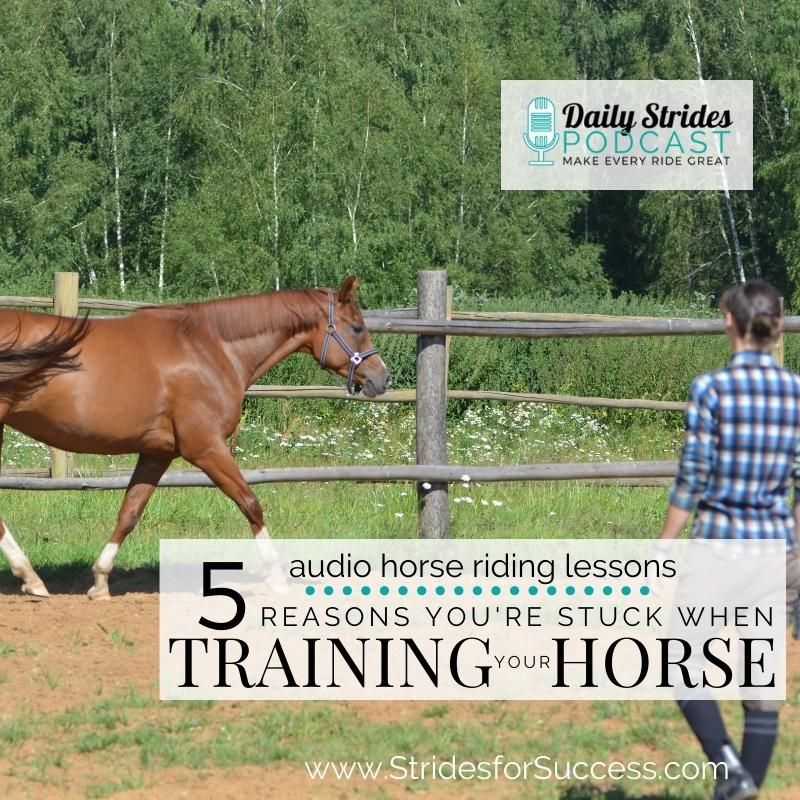
  • 5 Reasons You’re Stuck when Training or Retraining Your Horse

    5 Reasons You’re Stuck when Training or Retraining Your Horse

    [fusebox_track_player url=”https://op3.dev/e/traffic.libsyn.com/dailystridespodcast/1242_5_Reasons_Youre_Stuck_when_Training_or_Retraining_Your_Horse.mp3″ title=”5 Reasons You’re Stuck when Training or Retraining Your Horse” social_linkedin=”true” social_pinterest=”true” social_email=”true” tweet_text=”Find out what’s keeping you stuck when training or retraining your horse…” hashtag=”equestrian #podcast” twitter_username=”strides_success” ]

    It can be frustrating when you know exactly what you want to achieve when training or retraining your horse, but it seems to be taking ‘forever’!  It seems that no matter how much you explain your horse, he’s not ‘getting it’.

    Training or retraining your horse is something that takes time.  And, sometimes, it is our own impatience or actions that actually keep things stuck where progress is concerned. 

    Today I want to cover the 5 most common causes that may cause you to become a little stuck when training or retaining your horse.

     1. Lack of Consistency

    When we first think about consistency in our riding, we often think about our actual riding schedule.  How many days a week or month we are working with our horse.  And, yes, this is important.  However, what’s far more important in my opinion is what’s happening in each of those individual sessions.

    You are always training or retraining your horse. On the ground, in the field, on the trail, and in the arena.

    Practice is important.  However, only practicing specific things when the mood takes you will not get you the results you want.  How you are doing one this is how you must do everything.  Simply ‘practicing’ won’t make perfect.

    The key is to make sure you are consistent with your communication, your expectations, and your responses through all that you do. 

     2. Confusing Training and Re-Training

    Training and retraining your horse are two very different things.  And when we are working with our horses, it is really important to know the difference between the two. You can download a free printable article CLICK HERE
    that goes into more detail on this.

    Training is creating an expectation or an outcome to a certain question. Retraining is changing the expectation or outcome when the same question is applied. 

    When your horse already knows to do a certain thing a certain way that you want to change or modify, this is retraining.  And, just like us, when a certain expectation or habit has been in place for a while, it can sometimes be a challenge to change!

    Many riders fail to truly understand ‘retraining’. They don’t invest enough time in truly changing the associations or responses their horse has. This will often become really clear when pressure is applied to the situation and the horse reverts back to the ‘old way’ of behaving or responding.

    Equally as common is the rider who forgets that their horse does not understand the question.  Rather than becoming frustrated or annoyed, reframe this with ‘how can I better explain this to my horse.

    3. Differences Between ‘Thinking’ and ‘Doing’

    Have you ever watched a video of yourself doing something? Riding, dancing, running…? The thing that strikes most people when they do this is the vast difference between how they ‘think’ they are doing the thing, and how they are actually doing the thing!

    I regularly work with riders who really do need video evidence that I am not imagining seeing their lower leg constantly swing or their inside hand drop. That is the difference between ‘thinking’ and ‘doing’.

    If you have hit a bit of a plateau when training or retraining your horse, check yourself and what you are doing. 

    I strongly suggest videoing yourself.  I think that in this day and age, it’s as simple as using your phone propped on something and riding past it a few times.  It can be truly eye-opening.  Review your video and really look for any possible ‘mixed signals’ in the communication.

    Lack of coordination, your aids not being as independent as you thought, and just doing the wrong thing can all cause your training to stall and plateau. 

     4. Lack of Knowledge

    The final mistake you could be making when training or retraining your horse is simply not knowing enough.  Make sure you don’t fall into the trap of seeing someone else do something and then assuming you can do the same.  I see this happen a lot with regards to riders watching videos or ‘tutorials’ online.  If someone can do something well enough to create and post a video about it, there’s a pretty good chance that they have been practicing that thing for quite a while!

    Many riders are trying different methods or techniques with their horses without actually really knowing ‘why’ and ‘how’ it produces the result it does. 

    When training or retraining your horse, it is vital to understand as much as you can about the topic you’re working on.  The pre-requisites, preparation, aids, what it will feel or look like (especially at first), and how to develop it further.

    Knowing the aids to the canter is not enough when training or retraining your horse to perform a more timely, clean, and correct transition into the canter! 

    If you are trying to train or retrain your horse, begin scheduling an hour or two each week to actually LEARN more.  Going deeper into each topic and understanding how it fits in.  This will lead to more lasting success for you and your horse.

    5. Not Enough Time…

    You would never expect to go for a 3km run today and then be fit enough to run a full marathon tomorrow, would you?! And yet, as riders, we can often expect this of our horses!  This actually really ties all of the things we have already spoken about today together.

    Time is essential to build lasting results when training or retraining your horse. Physically, mentally, and emotionally.

    If you are not seeing results, could it be that you have not yet allowed enough time? Development, especially when correct, takes time. This can seem boring and long-winded.  And yet, this is often the difference between a horse that develops and a horse that stagnates in its training.

    The good news is that if you can couple time with consistency and correct actions, you will soon begin to see changes in both your skills as a rider. And your horse’s way of going.

    Happy Riding
    Lorna

    Download a printable version of this article when you CLICK HERE

    More on This Topic

    More Training & Support

  • How to Become a Better Rider in 90 Days

    How to Become a Better Rider in 90 Days

    [fusebox_track_player url=”https://op3.dev/e/traffic.libsyn.com/dailystridespodcast/1238_How_To_Become_A_Better_Rider_in_90_Days.mp3″ title=”Become a Better Rider in 90 Days” social_linkedin=”true” social_pinterest=”true” social_email=”true” tweet_text=”Become a Better Rider in just 90 Days…” hashtag=”horsepodcast” twitter_username=”strides_success” ]

    It’s probably safe to assume that you want to improve as a rider, right? That, if becoming a better rider in 90 days was guaranteed, you’d probably follow the plan and do the work?  Well, the good news is that, regardless of where you are in your riding right now, you can indeed improve over the coming 90 days (or 3 months).  However, it will involve a little planning, preparation, and commitment in order to make it all happen.

    Using the previous 90 days in your riding to create a plan to improve over the coming 90 days is a fantastic way to continue to make progress as a rider.

    However, it will require a little work upfront in both reviewing and planning.  Looking back at what happened and then using that information to make better decisions and take better actions going forward is where it all begins.  So that being said… Let’s dive into your past 90 days and see what you can learn that will kickstart the coming 90 and help you become a better rider.

    Reviewing Your Previous 90 Days

    How deep you go here is entirely up to yourself.  Many riders simply state the facts.  I am a big fan of doing this, initially.  And initially is a keyword in that sentence. Having numbers is a great place to start, however, if you want to really power into the coming 90 days in your riding, I feel it’s important to go deeper.

    Why are those the numbers you have in front of you? What circumstances, situations, and happenings led to them being there? And, most importantly, are you happy with them?

    Now, you’re probably thinking ‘what numbers?’.  Good question, let’s begin there.

        • How many days did you ride?
        • What was the average length of each ride?
        • How long did you, on average, spend tacking up and cooling down?
        • And, from that, how long on average did you spend actually working your horse?
        • How many of those interactions or sessions were intentional with a specific focus or plan?
        • And, how many were groundwork related (groundwork, lunging, long lining)
        • How many were just riding-related?
        • What was the number you actually wanted to reach regarding days working with your horse?

    Okay, once you’ve got all of your ‘numbers’, let’s go a little deeper into how you feel about all these numbers.

    What You Wanted Versus What You Got

    We all have an idea of what we want the outcome to be when starting something.  Otherwise, why bother starting? The challenge for many riders is that, over time, that ‘ideal desired outcome’ becomes lost in what their day-to-day reality looks like. And without that vision or goal to work towards, the day-to-day becomes a monotonous, never-ending cycle of just ‘riding’.

    It is so important to keep working towards something in your riding. It will help you to regain inspiration when things feel tough – and help keep the relationship between you and your horse developing and deepening. 

        • So, with all that being said and done; what was your ideal outcome for the previous 90 days?
        • Was that outcome in alignment with where you are in your life right now (was it doable)?
        • What parts of it, looking back, were clearly make-believe?
        • And, what parts of it were possible for you to make happen from your current situation?
        • What needs to be changed/dropped/postponed?
        • And, from what’s left, is that what you truly want in your riding?

    It can be hard to let go of dreams and ambitions.  Yet, if your current life and situation have clearly shown you that those things are not realistic right now, surely making a change would allow you to feel less tension and frustration?

    What ideal goal or desire could you work towards in the coming 90 days that’s both in alignment with your current situation and inspires you? That is probably something to begin working towards… 

    Creating a Plan for the Coming 90 Days

    Once you have your ideal desired outcome or goal, I feel that the best place to start is by working backward from it. Imagine it is 90 days from now (roughly 3 months from today’s date).  Imagine you are at the barn or yard, with your horse, and you have achieved the goal or outcome.

    Ask yourself, what did I have to do or change in order to make this possible?  Ask the question from the place of already having achieved the outcome (looking back) rather than from where you are now – looking forwards. 

    By asking this question from the place of already having achieved what it is you want, the differences become a lot more clear.  These differences are the obstacles you need to overcome to get from ‘here to there’.

    Be Realistic About Your Riding Skills

    Many riders, at this point, will begin to feel uncomfortable.  All of the differences can seem overwhelming.  And, maybe, this is the time to either make a longer timeline for your goal or to adjust the goal slightly to better suit where you are riding now in your life. However, having come this far, don’t give up!

    Remember that each of the things you need to change/remove/upgrade is now the actual focus points for your work with your horse going forward. 

    Meaning that, by putting these things into order of what needs to happen first, second, third, and so on, you have created the actual roadmap to get you to where you want to go in your riding. You can clearly see what needs to be worked on when you are planning out the days, hours, minutes of training, and interactions together.

    So assuming you were realistic about your current situation, your skills and resources, and the divide between where you are and where you want to be; congratulations – you’ve just figured out your plan going forward :)

    Deciding on a Timeline that Works for You

    From here, simply begin filling in your calendar.  What days can you ride this month? And, on each of those days, what will you commit to working on with your horse?  When you know what you are working on, you will know what you need to do in advance.  For some riders, this may look like learning a little more or improving their knowledge of the subject.  For others, it may be setting up exercises, riding spaces, or sourcing equipment.

    I am a great believer in building ‘wiggle room’ into your plan.  Suppleness is a real thing when it comes to working with horses – both in planning and in riding!

    Remember to build fun, partnership, and training into each week.  The ratios will vary depending on your goal or desired outcome and the season in your riding.  But all three are important to build into and touch on when it comes to really round out and deepening your relationship with your horse.  (You can find links to all of these below).

    From here, simply follow your plan!  If you are diligent and committed, you will see results in 90 days.  How exciting!

    Happy Riding
    Lorna

    Related Resources, Links, and Topics

  • Planning Your Month to Make Progress in Your Riding

    Planning Your Month to Make Progress in Your Riding

    [fusebox_track_player url=”https://op3.dev/e/traffic.libsyn.com/secure/dailystridespodcast/1224_Planning_Your_Month_to_Make_Progress_in_Your_Riding.mp3″ title=”Planning Your Month for Progress in Your Riding” social_linkedin=”true” social_pinterest=”true” social_email=”true” tweet_text=”Here’s how to plan your horse riding this month…” hashtag=”podcast #horseriding #equestrian” twitter_username=”strides_success” ]

    Planning.  I love making plans.  They are always so exciting to create, but often fail to deliver the necessary results when we try to act on them. This is usually because we are not planning correctly when it comes to our rides.

    This is a system you can use to help you plan your months in your riding that will help you move things along…

    This episode of the Daily Strides Podcast has been plucked from a week of lessons from Daily Strides Premium called “Planning for Progress in Your Riding”. The full week of lessons are available right now when you join Connection

    Start Slow with Your Goals

    I am all for big goals.  I love them.  You know the type of goals that make you think “Really, could that happen? Is it even possible?”.  However, if you are new to the whole ‘planning your month for progress in your riding’, I am going to suggest something more ‘doable’.

    What is there, right now, in your riding that is pretty doable for you and your horse to achieve or make happen this month?

    Think of things that, given your current set of circumstances, won’t have a lot of resistance show up along the way.  Now, initially, you may think ‘but that is too simple’.  However, I am going to ask you to trust me on this one…

    Trust me, if you can reach that small goal over the coming 4 weeks, you will also begin to achieve something else – MOMENTUM! 

    Your Current Circumstances & Lifestyle

    Having a goal of riding 4 days a week for the upcoming month is great.  Except if you only managed 2 days the whole of the previous month.  Or, even worse, you didn’t make it into the saddle at all the previous month!

    Your current circumstances probably won’t magically transform overnight because you have set a goal that requires them to do so. So it makes sense to set goals that work with how things look right now…

    It’s also helpful to realize if your current lifestyle or circumstances are not helping you when it comes to planning your month for progress in your riding.  This will allow you to begin making small shifts and changes, month on month.

    By gradually changing what your ‘current circumstances’ look like over a longer period of time – you can be in a completely different place 12 months from now. 

    Creating Stepping Stones

    What makes progress possible is the daily, consistent, little steps you take to improve your conversation with your horse. These are what matters.

    Set the intention that every ride this month will have a focus that leads you towards your bigger goal – then do just that.

    By remaining consistent in your approach, both you and your horse can build the momentum you need in your training to really and truly make the coming 4 weeks count for you in the bigger picture.  

    And, doing that 12 months in a row… Who knows where you can be, come this time next year

    Happy Planning!

    Lorna

    Planning for Progress in Your Riding


    This episode comes from a full week of lessons on this topic.  In this group of lessons, I will show you my proven, step-by-step monthly practice that I use with my riders, which will result in you actually beginning to see results in your riding.

    When you join Connection; my monthly online membership for equestrians, you will the full week of lessons on this topic.  You will also get weekly audio horse riding lessons (5 per week – each 12 minutes long) to use in your riding. 

    Guided audio horse riding lessons, weekly bonus live training, personal accountability, monthly challenges, and so much more… And all of your training is available on a private podcast feed so you can listen while you are with your horse :)

    Find out all the details and join today HERE

    Extra Resources for Riders

  • Warming Up Decisions for Your Unique Situation with Your Horse

    Warming Up Decisions for Your Unique Situation with Your Horse

    [fusebox_track_player url=”https://op3.dev/e/traffic.libsyn.com/secure/dailystridespodcast/1222_Warming_Up_Decisions_for_Your_Unique_Situation.mp3″ title=”Warming Up Decisions for You and Your Horse” social_linkedin=”true” social_pinterest=”true” social_email=”true” tweet_text=”Getting intentional with your warming up can change your horse and you…” hashtag=”equestrian #horsepodcast” twitter_username=”strides_success” ]

    How could becoming more intentional and creative with your warming up transform your riding? After all, it is something that you do every time you ride, right?!

    If you were to do one thing this month that has the potential to ripple into all the months hereafter where your riding is concerned; becoming intentional about your warming up might just be the thing. 

    This episode of the Daily Strides Podcast has been plucked from a week of lessons from Daily Strides Premium called “Increasing Suppleness with Your Warm-Up & Cool Down”. The full week of lessons are available right now when you join Connection

    Creating a Routine

    One of the great things about becoming intentional with your warm-ups is how much you learn about yourself and your horse. You will begin to see patterns regarding what works and what does not.

    You will also begin to instinctively know what to do when things are not going to plan in order to settle and refocus you and your horse. 

    This is particularly useful if you are traveling to a different barn, show grounds, an overnight trail, or competition. By knowing what works to produce a specific outcome, you can begin using your warm-ups to produce better results throughout the ride itself.

    Your warming up routine can help you and your horse get into the ‘zone’ for where you want to go. It helps align your mindsets…

    Decide on How Long it Will Be

    Many riders are surprised when they realize that there are no ‘rules’ regarding how long they must warm up.  I think that the idea of having a specific amount of minutes is reassuring and makes the ‘doing’ a little easier!

    Being rigid with the amount of time you spend warming up tends to diminish the positive effects of the warm-up! When you’re focused on the clock, you’re not focused on the quality and relevance of what you are doing…

    Instead, I recommend using the desired outcome for the schooling session as a whole to help you decide what will best help to prepare you and your horse.  The more intentional you become about your warming up supporting the work, the better your warm-ups will become.

    What Gait Will Help You Both

    When we learn to ride, we do things in succession.  The gaits in the warm-up are one of these things.  Walk, then trot, and on the canter. No deviation from that path!  However, as you become more experienced, I think that it’s okay to ‘stray’ a little…

    There are no rules that say you must walk for a certain period of time.  Followed by trotting for a similar time.  And only then can you canter! 

    There are horses out there who do better if canter is introduced before the trot.  Not a huge amount of canter.  And after quite a bit of walking where different questions have been asked.  It is a possibility. The important part is to be responsible and think of what’s best for your horse and his physical health and well-being.

    When it comes to creating a warm-up that works for you and your horse, be open to trying new things. And doing things a little differently. 

    Tailoring It for Your Horse

    Many riders will try to ‘force’ relaxation while riding the initial warm-up.  Obviously, you cannot force relaxation! I mention this because, for many horses, stretching and suppleness are something they must work on throughout the ride.

    For some horses, expecting ‘long and low’, or ‘stretching down’ in the first 20 minutes of the ride is asking too big of a question. 

    This can be due to past training, old habits, or conformation – a high head carriage.  There, of course, are other reasons as well.  What I want to encourage you to do is to find what works for your horse, and start there. Drop all other expectations.

    Warming Up Yourself

    Finally, it is important to consider yourself in the bigger picture.  Horse riding is a team sport after all – you and your horse.  Jumping on and then slouching around in the saddle for 15 minutes is not exactly a warm-up!

    Begin seeing your grooming and tacking up as part of your warming up routine – for you and your horse. 

    Use this time to set the rhythm and tone for the upcoming conversation in the saddle.  Get your blood pumping and flowing by really being intentional with your actions, your movement, and your breathwork.

    Your team – you and your horse – must work together and what leads up to you mounting up can make all the difference.

    Happy Riding

    Lorna

    Increasing Suppleness with Your Warm-Up & Cool Down

    This episode is the first of 5 guided audio horse riding lessons that are available for you to use while riding with your horse.  The other 4 lessons, the guided riding lessons, are available inside of the Connection Member’s Area.

    Join Connection today to get these lessons and so many others to help you make the most of your riding.

    Guided audio horse riding lessons, weekly bonus live training, personal accountability, monthly challenges, and so much more… And all of your training is available on a private podcast feed so you can listen while you are with your horse :)

    Find out all the details and join today HERE

    Additional Resources for Equestrians

  • 3 Exercises to Ride While on a Circle with Your Horse

    3 Exercises to Ride While on a Circle with Your Horse

    [fusebox_track_player url=”https://op3.dev/e/traffic.libsyn.com/secure/dailystridespodcast/1220_3_Exercises_to_Ride_while_on_a_Circle_with_Your_Horse.mp3″ title=”3 Exercises to Ride While on a Circle with Your Horse” social_linkedin=”true” social_pinterest=”true” social_email=”true” tweet_text=”3 Exercises to use while riding a circle with your horse…” hashtag=”horsepodcast #equestrian ” twitter_username=”strides_success” ]
    It is probably the most ridden shape for most riders, the trusty circle.  And yet, a lot of circles are uninteresting, uninspiring, and (if we’re being completely honest here) a total waste of time for you and your horse.
    When ridden with a little intention and purpose, the trusty circle can become one of the greatest ways to develop your horse and improve your skills.
    Here are 3 exercises you can ride next time you’re in the arena to help you make the most of your circles with your horse.

    1.  Counting Strides on the Circle

    This is a great way to practice and work on some basics in your riding.  By knowing how many strides you are riding on a specifically sized circle, you can begin to ‘test’ yourself and your horse.
    Start with counting strides to see if you can ride the same number consistently on each consecutive circle.
    Once you have your number and can maintain it, you can then begin to ask different questions.  Shortening the strides to fit more into each circle.  Or lengthening to fit less.  You can also play with tempo while you do this exercise.

    2.  Leg Yielding on a Circle

    Circles, in and of themselves, are a great way to build and develop suppleness in both horse and rider.  However, you can take this a step further by incorporating lateral work into your circle.
    By asking your horse to leg yield while continuing to ride the circle, you can ask different questions around both straightness and suppleness – for you and your horse.
    I find that this exercise also helps riders to become more aware of their own straightness in the saddle.  Couple this with the fact that, for many riders, rhythm can be a challenge, it truly is a great exercise to incorporate into your riding plans.

    3.  Accurate Transitions on a Circle

    The final way I suggest making better use of the versatile circle is to become intentional with transitions while on it.  Moving up and down the gears, whether between gaits or inside of a gait,  will test both horse and rider.
    Transitions on a circle are a great way of ‘tuning’ both horse and rider to each other. 
    The preparation involved before each transition, the lightness through the transition, and the quality of the gait after each one is a great way to test horse and riders balance.

    Riding A Circle

    So, next time you are in the arena, give one or two of these a go.  By beginning to ride each circle with a little more intention, you can dramatically improve the quality of your schooling.
    Happy Riding
    Lorna
    Connection; My Online Membership for Equestrians is open and enrolling new riders.  if you would like a day-by-day plan to follow in your riding, this is for you.  Your own time, your own arena,  your own horse…
  • Horse Riding Skills You Must Develop to Successfully Train Your Horse

    Horse Riding Skills You Must Develop to Successfully Train Your Horse

    [fusebox_track_player url=”https://op3.dev/e/traffic.libsyn.com/secure/dailystridespodcast/1216_Riding_Skills_You_Must_Develop_to_Successfully_Train_Your_Horse.mp3″ title=”Riding Skills You Must Develop in Order to Successfully Train Your Horse” social_linkedin=”true” social_pinterest=”true” social_email=”true” tweet_text=”Worried you’re not a good enough rider to train your horse? Think again…” hashtag=”horsepodcast” twitter_username=”strides_success” ]

    Many riders have a desire to school and develop their own horse. Yet, a lot of these riders don’t actually know what horse riding skills they need in order to make this a reality.  The fact of the matter is that you are always training your horse. Every single interaction.

    Through your actions, intentional or not, you are always communicating to your horse.  Telling him about what is allowed and what is not.  What is ‘acceptable’ and what needs to change. 

    However, if your horse riding skills are not consistently improving and developing, it stands to reason that this will eventually impact your horse.  Riders are often the cause of the plateau many horses reach in their training. Their own lack of development becomes their horse’s glass ceiling.

    So, in order to maintain the horse riding skills necessary to help your horse develop, you must revisit, upgrade, and develop certain skills regularly. 

     1.  Understanding ‘Why’ – The Nitty Gritty

    For many riders, when they initially learn to canter, they know ‘what’ to do.  Outside leg back makes up a big part of this ‘what’.  However, the vast majority of these riders don’t really know ‘why’.  When they learn why they put their outside leg back to ask for the canter, they also begin to understand the sequence of events.  Which leads to them learning about timing the aids for the canter.  The next obvious step is to begin using the more subtle aids to ask the same question; weight and seat.

    And all of these progressions become possible when the rider is interested in finding out ‘why’ in the first place.  

    Doing things for the sake of doing things won’t help you to improve your riding.  In order to consistently develop the necessary horse riding skills to develop and train your horse, you must go deeper into growing your knowledge first.

     2. Develop Your Actual Horse Riding Skills

    Just like your knowledge of ‘why’ you are doing things needs to grow, so too does the actual horse riding skills to do it! Knowing something conceptually and actually taking action and doing it is different.  Developing your aids is an ongoing, never-ending process.  There is always more that can be done to improve coordination, timing, and the balance of aids.

    It helps to try and ride more advanced horses every now and then.  This is especially true if you are working on training a young or green horse.  The more advanced horses will help to keep your riding skills ‘tuned up’. 

    Many riders experience a deterioration of their overall riding skills when they only ride a young or green horse.  Horses can truly invite you to ride badly! Part of your responsibility when training your horse is to ensure your skills are improving.  Not remaining ‘so-so’ or, even worse, deteriorating.

     3. Create a Feedback Loop

    Reviewing your progress is absolutely essential when you’re working on developing your horse.  This is one of those horse riding skills that many riders fail to see the value in.  And this is such a pity, as this is truly the only way to really begin identifying what is working and what’s not.

    A feedback loop can be something as basic as a riding journal.  Or it can be taking regular videos of your riding and reviewing them. 

    Working alone with your horse can often feel lonely and confusing.  You may find that you’re not quite sure of what to do.  Or what not to do, or stop doing.  It is for this reason that I suggest all riders begin having regular reviews in their riding.  It allows you to see things from a different perspective.

    If you are training your horse alone, you need to begin playing the role of trainer.  Trainers give feedback. 

     4. Be Intentional with Your Riding Plan

    Whenever you begin learning something, there will be a system in place to help you.  Honestly, think back to the last 3 things you learned.  Whether it was gaining a diploma or degree, cooking a meal for the first time, or assembling a piece of furniture…  There was a system created to help you achieve your goal.  Curriculum, recipes, and instructions are all systems.

    It stands to reason that if you are teaching your horse new things, you will also need a system in place in order to get consistent results. 

    Winging it might get you there every now and again.  But I’m going to assume here that you want more than just now and again.  You want to consistently move forward with your horse and his training. Taking time each week to review your goals is important.

    So too is creating a plan for each upcoming interaction that will help him to consistently learn new things and feel confident in doing more while being ridden.

     5. Your Suppleness

    Lack of suppleness in the rider is one of the biggest roadblocks to a horse’s development and training.  Suppleness is both physical and mental.  A rider who physically blocks their horse’s energy from flowing will also hamper any progress in his training.  All of your horse riding skills will require you to regularly upgrade your suppleness.

    Suppleness also is about how you think of both yourself as a rider and of your horse.  Mental suppleness means that you can overcome challenges while remaining calm and focused. It is a skill that must be developed! 

    It is important to regularly notice what you are telling. yourself.  The internal conversation.  Noticing where you are becoming ‘stuck’ in your thinking will allow you to consciously develop your mental suppleness.  This is one of the absolutely essential horse riding skills you will need to successfully train your own horse.

    Successfully Training Your Own Horse

    One of the most rewarding and fulfilling things you can do as a rider develops a horse.  Bring it on.  However, it is also one of the most challenging things to do.  You will question if you are good enough and able more times than you will want to!

    By consistently upgrading, developing, and learning your horse riding skills, it is possible.


    Additional Resources:-