Tag: rider aids

  • Conscious Transitions Between Walk & Trot

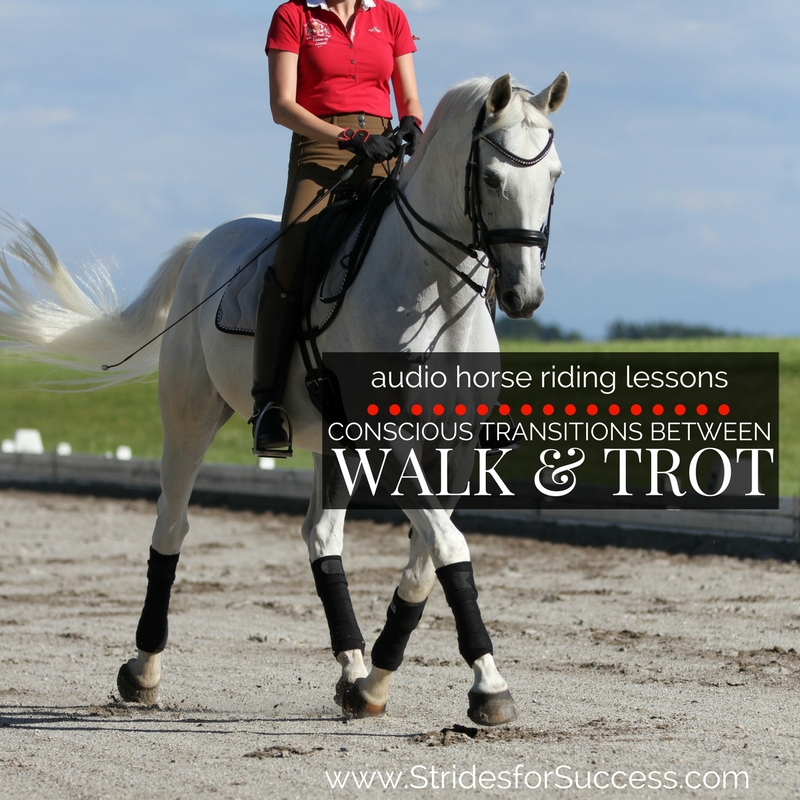
    Conscious Transitions Between Walk & Trot

    [smart_track_player url=”https://op3.dev/e/traffic.libsyn.com/dailystridespodcast/521-Concious-Transitions-Between-Walk-and-Trot.mp3″ title=”Conscious Transitions Between Walk and Trot” social_linkedin=”true” social_pinterest=”true” social_email=”true” tweet_text=”Working on Walk with your Horse? This will help :) Walk and trot – the most overlooked transition in horse riding!” hashtag=”focusonthebasics #equestrian” twitter_username=”strides_success” ]

    So there you are, walking along and at some point or another, you find yourself having to ask for trot.  You might walk a little faster, perhaps include a little jig jog or two until, 4 or 5 seconds later, you are finally trotting.

    This is not ideal at all!  But what is it about transitions between walk and trot, and not just walk to trot, but also trot to walk, that has a lot of us think they are not so important?

    Is it because it is the first real transition up the gears that we usually get to grips with when learning to ride? Most riders will have experienced going from walk to trot within the first lesson or three.  Or is it because we become so used to the trot being a wee bit bouncy to begin with that we are less than careful about trying to create a smooth transition into it?

    Whatever the reason, the transitions between walk and trot are some of the most overlooked by riders and it’s a pity because it is a transition that when given the attention it deserves, it can really and truly change your whole experience in the saddle and help you create that seamless communication between rider and horse.

    Begin where you are – the walk

    As with most things, the quality of the transition will only be as good as the gait leading up to it. invest time in establishing and maintaining a good quality walk with your horse.  Your horse should walk on and use himself correctly.

    Next time you are on your horse in walk begin to question the quality of the walk.

          • Is your horse responsive and listening to you?
          • Are you having to force him forward?
          • Are your connections with your horse equal?
          • Do you have an actual plan for what you want to happen?!

    Assess your past attempts at transitions

    Next, turn your attention to your past transitions and how they were…

          • Does it take your horse 4 or 5 ‘asks’ to eventually fall into a trot?
          • Or perhaps he is the opposite and shoots forward into the trot
          • Does your horse hollow his back as he picks up trot?
          • Does your horse ‘fall’ a little to one side or the other as he steps into the trot

    Most of the time our horse is responding to what we have allowed to continue, either with our lack of consistency or our ignoring the smaller, but essential details.

    One of the biggest reasons for poor transitions between walk and trot is a lack of responsiveness from both horse and rider.  Responsiveness is something that is mirrored in horse and rider – meaning that it is generally both parties at fault when it is less than ideal…

    Fine-tuning the responsiveness

    If your horse is a little dead to your leg, have a schooling whip on hand to back up your leg. You will probably find that 2 or 3 well-timed taps with the schooling whip is enough to send a message that your leg is something he should listen to.

    You may find that initially, he will run forward when you apply the whip, he will soon learn that there is no need to run away and charge forward.  The whip is merely a signal that he must pay attention to your leg and, therefore, begin to ‘step’ into the trot from your leg.

    Of course, the opposite of this is being a little too sensitive to the leg. If you experience this,  I suggest rethinking a little about how you are riding your horse. Are you teaching him that your leg is only used when he must go faster?

    If so, you need to begin reintroducing him to the fact that your leg is not something to run away from.  You can do this by being consistent with how and when you use your leg.  It is also good to be aware of what your leg is doing when it’s supposed to be relaxed (hint; this does not mean daylight between it and your horse’s sides!)

    You can also evaluate at your seat. Perhaps your horse is sensitive enough to begin reading your seat aids to move forward. If this is the case, you need to begin being more mindful about how and when you are applying them.

    Putting effort into your Preparation

    Preparing to trot from a walk requires just that; preparation. You need to begin to think about how you are signaling to your horse with your seat that he must move into a trot.

    Think about ‘allowing’ the energy to begin flowing underneath the saddle a little more.

    Practice how using your seat and weight aids can communicate either a whoa or a go to your horse and becoming consistent with applying them each and every time.

    Conscious Transitions Between Walk and Trot

    Understanding and Correcting Bad Habits

    Very often the hollowness which is generally accompanied by short, pottery or choppy strides is because we are simply not allowing our horses to trot. We often think of ‘allowing’ as being everything to do with our reins and hands, however, keep in mind that your rein aids are connected to your seat aids, so you must also allow through the seat.

    Rather than becoming a close peg and clamping down with your pelvis and thighs on your horses back when he begins to trot, think about opening up and allowing that energy to flow through your legs.

    Very often the reason people ‘clamp’ is because they are worried about the bounce they will experience when their horse takes the first few strides of trot. The irony of this is that the trot is far more uncomfortable when your horse is taking those short, choppy pottery steps – which a lot of the time is happening because your seat, legs, and upper body are like a vice grip on him!

    If you can relax and think about ‘carrying’ yourself into the trot, your horse will then be able to get his back legs underneath himself and push himself forward, rather than pull himself forward.

    A Good Transition – Every Transition

    Finally, I have mentioned consistency in cultivating a better transition a few times now, but it is important to stress that you must be consistent EVERY TIME you go from walk to trot, not just in the arena.

    Picture your horse actively walking around, and then beginning to push off into the trot correctly using his hindquarters. He will continue to carry himself, his shoulders will be free to swing along in the trot and you will experience a wonderful rhythmic trot from the word go.

    The Downward Transition

    The same thought and effort must also go into the reverse transitions, the trot to walk. All too often a nice trot is ruined by a rider literally dropping an anchor and hauling their horse back into walk.

    Just like you had to think about allowing the energy to flow while still continuing to move with it going up a gear, you must now begin to think about containing that energy, while still moving with it – more influencing it than controlling it – to get a wonderfully smooth transition that sets up a great walk.

    A lot of horses will fall into the walk.  Others will raise their head and neck and pull against their riders as they are asked to walk.  Another common sight is the horse that will hollow their back, hold their ‘head carriage’, but the whole hindquarters disengages.  All of these are usually rider faults.

    Horses that pull against their riders, generally do so as a result of riders pulling against their horse! Think of your reins as an influence, not a hand-break!

    It is important to set the transition up with lots of half halts. It signals to your horse something is going to happen and it shifts the hindquarters a little more underneath your horse.  This allows the horse to use their body more correctly as they ‘gear down’, carrying and balancing themselves better.  It also ensures that the is forward energy is maintained into the walk.

    Taking Responsibility for Your Body

    Lastly, don’t mistake hunkering down with your body for using your seat when asking for a downward transition. Very often the hollowness in the horse’s back is from a rider that simply makes themselves heavy in the saddle, which results in the horse moving away from underneath them.

    Be sure to continue to carry yourself, and be prepared to then immediately follow your horse into the walk as he steps into it. This is with seat and hand.

    I challenge you over the coming week to really focus on the quality of your walk to trot and trot to walk transitions. Not only will you see an overall improvement in how you and your horse communicate with each other, but also an improvement in both gaits, walk and trot, as a result of this as well.

    Happy Riding
    Lorna

    Finding the Gaps in Your Horses Training

    And, finally, if you would like to go further with your riding I highly suggest you give my free training series a go…Find the Gaps in Your Horses Training using this free audio series available for you to listen to in a private podcast feed – so just as easy as listening to the Daily Strides Podcast :) You can sign up for free HERE or visit https://stridesforsuccess.com/free

    Get Support & Guidance in Your Riding

    Get Audio Horse Riding Lessons and Begin Training Your HorseToday!

    Right now, there are so many lessons, on all different topics, available for you on a Private Podcast Feed that delivers them straight to your phone, so you can listen as you ride your horse. Your own time, your own arena, your own horse… More Details HERE

    Connection is an online membership for equestrians working alone to train their horse without a coach or trainer.

  • Correctly Applying Your Weight Aids

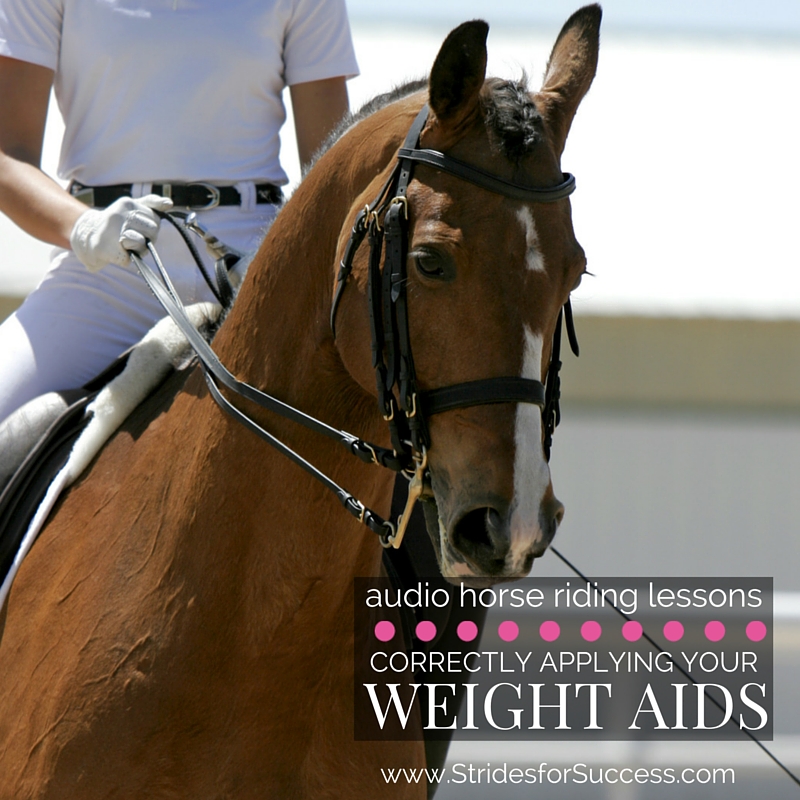
    Correctly Applying Your Weight Aids

    When we begin riding, we are generally told about this almost magical ability that we have to communicate with our horse, known as the weight aids.   However, it soon becomes apparent that we have to master many other aspects of riding before we can hope to use our weight to communicate with our horse…

    Unfortunately for many of us, this takes too much time to achieve, so instead we begin happily throwing our weight around in the saddle and then getting upset when our horse does something completely different to what we ‘asked’.

    [smart_track_player url=”https://op3.dev/e/traffic.libsyn.com/dailystridespodcast/516-Learning-to-Correctly-Apply-Your-Weight-Aids.mp3 Feedback” title=”Learning to Correctly Apply Your Weight Aids” social_linkedin=”true” social_pinterest=”true” social_email=”true” tweet_text=”Learning to Correctly Apply Your Weight Aids in the Saddle” hashtag=”horseriding #equestrian” twitter_username=”strides_success” ]

    So first and foremost, what are your weight aids?  The term ‘weight aids’ refers to where and how you are using your core to distribute your weight in the saddle.  Your weight aids are controlled with subtle movements which shift the pressure and weight of the seat bones in a way that communicates a certain instruction to your horse.

    You use your weight aids in all aspects of riding, from slowing down or stopping, to asking for more energy or moving forward.  Weight aids are an important part of transitions, bending, turning and even just riding a straight line.  Learning how to control your weight aid is a vital and essential part of good riding.

    It is only when we learn to develop a truly independent seat that those aids really can become useful to both us and our horse

    An independent seat is when you can move your legs or other parts of your body without affecting your overall balance & position in the saddle.  An independent seat is also something that is really earned by spending consistent time in the saddle, riding correctly and practicing correct movements and sound techniques.   A rider also needs a certain level of fitness and body awareness, so as to be able to use their muscles, and therefore shift their weight, as desired or required.

    If we do not first cultivate that independent seat, our weight aids can often work against us and our horse.  They can also when applied incorrectly, whether due to lack of knowledge or lack of control, contradict the other aids being applied which leads to our horse not performing as we think he should.

    Applying Your Weight Aids

    Many riders think that they are applying their weight aids correctly, however something as simple as not sitting straight in the saddle is enough to change the application and meaning of a particular movement.  Often riders will sit to one side, or favour one side of their body, when in the saddle and the problem then begins to compound when they begin shifting their weight around, giving a total different feeling to their horse than what the rider thinks they are asking

    Another way that the weight aids can begin to work against the rider if not correctly understood and applied is that often riders get a little ‘over enthusiastic’ in the application of the aid.  So rather than that subtle shift we mentioned in the beginning, they either begin ‘shoving’ or ‘pushing’ their horse, or they begin leaning…  Never Lean!  We can also incorrectly apply the weight aids, particularly when turning, by lifting our outside seatbone off the saddle…

    Keep in mind that both seat bones must remain seated if you want to give a correct and easily understood weight aid!

    The final issue I want to warn you of before we carry on is incorrect timing of the aid.  As with all things riding related, the weight aid being given will only be as good as the preparation leading up to it and the timing of it.  No matter how well-balanced, or finely tuned your seat may be, if you apply the aid at a moment when your horse physically cannot respond to it, the aid will never get anywhere near the result you desire.

    It is when you can combine a true independent seat with correctly applied subtle weight aids & a perfect sense of timing you will begin to master what we call ‘feel’ in the saddle

    To get an idea of just how subtle your weight aids and the ways you affect them are, I suggest beginning off your horse.  Find a firm surface you can sit on, and gently put a hand under each of your seat bones.  Feel how just applying a little more tension to the different muscles in your core, affects the distribution of the weight applied by your seat bones on your hands.

    Move your body as you would when in the saddle performing a half halt; feel how your seat bones would ‘block’ a river of energy that would flow underneath you through your horse’s back when you are in the saddle.  However, then begin to see how, my making slight adjustments,  you can soften that aid or smooth it out.

    Once you can begin feeling these subtle differences, try it with how you would move when you ask your horse to move forward, whether it be to transition up a gait, or within a gait.  Again, imagine the river of energy flowing underneath you and how, when applied correctly, your weight aids will ‘open’ and allow that energy to flow a little more.

    Of course, when you apply your weight aids you are not necessarily ‘blocking’ or ‘allowing’, just rather suggesting this to your horse, who with time, will understand and make adjustments as required

    Once you have a good feeling and understanding of the ’cause and effect’ of your body movements out of the saddle, then you can begin experimenting in the saddle.  Unfortunately however, many riders will experience that their horse is not all that attentive to their weight aids initially.  This is usually due to the fact that the rider has been guilty of literally ‘throwing their weight about’ in the saddle!

    However, all is not lost and you can begin to re-school or retrain your horse to your newly acquired subtle weight aids.  To do this you will have to be consistent and mindful of where you are sitting in the saddle and also that each movement or change is set in motion by applying the correct, subtle, weight aid first.   Your horse will, given time, begin to associate that particular weight aid with that instruction and soon, begin responding to the weight aid when it is applied.

    Really effective communication with your horse through your weight aids will take time and patience, however is really worthwhile in the end.

    Happy Riding

    Lorna

    Applying Your Weight Aids