Tag: training

  • Noticing When You’re Collapsing in the Saddle

    Noticing When You’re Collapsing in the Saddle

    [fusebox_track_player url=”https://op3.dev/e/traffic.libsyn.com/secure/dailystridespodcast/1195_Audio_Horse_Riding_Lesson_Working_on_Your_Self_Carriage.mp3″ title=”Noticing When You’re Collapsing in the Saddle” social_linkedin=”true” social_pinterest=”true” social_email=”true” tweet_text=”Here’s an audio horse riding lesson for you to use next time you ride…” hashtag=”equestrianpodcast” twitter_username=”strides_success” ]

    You can feel it when your horse ‘hollows’, right?  And I bet you can also feel it when your horse ‘grows a hand’ and begins to carry himself. There is either a feeling of contraction or expansion.  Okay, so because we agree on that, it makes sense that your horse can probably feel the same thing… Right?

    And yet, so many riders fail to consider the knock on effects that collapsing in the saddle cause.  How, just like when your horse hollows, your collapsing affects the whole ride. 

    When No-One is Watching

    What I have noticed after working with thousands of riders is that how most ride when alone and how they ride when being watched or judged, are different.  And yet, study any truly successful* rider and you will only see consistency.  What they do in the ring before the crowd is the same as what they do back home in the arena on a bog-standard Tuesday.

    *I personally believe success can mean something different to every rider.  To me, success as a rider is to have a deep relationship with a horse built on trust, respect, quality-focused time, and intention. 

    So back to you… How do you ride when no one is watching?  What do you do when you notice someone is paying attention.  Or when you pay someone to judge, coach, train, or instruct you.  Still not sure?  Okay, imagine I’m going to stand in the arena with you on your next ride.  What’s the first thought that goes through your head?  That is usually a good indicator of how you will ‘change’ based on who is watching.

    Collapsing in the Saddle Depends On…

    Now, that all being said, a lot of riders find themselves somewhere in the middle.  They carry themselves ‘mostly’, but when pressure is applied, things can quickly become, well, a little ‘slouchy’!

    Take the transition from trot to canter for example.  Many riders will carry themselves correctly right until the very moment that they ask for the canter… Only to collapse through the transition itself.  And, as you probably know, this is a crucial time where both horse and rider really need to take responsibility for their own body.

    I see pressure as being any point in the conversation where a ‘bigger’ question is asked. More is required, from both horse and rider.

    Another area that many riders, if they are going to collapse in the saddle, will do so is a downwards transition.  Let’s say from trot to walk.  Or walk to a halt.  They put so much effort into their riding before the transition, only to let it all fall apart at the crucial part.

    Let’s See If You’re Collapsing In the Saddle

    I thought it would be fun for you to test yourself on all of this.  Give it a go and rate yourself, so to speak!   So, I’ve created this week’s episode of the Daily Strides Podcast with the intention of helping you do just that.

    I am going to help you discover where you might collapsing through your body.  This episode is created for you to listen to as you ride.  Of course, if you don’t want to do that, you can listen before you ride and then apply the principles to your riding.

    However, I believe to get the most from this episode, give it a listen as your ride your horse.

    I would then love to hear back from you… You can either email me lorna [at] stridesforsuccess [dot] com, or DM me on Instagram @stridesforsuccess or message the Strides for Success Facebook Page.

    Tell me your experiences and, more importantly, what you are going to do going forward to stop ‘hollowing out’ on your horse during those crucial moments :)

    Happy Riding
    Lorna

    Additional Links to Help You:-

  • Working Towards Self Carriage on the Lunge

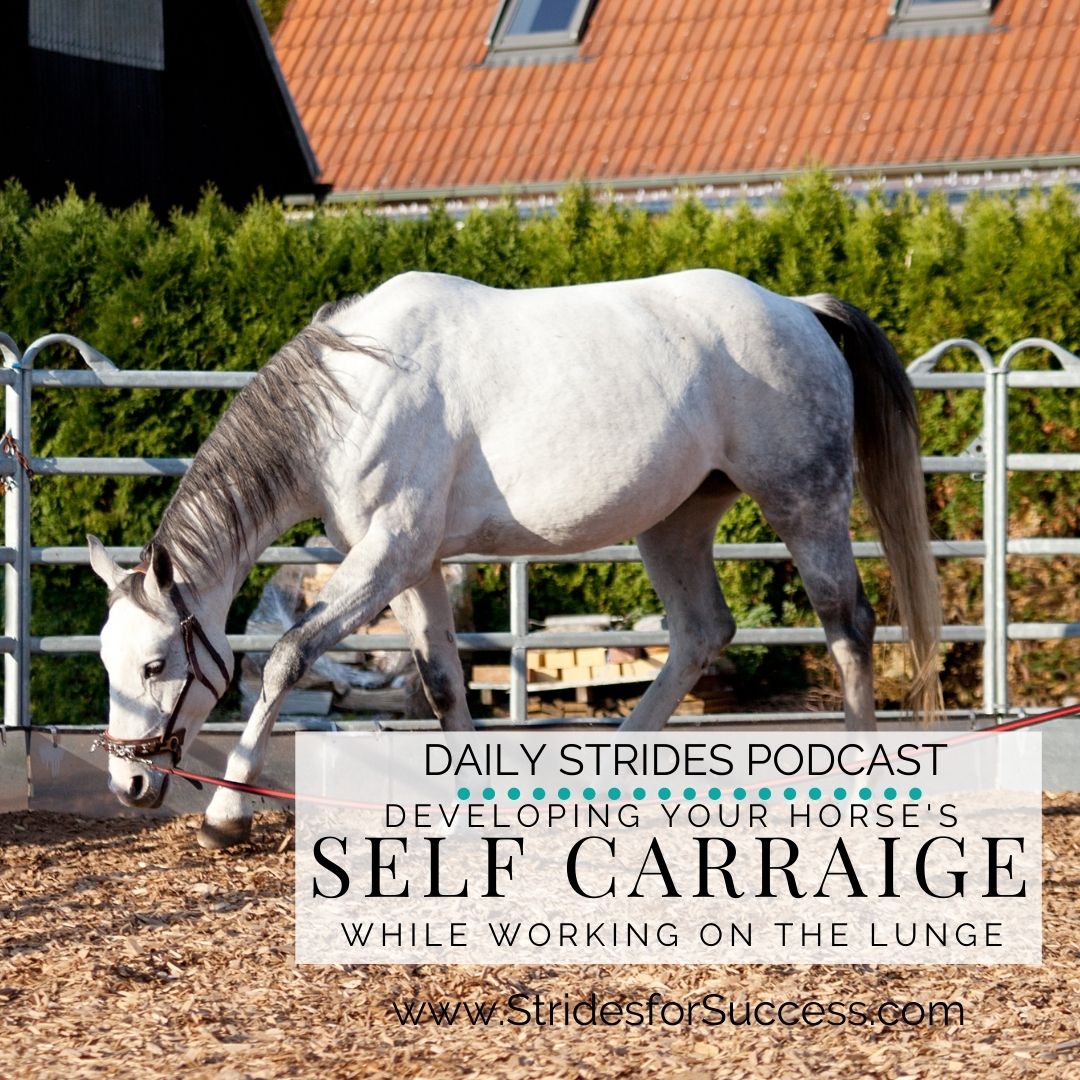
    Working Towards Self Carriage on the Lunge

    [fusebox_track_player url=”https://op3.dev/e/traffic.libsyn.com/secure/dailystridespodcast/1189_Developing_Self_Carriage_in_Your_Horse_on_the_Lunge.mp3″ title=”Developing Self Carriage in Your Horse on the Lunge” social_linkedin=”true” social_pinterest=”true” social_email=”true” ]

    Self carriage is something a lot of riders have on their ‘goals’ list for their horse. As though it is something that can be achieved once and ‘ticked off’. Done and dusted. If only…

    I believe that self carriage is a sign of development and growth in both horse and rider. A start in the sharing of responsibilities that lead to the desired outcome. Each team member realizing that it truly does take a team effort in order to make real and lasting progress.

    And yet, so often, the rider can get in the way and actually hinder the horse’s training when it comes to self carriage.

    Self Carriage is a Result

    I believe that true self carriage is not really something you can simply decide to do on any given day. If that were true, where would you begin? Rather, self carriage will naturally begin to show up and reveal itself when other factors are present.

    Self carriage occurs when conditions are right.

    So, as the rider and team leader, your responsibility becomes creating a situation where the conditions are right for your horse to begin carrying himself. And it is often much easier to do this on the ground, rather than on your horse’s back.

    Lunging for Self Carriage

    This is where lunging can play an important role. It will allow you to take on the perspective of a trainer for your horse. You can actually see what he is doing, rather than ‘feeling’ it (and possibly being wrong) from the saddle.

    Lunging allows your horse the space to experience his own development and growth, without a rider muddling the communication or feeling.

    He will get to develop his:-

          1. physical self
          2. mental self
          3. emotional self

    And all three are key for correct growth. We all know of a horse who can physically do the thing, but doesn’t believe he can do the thing. Or is worried and anxious about doing the thing…

    Training Yourself Too

    Lunging also allows you to train yourself. You will get to experience the consequence of each of your actions (or non-actions) as it plays out in real-time. When you mindfully apply an aid, you get to actually see the effect it has on your horse.

    Seeing the effects of your actions will help you to become more mindful of your aids – and that carries across to every area of your communication with your horse.

    If you are keen to go deeper into lunging and learn how to use this powerful tool to improve your riding, join me inside of Lunging for Riding.

    Happy Lunging
    Lorna

    Other Resources to Help You with This Topic:-

  • Your Riding Plan – Part 3 – Developing

    Your Riding Plan – Part 3 – Developing

    [fusebox_track_player url=”https://op3.dev/e/traffic.libsyn.com/dailystridespodcast/1179_Planning_Your_Rides_Part3_Developing.mp3″ title=”Your Riding Plan, Part 3:- Developing and Training” social_linkedin=”true” social_pinterest=”true” social_email=”true” ]

    Is every 30-minute ride starting to look and feel the same for you? Even the ones that you painstakingly chose exercises to work on? Annoying, isn’t it? Especially because actually ‘moving forward’ in your riding is the reason you are riding!

    If this is the case, firstly, take heart that you’re not alone! Remaining focused throughout the day to day riding can really begin to wear on most well-intentioned riders after a while. And can even cause riding to begin dropping off your list of priorities…!

    This is why I suggest a 3 pronged approach to developing your weekly riding plan in a way that keeps things interesting and moving forward…

    A plan that will take you, clearly, on a path to your goals. Part 1 is to introduce regular intentional Fun to your riding. From there, Part 2 is working on deepening your Partnership with your horse. Which leads us to…

    Part 3 – Developing

    Doing the work. This is part that most riders are good at talking about, planning about, and even trying in the arena. You have probably found yourself on more than one occasion in the arena, exercise all mapped out in your head. And yet realizing, in absolute dismay, that it is just not coming together for you.

    The key is to begin making ‘the work’ actually work for you and your horse!

    Developing is another name for training. I personally believe that both horse and rider need training in order to move forward in their relationship. Often, most horse and rider combinations begin with one team member not being as advanced as the other. In this case, the more advanced or developed team members will help to ‘lift’ the other to their level. The schoolmaster horse or the more experienced rider.

    However, at some point, most horse and rider partnerships will reach a level where they are now matching in their skills and abilities. And this can be where so many begin to plateau.

    Physically, Mentally, and Emotionally

    When we think of ‘working’ our horses or ‘training’ our horses, it can be easy to only focus on the physical. The things we can actually see. Increased flexion. Improved straightness. Maintained rhythm. However, reaching a new level in development actually involves your horse also develop emotionally and mentally.

    Your horse must believe that he can do the things you are asking him to do.

    The same applies to riders. Just focusing on actual physical riding skills will result in a rider plateauing in their training. We all know of the rider (maybe it is even you) who knows what to do and can do it… But just does not have the confidence to do it. Or who cannot consistently establish or maintain what it is that they are doing?

    Both horse and rider must develop both mentally, emotionally, and physically in order to really continue to grow individually and as a team.

    The Power of Simple

    I am a big believer in keeping things simple. Simple exercises that focus on simple outcomes. The basics matter and I believe that spending the majority of your ‘Developing Time’ there, will help you and your horse reach your goals much faster and easier. This is especially true if you have plateaued in your riding…

    Often, if you are not seeing progress (usually because Fun and Partnership are not included in the plan), you instinctively jump to complicated where training is concerned.

    I am going to urge you to rein in the temptation to do that and to really just focus and work on the simple in your training with your horse. It’s not fancy, it’s not fashionable! But it works.

    Choose simple exercises and rather work on them through the filter of what you want to achieve in your riding.

    For example, a serpentine can be used to work on transitions, bending, rhythm, walk, trot, canter, straightness, ground poles, flexion, relaxation, accuracy and so much more. One exercise, that is as basic as they come, and I’ve just given you 11 different ways you can use it in your training.

    Adding Developing To Your Riding Plan

    Just like Fun and Partnership, there are many different ways to incorporate Developing or Training into your riding plan. Here are a few suggestions you can use to get you started…

        • Groundpoles
        • Lunging in an enclosed space
        • Groundwork
        • Long Lining
        • Flatwork (while riding)
        • Gridwork
        • Jumping
        • Clinics
        • Workshops
        • Shows & Competitions
        • Long Lining over poles
        • Lunging in an open space
        • New experiences
        • Trail rides & hacking

    And that is just to get started with… I’m sure you can come up with many more ways and opportunities you can really begin training and developing both you and your horse.

    Again, you will see cross-pollination between the activities on your Fun List, your Partnership List, and your Training List. Remember, it is the intention that counts.

    Finding Exercises

    The final part of putting all of this together is to find actual exercises for you and your horse to work on each day as you ride. 3 exercises can go a long way. 5 and you have more than enough for a month’s worth of riding.

    Choose wisely and, remember, keep it simple!

    Happy Riding
    Lorna

    Additional Links to Help You:-

  • Planning Your Rides – Part 1:  Fun

    Planning Your Rides – Part 1: Fun

    [fusebox_track_player url=”https://op3.dev/e/traffic.libsyn.com/dailystridespodcast/1177_3_Essentials_You_Need_in_Your_Riding_Plan_Part_1.mp3″ title=”Planning Your Rides – Part 1:- Fun” social_linkedin=”true” social_pinterest=”true” social_email=”true” tweet_text=”Stuck and not sure of what to do in your riding? Here’s how to inject a little fun…” hashtag=”equestrianpodcast” twitter_username=”strides_success” ]

    All work and no play makes Jack a dull boy… Or so the saying goes. I tend to believe this is true. Especially when it comes to riders and their horses. Yes, ‘working’ is important. But, if you are only riding to ride… Well, maybe that is what is actually holding you back in your riding?

    I think that in order to really get the most from your riding plan to help you reach your goals, there are 3 key components. Not just work! Fun is just as important. And if you have been riding for any length of time, you will know that fun begins to wane after a while.

    One of the biggest reasons that riders don’t ride as much as they say they want to – is down to riding simply not being as much fun as it once was!

    Creating a plan for your riding is not just about the days you ride. It is also about finding a balance between 3 key elements that, I believe, are essential. Including these 3 elements will allow you to work towards your riding goals, while keeping things inspired, focused and interesting for all involved. Because, after all, that’s what Team Leaders do, right?!

    Part 1 – Fun

    Fun is one of my highest values. Seriously. I am all about it. I actively look for ways to make things more enjoyable. And I look for ways I drop or delegate things that are not so much fun for me. Imagine if you took this same approach to your riding?

    You see, I believe that most riders ride because riding is fun.

    Why do you ride? Because of how it makes you feel – or maybe ‘made’ you feel. And there is the rub for many riders. What starts as this fun, exciting, and new experience, every single ride, can soon become, well, a little same old, same old.

    You can make sure fun remains a big part of your day to day riding by intentionally planning enjoyable things for you and your horse to do, on a regular basis.

    So what is fun?

    Fun is enjoying the moment. The process. It is usually not an ‘end goal’ or ‘endpoint’.  We rarely say “I am struggling on through the mud now because I will feel like it was fun when I’m finished”. Fun is the actual activity. And, fun is for both horse and rider.

    It is something that you can do together and that has the single goal of allowing you both to enjoy yourselves and each other’s company.

    Many riders confuse activities that bring them joy with activities that are fun for all involved. I know a lot of horses who don’t find jumping the same jump or riding the same movement over and over again much fun. But their rider does!

    The rider ends the ride having had the time of their life. The horse ends by offering up a silent prayer of thanks for that particular 30 minutes of tediousness being over!

    Fun Can Mean Many Different Things

    I can bet that if you and I had a chat over a cup of tea, there would definitely be some things we could agree on as being ‘fun’. However, there are probably just as many that I would say are ‘fun’ and you would look at me as though I was crazy. Ironing, anyone?! Fun means different things to different people.

    And ‘fun’ can also change as you develop as a rider. Where initially the simple act of riding was fun, you may find that this just doesn’t bring you the same levels of enjoyment after a while. And this is where developing intention about what is fun becomes important.

    Fun also means different things to different horses.

    For some horses, practicing the course of fences is fun. Others enjoy the gallop on the sand at the beach. Or grazing in a safe paddock, maybe with their human close by reading a book or magazine. Massages, treats, natural horsemanship… There are endless possibilities and opportunities to discover what your horse enjoys.

    Ideas For Getting Intentional

    Here are a few suggestions to get you started with this. You may find that you are naturally drawn to one or two of these. Great. Insert them into your riding plan for this coming month.

          •  In-hand grazing
          •  A relaxing trail ride with a friend
          •  Loosely braiding or brushing your horse’s mane
          •  A leg or face massage for your horse
          •  Baking (you) and eating treats together
          •  A walk in-hand
          •  Grooming
          •  Natural horsemanship
          •  Picnic with your horse
          •  A trail ride with just the two of you…
          •  Observing your horse in the paddock
          •  A gallop in an open field
          •  Reading a book in the paddock, or beside the paddock (you know what’s safe for you)
          •  Full body massage for your horse
          •  A beach ride for both of you
          •  Brushing your horses tail

    These are just a few ideas, the list is endless. I am going to suggest choosing 2 or 3 and ‘slot’ them into your riding plan for this month.

    Trying New Things…

    Fun, just like everything else, has a comfort zone. A place where there is no excess tension there to make it feel a little different or ‘uncomfortable’. If confidence is an issue for you or/and your horse, stay in your comfort zone for a while to grow your confidence.

    Keep in mind that all things inside of our comfort zone can begin to feel ‘bland’ or ‘neutral’ after a while… Fun is no different…

    So, I am going to encourage you to step out of your comfort zone. I am challenging you to try something that you have not done before. Or something that you don’t think you, or your horse, would enjoy. Give it a go… See how it feels and, if you surprise yourself and discover it is, in fact, fun; great.

    You now have another activity to include in your ‘fun’ list for when you are creating your weekly riding plan.

    Happy Riding
    Lorna

    Additional Resources to Help Equestrians:-

  • 5 Essentials When You Become Trainer for You and Your Horse

    5 Essentials When You Become Trainer for You and Your Horse

    5 Essentials When You Become Trainer for You and Your Horse
    The ‘New Normal’.  I feel as though we have reached a point where we must begin looking at how we can settle into this period in our lives, rather than wishing for the way things were.  You may have to become the trainer for you and your horse.  I know that many riders are having to now begin, maybe for the first time, be the trainer, the instructor, the chief planner, as well as the rider.
    [smart_track_player url=”http://traffic.libsyn.com/dailystridespodcast/1145-5-Essentials-When-Developing-Your-Riding-and-Your-Horse.mp3″ title=”5 Essentials when You’re Trainer for You and Your Horse” social_linkedin=”true” social_pinterest=”true” social_email=”true” tweet_text=”Are you now coach, trainer, instructor, rider and everything else in between for you and your horse? If so, here’s what to focus on going forward…” hashtag=”equestrian” twitter_username=”strides_success” ]
    Progress doesn’t just happen.  There are a few essentials that must be consistently visited in order to maintain consistent progress.  Progress, I believe, is deepening the understanding and the relationship between horse and rider.  What you do with this progress is up to you.  However, I feel that all riders should be looking to at least try and build a conversation with their horse.
    Here are the 5 essentials you must regularly visit if you are to make this a consistent reality for you and your horse…

    1. Your Mindset

    Whatever you believe about yourself as a rider, is what is playing out in your day to day riding. Believe you can trot; low and behold, you will trot.  Canter is the same.  So too is half pass, jumping and any other discipline or movement to do with riding.  However, there is a flip side to this… Believe you will fall off; you probably will!
    Your mindset has the power to ‘cap’ both yourself and your horse’s development and growth.  It can become the glass ceiling that prevents you both from reaching your true potential as a team
    However, it also has the power to help you overcome challenges.  To move past ‘sticky points’ on your riding journey.  And to help you deepen your conversation and relationship with your horse.
    So, answer me this… What do you think about yourself as a rider?
    The reason this plays out the way it does is not magic or woo (or maybe it is?!).  However, if we want to just be practical, the reason this happens is due to you taking action based on your beliefs.
    Therefore, your opinion of yourself as a rider will dictate how you actually show up and ride.  If that is not motivation to dig a little deeper into your thoughts, I don’t know what is!

    2. The Basics

    Ah, good old auto-pilot.  I am a huge fan of putting the basics on autopilot in your riding.  Trust me, it works… Until it doesn’t anymore!  This is why I believe that, as a rider, it is your responsibility to revisit and ‘tweak’ your basics on a regular basis.
    What do successful riders spend 80% of their time working on in their riding and with their horses? The basics…
    Many riders find themselves ‘stuck’ in their riding due to something that falls under ‘the basics’ not being upgraded when it should have been in your riding.  Remember, what got you here won’t get you there.  Your basics will regularly have to be modified in order to serve the next level in your riding development.
    Your foot placement in the stirrup.  How you are using your reins.  Your position.  Sitting trot anyone?!

    3. Groundwork

    Every conversation between horse and rider begins and ends on the ground.  You mount up and you dismount.  Weak boundaries on the ground, very often, begin creeping into the ride.  Inconsistency on the ground can often confuse the aids in the ride.
    Groundwork can help you develop your aids and build responsiveness for when in the saddle.  
    It is also a great way to add some variety into your day to day schooling with your horse.  Lunging, long-lining, and groundwork itself all help you to gain a new perspective when training your horse.  They also allow your horse to figure things out without your weight confusing the issue in the saddle.
    Groundwork has huge potential as a tool when it comes to improving your riding.  

    Developing

    So many riders what to get from ‘here’ (wherever they are in their riding right now) to ‘there’ (wherever it is they want to go). However, they have no clue as to how they can make that happen.  If you are facing the possibility of becoming your horse’s sole trainer, you need a system!
    Riders need a proven framework to use when it comes to training and developing themselves and their horses. 
    A ‘Hit And Miss Approach (HAMA) will never lead to long term success when it comes to riding.  The most common HAMA I see riders use is the ‘What do I feel like doing today?’ variety.  Look, I am all for inspiration.  In fact, I think it is vitally important as a rider to ensure you have some when it comes to your riding.
    However, expecting to develop the conversation based on ideas you are plucking out of thin air 10 minutes before you mount up is not going to lead to long term success. 
    In fact, I have noticed that riders who plan (I use this word in the loosest of terms here) their rides this way often begin to get desperate with their exercises.  Rather find a system you enjoy and plug into it.

    Remember, every system should have ‘wiggle room’; meaning it must be able to adapt for you and your horse where needed. 

    5. Planning

    Which leads me straight into the fifth essential.  When you have a system to follow and some important essentials to work on, planning becomes so much easier.  And yet, this is the piece so many riders fail to implement.
    Strangely enough, it is also the piece that many riders pay a trainer for their expertise on.  Planning how to get from here to there for each unique horse and rider combination. 
    If you are to really take your new role of ‘trainer’ seriously, the planning element is vital to your success.  Have an intention for each ride. A focus for each week. A theme for each month.  All leading to your goal.  Planning is like mapping out the stepping stones you will need in order to get from ‘here’ to ‘there’.  If you are missing intention in your ride, it is very difficult to layer your wins in order to create a strong foundation to keep building from.
    Planning in advance will help you remain focused on your goals and moving towards them each and every ride. 

    Trainer for You and Your Horse

    If you are suddenly finding yourself in this new place in your riding, I have two resources to help you.  I have created a free Week’s Riding Plan HERE, that you can use to plan your upcoming week with your horse with intention and focus.   And if you would like more help and support, Connection is where you can get both those and so much more.
    Connection gives you the resources to learn what you need, but also the coaching to go and take action on what you have learned.  
    You can visit Connection HERE for all the details.
    Happy Riding
    Lorna

    Links to Additional Resources

    Get Going in Your Riding:-

    Daily Strides Premium is back! The first and original audio horse riding lessons you can use to improve your riding, train your horse, keep things interesting, have fun… Even if you don’t have a trainer or coach

    Connect with Lorna online:-

  • Working with an Online Equestrian Coach or Trainer

    Working with an Online Equestrian Coach or Trainer

    Working with an Online Equestrian Coach or Trainer

    As equestrians, we may be at the point where we need to face up an uncomfortable truth; ‘normal’ may not be returning for quite a while.  Harsh, but true.  Simply put, I feel that this means that this is as good a time as any to begin settling in and making yourself comfortable with this ‘new normal’.   For now, anyway.

    [smart_track_player url=”http://traffic.libsyn.com/dailystridespodcast/1144-Working-with-an-Online-Equestrian-Coach-or-Trainer.mp3″ title=”Working with an Online Equestrian Coach or Trainer” social_linkedin=”true” social_pinterest=”true” social_email=”true” tweet_text=”Thinking of taking a virtual riding lesson? 3 ‘checks’ to consider first…” hashtag=”virtuallesson #equestrian” twitter_username=”strides_success” ]

    The lives of so many riders have changed dramatically over the course of the past 90 or so days.  Things we took for granted have become coveted luxuries.

    Time in the saddle is one of these things for many riders.  For others, it is being able to work with a trainer or instructor in order to keep developing and moving forward.

    However, even in the midst of all this uncertainty, there are ways of making it work.  There are resources out there that, up until now, maybe you would have never considered.  You simply didn’t have to!

    But, in this ‘new normal’, these once unconventional resources are the very thing that will help you continue to improve and develop your skills as an equestrian.  And, help you to continue to develop your horse as well.

    My Experience as an Online Equestrian Coach

    I have been training and coaching riders online for seven years now.  Long before Zoom was a household name!  In that time I have discovered a few key areas that determine whether or not someone will benefit from online coaching.  That is what I want to share with you today.

    If you are considering working with an online equestrian coach or trainer, see the following points as a checklist…  Check that you are ready to show up in all the areas mentioned and then make your decision based on that.

    Q1. Are you Coachable? ☑️

    The first point is one that, at face value, most riders will reply something along the lines of ‘Yes, of course, I am” to. However, I want you to dig a little deeper here.   Coachable means that you are open to new suggestions. New or different methods.

    It means that you are open to trying new things in your riding style and method, often things that you may have previously disregarded or not had much success with?

    A willingness to learn and be open to new things is essential when working with any trainer or coach.  However, when online it really becomes important because of the lack of in-person contact.  At the end of the day, it comes down to the rider’s commitment to being coached.

    It is far easier to continue to inspire someone to keep going when I am in the same arena as that person.  It becomes a lot more difficult virtually.

    Q2. Are You Willing to Show up? ☑️

    Again, this is a question most riders will automatically say yes to, without giving it a second thought.  However, and again this is from experience, it takes commitment to be consistent virtually!  I have had many experiences over the years where the training session was scheduled.  I jumped on the call; only to be stood up.   The most annoying part of it all is that it usually was because ‘something came up’ in the other person’s day.

    A couple of months ago, I found myself in this same situation again.  Stood up.  When we did eventually get in contact with the rider, she had simply over-scheduled herself.  ‘Overly ambitious’ were her words.

    The thought struck me; if it was an in-person lesson and we were meeting in the arena, would she have also been a no-show?  I can almost bet the answer to that is no.

    And yet, many people see online as being not as important.  Less relevant somehow.  Time is time.  When you schedule an appointment with someone, you are scheduling their time.  If you are to successfully work with an online equestrian coach or trainer, you need to see ‘online’ as being equal to ‘in-person’.

    Q3. Are You Willing to Do the Work? ☑️

    And yes, another ‘but of course!’ question when we ask it first.  But really.  Working with an online equestrian coach or trainer means that you must be able to hold yourself accountable.  And, in my experience, it is this accountability that many riders struggle with.

    There are a whole host of ways to build accountability into your riding, I have a post HERE listing a few.  My suggestion is that, if you do decide to enlist the services of a virtual or online equestrian coach or trainer, put a few in place BEFORE you begin your coaching.  Accountability is easy when the going is good.  When you are finding success with your horse and you are making progress.

    However, accountability is essential when the opposite shows up in your riding.  And it will show up.  When things are tough.

    The times when you can’t seem to get the exercises correct or your horse is not cooperating.  When things are not going to plan is the very time when you should double down and stay the course.  However, it is also the time when it will become easier to embellish, exaggerate or tell an outright porkie or two about your efforts and progress!

    Accountability is being able to honestly communicate how things went with your trainer and then working with them to steer things back on track again.

    Working with an Online Equestrian Coach or Trainer

    So there you have it, 3 simple questions:-

        • Are you coachable?
        • Are you willing to show up?
        • Are you willing to do the work?

    If you can honestly, hand over heart, answer yes to all of the above; congrats!  You are ready to take this new step in your riding journey.  Again, this may not have been the solution you had in mind when you started out 2020.  However, as the world begins trying to navigate this new territory, this is one of the most accessible ways for riders to continue to be coached or instructed.

    And, in my experience, there is often added benefits to working with an online equestrian coach or trainer such as being able to review the lesson, over and over.  As many times as you need.

    No, it is not the same as having an instructor in the arena with you, but right now, it might just be even better.  You get to continue your journey with your horse, from the relative safety of your own arena or paddock.  For many riders, that beats putting both themselves and their families at risk of contracting or spreading the virus, hands down.

    Another bonus to virtual lessons is that you get a digital journal of your progress in your riding and lessons you can ‘retake’ time and again with your horse.

    If you are interested in online training and virtual riding lessons, you can find out more CLICK HERE and HERE.

    Happy Riding
    Lorna

    Other Resources for This Topic

    Equestrian Fitness Challenge ’24

    Let’s walk together for 21 days and have a chat about how you can do much more than you think you can as a rider and an equestrian… I am so excited to bring you along on this journey for the 100% FREE 2024 Equestrian Fitness Challenge
    There will be a daily walk, a 10 minute daily yoga practice, and lots of tips, ideas, exercises, and ways to improve so that you can show up as the best version of you – for you and your horse.
    Sign up today and let’s transform your riding – one stride at a time! 100% FREE 2024 Equestrian Fitness Challenge

    Connect with Lorna online:-

    Get Going in Your Riding:-

    Daily Strides Premium is back! You can use the first and original audio horse riding lessons to improve your riding, train your horse, keep things interesting, and have fun… Even if you don’t have a trainer or coach