Tag: training

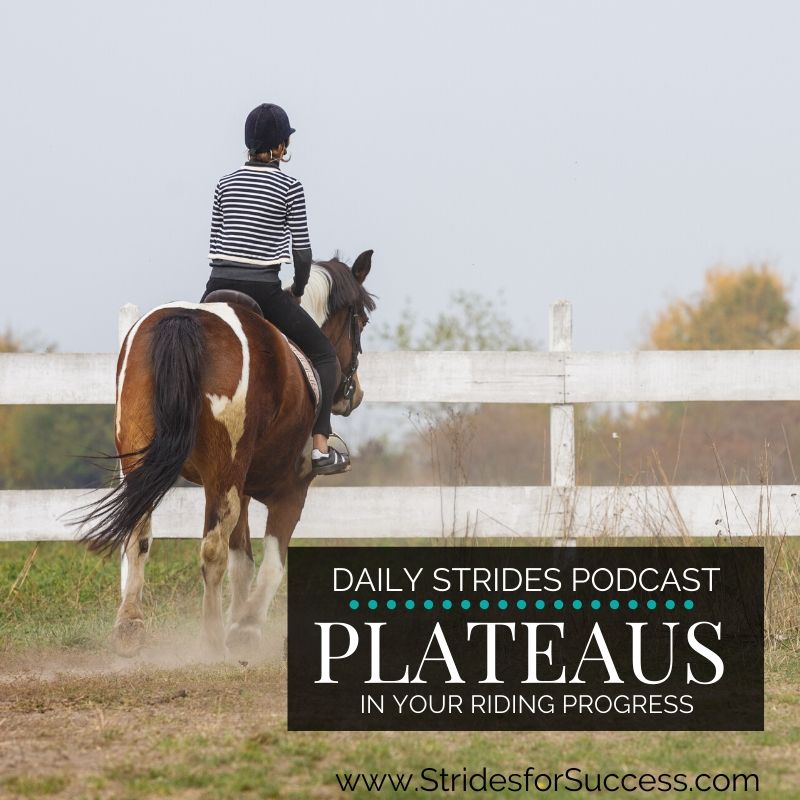
  • Overcoming a Plateau in Your Horse Riding Progress

    Overcoming a Plateau in Your Horse Riding Progress

    Overcoming a Plateau in Your Horse Riding Progress

    It is inevitable. All riders find themselves there at some point in their riding journey. The point where progress stalls and the comfort of the plateau is no longer what they are looking for. Recognizing that you are feeling a little stuck is the key to making the necessary changes to ‘unsticking’ yourself. The key to starting working towards progress again.

    [smart_track_player url=”http://traffic.libsyn.com/dailystridespodcast/1122-Overcoming-Plateaus-in-Your-Riding.mp3″ title=”Overcoming Plateaus In Your Riding Progress” social_linkedin=”true” social_pinterest=”true” social_email=”true” tweet_text=”Feeling stuck with how well you are doing in the saddle? This will help…” hashtag=”equestrian #podcast” twitter_username=”strides_Success” ]

    Before we dive into this topic, I just want to point out that this happens to all riders. It is absolutely inevitable. If you were never to reach a plateau, you would burn yourself out and become exhausted with the constant ‘effort’. However, remaining there leads to feelings of boredom and ‘same old, same old’.

    A Plateau is Often Necessary

    I love hiking. I especially enjoy it when there is a sizeable hill or mountain involved. One of the reasons is because I feel that it ‘tests’ me a little. There is a climb. The discomfort and effort involved in actually moving up to where I want to go. And then there is the feeling of relief and accomplishment when I reach the next plateau. The plateau almost compliments the climb necessary to get there.

    Horse riding is very much the same. There are feelings of discomfort when you’re learning something new. The feelings of ‘gosh, maybe I should just turn around and go back to where I was comfortable’. The doubting. The necessary focus and concentration. Your ability to ‘dig deep’.

    Learning something new is like climbing. It has the potential to be uncomfortable; until it isn’t. And this the plateau. The ‘new normal’ in how you communicate with your horse from the saddle.

    But, just like actual hiking, the initial relief that reaching the plateau brings will soon be replaced with wanting more. And that is where you must begin ‘climbing’ or learning again.

    Is it You or Is it the Horse?

    So once you have established that you may just be on this plateau a little longer than you planned, you need to begin creating a plan or a route to get you moving again. The first part of this is figuring out who is actually holding ‘the team’ on that plateau? You or your horse?

    There is a whole group of riders who will point a finger at the horse. However, there is another group who will put their hand up and realize that they are actually the issue…

    If you feel that it is your horse, I want you to first take a good hard look at your leadership skills where your horse is concerned. Often we can be skilled riders but lack the ability to lead the team forward. Remember, as your relationship with your horse develops, you must allow him more responsibility for his own actions. This requires you to allow your horse to make mistakes. Your job is simply to correct and then stand back and allow again.

    Sometimes, it is really the horse that is holding you both on that same level. The horse has reached his full potential in that area and will truly struggle to go further. If this is the case, I feel that it then becomes your responsibility to find a new partner to continue on your journey with.

    It is unfair to continue to ask your horse to go further when it is clearly not enjoyable or possible for him to do so. This, again, requires leadership qualities.

    When You Realise You’re the ‘Sticking Point’

    Where do you need to begin working on yourself? Is it your leadership skills that require attention? Perhaps it is your riding skills. Maybe coordination is an issue for you. Or timing. Maybe it is that there are simply ‘gaps’ in your riding knowledge. Pieces and parts that you missed along the way.

    I find that most riders are struggling with having the ‘gaps’ in their overall knowledge. This can show up in knowing what to do, but not understanding why you are doing it.

    Knowing what to do is great when you have a ‘textbook example’ to work with. For example, asking for the transition into the canter. However, when things don’t go quite to the book – as in your horse won’t canter – what then? This is where knowing ‘why’ you are doing what you are doing comes into play.

    I have firsthand experience of this myself. When I was younger and riding ponies, it was usually focused on the outcome. If we reached B, we were happy. However, later when I began riding and competing horses, HOW we reached B became far more important. Particularly if we wanted to then go on to C and D and E and F…

    I am passionate about this now when I’m working with riders in the arena and online. I feel that it is important for them to understand ‘why’ they are doing something, rather than just ‘how’ to do it.

    Starting to Climb Again

    Once you have identified why you are stuck on that plateau, you can begin the task of climbing again. Learning what you need to learn. Or developing whatever it is that needs to be developed. Now, often there are a few things that need to be tackled together in order to reach the next level.  However, naming them is key to making it happen.

    And, let’s be honest, it is going to feel uncomfortable again for a while. That is what climbing to the next level requires. However, the discomfort won’t last forever. There will be another plateau soon.

    A system will help you to stay on track and continue to make progress. For many riders, this is having a trainer to help them.   However, you can do this without a trainer as well. The key is to notice what is working and what’s not.

    Often when we begin something ’new’ or ‘different’ we try lots of different approaches. We throw the spaghetti at the wall and hope something sticks! Success comes when we begin to take notice of what is sticking and do more of that.

    Self Doubt is Normal

    Once you are back on the climb, you may notice yourself thinking ‘why did I start with this’. ‘Maybe I should just go back to where I was’… Firstly, know that you can. You can always go back – but to what end? I strongly believe that if you can simply accept that there will be periods of discomfort while you ‘climb’, your approach will change.

    It is always easier to bear something when we know there is an endpoint. Your next plateau in your riding is your endpoint when you are feeling discouraged on the climb to the next level.

    And keep in mind that once you reach the next level and have given yourself time to enjoy it there, you will soon begin feeling those feelings of ‘what next’. This is your signal to begin looking for a new climb for you and your horse.

    Happy Riding
    Lorna

    Other episodes and resources to help you with your riding:-

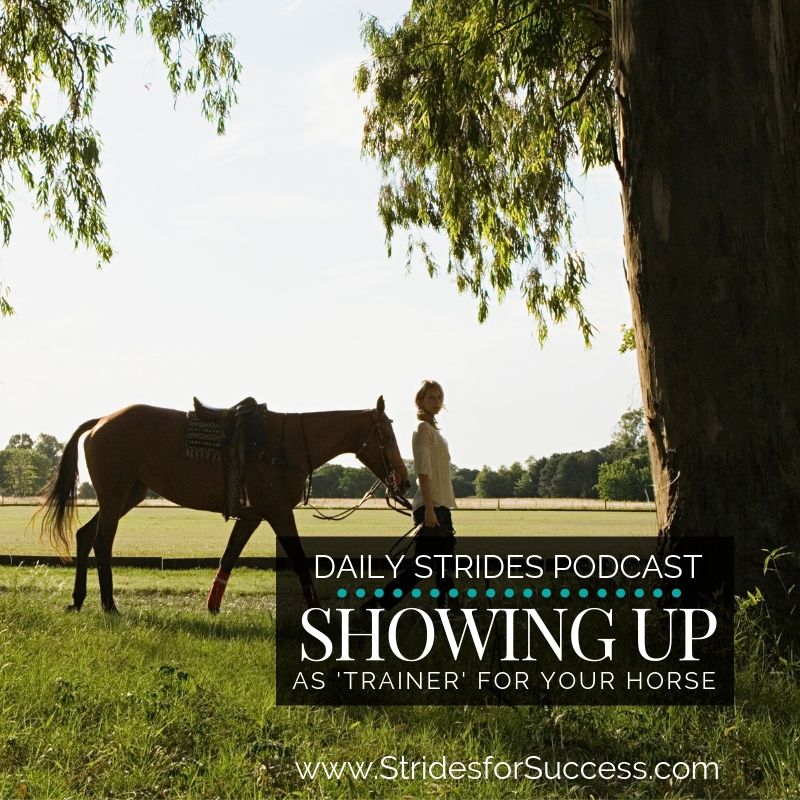
  • Showing Up as a ‘Trainer’ for Your Horse

    Showing Up as a ‘Trainer’ for Your Horse

    Showing Up as Trainer for Your Horse What this episode is all about & how it can help you:-

    • Realise that contact is a result of other things
    • Understand what ‘forwardness’ is and why it is so important
    • See the role you play in the forward and the contact
    • See how it should be present in every element of the ride, even halt

    Becoming a trainer.  It can feel uncomfortable to think of yourself as this for your horse.  Yet, if you are expecting your horse to do what you are asking him to do, well this is essentially what you are.

    The discomfort often stems from the realisation that being a ‘trainer’ comes with a lot of responsibility.  You are now responsible for how well you communicate your wishes to your horse. 

    Responsible for creating a working plan.  Ultimately, you are responsible for moving the conversation forward for both of you in and out of the saddle. 

    [smart_track_player url=”https://op3.dev/e/traffic.libsyn.com/dailystridespodcast/1104-Showing-Up-as-Trainer-For-Your-Horse.mp3″ title=”Showing Up as a Trainer for Your Horse” social_linkedin=”true” social_pinterest=”true” social_email=”true” tweet_text=”How do you see yourself in your relationship with your horse?  Like it or not, you are a ‘trainer’! Here’s why…” hashtag=”equestrian #horseriding” twitter_username=”strides_success” ]

    In this episode of the Daily Strides Podcast we pinpoint the most basic traits to cultivate in yourself in order to show up as a trainer for your horse.  Remember, if you are asking your horse to do things the way you want them done, you are training your horse!

    Acting Confident

    I really and truly believe that riders who succeed in the saddle, often do so because they have learned to act well.  They can put on a show when necessary for their horse and themselves.  When I say ‘acting’ I don’t mean entertaining.  Rather, that when things go a little off plan, as they will regularly do when working with horses, you can act like it is all under control.

    Acting is the ability to convince your horse that you are both safe and in full control of the situation, even when you are terrified and haven’t a cooking clue what is going on!

    The reason this is so effective is due to your emotions often following your actions.  When you act confident and self-assured, you will begin to feel those things as well. The more you feel them, the more real they become and soon the situation will seem completely different.

    When you act like you know what is going on, your horse will take his lead from you; allowing you to regain influence over both him and the situation. 

    Show Up Consistently

    There are two things that are necessary to reinforce any relationship.  Time and consistency.   Consistency is how you do things.  It is the energy and feel behind what is happening.  Your commitment to the relationship as a whole. 

    Consistency in and of itself is not enough.  It must be coupled with correct, positive action in order for it to be beneficial for your horse.  

    Think about how much time you are consistently investing in your riding.  Is your schedule consistent?  If so, is it enough time to really allow your horse to benefit from the training?  Or is your riding a miss match of snatched minutes.  Rushed and hurried.  Here and there…  Work on developing consistency in your schedule first.

    Consistency touches every element in your relationship with your horse.  From your aids to your grooming.  From healthcare to planning.  Consistently doing things correctly leads to confidence and results. 

    Model the Behaviour You Desire

    Be honest; have you ever become frustrated at your horse because he is not ‘relaxed’? If your answer is yes, with hindsight being 20:20, can you see the irony in this?   Asking and expecting one thing but then doing the opposite yourself.  Do as I say, not as I do…!

    If you want your horse to display a particular trait or energy, demonstrate this to him in everything that you do. Your horse will pick up on your energy and respond accordingly.    

    Try to lead by example with your horse.  Not only will it help your horse by setting the tone for your interaction.  It will also help you to become more intentional and focused with each of your interactions.  Having a plan for each session, whether on the ground or in the saddle, helps with this as well.

    Be Compassionate and Fair

    Something which I feel is essential if you want to really show up as a trainer for your horse, is a simple one.  Simple but often overlooked when in the thick of trying to ‘do’ something.  Being a responsible trainer means that you must be compassionate and fair.

    Instead of berating your horse for being ‘naughty’ or ‘not trying’, ask yourself how you can explain yourself better.  Maybe your horse just does not understand…

    This also applies to actually creating the plan for you and your horses training.  All work and no play is not fun for anyone.  Hammering on and on about a certain movement or principle in your riding will result in a sour horse.  And a frustrated you!

    Let your training style be enjoyable for both of you.  Incorporate fun into it at all times.  And when the going gets tough – remember to look at the bigger picture. 

    Sometimes it is better to step back and rather return to something a different day.  Maybe even from a different perspective or approach.  The goal is that you both enjoy what you are doing.  Keep that as the centre of all of your planning and interactions.

    Ask for Help – for Both of You

    The final point I want to bring up is that, as trainer, it is your responsibility to ask for help.  If you are genuinely stuck, or your horse is stuck, get help.  Einstein hit the nail on the head when he noted how doing the same thing, over and over, and expecting a different results is a form of insanity.

    If you are at a loss as to how something works, or why something is happening – ask someone else!  Often it is because we are so involved in or with something, we cannot see what is right in front of us. 

    This is where having an instructor or trainer is invaluable.  A set of eyes looking at the same thing, but from a different perspective.  However, help is available in other ways as well.  Video yourself and be the ‘other perspective’.  Or join a group of other riders and ask for help.  I have a free group HERE which you can join today for this purpose.

    Approaching Your Horse as a Trainer

    However you decide to get help, what is important is that you are open to asking.  Being the trainer for both yourself and your horse means that you are responsible for leading your team.

    Leaders do so by example. They inspire what they are looking for in those they are working with.  

    If you are expecting your horse to do what you want, and how you want it, you are a trainer.  Rather than stepping away from that responsibility, show up. Fully step into your role as trainer for your horse and see where it takes you both

    Happy Riding

    Lorna

    Other posts, episodes and resources that relate to this topic:-

    Daily Strides Premium

    Each and every month inside of Daily Strides Premium I host a live ‘Review and Planning’ call.  In there, you will go step by step through the month that was.  You then take that information and begin planning out the coming month.  When you will ride.  What you will work on.  And of course all aligned with your goals for you and your horse.

    Do you need to be competing? No!  Do you need to have competitive goals or ambitions? No again!

    In fact, I love working with riders who just ‘enjoy’ their horse; helping them to build and strengthen their relationship.  No competitions necessary ;) 

    Couple this with the live Q&As and the members only private group ~ we are here to help you remain accountable as team leader for you and your horse.

    All of the trainings are easily accessed using your phone, meaning that you can take them with you where ever you are going.  These trainings and so much more are available for you immediately when you join Daily Strides Premium. Find out more HERE

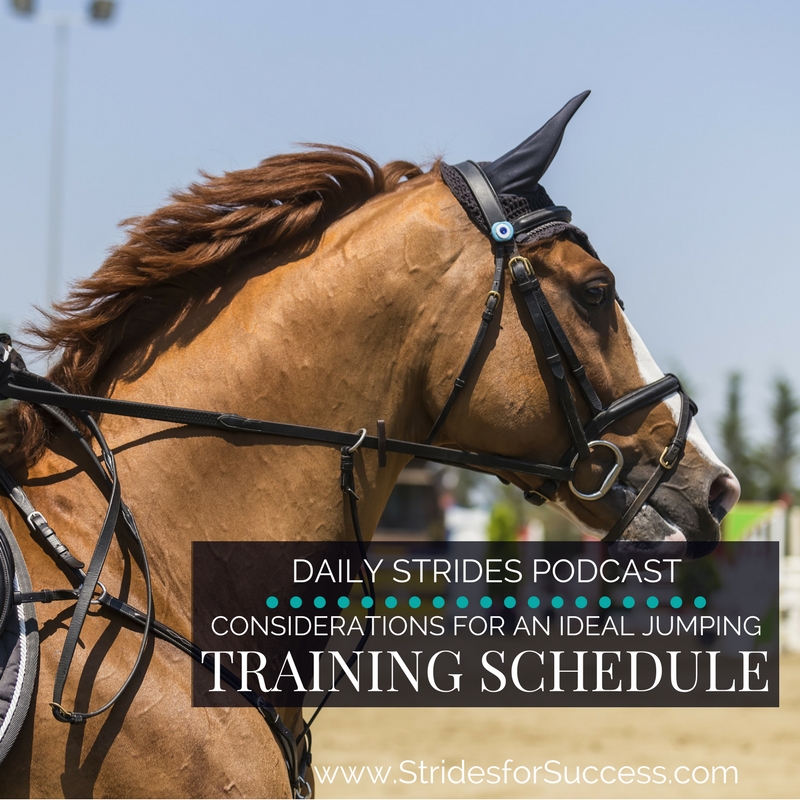
  • Considerations for an Ideal Jumping Training Schedule

    Considerations for an Ideal Jumping Training Schedule

    Considerations for an Ideal Jump Training Schedule

    What this episode is all about & how it can help you:-

    • It’s all about the bits ‘inbetween’ the fences
    • Think about conditioning – both mentally and physically
    • Notice where you & your horse’s strengths and weaknesses apply
    • Make each ‘jump day’ count

    [smart_track_player url=”https://op3.dev/e/traffic.libsyn.com/dailystridespodcast/1040-Considerations-for-a-Jumping-Training-Schedule.mp3″ title=”Considerations for a Jump Training Schedule” social_linkedin=”true” social_pinterest=”true” social_email=”true” tweet_text=”Not sure of how often you should be jumping your horse? Here is how you can create a training schedule for your horse and your jumping” hashtag=”equestrian #jumping” twitter_username=”strides_success” ]

    This is perfect for you if you have “dipped your toe” into the jumping part of horse riding and are loving it!  The next question for many riders is ‘how do I go forward from here?’.   Many riders want to jump every day, because it is so much fun.  We are going to cover this – and more – today.

    Creating a training schedule for jumping with your horse is essential if you want to begin seeing progress in this part of your riding.  A couple of episodes ago we began the jumping conversation, by focusing on ‘Introducing Jumping to Your Riding”.  If you followed my advice and suggestions, you have hopefully made it over your first fence!  Don’t worry if it was only 20 cm, it is still a fence.  Well done!

    But now you need to have something in place to work forward with.  This episode will also be helpful if you are jumping with your horse and you want to keep on progressing and working up over bigger fences.  It will help you to create a plan going forward.

    It’s All About the Bits “In Between’ the Jumps

    Contrary to what we all initially think, jumping really depends on what happens between the jumps!  A lot of riders don’t want or like to hear this, because, well, that is not the fun part for them.  They want to focus on the jumping of the fences themselves.

    If you want to be successful in the consistent conditioning and improving of your horse, and your own riding, you need to focus on what is going on between the fences. 

    If the ‘between the jumps’ part is not correct, you will have limited success over the fences themselves.  True, initially this won’t really be obvious; success over small fences is not that difficult.  However later as you start building up and the fences start getting higher, the lack of attention to details between the fences will become evident.  It will not be so much fun when you struggle to leave all the poles up!

    Apply the 80/20 rule. The 20 is the jumping and the 80 is between the fences.  The jumping is of course important, but the 80 is just as important to keep things moving forward.

    Think About Conditioning – Both Mentally and Physically

    Conditioning your horse should be a holistic process, both mental and physical.  Everything that you are doing in the arena, will come back to either developing your horse in a positive way for jumping, or un-doing the things you are trying to achieve!

    Make sure that everything you are doing is working towards the goal that you have. For example, I see a lot of riders who will trot aimlessly around the arena and then suddenly they decide that because there’s a jump, they will jump it.  It is literally a ‘point and go’ reaction to a split second thought they have had.

    Firstly, they could not possibly have a whole lot of rhythm in that approach.  Secondly, they are training their horse to look at a fence and then proceed to run flat-out at it.

    There is a reason that people do opening circles when they go into an arena before they jump the fences.  It is to establish things on the flat, the things between the fences, first.

    It is difficult at first, but please try not to allow yourself to get all caught up in the jumping only.  Focus about establishing everything, the basics, and then work on being able to maintain that as you go through the jumps, or around the course.

    Being able to maintain what you have established is important.  In doing so, you will condition your horse physically because he must remain balanced.  This will require a certain amount of development through his body.  But you are also conditioning him mentally to ‘wait’.  A lot of horses don’t like to ‘wait’, and this is usually because the rider, at some point, also did not like to ‘wait’!

    Make sure you consider this every time you are jumping or preparing to jump.   Everything you do is either adding to your horse’s abilities or taking away from it.  There is no neutral.

    Notice Where You & Your Horse’s Strengths and Weaknesses Apply

    This seems pretty simple, however if done correctly, it has the potential to change everything.  Learn to notice where your horse’s strengths or weaknesses lie.  For example, your horse may be a little loose in front.  Or he might not really engage through his back-end so he lacks power over the fence.  It could be that he tends to weave a little, so he kind of wanders.

    Notice where your horse’s strengths and weaknesses are, so that in going forward you are including work that is developing his strengths as well as improving his weaknesses.

    A lot of people just focus on the weaknesses.  I urge you not to.  Building on his strengths builds confidence.   Simply sprinkle the weaknesses in between the strengths in order to work on them.  Always try to build your horse’s confidence.

    Imagine for a moment something that you are not very good at doing, and you don’t enjoy doing (probably because you aren’t very good at it!)  How would you feel if you were forced to continue to do that thing all the time?  Not great I’m going to guess!  Well, the same principle applies for your horse.

    Of course, you are going to have to devote some time to working on the weaker parts of the ride and your performance together.  But, rather throw them in as odd little speckles, and in doing so this will build both of your confidence. 

    This could be your horse favouring approaching on one rein over the other, or landing on one lead over the other.  Don’t keep hammering on the bad rein / lead / side.   Rather allow the time to slowly but surely work on it, improve it and build it up.

    Keep in mind that most of what is going on over the fence, can be directly linked back to what is going on ‘on the ground’.   Remember conditioning can be done from the ground, and then later practiced over the fence.  Building the muscles, suppleness, accuracy, responsiveness and of course rhythm and relaxation.  Start on the flat and then progress to working on those same issues over a fence.

    Make Each ‘Jump Day’ Count

    Finally, try to restrain yourself from jumping the legs off your horse!  I see this happening a lot when riders get into that arena daily and jump and jump and jump.  Now, it is important to mention here that riders don’t do this intentionally from a place of ‘overworking’ their horses.  Rather from a place of being over enthusiastic about learning to jump and developing their jumping.

    If you find that you sometimes get caught up in the ‘jump jump jump’ energy, bring things back to that 80/20 rule I spoke about in the beginning.  Apply it to the days of the week you are going to jump.  2 days jumping, 5 days flat work for example.  However, in order for this to work, you must make each jump day count.

    You must create a plan, an intention, for what you will be working on for those two days.  Again, this is going to come back to understanding the strengths and weaknesses.  They will help guide you when creating your plan going forward.

    Once you have figured out your strengths and the weaknesses, you have created your plan and have scheduled your jump days there is a final step you can take to really 10x the impact of your schooling…

    Make Every Single Jump Count

    Get really clear on the desired outcome that you are looking for and set the intention for each and every jumping effort. 

    I also suggest for you, the rider, to try to get onto as many different horses as you can.  I realise it is not always possible for everybody.  But if you can, do.  Being on other horses, is firstly going to open you up to a whole different set of experiences.  In fact often it can be quite an eye opener.

    You will notice things about yourself in your riding.  Sometimes our horses can invite us to ride badly or to ride very well.  If a horse is inviting you to ride very well by something that he is doing, then there is the chance that he might just be ‘carrying’ you.  By getting on another horse, it will show that up, and you will know what to work on.  It could in fact turn out that the ‘weakness’ is something you are doing and needs work, rather than your horse.

    Riding other horses will also allow you to develop your eye for seeing a stride more quickly.  Knowing where your horse should be taking off for the fence, which will allow you to begin to gauge things a little bit better in your training.

    Lastly, riding other horses will build your confidence in your riding abilities.  It will allow you to  return to your own horse feeling that you are able to manage and cope with a lot more.

    Happy riding

    Lorna

    Links mentioned in the episode:-