Tag: training

  • Why Improving Your Accuracy Will Improve Your Engagement in Your Riding

    Why Improving Your Accuracy Will Improve Your Engagement in Your Riding

    [fusebox_track_player url=”https://op3.dev/e/traffic.libsyn.com/dailystridespodcast/1239_Using_Accuracy_to_Improve_Engagement_in_Your_Riding.mp3″ title=”How Accuracy Can Help Develop Engagement in Your Riding” social_linkedin=”true” social_pinterest=”true” social_email=”true” tweet_text=”Accuracy… It really can help improve your horses engagement…” hashtag=”horseriding” twitter_username=”strides_success” ]

    Accuracy can seem like a dull and boring concept when riding horses.  Sure, if you are going to compete in dressage or show jumping, accuracy can become really important.  But what about if you are simply a rider, working alone with your horse, trying to improve your overall skills?  Is accuracy still as important?

    I’m going to say yes, accuracy is important. And it is an excellent way of actually establishing and building engagement with your horse.

    Now, granted, accuracy and engagement might seem like they have nothing to do with each other initially.  How could do something at a specific point in the arena or in the conversation help with engagement?  And the answer is “more than you can even begin to realize”.

    What Is Accuracy?

    Accuracy is about doing a specific thing at a designated time or space when you ride. So, for example, picking up a canter at a specific marker in your arena, perhaps A or C.  Or riding a certain number of strides within a certain measured distance.

    However, in order for you to achieve true accuracy with your horse, the energy that goes into the preparation and, subsequent, follow-through is equally as important as doing the ‘exact’ thing.  

    This means that, as a rider, your attention to detail must include what happens before the transition, during the transition, and then after the transition. Realizing accuracy is about how well you can maintain what is established as you also allow the desired outcome to happen at the right endpoint.

    What Accuracy is Not…

    Contrast this with a rider who roughly kicks or pulls their horse in order to achieve the desired outcome at a specific point.  The overall ride lacks softness, consideration, knowledge of energy, and flow.  It is doing something with the sole purpose being to get a specific result.

    True accuracy is when the result adds to the overall performance and conversation between horse and rider.

    Being accurate, if it is merely to get something done, is not true accuracy.  It must play into the bigger picture of horse and rider.  Working on being accurate must incorporate the energy of what comes before and after the specific ‘point’.  And, in doing this, you can begin to build both engagement and true accuracy with your horse.

    What is Engagement?

    For many riders, when they hear the word ‘engagement’ in relation to horses and riding, the mind jumps to collection.  And, for most of those riders, true collection is not somewhere they visit regularly in their riding. And yet, engagement starts much earlier.  At the beginning in fact.

    Would your perception of engagement change if you began seeing it as a connection, rather than a collection, in your riding?

    If we think of the word ‘engage’ outside of horses and riding, it means that you occupy or attract someone’s interest or attention.  It can also mean entering into an agreement with someone. If we applied both of these to your conversation with your horse, can you see how engagement is a far more basic concept than we might first allow ourselves to imagine?

    And developing accuracy is an excellent way to attract your horse’s interest or attention a little more. To increase your horse’s focus on what you are saying or asking… On your desired outcome. 

    Engagement as an Agreement

    Once your horse has begun to focus a little more on you and what you are saying (or trying to say), you can begin to develop the conversation a little more.  This is where using accuracy can help to begin developing more contact and connection between you and your horse.

    Developing contact is often the point in your horse’s training where he agrees to begin taking on some of the responsibilities for your work together. An agreement. Engaged. 

    And this is also the point in training where energy can begin to truly be recycled through both of your bodies as you work together.  Rather than the energy falling out or leaking out somewhere, it remains within the container.  Part of the responsibility your horse engages with is to ‘hold’ that energy inside of his body.

    Accuracy and Engagement

    Hopefully, from this explanation, you can begin to see the link between improving accuracy and encouraging engagement when working with your horse.  It all begins with understanding that true accuracy requires a holistic approach.

    Attention to detail on the preparation, the doing, and the following through of what you intend to be accurate about. 

    As you become more consistent with this, your horse’s interest in what you are trying to achieve becomes heightened; engagement.  And at this point, you can begin to allow your horse to carry some of the responsibilities regarding your work together.

    Contact and connection.  Which, inevitably, begin to lead to the sort of engagement that will eventually, if you continue to develop and work on it, lead to collection.

    Happy Riding
    Lorna

    More on this Topic:-

    Join Our Online Communities for Equestrians

  • Riding the Same Simple Exercise Through the Different Filters of Position & Influence

    Riding the Same Simple Exercise Through the Different Filters of Position & Influence

    [fusebox_track_player url=”https://op3.dev/e/traffic.libsyn.com/secure/dailystridespodcast/1223_Riding_the_Same_Simple_Exercise_Through_the_Different_Filters_of_Position_and_Influence.mp3″ title=”Riding the Same Exercise with Your Horse Through Different Filters” social_linkedin=”true” social_pinterest=”true” social_email=”true” tweet_text=”There are so many ways to use a serpentine when schooling your horse…” hashtag=”equestrianpodcast #horseriding” twitter_username=”strides_success” ]

    There are hundreds, even thousands, of different exercises we can ride when schooling our horses. Often riders think that they have to get more and more complicated with their exercises in order to make progress in their riding.  However, I personally believe that, for the most part, simple works better.

    In this episode of the Daily Strides Podcast, I want to show you how to work on the same exercise, using two different filters

    This episode of the Daily Strides Podcast has been plucked from a week of lessons from Daily Strides Premium called “Examples of Different Filters to Vary Your Exercises”. The full week of lessons are available right now when you join Connection

    The exercise we are going to work on for this example with be a simple three looped serpentine.  I want to show you how you can use this exercise in lots of different ways.

    Keeping your riding interesting doesn’t need to be complicated; a single exercise can have so many uses

    The Different Filters for this Exercise

    The first filter will be your position in the saddle.  Specifically, your position while riding the three-looped serpentine.  There are many different points throughout the movement itself where you can ‘check in’ with how effective your position is.

    The key to using a specific filter or focus is to remember to continue to track it throughout the exercise – and not to become distracted with something else!

    The second filter is that of influence.  I suggest riding the same exercise, the 3 looped serpentines, but this time notice how well you can positively influence the horse. Your focus will be on how well your horse is going, and how you are communicating with your horse in order to maintain or improve this throughout the exercise.

    Shift, in your mind, where your focus is as you begin preparing to ride the exercise again through the new filter   

    I suggest choosing different filters that complement each other when planning out your exercises.  And, of course, make sure that they are working towards your long-term goals with your horse.

    Make sure you listen to this episode of the Daily Strides Podcast (it will be available to play at the beginning of this post) to hear all the details.

    Happy Riding
    Lorna

    Examples of Different Filters to Vary Your Exercises

    This episode comes from a full week of lessons on this topic.  In this group of lessons, we will take one exercise and look at how we can approach using it and riding it through a whole host of different filters.  I also try to take ‘complementary’ filters in each episode, so that you can build ‘themes’ for your months – which will lead to greater progress in your riding

    When you join Connection; my monthly online membership for equestrians, you will get weekly audio horse riding lessons (5 per week – each 12 minutes long) to use in your riding. 

    Guided audio horse riding lessons, weekly bonus live training, personal accountability, monthly challenges, and so much more… And all of your training is available on a private podcast feed so you can listen while you are with your horse :)

    Find out all the details and join today HERE

    Extra Resources for Riders

  • 7 Circles, 5 Serpentines, 4 figures of eight; on repeat…? What’s Your Riding Routine?

    7 Circles, 5 Serpentines, 4 figures of eight; on repeat…? What’s Your Riding Routine?

    [fusebox_track_player url=”https://op3.dev/e/traffic.libsyn.com/secure/dailystridespodcast/1219_Whats_Your_Riding_Routine_and_is_It_Helping_or_Hindering_Your_Riding.mp3″ title=”7 Circles on Repeat? What’s Your Riding Routine with Your Horse?” social_linkedin=”true” social_pinterest=”true” social_email=”true” tweet_text=”Listen to this episode of the Daily Strides Podcast if your riding routine is feeling a little ‘meh’ with your horse!” hashtag=”horsepodcast” twitter_username=”stridesforsuccess” ]

    What does your average ride or training session with your horse look like?  Do you have a riding routine that you follow? If yours is leaning towards, or if it already is, a little too predictable; maybe it’s time for a change?  While riding the same sequence often can sometimes be beneficial to your riding and training (more on that later), for the most part, it will only help habits to creep in.  And usually not the greatest of habits.

    Doing anything the same way, on repeat, almost always has the same effect.  Your body (and your horse) will look for the easiest, most efficient way of doing it; which probably won’t truly serve you!

    This is because, usually, the ‘easiest’ or ‘most energy saving’ way is not the best way; particularly when we are focused on developing and training.  So, why do we fall into the trap of riding 7 circles, 5 Serpentines, 4 figures of eight (or whatever your ‘go to’ routine?  And why do we continue to repeat it over and over again?

    If It Worked Once…

    For most riders, their version of the riding routine is born out of a series of exercises that they rode once or twice that produced a certain outcome. 

    Now, the outcome it produced might not necessarily have been the one they truly desired.  It could just have been a thought, which produced a certain feeling or emotion in your body.  Like ‘satisfaction’ or ‘accomplishment.  This is particularly true for riders who, in the past, have struggled to ‘find things to do’ with their horse.

    The fact that they continued to ‘work’ their horse for 30 minutes or so makes them feel successful.  This feeling is based on the quantity of the work, not the quality. 

    Another way a riding routine can work once, and in doing so quickly become the ‘go to’ routine is to do with behavior.  The horse may have responded or understood what the rider wanted that particular ride.  Sometimes the riding routine itself can be the catalyst for this happening.  However, more often than not, it has more to do with the specific circumstances of the individual ride.

    So ‘No’ to a Riding Routine Then?

    Not necessarily… I do believe in routines to help set the tone for the conversation.  I am also a fan of developing specific routines to achieve specific outcomes.  But these are more foundational.  I believe that routines help to develop the rhythm for the session or work you are focusing on with your horse. And that is the key.

    A routine can help to set the tone for the schooling session with your horse.  However, it’s the intention or focus that then guides the conversation forward.  

    By creating a specific intention for each movement, you can begin to make your riding routine work for you.  And I think that each intention should be a stepping stone of sorts towards a specific goal or desire.  The type of goal is not really important; it’s your commitment to achieving it that counts.

    Riding a circle for the sake of riding a circle will not help you or your horse in the long run.  However, that same circle, if used to increase suppleness, establish a rhythm, develop contact, gather energy, or any number of things you can focus on in your riding – is where the power of riding the circle lies. 

    Setting an Intention

    So, if the riding routine itself is not really the issue.  Rather the lack of intention with how we repeat it that is, how do you develop intention. I have many previous episodes and articles on goal setting (I will link to some below this article). However, there is also a quick way to figure this out…

    A quick and simple way is to ask yourself the question “If I could achieve one training outcome today with my horse, what would that be?

    Once you have the answer to this question, the next step is to identify what needs to be in place for this to occur.  For example.  If your answer is ‘riding a clean upward transition into the canter’, I would suggest basing the first few movements of your regular riding routine around responsiveness.

    Use your version of the “7 Circles, 5 Serpentines, 4 figures of eight” to work on the elements you need in place in order to reach your desired outcome or result for the ride. 

    The Positive Aspects of a Riding Routine

    Okay, so you can probably tell that I am not completely against having a riding routine for you and your horse.  A go-to, tried and tested set of exercises that you can ride to help you get a specific result.  And there are other ways that your individual riding routine can help you develop your skills and train your horse.

    By riding a specific riding routine regularly, you can begin to see the results of your training. You will feel (and see if you take regular videos) the differences as you and your horse improve. 

    A regular riding routine will also allow you to make strategic changes to your methods, training, equipment or anything else that can have an impact on your riding. By creating a baseline with your regular routine, you can then see the results of any changes you make.

    Click here to subscribe

    A Plan For Each Ride

    If you are still feeling uninspired or bored in your regular riding routine, perhaps having someone else create the plan will help?  Every week, I help riders all over the world to work towards specific outcomes with their horse using my guided audio horse riding lessons.

    Simply mount up, press play, and work through the movements and exercises with your horse; all focusing on developing or improving a specific outcome in your riding

    Knowing that each ride, or groundwork session, or lunging session, will now help you to improve your skills will turn your riding around.  You can find all the details about Connection HERE.  And if you are going to ride your horse later, what will your intention for your version of “7 Circles, 5 Serpentines, 4 figures of eight” be?

    Happy Riding
    Lorna

    Extra Links to Help Equestrians


  • Horse Riding Skills You Must Develop to Successfully Train Your Horse

    Horse Riding Skills You Must Develop to Successfully Train Your Horse

    [fusebox_track_player url=”https://op3.dev/e/traffic.libsyn.com/secure/dailystridespodcast/1216_Riding_Skills_You_Must_Develop_to_Successfully_Train_Your_Horse.mp3″ title=”Riding Skills You Must Develop in Order to Successfully Train Your Horse” social_linkedin=”true” social_pinterest=”true” social_email=”true” tweet_text=”Worried you’re not a good enough rider to train your horse? Think again…” hashtag=”horsepodcast” twitter_username=”strides_success” ]

    Many riders have a desire to school and develop their own horse. Yet, a lot of these riders don’t actually know what horse riding skills they need in order to make this a reality.  The fact of the matter is that you are always training your horse. Every single interaction.

    Through your actions, intentional or not, you are always communicating to your horse.  Telling him about what is allowed and what is not.  What is ‘acceptable’ and what needs to change. 

    However, if your horse riding skills are not consistently improving and developing, it stands to reason that this will eventually impact your horse.  Riders are often the cause of the plateau many horses reach in their training. Their own lack of development becomes their horse’s glass ceiling.

    So, in order to maintain the horse riding skills necessary to help your horse develop, you must revisit, upgrade, and develop certain skills regularly. 

     1.  Understanding ‘Why’ – The Nitty Gritty

    For many riders, when they initially learn to canter, they know ‘what’ to do.  Outside leg back makes up a big part of this ‘what’.  However, the vast majority of these riders don’t really know ‘why’.  When they learn why they put their outside leg back to ask for the canter, they also begin to understand the sequence of events.  Which leads to them learning about timing the aids for the canter.  The next obvious step is to begin using the more subtle aids to ask the same question; weight and seat.

    And all of these progressions become possible when the rider is interested in finding out ‘why’ in the first place.  

    Doing things for the sake of doing things won’t help you to improve your riding.  In order to consistently develop the necessary horse riding skills to develop and train your horse, you must go deeper into growing your knowledge first.

     2. Develop Your Actual Horse Riding Skills

    Just like your knowledge of ‘why’ you are doing things needs to grow, so too does the actual horse riding skills to do it! Knowing something conceptually and actually taking action and doing it is different.  Developing your aids is an ongoing, never-ending process.  There is always more that can be done to improve coordination, timing, and the balance of aids.

    It helps to try and ride more advanced horses every now and then.  This is especially true if you are working on training a young or green horse.  The more advanced horses will help to keep your riding skills ‘tuned up’. 

    Many riders experience a deterioration of their overall riding skills when they only ride a young or green horse.  Horses can truly invite you to ride badly! Part of your responsibility when training your horse is to ensure your skills are improving.  Not remaining ‘so-so’ or, even worse, deteriorating.

     3. Create a Feedback Loop

    Reviewing your progress is absolutely essential when you’re working on developing your horse.  This is one of those horse riding skills that many riders fail to see the value in.  And this is such a pity, as this is truly the only way to really begin identifying what is working and what’s not.

    A feedback loop can be something as basic as a riding journal.  Or it can be taking regular videos of your riding and reviewing them. 

    Working alone with your horse can often feel lonely and confusing.  You may find that you’re not quite sure of what to do.  Or what not to do, or stop doing.  It is for this reason that I suggest all riders begin having regular reviews in their riding.  It allows you to see things from a different perspective.

    If you are training your horse alone, you need to begin playing the role of trainer.  Trainers give feedback. 

     4. Be Intentional with Your Riding Plan

    Whenever you begin learning something, there will be a system in place to help you.  Honestly, think back to the last 3 things you learned.  Whether it was gaining a diploma or degree, cooking a meal for the first time, or assembling a piece of furniture…  There was a system created to help you achieve your goal.  Curriculum, recipes, and instructions are all systems.

    It stands to reason that if you are teaching your horse new things, you will also need a system in place in order to get consistent results. 

    Winging it might get you there every now and again.  But I’m going to assume here that you want more than just now and again.  You want to consistently move forward with your horse and his training. Taking time each week to review your goals is important.

    So too is creating a plan for each upcoming interaction that will help him to consistently learn new things and feel confident in doing more while being ridden.

     5. Your Suppleness

    Lack of suppleness in the rider is one of the biggest roadblocks to a horse’s development and training.  Suppleness is both physical and mental.  A rider who physically blocks their horse’s energy from flowing will also hamper any progress in his training.  All of your horse riding skills will require you to regularly upgrade your suppleness.

    Suppleness also is about how you think of both yourself as a rider and of your horse.  Mental suppleness means that you can overcome challenges while remaining calm and focused. It is a skill that must be developed! 

    It is important to regularly notice what you are telling. yourself.  The internal conversation.  Noticing where you are becoming ‘stuck’ in your thinking will allow you to consciously develop your mental suppleness.  This is one of the absolutely essential horse riding skills you will need to successfully train your own horse.

    Successfully Training Your Own Horse

    One of the most rewarding and fulfilling things you can do as a rider develops a horse.  Bring it on.  However, it is also one of the most challenging things to do.  You will question if you are good enough and able more times than you will want to!

    By consistently upgrading, developing, and learning your horse riding skills, it is possible.


    Additional Resources:-

  • How Well Must I Ride to Train My Horse?

    How Well Must I Ride to Train My Horse?

    [fusebox_track_player url=”https://op3.dev/e/traffic.libsyn.com/secure/dailystridespodcast/1211_How_Well_Must_I_Ride_To_Train_My_Horse.mp3″ title=”How Well Must I Ride to Train My Horse?” social_linkedin=”true” social_pinterest=”true” social_email=”true” tweet_text=”Do you ride well enough to train your own horse? Here’s how to find out…” hashtag=”equestrianpodcast” twitter_username=”strides_success” ]

    It’s a big question, and it’s a question that so many riders wonder about.  “Can I train my horse, alone?”.  For many riders, they will answer this question with another one; “An I a ‘good enough’ rider?”.   There are millions of riders all over the world, all with different combinations of skills and talents; being a ‘good’ rider is relative!

    However, if you want to begin truly working with and training your horse, I feel that there are a few simple questions that you can ask yourself to see if you are truly ready or not.

    How Much Do You Know?

    I have already said that ‘good’ is relative, but so too is training.  I love the idea that it doesn’t take a black belt to train a white belt in karate.  Meaning you don’t have to be a complete expert or master at something in order to teach someone who knows very little to nothing about that thing. “So I can train my horse then?”. Well, that depends…

    What is important is that you know more than your horse on the topic you want to improve.

    Let’s focus for a moment on rhythm.  If you begin working on improving your horse’s natural rhythm, it stands to reason that you at least have a good understanding of what that improvement would look like.   An even better situation would be to have achieved this previously with another horse.  However, depending on each unique situation, I don’t always feel this is essential. What is key is your understanding of the movement, principle, or topic.

    Hoping to train a horse on a topic that you have little knowledge, understanding, experience, or training on yourself is simply wishful thinking

    Having spent a number of years riding alone in an open field, I can definitely say that having resources is important.  Now, I am not saying that you need a perfectly manicured arena to make progress with your horse.  But there are certain things that, if you have them, will definitely make the training journey a more smooth one!

    Do You Have the Resources?

    Time is the number one resource you will need if you are going to ever hope to correctly improve your horse’s way of going.

    Lack of time is why most riders never really get going when they are working with their horse.  They will go ‘hell for leather’ for a week, maybe two.  And then, something happens and all horse-related activities are put on pause for another week or two.  This stop and start method will only serve to ensure that you keep reliving the same few weeks, over and over.  With little to no visible progress.

    Taking a break, intentional or otherwise, every now and again is not bad; in fact, sometimes it can be really helpful.  However constant stopping and starting with your training program is a recipe to remain stuck. 

    “I have the time, does this mean I can train my horse?”.  Again, it depends…!  Another important resource to take stock of is your riding area, especially if your climate is less than favorable a lot of the time.  Muddy, slippery, or baked hard footing is neither good for the horse or the rider (we tend to fall every now and again!).  If you are really serious about training your horse, make sure that you have somewhere to work, especially when the weather becomes a little otherwise!

    Remember to take stock and connect with the people in your life who can help you achieve your goals. 

    From a trainer for occasional advice, to an online course and community, to a babysitter or driver for children. You will need support if you are to successfully train your horse over the long term. Finally, resources can also include different tack and equipment, floodlights, poles and uprights, a lunging arena, suitable trails and hacking areas, and so much more.

    Are You Consistent with Consistency?

    At this point, many riders get a little excited!  “Yes, I have all of the above, so I must be ready to train my horse”… Well, not quite!  When training your horse, you will have to do different things in order to achieve different results.  Repeating the same thing over and over again will not take your horse from here to there (wherever you’ve decided there is).

    As a trainer, it is your responsibility to make strategic changes to what you are doing, and remaining consistent with those changes in order to track the result or outcome. 

    One of the biggest mistakes I used to make when riding in the fields when younger was trying things once. You see, I was usually open to giving things a go.  However, if I didn’t see immediate success, I was also quick to drop said thing and either revert to the old way or try something totally new again. Not the approach to take if you want to see success!

    Be willing to find out what you think may be the next thing to try, change, introduce to your horse’s training. Then track how your horse responds to this over a period of time.

    Being consistent means that you are intentional about every aspect of your approach to training.  From your schedule to the way you communicate, to your aids, to your rewards, to your corrections, and your attitude in general.

    How Supple Are You?

    “Okay, this has nothing to do with how I train my horse, surly?”  Oh, but it does!  You see, it’s easy to think of suppleness as just being something for your horse.  Ride a few bends and circles every now and then, and Bob’s your uncle, Sally’s your aunt!   However, I believe that suppleness is just as important for riders; and it’s not just about your physical aids.  It also concerns your emotional and mental development as a rider.

    I see many riders, who ride pretty well, become mentally ‘stuck’ on something in their horse’s training

    Usually, it is something they don’t want or desire.  And whatever the thing is, they fixate on it.  They have this all-or-nothing approach to it, and this means they cannot see past it.  For example, the horse that throws a buck in the first 10 or so strides of canter. An independent rider doesn’t even notice the buck; they are busy assessing the quality of the transition, and the quality of the canter they find themselves in.  The buck is just a distraction that they easily ignore.  And this generally means it will soon go away!

    The unsupple rider rides the transition into the canter, and the canter itself completely waiting for the buck.  Their only focus is what they ‘know’ is coming.  And, inevitably, it does!

    Training your horse will require you to look past any distractions that show up. It will require you to remain focused on the desired outcome, and to try keep your horses focus there as well. 

    How Independent Are You?

    Finally, if you have checked all of the above boxes, the last question I would ask in this situation is regarding my level of independence.  This is for both in the saddle and out of the saddle.  If you struggle to stay on in the trot, you need to be honest with yourself in that you are not the person to improve your horse’s trot!  Similarly, if you are struggling to stay on board in canter, or over a jump, you’re not the person to help your horse with these things!

    I suggest assessing your independence by asking yourself “Am I responsible for my own balance and support? Or am I using my horse to support and balance me?”

    “Oh, so I probably can’t train my horse then…”  Not exactly, I am a great believer that if there is a will, there’s a way…  If the answer to the previous question was the latter, I suggest getting help in developing more support and independence first; and probably on a different, more experienced, or schooled horse).  However, keep in mind that there are lots of ways you can begin to train and school your horse that don’t require you to be the world’s greatest rider.

    Lunging and groundwork do not require skill in the saddle, and, if done right, they both help to develop your skills as a rider – and your horse’s skills as a riding horse. 

    “Okay, so I can use lunging to train my horse! This is great, except I don’t know how to get started…”. I’ve got you covered; I have a free guided audio training ‘3 Days to Successful Lunging’ that you can get HERE
    .

    Confidence is Key…

    For many riders, training their own horse is essential due to a lack of resources.  There are no trainers close by, not enough of a budget to afford a trainer, or a lack of time to commit to a trainer.  If you find yourself in this situation, notice how the thoughts of training your own horse make you feel…

    Often we talk ourselves out of training our own horses because it will require us to do something we have never done before – and that is uncomfortable!

    If you are feeling uncomfortable about training your horse, yet you have ‘ticked all the boxes’ with the questions above, you’re probably ready!  It is simply the fear of failing that is holding you back.

    Growth requires us to get uncomfortable.  And as adults, because many of us are out of the habit of learning new things – and failing the first 10 or 20 times, training your horse can feel really uncomfortable!

    Start with what you know.  Go deep in your knowledge and understanding of something.  Think about the best way to explain this to your horse.  And then go do it. Remember to be intentional about changes, actions, aids, etc. Record it all… And see where the journey takes you

    So, to answer the question “Can I train my horse?”… The answer is clearly that it depends on a couple of different things, but if you are keen, there are lots of resources listed below to help.

    Happy Riding
    Lorna

    Additional Resources on This Topic:-

  • Putting All the Pieces Together When Training Your Horse

    Putting All the Pieces Together When Training Your Horse

    [fusebox_track_player url=”https://op3.dev/e/traffic.libsyn.com/secure/dailystridespodcast/1204_Putting_the_Pieces_Together_when_Training_Your_Horse.mp3″ title=”Putting All the Pieces Together for Your Horse” social_linkedin=”true” social_pinterest=”true” social_email=”true” tweet_text=”Have you been struggling with training your horse? Here’s a way to put all the pieces together…” hashtag=”equestrianpodcast” twitter_username=”strides_success” ]

    It can feel really overwhelming when we begin looking at all the different things you need to include when training your horse, right?  All these ‘steps’ and ‘principles’ are big pieces of a puzzle in their own right; they also have to work together in order to get the full picture!

    The training scale is a proven way for you to take these pieces and make them work, regardless of horse, discipline, schooling, or past experience. 

    And yet, if you just read ‘training scale’ and instantly decided that this is not the way for you where training your horse is concerned; hear me out.  It is not just for dressage.  And certainly not only about pictures of tall men on small horses from the 1900’s… (that is the picture that so many people have when the training scale is mentioned!).

    The training scale is as beneficial for trail horses as it is for dressage horses.  For showjumpers, to riding school ponies.  It is truly a system that helps all horses really harness their natural abilities and develop them. 

    Training Your Horse

    Let’s be really honest here; you are always training your horse.  Whether you are just walking him from the stable to the field, or you are jumping courses of fences, there is training happening.  Training is basically setting boundaries for what you expect and want to happen during the conversation.

    The more ‘developed’ your horse is, the better he will be able to respond to your questions. 

    The training scale is a system that helps him to develop; emotionally, mentally, and physically.  It takes basic concepts and builds on them, step by step, on a scale.  As you work with your horse you will touch on each of these concepts and strengthen them.

    The Steps in the Scale

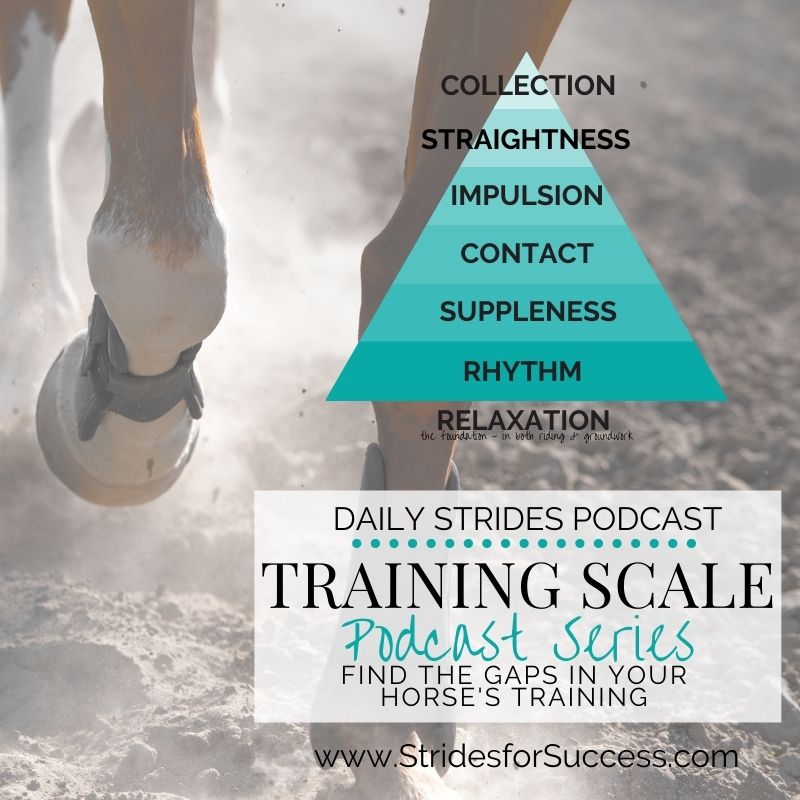
    There are a few different opinions and ideas regarding the order, however, almost all scales will include the same steps.  Relaxation, rhythm, suppleness, contact, impulsion, straightness, and collection.  They will almost all end or finish with collection being the ‘goal’ or pinnacle of the scale.

    I suggest that when you are training your horse, start with the foundation of relaxation.  Let this be the principle that all the others are built on. 

    I have written more on relaxation HERE and HERE.  I feel it might have a slightly confusing name when it comes to horses and training horses.  Rather than it being about lying horizontal with a glass of something nice, it is about the ability to manage the correct levels of tension for the question at hand.

    In my experience, when the training scale is correctly applied, it will only serve to enhance what is already there; for both horse and rider.  

    Working Through the Steps

    A key question many riders have, is how long will all of this take?  How long can you expect to work on this process when training your horse?  The answer, unfortunately, is a little along the lines of how long is a piece of string?! Horse riding and all that goes with it is ongoing.

    It is something that you can always go deeper and further with, regardless of horse or rider.  There are no ‘end points’ when it comes to developing and training. 

    I think it would be pretty naive to try to work through the full training scale in 6 weeks (allowing a week for each step).  I also think it would be unrealistic to do this in 6 months…  6 years would allow you to see a lot of progress, however, I also don’t believe it could be seen as ‘done’.

    And the lovely thing about the training scale is that, as you work on developing each aspect more, you can do so through the filters of each of the other pieces. 

    Filling in the Gaps

    I would imagine that you have, at some point while training your horse, touched on two or more of the steps in the training scale.  Suppleness and contact, perhaps?  Or relaxation and straightness?  And this is just fine.  In fact, it is how many riders are working with their horses on a day-to-day basis.

    Using a system like the training scale allows you to reach all of the different aspects of your horse’s training.  It allows you to fill in the gaps – and, trust me, there are probably gaps!

    Gaps are funny things in horse riding!  They don’t normally show themselves until pressure is applied. Meaning, both you and your horse may be oblivious to them until something shows up that questions you both.  Maybe it is an unexpected event.  Or a bigger challenge than before.

    When you work with an actual system, it will allow you to return to any gaps and correct them, from a foundational level.  Rather than just putting on a bandaid and saying a prayer! 

    The Foundation

    As mentioned, I do believe in starting with the foundation of relaxation.  Relaxation is simply having the right amount of tension present for the movement that is being worked on at that moment.  It is also for both horse and rider; often excess tension comes from the rider, not the horse!

    As you begin to systematically work on training your horse using the training scale, allow relaxation to be the first ‘filter’ you use.  

    When you look at rhythm, is relaxation present as well?  As you do this more and more you will probably notice a relationship between the two of them, and how, when one is lost the other tends to leave as well pretty soon afterwards!

    From here, as you then work on suppleness, notice if both rhythm and relaxation are present.  Applying this to your training will give you a neverending list of potential things to work on with your horse.  And all through either groundwork, lunging, or riding.

    What Do You Believe?

    The final piece I want to touch on is using the training scale to train your horse by developing him emotionally.  I do think that this is often overlooked.

    We have all met the horse who, we know, can jump the fence; however, sadly, the horse does not believe in his own abilities.  It is never a good place to be, for horse or rider.

    As you work with your horse going forward, think about how you can help him to strengthen mentally and emotionally; not just physically.

    Happy Riding
    Lorna

    Find in the Gaps In Your Horse’s Training

    If you are interested in learning more about where you might be missing pieces in your riding, sign up for my new free training “ FIND THE GAPS IN YOUR HORSE’S TRAINING.  This audio training can be listened to, via podcast app, to help you figure out where to begin working with your horse.

    You can sign up and get it, for free, HERE

    More Resources to Help You on this Topic