Tag: transitions

  • Smoother Transitions from Canter to Trot

    Smoother Transitions from Canter to Trot

    [fusebox_track_player url=”https://op3.dev/e/traffic.libsyn.com/dailystridespodcast/1287_Smoother_Transitions_From_Canter_to_Trot.mp3″ title=”Smoother Transitions from Canter to Trot” social_linkedin=”true” social_pinterest=”true” social_email=”true” ]

    What goes up, must come down; apparently. And this certainly applies to the gaits when you’re riding your horse. For many riders, successfully riding the transition into the canter and then staying with the movement in the canter itself is a great achievement. However, the next piece of the puzzle is returning to the trot.

    For many riders, no matter how good the canter is and how well they can ride it; the bumpy, uneven, and unbalanced return to trot puts a damper on the whole experience.

    And, yes, the transition from canter to trot can be tough to ride; but it is definitely ‘doable’. Here’s how you can improve this for you and your horse.

     1. Prepare Yourself and Your Horse

    I know, it seems a little ‘Captain Obvious’.  However, when we have to do something that we struggle with, we can approach it with a ‘get this over with as quickly as possible’ type of energy!  So rather than ‘just doing it’, remember to first take the time to set both yourself and your horse up for the upcoming canter to trot transition.

    As you are cantering and preparing for the downward transition, make sure your horse is balanced and responsive to your aids. Also, work on maintaining a consistent rhythm in the canter

    Another part of the preparation is to make sure you are in the best place to both ask for trot and allow the transition to happen.  I will chat more about this later in the article.

     2. Use Your Half-Halt

    So many riders think of half halt as being a once and done thing.  The truth is that, more often than not, the half halt is a ‘more the merrier’ aid to use when riding.  A few good quality half-halts will help to rebalance your horse before the transition. And let him know something is happening so he can be on the lookout for your eventual ‘ask’.

    The half halt will not only balance and steady the energy in the canter, it’ll also help your horse to lighten the front end a little more; essential for a smooth canter to trot transition.

    Use your full body in the halt halt.  Your seat, your legs, and your hands.  And remember that the ‘squeeze’ or resistance is only for a split second.  One beat of the stride.  Then release.  The goal is to engage your horse’s hindquarters and bring them back onto their haunches.

     3. Sit up and Engage Your Core

    And the required self carriage is not just for your horse.  It also applies to you.  Make sure that you prepare your body for the transition by sitting up tall and engaging your core muscles. This will help you maintain your balance and give clear cues to your horse.

    If you are in the right position to give the canter to trot aids, there is a much better chance your horse will understand – and then respond – to those aids. 

    This also allows you to follow the transition from the canter into the trot.  Collapsing through your seat will only result in a bumpy experience as the transition happens! And it will also leave you in the wrong place to ride the trot after the transition.

     4. Coordinate Your Aids

    Asking for the transition can be tricky for some riders. There is a struggle with how to truly balance the aids so that you ask the ‘right’ way for your horse to understand.  Focus on your seat first.  The ‘swing’ or ‘roll’ of the canter.  With canter, your inside seat bone is always leading your outside seat bone.  Part of the aids to ask for trot is to signal the change using your seat.

    Once you have engaged your seat bones, you can also your voice as an aid to support your other aids. Saying something like ‘woah’, ‘steady’ or “trot” or can be a big help for your horse to understand what your physical aids are asking.  From here, close your legs and squeeze lightly to encourage your horse to move forward into the trot.

    It’s really important that you are ready to follow your horse into the trot. This is really how you can ‘smooth’ the tension. 


    5. Allow in the Trot

    This is a key piece to any downward transition.  You MUST allow the horse to move forward into the new gait.  So many riders hold on too long with their aids.  This will only cause the trot to become jerky, hollow, or flat. Allowing involves your body moving in a way that works with the horse, rather than against.

    Practice identifying the very first step of the trot. As your horse takes that step, allow through your seat and your hands (your elbows, really). This will soften the contact – and smooth the tension.

    From here, move with the horse in the trot.  Think about keeping steady contact with the reins while allowing your horse to find their balance in the new gait.  It is usually easier to post or rise when first in the trot.  If you find that your horse is becoming hollow, this is especially important.  Often it is a bouncy rider trying to ride sitting trot that causes that hollowness!

    Practice the Canter to Trot

    It goes without saying, in order to improve you will have to do the work.  Regular practice will help you and your horse become more familiar with the transition.  It will also improve your timing and communication. Gradually work on refining the aids and asking for smoother transitions over time.

    Remember, transitions require coordination and communication between you and your horse. Be patient, and try to remain balanced.  Work on asking your horse with clear and consistent aids to achieve a smooth canter to trot transition.

    Happy Riding
    Lorna

    Improve Your Canter

    The canter is a big topic for riders. There can be so much pleasure and joy found there. And, often, an equal amount of bumps, flatness, and non-starts! If you are keen on improving your canter in just 4 weeks, make sure you take a look at my program Improve Your Canter.

    You will learn what is happening and how you can best time your aids so that your canter will go from being hit-and-miss to smooth and connected.

    With audio horse riding lessons to listen to 4 days a week while you ride, all filled with different exercises for you to practice, Improve your Canter will help you finally ride the canter the way you want.  Every single time.

    More on This Topic:-

    Training For Riders:-

  • Smoother Downward Transitions

    Smoother Downward Transitions

    [fusebox_track_player url=”https://op3.dev/e/traffic.libsyn.com/dailystridespodcast/1280_Removing_the_Handbrake_During_Downward_Transitions.mp3″ title=”Smoother Downward Transitions” social_linkedin=”true” social_pinterest=”true” social_email=”true” ]

    There is a tendency for riders to ‘hold’ a little too much during the downward transitions.  And while the half halt is essential to the preparation and transition itself… Too much can lead to a very ‘stuck’ feeling when the horse actually makes it into the new gait!  A little like ‘stuck in the mud’.

    In this episode, I am releasing a Connection Bonus Live Call from June 2021.  This is due to an ongoing hoarse voice!  I hope you enjoy the ‘episode’ and that it is useful for you in your riding.

    The focus for the month inside of Connection was self-carriage through downward transitions.  In this particular call, I discuss ‘releasing the handbrake’, especially through the seat and hands, while riding the transition.  I do hope that you find this helpful for your downward transitions.

    Happy Riding
    Lorna

    Get All Of The Training

    Join Connection today and get all of the audio horse riding lessons on this topic (and all the others I mention here today) to begin using in your riding.  Everything comes straight to your phone, via a private podcast feed.  There’s also extra bonus live training (like the excerpt above), live Q&A and so much more. All the details are over at https://stridesforsuccess.com/connection

    More on This Topic:-

    Additional Resources:-

  • Tipping Forward while Transitioning into the Canter

    Tipping Forward while Transitioning into the Canter

    [fusebox_track_player url=”https://op3.dev/e/traffic.libsyn.com/dailystridespodcast/1277-Tipping_Forwards_while_Transitioning_into_Canter.mp3″ title=”Tipping Forwards While Transitioning into the Canter” social_linkedin=”true” social_pinterest=”true” social_email=”true” tweet_text=”How to stop tipping forwards through canter transitions” hashtag=”canter #onlinehorseriding” twitter_username=”strides_success” ]

    Have you ever fallen into the trap of trying to actually get your horse to canter? It’s a sneaky one that hides in plain sight. And it is an exhausting one as well. The good news is that you’re not alone! Over the years, I have seen so many riders make this mistake.

    Because trying to make your horse canter, and asking your horse to canter are two completely different things…

    And the latter, asking your horse, is so much easier, balanced, and enjoyable for all involved. It also has a much higher success rate as well ;)

    Tipping Forward while You Transition into Canter

    There are lots of reasons why riders find themselves tipping forward when getting into the canter. Lack of balance, coordination, self-awareness, position, and correct aids, to just name a few. And, as already mentioned, believing it’s your job to ‘make’ your horse canter also causes many challenges.

    Whatever the reason for it, finding yourself tipping forward on entry into canter is often not the best place to be, for the transition and for the canter itself

    And tipping forward not only makes things more difficult for you, but it also really can become a hindrance for your horse as well. It can negatively impact your horse’s ability actually to complete the transition. Just like us, our horses need to try and remain balanced, coordinated, and ‘forward thinking’ during the transition. And on the off chance that he does indeed make it into the canter, the rider tipping forward can make it difficult to establish a good quality, forward-moving, and engaged canter.

    The transition into the canter is an ‘upward’ transition, both between gaits and physically as well. If you throw your weight forward, you are blocking the horse with your body

    The Transition into Canter for Your Horse

    As your horse prepares to move into the canter, whether it is from walk or trot, he has to ‘reorganize’ his body a little. This is due to the canter being completely different from the walk or trot. The footfalls, the energy, the rhythm… All of it changes.

    In an ideal situation, your horse would maintain balance, engage the hindquarters, lighten the front end, and literally ‘step’ into the canter from the previous gait

    If the rider has tipped forward, this becomes close to impossible. The rider’s weight will have shifted onto, usually, their knees and inner thighs. This prevents the seat from connecting through the transition. The rider’s hands will also be affected. Either they will run forwards, up the mane. Or drop downwards, further leaning weight on the withers and shoulders.

    Often you will see horses responding to the rider tipping forward by ‘running’ through the transition. Or failing to transition at all into the canter

    Focus on Your Seat & Posture

    So, let’s say that you have identified that you do, indeed, have a bit of a habit of tipping forward through the transition. The first two things I would suggest to work on this is to try to remain engaged through your seat and aware of your posture.

    Work on trying to keep your shoulders above your hips, not in front or behind, both before, during, and after the transition; this will require self-carriage and engagement of your core

    As your horse ‘steps into’ the canter, notice how your belly button (your seat) will lead the rest of your body into the canter. If your shoulders are ahead of your hips, your seat cannot move with the horse into the canter.

    If you can maintain your posture before, during, and after the transition, it will allow your aids to work freely, independently, and with clarity to communicate with your horse

    Pay More Attention to Timing & Accuracy

    Rather than just seeing the transition into a canter as being random, become more specific. When and where do you want it to happen? From what type of trot or walk? And on which lead are you asking your horse to ‘strike’?

    By investing time and effort to better prepare your transition, you can then also decide when is the best place inside of the stride to ask…

    Asking for the transition at the wrong time in the stride of the current gait can often result in your horse becoming too tense. Losing relaxation will cause both rhythm and balance to also be lost. Also, horses usually want to please, and your horse may feel like he adds a ‘hop, skip, and jump’ just before the transition to get there!

    Any tipping forward of your body can make all of these things worse and cause an even greater loss of balance – for both of you!

    Focus on Your Hands and Legs

    A practical piece of advice is to focus on your hands and legs throughout the transition. Notice if you tend to ‘drop’ one of your hands… Or maybe lift a hand. Also, pay attention to how you move your hands through the transition.

    Your hands are the aids you can actually ‘see’ when you ride, so use them as indicators or guides as to how well you are maintaining your posture and seat before, during, and after the transition

    Remember, all of your aids are connected, so tipping forward will have a domino effect on all of the ways you use to communicate with your horse. Once you have your hands pretty independent through the transition, focus on your legs. Are your heels and lower legs coming up? Maybe just one is due to you tipping to one side – a very common issue, especially to the ‘inside’.

    By noticing if you can maintain the weight into your heels, you can begin to assess what your lower body is doing through the transition

    Your legs are there to both help ‘ask’ for the canter, but also to support your horse, especially if he’s green, into the canter and in the canter itself. This means they need to be in the right place and independent both before and when you ask. They also need to assist with establishing the canter after the transition as well. They cannot do any of this when you are tipping forward through the transition.

    Ask and then Allow

    My final suggestion is the one that I use all the time with riders. I want to simply remind you that it’s your job to ask the question. It is NOT your job to canter!

    Get really clear asking the question, and then get out of your horse’s way and let him respond

    Getting out of the way means positioning yourself in the best possible place for your horse to answer the question. You can do this by maintaining your posture, your own independence, and balance.

    The more you can begin to focus on setting the transition up as best you can, and then creating as much clarity as possible with your aids, the better your transitions into canter will become

    If tipping forward as you transition into canter is a habit that you have had for a long time, it may take a little work to replace. However, I also know that the key to doing this is to become mindful of your body and actions.

    Happy Riding
    Lorna

    More on This Topic

    More Training & Support

  • Using Transitions to Improve Your Posture

    Using Transitions to Improve Your Posture

    [fusebox_track_player url=”https://op3.dev/e/traffic.libsyn.com/dailystridespodcast/1273_Using_Transitions_to_Improve_Your_Posture.mp3″ title=”Using Transitions to Improve Your Posture” social_linkedin=”true” social_pinterest=”true” social_email=”true” tweet_text=”A riding exercise for this week ” hashtag=”horseriding #equestrian” twitter_username=”strides_success” ]
    For many riders, posture is something that they rarely think a whole lot about. It’s a basic that you ‘set and forget’. Meaning, you figure out what it is and how it feels, and then you are diligent in putting it onto autopilot. Which then frees you up to focus on other things. And this works well; until it doesn’t…
    Transitions, particularly between gaits, have this special ability to shine a spotlight on any weaknesses either horse or rider has, and riders posture is often the focus of this attention
    However, transitions by their very nature can also be a really useful tool to help riders overcome any posture challenges. They require you to engage and carry yourself. And they also continually question you by requiring balance throughout the movement.
    Here are a few ideas to help you make the most of using transitions to improve your posture…

    Know What You Want Before the Transition

    It seems so obvious but getting clear on exactly what you want to achieve beforehand will help.  This means moving out of ‘autopilot’ and becoming present with regards to how you are using your body in the original gait. How does it feel through your shoulders and chest when you are carrying yourself?  And your seat?  What are your hands doing?
    In order to improve something that you already have a habit of doing, you must first become self-aware. Use your time in the gait before the transition to assess your posture and correct any problems. 
    By becoming more self-aware, you will often notice where those bad habits are beginning to slip into your everyday riding.  Maybe it’s a collapse of a shoulder through a bend or corner.  Or perhaps a tendency to become heavy through your seat as you half halt.  Whatever you notice, fix it inside of the gait first, before then moving on to working on it through the transitions themselves.

    Practice in Walk and Halt

    What if someone said that before you could trot, canter, or do any of the ‘fun things’ you love to do on a horse again, you first had to perfect your ability to walk?  Many riders don’t think of the walk as being something that needs work, but this couldn’t be further from the truth.  This is why I think investing time in your walk will help both you and your horse in the long run.
    When you first begin actually using transitions to improve your posture work between walking and halting.  Focus on being as consistent as you can within these two gaits, and only then, begin introducing trot to the mix. 
    Notice how well you can maintain both your posture, your position, and your positive tension throughout your body.  All of the above will influence the horse through the transition, and help determine if the transition is a success or a little less than inspiring!

    Positive Tension in Your Body

    This is a key part of transitions.  The energy needed to ride a transition is different from what’s being done both before and after the transition itself.  And it can often be a struggle to find the correct level of tension – relaxation – through it.
    There is also the responsibility of smoothing out the tension levels so that what came before blends with the transition and then smoothly continues into the new gait. 
    Riders who carry excess tension in their bodies through the transitions tend to lose their posture.  They either become ‘contracted’ through certain parts of the body – for example, the arms and shoulders – or they ‘lean’. This will look like their shoulders are either in front of or behind their hips.
    One of your goals as a rider, through all transitions, is the ability to find the correct level of tension and then blend that with what’s before and after the transition itself – and then help your horse to do the same. 

    Remain Aligned Through Your Body

    Once you’re clear on what you want, you can now begin to practice this through different transitions.  Pay attention to the alignment of your body.  If you find, at any point, that you have lost that basic alignment, pause a second and try to figure out why…
    Keep in mind that sometimes poor posture is a symptom of something else going on, perhaps position related. Find the root cause, and correct that first. 
    This will often result in your posture being more consistent, without you having to actually ‘fix’ anything regarding your posture. Self-carriage is a big part of posture, so if in doubt, lift yourself.  Carry through your body, open your chest, and elongate or lengthen down through to the heel.

    Using Transitions to Improve Your Posture

    As I’ve mentioned, transitions are a great way to really highlight what’s going on in your body when you ride. By taking the time to really notice what you’re doing, you can often fast-track your progress in other areas.
    Keep in mind, if your posture is letting you down through each transition, you are spending precious strides in each new gait trying to ‘fix’ that and re-establish what was lost. 
    Making ‘good posture’ a goal for you and your horse over the coming weeks and months will allow you both the space, literally, to begin implementing new things in your riding.
    Happy Riding
    Lorna
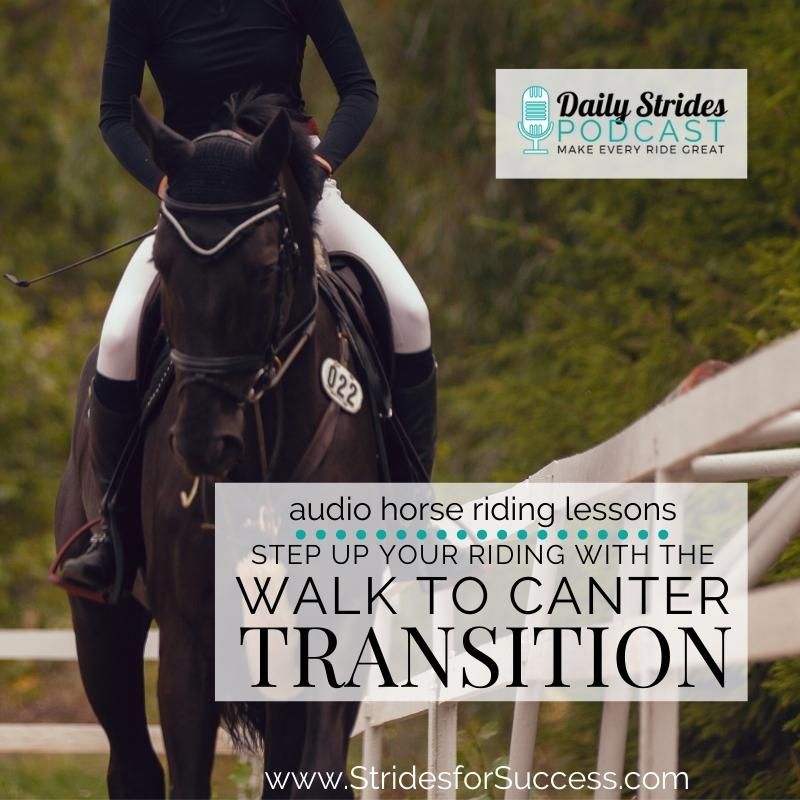
  • Step Up Your Riding with the Walk to Canter Transition

    Step Up Your Riding with the Walk to Canter Transition

    [fusebox_track_player url=”https://op3.dev/e/traffic.libsyn.com/dailystridespodcast/1256_Step_Up_Your_Riding_With_The_Walk_To_Canter_Transition.mp3″ title=”Step Up Your Riding with the Walk to Canter Transition” social_linkedin=”true” social_pinterest=”true” social_email=”true” tweet_text=”Something fun to try this week riding your horse…” hashtag=”walktocanter ” twitter_username=”strides_success” ]

    This transition is a personal favorite of mine.  To ride and to help other riders as well. I really do believe that the walk to canter transition can help you and your horse to connect more to each other.  It can help you to have more clarity over your canter aids, and your horse to become more responsive. And you both to develop so that your training can progress forward.

    In fact, the walk to canter can help horses and riders progress in ways that they don’t even realize they are.  It introduces a certain level of collection to the ride. For many riders, this is one of the best introductions to this as it feels very natural and ‘in flow’.

    You can begin introducing, or refining, the existing transition from the walk to canter today in your training by focusing on a few different elements.

    Your Canter Aids

    One of the reasons the walk to canter transition is so good for riders is due to the speed of the walk.  Many riders can feel flustered, bounced, rushed, or tense when preparing for and riding the trot to canter transition. Which is one of the reasons I love helping riders to effectively use the walk to canter transition in their training.

    The walk to canter transition allows riders enough time and space to identify the point in the stride to ask for the transition, as well as actually apply their aids in a meaningful and effective way. 

    I have an article and Daily Strides Podcast episode HERE that details the aids to ask for the canter that you might find useful for your riding.

    Timing Your Aids to Ask for Canter

    One of the biggest challenges riders have when it comes to getting into a canter with their horse is timing.  When you ask the question makes a huge difference to how your horse responds. If we ask at a point in the stride where he simply can’t respond, this can lead to excess tension, rushing, or just being ignored!

    When using the transition from walk to canter to really work on the timing of their ‘ask’ for the canter, it allows both horse and rider to begin riding cleaner transitions

    I would suggest spending some time on the walk familiarising yourself with what is moving where underneath you.  When you feel your right seatbone swing down and forwards, it means that your horse’s right back leg is also moving forwards.  As this is happening, your left seatbone will have moved up and is ‘moving backward’. This is because your horse’s left back leg is, at this moment, on the ground. His body is moving over the back leg, creating the ‘up’ feeling through your seatbone.

    You will ask for the canter as the outside back leg is moving forward and preparing to step down into the stride.  This will allow this leg to become the 1 in the 1,2,3 that makes up a canter stride. 

    I have another article and an episode of the Daily Strides Podcast HERE that goes into much more detail when it comes to timing your aids to ask for the canter.

    Increasing Responsiveness

    So often, we make the mistake of assuming this is a horse issue.  ‘My horse is not responsive enough’ is a common complaint among riders! I truly think this has more to do with you first.  And when you begin to become more responsive and intentional, your horse will respond by improving how well he listens.

    Begin building responsiveness by becoming very focused on what you want to make happen, when you want it to happen, and where you want it to happen – and stick to those decisions. 

    A great exercise you can use to help you work on increasing responsiveness is to ride set numbers of strides in each gait.  So, for example, 10 strides of walk followed by 10 strides of trot. Then back to 10 strides of walk again. As you and your horse improve the communication between you both, begin playing with the number of strides between each transition.

    The more responsive you both become, the easier you will find it to ride fewer strides in each gait while still maintaining your relaxation, balance, and suppleness.  

    This is when you know that you and your horse are on the same page, listening to each other, and ready to ‘step up’ into the canter from the walk.  I have a previous article and episode of the Daily Strides Podcast HERE that will help you to improve your responsiveness in your riding.

    Riding the Walk to Canter Transition

    Once you and your horse are clear on the aids, clear on the timing, and responsive towards each other, you can prepare to ask for the walk to canter transition. Start by focusing. on the rhythm of the walk, the energy inside of the walk, and the flexion.

    From here use your half halt to firstly get your horse’s attention, and then, from there, to gather and channel the energy a little more inside of the walk

    This will feel like a slight collection and your horse will need this in order to successfully make the transition from walk to canter. Your job in all of this is to set things up and then allow your horse to actually perform the transition. So many riders think it is their job to canter. It’s not. Make sure you engage your core, work on your posture, and allow your horse to simply ‘step into’ the new gait when you ask.

    I have a previous article and episode of the Daily Strides Podcast HERE on how important your posture is to a successful transition into the canter.

    From here, it is simply a matter of ‘asking’ and then allowing your horse to respond.

    Happy Riding
    Lorna

    Riding a Smooth & Timely Walk to Canter Transition

    Some exercises can have a ripple effect all through our riding when we dedicate some time and energy to making them better.  I believe that the walk to canter is one of those exercises and I am excited to help you master the transition this month with your horse.

    This group of episodes is available for you to begin working with today, inside of Connection. They are suitable for all horses and riders who are able to canter. They will help you both become clearer on the aids, and more focused on timing and its importance.  And more balanced and responsive as well. 
    Riding a Smooth and Timely Walk to Canter Transition

    More About Canter Transitions:-

    Get Support & Guidance in Your Riding

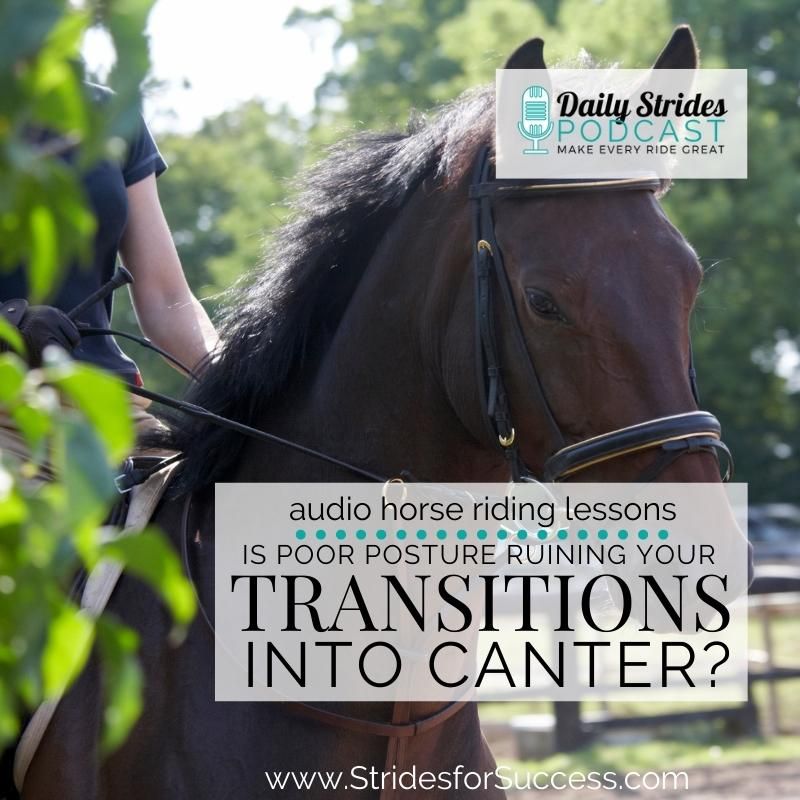
  • Could Poor Posture be Ruining Your Transitions to Canter?

    Could Poor Posture be Ruining Your Transitions to Canter?

    [fusebox_track_player url=”https://op3.dev/e/traffic.libsyn.com/dailystridespodcast/1255_Is_Poor_Posture_Ruining_Your_Transitions_Into_Canter.mp3″ title=”Could Poor Posture Be Ruining Your Transitions into Canter?” social_linkedin=”true” social_pinterest=”true” social_email=”true” tweet_text=”Here’s how to get better transitions into canter…” hashtag=”horsepodcast” twitter_username=”strides_success” ]

    The transition into canter is one that always gives us opportunities to develop and improve as riders. And it can do the same for our horses as well. And yet, for many riders, improvement is frustratingly slow! The good news is that it doesn’t have to be this way.

    Canter and transitions into the canter are one aspect of horse riding that can improve quickly, often with just the smallest of tweaks applied.

    The key is to be strategic about what you are tweaking. And be willing to look out for the effect it has on yourself, your horse, and the transition in general. One of the simplest ‘tweaks’ you can apply is around improving your posture when you ride.  By simply ‘sitting differently’ you can transform the transition for the better.

    Self-Carriage as a Rider

    Self-carriage is a big topic when it comes to horse riding. It’s something we are always trying to cultivate and improve in our horses.  And rightly so, as when your horse develops both the understanding and the ability to carry himself a little better, it opens doors to so many new opportunities for you both to work together.

    I think that if you are asking your horse to carry you, and he obliges. Well, the least we can do as a rider is to take responsibility for making that as easy as possible for him to do. Carry ourselves. 

    Unfortunately, terms like ‘shoulders back’ have been shouted for so long to so many riders, that true self-carriage has become a little, well, confused in our heads!  Rather than thinking about ‘shoulders back’, I suggest visualizing ‘opening your chest’.  So from the point of your one shoulder across the front of your chest to the point of your other shoulder. Open this space up.

    Couple this with the feeling of creating ‘space’ between your ribs and your hips.  Elongating your body. This is self-carriage (and engagement) through your body as a rider and it will help your transitions to canter.

    Poor Posture & Its Results…

    When you are in true self-carriage, coordinating and using. your aids become so much easier.  Meaning when we are heavy, slouched, and too relaxed (not enough engagement or tension) through our bodies, things can become muddled up very quickly!

    Your body becomes harder to move. Some aids are impossible to move independently.  And you can no longer move with the energy your horse is creating. 

    When riding, especially transitions to canter, you are either working with the energy or working against it. If your horse, because he is the kind soul that he is, does actually canter when you ‘ask’ we need to be in self-carriage. When we are not, by blocking this energy, you are telling your horse that his response to your ‘ask’ for the canter was the wrong one!

    Horses become confused very quickly when riders say ‘go’ only to quickly follow it with a ‘no’! Poor posture causes your body to say ‘no’ to his doing what you asked him to do… Not a good result! 

    1255 Could Poor Posture be Ruining Your Transitions to Canter

    Lack of Independence

    The other downside to poor posture, especially as you ask for transitions to canter is your lack of independence. This means that you are dependent on either your other aids for balance or support. Or your horse.  Either way, it will cause issues as your horse moves from the walk or the trot into the canter.

    If you are using your hands to balance in the saddle, this will make true contact impossible.  As well as stop the forward flow of energy your horse needs when performing transitions to canter.

    If you are dependent on your horse for support and balance, the upward energy created through transitions to canter will throw you off balance.  Both of these situations will cause both the transition and the canter that happens afterward to become tense for the horse and rider.

    Relaxation is the foundation of everything when riding. Creating excess tension due to a lack of independence through seat and aids will ruin your transitions to canter. 

    Light Transitions to Canter

    Begin by modeling, through your body, what you want your horse to do.  In the transitions to canter focus on carrying yourself. By doing this you will both communicate with clearer aids and create the space and balance necessary for the transition to happen.

    The transitions to canter are ‘upward’.  They feel like a step up into the new gait. If we block that upward movement of the energy, our horses cannot respond as we would like them to. 

    As your horse ‘steps up’ into the canter, allow your seat to follow first. Then your hands, and finally the rest of your body.  Work on strengthening the connection between your seat and your hands.  Whatever your seat does through the transition, and in the canter itself, let your hands do the same.

    By practicing this consistently and preparing your transitions to canter beforehand, you will find that you will not only have a better transition. But you will also your canter will improve as well.

    Happy Riding
    Lorna

    Improve Your Canter

    Improve Your Canter is a 4-week program you can use to help develop both you and your horse in the canter. It is suitable for riders working alone without a trainer or coach. In there you will learn what is happening underneath you and why. You will also put this into practice using audio horse riding lessons. tailored for each day of the program, with your horse.

    CLICK HERE TO JOIN TODAY

    More About Canter Transitions:-

    Get Support & Guidance in Your Riding