Author: Lorna Leeson

  • Making Time for Horse Riding

    Making Time for Horse Riding

    How many times a week do you ride on average? I know only too well how ‘life’ can just get in the way. How other things just seem to crop up and demand your attention.

    In fact, I have seen how even with a scheduled riding lesson, most adults find it difficult to keep that appointment in their calendar. This is often due to unforeseen circumstances. It leads to feelings of frustration in all involved parties: the rider, the instructor, and the horse.

    Making Time for Riding

    Let’s have a quick look at a few action steps you can put into practice today that will increase your chances of actually getting to the barn and into the saddle more often.

        1. Schedule time with your horse
        2. Make that time non-negotiable
        3. Pack and plan ahead
        4. Ask for help if necessary
        5. Keep motivated and inspired
        6. Set yourself a goal or challenge

    So let’s go through each of these in a little more detail.

     1. Schedule Time for Horse Riding

    We all have a schedule, whether it be in our heads, in our journals, or on our phone, p.c, iPad. Each day there are certain things we have to get done, our tasks. The thing is, we will often put aside other projects in favor of those which we prioritize. In order to make your horse riding a priority, you need to begin to fit it into your schedule. This is so that other ‘less important’ things can work around it, and not vice versa.

    Remember when you are scheduling your time for horse riding to allow for all of the things.  The drive to and from the stables, tacking up, warming up, cooling down. Also the general care of your horse.

     2. Make This Time Non-Negotiable

    Now, this can often be difficult for us to do, particularly if we have other responsibilities elsewhere.  Family, business, work, all demand both time and energy from us.  However, making time for yourself and something you enjoy is also an important part of continuing to show up for the other things. Particularly if you want to do well and be of greater service to these other areas of your life.

    Block out the time on the office calendar, there is no need to tell others what you are doing with your time. Switch off your phone or, if you really do need to stay in contact, put it onto ‘Do not disturb’ or ‘Silence’ mode. You can then monitor who you speak or communicate with within that time block.

    Lastly, assess every so-called ‘Emergency’ that you have to deal with. Often, these things are only taking your attention and focus from your goals, in order to facilitate someone else’s agenda.

    I realize this sounds a bit uncaring initially.  However, trust me!  Once you begin to really give thought to what is an emergency and what can wait two or three hours without the world ending, you will begin to notice a feeling of freedom. It will also give you a sense of more control in your life.

     3. Pack and Plan Ahead

    This is a no-brainer, but it often surprises me how many people fail to do this. Pack your riding gear the night before. Then either put it in the car or by the front door to pick it up as you leave. Have your tack cleaned and ready to go, again packed and waiting. Always have a raincoat or jacket in the car if necessary, as well as your helmet and gloves.

    Boots are another thing to have prepared. In fact, depending on where you live, you could keep a pair of Hunters or similar in the boot of your car at all times. Then, even if you forget your actual riding boots, you are still good to go! The other thing that I recommend packing ahead is a snack or food.

    Often, after a busy day at work we feel tired and hungry… Those feelings being to put those ‘oh I will just ride tomorrow’ thoughts into your head! Be prepared for it!

     4. Ask for Help if Necessary

    Often, no matter what we do, we still cannot seem to make enough time available to do everything. All of the things that we feel are expected of us. You need to begin accepting this and looking for ways others can help you.

    For example, bringing your horse in from the paddock and tacking up. This takes time that perhaps you don’t have. Ask your barn manager if they can perhaps have your horse in and ready for you on certain days and times. They will probably charge a small fee; remember now their time is being spent, not yours, which makes this fee only fair. Or, ask your spouse or partner to arrange to cook dinner two nights a week… Even have take out once a week!

    Begin to look at your schedule with a fresh perspective for things that you are currently doing, but which others could easily do for you… Then ask for help!

     5. Set Yourself a Riding Goal or Challenge

    I know, it sounds often childish (memories of my parents playing the “Go fetch my shoes…. I’ll time you!” come rushing back!). But, it often works. There are some great Apps that you can download and use. Now, while not actually for horse riding, they work the same.

    Nike Running allows you to set challenges that are supposed to be completed under your own steam, running. But, this app can easily be used for riding, allowing you to clock your ‘workouts’ time-wise and set goals to spend a certain amount of time in the saddle each week. You can also get the Equestrian Fitness Challenge that I have created. You can use it while you ride to help keep you accountable, moving forward.

    I also have a free riding planner you can use HERE.  In there you will learn how to take one exercise and make it work for a month in your riding.

    The most extreme ‘challenge’ that I can imagine is actually entering you and your horse into an event or competition. The date is set, you have spent the money… Great motivation to get to the yard and into the saddle!

     6. Stay Motivated and Inspired

    This is different for everyone. What inspires one person, can turn the next person off completely! Sit down at some point over the coming days and try to recall what makes you excited and eager to get into the saddle. Then look for ways to incorporate more of this into your daily life.

    Whether it be reading your favorite magazine, watching the showjumping on the T.V, beautiful photos of dressage on Pinterest… Whatever floats your boat!

    Often the challenges or goals that we spoke about in point 5 are enough to make us jump up out of bed each morning, rearing to go. But more often than not, we need a little extra something to help keep moving the ball down the field or the horse around the arena!

    Podcasts (like the Daily Strides Podcast) are also a great way, as you can listen to them while you make the journey to work or the barn, imagining what you will do when you actually ride, creating excitement all the way.

    Another idea for creating motivation to ride is cleaning your tack!  Seriously… How well does it feel to ride your beautiful horse, all kitted out in pristine tack?  The little things :-)

    Make Time For Horse Riding This Week

    Have you any helpful tips or ideas that our other readers can use to increase their time in the saddle?  If so, we would love to hear about them in our free online community for equestrians HERE.

    I am also going to add links to other episodes and blog posts on this topic below.  They will help you create more time for horse riding in your life. 

    So, take some time today. Review your schedule and look at where you can take more time to invest in yourself and your horse!  You will both thank you for it!

    Happy Riding

    Additional Resources for Equestrians

  • 7 Steps To Winning Back Lost Clients

    7 Steps To Winning Back Lost Clients

    Have you ever really sat down and created a list of all the clients and customers you have not seen or heard from in a while? If you have, you will know first hand what a list that can be!  Winning back lost clients can be a game-changer for your business.  If you have not already made this list, here’s my suggestion.  Make time this week to brew yourself a pot of tea, take a trip down memory lane and begin doing so.

    Once you have your list, I have 7 steps you can use to begin reengaging with them.  And inviting them become a part of your business again. 

    Why Winning Back Lost Clients?

    Customers are lost for lots of reasons… A change of circumstance, conflicting schedules, lost interest or, horror of horrors, they left because they were unhappy about something in your business.  If you can win back just a small percentage of those ‘lost clients’ it can show a marked difference in your bottom line.  Remember an existing, or past client is always cheaper to acquire than a new one!

    Here are the 7 steps to implementing this:

        1. Get all the names down where you can see them.
        2. Identify those you will not be able to win back.
        3. Decide how to best approach them.
        4. Write your email or plan your script.
        5. Create a special offer for them.
        6. Ask for feedback or information as to why they stopped.
        7. Take action!

    Okay, now let’s look at each of these steps in a little more detail…

    1.  Write Them All Down

    Now, this sounds easy enough.  However, if you have been in business a few years it can be quite a task! Probably the quickest way to approach this is to sift through your invoice and receipts journals, followed by your email and phone contacts.

    Once you begin taking that stroll back in time, your memory will do the rest, turning up situations and incidents that had long been relegated to the back of your mind.

    2.  Cull Your List

    You know, it’s unfortunate, but in life, not everyone will be a great fit for you and your business.  I believe in ‘vetting’ potential clients before they come into your circle, to make sure they are a suitable match…  But there will always be the odd few that will fall through the cracks.  They become customers when clearly they would have been much happier elsewhere.

    When they leave, you will know who they are and those people are the ones I am talking about now!  Remove them from your list.  Don’t even go there…  Somethings are better left alone!

    But these are not the only people you may not be able to do business with again.  Inevitably there will be other people who will fall into this category.  Perhaps they have moved and are no longer in the same locality.  Maybe their financial situation has changed.  Or, perhaps they have passed away.  The children may have grown up and left the house (but, be aware that they might now have grandchildren…?!)

    Whatever the reason, if you cannot regain their custom, drop them from your list.

    3.  Decide How to Best Approach Them

    If you had a good relationship with the person, perhaps a phone call is the best way to open the lines of communication again.  Alternatively, a well-written email may suffice.

    You know your customers best, so stick to your own style of how you do your business.

    I personally enjoy email, followed up if necessary by a phone call.  The email is unobtrusive and gives a person time to consider doing business with you again and avoids putting them on the spot.

    4.  Write Your Email or Plan Your Script.

    When you craft your email, make sure it is well written and sounds and feels like you.  They know you, so allow your personality to come out in the email.  Also, take time to consider the Subject Line of your email… This may be the decider as to whether your email gets read at all or not.

    The same goes for the phone call, have a script you can use to guide the conversation along.  

    If your exchange veers a little off course, listen to the person, enjoy the chat, but then gently guide it back to where you want to bring them.  You have to have a plan before you get on the phone!

    5.  Create A Special Offer For Them

    In order to regain their business, you may be inclined to ‘sweeten the deal’ by creating a special offer…  Perhaps the first four lessons at last year’s prices.  Or a 20% discount on the first month’s boarding.

    You know your business best, so assess the situation and figure out what would appeal to that person.  

    Also, know in advance how much they are worth to you as a customer if they were to come back.  This often helps put ‘deals’ into perspective.

    6.  Ask for Feedback

    This can often be uncomfortable to ask, face to face.  If so, I suggest creating an online survey that you can ask your old clients to fill out.  It can be a great insight into parts of your business that you were unaware had issues or were broken. It is also an alternative way to gauge the general feeling of clients without any awkwardness.

    Remember to leave space at the end for the old customers to write their own feelings and opinions on the situation.  Perhaps this can prevent you from losing current clients in the future, so be open-minded.

    7.  Take Action!

    Getting an old client back is far cheaper and easier than finding a new one.  However, it can often feel mentally and emotionally uncomfortable for us business owners. The nervous or anxious feelings are often the result of not knowing what might come up.

    However, if you are brave enough to take action, you may just have two or three new ‘old’ clients by the end of the week.

    Keep in mind that when people’s situations change, so do their habits.  Often they have just forgotten about you and about how much they enjoyed your yard or barn.

    And even if they don’t come back, maybe you can learn something that will help you make your current clients even happier!

    You will never know unless you try… so best of luck :-)

    Have you ever tried to regain the custom of past clients?  How did you go about this, and what results did you experience? 

    Happy Riding
    Lorna

    Additional Resources for Equestrians

  • Riding Through The Handstands

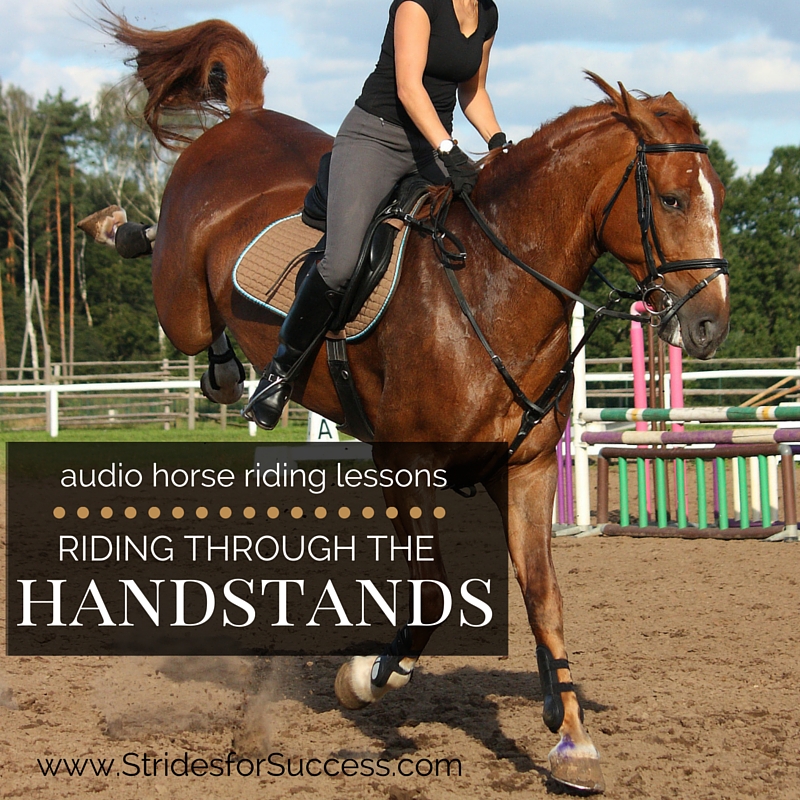
    Riding Through The Handstands

    Is there a feeling similar to ‘that’ feeling? The one where you’re happily riding your horse and you begin to feel that subtle lift in your horses back underneath you. This ‘up’ feeling is often accompanied by perhaps a head shake, or a swish of the tail.

    You just know, with a growing sense of dread, that at any moment your usually placid and co-operative trusty steed is going transform.  Your horse will demonstrate his gymnastic abilities with perfect handstands and cartwheels across the arena or field.

    Think Differently?

    But hold on, what would happen if you began to think a little differently about this behaviour change.  Where, instead of feeling impending doom and dread, you think ‘thank you’.  You can now assume that your horse is actually continuing to be his usual reliable self and is perhaps warning you of his intention.  All so that you can strap on your safety belt and enjoy the ride?

    Okay, probably not! But now that he has let you know, you can change the outcome.

    Your actions in those few split seconds, before he begins his merry dance,  have to ability to change everything. And they can become the deciding factor as to whether or not you finish the ride or get off at an earlier stop!

    So, the three things that will greatly improve your chances of finishing your ride?

    1. A defensive leg position
    2. Keep your upper body back
    3. Looking Up

    So let’s have a look at these three actions one by one in a little more detail.

    Riding Through the Handstands

    1. A Defensive Leg Position

    When we are riding, under normal circumstances, our lower leg (below the knee) should be underneath us.  Almost as though we were standing on our own two legs. Having your leg under you is one of the basics of supporting yourself and your body while you ride.

    Now, if your horse suddenly decides to try his hoof at the highland fling, everything changes. When your horse’s back changes position, from being basically horizontal to having a more vertical alignment, it would make sense for your lower leg to change position as well, in order to sufficiently support you in this new, if fleeting, position.

    The trick is to ‘assume’ this new lower leg position before your horse changes his.

    Of course, it almost goes without saying but let’s just mention it to be sure, this all hinges on you keeping your heels down. This is certainly not the time to be a ballerina on your tippy toes, trust me!

    2. Keep Your Upper Body Back

    There are three reasons that this is a vital key to staying in the saddle and making the super glue work. The first one is that you will use your abdominal muscles to brace against the momentum your horse will create when he bucks. Having a strong core is extremely helpful here. However, even if you are not as buff as you wish you were, there are things you can do.

    Simply rocking slightly back on your pelvis and opening your chest will activate those muscles.  This will help keep your body in alignment when the buck happens.

    The second reason this that you want to get your horse’s head up as soon as possible. When your horse bucks, he is using his body like a catapult; front end down, back-end up.  Often with the sole purpose of flinging his ‘load’ somewhere.

    If you can get the front end up, odds are that the back-end will go down.

    The third reason is that when you use your core, in addition to having a slightly forward lower leg position, from the side you will look like a ‘tug of war’ participant mid match. If we visualize an actual tug of war competition, we can see that by keeping this stance, they are using their whole body, not just their arms.

    This is what you want to do, brace your whole body, not just your arms against your horse.

    3. Look Up

    It sounds so simple.  And it’s probably the last thing you think of doing!  But this simple measure may be the difference between hitting the dirt and riding your horse through a buck. When you look up, you naturally keep your shoulders open and back. You also help your balance by looking at something in the distance.

    The other advantage of looking up is to see where you can send your horse to distract him. This allows you to ride him through and out of the bucking spree. Simple but so effective.

    Practicing Your Riding Skills

    So, there you have it, the next time your horse decides to show you just how athletic he can be, you know what to do.

          1. Get your lower leg forward
          2. Brace your core muscles by tilting slightly back
          3. Look up.

    The quickest way to end the performance is to get his head up and ride him forward into something different. Strangely, this is one of those things that, if you can keep those three points in mind, it actually is not such a big deal anymore at all.

    Have you ever had any ‘hair raising’ experiences on your horse while riding?  We would love to know what happened and how you dealt with the situation.  Make sure you join our free online community for riders HERE and tell us all about it.  Oh, and remember to include the outcome :)

    Happy Riding
    Lorna

    Additional Resources for Equestrians

  • Everything Takes Time and Persistence

    Everything Takes Time and Persistence

    The following text is an excerpt from a business coaching resource I created for equestrian business owners. Time and persistence, when coulpled in the right way, will help entrepreneurs overcome most challenges.   If you would like help with your business, you can reach out to me privately on Instagram, @lornaleeson.

    “The important thing to remember here is that everything takes time.  EVERYTHING!  Looking at any situation as a monumental leap from here to there will often seem impossible. However, breaking it down into smaller pieces, makes it seem much more manageable. Perhaps dividing it into two years, and then again chunking it down into even smaller pieces, quarters.  From here, breaking it down into months, weeks and lastly days…  Well, now anything can become possible!

    Big Desires & Goals

    Let’s look at this situation another way.  As I write this I am sitting on my farm in South Africa.  Let’s say I have a goal or desire to get back to Ireland (my home country) for a visit.  I can have a look on a map and see the vast distance between S.A and Ireland. Paying attention to all the land and sea (mostly land) between here and there!

    In doing so, I could easily decide that it is far too vast a distance for me to ever cover. And so, never even start the journey. 

    And looking at it like that, taking action and stepping outside my front door here on the farm seems a little useless.  Just imagining Ireland, from my perceived reality right now; yes, it is a MASSIVE distance.

    Leverage What You Have

    However, I have options.  Depending on how I decide to go about getting ‘home’, I could start today. And within 24 hours or 6 months, I can be there (all going to plan!).

    The quickest way to achieve that is by having the necessary cash on hand to purchase a plane ticket.  Yes, I will still have to drive the hour to the nearest airport.  From there, catch the first flight, transfer at another airport, catch the second flight. And then transfer again at a third airport. Then, after catching the final flight, I will depart that third plane in Ireland! All in less than 24 hours than when I began my trip.  In this case I can leverage money.

    No Money? Leverage Time & Effort…

    For many entrepreneurs, a lack of money is the perceived thing holding them back.  However, there are other things you can use if funds are not available. Time and persistence will help you leverage these things.  Let’s go back to my initial goal of going to Ireland, but this time without available cash for a plane ticket.  I could if I wanted, set out on foot tomorrow morning.  Plotting a trail up through Africa, crossing the Mediterranean Sea into Europe. And, after crossing Europe, catch a ferry to Ireland.

    It would take me longer.  And it is riskier journey and path to follow.  There will probably be the odd twist and turn, some leading me in a direction away from my desired destination…

    But after 6 to 8 months, a very exhausted, but far more learned and experienced me, would arrive in Ireland.   It is the longer route.  And it is a far riskier way.  Definitely not for the faint-hearted!  Most importantly it would involve me using all my resources, contacts, skills, and knowledge.  However, it is doable.

    Time and Persistence

    This is how you should look at your journey from where you are with your business to where you want to get your business to.

    If you have money available to spend, you can use it to ‘buy a plane ticket’ . This will move you faster from A to B.  But, if you don’t, you can also use what you have right now.  You will achieve the same results, but with a little more time and energy.

    Chunk it down.   Break it into smaller ‘stages’.  Divide those into smaller pieces. And finally, you will be left with the ‘steps you can take.  One by one.  Use both time and persistance to get you to your desired destination.

    Happy Riding
    Lorna

    Additional Resources for Equestrians

  • Paying It Forward

    Paying It Forward

    . As equestrians, I believe we have an important role to play in encouraging new riders into the world of horses; paying it forward so to speak.  “Today I spoke with one of the Moms at the yard and she passed an observation that has stayed with me…  “You are great to have all these children around all the time and to spend so much time, care, and attention on each of them.”

    It reminded me of when I was young and overflowing with enthusiasm for anything horse-related. I spent every waking extra hour at the barn, stables, yard.  If there was a pony there, I was there! I distinctly remember the feeling of rushing home from school and, with all thoughts of homework cast aside, scrambling into my ‘riding gear’ and setting off to the riding yard on my trusty bicycle.  Every pedal action fueling the thoughts in my mind of eventual cross-country or showjumping glory.

    Later, I upgraded my mode of transportation to my trusty pony Shadow who, to my dismay, my trainer very honestly and I think with no hard feelings, truthfully, labeled useless…  As a show-jumper; yes.  As a young girl’s first love…  Ah, she remains my favorite and most loved :-)

    Instilling Values

    Either way and regardless of the mode of transportation, I lived for the stables.  The smell, the work, the feeling of utter joy at achieving a perfect stable.  This was after painstakingly clearing every piece of droppings from the bed.  My trainer was a strict lady and if I was not personally willing to lie in the bed, how DARE I even suggest her horses would!

    It not only made me feel alive, the riding, training, and interacting with horses. But also it, daily, willed me to do my best and, often, reach well beyond what I thought I could achieve.

    Yes, It was hard work, no doubt about it.  It was a HUGE responsibility.  And yet, it also taught me so many lessons which, if I was not exposed to such circumstances, I am sure would make the present ‘Me’ a far lesser person.   I am now a person who will very verbally tell the children at her yard that leaving the tack/equipment/horse unattended when tired/unsure/wanting to go home was just unacceptable.  A person that won’t accept anything but your best effort in the arena.  And a person that expects a basic use of initiative at all times from all in her company, and a person who demands an unwavering allegiance to the pony or horse’s best interest from all her ‘little people’ and ‘big people’.

    Coming Full Circle

    Bringing me full circle to above mentioned Mother’s comments….  I do this, not because of some sadistic sense of satisfaction from ‘young labor’, but rather in the hope that the values of initiative, self-belief, and responsibility that were embedded in me twenty years ago (yes, do the maths!) will be transferred into an impressionable and open few who, God willing, will go on and in another twenty years, pay it forward again…

    But with more experience, knowledge, and confidence than I could ever hope to instill in them….

    Paying it Forward

    So today, when at the barn or yard…  Look at those little earnest faces.  View them as little vessels waiting to be filled with the most wonderful of all that is horses. From this place, ask yourself the question, “What life lessons and skills served me best?” and in your answer, there is the beginning to paying it forward.

    We would love to hear your experience of paying it forward.  Whether it be someone who bestowed this gift on you?  Or how you try to incorporate it into your life now, as a gift for future generations.

    Happy Teaching!

    Additional Resources for Equestrians

  • Are You Straight When You Ride?

    Are You Straight When You Ride?

    Being straight is a focus for many riders.  Often when I am in the arena I end up reminding my riders that they are not riding motorcycles; they are riding horses.  From the outset, it seems like a pretty random statement to make.  However, let me explain the sequence of events that leads up to me mentioning motorcycles…

    Straightness is for Horse & Rider

    While we always hear of how important it is for our horses to be straight and symmetrical when working, many riders will automatically just assume that they are straight or even at all times in the saddle.  They are shocked when they see photographs or videos of them that show how lopsided they can often be.

    Are you Straight when you ride?

    Today I want to chat about a simple strategy you can begin implementing the next time in the saddle that will help you become more mindful of how even you are actually sitting when working and schooling your horse.

    When you are riding, do you ever take the time to glance down to catch a quick glimpse of your hands? If so, have you noticed that one is sometimes definitely higher or lower than the other?  

    In my experience, this ‘little’ problem is the cause of a lot of other bigger issues that many riders deal with on a daily basis. It is also a ‘little’ problem, which if not corrected early, can cause big problems later, as it generally leads to an unstable foundation all around.

    Straight Through Your Shoulders

    As you ride today, I want you to be aware of how equal the level of your hands is. Remember your hands are connected to your arms, which in turn connect to your shoulders. When your hand drops it is usually followed by that same shoulder. When your shoulder drops, it leads to a whole hornet’s nest of issues, making your awareness of this potential riding habit crucial to your straightness when riding.

    I want you to pay particular attention to the level of your hands when on circles, bends, or turning. It is during these times, your hands are almost being invited to behave badly! Watch that while you open your inside hand, you don’t drop the inside hand.

    The result of dropping your inside hand is often the ‘motorcycle rider’; leaning to the inside with your shoulders as you travel around the bend.

    If you are inclined to do this, you will find the direct consequence of dropping your inside shoulder is your seat-bones and hips move towards the outside of the saddle, which is the exact opposite of where you want your weight to be around the corner.

    Becoming aware of this happening is the first step towards correcting or preventing it.

    Happy Riding
    Lorna

    Additional Resources for Equestrians:-