Tag: contact

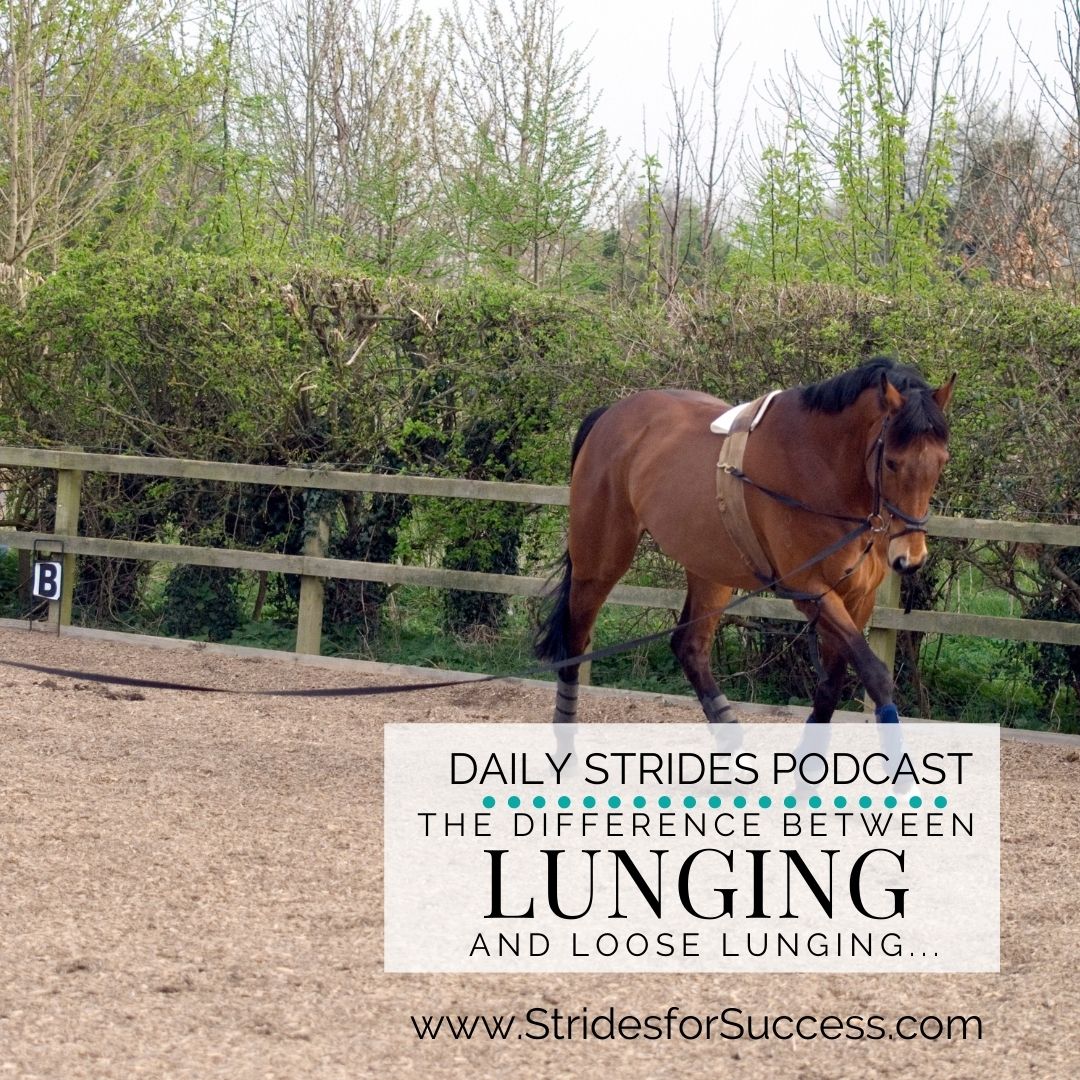
  • Loose Lunging versus Lunging…

    Loose Lunging versus Lunging…

    [fusebox_track_player url=”https://op3.dev/e/traffic.libsyn.com/secure/dailystridespodcast/1190_Why_Loose_Lunging_is_not_Lunging.mp3″ title=”Why Lunging and Loose Lunging are Different…” social_linkedin=”true” social_pinterest=”true” social_email=”true” ]

    Do you know that, contrary to popular belief, lunging is not ‘running in circles’? That, when done right, lunging is one of the most beneficial, easy to use, and low barrier to entry tools you can work with your horse to improve your riding.

    True and good quality lunging improves both horse and rider; and can be used by all horses and riders, regardless of where they are in their riding journey.

    Yes, it is that good… This is why I feel a little passionate when people confuse loose lunging for actual lunging! In fact, I don’t believe that loose lunging should even be called lunging. What it should e called depends on what you are using it for… But it is not lunging.

    So, what is Lunging?

    Lunging is when you use a combination of natural and artificial aids to ask questions of your horse. A lot of those questions are ones that you would use similar aids to ask when you are riding.

    True lunging is when you ask your horse to do things using a combination of aids that would also work if you asked a similar question when in the saddle. Just now, you’re on the ground.

    Just like you use your seat, your legs, your hands, the reins, your weight, your thoughts, your voice, groundpoles, the arena fence, and so many other natural and artificial aids when you ride, you do the same when you lunge. Your position, your body language, the lunge line, the lunge whip, the arena boundary, groundpoles, your voice, etc., etc.

    And, what’s magic is that you and your horse get to experience all of this from a new and helpful perspective.

    And what is Loose Lunging?

    Loose lunging is when you take a lot of the artificial aids out of the equation. Notice I said a lot, not all. The boundary is still there (so the arena fence or rail). And also, many people use a rope or other similar piece of equipment to enhance their natural aids. A little like the lunge whip would do if lunging.

    The key difference between lunging and loose lunging is the contact and connection.

    True lunging, just like riding, encourages contact and connection between horse and rider.  Loose lunging does not have that element because there’s no lunge line.  And while you can ride without reins, the result is not the same as riding with them.  The same with lunging…

    Which is one of the big reasons I personally think loose lunging often quickly ends up being simply running in circles. Not always, and I want to stress this. But very often, the horse is simply running aimlessly around the rider in the center who has little to no influence over the situation as a whole.

    It also very often has a lack of focus or intention for the interaction… So it doesn’t really move the conversation forward for horse or rider.

    How Do I Start Lunging?

    If you would like step-by-step instruction on getting started and then taking your lunging further, Lunging for Riding is ready and waiting for you to join HERE. In there you will get 4 weeks of lunging plans, audio training. All put together in an easy-to-follow program that will literally transform your lunging – and your riding.

    Happy Lunging
    Lorna

    Other Resources to Help You with This Topic:-

  • The Canter to Trot Transition

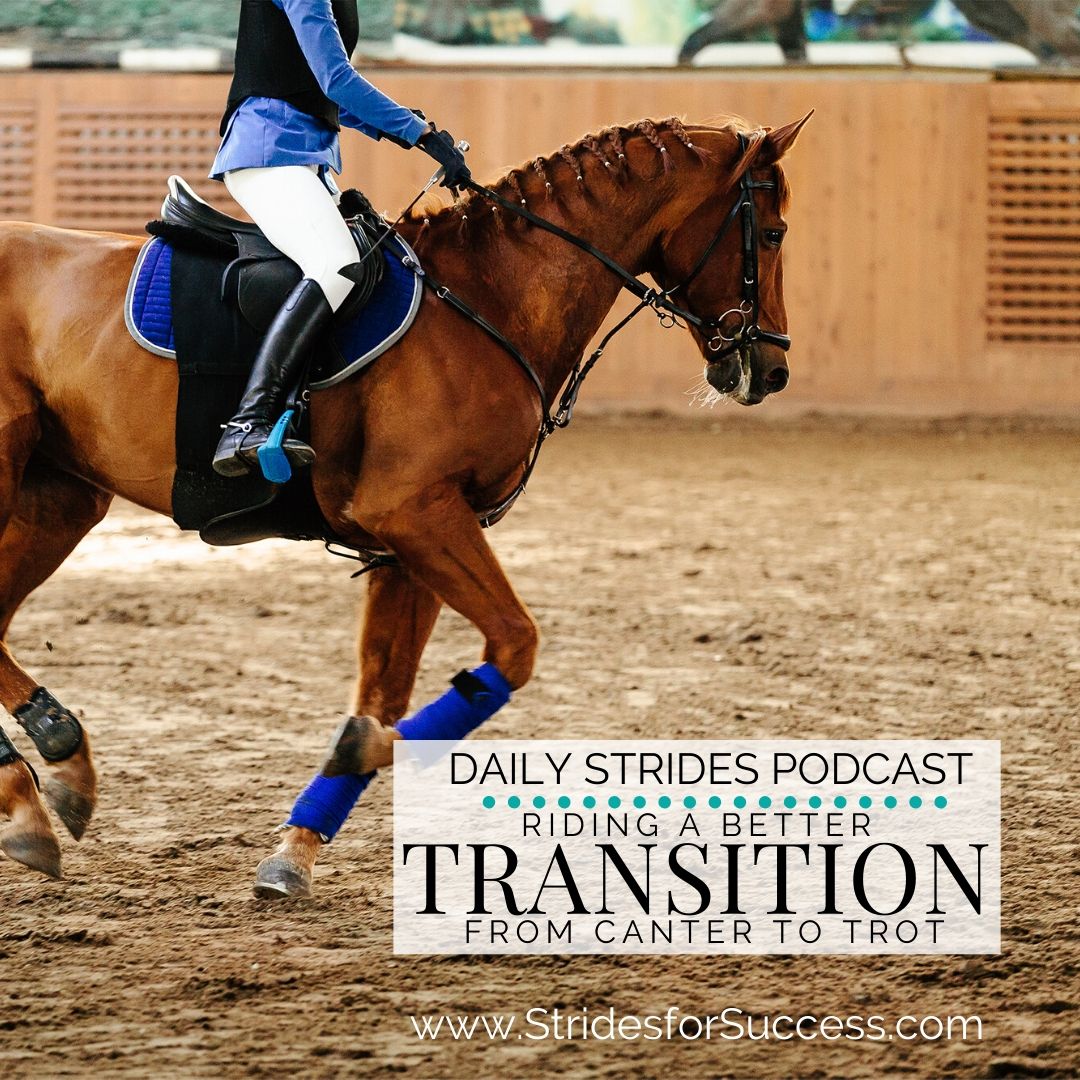
    The Canter to Trot Transition

    Transition from canter to trot
    The canter to trot transition is the one transition that so many riders don’t ever think about until they are in the midst of it. So much focus and attention are put into getting into the canter, and yet the ‘getting out of the canter’ is just left to chance.
    [smart_track_player url=”https://op3.dev/e/traffic.libsyn.com/dailystridespodcast/1146-Your-Canter-to-Trot-Transition.mp3″ title=”Riding a Better Transition from Canter to Trot” social_linkedin=”true” social_pinterest=”true” social_email=”true” tweet_text=”Smooth out that transition from canter back to trot with this episode of the Daily Strides Podcast” hashtag=”equestrianpodcast” twitter_username=”strides_success” ]
    Today I want to give you a few ideas to work on, in the saddle, before you get into the canter that will help you begin riding a smoother and more ‘put together’ canter to trot transition.

    The Bouncy Transition

    For so many riders, the canter to trot transition is filled with bounce and general bumpiness.  And usually in a way that is not benefiting the rider or the horse.  I personally think that this is often due to the fact that the canter can and will improve the trot.
    Meaning that when the trot is flat and not all that great, the rider is okay. However as soon as there is ‘more’ happening in the trot; well it’s not all smooth sailing or riding.
    So if you find yourself being able to manage quite nicely when in trot ‘before the canter’, but struggling little with the same trot after a canter, you are in need of suppleness. Because this is a rider issue.  It is your inability to ride the transition that is the issue where.

    Working on Your Responsiveness

    If you are experiencing challenges with your canter to trot transition, I am going to suggest starting with responsiveness.  And not when cantering!  Before you begin riding the canter, work on improving your responsiveness as a rider. I firmly believe that almost always, a lack of responsiveness comes from the rider.
    How consistent are you being with your aids and your riding in general? Your horse will ‘mirror’ or ‘reflect’ your approach to responsiveness. Meaning the ball is firmly in your court when it comes to improving it.
    Responsiveness is important for al transitions.  where a lack of responsiveness affects the downward canter to trot transition is that when it is lacking, a certain amount of ‘hauling’ happens!  Rather than the aids communicating the intention for a smooth transition to the horse, the rider has to pull and tug the horse into the trot.
    My advice is to work on your responsiveness in halt, walk and trot before you pick up the canter.  Pay particular attention to your timing, your half-halt, and how you are ‘releasing’ when your horse responds.

    Maintaining the Contact

    The canter to trot transition can be confusing when it comes to contact for many riders.  There is a tendency to throw the contact at the horse. I often think that this is in a slightly misguided attempt to prevent catching the horse in the mouth.  And while you definitely don’t want to catch or jab your horse in the mouth; you also don’t want to drop him where contact is concerned.
    Contact is like a mutual agreement between horse and rider.  Maintaining a positive and ‘working’ contact through the transition is essential if you are both to build trust and confidence.
    The other side of contact is when the rider holds on too tight.  This is usually due to either a need to balance on the reins – which NEVER works!  Or a deep desire to control EVERYTHING!  Again, contact is a mutual agreement.  It cannot be this when you are using it to further your own agenda 😉
    Here, I advise you to begin establishing a truly independent seat.  Correct your base of support and begin relying on yourself to maintain balance throughout the transition.  It will go a lot further to riding a good canter to trot transition.
    Incorrect use of the contact through the transition often causes the horse to hollow.  This results in that horrible bounce riders experience as the horse moves into the trot.  The irony, of course, is that this same bounce causes many riders to hold on even tighter!  Learn to follow your horse, seat, and hand, through the transition.

    Asking for Straightness

    If you ride a canter for any length of time, without being mindful of what is happening, your horse might begin to ‘curl’.  Usually, it is around your inside leg.  But sometimes the hindquarters ‘curl’ to the outside.  Either way, all thoughts of straightness fly out of the arena and this has a real negative impact on the canter to trot transition.
    In order to really maintain the energy flow, so, therefore, establishing a good quality trot from the get-go, attention to straightness is necessary.
    My advice is to begin working on this in other transitions.  Allow it to become a habit for you and your horse in all transitions.
    Will it be perfect from the beginning?  No!  In fact, it probably won’t be anywhere near perfect for quite some time.  However, by training yourself to look for this, from day 1 (today) you will be more inclined to encourage it through the canter to trot transition.

    Your Position Through the Transition

    There is a tendency for riders to either lean back or collapse forward when riding the canter to trot transition. Either of these things is going to make for an uncomfortable entry to the trot.  If riders lean back, it encourages the horse to become hollow.  Simply put, the energy no longer flows from the back end to the front end.  Hollowness also causes a really uncomfortable ‘bumpiness’ to happen!
    Keep in mind that there is also a tendency for many horses to become heavy in front when they get back into the trot from the canter.  The rider sitting perched on the withers will only amplify this!
    Your focus should be on maintaining your alignment, before during and after the transition.  This will put you in the best position to communicate with your horse.  And also, to allow your horse to actually do what you have asked him to do.
    Again, practice this as you work between halt, walk, and trot.  Use the slower gaits to really begin training your body to remain aligned, so that when you do ask for the canter to trot transition, your body will be more inclined to remain in alignment.

    The Canter to Trot Transition

    Simple things practiced correctly before you ever get into canter can really help you to improve this transition.  Finally, I am also going to suggest getting back into a rising trot, posting to the trot, as soon as possible after the transition. This will allow you to establish your balance more quickly.
    And, the rising trot will encourage a more rhythmic trot from the first step as well.
    Happy Riding
    Lorna

    The Original Returning to Riding Program

    Are you looking for a way to get back into confident regular riding again? If so, I have a step-by-step, day-by-day plan to help you make this a reality that works with your existing lifestyle.
    The Original Returning to Riding Program is an audio program, that plays from a podcast that you subscribe to on your phone.  Each day, new training or lesson is available for you to use as you make the transition from ‘grounded’ to regular riding again. You can find out more about it HERE

    Additional Resources on This Topic

  • 4 Ways Your Hands May Be Wrong While Riding

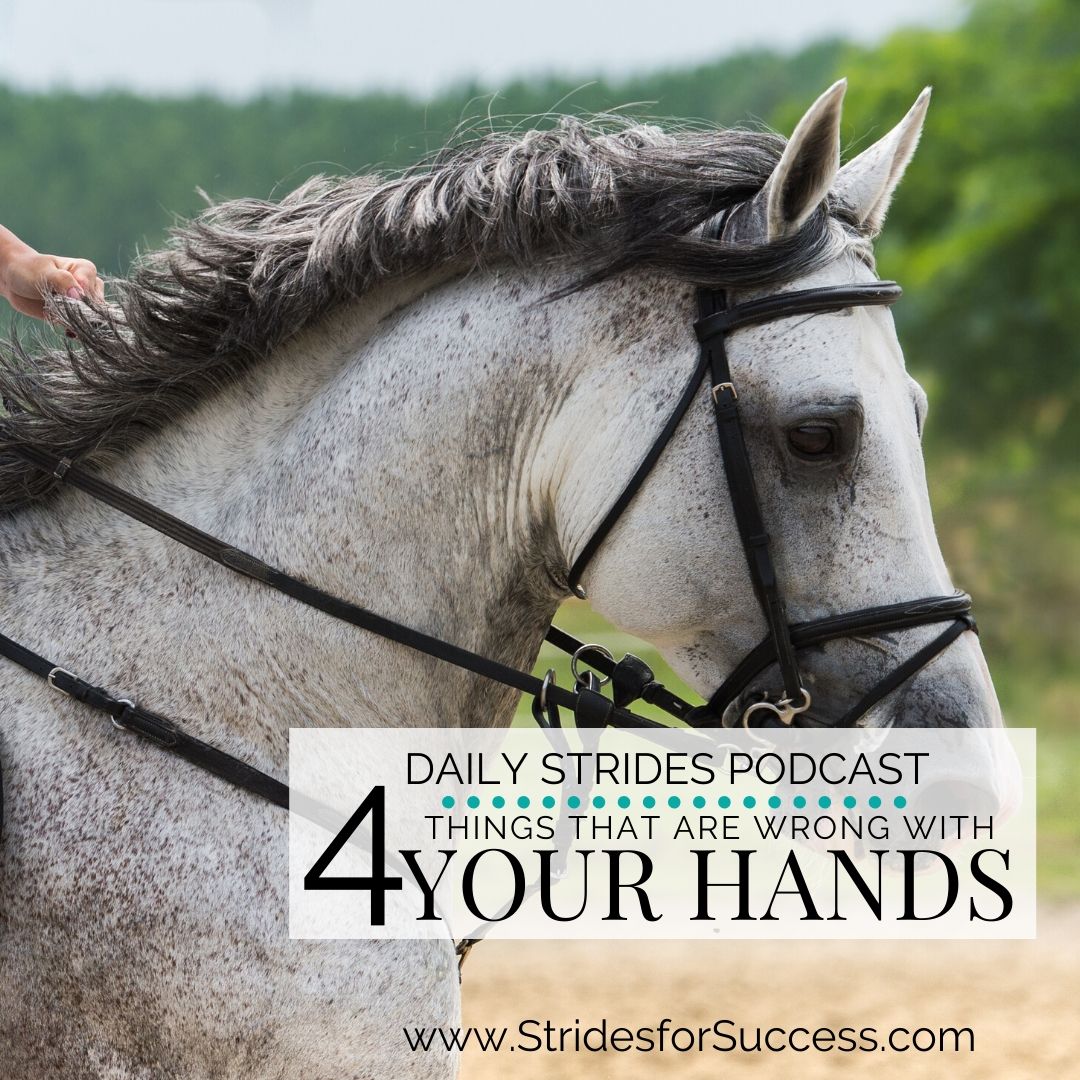
    4 Ways Your Hands May Be Wrong While Riding

    4 Ways Your Hands May Be Wrong While Riding
    As I was creating my notes for this episode, it struck me that there is a strong probability that this sounds a lot like Goldilocks!  Too much, too little and ‘just right’ will come up repeatedly as I begin talking about your hands when you are riding.  Obviously, we are aiming to achieve ‘Goldilocks’ hands; just right!
    But seriously, the reason I recorded this episode is due to so many riders struggling with their hands.  They are trying to improve contact and connection.  However, they are actually missing some of the basics of the hand aids.   And I think that making sure your hands are being useful, rather than confusing, is a really important basic that many riders are missing.
    [smart_track_player url=”http://traffic.libsyn.com/dailystridespodcast/1137-4-Things-You-Might-Be-Doing-Wrong-with-Your-Hands-While-Riding.mp3″ title=”4 Ways Your Hands May Be Wrong While Riding” social_linkedin=”true” social_pinterest=”true” social_email=”true” tweet_text=”Why having ‘Goldilocks hands’ will help you in your riding… ” hashtag=”equestrian #truestory #podcast” twitter_username=”strides_success” ]
    So, that all being said, let’s dive into the 4 things that you may be doing with your hands while riding that is negatively influencing your conversation with your horse.

    1 . Too Much Fidigiting on the Reins

    Piano Fingers.  In my experience, once a rider has caught on to this habit it can be a really tough one to break.  Piano Fingers is my name for hands that are continuously moving up and down the reins during each ride.  They move closer to the bit, causing a lot of tension on the rein and contact.  And then, without any word of warning, everything changes as they move closer to the buckle of the rein.
    Up and down the hands go throughout the ride.  This is usually accompanied by statements about ‘lack of contact’ being uttered by the rider from time to time…
    Piano fingers make it really difficult for both the horse and the rider to settle into any sort of rhythm regarding the overall communication.  There literally cannot be a contact, because the riders only consistency surrounding it is to continue to drop it!
    The good news is that, with a little mindfulness and attention, you can remedy this quite easily.  The first thing to make sure of is that you are holding the reins correctly.  As the rein comes into your hand, it passes between your little finger and ring finger.  Then it comes up the inside of your fingers, to pass over the top of your index finger.
    Your fingers don’t ‘hold’ the rein.  That is a job for your thumb.  As the rein passes over your index finger, you thumb presses down there, allowing you to hold and maintain the contact.  
    Holding the rein with your thumb also frees up your fingers to ask different questions using the reins and contact with your horse.

    2 . Carrying Your Hands Too High or Too Low

    One of your responsibilities as a rider is to carry your own hands.  So many riders fail to do this.  They allow their hands to rest on the horse or on the saddle as they ride.  Doing this makes the hand aids completely ineffective in the conversation between horse and rider.
    Carrying your hands’ too low or too high changes how the bit applies pressure to your horse’s mouth.  It also changes how supple your arms are when following the horse and connecting with the contact.
    Correcting this simply requires you to pay attention to your lines.  From a side view of you and your horse, there should be a straight line from your elbow to your horse’s bit.  
    If you see a V shape, your hands are probably too low.  If you see a ^ shape, your hands are probably too high.  Your hand will cause the ‘point’ in the V or the ^ with your arm making one side and the rein creating the other.
    Hands being held too high is often due to nerves or anxiety on the part of the rider.  Many riders look like they are directing air traffic, rather than simply allowing their hands to be the quiet aid that they should be in their riding.
    Hands that are too low can be due to either a failure to carry them, laziness!  Or it can be due to some misguided attempt to the horse ‘on the bit’ by holding the hands closer to the knees and sawing the bit in the horse’s mouth. Please DON’T do this!  Your horse tucking his head in to get away from your painful sawing is not traveling ‘on the bit’!

    3 . Carrying Your Hands Too Close or Too Wide 

    Are you beginning to see why I mentioned Goldilocks at the beginning?!  How close your hands are in relation to each other when you ride will depend on a lot of things.  Your skills as a rider play the biggest role in deciding this.  However, your horse’s experience and ability to understand aids also plays a part.  Finally, the question you are asking at any given time will also dictate where your hands are in relation to each other as you ride.
    For most riders, carrying your hands 6 to 8 inches (so 15cm to 18cm) apart is a good rule of thumb.  This seems to allow both horse and rider to understand the questions and respond accordingly. 
    As you and your horse develop the conversation you have together more, you can refine this.  Refining simply means that your hand aids become more subtle.  So, in this case, moving your hands closer together.
    However, if you start off with your hands’ side by side, you will probably end up confusing both yourself and your horse in the long run!  Your confusion will come down to correctly using ‘outside and inside’.  Your horses will come from the pressure seeming to come from the same place.
    Remember, all aids can be refined, and how close together with your hands are is one way you can refine your hand aids. 

    4 . Too Hard or Too Soft

    The final mistake I want to cover today that many riders make in the saddle is, intentionally or not, having hands that are too soft or too hard on their horse’s mouth.  Let’s deal with the more obvious one first; too hard.  Too hard is when the pressure is too much all the time on the contact between horse and rider.  It is the difference between ‘asking’ and ‘forcing’ the horse to do something.
    However, too soft is also an issue when it comes to your hands and hand aids while riding.  Too soft is often a reflection of your leadership skills, an essential part to becoming a better rider. 
    Soft hands are usually due to a rider who lacks confidence in their own abilities in the saddle.  They worry that they will hurt the horse by becoming unbalanced and leaning on the reins for support.  Now, obviously, this is a valid concern at the early stages of your riding.
    However, there comes a point when you have to begin working on your core stability and independent balance as a rider. The more confident you are in your own abilities, the more you will reflect this in how you communicate with your horse using your hands.

    Finding Your ‘Goldilocks’ Hands

    Your aids will always be a work in progress.  You will refine them more and more as you develop your conversation with your horse.  However, I feel that it is good, to be honest with yourself from the beginning of your riding.  Remember, all of your aids work together.  There is a ‘Balance of Aids’ in play, always.
    You hands must support your other aids while you are in the saddle.  
    Finding your initial ‘happy place’ or Goldilock’s hands will help you to show up more consistently for your horse every time you mount up.
    Happy Riding
    Lorna

    Other Resources for You in Your Riding:-

  • A Map for Progress in Your Riding

    A Map for Progress in Your Riding

    Having a map often simplifies the journey.  It helps plan a clear route from A to B.  Riding is a journey.  And so many riders want a map or a plan to follow for progress in their riding.
    [smart_track_player url=”http://traffic.libsyn.com/dailystridespodcast/1121-A-Map-For-Progress-In-Your-Riding.mp3″ title=”A Map for Progress in Your Riding” social_linkedin=”true” social_pinterest=”true” social_email=”true” tweet_text=”Hit a plateau in your riding? You need a map…” hashtag=”equestrian #horseriding” twitter_username=”strides_success” ]
    Well, hold your horses!  What if I was to tell you that there is a map available for equestrians.  Oh yes, and it is loosely called the training scale or the traditional training scale.  So many riders discount this because they think that they have to be riding at a certain level in order to use it.  Or that the training scale is only for riders of a certain discipline, usually dressage.
    Many riders also believe that the training scale is only for the horse.  And a certain ‘type’ of a horse at that. This couldn’t be further from the truth.
    Horse riding is a team sport.  Your horse’s long term success depends on your abilities in the saddle.  Improve your riding skills and you will have improved conversations with your horse.  It is as simple as that.

    What is the training scale and how can you use it as a map in your riding?

    The training scale is a basic system many trainers use when working with horses.  There are certain principles or ‘steps’ which, when followed, ensure that the horse and rider have the mental, emotional and physical ability to progress in their training and riding.
    What often happens is that, without even being aware of the training scale, you are working on some of the principles.  However, when one piece is ‘missing’ or weak, you’ll find that progress stalls.  This is where so many horses and riders then become stuck. 
    Understanding what the training scale is and how you can begin using it today will help you with this.  It means you will clearly see what’s missing or needs work.  Which will inevitably lead to fewer gaps in your training.  Fewer gaps mean that momentum can really begin working for you where your training and progress are concerned.
    By following the principles, step by step, you can really make sure you have a full education in riding.  You can also ensure that your horse is being correctly developed, so he will have the physical and mental abilities necessary to progress in his training.

    Training Scale Foundation:- Relaxation

    Relaxation.  It is a big concept for so many riders.  And the fact that is has nothing to do with ‘doing nothing’ is what confuses so many!  Relaxation should rather be called ‘tension management’.  This is what you must do in order to fully understand and implement relaxation.  Manage your tension in the saddle.
    When you try something new in your riding, often relaxation is the foundational piece that needs attention again.  All new principles must be worked through from the perspective of relaxation.  Can you manage your tension levels as you move up and down through the gears or gaits?  How about if you switch from moving straight to moving laterally?  Or if you decide to pop a fence or jump?
    Different tension is needed for different tasks or work when riding.  Relaxation is your ability to manage your tension, so that it appears smooth throughout the ride. 

    Training Scale Step 1:- Rhythm

    Relaxation is the foundation.  This means that rhythm is the first actual ‘step’ on the ladder or scale.  Rhythm with horses, in my opinion, is that your horse is as close as possible when being ridden to how he naturally moves, in the field alone.
    I believe that your natural rhythm is how you feel when you are ‘doing you’.  When you are doing something you love to do that you find easy to do.  The thing that makes 3 hours feel like 3 minutes.  
    The trick is to work on bringing that same feeling across to the saddle with you. That same openness, flow, and energy.  Your natural rhythm.  This will take time to develop, however it is essential to make progress in your riding.

    Training Scale Step 2:- Suppleness

    The loosey gooseyness that is essential for both horse and rider.  I believe that in most cases where riders are ‘stuck’ are due to a lack of suppleness.  This is often seen when the contact is an issue.  It is a lack of suppleness from the rider that is causing the block through the horse’s energy.

    Suppleness is a mental, emotional and physical development.  It is the ability to move and flow, while still remain strong and true. 

    I am going to ask you to really consider this if you are having issues with, for example, contact with your horse.  If it is ‘fleeting’, you have it for a stride or 4 only to lose it again, take a look at your suppleness. Working on this has the potential to really and truly get you unstuck – without having to actually do anything ‘different’ in the saddle.

    Training Scale Step 3:- Contact & Connection

    Ah, the part everyone wants.  The holy grail; ‘on the bit’.  However, this cannot be correctly or consistency achieved if the other parts we have mentioned are not strong and active in both horse and rider.   I often think of contact as being the step of the training scale where both horse and rider ‘graduate’.
    It is where the horse begins to take responsibility for their own actions and way of going.  it is also where the rider must be confident enough to allow the horse to do this. 
    Contact is a little like a contract that both horse and rider are entering into.  I am agreeing to trust you if you meet me halfway.  This is why sawing, pulling, pushing and shoving will not produce correct contact.  The steps we spoke about before are the only way to actually achieving true, lasting contact in the ride.

    The Traditional Training Scale – Steps 4 to 6

    I have created a free mini-course for you where I go into detail far more detail about the training scale.  I really feel that if you can understand these basic principles, it will move your riding forward.  Even the most basic of conversations with your horse has these things woven through it.
    You can find the 5 Days to Clarity HERE.  I hope that you take the 5 to 10 minutes each day to give it a look or listen and really and truly move things forward in your riding.
    Happy Riding
    Lorna
    Other Resources to Help You in Your Riding:-
  • Riding a Horse who is Tossing or Throwing his Head

    Riding a Horse who is Tossing or Throwing his Head

    [fusebox_track_player url=”https://op3.dev/e/traffic.libsyn.com/dailystridespodcast/1117-Riding-a-Horse-that-Tosses-or-Throws-his-Head.mp3″ title=”Riding a Horse that Tosses or Throws His Head” social_linkedin=”true” social_pinterest=”true” social_email=”true” tweet_text=”To retrain a horse that tosses or throws his head…” hashtag=”horsepodcast” twitter_username=”strides_success” ]

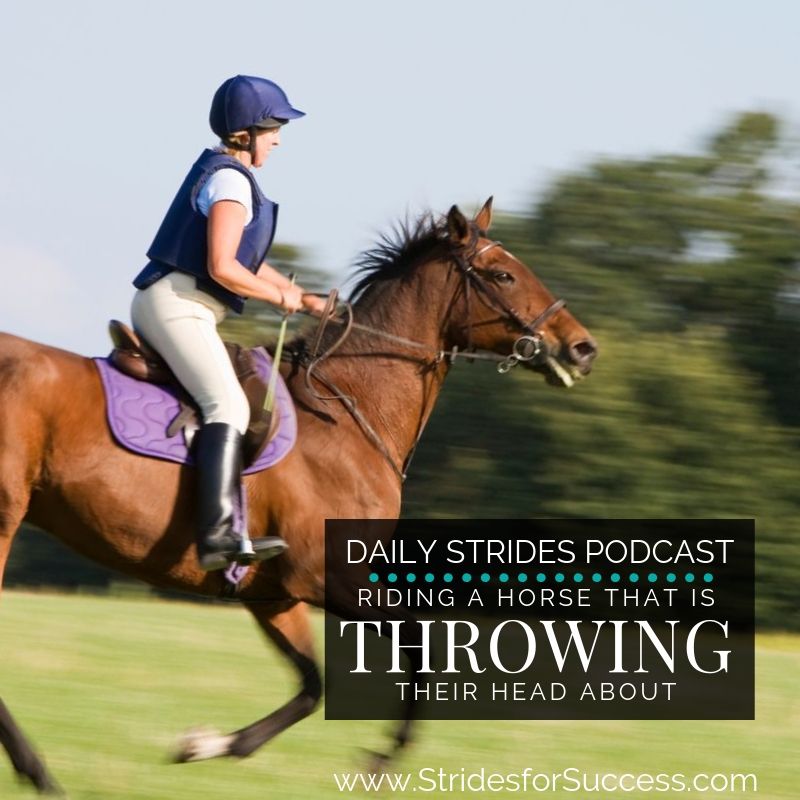
    Setting goals and making plans can feel like a waste of time when your horse is continuously tossing or throwing his head about. If you have a horse who reacts this way when being ridden, you will agree with me. It seems that no matter what you do, this issue is going to taint everything else in your riding. And it will.

    Horse riding is about the conversation between horse and rider. A big part of that conversation is the contact and the connection.  Tossing or throwing of the head makes consistency in both of these things pretty impossible.

    I do want to preface this by stating the obvious. If you are struggling with this issue, get your horse checked first and foremost by a vet. Rule out any health issues or other issues that may be leading to this behavior. I am also going to strongly suggest having a chiropractor, dentist and qualified saddler come out and assess or work with your horse.

    With head tossing or throwing, the details are important. Rule out every possible outside interference first. From there, you can begin to work on things that you can influence when it comes to changing this behaviour.

    Consider Your BIt

    I know, I have already said about a saddler. But having a look at the actual bit can sometimes help to clear this problem up from the get-go. As riders, we tend to have a couple of favorites or go to bits. One that we have had success with over the years and we find most horses enjoy being ridden in. However, we often forget the one really important thing

    Horses change. What worked for the past 5 years, or 5 weeks, might no longer work that well anymore. As your horse develops, the contact will change. It stands to reason that pmaybe the bit may need to change as well.

    It is always important to remember that all horses are unique individuals. What works for one might not work for another. It is easy to assume everything is training related. However, sometimes, the horse is just not comfortable with a particular piece of equipment. All the training in the world won’t change that.

    Keep in mind that this may also be the noseband or even the shape or type of bridle. Assess all the equipment regularly and make changes as necessary

    Is it a Training Issue…?

    A horse who is continuously sticking his nose in the air is going to have developed differently from a horse who engages through its back. Simply put, where the energy goes will decide how the horse physically develops. Hollowness seems to almost always accompany a horse who is tossing or throwing his head about.

    Correct training is using specific principles in order to allow the horse to use his body to the best of his natural ability.

    A horse who is traveling with his nose in the air is definitely not doing this. Now, whether the training caused the tossing or the tossing caused the incorrect training will depend on each situation. What is important to note is that most horses who are regularly tossing or throwing their heads about will need some form of re-training or re-schooling.

    A simple way to imagine this is by thinking of your horse’s back like a stick. His ears are one end of the stick, his tail the other. When you put something really heavy in the middle of the stick, it will break. Now, and this is the important part, look where the ‘ears’ of the stick go when the stick breaks. Up in the air.

    The Rider’s Influence

    Now, you might be thinking that having his nose in the air and tossing or throwing his head about are two different things. And they are. However, it is the rider’s reaction to the nose in the air that can lead to the horse beginning to toss or throw its head about.

    Hollowness occurs when the energy is not connecting through from the back to the front. The energy channel is broken. Correct training can repair or strengthen that channel

    And yet, most riders will focus on what they can see. What is right in front of them… Their horse’s nose. A ‘war’ begins. The rider tries to force the horse’s head down. The horse resists, because of the hollowness, and tries to keep its nose up.

    The riders focus should be on what is happening underneath them, rather than what they can see in-front of them. The ‘in front’ is usually the result of what is going on both behind and under the rider at any given time.

    Re-Training Takes Time…

    If your horse has been tossing or throwing his head about for any length of time, his body will have developed in a way that best supports this behavior. For the most part, this is not the ideal way a horse should develop! Particularly if we want to go on and ‘do something’ with the horse where we are asking bigger questions of his abilities.

    Muscles take time to develop. Which means that your horses retraining will take time.

    I would suggest setting up an initial 12-week or three-month plan to really begin working from the beginning again with your horse. I personally believe that the traditional training scale is a great way of really allowing your horse’s natural abilities to shine while developing him physically and mentally.

    I have a step-by-step program HERE that gives riders the exact tools and exercises they need to begin working on this the right way.

    Quick fixes are not going to ‘cure’ this particular issue. They are a band-aid, which when pressure is applied, is going to come off. Time, correct training, and consistency are really the only way to re-training or re-school this issue if it does stem from incorrect training. This is also true if some other issue has caused the horse to develop incorrectly.

    Head Tossing due to Anxiety

    Increased anxiety in the horse often results in head tossing. I find that this often is the result of the rider asking questions that the horse simply cannot answer. Why they can’t answer can be down to either being unable to answer the question. This is often called ‘over-facing’ a horse.

    Asking too much too soon. The horse is just not physically, mentally or emotionally able, at that point, to do what is being asked of them.

    Anxiety can also come from simply not understanding the question. This can be down to two reasons. Lack of training, in which case, I will again suggest the traditional training scale. Not understanding the question can also be due to the rider not asking correctly. Rider error…

    The Rider…

    So many horses are tossing or throwing their heads about as a direct result of something a rider is, or isn’t, doing. If you have a horse who is doing this particular behavior, I feel that it is really important to put your riding under the spotlight.

    Piano fingers can often be the culprit. Riders who are allowing the reins to get long. And then, realize this and shorten them back up again. Their fingers are in almost constant motion up and down the reins! Piano fingers!

    You have a huge influence over your horse. Particular over your horses head seeing as you have a literal direct line to it in your hands.

    Another way a rider can be the issue is when they, intentionally or not, are asking the horse to create more energy. But then blocking or holding that energy and not allowing it forward. It can be a driving seat. A tapping or swinging leg. A whip that is literally animated with each stride the horse takes.

    Pressure & Release

    The final suggestion I am going to make when it comes to working with a horse who is tossing or throwing their head about is to work on refining pressure and release. This is the way we really and truly communicate what we want to our horse. We apply pressure and then, as soon as the horse begins to make a move the way we want him to, we release the pressure. The release is the reward.

    Pressure and release is so important when it comes how we train or re-train our horses. It can also help to begin working with a horse who is feeling anxious or who is not responsive to aids.

    It is important to realize that this particular challenge will usually require a more long-term approach to correctly retraining the behavior. It will take time. It will take consistency. However, it can most certainly be done.

    Happy Riding
    Lorna

    Other resources to help with this topic:-

    Other Episodes on Similar Topics

  • Why ‘Forward’ is Essential for Contact

    Why ‘Forward’ is Essential for Contact

    Why 'Forward' is Essential for Contact

    What this episode is all about & how it can help you:-

    • Realise that contact is a result of other things
    • Understand what ‘forwardness’ is and why it is so important
    • See the role you play in the forward and the contact
    • See how it should be present in every element of the ride, even halt

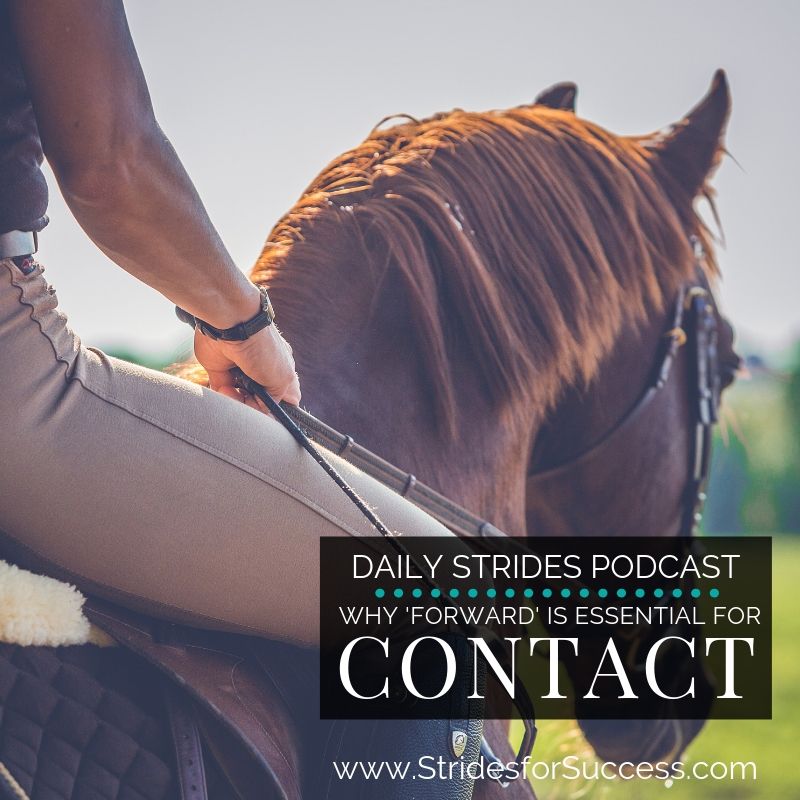
    Contact.  You know how important it is to your overall conversation with your horse.  However, for many riders, contact can be elusive!  It comes and goes without any real impact being made from it.

    Time and again I see riders in the arena, sawing the mouth off their poor horse in a desperate misguided attempt to achieve ‘on the bit’.  However, if ‘on the bit’ is the goal, it is important that we go back to the drawing board first.

    [smart_track_player url=”https://op3.dev/e/traffic.libsyn.com/dailystridespodcast/1103-Forwardness-is-Essential-for-Contact.mp3″ title=”Why ‘Forwardness’ is Essential for Contact” social_linkedin=”true” social_pinterest=”true” social_email=”true” tweet_text=”Is contact between you and your horse feeling a little elusive? This will help…” hashtag=”equestrian #horseriding” twitter_username=”strides_success” ]

    It is important that we first understand what is necessary in order for contact to be present between horse and rider. 

    In this episode of the Daily Strides Podcast you will learn why forwardness is key to creating a consistent contact with your horse.  How, without forwardness, there can’t be a contact.  And without true contact, the conversation will stall. 

    Contact Is a Result of Other Things Being Present

    I want to deal with this first.  There is a common misconception surrounding contact, which tends to make achieving it all the more difficult for riders.  Contact is not just the reins.  It is not just you holding the reins.  Contact is the result that happens when the other necessary pieces are in place.

    When you focus on making sure everything is ‘ready’, the contact will appear as if by magic.  Similarly, if the necessary parts are not in place, contact will remain elusive.  

    The first piece that is necessary to have in place in order to achieve true contact, is forwardness.  It is the foundation of it all. However, it is also the piece that is most often overlooked and missing.  If forwardness is missing, contact in the true sense of the word, cannot occur.

    What is Forwardness?

    Simply put, forwardness is you and your horse moving and thinking with a sense of purpose.  It is both a mental and a physical element in your riding.  Horse and rider must be thinking forward in order to move or actively engage in forwardness. 

    Forwardness is the energy inside the container that is you and your horse.  It is the difference between ‘dilly dallying’ and ‘focused’ movement. 

    I speak a lot about the importance of having an intention with each ride and each interaction with your horse.  Forwardness is the energy that moves you towards that intention.

    Failing to engage in ‘forwardness’ is like forgetting to turn on the engine.  

    What is Contact?

    Contact is also both physical and mental when it comes to your riding.  Many riders only focus on the physical element.  The reins.  Your hands.  The mouth and bit.  However, in order for true contact to be achieved, the mental element must also be engaged.

    Contact is like an unwritten mutual agreement between you and your horse, to move forwards on the journey together.  It is the relationship.  

    Contact is not a stand alone event.  It happens because other things are in place and present.  When all the conditions are present, contact will occur naturally.  When it is forced or when one side is not completely happy or confident in the contact, it is not true.

    Your Alignment in the Saddle

    I have already spoken about forwardness.  It is the foundation for your contact with your horse.  However, from there, the next element you can begin working on is… You!  What are you doing in the saddle?  How are you doing it?  

    How is your alignment?  Both physical and mental.  Position and thoughts. If you can remain aligned, contact becomes so much easier for you and your horse. 

    Physical alignment is your lines; head, shoulder, hip, heel and elbow to bit.  Mental alignment is having an intention that you allow to guide you throughout the ride.

    Relaxation, Rhythm and Suppleness

    The next pieces necessary for true contact is the proceeding steps of the traditional training scale.  Relaxation or, said differently, managing the tension for both you and your horse throughout the ride.

    Rhythm is the sequence of hoofbeats.  I find that trot is a great place to work with this. It has an energy to it and it also, usually, has a great natural rhythm to it as well.  The forwardness and the rhythm are easier to achieve. Suppleness is also essential.  The ‘loosey gooseyness’ of both horse and rider.

    Suppleness is also your approach.  It is a mental as well as physical element to riding.  It is both you and your horses ability to bend and flex, physically and mentally, depending on what shows up.

    Consistency is Another Key Element

    Once you understand all that is required for contact to be present, you job is to begin showing up consistently.  Your focus on the basics will result in your developing the more intricate aspects of your riding.

    If you lead by example, your horse will begin to align with you – and contact will occur!

    The goal is to develop both you and your horse enough that the contact is ever present.  Initially it may feel ‘touch and go’, however, over time if you are consistently practicing the basics, you will be able to maintain contact for longer periods.  Even in the halt.

    Consistent Contact; Even in Halt

    I said earlier that forwardness is essential in everything in riding.  It is the foundation.  However, many riders think that the halt is the exception to this.  It is not!  Forwardness must be present even in the halt.  And this can be seen through the contact when in the halt.

    Imagine a horse that is asked to halt without any attention being paid to ‘forwardness’ through the transition.  The horse will usually look hollow.  Collapsed through his body.  This is where you see riders furiously sawing at the mouth, hoping to get him back ‘on the bit’.

    Now, imagine a horse that is correctly ridden into the halt.  Even though he is stationary, he is thinking forward.  His core is also engaged.  His body contains the forward energy, which is engaged with the rider through the contact. 

    A halt that was achieved through working forward will result in a horse standing with a sense of purpose.  If the halt lacks forwardness, the horse will be almost slouching, hoping for a snooze!

    Engaging the Energy

    My hope is that, going forward, you begin looking at contact from a slightly different perspective.  Think of getting all the small dominos lined up so that, when activated, you can ‘knock’ the big domino that is contact.

    Focus on your intention and allow it to help you create positive energy in your ride. 

    This energy will help you to connect and engage all the necessary elements to allow true contact to happen.

    Happy Riding

    Lorna

    Other posts, episodes and resources that relate to this topic:-

    Daily Strides Premium

    Each and every month inside of Daily Strides Premium I host a live ‘Review and Planning’ call.  In there, you will go step by step through the month that was.  You then take that information and begin planning out the coming month.  When you will ride.  What you will work on.  And of course all aligned with your goals for you and your horse.

    Do you need to be competing? No!  Do you need to have competitive goals or ambitions? No again!

    In fact, I love working with riders who just ‘enjoy’ their horse; helping them to build and strengthen their relationship.  No competitions necessary ;) 

    Couple this with the live Q&As and the members only private group ~ we are here to help you remain accountable as team leader for you and your horse.

    All of the trainings are easily accessed using your phone, meaning that you can take them with you where ever you are going.  These trainings and so much more are available for you immediately when you join Daily Strides Premium. Find out more HERE