Tag: contact

  • Working Long and Low

    Working Long and Low

    [fusebox_track_player url=”https://op3.dev/e/traffic.libsyn.com/dailystridespodcast/SFA481-Working-Your-Horse-Long-and-Low.mp3″ title=”Working Your Horse Long and Low” social_linkedin=”true” social_pinterest=”true” social_email=”true” ]

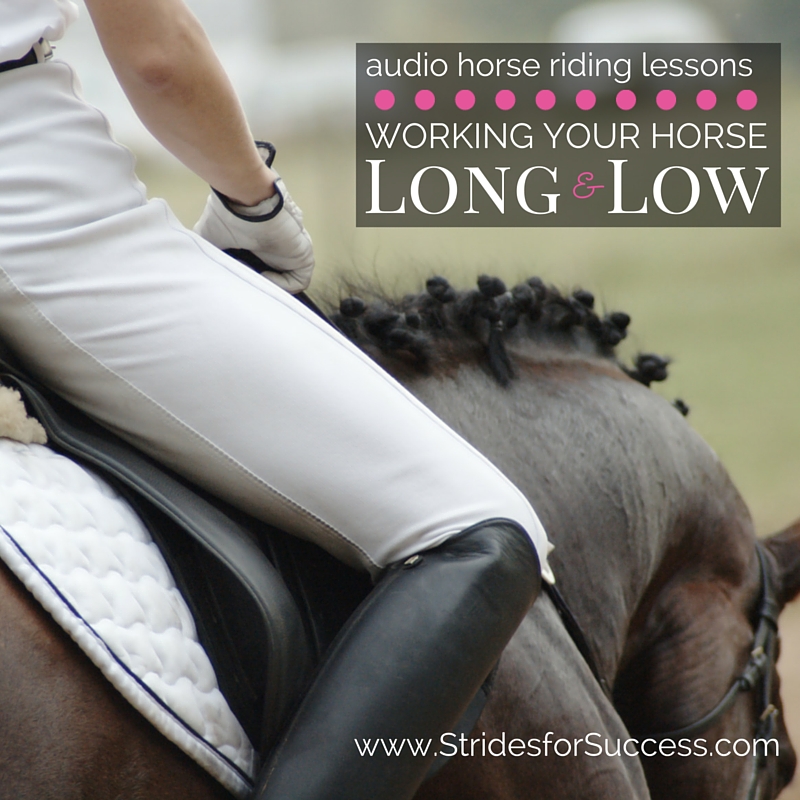
    So often when we are riding, relaxation for both ourselves and our horse is one of the goals for the ride.  This being so, you may have tried working him long and low. And probably during warming up or cooling off.

    However, you may also have noticed that asking your horse to work long and low can be pretty hit and miss…  He might get faster and faster as he becomes really unbalanced and begins falling onto his forehand…

    What is Long and Low?

    Working your horse long and low involves stretching and elongating his topline, from the tail to the poll.  

    It helps to build his topline, strengthening the ‘suspension’ muscles underneath you and also, create more longitudinal suppleness, which will benefit your horse greatly while being ridden.  So often when riding we think of suppleness as bending and flexing from left to right and while this is true, this is lateral suppleness.

    Working your horse long and low helps with his elasticity and flexibility from tail to poll, along his back, which is essential to his correct development.
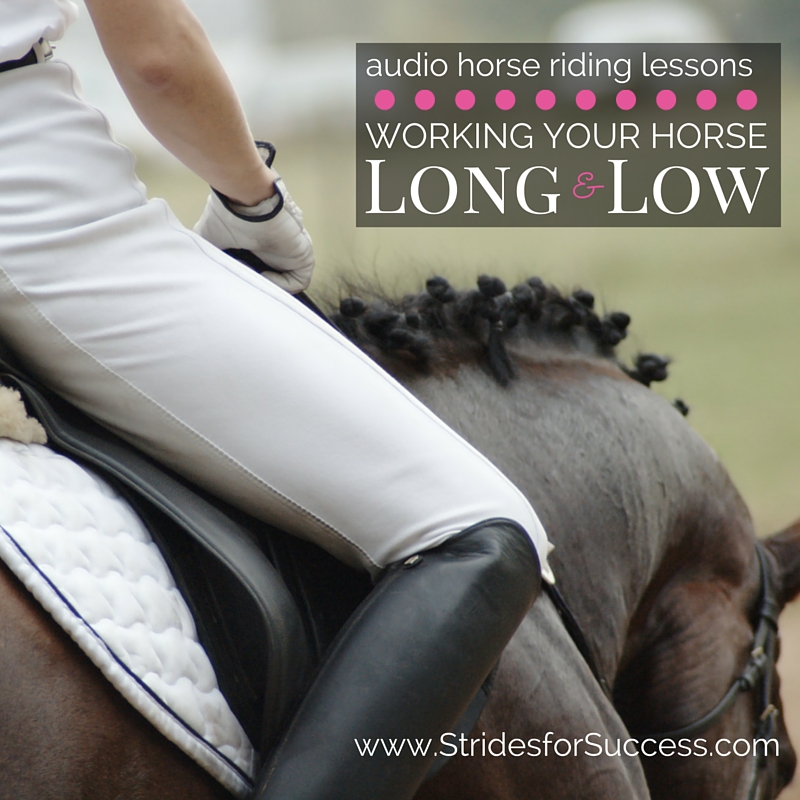
    Riding your horse long and low

    Increasing Flexion with Long & Low

    When riding your horse in a long and low frame, you will feel his hindquarters swinging underneath you.  This is due to the muscles in his back becoming more supple and loosening up.  This can only happen when your horse relaxes enough through is back, allowing the energy to flow and connect.

    This results in your horse developing an increased range of flexion and movement in his joints, which will allow for a bigger, more flowing, step or stride. And a more sound horse!

    Your horse should remain balanced, in rhythm and have a consistent forward movement while he is working in the long and low way, whether in walk, trot or canter

    Riding ‘the Rainbow’

    When you are correctly working long and low, think of your horse’s back as being a rainbow. And you’re perched on the top of that rainbow!  And just like with a rainbow where the ‘colour stripes’ begin at one end and follow through right to the other end, your horse’s energy should do the same.

    From the hindquarters, right through the back and to the contact with your hand in front.

    First Forwardness…

    First and foremost, there must be forward energy or impulsion happening in the gait.  This must come from the horse’s hindquarters coming in underneath him and ‘pushing’ off with each step.  It is also vitally important to maintain contact with your horse’s mouth.

    As your horse reaches forward and stretches down, your hands must follow.  Otherwise, you restrict him and may cause him to lean and get on his forehand.  

    Your job is to help keep the impulsion and the contact consistent while the horse is working long and low, all the while being light in the saddle. This is so his back can rise up and almost ‘arch’ underneath you.

    However, often riders do not understand the mechanics behind this frame and this generally results in a few different ‘variations’ of the movement. A lot of these ‘variations’ will result in your horse failing to maintain the balance, rhythm and forwardness that is required.

    Front-Wheel Drive Verus Rear Wheel Drive

    If the hindquarters are not stretching in underneath him, your horse will quite simply be in ‘front-wheel drive’. This is when he is pulling himself along using his shoulders rather than ‘rear wheel drive’; pushing from behind.  Horses that are in front-wheel-drive cannot then elevate their back due to there being no real support behind for the ‘suspension’ to happen.  They also cannot elevate their front end, which must lighten if true connection and suspension are happening.

    Simply put, if there is no forward energy or impulsion coming from the hindquarters to keep pushing that energy through, the ‘rainbow’ that is your horse’s back will cease to exist, making long and low impossible.

    Dropping the Contact

    Another incorrect method of the long and low movement being ridden that is often seen is the rider literally throwing the reins at the horse and hoping this will result in the horse stretching himself.  The rider completely fails to keep contact with their horse’s mouth.

    When asking your horse to transition into a long and low shape, the contact with your horse’s mouth is essential at all times.  Your horse must stretch into and reach for that contact.

    Even though your horse’s head and neck are much lower than where they are usually positioned when working, maintaining a consistent contact is essential if you are to contain the energy that is being created behind.  

    Your horse will reach down and almost stretch into the contact, which will see you lengthening your reins gently, stride by stride, as your horse stretches more and more.  However, your lengthening of the reins must happen in unison with your horse stretching, and most certainly not before!

    Blocking with Your Body

    One of the other, often seen ‘variations’ is the rider leaning forward with their upper body. They somehow think that if they themselves stretch long and low, their horse will follow suit!   Not only will this inevitably unbalance both the rider and the horse, but you are also literally ‘blocking’ your horse’s back from rising up to meet you.

    Remember, part of your horse working in the long and low frame comes from him engaging his tummy muscles to lift himself.  

    You must rather think of your riding position as lightning up with your horse. However, it is more of an up stretch, allowing for your horses back to then come up and meet you there than a forward lean.

    Start when Cooling Down

    I suggest that if you and/or your horse are new to this way of going to rather try after you have finished working your horse and are cooling down.  This way your horse is more inclined to want to stretch his back into the long and low shape and also, you will more likely to be working nicely in a balanced, rhythmic movement.

    While you can ask your horse to work like this in walk, trot and canter, I personally think trot is generally the easiest gait to ask in.

    This is due to the walk often not moving forward enough (with a great potential to get sticky and choppy) and the canter going the opposite way and moving too forward initially!

    When you are asking your horse initially, begin by doing something ‘different’ with how you ride, so your horse can see a difference.  One way of creating this difference is by positioning your hands differently.

    Try keeping your hands wide and lowered, but again, only as your horse reaches down into the contact.

    Maintain Forwardness & Flexion

    Remember to keep the forward energy happening throughout the movement.  Use a circle or bend to help with the flexion and suppleness, which even though more lateral, will help him also loosen up longitudinal as well.  You can begin to encourage this by using your inside rein to ask for some flexion through his poll towards the inside of your circle.

    Only ask for  3 or 4 strides of long and low initially, as your horse will have to develop himself to carry this frame for any length of time.

    Maintain Your Posture

    Keep in mind that you must be sitting up and allowing him to arch his back and bring it up. This is as his hindquarters come underneath him and as he stretches his head and neck down.

    If you are heavy or collapsed in the saddle in any way, you will block this energy resulting in your horse hollowing his back rather than lifting or arching it.

    Stay in rising trot rather than sitting trot.  This is because if you tend to bounce, the sitting trot will cause you to ‘dig’ into his back and encourage him to duck and hollow his back away from you, not lift his back up underneath you

    Maintain Contact

    Focus on keeping an unbroken line from your elbow to your horse’s mouth.  As your horse lowers his head and neck, you too will have to lower your hand to maintain this line.

    However, equally as important to remember not to completely straighten your elbows as this will cause a jarring effect on your horse’s mouth and again, result in him becoming hollow along his back and trying to evade your contact rather than trust it.

    When he has begun to drop his head and neck and stretch down, focus on your position.  Feel his back rising or growing in height underneath you and use this to remind yourself to continue to sit tall in the saddle and stay light.  Focus on balancing your shoulders above your hips, not leaning forwards, backwards or to either side.

    You’ll Know When You Feel It…

    Finally, remember to enjoy the amazing sensation when your horse correctly works long and low.  If you are wondering if you got it right or not, trust me, it is one of those things that once you achieve it, you will definitely feel it :)

    How long it takes your horse to understand what you are asking will really depend on your horse.  Some horses have become so used to leaning on the rider’s hands. Travelling on the forehand like this will take some time for them to build up the trust and strength to work long and low.  Other horses love it and almost naturally transition there after work to ‘stretch out’ their muscles.

    Either way, you must remain consistent through your aids and patient while asking your horse.

    Your horse must first learn to accept your contact before you can begin asking him to work in a long and low frame.  

    From there, it is up you to maintain the impulsion and forward movement that is necessary to maintain the balance and rhythm, that will result in your horse reaching for the contact and truly stretching his topline.

    Happy Riding
    Lorna

    Additional Resources on This Topic

    Working Long and Low

  • Applying the Rein Aids while Riding

    Applying the Rein Aids while Riding

    .. This[fusebox_track_player url=”https://op3.dev/e/traffic.libsyn.com/dailystridespodcast/SFA471-Applying-the-Rein-Aids-as-You-Ride.mp3″ title=”Applying the Rein Aids as You Ride” social_linkedin=”true” social_pinterest=”true” social_email=”true” ]

    Do you find yourself becoming confused and frustrated about how you are supposed to be using your rein aids while riding?  Do terms such as soften your rein, fill up your rein, hold with the rein, lighten the rein leave you baffled?  Not to mention how much pressure is good and how much is too much?!

    I want you to take a quick trip down memory lane and back to your first ride on a horse…  Chances are that back then, before you knew any different, you thought of your reins as the means to steer and stop your horse.

     However, you soon began to realize that while your reins make up part of the system to do this, in order to really have a happy contact with your horse, you needed to reframe how you think of your reins. And what you use them for.

    Applying Your Rein Aids while Riding

    What are Rein Aids For?

    Your reins are, first and foremost, the way that you collect the energy your horse creates in his hindquarters and back, so you can then channel it where you want it to go.

    This is done through you have a consistent contact on the rein. This allows your horse to build trust in you that you won’t catch him or drop him while he is working into that contact.

    However, before you can even begin thinking about this, we must first discuss how your hand will come to meet the rein and the effect this has on you and your horse.

    An Extension of Your Core

    While your hands are holding the actual reins, it is good to keep in mind that they are merely acting on behalf of your body.  

    This means that any aids happening through your core are connected to the conversation you are having with your horse down the rein with your hands.

    A practical example of this is a pony trying to eat grass while being ridden.  Riders that depend on the strength of their arms to apply rein aids will be pulled forward out of the saddle when the horse puts his head down.  However, a rider that is connected through their seat and core, merely using their arms and hands as an extension of this, will sit tight as their core will come into play rather than their arms.

    Your Hands and Arms

    It amazes me that so many riders still believe they are strong enough through their arms to ‘win’ a pulling match against their horse.  The sad part is that the pulling match should never happen to begin with.

    Your hands have an important job of gathering up the energy created by your horse, however, this can only be achieved if your horse trusts your hands enough to connect that energy with them

    Next time you are in the saddle, become aware of the fall of your arms as you ride.  Is it a natural fall?  Are you perhaps overarching your back? Is this resulting in your elbows being slightly behind your body?  Or maybe you are collapsing your upper body causing your elbows to be in front of your body?  How supple and flexible are your elbows?

    Your arms should fall from your shoulders in a natural position.  

    Being supple and soft means that there will be little tension in them, just enough to carry your hands, which should be on a straight line between your elbow and your horse’s mouth along the rein.  Your wrists should be straight, never clawed or bent.  In fact, if you have to claw your wrist to ‘activate’ the rein, your reins are too long!

    Your fingers and hands should also be soft and supple.  Try not to clench your fingers into a fist.  Rather use your thumb as a ‘clamp’ to hold the reins which will allow your fingers to follow and communicate with the rein and your horse’s mouth.  Keep the pads of your finger tips as the touch point with the palm of your hand.


    Suppleness Through Your Body

    If your horse trusts you to be consistent and considerate with the rein, he will ‘seek’ the rein by moving his poll forward and down into the contact.  A horse trying to evade or get away from a sharp hand will rather move his head up and back, causing his back to hollow.

    Focus on keeping your hand and elbow supple and elastic.  Move with your horse

    So often horses that have been labeled as lazy or not very forward are this way because of a rider that failed to follow with their hand.  Turning your knuckles on top, rather than your thumb, causes a similar scenario.

    When you think of giving with your hand, think of allowing through your fingers first and then, if necessary through your elbows.  It should be a slight, subtle communication with your horse.  Work on how you can ‘allow’ using your fingers and next time you ride see if your horse responds to this more subtle direction.

    The same applies when you think of taking or restraining; imagine moving the pads of your fingers closer to your wrist or ball of your thumb, gently closing your fingers rather than stiffening or clamping your fist.

    Building Responsiveness

    As you are practicing this, pay attention to how much pressure you are applying and how your horse responds.  This can be a confusing principle for many riders.  And it is often compounded by the fact that their horse may have already become a little hard or unfeeling through his mouth due to being ridden with hard hands before.

    I suggest that rather than thinking about applying pressure, reframe that into what is necessary to ride your horse at that time in order to achieve or maintain the desired outcome.  Then, over time, make adjustments and refine how you are applying the aid

    The amount of pressure in your hand will directly correlate to how your horse is going. From the hindquarters through the back. And then resulting in where his head and neck are positioned due to this way of going.

    Rein Aids & Self Carriage

    The more true collection your horse has achieved, the lighter he will be in your hand. This is because he is now carrying himself. The result is that his poll having lifted up and is now situated closer to your hand.  When working in a more relaxed outline, there will be a more consistent pressure.

    Your job, as the rider, is to maintain that balance between your hand and your horse’s mouth through the rein.

    However, if your horse is heavy on the forehand or leaning, you will feel a distinctly heavy and uncomfortable amount of pressure or weight down the rein.  This is due to your ‘carrying’ him, rather than, as we just mentioned with the collection example, him carrying himself.

    Consistent Contact (versus ‘Piano Fingers’)

    The final point I want to talk about is ‘piano fingers’!  Many riders think that by opening their fingers completely on the reins, they are somehow being nicer to their horse.  Bear in mind that contact through the rein is a conversation.  And conversations are a two-way street…  Opening your fingers stops you from hold up your end of the chat!  Rather work on being more supple and following through your hand, elbow and shoulder.

    From there, when your horse learns to trust your contact, you can begin refining the pressure and movements in your communication.

    I also feel it is important to note that this consideration of your horse’s mouth should colour all aspects of your time in the saddle.  From gathering up the reins initially. To shortening and lengthening the reins (which we have a video on). And even to rewarding your horse by softening or giving with your inside rein.

    Subtlety is the key to success where your horse’s mouth is concerned…  Be gentle, soft and kind at all times.

    Your Responsibility…

    It is worth repeating again that in order for your horse to truly accept the contact you are providing down the rein, you must first guarantee him that you are going to provide a steady, soft, consistent contact to begin with.

    And just like your horse having to strengthen himself in order to build up to a more collected way of going, you will too.  This means finding ways to develop an independent seat. And practicing on making changes and adjustments gently and softly

    Happy Riding
    Lorna

    Additional Resources for Equestrians:-

    Applying Your Rein Aids while Riding

  • Controlling Your Hands While Riding

    Controlling Your Hands While Riding

    Do you find that often when you ride, your hands begin to do their own thing?  Waving about, flagging some imaginary air traffic, conducting a symphony, or just bouncing up and down like a jack hammer?!  To make this even more frustrating; it seems like the more you try to ‘quiet’ or ‘still’ your hands the worse the problem becomes…

    [smart_track_player url=”https://op3.dev/e/traffic.libsyn.com/dailystridespodcast/SFA371-Controlling-Your-Arms-and-Hands-While-You-Ride.mp3″ title=”Controlling Your Hands and Arms While You Ride” social_linkedin=”true” social_pinterest=”true” social_email=”true” tweet_text=”Having trouble with controlling your hands in the saddle? This will help…” hashtag=”horseriding” twitter_username=”strides_success” ]

    The uncomfortable truth is that while you might be feeling frustrated about your lack of control, it is often your horse that is taking the brunt of this particular riding challenge. He may begin to fight you for the reins, lean on you or pull you along.

    Or maybe you spend time while riding continuously changing or fiddling with the length of your reins, dropping your hands and straightening your elbows, twisting your wrists so your knuckles are on top.  Or perhaps you are flapping your shoulders and arms in an attempt to ‘relax’ and all the while, that soft, following contact with your horse’s mouth continuously evades you…

    Controlling Your Hands and Arms as you ride

    Steady hands come from a relaxed body that is carrying itself. Relaxed does not mean floppy or loose, but rather supporting yourself without any signs of tension. Relaxation will also allow your body to follow your horses movement, which is the first key to controlling your arms and hands. I realize that it seems almost counter intuitive to focus on your body first when trying to ‘fix’ your hands, however one will not happen without first controlling the other.

    When your body is relaxed, your ‘shock absorbers’ can work optimally, working with the energy from the horse and not against it. Often hands that bounce around are the result of a rigid or tense rider, who is only rigid and tense because they are trying so desperately to control their body! It is a vicious cycle.

    The first thing to do is begin paying attention to your seat and pelvis and how, in walk, they follow your horse. Notice your breathing, and lift your upper body to allow your lungs to fill with air with each breath, to remove any tension from your body. Open your chest, remembering all the while to carry your body, not slouch, and then allow your arms to simply fall from your shoulders.

    Then remember to carry your hands. Don’t just allow gravity and your horses mouth to dicate where your hands are at any given time. In order to become soft through your contact, you must carry your own hands, which means bending your elbows. A good guide line is to try keep your hands around the height of your belly button.

    Once you have your hands where they should be, pay attention to how your shoulders, upper arms, elbows, fore arms, wrists and fingers all work together to follow your horses mouth. If you move your hand forward, move it from the elbow. Supple elbows will allow you to absorb movement and continue to keep a soft contact.

    Pay attention that your fingers are closed on the reins. Also, that you are ‘holding’ the rein with your thumb by pinching the rein between your thumb and index finger, not by squeezing your fingers. This will then free up your fingers to have more subtle ‘conversations’ down the reins to your horses mouth. Holding the reins this way will also prevent your reins becoming long and causing you to drop the contact with your horse.

    Controlling Your Hands adn Arms while you ride

    Begin establishing a following contact by lengthening your reins out, so you initially will have very little connection with your horses mouth. Move your elbows and hands with your pelvis and seat. Think of them being somehow invisibly connected to each other and relaxed enough that the movement of your horse underneath you is enough to quietly influence your body. Don’t force the movement, you must follow your horse, not drive your horse along by pushing with your seat or hands. When you feel that you are now following your horses mouth, you can begin to slowly gather up your reins again and begin establishing a contact with your horses mouth. If you feel any tension coming back, gently lengthen your reins and begin again.

    Another good visualization you can use is to think about carrying cups of hot tea… If your arms are tense, the tea will splash and spill from the cup.  If your arms are floppy, the same thing will happen. Only when your arms are ‘working’ with your moving body, will the tea stay in the cup!

    Remember that you do need to have a contact when riding. However that contact must come from soft, following hands that provide steady, consistent support connection and direction when needed. Sometimes it seems that more emphasis is placed on the leg and getting our horses back end working underneath him while being ridden. And this is true…

    However, there must also be a contact to direct and contain that energy and ask your horse to work in a frame. Be careful not to hang on your horses mouth, but also not to lose the contact either. It is a fine balance, which needs to be continuously re-evaluated and adjusted depending on the work or the results of other aids.

    30 Day Rider Fitness Challenge

    A strong core must be maintained throughout, so you are carrying yourself and are agile enough to follow your horse. When you can begin to confidently carry both your body and your arms, you will find that the tension which was causing the jarring or bouncing will soon dissipate, leaving you with quiet, soft hands from which you can begin direct that wonderful energy.

    Happy Riding
    Lorna


  • Riding on the Bit

    Riding on the Bit

    [fusebox_track_player url=”https://op3.dev/e/traffic.libsyn.com/secure/dailystridespodcast/576-Correctly-Riding-Your-Horse-On-The-Bit.mp3″ title=”Riding On the Bit” social_linkedin=”true” social_pinterest=”true” social_email=”true” tweet_text=”Struggling with On the Bit? This will help…” hashtag=”horsepodcast, #equestrianpodcast” twitter_username=”strides_success” ]

    So, we’ve all been there, riding around the arena on our horse, desperately seeking the elusive ‘On the Bit’.   Pumping with our legs, ‘sponging’ with our hands; doing our level best to achieve what is beginning to feel like the holy grail of riding a horse!

    All the while hoping, praying, wishing (hey, when you are desperate you will resort to anything!) that a lightning bolt will just shoot out of the sky and, **Poof**, your horse is ‘on the bit’!

    The sad part is that the more we pump with our legs, push with our seat and plead with the Good Lord to show us mercy and deliver us from this agony that is our desperation… The less and less likely we actually are of achieving our goal!

    For many trainers, it can feel like there is a fine line when explaining this concept.  I am taking the brave (or stupid, depending on where you see the line) step of trying to decipher this massive mystery.  A feat by which so many riders define themselves.

    Riding on the Bit - Daily Strides Podcast - Strides for SuccessWhat Is ‘On the Bit’?

    The term ‘on the bit’ is an extremely misleading one as rather than focusing on your horse’s head, neck, and mouth.

    Your focus as the rider should be on what you are staying to your horse through your aids.  And then noticing how your horse is then using his body in response to this.

    The key to truly having your horse accepting your contact is the reason behind wanting him to do so.  So you can collect and then channel the energy that is being created in his hindquarters as it passes through his body to his front end.

    Developing On the Bit in Your Riding

    As this energy is then gathered and channelled, you will find both you and your horse on the bit.  You may only see glimpses at first; but over time this will develop.  you will both learn to establish on the bit earlier in the ride.  And also, maintain this contact and connection for longer periods as you both develop.

    The rider needs to begin making small adjustments. Not only their body, but their mind, so as they can become ‘feather riders’ and allow the horse to actually use his back underneath them.

    I discuss this topic in far more detail in the following blog and episodes posts:-

    Happy Riding
    Lorna

    Additional Resources To Help Equestrians:-