Tag: daily strides podcast

  • Top 3 Mistakes when it Comes to Groundpoles

    Top 3 Mistakes when it Comes to Groundpoles

    Top 3 Mistakes when it comes to Groundpoles

    What this episode is all about:-

    • Mistake 1:- Overestimating the amount of poles and complexity of exercise
    • Mistake 2:- Incorrectly mapping the distance or adjustments
    • Mistake 3:- Not realising how much influence you have over your horse

    [smart_track_player url=”https://op3.dev/e/traffic.libsyn.com/dailystridespodcast/1054-Top-3-Mistakes-when-it-Comes-to-Groundpoles.mp3″ title=”Top 3 Mistakes Riders Make when it Comes to Groundpoles” social_linkedin=”true” social_pinterest=”true” social_email=”true” tweet_text=”Are you making any of these 3 mistakes when it comes to your groundpoles in your schooling? ” hashtag=”Equestrian #Podcast #groundpoles” twitter_username=”Strides_Success” ]

    If you have been riding for any length of time, you are probably well versed on the benefits of groundpoles.  In fact, I would bet that you have tried them a few times…However, there are a few basic mistakes riders make when it comes to groundpoles in their riding and I want to address them today.

    This episode of the Daily Strides Podcast is specifically about the top three mistakes that riders make when it comes to groundpoles. These are the things that show up time and again when schooling horses using poles.

    Fortunately, they are easily ‘fixable’, so you can really make your groundpoles exercises work for you and your horse.

    Mistake 1:- Overestimating the amount of poles & complexity of exercise

    Many riders fail to ever get started on their groundpoles journey due to this misconception regarding working with the poles. They believe that they need a lot (read 20+) poles laid out in complicated shapes.  Couple this with needing a massive, undisturbed or private arena to do this in…

    I think this belief comes from seeing the beautiful pieces of art many trainers share on Instagram, Pinterest and similar…  I say ‘art’ because this is really what these types of grids are.

    Groundpoles do not have to be complicated. You can do just as much with three to five poles, and get so many wonderful benefits as well.

    Couple this with the fact that your poles don’t have to be long jumping poles.  Shorter and ‘sturdier’ poles can work just as well.  In fact, the shorter poles will encourage more accuracy.  Also, the less poles you have, the more ‘outside the box’ you need to be and the more specific you need to be.

    Limiting yourself to what you have really can work in your favour.  You will find that you will spend more time mastering those basic exercises you are working through – which will benefit you over time.

    Mistake 2:- Incorrectly Mapping the Distance or Adjustments

    The second area where riders tend to get all caught up is when it comes to working with the distance between their groundpoles.   Many riders feel a little unsure about the distance – usually because it looks so much bigger (or smaller) than they think it can be – that they stick to ‘what it said in the book’.

    Remember, books, blog posts and videos are just guidelines. All horses are different, and when you are going to set up your groundpoles, let the distances from the books, videos and blog posts be your guidelines – not your ‘exacts’.

    The ‘correct’ distance is important, however it is equally important that you make sure to then adjust the distance further to suit your horse.

    Later, when you and your horse become more experienced and when your horse is more developed, you can both make the necessary adjustments to suit the ‘correct’ distance.

    When you are starting out, try to make your horse and yourself as comfortable as possible. We want it to be fun and enjoyable. Be flexible, rather than rigid, in the beginning.

    The other added advantage to making these adjustments along the way, is that you can almost measure your progress. As the Team (you and your horse) become more put together, you will be able to see your progress by the way you are moving, or adjusting, the groundpoles.

    Mistake 3:- Not Realising How Much Influence You Have Over Your Horse

    Many riders will go out there.  Set up their groundpoles.   ‘Roll the pole’ to suit their horse.  But then become upset that their horse is not doing things quite the way they want them to do it.   This is most likely a rider issue.  Figuring out if this is the case, or not, if paramount here.  Firstly, you can get off your horse and rather lunge your horse over the poles.  Allow your horse figure it out for himself.

    This is particularly  valuable when it comes to your horse developing his own balance, and just figuring out, in general, where to put his feet and how his body works.

    Remember that groundpoles are a little like gymnastics for horses. Many riders think that gridwork is the ‘gymnastics’, and yet groundpoles are the basics, the bones, for gridwork.  You can definitely allow your horse to discover how he is able to use his body over the poles by lunging him.

    Secondly, back in the saddle remember that every movement that you make can influence your horse. Some influences are positive and some are negatively.

    When things are not working out as you would like, consider for a moment that it could be you.

    The ‘Loose Backpack’ Analogy

    A good way of explaining this, and one I use regularly in the arena with riders is the ‘loose backpack’.  There is it, is just bobbing about on their backs – the riders back.

    It is heavy, loose-fitting and, in general, is knocking the balance of stride.  This leads to knocking the rhythm; which leads to a lack of relaxation due to the knock on effect of increased frustration.

    Sometimes we can be that backpack for our horses.

    Now,  I want you to think about doing that same exercise with a well fitted backpack.  It moves with you, it is not bouncing about all over the place and it is so much easier to find your own balance.

    Groundpoles & Applying This to Your Riding

    Think about this when you are riding over the poles. Focus on getting out of your horses way, but also not just throwing the reins him. The contact and connection are still really important, and in order for you to have that contact and connection you need to develop a certain amount of suppleness around your body, while working on increasing your horses suppleness.

    I have a past episode of the Daily Strides Podcast which includes ‘contact over groundpoles’  HERE which you can have a look at.

    Here at Strides for Success, we are working on horse riding being a ‘Team Sport”.  You need to play your part by being supple in order to help your horse – and your team.

    1. Understand and recognise when you are balanced
    2. Understand contact and connection – and how it affect every day riding

    Connection Through the Whole Line

    Issues with connection, for a lot of riders, appears after the poles.  Riding the poles is easy enough using the basic light seat.  The trouble comes in when the poles are finished and the rider wants to go back to their more upright normal seat.

    The ‘reconnection’ of your seat must be a lovely and smooth reconnection

    Riders forget this and just plug their bum in to the saddle.  The result is that they become heavy and, well,  not so nice for the horse. Remember that you are always trying to cultivate that connection with your horse, and the connection is the conversation.

    A conversation never just ends.  There is a lovely ‘flow’ to things, and it is this flow that you should be working on as a rider when working over groundpoles.

    July 2018 is dedicated to Groundpoles inside of Daily Strides Premium.   All past themes are available for you inside of there when you become a Daily Strides Premium Member.

    Happy Riding

    Lorna

    Links mentioned in the episode:-

  • True Impulsion versus Running when Riding

    True Impulsion versus Running when Riding

    True Impulsion versus Running when Riding

    What this episode is all about & how it can help you:-

    • What is impulsion
    • What is necessary for you to maintain impulsion
    • How to know if the energy is “falling out”
    • Working towards consistent impulsion

    [smart_track_player url=”https://op3.dev/e/traffic.libsyn.com/dailystridespodcast/1053-True-Impulsion-versus-Running-in-Your-Riding.mp3″ title=”True Impulsion versus Running in Your Riding” social_linkedin=”true” social_pinterest=”true” social_email=”true” tweet_text=”Are you creating impulsion – or just ‘running’ in your riding?” hashtag=”Podcast #Equestrian” twitter_username=”strides_success” ]

    We have all been there…   In the saddle and wanting to do something.  You ask for ‘more’ but instead of being able to harness that energy, it tends to just fall out the front end!

    This episode of the Daily Strides Podcast is all about what impulsion is, and how you can use it in your riding.

    What is Impulsion?

    Impulsion is basically the energy that is created within yourself and your horse as you are riding, in order to do something. If you are moving forward with a sense of purpose, you have created energy.

    However, true impulsion is not just the creation of the energy, but the actual management of the energy.

    Having the energy to work with is not enough.  You must learn how best you can tap into it.  The energy must be a resource which you can use when you need it.  This can be a certain movement.  A specific question you ask your horse.  Maybe a transition or a jump.  A lengthening or shortening. All of these things, if ridden and performed correctly, need to have impulsion present.

    Impulsion versus Running

    Many riders go wrong by forgetting (or not realising) that true impulsion takes quite a bit of training in order to really master it. They create ‘running’, rather than true impulsion.

    Running and impulsion are two very different things.  What is necessary in order to maintain impulsion, the preceding ‘steps’ in your horses training program, are often missing or not well established.  It can feel like your horse is diving forward like an arrow.  The energy is present, however the management of that energy is lacking.

    True impulsion creates a feeling of lightness.  This is due to the presence of self-carriage from your horse.  Self carriage can only be developed with correct training over time…

    What is Necessary for You to Maintain Impulsion?

    One of the simplest ways to understand impulsion is to look at where it ‘resides’ in the steps of the traditional Training Scale.  The principles or steps that come before or underneath it need to be present in order for it to be present. Relaxation, rhythm, suppleness and contact.  Once those steps are present, then you can then begin working on true impulsion.

    However, I personally think that you can begin working on this from the beginning.  Forwardness is key in riding.  It is energy.  The true management that comes with impulsion may not be present, however cultivating forwardness the beginning of it.

    Before you work on anything else, it is important to ensure that both you and your horse are thinking forward. Again, impulsion is the management of forwardness.  In order to begin managing, you need to have something to manage – the energy.

    Recognising When the Energy is ‘Falling Out’

    As already mentioned, running feels very much like everything is falling out the front end. Sometimes it can look and feel like heaviness; carrying the weight of your horse on your shoulders!  Running is exhausting for both horse and rider.

    Running or falling out is your lack of any real influence or impact on what is happening with the energy.

    I hesitate to use the word control, simply because a lot of riders then feel that they need to control the situation. You can only control yourself.  You can never truly control your horse. You influence your horse. Which is why running is a result of not having the required amount of influence over the horse.

    Another way a lack of impulsion can feel is when there is nothing coming through. Sometimes there is not enough energy being created in the first place. There is nothing there to connect through. Falling out can also be through the shoulders, the hind quarters.  Anywhere that there is a lack of energy or management when it comes to the ride.

    How You Can Begin Working on Improving Impulsion

    I’m going to suggest the most obvious and less exciting path; the one of going back to basics! Begin working on the energy today, even if the basics are not in place. Work through your schooling movements with a focus on forwardness, which will eventually become true impulsion.

    Forwardness is to have your horse both moving and thinking forward. The ‘thinking’ part is very important. Many riders forget this, however it is a vital component to the horse moving and working correctly.

    Once you have established forwardness in all you are doing, then you can begin ‘tidying things up’. This is where your rhythm, relaxation, working into the contact, ensuring your horse is nice and supple and make sure he is working through his back all come into play.

    Incorporate transitions up and down.  Be mindful of when and how you apply your half-halt. The key is consistently riding through the basics correctly.

    Correct Management Depends on You

    Impulsion is management, and it is your ability to manage all those things. I believe that the training scale is just as important for riders as it is for the horses. Work on establishing YOUR rhythm, YOUR relaxation, YOUR suppleness.

    There must be a constant progress, building, happening in your riding. Strength comes from true suppleness. Make sure you understand fully what contact is, and that you are showing up each and every ride being the consistent contact.

    When those pieces are in place, you can then begin to effectively manage the energy as it is flowing through. That is true impulsion.

    Think of all the parts of your body that you are using to make a connection with your horse.  It is truly working with all your different aids to build both you and your horse that results in true impulsion.

    Happy Riding

    Lorna

    Links mentioned in the episode:-
    
  • Confidence, Building it from the Ground Up

    Confidence, Building it from the Ground Up

    Confidence, Building it from the Ground Up

    What this episode is all about & how it can help you:-

    • It is your journey – so it can be what you want it to be
    • Find your confidence ‘reset point’ and stick to it for a while
    • Becoming confident in being a little uncomfortable
    • Consistency, Support and Stories…

    [smart_track_player url=”https://op3.dev/e/traffic.libsyn.com/dailystridespodcast/1048-Confidence+and+Building-it-From-the-Ground-Up.mp3″ title=”Confidence; Building it From the Ground Up” social_linkedin=”true” social_pinterest=”true” social_email=”true” tweet_text=”Is there a story playing in your head that is stopping you from getting into the saddle? Building Confidence… ” hashtag=”confidence #lovinghorses” twitter_username=”strides_success” ]

    Does the thought of getting into the saddle fill you with a sense of anxiety and dread?  Yet you really want to be able to ride your horse in a way that gives you a sense of enjoyment?

    This is the ‘catch 22’ faced by a lot of riders.  The trouble is, even though there are so many riders feeling this way, it is a very lonely place to be on your riding journey. This episode of the Daily Strides Podcast is the episode for you.  My hope is that, after listening, you will feel more confident about thinking about the journey back into the saddle and anxiety free riding.

    Why This is an Important Topic

    I regularly get emails from riders, all over the world, asking me what they can do to get back into the saddle. This in part comes from the fact that I created the 30 Day Rider Fitness Challenge.  A lot of riders take the challenge because they hope that by feeling fitter, it will actually grow their confidence.  I do believe that while fitness is definitely part of building confidence, it is not the full story.

    It is important that you understand as a rider, that you can never really control the horse.  You can influence the horse. The only thing you can truly learn to control is yourself. 

    If you can learn to have more control over yourself, you can learn to have better influence over your horse.

    Today I want to start from the ground, and work up from there. This is where I suggest that any rider who is in this particular situation should start.

    This is Your Journey

    Make it exactly what you want it to be.  Not what other people want you to make it.  Very often when a rider is feeling anxiety, or pressure, some of it is coming from outside forces. Simple questions like; “But you have a horse, why don’t you ride?” or “But you used to do all of this, why aren’t you doing it anymore?” or “It’s simple, it’s easy, just do it, get over yourself!”

    Those questions are probably coming from a good place. They might be coming to you with the greatest of intentions.  But they are not helping you.  At all.

    The first part of building confidence is realising that your journey with horses is just that – YOUR journey.

    The reason you want to include horses in your life is because it probably makes you feel good. However, if you are feeling anxiety, stress and all of these negative feelings, well, they are the exact opposite of good.

    Stop.  Hit the re-set button. Choose what you want.  And feel good about it because, again, it is your journey and you can make it whatever you want it to be.

    Finding Your Confidence Re-Set Point

    Find the place where there is no anxiety, and stick there for a while.  I know that is not always the fun or exciting thing to do.  In fact, it is probably not what you want to hear at all…  However, I really believe that this is the only long-term way of actually getting yourself to a place where you can enjoy horses again.

    Your ‘place’ could, for example, be just talking to your horse over the paddock fence.   It could be talking to your horse in the stable.   It could be taking your horse with a head collar and lead rope for a walk.   It could be having someone lead you on your horse.

    It doesn’t matter what or where it is.  Remember, this is your journey. I want you to find the place where you don’t have anxiety, and I want you to settle in there and get used to it. Every time you see a horse, or see something on Facebook about horses, or you are looking at pictures of horses – I want you to think about this place with no anxiety.

    It is going to take time, and it is going to take commitment on your part, because you are consciously going to have to find ways that are going to make you think about that ‘happy place’ with your horse.  However, it is well worth the ‘mental conditioning’!

    Becoming Confident in Feeling a Little Uncomfortable

    Once you are there, and only when you are there in your place where you don’t feel the anxiety anymore, you can think about growing.  Start to become a little more confident by becoming a little bit more uncomfortable.

    Uncomfortable for you might be having somebody lead you on your horse.   It might be going for a 5 minute ride in walk, in a lunge ring.   It could be getting into a 20 x 40 meter fenced arena and going for a trot. It doesn’t matter what it is – it’s about what it is to you.

    What is important is that at any point, you know that you can go back to the ‘comfort zone’, but you are going to challenge yourself.

    Because you know how comfortable the ‘comfort zone’ is, and because you feel so safe and secure there, you can then stretch things a little, and push yourself into the uncomfortable part.

    You will start noticing how the uncomfortable part begins to feel comfortable. And that is it – slow and steady. You don’t move out of that uncomfortable zone, until that uncomfortable zone begins to feel comfortable. In this way, your ‘comfort zone’ is expanded and bit by bit, you can move forward.

    Confidence, Consistency and Stories…

    In the beginning, this takes time. But you will find that once you start to get the little ‘win’, and then the next little ‘win’, things will start to gain momentum.  The discomfort dissipates quicker and quicker each time.

    As you start to feel more confident about your own abilities, you see that perhaps the story you were telling yourself, wasn’t the truth. And even if that story was the truth at that time, it is not the truth anymore because you have changed as a person.

    You have changed on the inside, and you have re-set what was making you feel anxious and tense. Simply put, because you have changed, you have to now change your story to match this new you.

    You must change what you are telling yourself, what you are telling people and, importantly, what you are allowing people to tell you.

    Finding the Right Support

    All of this takes time.  Which is the frustrating part for many riders.  You can speed the process up however, if you find the right support.  Support in the form of a knowledgeable person whom you trust. Somebody who will stay with you and allow you this time.  Not the person who says one thing and then without warning, proceeds to unhook you and leave you high and dry!

    A trustworthy, sympathetic and compassionate person who is also going to ground you back into reality. A person who, when your story is a little ‘muddled’, you can rather listen to theirs for that moment.  Just until you feel relaxed again. 

    I wish you all the best with this.   Know that it can be done!  All it takes is that you get clear on what you want – not what people want for you. Then start today to take those small steps towards confident riding again. You can do this!!

    Happy Riding

    Lorna

    Links mentioned in the episode:-

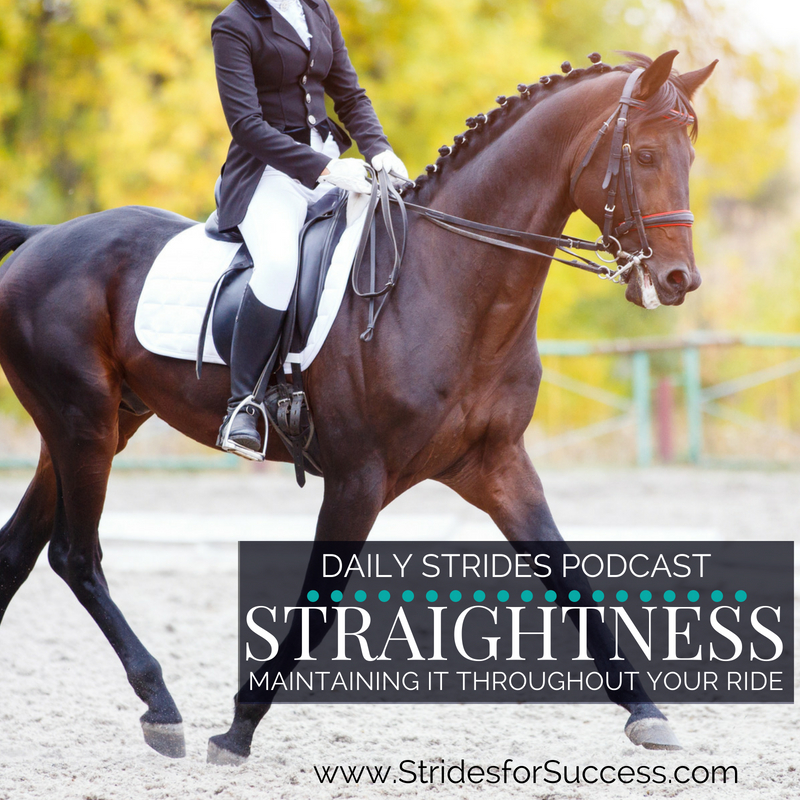
  • Maintaining Straightness Throughout the Ride

    Maintaining Straightness Throughout the Ride

    Straightness, Maintaining it Throughout Your Ride

    What this episode is all about & how it can help you:-

    • Be clear on what is straightness
    • Understanding how your aids are a mould
    • Knowing why you have to regulate where the energy is flowing
    • Notice when things are crooked

    If I were to stand in the arena, and you were to ride directly towards me – how straight would you and your horse be?  And how well could you maintain that straightness?  Be honest!

    [smart_track_player url=”https://op3.dev/e/traffic.libsyn.com/dailystridespodcast/1047-Maintaining-Straightness-Throughout-Your-Ride.mp3″ title=”Maintaining Straightness Throughout Your Ride” social_linkedin=”true” social_pinterest=”true” social_email=”true” tweet_text=”Struggling with keeping things on the ‘straight and narrow’ with your horse? ” hashtag=”equestrian #horselovers #makeeveryridegreat” twitter_username=”strides_success” ]

    Before we even get into the straightness it is important to stress the fact that, in order for your horse to be straight, there must be energy happening inside of his body.  Often riders try to work on straightness, but there is just no energy happening!

    If you look at the traditional Training Scale, impulsion comes before straightness.  Phew – that being said, let’s crack on with today’s topic…

    What is Straightness?

    If we were in an arena together and you were to ride towards me, I would assess straightness just like this.  I would look for your horse’s two legs on the left side of his body and the two legs on the right side of his body to be travelling on two separate tracks, that are running parallel with each other. Train tracks.  It’s that simple.

    Your horse must not deviate from those two parallel tracks.  Simply put; he must not ‘derail’. 

    How could he derail?  He could go crooked by winding and bending.  He could ‘wander’ a little.  However one of the biggest issues riders face is that the shoulders or hind quarters tend to shift off the track.  The horse really and truly derails ‘just a little bit’!

    Bringing it back to us in the arena together, let’s pretend I am standing in front of you (being all brave!).  You are riding towards me.  I should not be able to see your horses hind legs, because technically they should be behind the front legs (this is an example and of course confirmation etc will not make it literal!).

    So, if your horse were to deviate off the tracks, I would then be able to see the hind legs (from the front), or the front legs (from the back).  If I can see this, your horse is no longer working on parallel tracks, but rather three or four different tracks – which dissipates energy.

    Todays episode is all about working on the two parallel train tracks with your horse in basic riding and schooling.

    Your Aids are a Mould

    I said earlier that for straightness to be true, there needs to be energy coming into the channel that you and your horse are creating.

    Rather than ‘channelling’ energy, think about your aids being a mould – and any and all energy that is created in the hind quarters has to fill this mould. 

    When that mould is filled, the physical representation of it is that your horse is riding straight.  If your horse is crooked, it is usually because your mould is, somehow, crooked.

    Sometimes horses can develop where they are a little bit stronger on one side than on the other.  This can be due to a lot of different factors – perhaps an injury.  But it could also be the rider being an influence.

    But usually, if given the opportunity, the correctly schooled horse will go straight – until the rider steps in the way and gets the mould a little wrong. 

    Think about how maybe you are sitting more one side more than the other.  In doing so, your mould is not symmetrical.  Maybe your one hand has dipped down; maybe your one hand has opened more; maybe you have more tension in one seat bone more than the other; maybe your shoulders are tipped slightly; or maybe your one shoulder is travelling ahead of the other.

    By thinking about this mould in the context of any crookedness showing up in your horse, it sometimes becomes easier to identify how you are possibly negatively influencing your horses straightness.

    Sometimes It is Not the Rider

    That all being said, sometimes it can be that the horse has developed physically in a way that he is stronger one side that the other.  This causes him to become uneven as he pushes forward.  He is basically covering more ground one side than the other, which is causing him to be crooked.

    In this case you, the rider, may be straight and your mould is indeed true and perfect.  The the simple fact that there is more energy coming into your mould on one side than the other, is causing the mould to bulge.

    So, there are two ways we must consider this.  First, that we are setting up the mould correctly.   Secondly, that if we are sure that our mould is symmetrical and even, we need to consider that there is more energy coming in one side than on the other, that could be causing the crookedness.

    You Have to Regulate Where the Energy is Flowing

    As a rider, you need to begin thinking about regulating energy, and where this energy flows.  Very often when we talk about regulating the energy and energy flow, we can take it back to contact and connection.  This is how you are communicating with your horse at any given point.

    When you couple your connection or communication with straightness; this is where you get the horse to go where you want him to go

    Let’s assume that you have straightened yourself out.  Sometimes, a horse is perhaps a little bit stronger on one side than the other.  You may see this with a horse that tends to travel one way, the wrong way, over the other, the right way!   For them, it feels uncomfortable to do anything else.

    This is a good indicator of where you need to start regulating things.  Start simple.  Sprinkle little adjustments and exercises in to the regular work.

    Make it easy by doing things that your horse can easily do and perhaps enjoys doing – and then sprinkling the more difficult exercises or movements in between

    One way you could do this is working on a slight incline.  It is very difficult for a horse to have unequal thrust going up a hill.  By your regulating where that energy is flowing, and all the time making sure that your mould is perfect, your horse is going to begin working straight.

    Also, bear in mind that because he has travelled a certain way for a while, it is going to be uncomfortable for him to travel a different way.  Even if this ‘new’ way is the correct way.

    Don’t push it.  Slow and steady is going to win the race when it comes to true straightness

    Noticing When Things are Crooked

    For many riders, issues with straightness will show up in the canter.  If this is the case, I would suggest rather going back to basics; transitions between walk and trot and halt.  You will notice a lot there.

    Notice where there deviations away from the straightness with your horse.  Think about why this could be happening, and then begin to formulate a plan

    But remember, you must be the mould.  The energy must come through to fill your mould, and if your mould is not symmetrical and equal, well your horse is not going to be either.

    Happy Riding

    Lorna

    Links mentioned in the episode:-

  • How to use the Training Scale with Transitions

    How to use the Training Scale with Transitions

    How to Use the Training Scale with Transitions in Your Riding

    What this episode is all about & how it can help you:-

    • Relaxation and Rhythm
    • Suppleness and Contact
    • Impulsion and Straightness
    • Putting it all together

    [smart_track_player url=”https://op3.dev/e/traffic.libsyn.com/dailystridespodcast/1046-How-the-Training-Scale-works-with-Transitions.mp3″ title=”How The Training Scale Works With Transitions” social_linkedin=”true” social_pinterest=”true” social_email=”true” tweet_text=”Ever wondered about the training scale and how it can help you ride better transitions? This episode from the Daily Strides Podcast will help” hashtag=”Equestrian #Podcast” twitter_username=”strides_success” ]

    The Training Scale is an important principle when it comes to riding and working with horses.  It is particularly important to consider the training scale when it comes to riding good transitions.

    However, you may find yourself thinking “How could I possibly fit the Training Scale into a couple of seconds?”…  That is what this episode of the Daily Strides Podcast is all about.We are going to begin at, well the beginning, the very start of the Training Scale which is Relaxation.

    Relaxation and Rhythm

    Relaxation is a principle that a lot of riders tend to become confused about.  This is often due to how we see relaxation in our everyday life and how we use the word relaxation in day-to-day living.  That is not this!  Please keep in mind that they are not the same thing – at all!

    Relaxation is the foundation of everything when it comes to riding and working horses.  I find that relaxation goes hand in hand with rhythm.   In fact, you will find that in some variations of the Training Scale they are somewhat interchangeable depending where they are and what they are doing.

    The first step to a good transition is the setting-up and preparing of your transition.  This simply means that whatever you are doing at the point before the transition must be ‘good’ and of a high quality.  You can usually assess this by assessing the overall quality of relaxation and rhythm in that exact movement and moment.

    The Catalyst for Your Transitions

    Have you ever thought about the word transition.  It means ‘change’.  As you ride through the transition, things are going to have to change.  However, in order for things to change, there must be a catalyst.  Something which, when added to the ‘mix’ will produce a change.

    In riding, the catalyst is very often the amount of tension present in the horse and rider. 

    This tension is not excess tension, which will show up as a loss of relaxation and rhythm.  Rather it is a change in how the energy is used, the tension, in order for the change to happen.

    However, when we focus on developing relaxation based on our day-to-day idea of it, the transition is going to suffer.  Many riders fail to see this difference.  They think things must remain the same.  However, if things remain the same – well they will stay the same!

    Your job as the rider is to manage this change of tension.  You can do this through your half halt before the transition and your ‘allowing’ after the transition.   You create the necessary tension and, also, you then smooth everything out afterwards. 

    They key is to manage tension so much so, that to those watching on the ground, it will appear relaxed all the way through.  From the original movement, through the transition and on to the next movement or gait.

    One of the best ways to measure your success in doing this, is to keep an eye on the rhythm.  Generally speaking, if the relaxation goes then the rhythm will follow suit.  These are the basics of the training scale that everything else is built on.

    Suppleness

    I believe true suppleness is two-fold.  You must be supple in the way you are approaching the transition mentally and physically.  The suppleness of the approach comes into the balance of your aids, and how you are going to ride this transition, to make it the best it can be.

    Suppleness in transitions, from your horse’s point of view, is the ability to manage that energy change. 

    The energy change comes through when the horse is literally changing what he is doing.  This could be that he is lengthening or shortening his strides.  It could be that he is moving between gaits.  Maybe that he is going from being straight to having slight flexion.  Whatever the case may be, there is a change happening.

    Working on your horses suppleness through that transition is working on how he is managing to allow that energy to flow through him, while this change is happening.  The more successful he is, the more supple he remains through the transition. 

    The more smooth it looks. The less energy is lost.

    Contact and Connection

    The next step of the traditional training scale is contact and connection.  Simply put, this is looking at how successful you are at keeping the energy connected through the transition.

    One of the easiest ways to simplify this is to think about your contact and connection in day-to-day life; it is simply your communication with other people.

    The trouble is that many riders think that contact is only to do with the reins, the bit and the hands.  It is not!  You are in contact and communicating with your horse in so many other ways – your legs, your seat.  You can influence your horse with your body, your voice, your thoughts.  All of these are contact points with your horse.

    So, rather than thinking about contact and connection as just being to do with your hands and arms, think of it as being more holistic. How am I communicating? 

    Here are a few questions you can ask yourself next time…  How am I connecting with my horse at this point through this transition?  How am I setting up this transition?  How do I do this in a way that as we move through this transition?  How am I connecting and communicating with my horse?  What is the contact and connection looking like, all the way through?  Is it consistent all the way through?

    Obviously, the consistency will not be the same all the way through, it must change because a transition is a change.  Therefore being able to balance your aids, balance the contact and connection all the way through the change of the transition, is what you are looking for.

    Impulsion

    Impulsion simply means that there is enough energy being created and held inside of the system that is ‘you & your horse’ to make something happen.  In this case it is the transition itself.

    My big piece of advice when it comes to training scale, impulsion and transitions is to make sure that you are not forgetting that the transition must go somewhere – you are transitioning into something else. 

    Sometimes riders can become so focused on the transition itself, that they forget to focus on what needs to happen afterwards.  Impulsion is there to make sure that you are having this continuation of energy all the way through.  It also ensures that whatever you are transitioning into, will have enough available energy there to carry it forward and maintain.

    Your job as the rider is to ensure that you are managing the impulsion.  You are setting things up so there is enough available energy there.  It is a balance.  If there is too much energy you will feel things become a little, well, volatile!  If there is not enough energy, it is not going to carry you through the transition.  There is a very fine balance that must be maintained all the way through.

    Straightness

    One of the ways to balance this by maintaining true straightness true your transitions.  Your straightness is really your channel.  It is your way of ensuring that the energy you create is directed, or channelled, where you want it to go.

    Leaks are where this energy is lost.  You can prevent leakages through focusing on the straightness.  The other thing you can manage, and hopefully prevent, are ‘explosions’!  If there is too much energy bundled up and it is not allowed to flow through, there are going to be ‘explosions’!

    I suggest that you think of straightness as not just channelling the energy, but consistently flowing the energy on to something else. 

    Your straightness through the transition is making sure that the energy is getting through to where you want to go.  Remember, the end point is what you are transitioning into.

    Collection

    The final step on the training scale is collection.  I don’t really feel that collection in and of itself, is necessary.  But where I would see the collection coming into each transition is the balance, or control, of all the above.  The half halt could perhaps be used to just re-balance as you are working through that as well.

    Collection is almost the gauge of the strength and obedience.  It is outcome when you are able to combine all the other pieces together in a balanced way.

    Putting It All Together

    We have covered a lot today.  In fact, each of these topics truly deserve a post or episode to themselves!   But if you can try to approach each transition by thinking about having all those elements and factors present.

    I really feel that understanding the connection between each of the steps of the training scale will help you as a rider; regardless of your level of experience.  With the Training Scale, one piece can never really be worked on in isolation.  There should always be a holistic approach to each of the steps as you are working with them with your horse.

    Start at the beginning with the basics, but have your eye on riding them through the filter of eventually developing the top level steps as well. 

    Happy Riding

    Lorna

    Links mentioned in the episode:-

  • Straightness in the Canter

    Straightness in the Canter

    Straightness in the Canter

    What this episode is all about & how it can help you:-

    • Rule out possible causes for your canter being crooked
    • How to ensure you are straight
    • The benefits of initially working in walk and trot
    • What to look for in your canter and how you will know if you are truly straight

    [smart_track_player url=”https://op3.dev/e/traffic.libsyn.com/dailystridespodcast/1042-Straightness-in-the-Canter.mp3″ title=”Straightness in the Canter” social_linkedin=”true” social_pinterest=”true” social_email=”true” tweet_text=”Are you struggling to stay on track in canter? This will help…” hashtag=”equestrian #podcast #canter” twitter_username=”strides_success” ]

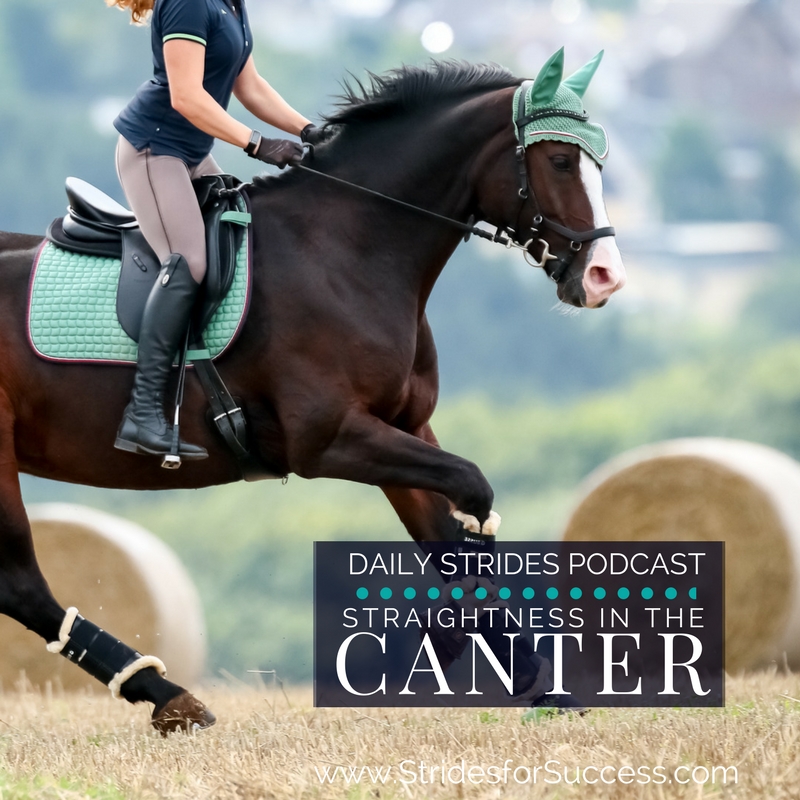
    Has this ever happened to you?  You’re cantering, along enjoying every stride, when suddenly it dawns on you that things are not quite as straight as they could be.  In fact, if you give a quick glance over your shoulder, you wonder if it is indeed possible for your horses’ back end to pass you out!  Hmmm, straightness in the canter.

    This episode is focused on how you can keep your horse straight through the canter.  Deviations away from this ‘straightness’ can often be subtle, but it is often there…

    Rule Out Possible Causes

    Before we go any further, obviously I am assuming you have ruled out the possibility of a physical ailment causing any crookedness in your canter.

    Making sure that there isn’t something physically wrong with your horse is first and foremost.  Physical ailments may be preventing him from carrying the same amount of weight on both hind legs for example.  If you are worried about that, have your horse checked by a vet.  Also I suggest have both teeth and tack checked as well.

    Once your horse has been given a clean bill of health, I want you to turn your attention to yourself – and what you are doing in the canter.

    Make Sure You Are Straight

    Very often riders get hung up on the fact that their horse is being a little bit crooked, but meanwhile it is the rider that is being a little crooked.  Your horse is often merely reflecting or mirroring back what you, the rider, is doing in the saddle.  Rider crookedness can often be quite obvious, as with the shoulders. Is one shoulder dipped slightly lower than the other? Or, is one shoulder travelling slightly ahead of the other?

    Something that is a little more difficult to feel and more difficult to remedy, is when your seat bones that are not straight.  Often, I see that a horse will go disunited behind in the canter due to the rider ‘forcing’ the horse, with their seat, to travel this way.

    Make sure that you straight in your riding, and especially in your canter.  If you are unsure about how straight you are, check out this free training HERE  that will get you well on your way to straightening things out in your body.

    So, let’s now assume that you are indeed straight, your horse is perfectly healthy, the tack fits… Where can you start if your horse is a still a little bit crooked in the canter?

    Work in Walk and Trot Initially

    Firstly, I suggest that you and your horse go back to the basics.  Start in trot or walk.  Focus on riding a lot of straight, balanced transitions.  Crookedness can be quite obvious in the canter, leading riders to only work and focus on the canter.  But this often only works to reinforce the crookedness!

    Remember all the time that you are working your horse, you are strengthening and building muscles.  You are both developing and you can do this the right way, or the wrong way.  When you repeatedly ride the crooked canter, be careful you are not ingraining that fault in your horse’s basic body structure.

    Rather take it back down to where you can really and truly control things.  Of course in the walk and trot all things are generally equal, meaning that while the canter can sometimes feel a little ‘one sided’ (not equal), due to the nature of how your horse travels in the canter, the walk and trot are very equal and symmetrical.

    So, it makes sense that when you are working, you are conditioning and strengthening your horse to move in that symmetrical way.   By him continuously moving straight and symmetrical, it is going to strengthen and develop this way.

    However, sometimes that alone will not be enough.  If this is the case I am going to suggest that you try to take any crookedness, or any desire to go crooked, out of the equation.  One of the simplest ways to do this is to work on hills.  Gentle, gradual hills or inclines.  When you work your horse up and down the hill, and you horse will find it very difficult to travel ‘crookedly’.  This is due to him needing to have both sides thrusting him forward equally.  In this way you can develop both sides.

    Unfortunately, a lot of riders won’t invest the necessary time and energy to do this, usually because it is boring in the walk!  If you are struggling with this (and yes, the struggle is often real) try focus on other things.  Perhaps include some lateral work into your schooling. The focus is on consistently building and developing.  Trying get that equal thrust from both hind legs, which will help to straighten out your canter.

    How You will Know if Your Canter Needs Work

    So, you are at this point probably wondering if your horse is truly straight – or if there is a little crookedness happening in your canter.  How will you know if your horse is crooked or not?

    Obviously, if you have mirrors in your arena, it is as simple as paying attention to what is happening.  However, this is not the case for most riders.  If you don’t have mirrors you can check whether your horse is straight in the canter by using a video.  You can set your phone up and, simply, ride straight at it.  If you don’t have a video, you could ask somebody to watch and tell you.

    What should you look for?  Simply that your horse is on two tracks.  This means that both legs on the left side of his body are on one track (meaning the back leg is behind the front leg), and both legs on the right side of his body are on the other track.  So, you have two straight parallel tracks, a little like train tracks.

    You can also check that he is straight throughout the rest of his body.  Sometimes you will notice a little bit of a curve or a kink.  Checking for your horse’s tail between his back legs can often help you see this one.

    Of course, don’t focus all your attention on your horse, but also pay attention to you, the rider, and what you are doing in the saddle.  By focusing on yourself as well, you are making sure that you are both developing together in moving forward with this.

    Finally, balance is an important element when it comes to straightness.  Pay attention that you are producing balanced transitions.  If your horse is using his whole body, as opposed to using one side and then compensating for the lack of using the other side, your transitions will feel more balanced.  Aim for straight transitions, all the way through.

    Only when balanced in the walk and trot, attempt cantering again

    When you genuinely feel that you are both straight throughout your walk and trot, then you can begin asking for the canter again.  Don’t keep hammering on the canter if it is not right, because all you are doing is reinforcing the ‘unwanted’ outcome.

    As I have already mentioned, sometimes it can be as simple as straightening yourself up so that you are carrying yourself.  In doing this, you then allow your horse to carry himself in way that is also straight. 

    Remember, any excess tension on either side of your body or your horses body, will reflect through into the canter.

    Happy Riding

    Lorna

    Links mentioned in the episode:-