Tag: daily strides podcast

  • Making a Success with Shorter Riding Times

    Making a Success with Shorter Riding Times

    Making a Success of Shorter Riding Times

    What this episode is all about & how it can help you:-

    • Have a plan for what you are going to do
    • Get as much ready as you can in advance
    • Create and stick to a routine that works
    • Learn to say no to distractions…!

    [smart_track_player url=”https://op3.dev/e/traffic.libsyn.com/dailystridespodcast/1068-Making-a-Success-of-Shorter-Riding-Times.mp3″ title=”Making the Most of Shorter Riding Times” social_linkedin=”true” social_pinterest=”true” social_email=”true” tweet_text=”Winter is here for many riders & this episode of the Daily Strides Podcast will help you make the most of the limited time in the saddle…” hashtag=”horseriding” twitter_username=”strides_success” ]

    Many riders find that, from time to time due to other responsibilities, they have shorter riding times to spend in the saddle.  If you are feeling like this right now, this is the episode for you.  Today we are chatting about making the most of your time.

    As I am writing this blog post, it is that time of the year again.  Winter is on its way in the top half of the world.  The days are getting shorter, which means there is less time riding.   Summer is also making its presence felt in the bottom half of the world, meaning soaring temperatures and, again, less than ideal conditions for riding for many riders.

    In this episode of the Daily Strides Podcast I want to give you a few ideas on how to make the most of your riding time, when time is not on your side!  In these situations, it is often easier to leave riding.  However, this can lead to a bad habit setting in.

    One of the first suggestion I am going to make to help make sure you are getting in the saddle is to create a plan…

    Have a Plan for what You are Going To Work On

    If you have been a listener or reader of my content for any length of time, you will know that i am all about having a plan for each ride.  An intention for each and every interaction and ride you have with your horse.

    Indecision is one of the biggest road blocks riders struggle to overcome in their riding.  A concrete plan will make sure you don’t fall victim to a ‘I don’t know what to do, so I will just do nothing’ way of thinking. 

    When I talk about having a plan, I mean knowing exactly which exercises you are going to work on for that particular day.  I suggest choosing one or two that work towards a similar theme – your intention – for the ride.

    Creating Your Plan Based on Your Goals

    Many riders feel a little overwhelmed when thinking about this, however in my experience, it really does not have to be difficult at all. Firstly, think about what you would like to see improve three months from now.  Maybe it is overall suppleness so you can ride a balanced 15m circle for example.

    Once you have made your decision, create a goal out of it.  Remember to make it something that you can actually see or feel when it happens (like the 15m circle). From your goal, choose three different themes for each month inside of those three months.

    Again, if we take the suppleness, maybe month one can be responsiveness & forwardness.  Month two can be rhythm and month three can be basic straightness.  From here, I would begin looking for exercises that focus on the month one theme.  You can also identify exercises that compliment that theme.

    You don’t need a different exercise for each day, but perhaps have 7 or 8 exercises over a month or 4 week period and weave them in and out of your schedule.  This way you can see what your horse responds to best.

    This will also help you to begin creating warm-up plans to suit your horses individual needs. 

    Get as Much As You Can Ready In Advance

    You can also begin identifying where you are spending your precious time with your horse.  From here,  you can begin to make changes that will allow you to spend more of your time in the saddle.

    One example is if your horse is boarding at a barn, to arrange for somebody to have him in for you when you arrive. Or maybe you can ask that his feeding times be adjusted slightly to give you more time schooling with him. If your horse lives out or is turned out, a blanket can save you with your grooming time.

    Your own unique circumstances will dictate where you can begin making changes.  So many of us get stuck in the rut of doing things a certain way because that is the way we have always done those things… 

    Actively look for ways you can make changes that will positively impact your time with your horse.

    Create a Routine that Works with Shorter Riding Times

    I have already mentioned how riding similar exercises will help you to begin identifying warm ups that suit your horse.  If you had a routine warm up you could use when time was of the essence, imagine how much more time you could spend schooling…

    I believe that you should have different routines for different things. I also believe that your routine creates the rhythm, which sets the tone for the conversation with your horse.

    Create routines that support you both. An example would be if you are working with a younger horse, or a more sensitive / hot horse, and your intention is to work on relaxation and rhythm. Arriving at the yard feeling stressed, then continuing to rush and race through grooming and tacking up will only make your goal more difficult to achieve. 

    If you find you are a little ‘off track’, go back.  Realign yourself with your theme for the month and then decide what is the best tone to aim for with your conversation in order to achieve that theme.

    Learn to Say No to Distractions…!

    Finally, learn to say no!  It is so easy to get caught up in other’s stories and what is going on at the barn. You need to be focused on what you have planned to do for that particular day, and not allow yourself to become distracted.

    Don’t allow others to side track you from what you and your horse are working towards.  Their agenda is just that, theirs.

    It is your job to keep your focus trained on your own intention, especially when you are trying to make the most of shorter riding times.

    Informing Your VIPs and Allowing them to Support You

    We all have important people in our lives.  Our partner, our children, our co-workers, our boss, our staff… So many people who can potentially support us, but only if we make our intentions and plans known to them.  Look for ways you can delegate or shuffle things around.  Find opportunities to batch things together.

    Letting the VIPs in your life know why you are making the changes will allow them to play a more supportive role in helping you make riding a reality – even when time is limited. 

    It may be as simple as ‘double cooking’ two nights a week.  Or eating left-overs or a take-out for dinner!  I could be having a neighbour or grandparent to ferry the children around on a particular afternoon.  Or asking your partner to walk the dog two days a week.

    Shorter Riding Times can Move You Forward

    Trust me, if you actually make a plan and get out and ride, you will feel that you have accomplished something and have moved things forward.

    Even if the ride itself was not all that great, the fact that you made it happen goes a long way to actually setting the tone for what you and your horse will be doing in the future.

    Remember, shorter riding times does not have to mean the end of progress for you and your horse.  In fact, you can use this as a opportunity to really laser focus your intentions and make things happen for you and your horse.

    Happy Riding

    Lorna

    I am hosting a free live online training on Relaxation in Riding and I would love for you to join me there…  If you’re interested, you can register for your seat by CLICKING HERE

    Sign Up for the FREE online live training

    Links mentioned in the episode:-


  • What are ‘The Basics’ When It Comes to Riding?

    What are ‘The Basics’ When It Comes to Riding?

    What are the Basics when it Comes to Riding

    What this episode is all about & how it can help you:-

    • Understanding the conversation is always happening
    • Your position
    • Your Aids
    • Understanding how your horse ‘goes’

    [smart_track_player url=”https://op3.dev/e/traffic.libsyn.com/dailystridespodcast/1067-What-Are-‘the-Basics’-When-it-Comes-to-Riding.mp3″ title=”What Are The Basics When it Comes to Riding” social_linkedin=”true” social_pinterest=”true” social_email=”true” tweet_text=”Feeling overwhelmed trying to figure out the basics in riding? This episode of the Daily Strides Podcast will help…” hashtag=”podcast #equestrian” twitter_username=”strides_success” ]

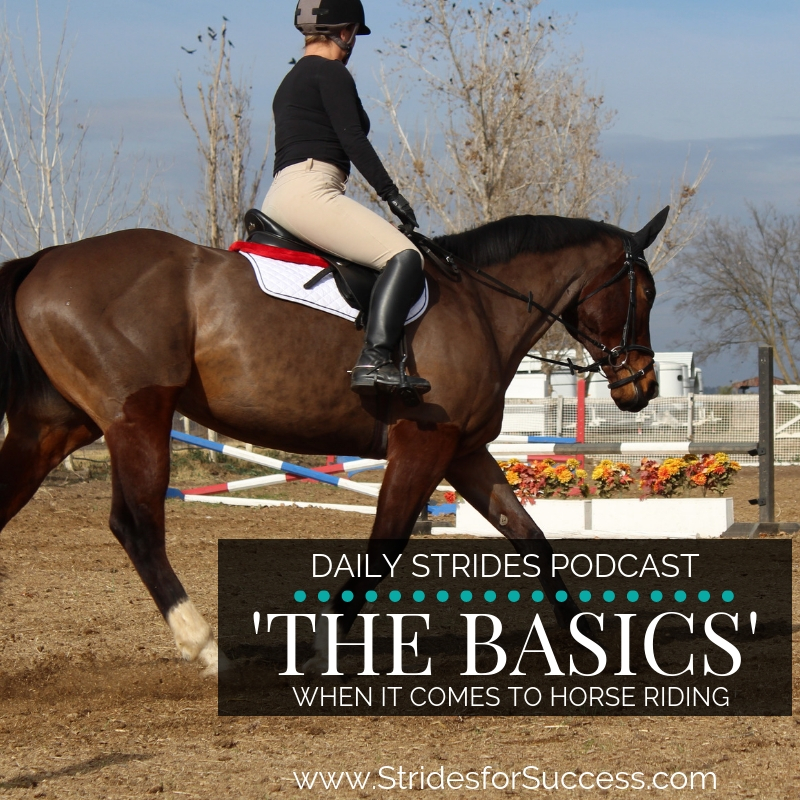
    The ‘basics in riding’… It sounds like a bit of a list for riders to master before they move on.  And I suppose in a way, they are.  Like most things, there are a few foundational pieces that, once you understand how they work, can be used to create a foundation for you & your horse going forward.

    CLICK HERE to register for the free online live training on

    In this episode of the Daily Strides Podcast we will chat about 4 of those ‘basics’ and also, where you will transition to after the basics have truly been mastered.

    Understand that the Conversation is Always Happening

    The first thing to remember is that the conversation is always happening. Always.  It is on-going and not only when you are in the saddle. As the ‘Team Leader’, you need to set the tone of the conversation.

    The conversation starts when you and your horse first begin interacting.  When you are aware of the others presence. 

    You build on the conversation all the time. Each day you build on the conversation you had the previous day.

    Many riders make the mistake of thinking that the only time they are communicating with their horse is when they mindfully ride an active aid.   However, for most novice riders, they are talking all the time to their horse.

    The constant shifts and movements in the saddle unintentionally adding to (and confusing) the overall conversation between horse & rider.

    Ask yourself, ‘How am I leading this conversation?’, and ‘How am I contributing to this conversation?’.  The answers to these questions are something you can continually try to improve.

    Your Position

    If you have ever had a formal horse riding lesson, this is something your trainer or instructor probably devoted quite a bit of time to.  And for good reason.  Your position is a vitally important part of the basics.

    A correct, supple and strong position puts you in the best possible place to have the most impact when you do activate your aids.  You are in the right place at the right time. 

    You are not having to readjust all the time and you are not giving muffled instructions to your horse. It means that things are clearer from you, and your horse has a better chance of understanding.

    Of course, another big advantage of having the correct position is that there is a better chance of you staying in the saddle!

    A correct position results in a balanced rider.  A balanced rider relies on their own body to balance themselves, rather than relying on the horse, the stirrups or the reins.

    One of the easiest ways to check your position is to make sure ‘the lines’ are present.  Head, shoulder, hip and heel is the first line. Elbow, hand, through the rein to your horses mouth is the second line.

    Get those two lines right all the time, and you will have a much better chance of sitting pretty in the saddle.  You will also be far more successful in your overall communication with your horse. 

    Your Aids

    An obvious but oh so important part of the overall conversation you are having with your horse.  The problem occurs when you are ‘going through the motions’ with your aids, but failing to truly understand your aids.

    One of the issues I see come up a lot is active versus passive.  There is a lot of confusion surrounding an engaged and active aid versus a disengaged aid.  A good example of this is the leg aids and ‘taking the leg off’.

    It is really important that you understand your aids and how those aids work when asking your horse a question.   A good example is the transition to canter.  You probably have been told to put your outside leg back – but do you really know why you are doing that?

    Begin trying to understand why you are doing what you are doing.  This way, you can begin to ‘weave’ aids together depending on the different situations you find yourself in.

    The Basics also Include the Balance of Aids

    Aids are not static.  They are consistently evolving and changing.  This is the balance of aids. How they change is in the proportion that you are using them with each other in different circumstances.  The pressure will also vary as well as the sequence.

    In order to truly begin improving the overall conversation between you & your horse, you need to understand why a particular aid is being used in a particular way. It is knowing how that aid influences the horse that allows you to become more effective & of greater influence in the saddle.

    As I mentioned, the aids are constantly evolving and part of that is then taking the next step.  Focusing on the timing of a particular aid.  Asking a question at the right time, allows your horse to respond in a timely manner.  It allows the smooth grace of the ride to continue.

    You can use your aids in different sequences.  They can be grouped together differently to mean different things. Once you have mastered the basics aids, you can then begin refining things further.  Making adjustments within the gait itself or even within the stride itself.

    Understanding How Your Horse ‘Goes’

    “Goes”…  It is a fairly basic word in and of itself, isn’t it?!  However so many riders I meet just fail to really and truly understand how their horse is moving underneath them.  I feel that it is important to understand how your horse goes, and not just in the basic walk, trot, canter and, if you’re brave, gallop.

    It means understanding how he moves his body. What it looks and feels like when he is moving correctly and how he is moving it when things are less than what we want them to be.

    It is begin able to see and feel the differences between the version we don’t want and the version that we do.

    For example would you notice if he began lifting his legs higher during each stride.  Would you feel the extra flexion, energy and suppleness through his joints and, consequently, throughout his whole body?

    Knowing how he is ‘going’ means that you understand how he is achieving a certain way of moving – so you can influence him in repeating it. 

    Building a Correct Foundation of Knowledge

    One of the bane of many trainers and horses lives is the ‘quick fix’!   So many riders try to find a quick fix to issues that they don’t really understand to begin with.  Going on the bit by sawing his mouth. Or putting him in a frame using a gadget to hold him there.

    It is so much better to begin figuring out what is causing the horse to do whatever he is doing that you are having an issue with.  The ‘undesirable’ action.

    It is also worth noting there that, a lot of the times if you don’t fully understand ‘why’ he is or is not doing something, you are probably a large contributing factor to that something!

    As a rider, you need to understand the mechanics of each situation.  If your horse needs to move a certain way, you will then begin to see how you can either assist him or hinder him with how you try to influence him.

    Identifying Your ‘Basics’ that Need Attention

    It can feel a little overwhelming initially trying to figure it all out.  Go easy on yourself and start at the beginning with your seat, your position & your aids.

    To summarise, remember that the conversation is always ongoing, both on the ground and in the saddle. It is constant and does not stop.

    A good position is very important because it leads to more effective aids. Understanding your aids and noticing how your horse is responding to them. If he is not responding you need to know how to tweak your aids.

    Finally you need to understand the mechanics of how your horse works.  Moving from being a passenger to being a team leader for your horse means that you begin influencing.  Knowing what is going on underneath you will allow you to begin positively influence the horse by what you are doing in the saddle.

    Happy Riding

    Lorna

    If you are feeling a little overwhelmed and find that you are stuck in your progress, I would love you to join me on a free online live training called ‘The 6 Basics to Focus On when Riding”.

    CLICK HERE to register for the free online live training on

    Links mentioned in the episode:-

  • Landing on the Correct Canter Lead After a Fence

    Landing on the Correct Canter Lead After a Fence

    Landing on the Correct Canter Lead

    What this episode is all about & how it can help you:-

    • Understand the influence of your weight on the approach
    • Learn how to ‘open a door’ for your horse
    • Begin shifting your weight over the fence
    • Effectively school on this to practice it

    [smart_track_player url=”https://op3.dev/e/traffic.libsyn.com/dailystridespodcast/1066-Landing-on-the-Correct-Canter-Lead-After-A-Fence.mp3″ title=”Landing on the Correct Canter Lead After A Jump” social_linkedin=”true” social_pinterest=”true” social_email=”true” tweet_text=”Struggling with canter leads on landing over jumps? This episode of the Daily Strides Podcast will help…” hashtag=”equestrian #jumping” twitter_username=”strides_success” ]

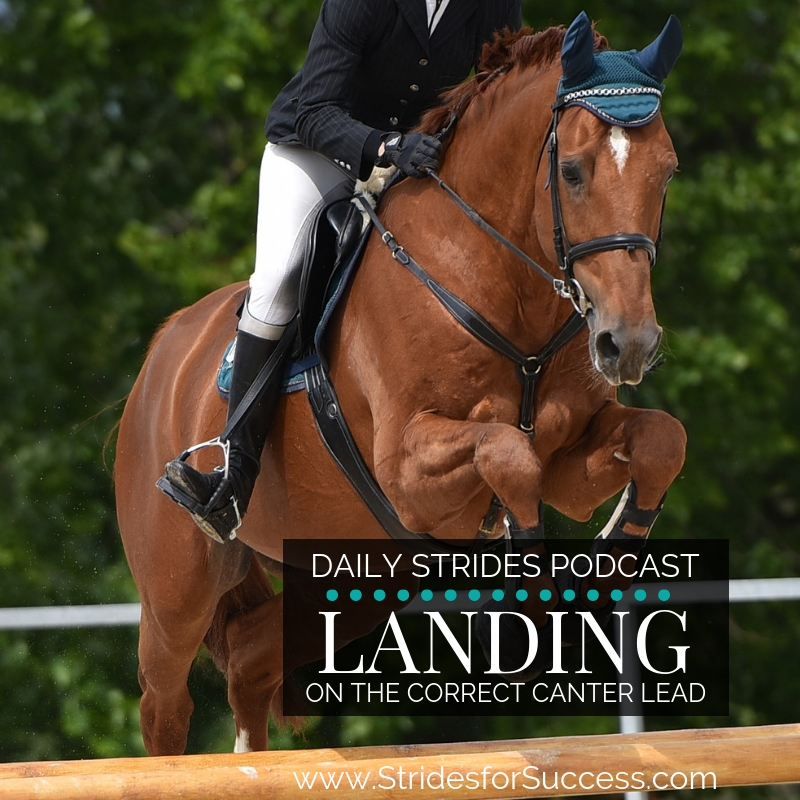
    Are you struggling with your correct canter lead when landing from a fence? Perhaps you approach the fence on the one rein, however the track or exercise requires a change of rein after the fence.  You find that you often need to come back to trot in order to change lead.  Or perform a flying change.

    In this episode of the Daily Strides Podcast we focus on your correct canter lead on landing from a jump.  I will give you some practical tips you can implement the next time you ride. However, like all things in horse riding, it will take mindfulness and effort on your part.  But the results are well worth it.

    Why the Correct Canter Lead on Landing is Important

    Think back to the last time you were jumping.  If you could add up how many minutes you actually spend jumping and place that side by side with all the minutes spent in between the jumps…  So much of jumping depends on what you are doing on the ‘flat’ before and after (or in between) the jumps.

    Now, obviously we first have to master actually getting over the fences.  Getting from A to B.  However, once we have that, our focus then really shifts to the part on the flat between the fences.  Having to continuously either transition to trot to change lead breaks the flow between your fences.

    Therefore being able to ask your horse to land on a specific lead will help the overall flow of your jumping. 

    Which leads to the question, ‘How do I tell my horses that I want him to change lead in the air over the fence?’.  Now, you can do this over a smaller jump, however there is often not enough time for you to get clarity on what you are trying to do. Which means they are asking in a way which is not very clear to the horse.

    For this reason I suggest you work over fences that are around 60 to 70 cm (2 foot to 2 foot 6 inches).

    Can you work over smaller fences?  Yes of course, you can apply this to working over a pole on the ground if you want.  However, I have found the riders gain more clarity – and have more time to make necessary adjustments initially – when the fences are a little more substantial.

    Your Weight on the Approach

    You must be very clear on where your weight is before the fence. If you are approaching the fence on the right canter lead, so your horse is leading to the right, you must be positioned correctly to reflect this.  Your inside seat bone and leg, in this case, your right seat bone, should be slightly more weighted.

    Being mindful and specific about the details on approach will help both you and your horse notice when things change or shift.  It is the small, subtle changes that ask the horse to also make a change 

    Your horse will do everything in his power to keep both of you upright.  Who wants to fall over, right?!  So it goes without saying that if and when you shift your weight, he will try shift as well to remain underneath you.

    Often the rider is sitting incorrectly on the approach to the fence. This is why being very clear on what you are doing before the fence is so important.

    It is worth repeating; jumping has very little to do with the actual jumping of the fence.  It is more to do with what is happening before and after the fence

    ‘Weighting’ is not Leaning or Tilting…

    A word of warning; when I say that you must make sure that your weight is on the correct side, I do not mean that you must be leaning towards that side!

    Leaning or tilting, particularly with your upper body will have the complete reverse effect.  Leaning to the inside is usually accompanied by a shifting of the seat to the outside of the saddle.  You definitely don’t want to happen!

    Weighting it only means that you have a little bit more weight dropped into that inside seat bone and / or heel. In fact, it has more to do with your core than anywhere else in your body.

    There are some links at the end of this post to other episodes and posts that go into more detail about weighting and how to do it correctly.

    Opening a Door for Your Horse

    Most horses seem to respond well when they feel like they have a ‘way to go’.  I call it a door. Very often you have to open a door to show your horse which way you want them to go. You can do this through your rein.

    You can use a more open rein to show your horse which direction you want to take on landing.  Direction will determine ‘inside’ and ‘outside’, which in turn will dictate the choice of lead.

    By using more of an open left rein, for example, he will begin realise that you will be tracking left on landing.  This allows him to perform a quick switch and land on the left lead from the jump.

    Remaining Straight While ‘Opening a Door’…

    The down side to doing it this way is that very often because you have opened that door, the shoulders tend to follow through the same space!   This results in losing your line.  I’m sure you know how important lines are when jumping!

    For example, let’s say that you are on the right lead approaching the fence, and want your horse to track left on landing.  You can open your left rein as a way to indicate to your horse that you want to track left and therefore land on the left canter lead.

    The potential is there that he can come off your line, veering slightly to the left. Now, for the most part, if you are indeed tracking left after the fence, it shouldn’t be too much of a problem.  You can correct him using your other aids.

    However, if you are riding a related distance or a combination, veering off your line can have huge repercussions on the following jumps.  In those instances, you definitely want your horse to ‘stay the line’. 

    Shifting Your Weight Over the Fence

    We spoke earlier about weighting your inside seat bone. Where I suggest making this change or shift is as your horse is going over the fence.

    This is a subtle, quiet shift.  It does not mean that you throw your body one way or the other. A shift in the weight can sometimes be made by simply turning your head

    I am sure you have often it said often when riders are training how important it is to ‘look for the next fence’.   This is not only to be sure of where you are going, but also to make that subtle shift begin to happen.

    When you and your horse are well ‘tuned in’ to each other, you won’t need to think about the shifts.  They will just happen, as though on autopilot

    In order to make this happen, I suggest beginning to work on this in your very next ride.  You will find that, as you progress, it becomes automatic for you too. This allows you to focus your attention on other issues.

    Refining Your ‘Subtle Shifts’

    Initially think about just turning your head and looking in the direction you want to travel on landing.  You could even allow your shoulders to follow a little bit as well. You will often find that this is enough to affect the weight in the saddle.

    Keep in mind that refining your aids all depends on how well you and your horse have been conversing or communicating with each other up to this point.

    If you have been doing a lot of unnecessary ‘talking’ by overusing your aids, then your horse is probably not going to listen as well as you would like.

    You begin refining your conversation by only speaking to your horse when you have something worthwhile to say. Meaning that you only apply your aids or ask for your horses attention when you have something worthwhile to add to the conversation

    Schooling to Practice Landing on the Correct Canter Lead

    Every time you are approaching a fence, pay attention to how you are ‘sitting’ and make any necessary corrections.  Have your inside seat bone and heel weighted a little.

    Be clear on where you want to go afterwards.  In other words, have a clear line planned out in your mind’s eye.

    When you are in the air, shift your weight slightly from the inside to the outside.  Said differently, swap your inside and your outside.  You can also open your inside hand a little.

    Finally, make sure you are looking in the direction you want to go as you go over the fence. As you are in mid-air you should already be thinking about the next fence and plotting your line. This will make enough subtle shifts in your body for your horse to pick up on, and for him to make the change.

    A Word of Caution

    This goes without saying, but let’s just include it here anyway…  This episode and blog post is assuming that you have had all the necessary ‘checks’ performed on your horse.

    Many riders struggle with canter leads due to problems with the horses back, legs, tack suitability or teeth to name just a few. 

    Make sure that your horse is sound and that there are no underlying problems which are potentially hindering him, or making it uncomfortable for him to land on a correct lead.

    Happy Riding

    Lorna

    Links mentioned in the episode:-

  • Following & Allowing in Your Riding

    Following & Allowing in Your Riding

    Following & Allowing in Your Riding

    What this episode is all about & how it can help you:-

    • Stop forcing and be ‘led’
    • Notice how it feels underneath you
    • Notice how you can begin to influence through your seat
    • Are you allowing your horse or are you blocking your horse

    [smart_track_player url=”https://op3.dev/e/traffic.libsyn.com/dailystridespodcast/1065-Following-and-Allowing-in-Your-Riding.mp3″ title=”Following & Allowing in Your Ridin” social_linkedin=”true” social_pinterest=”true” social_email=”true” tweet_text=”Struggling to get started using your seat in the saddle? This episode of the Daily Strides Podcast will help…” hashtag=”equestrian” twitter_username=”strides_success” ]

    I know that you know how important your seat is as a rider.  It is one of the biggest ways we communicate with our horses.  However many riders I meet are a little confused as to how they can get started with really using their seat in their riding.

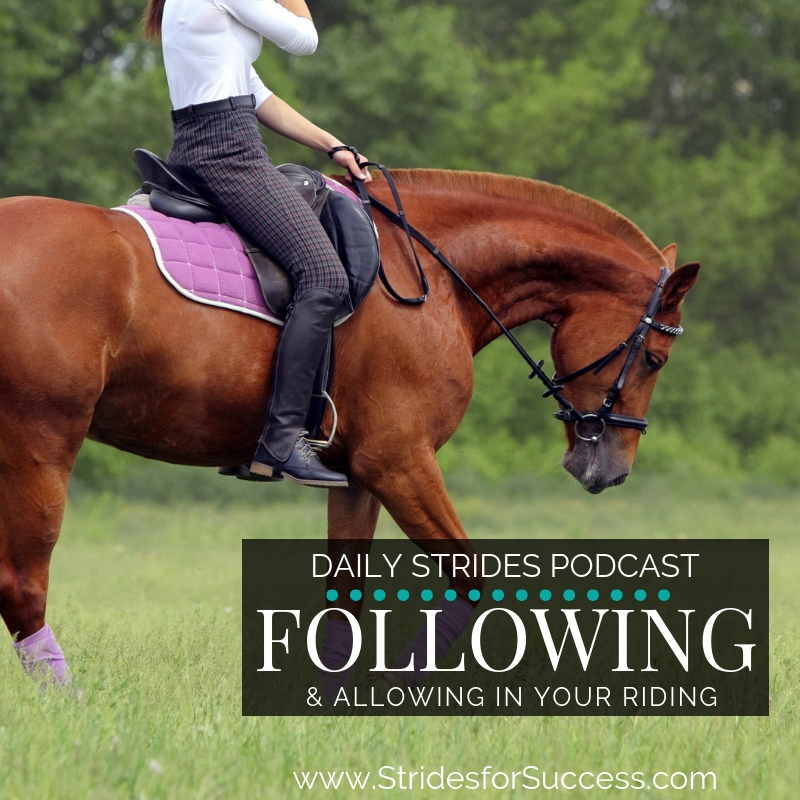
    In this episode of the Daily Strides Podcast you will learn all about following and allowing with your seat.  I believe this is one of the simplest ways you can begin developing your seat next time you ride.

    Stop Forcing and Digging with Your Seat

    When it comes to your seat as a rider, one of the most important things to understand is that you ‘influence’ with it. Simply put, this means you need to stop forcing with your seat.

    Let go of the idea that you need to push and shove your horse around using your seat

    If you push and shove with your seat, it very often has the opposite effect you are looking for.  Your horse will probably hollow and duck out-of-the-way of your seat.  This is because it is uncomfortable for him; imagine someone applying a huge amount of pressure to specific points on your back!

    Be wary of digging with your seat.  If you find that you are trying to dictate to the horse with this downward and forward motion, you are indeed digging! 

    This happens a lot in lateral work. Riders tend to shove the horse across the arena and you end up losing the relaxation and the rhythm, because the horse is no longer moving at ease.

    Allowing Yourself to Be ‘Led’

    The opposite of forcing is rather allowing yourself to be led. This is difficult for many riders to really do well initially.  Simply put it means that you are going to allow the horse to move you, rather than you moving the horse.

    What feels like ‘doing nothing’ is a difficult thing to do while in the saddle; but is essential to learn in order to really follow your horse

    Sit in the saddle and, simply, allow the horses forward energy and movement to move you. This takes a certain amount of relaxation in the rider’s body, but also takes a certain amount of self carriage.

    Meaning you are not really ‘doing nothing’, you are responsible for carrying yourself and balancing the tension in your body.  Said differently, you are also responsible for maintaining the correct level of relaxation as you ride

    Riders often get into the saddle and just sit there collapsing through their body. Rather think of yourself as ‘standing’ in the saddle. You need to carry your upper body as though you were standing.

    Carrying your upper body frees up your lower body to be led by the horse

    Notice How it Feels Underneath You

    I’m going to be honest with you, if you are used to always trying to ‘move’ your horse with your seat, following will take practice.  However, once you can do this, I want you to then begin noticing how it feels.

    Timing is a big part of the conversation between you and your horse. You need to ask questions at the correct time in order to give the horse enough time to respond to whatever you have asked

    Getting to understand timing comes down to getting to know what is happening underneath you. Notice how each leg is moving in each gait, walk, trot and canter.  I always suggest starting in walk.  It is slower and easier to really ‘feel’ your seat and hips move with your horse.

    If you cannot feel which hoof is where at any given time, work with what you can see. Look at the front legs and use them to figure out where the back legs are at that time. In other words, learn the sequence of your horse’s footfalls. The walk will be a certain sequence, the trot another sequence and the canter as well.

    Knowing where the front legs are will tell you exactly where the back legs are at any given time

    The reason I focus so much on what the back-end is doing is because the horse’s ‘engine’ is at the back. When you are asking a question you want your horse to respond from behind first. Noticing how it feels and what is happening underneath you with the behind section of your horses body, will help you ask at the correct time.

    Notice How You Can Begin to Influence Through Your Seat

    Once you can follow and correctly identify what is moving when, you can begin looking at influencing your horse through your seat.  I believe a lot of influencing is ‘allowing’ when it comes to riding.

    By correctly ‘allowing’ you are going to influence how much energy will be flowing at any given time, and where that energy is flowing to

    You could decide to shut down or restrict the flow a little.  Or you could decide to allow more to flow through. You could ask for a little more bend or flexion with your seat.  You can ask for more energy to be created using your seat.

    It all comes down to asking and then ‘allowing’ your horse to follow through with what you asked

    Begin with Smaller Requests

    I suggest really just getting started.  Many riders wait until the ‘perfect’ time to start using their seat to influence.  There won’t ever be a perfect time, so begin today. Start playing with the seat and how the horse responds to it.

    I suggest starting in the walk and trot first. Remember that your seat on it’s own is not a completely isolated aid.  There is the whole balance of aids working together all the time to communicate with your horse.

    Initially your other aids may have to be stronger, or louder, while you are training your horse to listen to the more subtle and quiet seat aid

    However, as your horse begins to respond to your seat, you can really begin refining your seat.  Keep in mind that consistency is essential.  Especially as your horse begins to listen for those subtle questions that you are asking. In doing this you will get a better conversation happening between you and your horse.

    I suggest starting with your half halt. I have a free audio training you can use for that HERE
    .  Noticing this as you start working on it with your horse is how you can start to ‘allow’ with your horse.

    Are You Allowing Your Horse or Are You Blocking Your Horse

    The final thing I want to touch on is that the opposite of allowing is blocking. Often riders tend to block their horse, even though they want to allow.  An example of this is the length of the active half halt aid.  The split second.

    What sometimes happens with riders is that they stop allowing and begin blocking.  It is often because the aid becomes a long drawn out constant. The engaging or active use of the aid becomes continuous. They tend to dig down deep and get heavy.

    When we ask our horse to do something, what we want is for them to engage their core. In doing this it is almost feels as if they lift their back and lighten

    If you are being heavy and using a more blocking motion with your seat, your horse has no space or room to engage and lighten.

    Another side effect of blocking is that the energy can no longer move forward.  This often occurs just after a transition between gaits.  The rider asks for the transition but then ‘blocks’ the horse from moving forward into the newly requested gait.

    Forwardness is key to everything in riding.  Once you lose forwardness, everything else will fall apart as there is no energy there to maintain the movement

    What to Work on Next Time in the Saddle

    I suggest you start by allowing yourself to be led.   Really feel what is going on underneath you and how one step or foot fall affects the next.  Feel where your hips are in relation to your horses hips.  From here, begin to take more responsibility for how you are sitting in the saddle.   Later, once you can truly ‘follow’ begin working on the ‘allowing’.

    It is a continuous work in progress for all riders and something you can experiment and refine on a daily basis in the saddle.  Understanding your seat is really the beginning of refining your ‘influence’ over your horse while riding.

    Happy Riding

    Lorna

    Links mentioned in the episode:-

  • Using Your Legs to Create a Channel when Riding

    Using Your Legs to Create a Channel when Riding

    Using Your Legs to Create a Channel when Riding§§

    What this episode is all about & how it can help you:-

    • Sitting straight in the saddle
    • Allowing your legs to ‘drape’
    • Understanding an active aid versus an inactive one
    • Supporting your horse when he needs support

    [smart_track_player url=”https://op3.dev/e/traffic.libsyn.com/dailystridespodcast/1063-Using-Your-Legs-To-Create-A-Channel-In-Your-Riding.mp3″ title=”Creating a Channel with Your Legs in Riding” social_linkedin=”true” social_pinterest=”true” social_email=”true” tweet_text=”Ever wondered what your legs should be doing while you’re in the saddle? Here is the less obvious answer…” hashtag=”Equestrian #Horseriding #Podcast” twitter_username=”Strides_Success” ]

    Remember back to when you were first learning to ride.  You possibly saw your legs as being a ‘go button’ of sorts.  Go forward or go sideways.  However, as you began to improve the conversation, by refining your aids, you realised that your legs have started to also become a channel of sorts…

    A channel for the energy that is created inside of the ‘container’ that is you and your horse together.

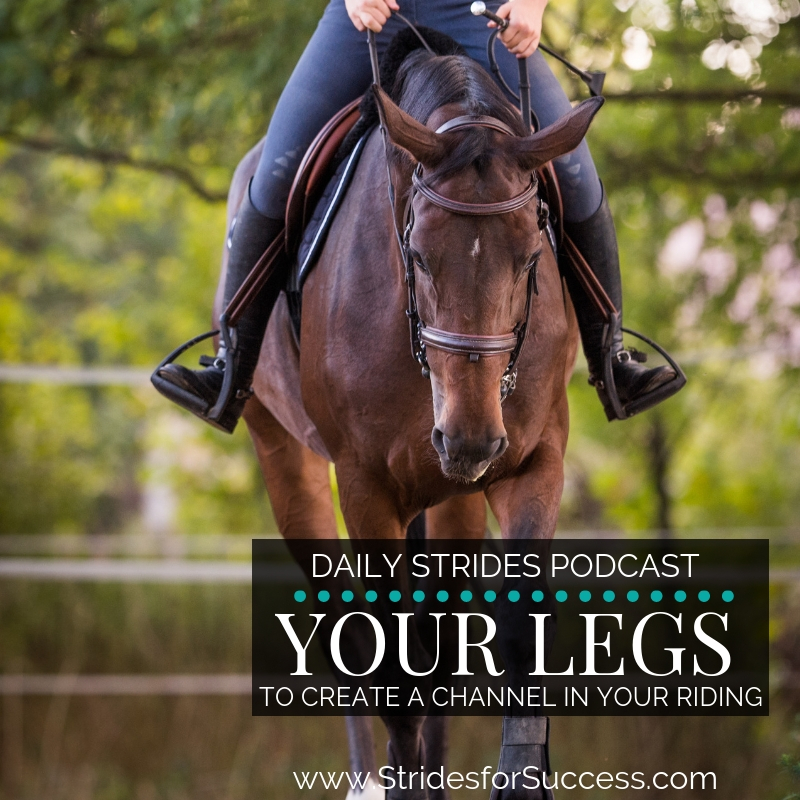
    In this episode of the Daily Strides Podcast you will learn all about creating that channel with your legs and how it will improve your overall riding.

    Your Whole Body is a Channel

    I want you to think about this; your whole body is connected.  I realise that this is not a new piece of information, however many riders fail to see how one part of their body has direct influence over other parts.  How the placement of your leg can impact the placement of your seat or vice versa.

    If you are just starting out, I think it is far easier to allow the more obvious body parts to influence the more ‘subtle’ parts.  Your legs to influence your seat, rather than the other way around.

    Later then, as you begin to gain more control over your body in the saddle, you can start ‘swapping’ this out a little.  Your seat to influence your legs.  Your seat will define or indicate where your legs are positioned at given time in the saddle.

    Sitting Straight in the Saddle

    Part of this influence is how straight you are positioned in the saddle.  When I say ‘straight’ in the saddle, it is straight in two ways.

    Firstly that there is an equal amount of you on both the left and the right of the saddle.

    One of the most common ways riders become ‘crooked’ is when they are sitting with one seat bone closer to the centre of the saddle than the other. 

    The second way to ensure you are ‘straight’ is to make sure you are indeed sitting on your seat.  Both of your seat bones centred and pointing straight down underneath you. It is all too easy to fall into the bad habit of sitting either with their pelvis rolled too far forward or too far back.

    Sitting on your fork, or rolled back into a more ‘armchair seat’ automatically shuts down your seat aids.  This will result in your legs not being able to work correctly while riding. 

    Allowing Your Legs to ‘Drape’

    Once your seat is correct, you can allow your legs to ‘drape’ over your horses sides.  This sounds exactly like what it is.  Drapes are often another word for curtains and you want to think of your legs being allowed to hang from your hips like curtains.

    They have their own weight and shape, and yet they will follow the contours of what they are ‘draped’ over.

    For many riders, particularly women, it can be difficult to truly allow legs to ‘drape. This is often due to the fleshy part on the inside of the thigh.  If you suspect this is an issue for you, I have a little exercise you can use to help.

    What I suggest is just put both your legs up as though you were a jockey, touching your knees above your horses withers. Now take your right hand from the back underneath your right leg and pull that fleshy piece out behind your actual thigh.  Then lift your leg out and gently allow your leg to drape down over your horses side.

    When your leg is positioned correctly, you will feel that there is contact all the way down.

    Many riders concentrate on the contact at the knee, but I prefer it if the knee is loose and it is not locked on the horse. What you will now find is that the rest of your leg from your thigh all the way down to your calf and ankle is going to be draped around the horse.

    Understanding an Active Aid Versus an Inactive One

    The next thing to understand is that you have active leg aids as well as inactive leg aids. In other words you can engage your leg aids, or you can disengage them.

    It is important to recognise that when your leg is off and is not engaged (or inactive), it doesn’t mean that there is actual daylight between your leg and the horse!

    Your leg is still ‘on’ the horse, however it is similar to having hit the off switch.  You have disengaged it. You don’t take your actual leg off or away from your horses side. There should never be daylight between your leg and the horse’s sides, but you do want it that the leg is not active.

    The reason that this is important is because later as you and your horse become more developed, you will play less and less of a supporting role to your horse.

    Very often in the beginning we, as riders, have to support our horses. This is not always actual physical support, in that you are holding him up.  It can also be more of a moral support. As soon as your horse’s balance develops and he becomes stronger, you will have to support less and less.

    If your leg were to be active all the time, you would first of all be exhausted and secondly your horse would eventually simply tune out

    Supporting Your Horse When He Needs Support

    Very often at the beginning of our development journey with our horses, riders find themselves supporting their horses.  This can be both a mental and a physical support.  It is a ‘reminder’ to keep things on track when things are going off track a little.

    A lot of the time this is described as ‘balance’.  You will step in initially when your horse loses balance and help him to regain it. 

    However, as confidence and strenght builds, your relationship with your horse will also shift and change.  As you and your horse becomes stronger and you are positioned correctly, you are better able to actively engage the aids when you need to engage them.

    When you engage your aids, you can create energy.  This energy is then put into the channel you have created, so you can best direct it. 

    Understanding and Strengthening Your Channel

    Managing this energy is really your channel.  It can also be thought of as the container that is made up of you and your horse. You actively and mindfully put energy in there.

    Then you decide how, where and when that energy will be used.  Yes, you can use your leg to ask your horse to create the energy, but once it is there you can use your legs to channel that energy as well

    Channeling can be in a directional way by directing where the energy is going to go. The channel can also be how the energy is being used. Is it running out, or is it being held?

    Developing Your Channel

    Of course, as you begin to refine the conversation between you and your horse, your seat will then become a bigger part of your channel.

    Initially it is your legs which are guiding your seat, but what we want is that the seat is doing more of the guiding. You will eventually build to that.  This may look like your seat allowing or resisting.

    However your seat moves and influences, it will become a bigger part of your overall conversation.  Of course your legs don’t completely cease to exist any more, but there is a balance of aids, and the balance will eventually shift.

    In other words it will then become less about your legs and more about your seat

    Your legs will still have to be positioned correctly because your legs dictate your seat, and your seat your legs. But as you become stronger and more developed you will have to think about it less, and it will naturally fall into place.

    That is the channel. Once you have the channel created then you can start strengthening the channel, and you can start creating true impulsion in your riding.

    Happy Riding

    Lorna

    Links mentioned in the episode:-

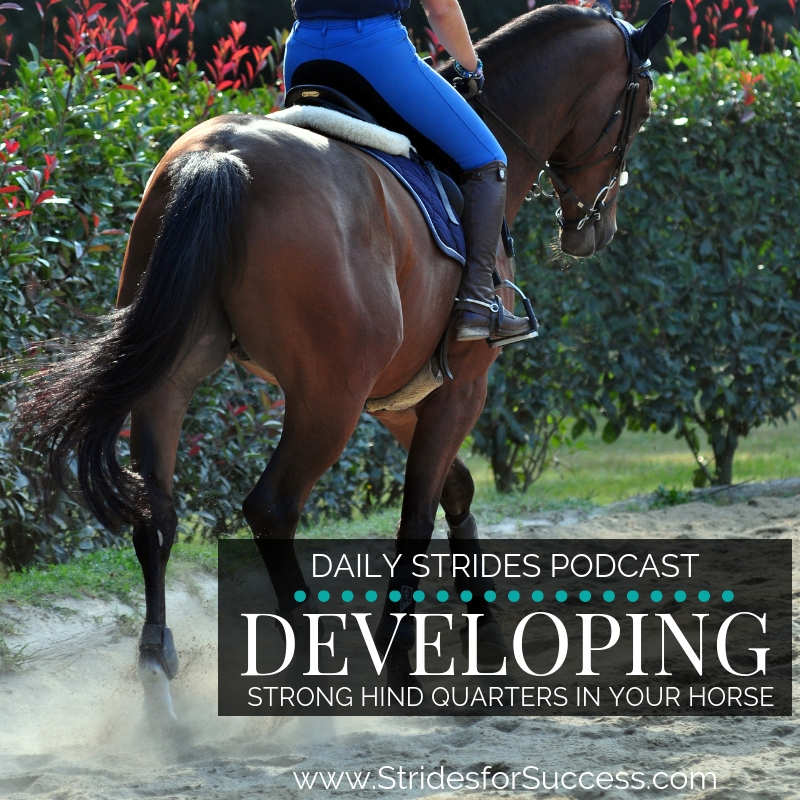
  • Developing Strong Hind Quarters in Your Horse

    Developing Strong Hind Quarters in Your Horse

    Developing Strong Hind Quarters in Your Horse

    What this episode is all about & how it can help you:-

    • Understand what strength is
    • Figure out how it relates to suppleness
    • Work on straightness to strengthen your horse
    • Notice when things begin to develop

    [smart_track_player url=”https://op3.dev/e/traffic.libsyn.com/dailystridespodcast/1062-Developing-Strong-Hind-Quarters-in-Your-Horse.mp3″ title=”Developing Stronger Hind Quarters in Your Horse” social_linkedin=”true” social_pinterest=”true” social_email=”true” tweet_text=”Are you trying to develop your horses top line, but getting nowhere?! This episode of the Daily Strides Podcast will help…” hashtag=”equestrian #podcast” twitter_username=”strides_success” ]

    Have you found yourself wondering or wishing about your horses top line or frame?  You probably have heard that they are related to how your horse is working, but struggle to really connect the pieces together in the saddle.

    This episode of the Daily Strides Podcast is all about specifically the hindquarters and building strength in the hindquarters in your horse, which will lead to overall development.

    Time & Consistent Correct Training

    Riders are often looking for quick fixes. They want their horse to be on the bit.  They want the horse to be working in a ‘frame’.   But they are forgetting that strength takes time.

    If I sent you to the gym today, and asked you to do a certain amount of exercises, your success would depend on your current fitness level.   Whether you could do it, or not.  Of course if you push past what you are physically able to do, you are probably going to injure yourself; or wake up the next morning feeling incredibly sore.

    This is the same for our horses. Very often people are asking their horse to work within parameters that the horse is not used to working in.

    When this happens, the horses current level of development will be challenged as well.  It is not comfortable for your horse.  Neither is it enjoyable and there is a high risk of causing injury.  The other ‘outcome’ of pushing too hard or too fast is that your horse may begin to compensate elsewhere, and you will end up training the horse ‘backwards’.

    What is True Strength?

    Strength is your horse’s ability to propel itself forward. When buying a car you will look at the engine of the car. The hindquarters are the engine of your horse, so this is where you need to spend a lot of your time maintaining and developing your horse. So everything you are doing is for the good of the engine – the hindquarters.

    Strength, as well as being your horses ability to propel himself forward, is also his ability to correctly carry himself.

    As he becomes stronger, your training will ask different questions.  These ‘questions’ will require him to carry himself differently.  He needs to be physically strong enough in order to correctly do just that, and then develop further in his abilities.

    How Strenght Relates to Suppleness

    I believe that strength and suppleness are very closely connected, and so too is straightness. I suggest starting with suppleness, which leads to strength, which leads to straightness.

    Suppleness is basically asking your horse to become more ‘limber’.  This increases the overall ease and flow when being ridden. I don’t believe that suppleness is standing still asking your horse to eat a carrot somewhere at its elbow.

    Suppleness when ridden requires movement.  It is your horse is working and moving, and is able to use himself to the best of his ability.

    Working on Straightness to Strengthen Your Horse

    As you begin to correctly build and improve the horse’s suppleness (and your suppleness as a rider) you will find that you both become stronger. That strength then leads to the straightness.

    Straightness is important because if your horse is straight it means that he is pushing or thrusting forward equally from behind. One side is not firing stronger that the other side!

    Obviously straightness is not only to do with the hindquarters, it is also to do with the whole body, as is suppleness and strength. But I am focusing on the hindquarters today.

    As you begin to build this, the horse can begin to carry themselves differently which engages the core. As the core begins to get more engaged, you will begin to see his top line develop and he will begin to naturally carry himself better.

    This simply means that his weight is being carried differently as he is working. 

    The Cycles in Your Horses Development

    You will notice that as he begins to develop more strenght, he will carry himself differently which will lead to him becoming straighter.

    The cycle will keep repeating and developing as his training develops; suppleness, strength, straightness. These three principles keep building on each other.

    You will notice as you begin to invest time working on this that your horse will begin to feel different as he carries himself more correctly.  You will also probably notice that your horse will begin to work into the contact.

    The improvement in the contact is the result of correct development allowing him to carry himself more.  This allows him to take more responsibility for his half of the contact. 

    He will no longer lean or depend on you.  He will truly be able to contribute to the correct development of the contact, which is a little like agreeing to hold hands.  You become equal partners and it is a mutual agreement that the two of you have come to.  He must first of all be physically strong enough to do this.

    Noticing when Things Begin to Develop

    Consistency requires just that, constant attention to detail in your riding and training.   I also believe in applying consistency to how mindful you are about your horses development.

    Notice where your horse is, and notice any weaknesses that show up. Notice if you maybe ask for a bend to the left, is he rather bracing against you or is his head tilting to the side. He may also be struggling to track up one side or the other.

    It is so important to begin noticing things like this, because it is only by noticing them that you can then begin to work on them.

    Developing Symmetry in Your Horse

    Most horses, just like us, tend to favour one side over the other. Next time you ride your horse, begin paying attention to how much ‘ease and flow’ there is doing the same exercise on both reins.

    If you do notice a weakness of one side or a favouring of the other, take a more long term approach when dealing with it. 

    So many riders make the mistake of hammering on the weak side. If someone made you continually do something which you find difficult over and over again,I am sure you would start to feel definite resentment beginning to grow.

    Your horse is no different. Rather sprinkle the ‘difficult’ exercises or questions in between things which he enjoys and finds easier.   Allowing him to do the things that he finds easier right now in his present situation, and rather just sprinkling in these more challenging questions, allows him to feel good about working and developing himself.

    How to Know When Things Begin to Develop?

    Normally one of the first indications many riders get is through a downward transition. As you go down let’s say from canter into trot, you will feel that there is a lovely lightness the first two strides of the trot.  Now, the downside is that it will probably be for just that amount of time, one or two strides, and then it is lost and become a little heavier again.

    But that lightness through that initial transition is where he engaged himself, held himself and carried himself and is the beginning of true strenght in his body. 

    He just was not physically, or perhaps mentally, strong enough to continue.  As part of our OTTB Owners Program and also the Clarity and Confidence Riding Program,  I talk a lot about how the horse has to develop mentally through all the different principles, as well as physically.

    He must not only physically feel that he can carry himself, but also that he has the confidence to continue carrying himself going forward. 

    Celebrate Those Initial Steps

    When you begin to notice those initial couple of strides as they start to happen, your goal as the rider is to try and get more of those ‘feeling good’ moments.  More lightness that lasts longer, and are closer together in frequency.

    Simply put, over time you are lengthening the ‘feeling good’ moments for your horse, so the contrasting not so desirable parts are becoming shorter and less frequent. Over time you will build it from where it is a glimpse every now and then of what you want, to where what you want is the mainstay of the ride

    Happy Riding

    Lorna

    Links mentioned in the episode:-