Tag: daily strides podcast

  • Understanding ‘Establishing’ and ‘Maintaining’ in Your Riding

    Understanding ‘Establishing’ and ‘Maintaining’ in Your Riding

    Understanding Establishing and Maintaining in Your Riding

    What this episode is all about & how it can help you:-

    • Your greatest responsibility as a rider
    • How it all begins on the ground
    • The number 1 mistake riders make
    • Working it in to each and every exercise and movement

    [smart_track_player url=”https://op3.dev/e/traffic.libsyn.com/dailystridespodcast/1041-Establishing-and-Maintaining-in-Your-Riding.mp3″ title=”Understanding Establishing and Maintaining in Your Riding” social_linkedin=”true” social_pinterest=”true” social_email=”true” tweet_text=”The ‘rinse and repeat’ of horse riding – a way to fix any ‘speed wobbles’…” hashtag=”horses #equestrian” twitter_username=”strides_success” ]

    Isn’t it strange how as riders we expect things to be push button when it comes to our riding?  We expect to be able to jump in the saddle, and that everything is just going to work out.  Then we get so disappointed when it doesn’t happen.

    Today I am going to give you the plan, so you can begin to make that happen every time you get into the saddle.

    Your Greatest Responsibility as a Rider

    Do you, like a lot of riders, tend to forget that there is a responsibility on your part to establish something first and foremost in your riding?  Perfect harmony and connection often isn’t something that just happens.  It is our job, as team leaders, to work at establishing it.

    Yes, over time it becomes easier and easier; quicker to establish.  Maybe later you will even get to the point where it does turn into a push button situation.  But initially it is not going to be that.  I will require your focus and attention to establishing a certain way of going in your rides.

    But the challenge does not end there; this is a ‘two part’ series.  Once you have successfully established this harmony, this contact, this connection; it then has to be maintained. 

    Part of maintaining is first, making sure that everything is going as it should be, and secondly noticing when you need to go back to the establishing phase again.  It is a little like breaking something down, in order to then build it back up again.  Building it back to exactly what you want each time.

    Again, this is something that over time will become almost like a ‘rinse and repeat’.  It becomes easier, it becomes quicker, it becomes a lot more ‘yes, you can sit back and allow it to happen’.  But not when we are first starting out.

    Why It All Begins on the Ground

    Ground work, I believe, really and truly starts when you are fetching your horse from the paddock or in the stable with your horse. Establishing and maintaining starts right there, during those first initial interactions each day.

    Firstly, it establishes boundaries.   It establishes the way that your relationship is going to be going forward for that day.  You can establish your rhythm here.  You can establish relaxation. You can establish the intention for whatever it is that the ride is going to be.  Focus on what you are doing during this time.  The ground work element is where it all begins.

    A lot of riders might be establishing certain rhythms on the ground, but they fail to maintain them throughout the process.   So many problems in the saddle can be traced back to this lack of establishing and maintaining on the ground.  You can find out more about groundwork HERE

    So, if you are feeling that there is some disconnect going on with you and your horse in the saddle, look to your ground work first.  Look at the basics.  You, on the ground, working with your horse.  What is the conversation that is happening?

    The Number 1 Mistake Riders Make?

    They fail to set and follow through on their intention for each ride.  Let’s say, for example, that you want to establish and maintain a good quality working trot.  A lot of riders will get on and expect the push button solution.  They climb into the saddle, without spending any time being intentional when on the ground.

    I suggest that you begin setting that intention on the ground.  The rhythm, the relaxation and the energy required for a good quality, forward going, working trot.  Then carry that intention across into your warm up.  The same principles.  Then bring the same intention with you as you begin to work through your actual schooling session with your horse.

    Your intention is all the time building.  It is layering.  It is becoming part of every aspect of your ride for that day.

    Coupling Your Intention with Actual Energy

    One of the essential elements when establishing anything is having energy present.  Energy or action.  Forwardness.  There simply must be forwardness there in order for anything to happen in your riding.

    A big part of establishing, is that you are putting energy into the funnel, or channel that is you and your horse going forward.  There must be energy present in order to have anything to maintain. 

    That is where I would begin with the establishing; make sure your horse is moving forward.  That he is thinking forward; and that you are thinking forward.  You are all the time bringing it back to your intention for that day, and then moving your horse along into that.

    Using the example again of establishing and maintaining a good quality working trot.  Let’s say you have established a good quality trot.  Many riders then make the mistake of thinking that they can just then just sit there and the horse can, well, just ‘continue’.  In an ideal world, yes perhaps that will happen.

    However for most riders this is not going to happen, because unless your horse is extremely developed mentally, physically and emotionally, he is not going to be able to continue carrying himself in that. 

    He may lose rhythm or tempo.  It could be that there is no longer any energy being put into the funnel.  Remember, every step your horse takes, he is dissipating some of that energy.  So, the energy needs to be continuously replenished.

    Maintaining what You have Established

    This is were maintaining comes into your riding.  Think of the banks of a canal or a river.  Ideally, the banks are maintained.   Anything that flows, electricity, water etc., needs to have the channel it flows through maintained.

    Your job as the rider is to maintain the channel or funnel.  This allows you to best direct that energy to where it needs to go.

    Let’s go back to our working trot example again.  You have established this lovely, forward going, working trot.  Your job is to now maintain it.

    Maintain it against what?   Oh, the normal day-to-day ‘speed wobbles’ that show up when something is moving!  The loss of balance, the loss of rhythm or tempo.  A loss of impulsion or energy.  A loss of focus or intention.  What is important is to understand that through these ‘speed wobbles’, the cycle starts again.  Rinse and repeat.

    Sometimes, the re-establishing can be transitioning into a different gait.  Or it could be transitioning from going perhaps in a straight line, to riding a circle.  Remember, a transition is a change.

    Change is the ‘breaking it down’ I spoke of earlier, in order to put it back together as you want it to be. 

    If you notice that you can no longer maintain, and it feels like everything is beginning to fall apart, change it.  Why?  Because it is so much more difficult to try to fix that from where you are.  The maintenance becomes too high!

    Rather take it all apart, change or transition.  Then from that place, being building up again.  That is the cycle of establishing and maintaining coming full circle in your riding. 

    Working It In to Each and Every Exercise and Movement

    Horse riding involves a lot of moving parts.  Anyone with a mechanical background will tell you that the more moving parts you have, the more maintenance it will require!

    Establishing and maintaining is a cycle that must continuously be repeated in your riding.  Every time there is a transition, or you ask your horse to do something different, it starts all over again.  Even the transition itself must be established and then maintained throughout the transition.

    It sounds exhausting, doesn’t it?  However twenty minutes of good quality focused work will far outweigh double that time in mediocre muddling around an arena.   A little something to think about the next time you are in the saddle.

    Happy Riding

    Lorna

    Links mentioned in the episode:-


  • Considerations for an Ideal Jumping Training Schedule

    Considerations for an Ideal Jumping Training Schedule

    Considerations for an Ideal Jump Training Schedule

    What this episode is all about & how it can help you:-

    • It’s all about the bits ‘inbetween’ the fences
    • Think about conditioning – both mentally and physically
    • Notice where you & your horse’s strengths and weaknesses apply
    • Make each ‘jump day’ count

    [smart_track_player url=”https://op3.dev/e/traffic.libsyn.com/dailystridespodcast/1040-Considerations-for-a-Jumping-Training-Schedule.mp3″ title=”Considerations for a Jump Training Schedule” social_linkedin=”true” social_pinterest=”true” social_email=”true” tweet_text=”Not sure of how often you should be jumping your horse? Here is how you can create a training schedule for your horse and your jumping” hashtag=”equestrian #jumping” twitter_username=”strides_success” ]

    This is perfect for you if you have “dipped your toe” into the jumping part of horse riding and are loving it!  The next question for many riders is ‘how do I go forward from here?’.   Many riders want to jump every day, because it is so much fun.  We are going to cover this – and more – today.

    Creating a training schedule for jumping with your horse is essential if you want to begin seeing progress in this part of your riding.  A couple of episodes ago we began the jumping conversation, by focusing on ‘Introducing Jumping to Your Riding”.  If you followed my advice and suggestions, you have hopefully made it over your first fence!  Don’t worry if it was only 20 cm, it is still a fence.  Well done!

    But now you need to have something in place to work forward with.  This episode will also be helpful if you are jumping with your horse and you want to keep on progressing and working up over bigger fences.  It will help you to create a plan going forward.

    It’s All About the Bits “In Between’ the Jumps

    Contrary to what we all initially think, jumping really depends on what happens between the jumps!  A lot of riders don’t want or like to hear this, because, well, that is not the fun part for them.  They want to focus on the jumping of the fences themselves.

    If you want to be successful in the consistent conditioning and improving of your horse, and your own riding, you need to focus on what is going on between the fences. 

    If the ‘between the jumps’ part is not correct, you will have limited success over the fences themselves.  True, initially this won’t really be obvious; success over small fences is not that difficult.  However later as you start building up and the fences start getting higher, the lack of attention to details between the fences will become evident.  It will not be so much fun when you struggle to leave all the poles up!

    Apply the 80/20 rule. The 20 is the jumping and the 80 is between the fences.  The jumping is of course important, but the 80 is just as important to keep things moving forward.

    Think About Conditioning – Both Mentally and Physically

    Conditioning your horse should be a holistic process, both mental and physical.  Everything that you are doing in the arena, will come back to either developing your horse in a positive way for jumping, or un-doing the things you are trying to achieve!

    Make sure that everything you are doing is working towards the goal that you have. For example, I see a lot of riders who will trot aimlessly around the arena and then suddenly they decide that because there’s a jump, they will jump it.  It is literally a ‘point and go’ reaction to a split second thought they have had.

    Firstly, they could not possibly have a whole lot of rhythm in that approach.  Secondly, they are training their horse to look at a fence and then proceed to run flat-out at it.

    There is a reason that people do opening circles when they go into an arena before they jump the fences.  It is to establish things on the flat, the things between the fences, first.

    It is difficult at first, but please try not to allow yourself to get all caught up in the jumping only.  Focus about establishing everything, the basics, and then work on being able to maintain that as you go through the jumps, or around the course.

    Being able to maintain what you have established is important.  In doing so, you will condition your horse physically because he must remain balanced.  This will require a certain amount of development through his body.  But you are also conditioning him mentally to ‘wait’.  A lot of horses don’t like to ‘wait’, and this is usually because the rider, at some point, also did not like to ‘wait’!

    Make sure you consider this every time you are jumping or preparing to jump.   Everything you do is either adding to your horse’s abilities or taking away from it.  There is no neutral.

    Notice Where You & Your Horse’s Strengths and Weaknesses Apply

    This seems pretty simple, however if done correctly, it has the potential to change everything.  Learn to notice where your horse’s strengths or weaknesses lie.  For example, your horse may be a little loose in front.  Or he might not really engage through his back-end so he lacks power over the fence.  It could be that he tends to weave a little, so he kind of wanders.

    Notice where your horse’s strengths and weaknesses are, so that in going forward you are including work that is developing his strengths as well as improving his weaknesses.

    A lot of people just focus on the weaknesses.  I urge you not to.  Building on his strengths builds confidence.   Simply sprinkle the weaknesses in between the strengths in order to work on them.  Always try to build your horse’s confidence.

    Imagine for a moment something that you are not very good at doing, and you don’t enjoy doing (probably because you aren’t very good at it!)  How would you feel if you were forced to continue to do that thing all the time?  Not great I’m going to guess!  Well, the same principle applies for your horse.

    Of course, you are going to have to devote some time to working on the weaker parts of the ride and your performance together.  But, rather throw them in as odd little speckles, and in doing so this will build both of your confidence. 

    This could be your horse favouring approaching on one rein over the other, or landing on one lead over the other.  Don’t keep hammering on the bad rein / lead / side.   Rather allow the time to slowly but surely work on it, improve it and build it up.

    Keep in mind that most of what is going on over the fence, can be directly linked back to what is going on ‘on the ground’.   Remember conditioning can be done from the ground, and then later practiced over the fence.  Building the muscles, suppleness, accuracy, responsiveness and of course rhythm and relaxation.  Start on the flat and then progress to working on those same issues over a fence.

    Make Each ‘Jump Day’ Count

    Finally, try to restrain yourself from jumping the legs off your horse!  I see this happening a lot when riders get into that arena daily and jump and jump and jump.  Now, it is important to mention here that riders don’t do this intentionally from a place of ‘overworking’ their horses.  Rather from a place of being over enthusiastic about learning to jump and developing their jumping.

    If you find that you sometimes get caught up in the ‘jump jump jump’ energy, bring things back to that 80/20 rule I spoke about in the beginning.  Apply it to the days of the week you are going to jump.  2 days jumping, 5 days flat work for example.  However, in order for this to work, you must make each jump day count.

    You must create a plan, an intention, for what you will be working on for those two days.  Again, this is going to come back to understanding the strengths and weaknesses.  They will help guide you when creating your plan going forward.

    Once you have figured out your strengths and the weaknesses, you have created your plan and have scheduled your jump days there is a final step you can take to really 10x the impact of your schooling…

    Make Every Single Jump Count

    Get really clear on the desired outcome that you are looking for and set the intention for each and every jumping effort. 

    I also suggest for you, the rider, to try to get onto as many different horses as you can.  I realise it is not always possible for everybody.  But if you can, do.  Being on other horses, is firstly going to open you up to a whole different set of experiences.  In fact often it can be quite an eye opener.

    You will notice things about yourself in your riding.  Sometimes our horses can invite us to ride badly or to ride very well.  If a horse is inviting you to ride very well by something that he is doing, then there is the chance that he might just be ‘carrying’ you.  By getting on another horse, it will show that up, and you will know what to work on.  It could in fact turn out that the ‘weakness’ is something you are doing and needs work, rather than your horse.

    Riding other horses will also allow you to develop your eye for seeing a stride more quickly.  Knowing where your horse should be taking off for the fence, which will allow you to begin to gauge things a little bit better in your training.

    Lastly, riding other horses will build your confidence in your riding abilities.  It will allow you to  return to your own horse feeling that you are able to manage and cope with a lot more.

    Happy riding

    Lorna

    Links mentioned in the episode:-

  • Confidently Getting Started Over Jumps

    Confidently Getting Started Over Jumps

    Confidently getting Started Over Jumps

    What this episode is all about & how it can help you:-

    • Why the basics still apply
    • Why balance is essential; for both you and your horse
    • Think of helping your horse, rather than hindering
    • How to begin perfecting over small jumps first

    [smart_track_player url=”https://op3.dev/e/traffic.libsyn.com/dailystridespodcast/1038-Getting-Started-Over-Jumps.mp3″ title=”Confidently Getting Started Over Jumps” social_linkedin=”true” social_pinterest=”true” social_email=”true” tweet_text=”Thinking about jumping but feeling a little overwhelmed about the ‘up and over’? Here is how to confidently get started over jumps” hashtag=”equestrian” twitter_username=”strides_success” ]

    Does the thought of jumping with your horse fill you with excitement?  Is that excitement mixed with a dash of fear?  Like most riders, you probably have thought about jumps and jumping.  And yet thoughts of the ‘up and over’ tends to keep you, and them, away from it.

    This episode is all about jumps and, more specifically, getting you started over jumps in your riding.

    Working over jumps can be beneficial for both you, the rider, and horse.  It helps to keep things fresh and interesting.  It works both the brain and the body in a slightly different way.  But there can be the limiting perception of a ‘barrier to entry’ for many riders.  A very high barrier that perhaps you feel that you cannot get over in order to make it happen.

    I’m here today to tell you that you can not only get over the barrier, but enjoy yourself along the way as well.

    Jumping is really and truly just like riding a very big canter stride.  I am basing todays training on the prerequisite that you have a fair working knowledge of the canter;  how it works, what’s happening, what you should be doing and what your horse should be doing.

    From canter, beginning to jump is simply placing a pole underneath that canter stride.  I know this sounds like a very simplified description, but bear with me here.   My goal is to lower your anxiety towards jumps and jumping by at least a couple of notches!

    The Basics Apply Still – Especially Rhythm & Relaxation

    Successful jumping is built on the basics of good flatwork, with principles such as relaxation and rhythm being extremely important when it comes to jumping.  One of the most obvious ways riders start off on the wrong track when it comes to working over jumps is the tendency to confuse speed with impulsion.  Bounding towards a jump at great speed becomes scary for all involved; the rider, the horse and even the spectators.  It is definitely not how it should be done.

    Jumping is all about relaxation and rhythm, and that is why you should try to eliminate any anxiety as it shows up.

    Balance is Essential; Both You and Your Horse

    Start by cantering over a single pole.  Focus on your on balance as you do this.  Balance between and over the jumps is essential for both you and your horse.  Where many riders tend to fall short in the balance department, is that they depend on the horse to balance them.

    A good basic jumping position will help you to remain balanced using your own body.  You can practice this on the flat, before trying it out over a pole or, later, a fence.   

    It is important that you keep the weight into your heels, keep your leg underneath you, and you use your bum to basically balance the upper half of your body – a little like a weighing scale effect.  Lastly, your horse must be given enough freedom through his head and neck, for him to stretch out and make it over the canter pole, or whatever you are doing.

    Allowing does not mean that you throw everything at him and with a ‘best of luck’ attitude.  Remember, think about balance here.  Your horse also needs to remain in balance.  It is no good you being balanced, if your horse is not.  Your job as rider is to help your horse remain balanced as well.  You can practice all of this while cantering over a single pole on the ground.

    Think of Helping Your Horse, Rather than Hindering

    This is a largely misunderstood principle in jumping.  Many riders, when they start jumping, think only of themselves.  They launch themselves forward towards the horse’s head, without a single consideration for how this will feel for their horse.

    If you have ever jumped anything yourself (on your two legs) with a backpack on your back, you are going to understand what I mean here.  Imagine yourself with your backpack on your back and some things inside.  This particular backpack is loose and is moving around – meaning it’s not very secure.  Jumping anything in this set of circumstances is hard work!

    However, let’s now change that backpack for a more professional type of backpack that hikers would use  One that is stabilised at the front as well as the back, where it fits correctly, and is shaped to suit the body of the person wearing it.  Everything is snugly packed inside and is not moving around, it is balanced and secure.  It now becomes a whole lot easier to jump something, with that on your back.  That is how you need to become for your horse.

    You need to become balanced and secure over the fence, rather than loose and floppy.  I know, simple words – but sometimes simple is easiest to understand!

    Your horse needs to lift his front legs to get over the fence.  If you launch yourself in the general direction of the horse’s head, you are make it very difficult for your horse to truly lift and use himself correctly.

    Resisting the Temptation to Throw Yourself Forward!

    Throwing yourself at your horse’s head means you are no longer balancing yourself, simply because your legs are no longer underneath you!  Your legs will be left behind in the saddle with the rest of your body on the horse’s neck.   Your weight is now being added to his own body weight that he has to lift in order to clear the fence.

    I think this happens because a lot of riders want to model their position on top show jumpers. However there is one big difference between a lot of riders and the top showjumpers – the height of the jumps! 

    You don’t really have to do a whole lot at all going over a small pole, the bigger factor here is that you are remaining balanced.  Balanced will help your horse, launching yourself will hinder.

    Make Perfect Over Small Jumps First

    Finally, I am strongly suggesting that you perfect things over the little jumps, even the pole on the ground, before you start building up.  If you can get it right over the smaller ones, you are inevitably going to get it right over the bigger ones.

    This way you will also get to build your confidence.  In building your confidence, you build the relaxation.   When you build the relaxation, you will also find that the rhythm becomes more natural as well. 

    The result will be an approach that feels good, a correct take off and you and your horse feeling balanced and ‘a team’ as you are going over the fence. Everything is in balance, relaxed and rhythmic.  From there you are perfectly poised to either go on to your next fence, or whatever you want to do.

    The Benefits of Starting Working Over Jumps

    Unfortunately a lot of riders may feel that working over jumps is not for them.  However, if shown the value of including this in their schooling, a lot reconsider.  Values such as engaging a different sets of muscles within the horse and the rider.  Being prepared on the trail or a hack to pop over something you meet.

    Jumping also gives you a greater sense of this balance and this communication.  It is a real feeling of teamwork between the horse and the rider, that they must work together to get over this obstacle that is in the way.

    I suppose the important thing to remember is to take it slow and steady.  Work over smaller jumps initially before building to bigger, higher and more complex.   This way, you and your horse can successfully work out jumping, and get it working for both of you.

    Happy riding

    Lorna

    Links mentioned in the episode:

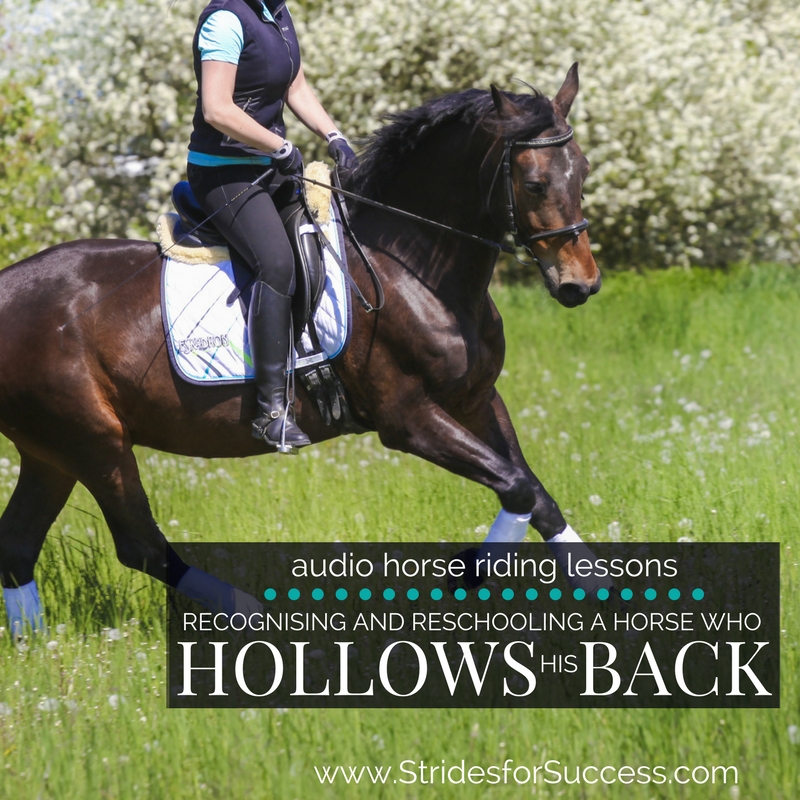
  • Recognising and Reschooling a Horse who Hollows His Back

    Recognising and Reschooling a Horse who Hollows His Back

    Recognising and Reschooling a Horse who is hollow through his Back

    What this episode is all about & how it can help you:-

    • Knowing what a hollow back looks and feels like
    • Realising you may be playing a big part in what is happening
    • Understanding the role your own self carriage plays in your horses self carriage
    • Beginning to build on a correct way of going in your rides

    [smart_track_player url=”https://op3.dev/e/traffic.libsyn.com/dailystridespodcast/1035-Recognising-and-Reschooling-a-Horse-Who-Hollows-His-Back.mp3″ title=”Recognising and Reschooling a Horse Who Hollows His Back” social_linkedin=”true” social_pinterest=”true” social_email=”true” tweet_text=”Is your horse a little ‘hollow’ through his back and are you maybe causing it… ” hashtag=”Equestrian #horseriding #selfcarriage” twitter_username=”strides_success” ]

    There you are, happily riding along.  Feeling all those good feelings we feel as riders; until you ask for something different.  Suddenly, it feels like everything has just ‘deflated’ and, to be honest, it has a little because your horse just went hollow through his back. 

    You see, it is not just you the rider who should ‘carry themselves’ and work at having a strong and connected back.  Your horse also needs to work on carrying himself in order to avoid becoming hollow through is back as well.

    Knowing What a Hollow Back Looks and Feels Like

    Being able to pinpoint and feel when your horse begins to hollow his back, and then later take steps to avoid it happening, is key to reschooling through this problem.  When your horse begins to hollow his back, it really feels as though his back is not supporting you any more.

    Think about this, when his hind legs (hind quarters) are engaged and working underneath him, they support you on his back.  When they get ‘left behind’ that support goes away…

    Couple this with the fact that most horses will also raise their head and neck and become resistant to the rein aids as well.  The result is your horse literally hollowing his back from underneath you and you experiencing that ‘sinking feeling’.

    Because the head and neck will usually ‘come up’, the rider can literally feel the horses shoulders brace against the contact and seat.

    This resistance is one of the most obvious signs that your horse has begun to become hollow thorough his back; and should send a few warning bells off in your head regarding what you can do to get things back on track.

    Realising That You May be Playing a Big Part in What is Happening

    Riders the world over tend to get into the saddle with the sole intention of making the horse ‘do’ something.  A good example of this is the all important ‘on the bit’ goal so many riders have, but either way, when we become so concerned with just one ‘goal’, it can be a little like putting blinkers on!

    Riders end up focusing on what they can see in front of them; the horse’s head and neck.  They also ‘see’ their hands and arms…  You must switch your focus from what you can see – to what you can feel, both in your horse and in your aids. 

    Just focusing on one part of the whole picture often results in your position suffering.  It is all the gripping, the squeezing, the twisting the shoving that you are doing to get things ‘looking’ like you think they should look. 

    But remember, from where you are sitting, you are only seeing a third of the picture.  This third should be the ‘result’ rather than the cause part of the overall picture!  When we start to make the front end the ’cause’, the result is never good!

    So, I mentioned that very often when riders get into this mindset and way of riding, they are moving – a lot!  All of this movement only serves to move your position further and further from where it should be. 

    The further you move away from where you should be, the less clear your communication becomes.  The less effective your aids are.  And the less you can balance yourself. 

    Understanding The Role of Your Self Carriage in Your Horses Self Carriage

    It is this lack of balance that causes you to become heavy in the saddle, which in turn can lead to your horse becoming hollow through his back.  He is literally trying to get out from under your unbalanced, ineffective position!  Harsh, but true!

    Instead of carrying yourself, you have become a ‘dead weight’ in the saddle.   Rather than thinking ‘light’ and ‘refined’, you are scrubbing and having to over do the communication through your seat.

    Many riders at this point become frustrated because their horse is not really listening or being responsive to their ‘seat aids’.  So rather than taking things back to basics and allowing their other aids to apply any extra pressure if necessary, they try to knuckle down even more on the already ineffective seat aid.

    It is a vicious cycle that usually leads to all parties becoming frustrated by the lack of understanding and progress!  An overly excited (heavy) seat will also effect the rest of your body and the rest of your aids.

    As the team leader for you and your horse, you need to lead by example when it comes to self carriage.   Learn to first carry yourself in order to feel what is going on underneath you.  It is only by carrying yourself that you can create the space your horse needs to carry himself.


    Beginning to Build on a Correct Way of Going in Your Rides

    Start with the basics, the walk to halt transition.  Work on setting it up correctly and allowing your horse to ‘close’ the halt.  Simply put, allow his space to ‘park’ his back-end underneath his body.

    Think of creating a space that he can easily close the lid of the box that all four of his legs should create when he is in a square halt.  

    Notice any tension through your lower back.  Notice if you are leaning, or becoming heavy.  Start to ‘feel’ if you are indeed creating that space for your horse; and then inviting him to step into it.

    Make a point of thinking light through the transition.  Go over it again and again, making small adjustments each time until you begin to ‘feel’ a difference underneath you.

    From here, start to look for this feeling throughout the other movements in your ride.

    Happy Riding

    Lorna

    Links mentioned in the episode:-

  • The Importance of Correcting & Perfecting the Basics in Riding

    The Importance of Correcting & Perfecting the Basics in Riding

    The Importance of Correcting & Perfecting the Basics in Riding

    What this episode is all about & how it can help you:-

    • Realising you can get by without them – until you can’t!
    • Starting from the beginning – what to focus on
    • Realising it will be a continuous, never-ending work in progress
    • Building on it in a system and way that works

    [smart_track_player url=”https://op3.dev/e/traffic.libsyn.com/dailystridespodcast/1033-The-Importance-of-Working-on-the-Basics.mp3″ title=”The Importance of Working on the Basics in Riding” social_linkedin=”true” social_pinterest=”true” social_email=”true” tweet_text=”The basics in horse riding and why they are so important…” hashtag=”Equestrian #horseriding #thebasics” twitter_username=”strides_success” ]

    You know they are important, and you know that it should be what you are focusing on every day (or at least 80% of your time in the saddle), you know how beneficial they are going to be – and yet you kind of got by without them … until you didn’t!

    That is the Basics in horse riding – and that is what we are talking about today.

    Realising you can get by without them – until you can’t!

    The basics are important with most things in life.  They are what we should pay attention to and work on.  In fact, if we keep hammering on the basics and get them perfected, a lot of the time, other things seem to fall into place.

    Horse riding is no different.  But the problem with horse riding is that, you can get by without the basics.  One of my trainers used to say to me that any idiot can jump a fence, but it is getting from A to B in style that counts.  This is so true, because any person can get on a horse and ride.

    But it’s understanding and mastering the basics that counts when you want to start to go to the next level.  If you don’t have the basics in place, you find yourself going nowhere slowly.  Roadblocks and lack of progress will plague your riding.

    It is only when this happens that a log of riders are open to admitting they may have missed a step or four…  And they need to go back to the start.

    Starting from the beginning – what to focus on

    Forward, forward, forward…  I say this almost every week inside of lessons in Daily Strides Premium – you must be going somewhere to do anything.  There must be forwardness – not only moving forward, but also thinking forward.  Because even if you are working on the halt, or maybe even rein back, you must be thinking forward.  Forwardness is key.

    Relaxation…  A lot of people will work on rhythm and suppleness, but they forget that they are all built on the back of relaxation.  If you don’t have relaxation, you cannot have the others.  When I talk about relaxation, it is not to the point where the horse is falling over himself and can’t lift his feet.  It is the lovely ease of movement and fluidness that comes through the horse when he works.

    You need tension to hold the horse together, but you don’t want any excess tension coming in and ruining that relaxation. There is a fine line that we walk with relaxation, which many riders unknowingly cross…

    As I said, when you start out those things are not that important, but later when you want to build and start progressing, this is where you will notice that you might not have the full picture – not all the pieces of the puzzle are there for you to put together.

    Position, Position, Position…  You must carry yourself properly in the saddle.  You cannot expect your horse to do anything, if you are not holding up your end of the bargain and carrying yourself correctly.

    Your position is also important from the point of view that you are in the best possible place to give the clearest communication to your horse at any given point.  There is no point in you wanting to do something, and every time you would like to move your legs slightly, you find that they have migrated to the wrong spot.

    As I said, when you start out those things are not that important, but later when you want to build and start progressing, this is where you will notice that you might not have the full picture – not all the pieces of the puzzle are there for you to put together.

    Realising it will be a continuous, never-ending, work in progress

     Where this ‘trips up’ a lot of riders is that they think that once they get into the saddle and they can walk and trot, and maybe canter and pop a little fence – then they don’t have to think about these things anymore.

    Are you familiar with the 80/20 rule?  Basically 20% of your efforts will give you 80% of your results.  In horse riding I think the 20% is composed of the ‘big things’.  Schooling over fences, working on the test, practicing your movements etc.  The other 80% should be devoted to the improvement and mastering of the basics.

    The 20% will bring the big results, but that cannot really happen without the 80%…  Again, horse riding and the basics require a consistent effort in order to make progress.

    If we take relaxation for example.  It shows up at every level of riding.  Just like rhythm; it is there all the time.  It doesn’t matter whether you are just starting out, or whether you are at the Olympics, you need to have those two elements present in what you are doing to succeed, and do it correctly and to the best of your ability.

    Every time you reach a new level with regards to your skills and regards to what you and your horse can do, you will find that you are going to bump into something which have you work on these again, but from your new level.

    So, as you progress, they come with you, they are there all the time.  It is like you are all on this journey together – yourself, your horse and all the basics. 

    You are all the time trying to balance each other out.  Understand that you and your horse are obviously the big pieces, but for you and your horse to work, there must be a balance of all the little pieces.  The basics are all the little pieces that balance it all out – they need to be there.  If they weren’t there, there would not be a complete picture, and it is not going to work.

    Building on it in a system and way that works

    So with all this in mind, we need to a proven system to help us progress.  This is where a lot of people would turn to the traditional Training Scale.

    I don’t have an issue with the Training Scale per se.  I have an issue with how people see the Training Scale as being exclusively for the horse.   The relaxation, the rhythm, the suppleness, contact and connection.  Then you take it to the next level it is impulsion, straightness and collection.  I believe that they all matter to the rider as well.

    Very often you will see a horse that perhaps has mastered some of these elements or steps paired with a rider who doesn’t really understand it.   The horse will carry the rider for a certain amount of time but eventually the horse is going to start mirroring the rider.  Then you are going to get this breakdown of the basic aids from the horse’s perspective, because the rider is not consistent with what they are doing.  They should both be working through this together.

    For example, take suppleness.  Not only suppleness as it relates to the physical body of the horse and rider.  But also considering suppleness as it relates to how they think about or approach things…

    The basics are essential to correctly riding and working your horse.  Take the time, find different exercises that will help you incorporate some work on them into your schooling sessions.  Both you and your horse will benefit from them in the long run.

    Happy Riding

    Lorna

    Links mentioned in the episode:-

  • Reschooling a Horse that is Dead to Your Leg

    Reschooling a Horse that is Dead to Your Leg

    Reschooling a Horse that is Dead to the Leg

    What this episode is all about & how it can help you:-

    • Figuring out why your horse is dead to the leg
    • Committing to consistency going forward
    • Creating a ‘rule’
    • Refining your ‘rule’

    We have all been there.   You are in the saddle on your horse, you are riding away – you apply your leg, and … NOTHING.  He is just completely ignoring everything, and you must resort to these huge kicks.  Oh yes, the horse that is dead to the leg.

    It is extremely frustrating, because you know the key to everything is forwardness, but you just cannot get into first gear to get any forwardness happening.  Why does this happen?

    Figuring out why your horse is like this

    There are a couple of reasons, and today I want to touch on the three main ones that I see happening time when dealing with a horse who is dead to the leg.

    1.  Some horses are just more ‘docile’ than others.  They are laid back and not really concerned about how fast they can go or how high they can jump.  They like to take life nice and easy, and take you the rider with them!  Of the three we are going to talk about today, this is probably the smallest group of horses.
    2. Lack of Consistency.  By this I mean the lack of consistency as a rider.  One day the rider is in the saddle and focused on schooling and responsiveness.  They have expectations of their horse based on what they are doing that day.   The ‘lack’ comes in when the next day, they just take it easy and let the horse do whatever they want.  Not really caring what is going on with the legs or any other aid.  This can lead the horse to become a little confused, or rather he thinks the rider is confused!  He then just decides to ignore all further directions coming from the legs of the rider in the saddle.  This is how a lack of consistency can cause a horse to be dead to the leg.
    3. Consistently doing the ‘wrong things’ in the saddle.   I am referring to a rider who is consistently banging and moving about in the saddle.  Many riders are up there and have no control over their body.  They are slapping their legs, and moving and wiggling and shaking…  The horse just never knows if that was a speed wobble from the rider, or if it was an actual aid.  So again, the horse decides to do nothing.  I personally think that this is the most common cause of horses to become dead to the leg.   It is also worth keep in mind that it may not have been you that has trained the horse this way.  This potentially happened long before you met or rode your horse, when somebody else was riding your horse.

    The third point is seen a lot in riding school ponies – bless their souls!  Because there is that consistent nagging (slap slap, bang bang, slap slap) going on from rider’s legs on their sides, which they have learned to ignore.

    However, when you get a rider who wants to communicate, well, they ignore it as well unless the rider makes it quite clear that they are open to having a real conversation, rather than just banging and shouting at the horse.

    This not only happens with riding school ponies, but you also get all sorts of horses that just over time have been exposed to riding in that way, and therefore their default method of ‘staying sane’, is to ignore the rider.

    Whatever the reason is – and I think it is important to understand what the reason is with your horse – we now must start looking at how we can turn things around.

    Committing to consistency going forward

    Firstly, we should commit to consistency going forward, but it must be doing the right kind of things consistently in order for this to work .  What we are looking for here, is that every time you are on your horse, you are consistent in how you are ask or communicate.

    Gone are the days where one day you are so strict and you want everything to be so refined and perfect, and then the next day you just let your horse do whatever he wants.  There must be a consistency from you the rider, to improve your horses responsiveness. This is particularly true when to reschool a horse to listen and respond to the leg aids again.

    Creating a ‘rule’

    In order for you and your horse to know where you stand with each other, you need ‘rules’.  The way I would go about creating a rule in this situation, is using a schooling whip.  I prefer a schooling whip over perhaps a jumping crop or a shorter whip, so that when you apply the aid, your hands do not have to come off the reins and break the contact.

    The reason we would use our stick is to remind our horse that, “Yes, I just used my leg, and that means please respect my leg and respond”. 

    How I would use this is that when you put your leg on and your horse ignores it, immediately give just a tap behind your leg.  The timing is everything here, it must be immediate so your horse begins to see the connection.

    The schooling while is almost like the way a teacher would use a pointer in the classroom, to point something out on the board. Or bring the classes attention to something specific.

    You are going to use the stick to tap behind your leg.  This is key.  Not the shoulder, not the hindquarters, not behind your thigh, it must be behind your lower leg where you are applying the aid that he has just ignored.

    It is also important that you always give the option of the leg first, otherwise it does become like ‘beating’ the horse.  By doing this you are saying to your horse, “Excuse me, I just said something and you ignored me – can you please answer me”.

    In my experience, it usually takes no more than three to four times before the horse starts to listen to the leg.  He realises there is a consequence.  A direct reaction to their inaction.  This is where the consistency on your part comes in.

    You say leg, he doesn’t respond, you respond straight away with the tap with the schooling stick.  That is how you create the rule.

    Refining Your ‘Rule’

    Over time, you will obviously need to start refining the rule.  It is not practical to have a schooling whip with you all the time, reminding, reminding, reminding!

    How you will begin doing this is by again applying the leg but initially asking with a slightly stronger leg aid than what you would normally do.  This could be applying more pressure, or it could be an actual kick with your leg.

    Over time as you are refining it, you are more using the muscles in your leg, and it becomes about varying amounts of pressure.  More of where you want it to be.  The secret conversation, as opposed to Pony Club.

    Remember, as you are refining it, it is going to become softer and gentler.

    Allowing Your Horse To Respond

    The final piece when reschooling a horse who is dead to your leg, is that when you ask your horse to go forward, you must allow your horse to then go forward.  So many people will ask for forward, and as soon as the horse goes forward, they then shut the whole thing down.

    This could be a conscious (I don’t want him to ‘run’) or a subconscious (I don’t want to be run away with) reaction.  Whatever the reason, if you keep asking and then changing your mind, your horse will begin ignoring you again.

    Because we are reschooling here, and he must respect what you are saying, you must then follow through with allowing him to complete whatever task you asked him to do.  This comes into not only forwardness, but if you are asking for lateral work or whatever else you may be asking.

    You must allow and facilitate that happening underneath your saddle, for it to become a new, and better way of you and your horse talking to each other.

    Happy Riding

    Lorna

    Links mentioned in the episode:-