Tag: daily strides podcast

  • Working Towards a Consistently Better Quality Trot

    Working Towards a Consistently Better Quality Trot

    Working on a Consistently Better Quality Trot

    What this episode is all about & how it can help you:-

    • The importance of establishing Forwardness in the Trot
    • How you can begin encouraging more responsiveness
    • Why you must Activate the Inside Hind Leg & outside hind leg
    • How you will know when it is ‘working’

    [smart_track_player url=”https://op3.dev/e/traffic.libsyn.com/dailystridespodcast/1025-Working-Towards-a-Consistently-Better-Quality-Trot.mp3″ title=”Working Towards a Consistently Better Quality Trot” social_linkedin=”true” social_pinterest=”true” social_email=”true” tweet_text=”Trotting – we do it most times we’re in the saddle; here’s how you can make it better…” hashtag=”equestrian #horseriding” twitter_username=”strides_success” ]

    When was the last time you went out riding with the sole intention of improving your trot?  Trotting is a gait we spend a lot of time in when in the saddle.  Yet, for many riders it is an afterthought in their schooling plan…

    I think the reason for this is due to most riders feeling like they have ‘mastered’ the trot when they can managed a few ‘up-downs’ without being bounced out of the saddle!  It tends to get put on auto-pilot after that point; and promptly forgotten about it!

    If this has been the case for you and your horse, today is the day we take the trusty trot off of auto-pilot and begin consciously working on establishing and maintaining a better-quality gait.

    The Trouble with Auto-Pilot Too Soon

    As I said a lot of riders put their trot onto auto-pilot.  They get into the saddle and the auto-pilot part comes from the fact that they allow the horse to dictate the posting.  The ‘Up-Downs’.  The Rising.  The horse will move the rider, rather than the rider moving with or influencing the horse if necessary.

    Becoming stronger through your position, particularly where core strength is concerned, will allow you to hold or carry yourself.   This will in turn place you in a good position, which will allow you to easily communicate with your horse.

    As you become stronger in your position, particularly in trot, you will soon see how you can begin to influence the horse as opposed to the other way around.

    The Importance of Establishing Forwardness in the Trot

    It is easy to become lulled into a false sense of ‘purpose’ when it comes to the trot.  In fact, one of the most common challenges many riders face in trot is the is a lack of forwardness.  Forwardness is essential to developing a good quality trot, so start here.

    I realise that ‘forwardness’ has the potential to scare a lot of riders.  But rather than seeing forwardness as speed, see it as moving with a sense of purpose.

    Our aids help us channel the horse’s energy from the back to where we want to go.  You cannot channel anything, if it not there to begin with.  Make sure that your horse is working forward and that you are thinking forward as well.

    How Your Posting Can Influence the Overall Trot

    Once you have established forwardness in your trot, you can then begin to turn your attention towards ‘tidying’ things up a little.   This starts will encouraging responsiveness, in both you and your horse.

    I suggest working with your half halt and transitions.  While you are shifting up and down gears, become aware of how you are posting or rising in the trot.  You should be balancing yourself and moving your own body, rather than using the horse’s energy and momentum to ‘bump’ you up and down.

    In order to begin working on a better quality trot you must be able to positively influence your horse, rather than the other way around…

    Allowing your horse’s energy to bump you up out of the saddle, followed with allowing gravity to assist your ‘coming down’ is not posting.  That is bobbing along!  Focus on moving with your horse.  Meeting him half way. Think of dancing – you are moving together, but each person is responsible for their own part of the dance.

    When you learn to take responsibility for your own movement in the saddle, you can then begin influencing your horses movements.  A small ‘stretching out’ of the ups or downs to steady things.  A quickening of your movement to energize things.  There are so many things you can do when posting correctly to influence your horses way of going.

    Working on Encouraging Responsiveness

    I recommend using basic half halts and transitions to fine tune the communication between you and your horse.  Stick to basic transitions between walk and trot initially.

    Work on refining the transitions so much, that your horse feels like he is just waiting to do what you ask. 

    Depending on both your level of riding skill and your horses training, you can refine this exercise to the point where there are two strides of walk and then trot.  Maintaining the quality of the transition from the trot to walk is important here.  So too is are the two strides of the walk.  Finally, ensuring that the trot is pushing it forward again, forwardness…

    Why you must Activate the Inside Hind Leg & outside hind leg

    Activating your horse’s hind quarters is a vital part of a good quality trot.  The hind quarters are made up of the inside leg and the outside leg of your horse.  Depending of which way your horse is flexed, or bending, you have an inside and an outside.  When thinking about the hind quarters, it is important to also think about straightness.

    Straightness is, when speaking about the hind quarters, both hind quarters using the same amount of thrust as they are pushing your horse forward. 

    Many riders focus their attention on the inside back leg, but it is important not to forget about the outside back let.  Don’t allow it to just do its own thing.   In order for there to be a good quality trot, both hind legs must be present and pushing forward.

    Trot is a fantastic gait to work on this because, in trot, all things are equal.  Your horses legs move in diagonal pairs, and each diagonal is moving the same as the opposite pair.  This gives you a good opportunity to really develop this equal push.

    You can use your half halt to connect both back hooves to the ground.  The hoof on the ground is important to think about here, because this is where your horse pushes from.  Each stride sees his hoof is landing on the ground. This is followed by his leg (and body) moving over that hoof and then being propelled forward by his hoof pushing off the ground.

    If your horse is not pushing equally from both hind legs, he will not be straight through his movements.  Learning to tell which hind leg is on the ground and which is moving through the air at any given time is the start of influencing one or the other.  When you can do this, you can begin to truly influence the trot.

    How will You Know when the Trot Starts to Improve?

    Many riders begin with experiencing these wonderful ‘moments’.   Fleeting glimpses of how things should feel all the time.  It often feels like you are both ‘pausing’.  It does not feel like you are going faster, or slower.

    A good quality trot feels like there is more room in it.  More space available for you and your horse to use yourselves more each stride.

    You will also notice that your horse will begin to strengthen and develop more behind; his hind quarters.  This in turn feels like he can lighten the front end a little bit more, which in trot gives you that lovely expressive movement from the front legs; the ruler many riders hold their horses trot up against!

    All of this requires your position to be as correct as possible.  You will also have to develop an awareness for what you are doing in the saddle.   As you are posting, working on using each post as an area where you can start to influence the trot.

    Improving your trot is really and truly something that will have an impact on both your walk and your canter.  It also allows the rider to experience an almost instant change in how their horse is going, which helps inspire them to work on it more.

    Happy Riding

    Lorna

    Links mentioned in the episode:-

  • Reflecting & Moving Forward in Your Riding

    Reflecting & Moving Forward in Your Riding

    Reflecting on the Past Year going forward into the New year

    What this episode is all about & how it can help you:-

    • The importance of reflecting on the past year
    • How becoming aware of changes can help your future decisions
    • Grading yourself for 2017!
    • Using all this information to move forward into the new year

    [smart_track_player url=”https://op3.dev/e/traffic.libsyn.com/dailystridespodcast/1024-Reflecting-on-and-Moving-Forward-in-Your-Riding.mp3″ title=”Reflections and Moving Forward in Your Riding” social_linkedin=”true” social_pinterest=”true” social_email=”true” tweet_text=”Grading yourself as a rider and how it can help you in 2018… ” hashtag=”Equestrians #reflecting #goals” twitter_username=”strides_success” ]

    The new year means that is time for a clean slate when it comes to your riding goals.  New diaries, new resolutions and new plans.  That is a whole of ‘new’ happening.

    However, before we get too caught up with the ‘new’; I feel that the best gift you can give both yourself and your horse going forward into the new year is to first review what was.  What worked, what didn’t.  What changed, what needs to change.

    Are you ready to ‘show up’ and take an honest look at your past year? Super – let’s get started…

    I want to help you today to make a plan for your riding this new year that will result in both you and your horse moving forward.  I have seen it repeatedly, how riders get into the arena, they get their horse, they are full of ideas.  Then maybe it takes a setback or three, or perhaps it takes things not going exactly as they were supposed to happen, and then the whole plan is gone and everything falls apart.  I don’t want that to happen to you.

    We are going to go through a lot of things very quickly today, but don’t fear I have made a handy worksheet for you which you can get HERE .  It will give you more time to think about your answers.

    1.  Reflecting on the Past Year

    What was a success for you in 2017, when it comes to you and your riding?  I don’t feel that this must necessarily be something to do with competition or a competitive success.  It could be something as simple as your relationship with your horse is a lot stronger because he trusts you more, or vice versa.  It could be that you managed to go on a hack, or outride, or trail on your own.  It could be that you got fit enough that you could feel your seat in the saddle, and not only that you could impact your horse with it.  Imagine that!  If that is not a goal for 2018, can I just suggest that maybe you make it one.

    I want you to get reflective on this, and figure out what was a success in 2017.  What achievements are you most proud of?  Again, it doesn’t have to be competitive.  For me it was getting back into the saddle on a regular basis.  That was an achievement!  It starts 2018 off on a whole new footing for me.  So, work that out and have a think about it.

    How did this achievement (whatever it was) improve your relationship with your horse?  I want you to get a little bit deeper, and really pick out the pieces.

    Because if you are going to make goals going forward that make you happy, and that you align with as a person – you need to figure out what was it that made that goal worth doing, or worth getting, or worth reaching.

    Also, what didn’t go so well in 2017?  This will often be your starting point when it comes to ‘improvement goals’ for the new year.

    What challenge did you maybe fail to overcome?  What happened?  Why did it happen?  What distractions did you have to deal with this year?  Was it the sort of year that threw a lot of things up in the air for you, or was it the year that you really got things figured out?   If you didn’t reach your goals, why didn’t you?

    Now I know that they are very big questions.  Again, you can get your free worksheet  HERE which will allow you to go through these questions in your own time.

    2.  Awareness of the changes that happened

    Understanding what changed about you as a person and as a rider can be eye-opening for many equestrians.  Was there a pivotal moment or an ‘aha’ moment in your riding this year? Very often this is something you will have heard, read or seen before but for some reason, it just clicked now makes perfect sense.

    How have you changed as a rider in this past year?  Have you become more patient, have you become more quiet; always a good thing!  Have you become more diligent?

    Perhaps you are now more consistent?  Consistent in your aids, consistent in your riding, consistent in your reactions and responses.  How have you changed as a rider?

    What would you have done differently this past year, and why would you have done it differently?  If there was something that maybe didn’t go to plan, or something that hindsight being twenty-twenty you can look back and say that if I had that over I would make a couple of changes there.  And why?  It is not only realising where you would make the changes, it is understanding why you would make the changes, so that we don’t allow the same thing to happen again going into the new year.

    What do you want to leave behind in 2017?  What do you want to just close the book on?  That chapter is over, it’s finished, it’s gone.  There is nothing you can do about it, and you know what even if there was, you are choosing not to.

    The other side of this is knowing what you want to bring with you into the new year.

    3.  Identifying Your People

    Who supported you the last year in your riding?  This might not be an equestrian person per se.  This could be a husband who maybe cooked dinners.  This could be the person who drove the horse-box.  This could be the person who brought the horse in from the field, so that you had enough time to spend on your riding.  It could be of course, an instructor, a trainer, a friend.

    Who supported you, and who has made the biggest positive impact on your riding in the past year?  It doesn’t necessarily have to be a ‘who’, it could be a ‘what’.  It could have been a blog, it could have been a video, it could have been a course, it could have been a program.  It could have been a lesson, it could have been a specific person.

    Realising who or what has had the greatest impact will allow you replicate that in the coming year.  It also helps you build momentum.

    Who, if anyone, has held you back?  Oh yes, there is always the people there who hold you back.  I want to do a whole program on this soon.  It may be people at the barn, an instructor or trainer, a husband or a partner,  a boss, an employee…

    Who would you like to connect with in the new year?  This could be a person that you already know, and you just want to take that connection further, or deeper.  It could be somebody that inspires you.  It could be somebody at the yard or the barn, that you find that when you are around them you just have clearer thoughts about your horse riding, and what to do in the saddle.  It could be an online person.  Who is it?  Who would you like to connect more with in 2018?  If this is an online person, it could be as simple as commenting on blog posts, by the way.  It doesn’t have to be ‘in person’ connections.

    4.  How did you show up in 2017

    Oh… This is a goodie!  You can get worksheet  HERE to go through it all.  It is good because in there, you can grade yourself and your performance this past year.  A report card of sorts on 2017, and how you showed up as a rider and an equestrian.

    For extra bonus points you can also look at what grades you want to finish this new year with – 12 months from now…

    5.  Moving Forward into 2018

    Finally, moving forward into the new year.  What new goals or achievements will you be working towards?  What sort of rider do you want to become?  What do you want to feel in your riding this coming year?  How do you want to feel about your riding this coming year?

    This all begins with making a decision, identifying what you are looking for, and then put your mind to getting there. 

    And from all of this information I want you to choose your word for 2018.

    My word is supple.  Physically, mentally, emotionally supple.  Supple in how I ride, in how I respond and in how I approach things…

    I would love to hear what is your word for 2018.

    Happy Riding

    Lorna

    Links mentioned in the episode:-

  • A System to Plan Your Year in the Saddle

    A System to Plan Your Year in the Saddle

    A System to Plan Your 2018 In the Saddle

    What this episode is all about & how it can help you:-

    • Reviewing the past year – what worked, what didn’t
    • Planning out the coming 12 months using quarterly themes
    • Including other ‘stuff’ in your plans to help keep it realistic
    • Building out the next 4 to 6 weeks

    [smart_track_player url=”https://op3.dev/e/traffic.libsyn.com/dailystridespodcast/1023-Planning-Out-Your-2018-in-the-Saddle.mp3″ title=”Planning out Your 2018 in the Saddle” social_linkedin=”true” social_pinterest=”true” social_email=”true” tweet_text=”Simple, step by step system to planning a year of progress in the saddle…” hashtag=”Horseriding #Planning #Goals” twitter_username=”strides_success” ]

    So how was 2017 for you and your horse?  More importantly, do you have a clear plan going forward into 2018?  For many riders, one of the big factors to 2017 not being as ‘great’ as it could have been is due to how they approached the year.  It is easy to enter January with big ideas, bigger goals and near impossible resolutions…

    What if, today, we rather invested a little time formulating a plan for the new year.  Something actionable that, when all is said and done, you feel is definitely possible for you to not only achieve, but also if given the right circumstances, surpass.  Interested?  Great!

    Review Your Past Year

    Firstly, you need to clearly lay out how things went in 2017, and how it has impacted where you are right now with your riding journey.  Try and go as deep as you can with this; the good, the bad, what worked, what didn’t.

    What I find works well for me is to think back and choose a couple of really stand out positive moments.  This helps me to start the process and also, gives me a guideline for some things that I perhaps want to make happen again in 2018.

    Becoming clear on what makes you happiest.   Then simply using those moments as a compass for plotting a course towards making more of that happen, or involving more of than in your current lifestyle in the new year..

    Once we have 4 or 5 of those positive experiences, we can turn our attention to the not so great.  Obviously, there are going to be a few of these littered throughout your past year.  Whatever your challenge was, it is important to understand it.  Have a look at what didn’t work, why didn’t it work, and what you could do differently to make it work.

    Choosing Your Word for the Coming Year

    From here, you can begin thinking about the coming 12 months.  What I would suggest you do is to pick a word for this coming year.  This word will help simplify decisions.  Is it aligned with the word, or not.   This word is what you want your riding journey to represent in the coming year.   Mindful, connected, compassionate or patience are some possibilities.

    Once you have this word choosen, you are going to begin seeing how you can weave it in to the quarterly themes that you choose for your riding.

    Planning Your Quarterly Themes

    A year can seem like a long time.  We all know and realise that it is not, but approaching it as one big chunk of time can often cause one of two things to happen.  Overwhelm or fatigue.

    In order to navigate around this, but still keep your ‘year goals’ on track, I suggest breaking the year into quarterly themes.   Each quarter will be a piece of the puzzle which will make up the year goals, but they will also have separate goals of their own.  A little like “sub” goals.

    Try and choose your themes in a way that act as stepping stones towards the big ‘year’ goal.  But see them as individual goals in and of themselves.  From here, break each goal down over the twelve weeks, 90 days or 3 months.  However you decide to do it, is up to you.

    Start by pretending you have achieved that smaller, quarterly goal and then work backwards to where you are right now.  This will give you a clear picture of what has to be done on a monthly, weekly and then daily basis to reach the goal from your current situation.  Then simply make sure that the theme works with your choosen word, therefore keeping you aligned with your values.

    Keep the Plan Realistic by Including ‘Life’ Events

    Before you finalise any of your quarterly plans, make sure you have also included any life events into your schedule or calendar as well.  The non-equestrian related happenings that we all have going on in our lives.   These include holidays, work events, birthdays, retreats, travel, school holidays or anything that has the potential to throw your regular calendar off a little.

    These things are important and they will have an impact on your time, your focus and attention and also, perhaps, financial situation.  Doing it this way also allows you to consider your energy levels.  You can ‘tweak’ your quarterly themes to work with you, rather than against your current lifestyle.

    The Final Step; the Next 4 to 6 Weeks

    The final piece of planning out your 2018 to get what you want is get really detailed on what the coming 4 to 6 weeks will look like in your riding.

    I realise that Christmas is a busy time for many people and, due to this, may not be the best place to start.  Find a date that you can realistically start things.  Spend a week or two preparing everything if necessary.  The riding place, the stables, inoculations, dewormer, farrier, leather repairs…  You and your horse are a team and as team leader, it is your responsibility to make sure that everything is in place when you do decide to move forward with your plans.

    Plan it all out, and then plot out the 4 to 6 weeks.  Look at what the theme was and now get specific on what you are going to work on each week leading towards that end goal, the 90-day goal.

    For example, it may be working on your half halt.  This builds up to your trot, which then builds to the canter.   Theme out each of the months inside of the 90 days, and then start filling in the details. I want to work on my half halt, which means I am going to dedicate 20 minutes on that day working on my seat and how I am using it in the saddle.

    As you work on each week, find exercises that are going to help you with exactly that.  They are going to keep you accountable and moving forward in your riding.  This is the key to getting the results you want in the coming year.

    Happy Riding

    Lorna

    Links mentioned in the episode:-


  • The Importance of Timing in Your Riding

    The Importance of Timing in Your Riding

    The Importance of Timing in Your Riding

    What this episode is all about & how it can help you:-

    • Timing – the big picture view
    • How to make the best use of your time in each ride
    • Using short bursts of time to focus you when you are in the saddle
    • Understanding the importance timing when it comes to your aids

    [smart_track_player url=”https://op3.dev/e/traffic.libsyn.com/dailystridespodcast/1022-The-Importance-of-Timing-in-Your-Riding.mp3″ title=”The Importance of Timing in Your Riding” social_linkedin=”true” social_pinterest=”true” social_email=”true” tweet_text=”Timing has a lot to do with if you will succeed or not in your riding… ” hashtag=”Equestrian #Horseriding #ticktock” twitter_username=”strides_success” ]

    Correct timing in your riding is essential to communication, both on the ground and in the saddle, with your horse.  In this episode we are going to take a look at timing from the ‘big picture view’ and also the closer, more intricate detail orientated, view.

    Timing when Working Towards your Goals

    I believe the most realistic and successful way of planning out goals when it comes to horses and riding is working in 90 day (or three month) chunks of time.  I think if we look further than that, especially with horses, it can tend to become a little hypothetical.

    That being said, it is clearly important to have a realistic picture of what you want things to look like a year from now.  Each of your 90 day chunks should be with that ‘year’ goal in mind.   Start with the coming 90 days and working backwards from that goal to where you are right now.  This is your beginning and the place you will measure your time from.

    Timing when Riding Your Horse

    Timing is important when you think about the ride itself.  From how long you are warming up, to how long you are schooling your horse and then your cool down time.

    Rhythm is another way of measuring time and rhythm can be worked on while preparing the horse to be ridden, of course the rhythm while actually riding your horse and also putting the horse away afterwards.

    If you plan to have an even, steady rhythm to all the above parts of each individual ride, you will minimise those feelings of being rushed, overwhelmed or frazzled. 

    Knowing how much time you have before each ride and allocating it out into flexible portions will give you a framework to plug your actual schooling into.

    You can also pay attention to the time of day you ride and how that influences both you and your horses way of going.  Perhaps there is a time of day when your horse is more responsive or he listens better,  more focused and less likely to spook or become distracted. Timing is all about finding what works best for you and your horse.

    Timing the Segments of Each Ride

    So we have already mentioned allocating time for your warm up, time for the actual schooling, then giving time for the cooling off.  However, we can go a little deeper here by focusing on the exercises themselves and what we want to achieve in that ride.

    Concerning exercises, many riders are of the opinion that they must simply ride through each exercise a couple of times in order for them to have benefit.  I want you to think about if you were to allocate a certain amount of focused time on working through each exercise.

    Let’s use the example of 20 minutes for actual schooling work.  This 20 minutes of time can be divided up into 6 minutes, 6 minutes and 6 minutes, and I am going to put a minute between the two as well.  I realise this is an extreme example, but by giving your horse and yourself a focused 6 minutes and then a minute just to relax and unwind, you will find the quality of the work improves.

    This method is proven to work because it stops the exercise from becoming monotonous and never ending.  Also, when we give ourselves an end point, it helps us become a lot more focused on what we are doing between now and then. 

    It helps us assess the quality of the work we are doing.  Noticing what you want to work on, and what you want to have made happen when you get to the end point will help you become more consistent and disciplined in the saddle.

    Timing of the Aids

    Timing can also be used on a very precise split second level in riding with the timing of the aids.  Specific aids given at an exact moment in order for your horse to take that direction and make the necessary changes happen regarding his movement.

    As riders, it is this type of timing that we look to refine every time we get into the saddle.  This is where you should be working every single day.  This is what you can focus and concentrate on in those timed schooling sessions.   The practiced refinement of the timing of your aids.

    This begins when you start working on what is moving when underneath you.  Your aim is to feel your way here, not peek over the side!

    Knowing what is moving when beneath you, is the foundation for knowing when to apply your aids to get a specific result.

    You should ask with your aid at the moment when the horse can respond to your aid.  Otherwise your horse may not be physically in a position to respond your aid, resulting in frustrations about a lack of responsiveness. 

    Start working on developing this skill next time you are in the saddle.  Take note of what is moving, when it is moving, how is it moving and where would be the best point for you to act and influence that movement to get the desired result that you are after.

    Begin Working on Your Timing Today

    It is important to understand the importance of timing when it comes to riding.  Taking it from the big picture, 90 day goal view, all the way down to the split second application of your aids in the saddle.

    Happy Riding

    Lorna

    Links mentioned in the episode:-


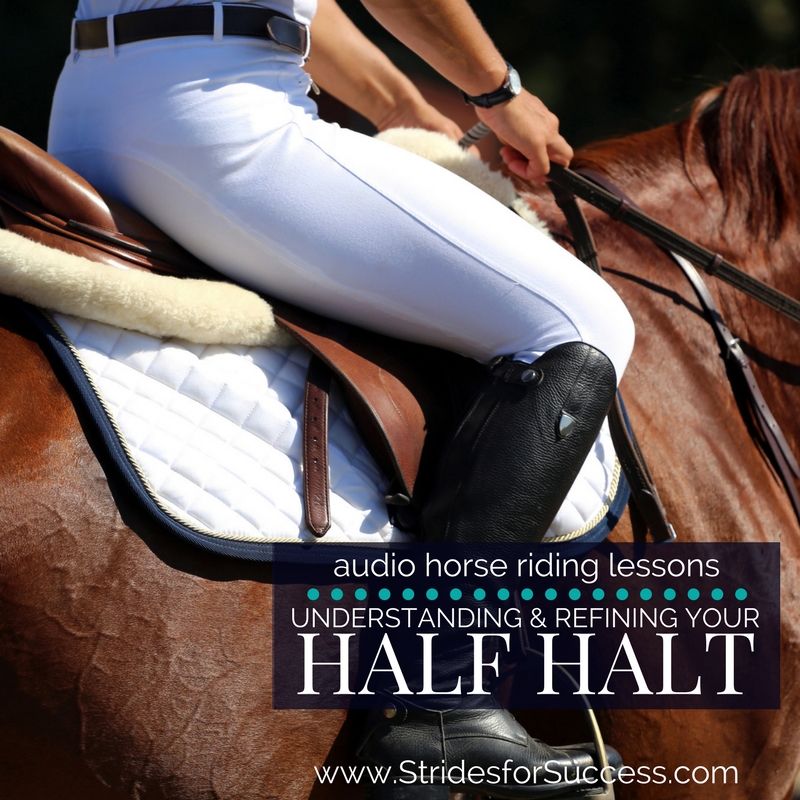
  • Understanding and Refining Your Half Halt

    Understanding and Refining Your Half Halt

    Understanding and Refining the Half Halt - Strides for Success

    What this episode is all about & how it can help you:-

    • Understanding how the half halt is like an intercom system for your horse!
    • Timing, Timing, Timing and why you are probably doing too much for too long…
    • Thinking about riding into your hand, rather than against it
    • Working towards slowing the front end to ‘catch up’ the back-end

    [smart_track_player url=”https://op3.dev/e/traffic.libsyn.com/dailystridespodcast/1021-Understanding-and-Refining-Your-Half-Halt.mp3″ title=”Understanding and Refining Your Half Halt” social_linkedin=”true” social_pinterest=”true” social_email=”true” tweet_text=”Thinking ‘half’ when it comes to the half halt ” hashtag=”equestrian #horseriding #halfhalt” twitter_username=”strides_success” ]

    Riding horses is all about balance.  It’s a balance between your aids, it’s actual balance sitting on your horse.  However one of the most essential, yet difficult balancing acts is the half halt.  There is an ever shifting balance between the aids, the rider and the horse.  In this episode I want to dig a little deeper into the half halt with some practical advice you can use immediately to get results.

    What is the half halt?

    The half halt is a communication aid between you and your horse.  It is your way of bringing your horses attention back to you, in order for you to then give directions about what you want him to do.

    Unfortunately what often ends up happening many riders is that they are so busy babbling to their horse – via the seat, legs, reins and fingers – that when they ride a half halt, their horse has completely tuned out.  He is no longer part of the conversation at all.

    Simply put, the half halt is all about bringing your horses attention back to you, so you can then convey something to the horse. 

    It all happens much quicker than most riders imagine…

    I like to think of the ‘half’ part in the name ‘half halt’ as pertaining to the amount of time it takes to ride the aid.   No longer than half a stride.  You can then take it a step further when you think about performing the aid within one footfall of your horse.

    Many riders hold the half halt for too long, and rather than it being that fine balance we mentioned at the beginning, it becomes an anchor in the sand.  Doing this has an obvious effect on the horses way of going.

    Rather work on getting your half halt to the point where it is so refined that nobody can see you doing it, and nobody can see the effect on the horse.

    It is also important to keep in mind that your goal should be to apply the half halt BEFORE things start to fall apart.  Many riders leave it too late and this results in an almost panicked and rash use of the aids in order to rebalance.

    How should you apply the half halt?

    Firstly, there must be a clear difference between what you are doing now and what you are going to do when you apply the half halt.  This difference is often missing due to the rider being too stiff and tense in the saddle.

    Think of ‘allowing’ through your seat and back in particular.  If you can establish and then maintain a lovely looseness before you apply the half halt it will make all the difference.  The half halt is that little bit of resistance for that split second.  When used correctly and consistently your horse will feel the change.  The difference.

    It is also worth remembering that it is a ‘slight’ resistance.  Subtle.  Quiet.  This is why developing a strong core can make a difference to your communication with your horse.

    The next part is that the horse shouldn’t change course from what’s happening.  He must be moving forward before you apply the half halt aids.  Once applied, he shouldn’t slow down, he shouldn’t stop.  This is where your leg aids come into play.  With them, you will ask your horse to continue moving forward.  This all happens in a split second (that one footfall) – leg on, leg off – and ridden in a way so that you are not bumping the horse.  It must be a subtle increase in pressure, and then a decrease in pressure, all inside that split second.

    Understanding the role of your hands in the Half Halt

    The third part of this simplified explanation is your hand.  A lot of riders make the mistake of bringing their hand back in the half halt, in other words they come against the horse.

    Rather think about your legs bringing the horse into your hand. 

    Your hand will not move back.  Rather think about the resistance that began in your lower back spreading up, across your shoulders and down through your arms.  Your arms will also have a certain amount of tension, resistance, in them.  That resistance is there to meet the energy that comes through when apply your leg aids.  It is truly a balance of your aids.

    The relationship between the front end and the back-end

    The half halt is what you can use to connect the back-end to the front end.  If ridden correctly, it will cause the front end to lighten so the back-end can come under it.   In order for this to happen, the back-end must be coming forward from behind.

    The result is a lovely lightning.  It is your horse re-balancing, re-adjusting, re-calibrating everything in order to lighten and carry itself a little better. 

    It is an every changing and evolving aid

    The half halt will be ridden differently for every horse and every situation.  The balance of the aids must be adjusted to fit the current scenario.

    When working with young or less experienced horses, or less experienced riders, the lightness will not happen straight away.  It takes physical and mental development in both horse and rider in order to really tap into the true power of a subtle half halt.

    However, these instances the answer is to perform a lot more half halts than a more experienced pairing or team of horse and rider would require.

    Summing up the Half Halt in a few simple steps

    Next time you are on your horse, think about the one footfall – that you should allow first through your back before you can ask for that little bit of resistance through your back.

    How your leg is then asking the horse to continue to move on so that it is bringing the energy in, but then your hand is there to meet that.

    Your hand is not coming up against the horse, your horse is rather coming into your hand, you are holding it for a split second and then you are releasing.

    That is the half halt in a nutshell.

    Happy Riding

    Lorna

    Links mentioned in the episode:-

    Links to other content that will help with this topic:-

    Click here to subscribe

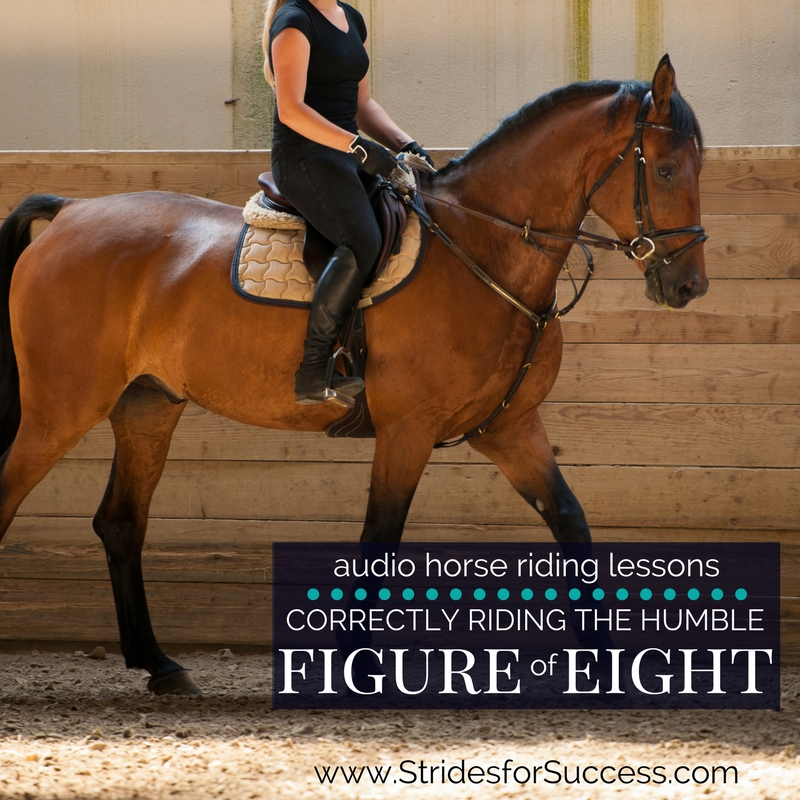
  • Using the Humble Figure of Eight in Your Schooling

    Using the Humble Figure of Eight in Your Schooling

    Correctly Riding the Humble Figure of Eight - Daily Strides Podcast

    [smart_track_player url=”https://op3.dev/e/traffic.libsyn.com/dailystridespodcast/1020-Using-the-Humble-Figure-of-Eight-in-Your-Schooling.mp3″ title=”Using the Humble Figure of Eight in Your Schooling” social_linkedin=”true” social_pinterest=”true” social_email=”true” tweet_text=”Rethinking the Figure of Eight ” hashtag=”Horseriding #Podcast” twitter_username=”strides_success” ]

    What this episode is all about & how it can help you:-

    • How accuracy is key to riding a successful figure of eight
    • The importance of rhythm all the way through
    • The power of ‘straightness’ through the change
    • Identifying where your challenges lie

    The figure of eight can be a fantastic aid in your schooling of both yourself and your horse, if it is ridden correctly and given the focus and effort it deserves.

    The humble figure of eight is one of those things that we learn very early in our introduction to horse riding.  It can sometimes seem that it is too easy to really bother with, but the figure of eight is something you can use regardless of the level you are at in your riding.

    It is an exercise that has lots of different benefits, depending on what level you and your horse are at in your training.  For example, each of the different levels of the traditional training scale can we worked on when riding the figure of eight.

    What is the Figure of Eight?

    Simply put, the figure of eight is two circles, side by side so they look like the number eight.  What trips many riders up is the fact that while it sounds simple, riding a single accurate circle is anything but simple and has a lot of potential for things to go a little off track.

    When we put two circles together, this can lead to further challenges if not approached carefully and with a plan of how you are going to ride the movement. This is one of the reasons why the figure of eight can be so beneficial for your riding, by developing not only physically (you and your horse), but also mentally as well.  You must be able to concentrate for the amount of time it takes to get you through the full figure.

    Why Accuracy is Key to a Good Figure of Eight

    Your circles must be well planned out.  I am going to suggest that if you are not fantastic at riding a line to rather put markers out which will help keep you on track.  Put more markers than what you would think you need out there.  You are going to be thinking about so many other things when you are riding the figure of eight that probably the shape is going to be the part that ‘gives’.  And you don’t want that.

    In order for the figure of eight to be beneficial to your schooling, a correct bend must be maintained throughout the exercise.  Your markers will help you to achieve this.

    The second point to consider when speaking about accuracy with the figure of eight is the middle point where the two circles join.  You must be very specific on where exactly that point is.  I would suggest maybe putting two poles out that you have to go through each time to avoid the centre from moving!

    Knowing its exact location is essential for a good approach and an equally as good departure from it and onto the ‘new’ circle.

    Relaxation and Rhythm while riding a Figure of Eight

    Both relaxation and rhythm are key while riding the movement, whatever gait you are in.  Whether you are in walk, trot or canter you want to make sure that you have those basics in place.

    The basic that is you are relaxed and your horse is relaxed, particularly when it comes to that all important middle point. 

    As well as the relaxation, you also want to notice that you are working to maintaining the rhythm.  A lot of riders will find that when they are on the circle the rhythm is great, but as soon as they begin approaching that middle point.  This is because you are preparing a lot of things to happen in order to successful change rein at this point, and it is easy to lose the rhythm (or / and relaxation) because of this.

    Riding the Figure of Eight

    When you are riding a circle on the left rein (circling to the left), you are riding in a particular way.  Your outside leg is going to be slightly behind or back from where your inside leg is; they are definitely not equal on your horse’s sides.

    The same applies to our seat bones and also our shoulders – our shoulders are going to be mirroring our horse’s shoulders, and they are not going to be ‘equal’.

    However, when you are approaching the middle point of your figure of eight, all this needs to change.  Your inside will become your outside and your outside will become your inside.  A lot has to happen in a small space of time, so I suggest simplifying things by riding a couple of strides of straightness each time at the middle point.

    Giving yourself between three and five strides where you are straightening things out will allow you to be more accurate and also help to maintain the rhythm and relaxation through the change as well. 

    Potential Areas for Things to Go Wrong

    There are two key areas where things have a lot of potential to go off track when it comes to riding a figure of eight.  The first is where the one circle ends, as you are approaching the ‘X’ or middle point (the point where the two circles intersect).  That final quarter of the circle what can sometimes lose its shape due to your horse beginning to fall in.

    To prevent this from happening, you must ride every stride.  Even though you are thinking ahead and you are planning for those couple of strides of straightness, you are not ignoring that final quarter of that circle in order to get there.

    The circle has to continue and you have to maintain the bend and stay on track in order to make that happen.

    The second area where things can potentially go off track is when you have passed the intersection point (the middle ‘X’ point) and have started on your second circle.  It is easy to ride off track by going too far out or a little bit too short.  Basically, our horse either falls out, or falls in.

    There can be a few reasons for this, but it is usually due to the rider not being very clear about where they want to go.  The lack of clarity in the riders plan leads to a lack of clarity in the aids and the communication in general.

    Keeping on Track

    Again, the biggest reason most riders ride mediocre figure of eights is because they underestimate all that is involved in riding a successful one.

    Focus on sitting tall in the saddle, having a good plan about where you are going to ride and how and then making it happen.  Use markers to plan out that track that you want to ride on, and then as you get better at it you can take the markers away and start to use your own eye – your line – to ride it.

    Begin in walk, building up to trot and later canter.  In canter, you can transition through that ‘X’ back down to trot, or you can ride a flying change.

    The beauty of the figure of eight is how versatile it is depending on your level of riding.

    Riding a good quality figure of eight will lead to increased suppleness, which is the next step of that all-important Training Scale for both you and your horse.  But in order to work on suppleness, the foundational pieces of the rhythm and the relaxation must be in place.  Let them be your focus the next time you ride a figure of eight in the arena.

    Happy Riding

    Lorna

    Links mentioned in the episode:-

    Other content that will compliment this episode:-