Tag: daily strides podcast

  • Learning to Wait for the Jump

    Learning to Wait for the Jump

    Learning to Wait for the Jump


    What this episode is all about & how it can help you:-

    • Understand why timing matters with regards to confidence
    • Modify your position depending on the jump
    • Working on the ‘wait’
    • Follow, rather than go first

    [smart_track_player url=”https://op3.dev/e/traffic.libsyn.com/dailystridespodcast/1031-Learning-to-Wait-for-the-Jump.mp3″ title=”Learning to Wait for the Jump” social_linkedin=”true” social_pinterest=”true” social_email=”true” tweet_text=”The art of letting the horse go first over the jump!!” hashtag=”jumping #equestrian #horseriding” twitter_username=”strides_success” ]

    The jump is in sight.  You have choosen your line.  However, as you approach, you notice some anxiety creeping in to your mind regarding timing.  Why?  Because, every now and then, you and your horse just don’t seem to go over that fence together!

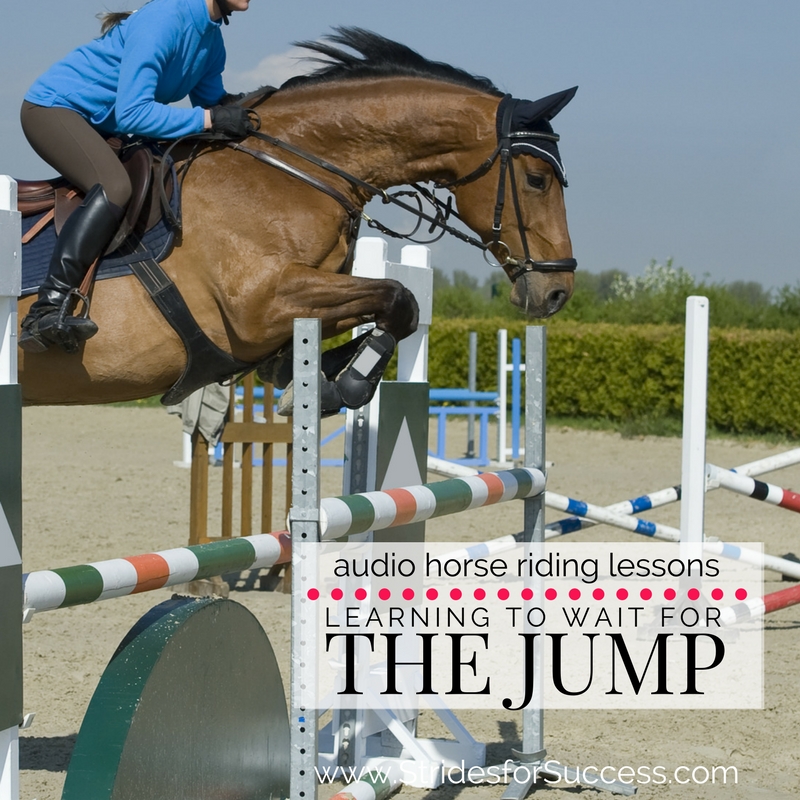
    Today we are talking timing.  Timing your jumping position when it comes to going over fences.  Specifically, make sure you are not going into your jumping position too early.

    Why Your Timing Matters with Regards to Confidence

    Arriving at the base of the jump already ahead of the movement has a huge impact confidence, for both horse and rider.  It can quickly erode trust and make both sides feel anxious when they see a jump.  The reasons are different for both horse and rider, so let’s look at them one by one.

    We will start with the horse.  Horses, particularly young or green horses rely on the riders guidance and support going over the jump.

    This support is just as much an emotional or mental support as well as physically supporting him through the connection and contact.  All parts of your body that are in contact and communicating with the horse.  Your legs, your seat and of course your voice plays a part.  Obviously, the hands and the reins are also a big part. 

    When the rider goes into the jumping position too early, the horse can feel let down or dropped.  Couple this with the fact that the rider has probably shot up the horse’s neck, makes it not only unnerving for the horse, but also difficult for them to lift their front end off the ground.  This is potentially further complicated due to a young horse not being developed physically enough to enable them to compensate for the rider fault.  The result is a different negative impact on the horses confidence.

    If we flip the coin, and focus on the rider as they approach the jump things are a little different.  An inexperienced rider who goes into their jumping position too early is often paired with a more experienced horse.  As they approach the jump and the rider is too early with their position, many horses see this as an opportunity to duck out the side door!

    Unfortunately for the rider in this situation, the force called momentum then usually comes into play!   This only makes the rider more anxious and tense on the next approach, which will only serve to increase the potential for things to go off plan.

    Your Position will Depend on the Jump

    It is important that you can correctly time your jumping position so that you move over the fence with your horse.  Your position will depend on the jump.  I see many novice riders ‘over doing’ their position over a smaller jump.  They look as though they are jumping 160cm, rather than 60cm!

    Keep in mind that your ‘fold’ will depend on the size and the aspects of each individual jump.  The height, the size, where the jump is, whether it is going up or down hill.  It is important to understand that when the jump is small you don’t have to fold as much.  A lot of riders by overdoing the ‘fold’ end up going into their jumping position too early.

    Think of it this way; the smaller the fence, the less time in the air.  Meaning the less time you have to fold in and out of your jumping position.  

    Rather try to ‘wait’ for the jump and then only do what is necessary, no more, when you get there.

    Working on the ‘Wait’

    Simply put, you must try to wait for the horse to get to the fence.  It sounds really basic, but for many riders they are so focused on what they should do, that they fail to ride where they actually are at any given moment.

    When you are jumping it is very important to try and merge these two things.  Obviously, you are thinking about where you are going to go after the fence, and what is coming up after the next fence – but you also must ride each individual stride getting to the fence.

    One of the ways that you can do this is by counting yourself down into the fence.  For example, as you are approaching the fence, pick a spot and decide how many strides you will get between that spot and the fence.  Then count down from that spot – three, two, one.

    Doing this will allow you to develop a better eye for where your horse is going to take off.  Also by counting it down “three, two, one” it makes it easier because you know that you must wait for “one” to be done before you go over the fence. 

    I normally get my riders to say something as they go over the fence, like “jump” or “land” if we are doing a grid with a couple of fences.  Say anything as you go over the fence – you could even say “now”.  You only allow yourself to go into your jumping position when you are on that word.

    Following, Rather than Going First

    Another way you can train yourself to wait, is by waiting for the horse’s front end to come up to meet you.  This does take a little more experience.  In an ideal situation, on the approach to the jump you will be out of the way and allowing the horse to take you both to the fence.

    Being out of the way means that you will not be perched on his neck!  As the horse goes to take off, his front-end will rise.  This is where you literally wait and then follow him on over.  If you throw all your weight at that front end while he is lifting it, you are making his job incredibly difficult.

    Another way to test this timing is to build yourself a couple of grids, starting off with just poles on the ground.  Then as you are trotting or cantering through – perhaps approach it at a trot and pick up canter as you are going through it – allow yourself to fold in and out of a light seat over the poles.

    Make sure that you are indeed sitting up in between the poles.  Sometimes when people go into their jumping position too early, they also tend to either stay there too long or they come up too early, and get the whole timing wrong.

    Whatever way it is happening with you, you need to work on that timing.  Practicing over ground poles is probably one of the best ways that you and your horse can happily work on this.

    Set up a grid of poles, and start working on folding in and out, all the way.  Allowing your knees to be the shock absorbers, all the while keeping that contact and connection with your horse all the way through.

    Happy Riding

    Lorna

    Links mentioned in the episode:-


  • Using Your Body to Effectively Influence the Canter

    Using Your Body to Effectively Influence the Canter

    Effectively Influencing the Canter with Your Body

    What this episode is all about & how it can help you:-

    • Understand the difference between being influenced and doing the influencing
    • Being able to ‘roll’ with the canter first
    • How feeling the reach of your seat is the start of understanding your influence
    • The part your legs and hands play

    [smart_track_player url=”https://op3.dev/e/traffic.libsyn.com/dailystridespodcast/1030-How-to-Begin-Influencing-the-Canter-with-Your-Body.mp3″ title=”Using your body to influence your horses canter” tweet_text=”Are you influencing or being influenced by your horse in the canter? Here’s how you can start having more say in the saddle in canter…” hashtag=”equestrian” twitter_username=”strides_success” ]

    What happens when you get into canter with your horse?  Do you find that you are more of a passenger than a rider?  Simply put, are you influencing the canter, or are you allowing the canter to influence you?

    Today we will start figuring out what is going on in your canter, so you can begin to have more of an influencing effect on it.

    The Difference between Influencing the Canter and Being Influenced by the Canter

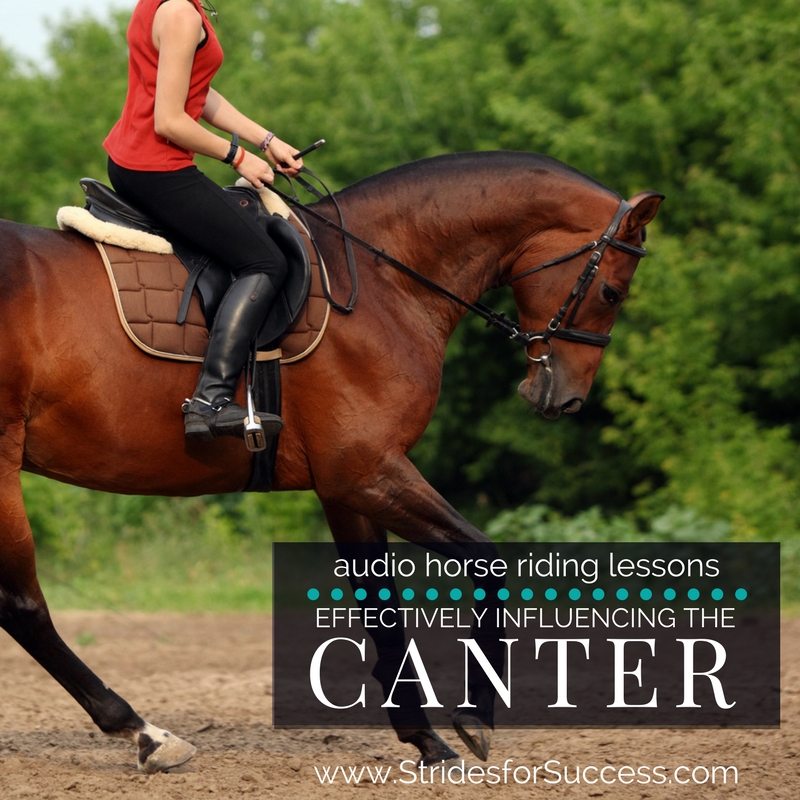
    The canter is a gait which can potentially have a lot of energy inside of it.  For many riders, being influenced by the canter feels like this energy is causing them to ‘bounce’ or ‘bump’ in the saddle each stride.

    Unfortunately, many try to correct this problem by gripping on or holding down into the saddle.  This only makes things more uncomfortable for both horse and rider.

    In order for the rider to begin influencing the canter through their aids and actions, they must first understand the canter.  Understanding what is happening underneath them.  This all begins with learning to first follow the horse.  Allowing the horse to influence.  Only then can they begin to focus on influencing the canter by what they are doing in the saddle.

    Being Able to ‘Roll’ with the Canter First

    A lot of what happens in the canter happens through the riders seat.  The seat is important to both transition into the canter, but also then to ‘roll’ with the canter.

    However, many riders, rather than ‘rolling’, they try to hold themselves in the canter.  I think that this often comes from some anxiety being present around canter.  Regardless of the reason behind this anxiety, the result is often that by the time they get into canter, they have a lot of excess tension in their body.

    This excess tension can often be seen by riders gripping with their thighs. In doing so they shut down any and all movement in their hips.  Simply put, there cannot be any roll.  It can also show up as a stiffness though their lower back. 

    Whichever one is happening, the experience is generally not going to be as smooth as the rider would like.  Every stride of the canter as it continues tends to result in the rider becoming a little more ‘bumped’ out of the saddle.

    However, if the rider could just relax and allow their body to move with, rather than gripping against, the result is them achieving the rolling motion.

    The good news is that once you can really move with the canter, you have overcome the first barrier to entry to a good canter.  Meaning you are on your way to effectively influencing the canter. 

    If you are at the stage that you have not mastered this rolling motion the following is going to seem a little counter intuitive.  But trust me, it works! The less you grip and the less stiffness in your lower back, the more you will stay with the horse.  Remember, when you try to dictate the roll before you truly understand how to move with it, it is very difficult to get into the same momentum and movement as the horse.

    Feeling the Reach of Your Seat Within Each Roll

    Assuming you have mastered the rolling motion, I then recommend that you bring your attention back to what your seat bones are doing.  Remember the rolling motion comes from your pelvis and hips.  In fact, the whole lower torso and upper thighs are moving with the horse.

    Identifying your seat bones and where they are at any given point in the canter is the beginning of being able to ‘feel’ in the saddle.  What I want you to feel is the reach. The arc your seat bones travel or move ever single stride. 

    Think of this ‘roll’ for a moment.  It will always result in your seat coming back to a ‘starting point’ and then setting off on the next ‘roll’ each stride.  It feels like a circular or oval motion.

    What I want you to focus on here is the reach, meaning the ‘starting point’ and then the ‘furthest point’ your seat travels as it continues on its roll.

    Once you can feel that, you can start playing with it.  You can start allowing the seat bone to perhaps reach a little bit further.  Or you can bring it back, so that the seat bone is not reaching as far.  It is really important that you maintain your posture and position throughout this; otherwise you will block or shut down the free movement in your seat.

    The Part Your Legs and Hands Play

    One of the helpful aspects of plugging your seat in correctly in the saddle, is that a lot of other things just fall into place naturally afterwards.  Your legs are one of these things!

    When you have any excess tension in the saddle, particularly around your seat or your thighs, your leg position becomes affected.  When in the saddle, you want your legs to simply fall down your horse’s sides.  Of course, when your horse begins moving there is a little work required in order to keep them still while your horse is moving.

    Once your legs are draping the horse, they are in the correct position to most effectively influence and communicate with the horse. 

    However, when there is tightness through our pelvis, our legs are generally too far forward.  Or if we are gripping with our knees our lower legs tend to go too far back.  A lot of ‘leg problems’ can be remedied by simply ensuring that the seat and pelvis is allowing the movement to happen when in the saddle.

    Maintaining Consistent Connection through Your Arms and Hands

    The final piece of influencing the canter is your hands and your arms.  Your hands and arms must follow the horse.  I like to think about your hands and arms being connected to your seat.

    It is important to understand that when the horse canters, there is a lot of natural movement happening.  You must be able to discern that movement and then begin following the horse.  This will ensure there is no resistance on your part through your hand or through the bit & rein.

    It is through this quietness that you can begin to influence the canter. The hands and arms are engaged in the communication, but they are not overpowering the communication.

    You will often see riders ‘pump’ with the top half of their body.  Rather try to ‘still’ through your shoulders, while allowing the movement through your elbows, and of course your wrists and hands.

    Your job is to try to keep your shoulders nicely balanced so that they are carrying you.  You almost want to think of your shoulders as a clothes hanger with a long garment hanging from them.  The garment is the rest of you.  But the clothes hanger is there providing the support.  Now imagine the wind moving the garment.  The wind is the horses movement or energy, the clothes hanger is your shoulder.

    Once again, once you can move with the horse and then understand that movement, then you can begin influencing the canter.

    Happy Riding

    Lorna

    Links mentioned in the episode:-

  • Enjoying Yourself and Learning as a Mature Rider

    Enjoying Yourself and Learning as a Mature Rider

    Enjoying Yourself and Learning as a Mature Rider

    What this episode is all about & how it can help you:-

        • Realizing that you, as a mature rider, have changed
        • Cultivating a support team around you
        • The benefits of starting at the beginning again – even if you think you don’t have to
        • The importance of maintaining your physical fitness

    [smart_track_player url=”https://op3.dev/e/traffic.libsyn.com/dailystridespodcast/1029-Enjoying-Yourself-and-Learning-as-a-Mature-Rider.mp3″ title=”Enjoying Yourself and Learning as a Mature Rider” tweet_text=”Are you finding that things are different because you’re a mature rider? A few ideas on how to excel…” hashtag=”equestrian” twitter_username=”strides_success” ]

    Are you trying to navigate the equestrian world as a mature rider?  Are you feeling that a lot of advice, ideas and activities don’t really align with you where you are right now?  Does it feel like a lot of what goes on in the global equestrian community is catered more towards younger riders?

    Today I want to talk specifically to the more mature rider in my audience; a group of riders that I love working with.

    Realizing That You Have Changed

    What is your ‘story’ as a mature rider?  Your story is your mindset – what you tell yourself and others day in and day out.  Is your story aligning with your current lifestyle?

    It is important to understand that mentally you have grown, or that you are growing.  The considerations that you may have had a few years ago probably look a lot different from the thoughts that weigh on you now as a mature rider. Disregarding this and trying to gloss over it won’t work.  These things are always there, in the back of your mature rider mind.

    Your responsibilities are constantly changing and evolving.  Looking after yourself becomes a little bit more of a priority now that you are a mature rider. 

    When you are younger you don’t have that same weight of responsibility regarding looking after your body and keeping healthy and fit.  You know that, for the most part, you will repair and your body can handle a lot of the knocks and bumps that will show up in your experience as a rider.

    However, as you begin to get a little older, falling off and breaking something is a very real and present consideration.  It presents a lot more of a challenge now than what it would have presented years ago.

    Recognize this, allow it to be there, and validate it.  This way your decisions become a little clearer and easier.  Rather than making decisions from a very ‘fear-based’ place, you are doing so from the realistic circumstances you find yourself in.

    What decisions are you making?  A lot of people get into the rut of doing the same thing that they have always done.  And yet, as we have just said, you have changed as a rider.  You are now a mature rider.

    You have grown.  You have evolved. You have shifted mentally. What you believed back then is not going to be the same set of beliefs you have now.

    Of course, physically you will also have changed.  It is important to recognize that and to recognize that perhaps your riding also needs to change to facilitate these changes, particularly in order to keep it enjoyable for this new version of you.  Being open to these changes is important as a mature rider.  This does not necessarily mean that you should change discipline. Perhaps it is the type of horse you would normally ride.  Maybe it is where ride.  Or the type of Instructor you are riding with.

    Sometimes, you don’t have to change anything at all as a mature rider.  However recognizing, realizing, and coming to terms with this ‘new’ you are going to make all the difference in going forward in your riding.

    Cultivating a Support Team Around You

    A good support team can be a great help, particularly if you are returning to riding when resistance shows up.  You will most likely have plenty of people who are your cheerleaders and praise you.  But there is often the odd one or two – you know the ones – that will give their little niggly comments every now and then.  Rather than allowing those one or two comments to overshadow your enjoyment of riding, listening, and focusing on your ‘supporters’ will help you ignore the ‘naysayers’.

    The right Instructor is part of that support base.   A supportive Instructor will sit down with you and figure out what you want.  They will not try to force you down a path of what they think you should want. 

    However, if you are not currently taking lessons, the role of an instructor can, potentially, be replaced by a group of other like-minded and experienced riders.  Again, the important thing to look for is that you feel ‘built-up’ after chatting with them, rather than negative and lacking confidence in your abilities.

    Having the support of your husband, partner, significant other, perhaps children or good friends, is also important.  If they are constantly telling you that you are crazy to go back to horse riding, it is going to have an impact on that mindset that we spoke about earlier.

    I believe that if you approach this from a responsible point of view, which comes back to understanding and recognizing that things have changed, and then trying to plot a new course for yourself.  This is going to make all the difference.

    The Benefits of Starting at the Beginning Again (even if you think you don’t have to)

    I would also suggest at some point, going back and starting at the very beginning when it comes to your riding and your training.  Why?  Because as your body and your mindset are changing as a mature rider, you may find that how you do things change as well.

    The half-halt for example; the physical changes in your body may mean that the balance of your aids is now a little different as it was before.  Riding is a constantly evolving process, so too is the half-halt – so it makes sense to revisit it from time to time.

    Starting at the beginning gives you a fresh clean slate.  It allows you to recognize and realize what is going on inside of your own, mature rider, body, and inside of your own, mature rider, head.  If you can be mindful of how you are changing as a rider, you now have a platform from which to work from.

    Remember, if you are trying to do the same thing that you have always done – even though you have changed; can you imagine how confusing it must be for your horse?!  

    He probably has no clue what you are asking for half of the time!  So give yourself the luxury of starting back at the beginning, and rediscovering your aids, your feel, and your general basic knowledge of the what’s, when’s, and hows in the saddle.

    I actually suggest this practice to all riders – go back to basics, master the basics.  You will see that any very successful riders spend 80% of their time doing the basics.  Day in, and day out.

    The Importance of Maintaining Your Physical Fitness

    The final thing, and of course we must bring it up as a mature rider, is your physical body.  One of the (many) things which change as we age is our body.  It can potentially become a lot less supple.  A lot less strong, physically.

    You need to manage it and maintain it regularly.  I would suggest that you begin to add a simple, basic routine off the horse that is going to compliment and support you when you get on your horse.

    Strength is so important.  Start thinking about where you could make changes today, that would incorporate a little bit of strength training, which will really and truly complement your work in the saddle.

    You can join the free 30 Day Rider Fitness Challenge HERE

    Finally, I personally think those mature riders are an inspiration…  Keep doing what you are doing and, most importantly, enjoy yourself.

    Happy Riding

    Lorna

    Returning to Riding

    Are you returning to riding?  Are you feeling a little overwhelmed with it all?  I may just have the thing to help you get back into the saddle – and enjoying yourself there again!

    The Original Returning to Riding Plan is a complete step by step audio program that takes you from ‘not riding’ to regularly riding and enjoying yourself again.  The plan is laid out over 6 weeks, however, you have lifetime access to go over it again and again as you want in the coming weeks, months, and years.

    You can find all the details HERE.  And I wish you all the best in making your ‘Returning to Riding’ as enjoyable and successful as you dreamed it would be :)

    Links mentioned in the episode:-

  • The Direct Relationship Between Your Fitness and Your Riding

    The Direct Relationship Between Your Fitness and Your Riding

    The direct relationship between your fitness and your riding

    What this episode is all about & how it can help you:-

    • How your fitness impacts your enjoyment levels when riding
    • The whole ‘staying on the horse’ element
    • Why it improves your communication with your horse
    • Fast-tracking your progress and breakthroughs

    [smart_track_player url=”https://op3.dev/e/traffic.libsyn.com/dailystridespodcast/1323-REPLAY-The-Direct-Relationship-Between-Your-Fitness-and-Your-Riding.mp3″ title=”The Direct Relationship Between Your Fitness and Your Riding” social_linkedin=”true” social_pinterest=”true” social_email=”true” tweet_text=”Still on the fence about improving your fitness levels? This will inspire you” hashtag=”horseriding #fitness” twitter_username=”strides_success” ]

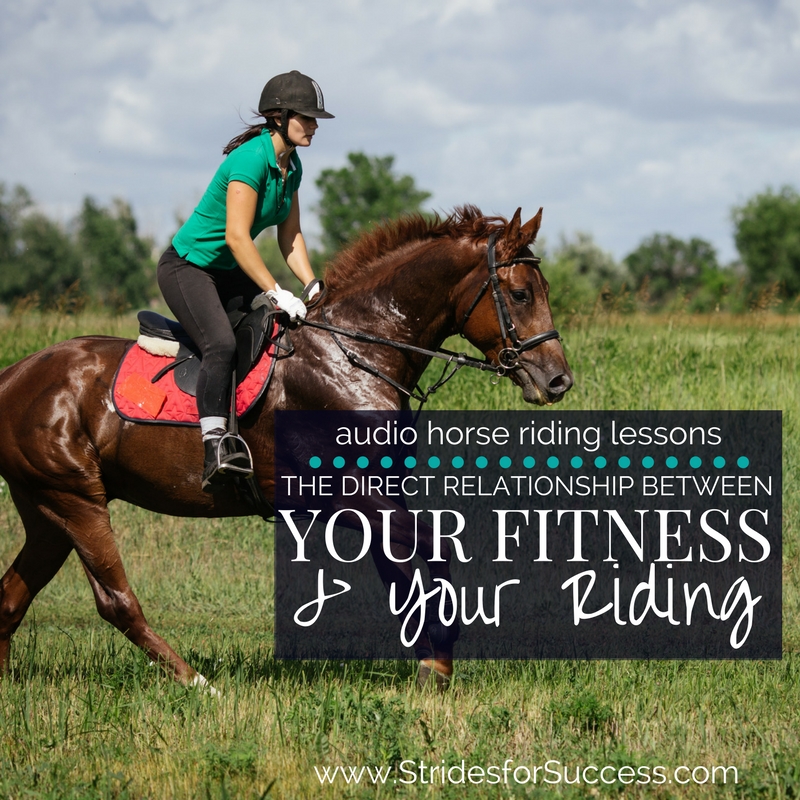
    Do you find yourself huffing and puffing after a couple of rounds of canter with your horse?  Or perhaps you feel exhausted after only 20 minutes into a lesson?  You find yourself wanting to do or give more effort, but you just can’t…

    My goal for this episode today is to inspire you to have even better communication with your horse by improving your overall fitness in the saddle.  It really has absolutely nothing to do with your horse at all.  This is all down to you, and what you can do to become a better team leader, for “Team You and Your Horse”!

    Rider fitness is a topic that a lot of people seem to avoid or overlook its importance to the overall effectiveness of how the horse goes.  Many riders spend hours planning out fitness, feeding, and conditioning programs for their horse, but fail to pay attention to their own fitness.

    Riding is a team sport, you and your horse.  I believe it is unfair and irresponsible, for you as the rider not to try to be the best version of yourself in the saddle.  The best version of you is one that can respond quickly and effectively and this comes down to your fitness levels.

    Focusing on improving your riding fitness levels will have benefits in so many areas of your riding.

    1.  You Will Enjoy Yourself More

    Have you ever experienced physical tiredness when riding?  It causes a slight lag in the relationship between your brain thinking something and your body doing it.

    When I returned to riding after a break, I both understood and experienced this a lot.  There were days when I felt mentally fine after riding, but physically I was exhausted.  That next day and the John Wayne Walk that it brought with it was not fun!

    In order for me to fully enjoy riding, I realised that I had to begin focusing on my personal fitness journey.  

    2. The Whole ‘Staying On’ Element

    One of the biggest benefits for many riders, when they begin improving their fitness levels, is the fact that they usually feel they can stay on a little easier!  Who doesn’t want that?

    The fitter you are, the better you will be able to cope with any unexpected movements that your horse may throw at you.  As riders, we know that when it comes to horses, things can sometimes be unpredictable.   The fitter you are, the better able you will be to control your body.

    Improved fitness simply means you can control your response; as opposed to just reacting, and trying to hang on for dear life.

     3. Improved Rider Fitness Improves Communication with Your Horse

    Personally, I feel that this is the most important reason for improving a rider’s fitness levels.  As an instructor, I often see how after twenty minutes into a lesson (usually the warm-up), tired riders begin to carry or hold themselves differently.

    A further ten minutes into the actual lesson, where real focus and concentrating are called for, they are pretty much exhausted.  The riders become frustrated because they want to do more, and mentally their brain is telling them to push on through.  But the reality is that their body is just not able to respond.

    Those slow responses, and sometimes even wrong responses ends up muffling the whole communication between the rider and the horse.  This in turn leads to even more frustration – not only for the rider, but for the horse as well.

    Imagine, if you were riding fit, how much more you could accomplish in your schooling time.  Physical fitness also lends to mental fitness.  So, when you are physically fit you will find that mentally, your concentration levels also improve.

    Again, from my personal experience, when I returned to riding I often found that my mind would start to wander after a while – obviously from fatigue.  It led to me being less than one hundred percent focused on what I was doing.  But as my fitness improved – so did my focus and my concentration.

     4.  Fast Tracking Your Progress and Breakthroughs

    Which do you think would help you and your horse get quicker and more consistent results?  An hour of ‘so-so’ work or twenty to thirty minutes of focused, quality work?  When it comes to riding horses, quality definitely outweighs quantity.

    Building your riding fitness will ensure that when you are finished, both you and your horse have enough in the tank to actually enjoy the cool-down, and enjoy each other’s company.  It feels like ‘celebration time’ together; you achieved a good quality workout.

    Imagine finishing each riding knowing that you both gave it your best, you gave it your all, and you had breakthroughs.

    Your becoming a better version of yourself fitness-wise, is going to directly impact the breakthroughs that you have in your riding.  The truth is that when a rider is unfit, they spend so much of their time in the saddle playing catch.

    When you are fit, you can focus on what you are communicating to your horse and how you are communicating it to your horse.  This allows you to respond in such a way that your horse is able to gauge exactly what you are looking for from him in the saddle.  It is only natural that this ‘better communication’ will have a direct positive impact on your progress and the speed of that progress.

    Now, bear in mind that I am all for having relaxing rides on your horse, the two of you enjoying yourselves together.  But wouldn’t it be great if you could get the same point across to you horse in, for example, 7 minutes rather than hammering away for 30 minutes and perhaps still being unsure whether the communication was clear?

     5.  Imagine What Your Horse Would Say…

    Hopefully, I have inspired a little something inside of you today to make your personal fitness a priority in your riding and your life.  If not, here is one final ‘nudge’ that might just help get you off the fence and onto the exercise mat…

    Imagine this … you are finished riding, and you put your horse either in the field or in his stable – either way back with his friends (the other horses).

    What would your horse say about you and about the ride as he experienced it? 

    If you are thinking (even a little), ‘oh thank goodness he can’t speak, or even if he can, thank goodness I can’t hear him’ – perhaps that is a sign that you should be doing a little bit more on focusing on your fitness.

    Happy Riding
    Lorna

    Links mentioned in the episode:-

    Equestrian Fitness Challenge ’24

    Let’s walk together for 21 days and have a chat about how you can do much more than you think you can as a rider and an equestrian… I am so excited to bring you along on this journey for the 100% FREE 2024 Equestrian Fitness Challenge
    There will be a daily walk, a 10 minute daily yoga practice, and lots of tips, ideas, exercises, and ways to improve so that you can show up as the best version of you – for you and your horse.
    Sign up today and let’s transform your riding – one stride at a time! 100% FREE 2024 Equestrian Fitness Challenge
    Have a super day
    Happy Riding
    Lorna


    Connect with Lorna online:-

    Get Going in Your Riding:-

    Daily Strides Premium is back! You can use the first and original audio horse riding lessons to improve your riding, train your horse, keep things interesting, and have fun… Even if you don’t have a trainer or coach

  • Understanding the Balance of Your Aids

    Understanding the Balance of Your Aids

    Understanding the Balance of Aids

    What this episode is all about & how it can help you:-

    • Why focusing initially on your seat usually won’t work
    • Understanding pressure and how it varies
    • Solving the inside leg to outside rein puzzle
    • How improving your balance can improve your responsiveness

    [smart_track_player url=”https://op3.dev/e/traffic.libsyn.com/dailystridespodcast/1027-Understanding-the-Balance-of-Your-Aids.mp3″ title=”The Basics to Understanding the Balance of Aids” social_linkedin=”true” social_pinterest=”true” social_email=”true” tweet_text=”Balance – a huge part of horse riding, especially the balance of aids in the saddle…” hashtag=”Equestrian #Podcast” twitter_username=”strides_success” ]

    Balance.  It is a concept that always shows up when discuss the important things in life. Balance blends the important parts together.  Balance, if adhered to, makes things work more seamlessly together.  Many riders think of balance as staying on…

    However, today I want us to focus on that important blending; the balance of aids.

    Every good relationship is built on communication, so it stands to reason that you should work on building your communication channels with your horse.  When in the saddle, this is achieved via your aids.

    Why Focusing Initially on Your Seat Usually Won’t Work

    When we initially learn to ride, things are often explained to us in a very simplistic manner, and of course it must be otherwise we would give up on the first day.  But then as we begin going deeper into the aspects of horse riding, we begin to understand that our seat is the most important aid we have when communicating with our horse.

    However, knowing that your seat is important and then riding in a way that conveys that to your horse, are two very different things!  Your seat is important “IF” you can control everything else!

    Which brings us to this balance of aids.  When you are learning to ride, through the different stages of your progress as a rider, that balance changes.

    Initially, your seat is not going to be so important as a clear aid.  Now, I realise that some people will argue with me here and insist that “Of course it is important”.  But no, really it is not because most riders cannot control their seat at that point.

    If you were to try to communicate with your horse using your seat when you first start riding, you are just going to be talking absolute gibberish to your horse.  Complete nonsense, which he can’t understand.  The result is the horse ignoring the rider, or becoming anxious by a ‘busy’ rider, which will inevitably result in both of you becoming extremely frustrated with the process.

    To counter this, when we learn to ride initially, the balance or aids gives a greater emphasis to our legs, hands and voice. 

    Then, as we refine our riding skills then the balance changes and the seat becomes more important.  Now, it is worth bearing in mind that your seat is not completely null and void at the beginning, but if you could imagine a pie chart of your aids, the seat ‘slice’ would be significantly smaller than the other pieces when we start our journey as riders.

    This is where I see the frustrations of a lot of riders.  They are not yet at the point where their seat can work effectively for them as a communication tool with the horse, and yet they are trying to do that, and it ends up negatively impacting so much in the saddle.

    So, keep in mind that if you are in the early stages of your riding journey, or coming back to riding after a break, your seat probably should not have such a big piece of the balance pie, when it comes to all your aids together.

    Understanding pressure and how it varies

    As you become more adept and more refined as a rider,  your aids are going to change.  The balance of aids is always changing, that is the nature of balance.

    However, it is also the balance inside of the aids themselves that is part of this change as well.  Simply put, this is the pressure at which you apply your aids.

    How much pressure you apply with a particular aid is going to depend on a few different factors.

    • What you are doing
    • Your abilities as a rider
    • The horse itself on that day
    • The responsiveness of the horse
    • The situation or circumstances you are riding in

    Every day this will change depending on the specific set of circumstances surrounding each ride.  An example of this is the difference between riding a horse in the arena and, the same horse, in an open field.   Even though it is the same horse (and maybe even the same day), the aids need to be applied differently in order to be effective.

    The pressure of each individual aid changes.  But so too does the sequence or how the aids are being applied together.  Everything can vary and it is this balance which must be considered every time we sit on a horse.

    Most riders have a goal of improving their ‘feel’ in the saddle.  ‘Feel’ is that point where you are no longer thinking or planning your adjustments.  You have the ability to keep your aids in balance regardless of the situation, the circumstances, the horse, whatever the case may be.

    Solving the Inside Leg to Outside Rein Puzzle

    One of the most misleading concepts regarding balance of aids is the inside leg to the outside rein.  Due to the focus being so much on the inside leg and the outside rein, many riders completely forget about the outside leg and the inside rein.

    All the aids play a big part in this concept working correctly, including the seat.  It’s just that the balance of aids has shifted slightly. 

    Let’s think of the pie chart again.  If we divide up our pie-chart based on how much relevance is going to be given to each individual aid, the inside leg to outside rein pie chart would not only contain two pieces, or halves.  All the other aids are still in there, playing a role; balancing.  However, the pressure exerted by them must vary depending on how the horse responds.

    If you were to just ride from the inside leg to the outside rein for example, and not use anything else, the concept will not work.  All the other aids must be there, the balance, in order to maintain the straightness and the connection with the horse.  Missing aids lead to lack of balance, which leads to being lopsided!

    How Improving Your Balance can Improve Your Responsiveness

    This brings me to the final piece of the balance puzzle.  When you begin to improve the balance of your aids, you are also going to find that overall responsiveness, both you and your horse, will improve.

    Realising that a balance is always there and always in play will ensure that you are working on refining it every day in the saddle.  This begins with self-awareness in the saddle.

    Begin noticing the ’cause and effect’ of your thoughts, movements and aids. “When I do this, in this way, I get this result”.

    By doing this, you will begin to see patters in how your horse associates specific aids with certain actions he must respond with.  The connections he has formed in his mind between two things.

    As you become more aware of those connections, you can then begin refining your aids more and more.  Playing with the balance and discovering what works best in particular situations.

    The final piece of this is devoting less time on thinking about your aids and more time on tweaking or refining the outcome to get the results you desire.  This is that ‘feel’ I spoke about earlier.

    It is a little like fine-tuning an old radio using the dial.  It can be a little frustrating at the beginning. Snippets of muffled communication, coupled with a lot of static.  It is only by making micro, minute changes to the dial that the communication and overall experience improves.  Then when it is correct, the result is instant.  Clear sound flows from the radio.

    Your balance of aids is similar.  it is fine tuning, tweaking, paying attention.  When you get it right your horse can hear you perfectly.  You can also ‘hear’ your horse

    It is also worth remembering that the perfect balance might be fleeting at the beginning.  That is the nature of balance; the stable spot when everything is moving. However, as you become better able to read and adjust your aids, you will find that staying in balance for longer becomes easier.

    Happy Riding

    Lorna

    Links mentioned in the episode:-


  • Position Faults that are Potentially Holding You Back in Your Riding

    Position Faults that are Potentially Holding You Back in Your Riding

    Position Faults that could be holding you back in your riding

    What this episode is all about & how it can help you:-

    • Understanding the importance of a good position
    • Your seat and where it should be
    • Your legs and heels and how they affect your stability
    • Your head, shoulders and arms and how they affect your position

    [smart_track_player url=”https://op3.dev/e/traffic.libsyn.com/dailystridespodcast/1026-Position-Faults-that-Could-Be-Holding-You-Back-In-Your-Riding.mp3″ title=”Position Faults the Could be Holding You Back in Your Riding” social_linkedin=”true” social_pinterest=”true” social_email=”true” tweet_text=”How good is your position in the saddle? Could a simple ‘tweak’ change everything for you?” hashtag=”Horseriding #Equestrian” twitter_username=”Strides_Success” ]

    If you were to mark your position in the saddle out of 10, how would you score?  Would you make the perfect 10?  Or would a few simple position faults undo everything for you?  These basic position faults have the potential to put a halt to your progress as a rider.  Yes, they can have that much impact on your overall riding performance.

    The reality of the situation is that without a correct position in the saddle, you tend not to make a whole lot of sense to your horse.

    Your position in the saddle is something that riding instructors the world over focus on daily during lessons.  A lot of riders sadly don’t realise how important their position is to their overall riding, because if they did more effort would go into correcting it.

    Why is Your Position so Important?

    Simply put, a good position puts you in the right place to be able to communicate most effectively with your horse.

    Another advantage of a good position is the dramatic decrease in your risk of unexpected dismounts (falls) because you are more secure in the saddle.  So, if you are working towards an independent seat, it makes sense to devote some time to perfecting your position.

    I want to visit a few areas where your position might be letting you down, and give you a few ideas on how to improve your overall position – and in doing so, improve your riding.

    Your seat and where it should be

    Are you guilty of sometimes treating the saddle as a place to sit, rather than a place to communicate from?  Your seat is probably your most important tool when it comes to communicating with your horse.

    If your seat is not correctly positioned in the saddle, the result is you talking gibberish to your horse! 

    It sounds a little harsh, but it is true.  The right position where your seat is concerned is essential from the first ride.   As you develop as a rider, your seat becomes more and more important to your communication with your horse.

    If your seat position is incorrect, or if you have been allowed to ride one way (which is the wrong way), your seat will be ineffective from the beginning.  These position faults will become amplified further down the line.

    What is ‘Good’?

    That being said, what is a good position when it comes to your seat?  Basically, you should be sitting on your seat bones.  They should not be sticking out behind you, nor should you be leaning back on your tailbone.

    If you could imagine your seat bones being two flashlights.  A good position will see those beams of lights pointing straight now to the ground below where you are sitting in the saddle.  They would not point backwards towards your horse’s hind hooves, and they would do if you were sitting a little forward, or perched in the saddle with your bum sticking out behind you.  Nor would they point towards your horse’s front hooves, which would happen if you were rolled back on your tailbone.

    Your seat affects the rest of your body. When your seat is plugged in correctly it has an almost domino like effect.  Everything else will have a greater success rate of maintaining its position as well. 

    How a Faulty Seat Position Affects Your Legs in the Saddle

    Many riders immediately notice how, once they have corrected their seat position, the their legs feel different.  Your legs cannot function to the best of their ability while riding if your seat is faulty.  The biggest cause for concern is gripping with your thighs and knees due to being perched in the saddle (your bum will be sticking out behind you and your back arched).

    When you are sitting correctly on your seat bones and carrying your body using your core, it allows your pelvis to open.  This, in turn, allows your legs to drape down around your horse’s sides.  This is important, regardless of what discipline you are doing.

    A closed pelvis creates a clothes-peg effect on your horse using your legs.  They become similar to a vice-grip; clamped closed in a bid to keep you in the saddle.    Rather think of actual drapes, material.  Your legs should be in contact with your horses sides, but not gripping or clamping.

    Your Ideal Leg Position

    One of the markers of a good position is the visible line from your head, through your shoulders, through your hip to your heel.   When that line is present in your position you are balanced.

    If you are struggling to imagine this line, try this:-   The next time you are in the saddle imagine you can click your fingers and, like magic, make your horse vanish.  If the line is present, you will land on your feet.  It it is not, you will either land on your face or on your bum.

    The head, shoulder, hip, heel line is the start of learning to become a balanced rider.  It puts you in the best position to use your own body for balance, rather than relying on your horse.

    The Ever Important “Heels Down”

    Oh, it may just be the most uttered phrase in arenas the world over.  But it really is an essential part of developing a good position which will lead to your independent seat.

    How much weight you are going to have in your heels will vary depending on your discipline.  Jumping generally requires a little more than dressage.  What is important here is to recognize that by dropping the weight into your heel, you elongate your leg.

    How a Relaxed Knee Improves the Overall Use of Your Leg

    The final position fault to do with riders legs is squeezing with the knee.  Next time you are in the saddle, I want you to try something.  Slip your hand between your knee and the knee roll of the saddle.  You should be able to swing your knee away from the saddle with very little resistance.

    Notice how, when you do this, your leg remains in contact with your horse.  It remains ‘on’ while your knee can stay relaxed.  

    Why do you not want your knees on?  Two reasons.  Firstly, you certainly don’t want to pivot on them because you would be a little top-heavy, increasing your chances of toppling off!      Secondly, your knees act, along with and ankles, as your shock absorbers.  If they are fixed in any way, this will result in bouncing, loss of position and ineffectiveness in the saddle.

    Your head, shoulders and arms and how they affect your position

    One of the most common position faults in this area is failure to carry the head.  It sounds strange, but a simple way of ensuring this is not the case in your riding is by focusing on creating and maintaining the space between your chin and your chest.

    However, your head can also influence your overall position through the direction it is facing.  Look where you are going and you will find that your head positively influences the position of your shoulders.  This of course will have a domino effect on your arms as well.

    Opening Your Chest and Shoulders

    I personally do not like the term ‘shoulders back’.  I find that it encourages riders to needlessly arch their back, which causes excess tension in both horse and rider. 

    Rather start with a correct seat position.  Then imagine opening or stretching the distance across your chest from point of shoulder to point of shoulder.  This will naturally encourage you to sit a little taller, focus on where you are going and, open your chest up.

    The Elbow, Wrist, Hand, Rein, Mouth Line

    The final part of your position I want to touch on today are your arms.  There is a second line that, when applied, makes all the difference in smoothing out the communication between horse and rider.

    That second line is from the elbow, down through your hand, through the rein to the horse’s mouth.  It should be straight at all times.  No Vs or kinks in it.  Neither the rein or the hand should deviate off that line between the elbow and the bit.

    Riders who work on mastering all of these potential position faults find that their communication with their horse improves dramatically. It is truly amazing how effective a few small changes can be.

    Your Physical Fitness and its Impact on Your Position

    Riding is a Team Sport – you and your horse.   Just like your horse, the stronger and more developed you become physically; the more fluid your movements and “self carriage” become in the saddle.

    Creating a detailed exercise program for your horse, while failing to take your own fitness into account will result in, at best, mediocre results in your riding. 

    Establishing and then maintaining an effective position in the saddle requires strength, suppleness and discipline.  Taking responsibility for your fitness is just as important as assuming responsibility for your horses fitness.

    We are starting a new round of the free 30 Day Rider Fitness Challenge on 1st of February.  This will be different to anything that has gone before; you choose what you want to do based on your unique circumstances. You can sign up HERE

    Happy Riding

    Lorna

    Links mentioned in the episode:-