Tag: relaxation

  • [Training Scale] Part 1 – Finding Rhythm in Your Training

    [Training Scale] Part 1 – Finding Rhythm in Your Training

    [fusebox_track_player url=”https://op3.dev/e/traffic.libsyn.com/secure/dailystridespodcast/1205_Have_You_Good_Rhythm_in_Your_Riding.mp3″ title=”Finding Good Rhythm in Your Riding…” social_linkedin=”true” social_pinterest=”true” social_email=”true” tweet_text=”How do you know if you have ‘good rhythm’ in your riding?” hashtag=”equestrianpodcast #horseriding” twitter_username=”strides_success” ]

    Rhythm is often a funny thing when riding.  The reason for this is that rhythm, in the true sense of the word, is any beat that is on repeat… And, most horses tend to have a beat or two that they repeat.  This leads many riders to struggle with rhythm.  Their question is “if there already is a rhythm, why is it something to work and develop?”.  And that is a mighty fine question…

    All rhythm is not made equal when it comes to horses, riding, and a general way of going. As riders, we need to find the correct rhythm that we want to repeat; and then make that happen regardless of what questions we ask…

    What is ‘Good Rhythm’?

    I often find that it is easier to begin explaining what ‘good rhythm’ is not. Have you ever been on a horse that feels like they are ‘sliding’ rather than walking?  It kinda feels like their legs are moving so quickly, that they might be moving together? But they’re not jig-jogging or trotting? They are also not gaited…

    The challenge here is that instead of being able to clearly identify a distinct 4 beat rhythm in each stride of the walk, the ‘beats’ are overlapping a little.  The left legs feel like they are almost moving together, and then the right legs.  Resulting in that ‘sliding’ feeling we just spoke about.

    Any rhythm is not a good rhythm when working your horse.  The indistinguishable beat produced by the horse ‘sliding’, while it is a rhythm – it continuously repeats itself – is not the rhythm we want in the walk. 

    A ‘good rhythm’ in the walk will have a clear one-two-three-four, one-two-three-four, one-two-three-four, on repeat.  Clear, distinctive beats that repeat consistently over a period of time.  This applies to the one-two, one, two, one-two, one-two, of the trot.  And the one-two-three, one-two-three, one-two-three, of the canter.

    Can Rhythm Be Improved?

    Okay, so once we can see what a basic ‘good rhythm’ sounds like in walk, trot, and canter, the next question often divides people.  Some riders believe that no, we cannot improve rhythm.  Doing so, or trying to do so, is asking the horse to do something unnatural for their unique abilities and as a unique individual.

    Similarly, there are other riders who believe the exact opposite; yes, you can totally change and ‘reform’ your horse’s rhythm to be different and better.  I’m not a huge fan of absolutes and ‘cookie cutter’ approaches when it comes to horses.  I tend to land somewhere in the middle of this debate…

    I believe that we can ‘enhance’ the rhythm each horse naturally has, particularly when it comes to helping them develop balance and strength through correct training methods, consistency, and time. 

    This means that, yes, each horse has their unique way of going.  However, through correct training, riders can ‘polish’ what is already there so that it becomes both more apparent and more beneficial to the horse’s way of going in general.

    How Do You ‘Develop’ Rhythm?

    I think that it is first of all important to understand the essential relationship that exists between rhythm and relaxation.  In my experience, when one is lost, the other will follow suit very quickly soon afterward!  In fact, many times the reason the rhythm is not ‘good’ to begin with is because of a lack of true relaxation in the horse and rider. I have written and spoken a lot about relaxation previously HERE, HERE & HERE (with more links at the bottom of each of those posts).

    Relaxation, in horse riding, is a word we use to describe how well the tension is being managed in both horse and rider in direct relation to the movement or task being performed at that point in the ride. 

    This means that the relaxation involved in walking to the arena and while warming up will look very different from the relaxation required to jump a 1.4m jump. Neither is better, neither is more correct.  They are different based on the question begin asked.

    To begin working on developing rhythm, it is first essential to identify if there is true relaxation present.  From there, depending on what you are doing (the question you are asking), simply allow your horse to move forward. As he moves forward, a pattern or beat will become noticeable.

    The rhythm that you experience when your horse is walking, trotting, or cantering while relaxed is the rhythm you can begin working with to enhance as you move forward. 

    And What is Tempo?

    Now, this is where I need you to pay close attention…!  So many riders think that rhythm and tempo as the same thing.  And that those words can be used interchangeably.  They are not and they shouldn’t! Rhythm and tempo are related to each other, but they are different.

    Tempo is how often a single rhythm occurs in a given measured space.  This can be measured using time or distance. 

    How often did the one-two-three-four, one-two-three-four, one-two-three-four, of the walk occur between two set poles for example or two points in the arena.  Or how often it repeated in a 15-second duration of time.

    When the tempo increases, or decreases, the rhythm remains the same.  It will just happen more or less often in a given time or space. 

    Maintaining as You’re Working

    Once you have a baseline, the next part of really developing your horse’s rhythm is to notice how this baseline changes when you ask different questions. For many riders, they may notice that the beat remains the same, however the tempo increases or decreases.

    An example of rhythm remaining the same but tempo increasing is often seen when a rider asks their horse to transition into canter through trot.  The one-two, one-two, one-two, of the trot begins to repeat itself far more quickly.

    Similarly, this can go the other way when a rider rides through a corner or bend.  The one-two, one-two, one-two rhythm of the trot decrease in how often it repeats.  The pattern or beat itself remains, but the tempo (how often that rhythm occurs) becomes less.

    I think that noticing where there are changes to both rhythm and tempo when you ask different basic questions of your horse is where you can begin when it comes to working on this. 

    Putting All the Pieces Together

    Again, the true rhythm will only really be there when there is also true relaxation and forwardness.  As you begin working with your horse, look for where any of these are being lost and really notice the effect it has on the rhythm.

    Many horses will become unbalanced, literally taking an ‘odd step’ that feels different to the others.  This will cause the one-two-three-four, one-two-three-four, to change.  Maybe it will feel like one-two—-threefour, or something else.

    Also keep in mind that the bigger the questions, the more likely it will be that this basic will be lost. 

    However, coming back to the basics again of relaxation, forwardness, and rhythm will allow you to begin working on developing the necessary strength in your horse to sustain a truly consistent beat throughout the ride.

    Happy Riding
    Lorna

    Find in the Gaps In Your Horse’s Training

    If you are interested in learning more about where you might be missing pieces in your riding, sign up for my new free training “ FIND THE GAPS IN YOUR HORSE’S TRAINING.  This audio training can be listened to, via podcast app, to help you figure out where to begin working with your horse.

    You can sign up and get it, for free, HERE

    More, More, More… To Help You :)

  • A Map for Progress in Your Riding

    A Map for Progress in Your Riding

    Having a map often simplifies the journey.  It helps plan a clear route from A to B.  Riding is a journey.  And so many riders want a map or a plan to follow for progress in their riding.
    [smart_track_player url=”http://traffic.libsyn.com/dailystridespodcast/1121-A-Map-For-Progress-In-Your-Riding.mp3″ title=”A Map for Progress in Your Riding” social_linkedin=”true” social_pinterest=”true” social_email=”true” tweet_text=”Hit a plateau in your riding? You need a map…” hashtag=”equestrian #horseriding” twitter_username=”strides_success” ]
    Well, hold your horses!  What if I was to tell you that there is a map available for equestrians.  Oh yes, and it is loosely called the training scale or the traditional training scale.  So many riders discount this because they think that they have to be riding at a certain level in order to use it.  Or that the training scale is only for riders of a certain discipline, usually dressage.
    Many riders also believe that the training scale is only for the horse.  And a certain ‘type’ of a horse at that. This couldn’t be further from the truth.
    Horse riding is a team sport.  Your horse’s long term success depends on your abilities in the saddle.  Improve your riding skills and you will have improved conversations with your horse.  It is as simple as that.

    What is the training scale and how can you use it as a map in your riding?

    The training scale is a basic system many trainers use when working with horses.  There are certain principles or ‘steps’ which, when followed, ensure that the horse and rider have the mental, emotional and physical ability to progress in their training and riding.
    What often happens is that, without even being aware of the training scale, you are working on some of the principles.  However, when one piece is ‘missing’ or weak, you’ll find that progress stalls.  This is where so many horses and riders then become stuck. 
    Understanding what the training scale is and how you can begin using it today will help you with this.  It means you will clearly see what’s missing or needs work.  Which will inevitably lead to fewer gaps in your training.  Fewer gaps mean that momentum can really begin working for you where your training and progress are concerned.
    By following the principles, step by step, you can really make sure you have a full education in riding.  You can also ensure that your horse is being correctly developed, so he will have the physical and mental abilities necessary to progress in his training.

    Training Scale Foundation:- Relaxation

    Relaxation.  It is a big concept for so many riders.  And the fact that is has nothing to do with ‘doing nothing’ is what confuses so many!  Relaxation should rather be called ‘tension management’.  This is what you must do in order to fully understand and implement relaxation.  Manage your tension in the saddle.
    When you try something new in your riding, often relaxation is the foundational piece that needs attention again.  All new principles must be worked through from the perspective of relaxation.  Can you manage your tension levels as you move up and down through the gears or gaits?  How about if you switch from moving straight to moving laterally?  Or if you decide to pop a fence or jump?
    Different tension is needed for different tasks or work when riding.  Relaxation is your ability to manage your tension, so that it appears smooth throughout the ride. 

    Training Scale Step 1:- Rhythm

    Relaxation is the foundation.  This means that rhythm is the first actual ‘step’ on the ladder or scale.  Rhythm with horses, in my opinion, is that your horse is as close as possible when being ridden to how he naturally moves, in the field alone.
    I believe that your natural rhythm is how you feel when you are ‘doing you’.  When you are doing something you love to do that you find easy to do.  The thing that makes 3 hours feel like 3 minutes.  
    The trick is to work on bringing that same feeling across to the saddle with you. That same openness, flow, and energy.  Your natural rhythm.  This will take time to develop, however it is essential to make progress in your riding.

    Training Scale Step 2:- Suppleness

    The loosey gooseyness that is essential for both horse and rider.  I believe that in most cases where riders are ‘stuck’ are due to a lack of suppleness.  This is often seen when the contact is an issue.  It is a lack of suppleness from the rider that is causing the block through the horse’s energy.

    Suppleness is a mental, emotional and physical development.  It is the ability to move and flow, while still remain strong and true. 

    I am going to ask you to really consider this if you are having issues with, for example, contact with your horse.  If it is ‘fleeting’, you have it for a stride or 4 only to lose it again, take a look at your suppleness. Working on this has the potential to really and truly get you unstuck – without having to actually do anything ‘different’ in the saddle.

    Training Scale Step 3:- Contact & Connection

    Ah, the part everyone wants.  The holy grail; ‘on the bit’.  However, this cannot be correctly or consistency achieved if the other parts we have mentioned are not strong and active in both horse and rider.   I often think of contact as being the step of the training scale where both horse and rider ‘graduate’.
    It is where the horse begins to take responsibility for their own actions and way of going.  it is also where the rider must be confident enough to allow the horse to do this. 
    Contact is a little like a contract that both horse and rider are entering into.  I am agreeing to trust you if you meet me halfway.  This is why sawing, pulling, pushing and shoving will not produce correct contact.  The steps we spoke about before are the only way to actually achieving true, lasting contact in the ride.

    The Traditional Training Scale – Steps 4 to 6

    I have created a free mini-course for you where I go into detail far more detail about the training scale.  I really feel that if you can understand these basic principles, it will move your riding forward.  Even the most basic of conversations with your horse has these things woven through it.
    You can find the 5 Days to Clarity HERE.  I hope that you take the 5 to 10 minutes each day to give it a look or listen and really and truly move things forward in your riding.
    Happy Riding
    Lorna
    Other Resources to Help You in Your Riding:-
  • Serpentines; Making Them Work for You in Your Schooling

    Serpentines; Making Them Work for You in Your Schooling

    Serpentines, Making them work for you in your schooling

    What this episode is all about & how it can help you:-

    • Understand the difference between controlling versus influencing
    • How markers can help you become more mindful throughout the movement
    • Why I suggest slowing things down initially
    • How to begin working on improving your serpentines today

    [smart_track_player url=”https://op3.dev/e/traffic.libsyn.com/dailystridespodcast/1057-Serpentines-Making-them-Work-for-You-in-Your-Schooling.mp3″ title=”Serpentines; Making them Work for You In Your Schooling” social_linkedin=”true” social_pinterest=”true” social_email=”true” tweet_text=”Are you ‘flying’ through your serpentines – or are they a well thought out school movement for you and your horse?” hashtag=”Podcast #Equestrian” twitter_username=”strides_success” ]

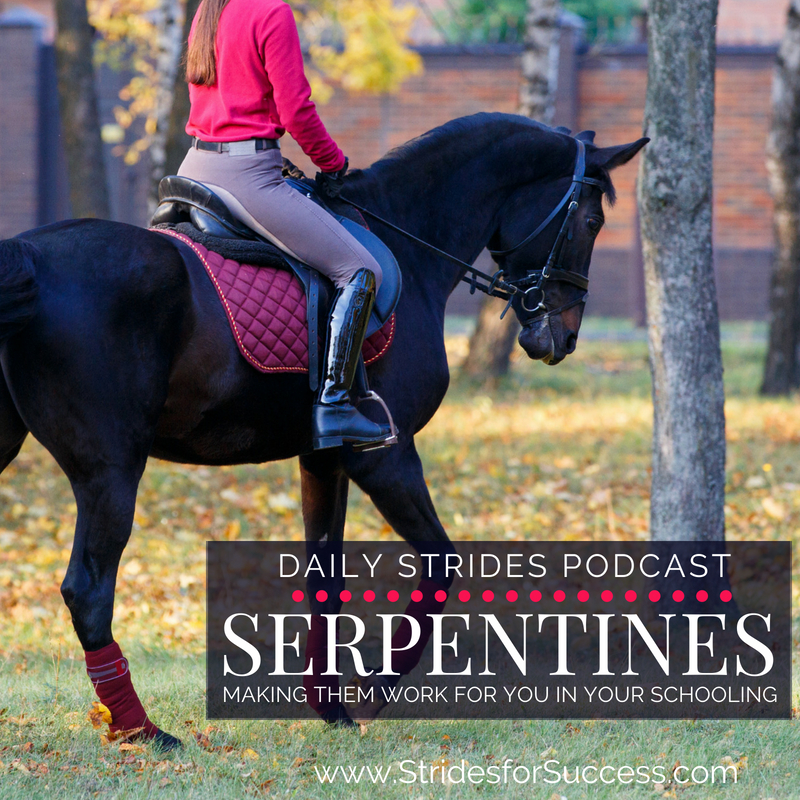
    Serpentines really are the exercise or movement that ‘have it all’ when it comes to working or schooling your horse in the arena.  Suppleness, straightness, rhythm, relaxation and a whole host of other principles in between.

    Yet, so many riders fail to make the most out of their serpentines and never really get further than ‘flying’ around the loops full speed ahead!  In this episode of the Daily Strides Podcast I am going to give you a few ideas on how you can get the most out of this basic schooling movement in your riding.

    Deciding on Which Serpentine Suits You

    First of all, let’s quickly chat about what a serpentine is and deciding how many loops is right for you and your horse.  The serpentine is, simply put, like riding the letter s in the arena, but with extra loops added in where necessary.

    The amount of loops in your serpentine will be determined by the size of your arena and how developed both you and your horse are in your training.

    The more loops in your serpentines, the more suppleness will be required to maintain the forwardness and the ‘shape’ of the movement over all.

    Most riders start out with a traditional 3 looped serpentine.  Any odd number of loops will see you finish the movement on the same rein you begun.  An even number or loops will have you change rein when you complete the movement.

    Controlling Versus Influencing in the Saddle

    Many riders have the mindset that they must ‘control’ their horse.  Control every movement, every step.  The rhythm, the forwardness… Even down to how their horse moves and uses his body.  If you are one of these ‘controlling’ riders, I’m afraid I’m going to have to burst your bubble…

    The only thing you can control while riding is yourself.  You cannot control your horse.  However, by controlling yourself, you can learn to have more influence over your horse…  

    One of the aims of correct training with your horse should be getting to the point where your horse takes responsibility for his own movements and actions.  You will ‘control’ yourself and he will control his self.

    Controlling everything is exhausting and results in your focus being place on the wrong things when riding.  Holding your horse up with your inside leg.  Or creating a fixed or rigid ‘frame’ for your horse to work in and therefore removing all suppleness.

    Correct Rather than Control

    As you ride your serpentines over the coming weeks, think of asking your horse to do something and then allowing him to do it.  Don’t be the rider who is always looking over your horses shoulder waiting for him to make a mistake!

    If he goes off track, or makes a ‘mistake’, yes, correct him – but then try to get out-of-the-way again and allow him to continue on.

    This way, you are allowing your horse to begin thinking for himself and taking responsibility for his own actions.  Shifting your mindset around this topic is the is the beginning of working towards self carriage with your horse.

    Using Markers to Help Your Accuracy

    Very often when riders set out to ride a serpentine, they get a little off track with the true shape of the movement they want to ride.  It can end up looking more like a zig-zag rather than a series of equal bends connected by straight lines.

    Before you ride your next serpentine, rather go out and mark the exact track that you want to ride.  The loops, the track as you cross the arena.  The shape, the sizes, the centre line. 

    You can use anything at all, once it is safe, to mark out the path you want to ride on.  Tyres, cones, stones, poles, uprights.  My only concern with using poles or uprights is that sometimes the horse can ‘cling’ to them a little.

    Slowing Down and Starting from Walk

    Once you have your path marked out, I then suggest getting into the arena on your horse and begin working on riding the movement.  Start in walk.  Ride the movement a few times in the walk and begin being mindful to what is going on underneath you.

    Serpentines have a lot of different moving parts as you ride through them and taking the time to notice each stride in walk will help you begin getting the most out of the exercise.

    Notice where you begin, the middle of the short side of your arena.  Pay attention to how you transition between straight and flexed.  How well is your horse ‘staying on track’ through the exercise itself.

    If there was a drone above you, taking a video, would your horses back, from tail to poll, be on the same track all the way through as the one you laid out?

    Most riders think about transitions as going up and down between gaits or gears.  However, a transition is simply a change.  I am going to recommend that, as you ride through the serpentine, becoming really mindful on how you are transitioning between the loops.

    Incorporating Serpentines into Your Schooling

    From here, begin thinking about the best way you can ask  your horse to actually ride the serpentines and then getting out of his way and allowing him to do just that.  No leaning or shoving or holding things up.

    It is common for riders to become a little too enthusiastic with your inside rein as you ride the basic serpentine…

    Notice the suppleness and the bend.  Notice how your horse is coping with the transitions between loops and if you are truly helping him or hindering the process.

    Once you have mastered the exercise in walk, I would then suggest taking things a step further by riding the exercise in trot.  Keep your focus on the ‘eye in the sky’ and how it would look if viewed from above.

    Also make sure you are not ‘controlling’ everything, but rather setting things up and then allowing them to happen. 

    There are so many other ways to add variations to your serpentines.  We have a whole collection of trainings inside of Daily Strides Premium themed around doing just this, which you can begin working on today when you join.

    Happy Riding

    Lorna

    Links mentioned in the episode:-


  • Relaxation; Building it Before You Get into the Saddle

    Relaxation; Building it Before You Get into the Saddle

    Relaxation; Building it on the Ground before getting into the saddle

    What this episode is all about & how it can help you:-

    • The importance of your mood and mirroring
    • Being mindful of what you are bringing to the conversation
    • How building rhythm can lead to relaxation
    • Creating routines that work for you and your horse

    [smart_track_player url=”https://op3.dev/e/traffic.libsyn.com/dailystridespodcast/1056-Building-Relaxation-Before-You-Get-into-the-Saddle.mp3″ title=”Relaxation; Building it Before You Get into the Saddle” social_linkedin=”true” social_pinterest=”true” social_email=”true” tweet_text=”Relaxation you can work on before you get into the saddle to help your riding” hashtag=”Podcast #Equestrian” twitter_username=”strides_success” ]

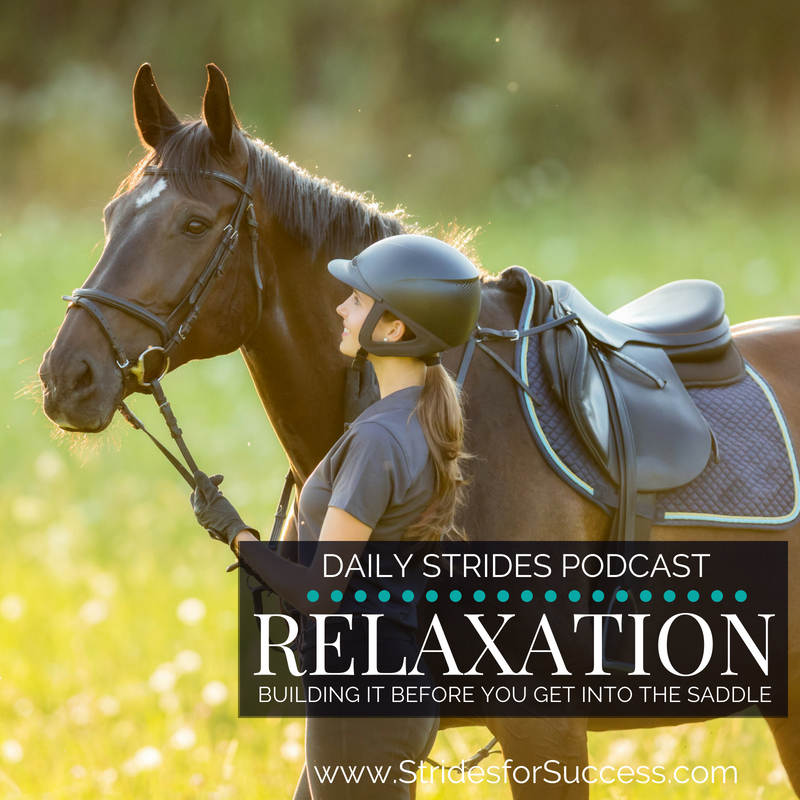
    As riders, it is easy to only think of relaxation when it comes to riding as something that starts when you get into the saddle. However, relaxation actually begins long before you ever mount up and that is what this episode of the Daily Strides Podcast is all about.

    It all starts when we are on the ground, interacting with our horse. This interaction truly sets the tone for each ride and there are ways that you can intentionally improve this tone; which will improve the whole conversation in the saddle.

    Your Mood and Mirroring

    I want to encourage to you begin checking your mood each and every time before you go to your horse. Your horse will often mirror back to you what you project on him.

    I find one of the best ways to maintain a ‘good attitude’ when riding is by setting a basic intention for the interaction with your horse

    Let this intention be your focus both on the ground, so grooming and tacking up, and also in the saddle. It is the goalposts that you are working towards with each interaction you and your horse have.

    Using Your Horse as a ‘Rescue Remedy’

    I find it a little alarming just how many riders I come across who use their horse as a ‘pick me up’. The go to their horse when they are in need of inspiration and a lift in their mood.

    Imagine if you had a friend who treated you the same way… They only ever contacted and visited when they were miserable, in order that you could help them feel better. Not such a good relationship and one that you would begin resenting over time.

    If you have been using your ‘horse time’ this way, I am urging you to shift that a little. Be the inspiration for your horse for a while and see how the relationship really grows.

    Being Open to Things Happening Differently

    Setting an intention is great, but only if you are truly aware that things will not go 100% to plan each time. Part of checking your mood and really being a leader for your horse is making peace with this.

    Become more supple in your approach. When things go off track, as they inevitably will from time to time, allow your intention be the guide to get you back on track

    Act like you would like your horse to act… Model, Model, Model…

    Be Mindful to What you Are Bringing to the Conversation

    We are all the time trying to improve our conversations with our horses. Part of a good conversation is being present.  Remaining focused on the person you are engaging with. Keeping your focus on them, rather than the person behind them or across the room!

    Remaining calm, relaxed and interested also help build the conversation. If you can remind yourself to bring those qualities to each of your interactions with your horse – the relaxation will follow naturally.

    Focused, present, calm and Interested…

    If you can work these qualities into your time with your horse on the ground, before you mount up, it will improve the overall relaxation when you do get into the saddle.

    Building Rhythm can Lead to Relaxation

    You can definitely begin creating the rhythm for your ride before you get into the saddle. Again, allow your intention for that day to lead the way.

    Adjust your routine to compliment what you will later work on when in the saddle

    For example, if you are going jumping – keeping things upbeat and energised is a good place to begin on the ground. It sets the tone for a focused and ‘sharp’ ride later.

    However, if you are rather working on encouraging relaxation throughout the ride, maybe working through some anxiety in your horse, the opposite will be required on the ground. Slow, steady, calm, relaxing interactions while grooming and tacking up will go a long way to setting the tone when in the saddle.

    Creating Routines that Work for You and Your Horse

    I personally have different routines to prepare both myself and the horse, depending on what we will be doing in the saddle.

    A routine for when time is short. A routine for when you have a lot of time to play with. A routine before jumping. A routine before a hack or trail ride.

    A well thought out routine on the ground will help create a rhythm, which will help maintain the relaxation throughout the ride

    Working with Your Voice as an Aid

    Because horses are not proficient in verbally expressing themselves, it is easy to overlook our own voices when it comes to communicating with them. However, your voice can be a powerful aid and one that, when it comes to relaxation, can work particularly well – both on and off the horse.

    The tone of your voice is far more important than what you are saying when it comes to communicating with your horse

    Imagine communicating with a toddler. Very often the words themselves are lost on the child, however the tone behind them is enough to allow the message to be understood.

    You can also use your body language with your voice to express yourself.

    Asking the Question ’Does He Understand?’

    A quick question you can ask yourself throughout your interactions together that will help to encourage relaxation. Horses, just like us, become frustrated when they don’t fully know what is being asked of them.

    Keep in mind that a ‘wrong answer’ from your horse is usually either down to you not asking the right question or not explaining well enough what you actually want

    If at any point he doesn’t fully understand, go back. This is also where mastering the basics helps you progress much more later down the road.

    Using a ‘Uniform’ to Help Build Relaxation

    Finally, as i just mentioned, horses enjoy knowing what is coming. You can begin using this to build relaxation by having ‘uniforms’ in both you and your horses lives.

    A particular set of boots means jumping. A specific pair of gaiters means flatwork. A certain field means relaxing turn out, while another field is for working in.

    I really think it is important that, initially anyway, you horse has two separate spaces that you are using. One for ‘work’, such as the arena or pen and one for ‘rest’ such as a paddock or turnout.

    It will help him to adjust his mindset for what is coming later.

    Build on Each Interaction

    Allow each day to build on the previous one. Relaxation and routine being blended together which create a rhythm that you can both work with.

    Let the baseline, for each interaction, be relaxation and let everything else build on that foundation

    Horses enjoy routine, they thrive in it. Routine is really the conscious blending of time and consistency. Begin creating ones today that allow your horse to feel good because he knows what is coming.

    Happy Riding

    Lorna

    Links mentioned in the episode:-
    
  • Smoothing Out the Ups and Downs in Your Riding

    Smoothing Out the Ups and Downs in Your Riding

    Smoothing Out the Ups and Downs in Your Riding

    What this episode is all about & how it can help you:-

    • Begin noticing where the ups and downs are happening
    • Take responsibility, rather than looking for a quick fix
    • Learn to Balance Your Aids Correctly
    • Using a Split Second to Smooth Out Your Riding

    [smart_track_player url=”https://op3.dev/e/traffic.libsyn.com/dailystridespodcast/1045-Smoothing-Out-the-Ups-and-Downs-in-Your-Riding.mp3″ title=”Smoothing Out the Ups and Downs in Your Riding” social_linkedin=”true” social_pinterest=”true” social_email=”true” tweet_text=”Are your rides a little to ‘turbulent’ for your liking? Here is how you can begin smoothing things out today…” hashtag=”equestrian #podcast #transitions #smoothsailing” twitter_username=”strides_success” ]

    Do things feel a little ‘touch and go’ when it comes to your riding?  You touch on how you want it to feel, but that feeling is all too brief.  It’s there for a few strides and then it is gone again.  Would you like to maintain that feeling for longer?  Smooth out your riding?

    This episode is focused on learning how to influence your horse more to create a more balanced, smoother ride for both of you.  A more polished finished to your riding.

    Horse Riding is Never ‘Done’

    I want to begin by warning you of a trap that so many riders make the mistake of falling into.  They finally ‘get’ something in their riding; and they then think that their work regarding that topic is done.

    Horse riding, by its very nature, is never ‘done’.  It is ever evolving.  There are challenges at every level that will lead to us having to re-navigate past topics from your new perspective or where you are now.

    Very often the key to overcoming new challenges in horse riding is going back to the basics – and applying those to the new challenge.

    Begin by Noticing Where the Ups and Downs are Happening

    You can do this by paying close attention to your rhythm and tempo.  Notice where they are lacking.  Can you maintain both consistently through a movement?  Can you maintain them through a transition?  At what point are they changing?  Is this every time, or only in a certain place or on a certain rein etc.

    A second way you can become more mindful about the basic quality of your rhythm and relaxation is by ‘testing’ your riding on a straight line.  When you are riding a longer straight line, perhaps on the road or trail, how well can you maintain? Do things tend to become faster, or slower.  Is there more or less tension the further you travel.  Or, is there a greater sense of ease?

    You can also pay attention to your aids and you in general in the saddle. What influence are you having with your riding?  Is it positive or negative. 

    Remember, you are always influencing your horse, regardless of if you are intentional about it or not.  Therefore, it makes good sense to become mindful on what you are doing – and making that influence a positive one.

    Taking Responsibility, Rather than Searching for the Quick Fix

    When you do begin to notice where things are not being well maintained, the second trap a lot of riders fall into is thinking that there is a ‘quick fix’.  A different bit, or a new noseband.  A change of martingale, or feeding plan…

    Keep in mind that often the easiest thing to ‘fix’ is the most obvious.  You, the rider! 

    Showing up and claiming ownership of your riding, faults and all, is an important part of becoming a responsible rider.  It is also the one thing that you truly have control over when communicating with your horse.

    Looking in and taking ownership of the fact that you are consistently either positively or negatively influencing your horse will go a long way to smoothing things out.  Keep in mind that your thoughts are also influencing your horse, so be mindful.

    Yes, sometimes you may have to change the bit, or martingale, the fact of the matter is that you are the single greatest influence.  So my advice to you is to check in with yourself first!

    Learning to Balance Your Aids in Your Riding

    Each of your individual aids, the ways that you communicate with your horse, are part of the bigger picture of an overall conversation.  No aid should be used alone, and as a whole, the proportions are always changing as well.

    Balance, by definition, is ever shifting.  The balance of your aids in your riding is an ever-changing way of maintaining the conversation with your horse. 

    What worked for one transition may have to be refined and ‘tweaked’ a little for the next.  What goes into each transition with you and your horse is different and what comes out of each transition is different.  Your aids need to be applied with this in mind.

    Think of it as being a large pie or pizza.  The ‘My Ways of Communicating with My Horse’ Pie.  Each aid has a slice.  These slices are continuously changing in size and proportion depending on the circumstances of each movement or transition.  If every thing you do on your horse was shown on one of these pies, you will see that very rarely are any two pies the exact same.

    Your responsibility as the rider is to tailor each communication with your horse so as your aids are balanced for what he needs at that exact moment.  This will happen all through the ride. 

    Using a ‘Split Second’ to Smooth Our Your Riding

    As a rider, I am sure that you are familiar with how important your half halt is.  It is the rebalancing of both you and your horse, throughout your ride. But, another place we can have a huge influence over the smoothness of the overall ride is within the transition itself.

    You are riding transitions the whole time in your riding.  A transition is simply a change.  Straight to bend, long to short, trot to walk…  Everywhere.  

    So, it makes sense to work on smoothing out the transitions themselves in order to even out the whole ride, doesn’t it?

    Inside of every single transition, there is a split second where you have the power to begin smoothing things out.

    Every change needs a catalyst to make it happen.  In riding, this can often be described as pressure or tension.  Your job through the transition is to find that ‘split second’ where you can smooth out what was needed, the catalyst, in order to make the whole transition appear relaxed.

    Start thinking about and looking for that door of opportunity within each transition as you go forward.  If you want to find out more, you can join me on the 2nd of June 2018 in my upcoming workshop on Relaxation in Your Riding.

    Happy Riding

    Lorna

    Links mentioned in the episode:-


  • Relaxation when Riding a Hot Horse

    Relaxation when Riding a Hot Horse

    Relaxation when Riding a Hot or Sensitive Horse

    What this episode is all about & how it can help you:-

    • Set an intention or baseline for each ride and encounter
    • Confidence and its direct link to relaxation
    • Becoming comfortable in the discomfort
    • What the ‘rinse and repeat’ looks like for relaxation

    [smart_track_player url=”https://op3.dev/e/traffic.libsyn.com/dailystridespodcast/1043-Relaxation-when-Riding-a-Hot-Horse.mp3″ title=”Relaxation when Riding a Hot or Sensitive Horse” social_linkedin=”true” social_pinterest=”true” social_email=”true” tweet_text=”Does relaxation seem like a far off distant ‘wish’ on your sensitive horse? This will help…” hashtag=”equestrian #podcast #relaxation #HotHorse” twitter_username=”strides_success” ]

    Have you been trying to work on relaxation when riding? However, your horse is just a little too ‘hot’ to relax. It seem the more you try to make him ‘relax’, the hotter and hotter he comes.  You’re not alone, it is a frustrating experience for many riders.

    This episode is focused how you can start to cultivate more relaxation when riding a hot or sensitive horse. I say sensitive because often the word ‘hot’ can bring up negative ideas. However, looking at your horse as rather being more sensitive means we can look at the situation with more compassion and less ‘heat’!

    Set an Intention for Each Interaction and Ride

    Before we go any further, relaxation is simply a lack of excess tension when the horse is being ridden.  Relaxation is also relative depending on the specifics of each unique situation.

    Relaxation is almost always accompanied by rhythm.  They are not the same, however it is very rare to have one without the other.  With this in mind, I believe that relaxation begins before you even interact with your horse each day.  Very often riders will arrive at the barn, and bring all their outside stresses with them.  The job, the dinner, the finances etc.

    What they fail to realise is this energy and frame of mind really and truly sets the tone for the interaction they have with their horse.  It sets the rhythm, which in turn will directly impact the relaxation.

    Becoming Aware of the Voice in Your Head!

    Why or how does this happen?  I’m not 100% sure, perhaps it is telepathy, perhaps not… What I personally think is that whatever you are subconsciously thinking about, the internal dialogue, is then being played out in your physical body.  The tension, frustration, anger, nerves etc.

    Because you then are in direct contact with your horse, and when riding you are actually using your body to communicate with your horse, this has a direct impact. 

    Setting a clear intention for each ride or interaction helps to prevent this from happening.  It helps you to get in the correct place mentally and emotionally in order to then interact, and therefore, influence your horse.

    Confidence and It’s Direct Impact on Relaxation

    This ‘head chatter’ can also have a direct impact on your confidence and your horses confidence.  I want you to think about something you do, which you are good at.  You have a level of confidence about it, which leads to a physical ‘ease’.  The task itself might not be easy, however you are almost flowing with it.

    The fact remains that very often the confidence issue can often be introduced by the rider.  Perhaps you are thinking about yesterdays ride.  Or maybe you are thinking about what ‘could’ go wrong.  Every time you get into the saddle, it is a whole new ride.  A clean slate.  Keep your focus on that fact and allow it to help you build confidence.

    Confidence is Equally as Important for Your Horse

    I also want you think about the fact that clarity leads to confidence.  When your horse understands what he is supposed to be doing.  When you are telling him ‘Yes, that is what I wanted, well done’, his confidence will grow exponentially.

    Confidence also comes when you build trust in your relationship with your horse

    As always, I am going to suggest starting on the ground, with basic groundwork to build that trust.  Create a rhythm on the ground.  Be compassionate in how you interact with your horse.  Build on it every day, routine and rhythm, routine and rhythm which will lead to a great trust when you are in the saddle.

    Groundwork builds your horses confidence, which will result in him being able to relax more through his body while being ridden

    Becoming Comfortable in the Discomfort

    Let’s take a different example this time to explain this concept… Imagine you are on a mare, she is a sensitive soul, and you can feel that the energy levels are definitely rising.  That feeling.  Most riders first reaction is to ‘rein her in’; literally using the reins to try to shut things down.  This rarely helps and often has the opposite desired effect by increasing the excess tension.

    Hmmm… Put yourself in the horses shoes here.  This is basically the equivalent of telling a highly stressed or excited human to ‘please relax’ or, even better, ‘calm down’.  It never works!  In fact, it has the opposite effect of making the person feel like they are not being heard or not being taken seriously.  It adds fuel to an already volatile situation.

    If you are beginning to feel frustrated, anxious, fearful in a situation, you are really only adding to the excess tension of the situation.  Rather feel your way a little through the discomfort.

    What does this discomfort look like?  It it almost an allowing of things to unfold, rather than jumping in to ‘control’ everything.  It is letting it ride for a few strides, rather than reining it in.  It is going with horse and learning to trust that all will be well.

    If you can become mindful enough to sit in the emotional or mental discomfort for a few seconds longer, the energy will begin to dissipate from that situation.  

    The result is almost always that your horse will also begin to feel more comfortable, which leads to increased confidence, which leads to greater ease, which leads to greater relaxation.

    If you stop ‘fighting’ it, the excess energy or tensions has nothing to fight and therefore nowhere to contain itself.  Obviously this is all within the confines of a safe and enclosed area.  Somewhere you feel confidence starting off.

    This Is Not a Physical Discomfort

    It goes without saying, but just for the record let’s say it anyway – this is an emotional or mental discomfort.  It is the voice in your head triggering feelings throughout your body.  There is no physical pain involved.

    The same principles apply for your horse.  Asking and allowing him to stay with the discomfort a little until it eases.  For many sensitive horses, this can be something as basic as having the riders legs in contact with their sides.

    Many riders with ‘hot’ horses, over time, learn to ride with their lower leg a little too far forward.  They see their leg as a ‘trigger’ for the horses tension levels.  However, in order to truly move forward in their training, those horses must learn that the leg is okay.

    It is an emotional discomfort for the horse, which can be eased if the rider is compassionate and consistent with letting it become the new ‘normal’.

    Yes, there will be moments of tension and anxiety, but you can learn to remain calm, confident and compassionate, your horse will soon become comfortable and relaxed in a previously stressful situation.

    How to Apply this when Riding?

    Let’s go back to our example of the mare who was beginning to feel a little excited or anxious underneath you.  Your job as the rider is to remain calm, be the energy you want her to mirror.

    Hold it out a little longer than you would have previously done.  This is you remaining in the ‘discomfort’.  Try to control where your mental and emotional energy is going.

    From here, you are then going to ask your mare to become a little uncomfortable with the situation.  Again, this is mental or emotional discomfort, never physical.  This can be when you begin to apply a little pressure through the half halt.  Keep in mind that the half halt is not an anchor thrown behind you in the sand, it is more of a suggestion to your horse.  A ‘heads up’.

    As soon as she begins to respond, you release the pressure, the discomfort.  It is as simple as that! Of course, it is also one of those often ‘easier said than done’ scenarios!

    Let’s be honest, it will take time and a consistent approach to really cultivate relaxation throughout your ride when in this situation.  However, it can be done.  You must be mentally and emotionally strong enough to lead the way for your horse.

    Happy Riding

    Lorna

    Links mentioned in the episode:-