Tag: arena

  • Essential Equipment When Training Your Horse

    Essential Equipment When Training Your Horse

    [fusebox_track_player url=”https://op3.dev/e/traffic.libsyn.com/dailystridespodcast/1291_The_Essential_EQuipment_Needed_to_Work_With_Your_Horse.mp3″ title=”Essential Equipment You Will Need when Working with Your Horse” social_linkedin=”true” social_pinterest=”true” social_email=”true” ]
    Have you ever begun following a recipe and it’s all going great, until… You realize that you are missing an ingredient.  And whether it is an absolutely key ingredient or a more ‘supporting’ ingredient, it matters.
    Because at the end of the process, what you’ve made is not exactly what you had in mind when you began…
    Training your horse at home can sometimes feel like this.  You get a few days or weeks into it, only to find your momentum grinds to a halt when you don’t have access to a key piece of equipment.
    Today, I want to help you identify what you will need (the basics) to get started and what you might like to add further down the line. After all, the equipment when training your horse is almost as important as the plan.

    The Key Pieces of Equipment

    As mentioned, I am really focusing on the absolutely essential equipment when training your horse today.  There are many ways we could go with this, but I am going to assume that you are working towards training your horse correctly and as a ‘riding horse’.  Meaning that your horse is an allrounder that you can then decide to dedicate more time to pursuing a specific discipline if you want to.
    So, in my experience, these key elements are essential:-
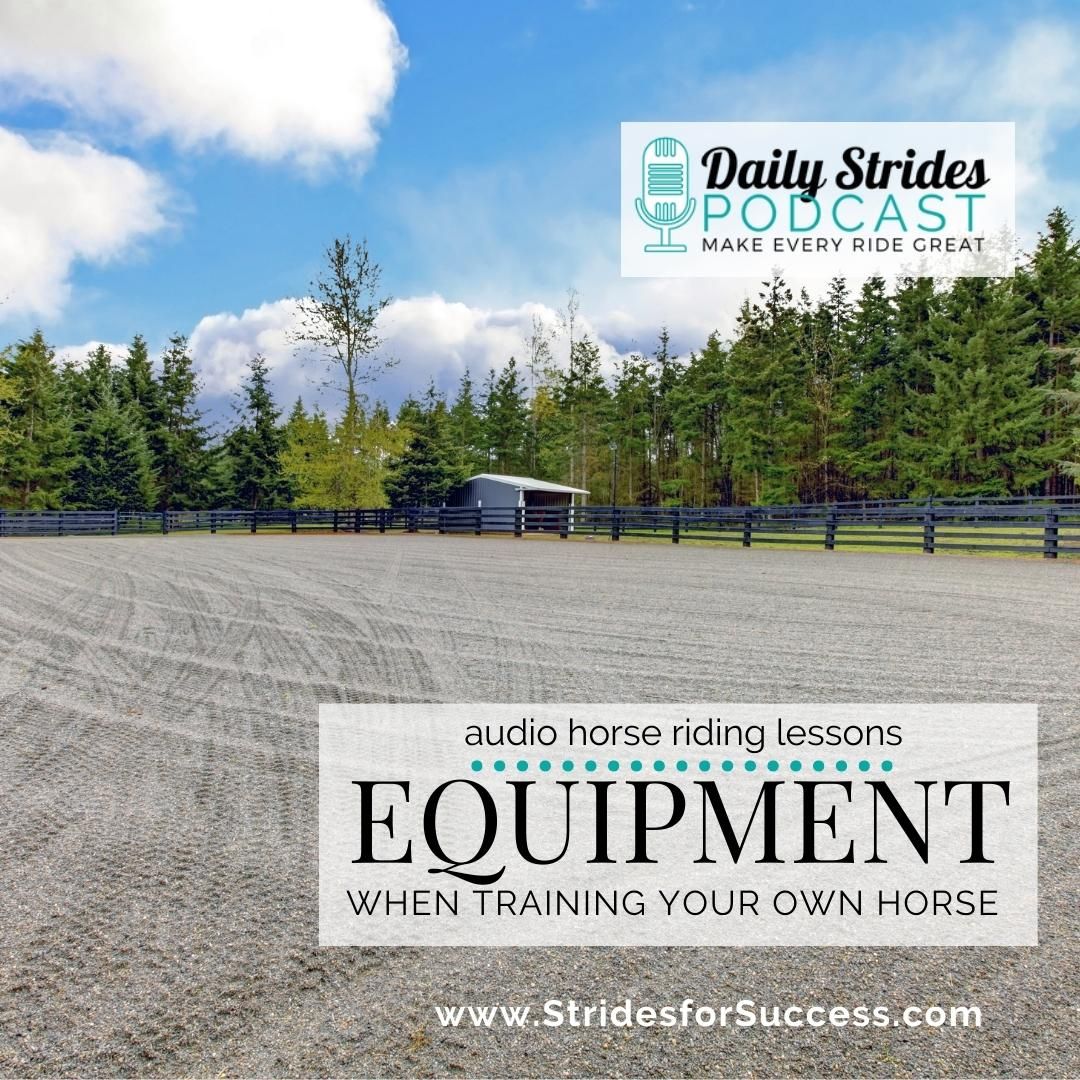
      • 40m x 20m flat (ish) space to work in
      • A boundary for that space
      • Markers (such as dressage letters)
      • Access to a safe riding trail or field to ride in
      • 4 to 6 (or more) poles
      • 4 to 6 uprights or ‘blocks’ to raise the poles off the ground
      • Sheltered, safe, and quiet place to tack up/groom, etc.
      • Good fitting and suitable saddle and bridle
      • Lunging rope and lunging whip
      • Helmet, gloves, and (ideally) body protector
    I want to divide these into two categories and go into a little more detail.  As you can probably see, the first 7 items on the list have to do with ‘where’ you will ride. The second 3 are actual things you can use on yourself and your horse.

    “Riding Area Equipment”

    • 40m x 20m flat (ish) space to work in

    I’m going to start here with the most obvious item on the list; a flat space to work in.  Now, to be fair, a 20m x 20 m space will also work initially.  However, as you begin to ‘do more’ with your horse, you will require a larger area.  And, personally speaking, anything smaller than 20m x 40m is almost a little too restrictive and small.  A ‘good sized’ flat space with good footing is definitely part of the essential equipment when training your horse!
    This space does not have to be an actual arena.  A flattish area in a field is also suitable.  However, this can become a little ‘muddy’ or ‘hard’ during different seasons. But, if you need to get started, it will work.  It’s what I personally had access to as a little person, and while not perfect, it did the job🙂
    • A boundary for that space

    Many riders overlook this aspect of their space.  Is a solid railing or tape line even considered a piece of equipment when training your horse? Yes, oh yes, it is! Especially if they are working in an open field or a very large open arena.  But remember, the boundary of the area you are riding and working your horse in is an artificial aid.  It will help you to reinforce your aids (particularly the outside ones initially) and help with accuracy.
    If you are riding in a field, invest in a roll of white 40mm ‘horse tape’ and as many ‘stakes’ for that tape as you need.  This way you can erect and dismantle your ‘arena’ easily when necessary.  It will also allow you to move it if the ground becomes unsuitable for riding.
    If you are riding in a very large arena, you can either use the same tape or you can use poles and uprights to demarcate a smaller riding space.  Again, this is not a permanent ‘arena’; you will be riding in a larger space soon and then the poles or tape can be moved.
    • Markers (such as dressage letters)

    Whether or not you want to learn true dressage, having the markers is really handy when training your horse. I simply message the dressage letters because they are easy to obtain or to make if necessary.
    If you do want to make your own, find 8 bucket lids and simply paint one of the letters A,K,E,H,C,M,B,F onto each lid.  Then cable tie, nail, or screw the bucket lids to a pole or something suitable where the markers should be.  The measurement of the markers is important.
    • Access to a safe riding trail or field to ride in

    Riders and horses who only work in one space all of the time tend to become sour.  They also don’t learn to increase both their confidence and their trust in each other.  This is why I feel it is important to have access to an alternative riding area that you can use for simply relaxing and enjoying each other’s company – or training!
    A horse trail or quiet country lane is perfect.  An open field will also suffice if the footing is safe and suitable. The more safe riding areas you have access to, the more options you have when it comes to equipment when training your horse.
    • 4 to 6 (or more) poles

    I do think that a few poles are ‘essential’ equipment when training your horse.  Especially when you are serious about the work being done.  They are for going over, going through, on the ground, and raising them up as well.
    They do not have to be fancy or 14′ in length. In fact, shorter ‘thicker’ poles will help encourage more accuracy🙂
    • 4 to 6 uprights or ‘blocks’ to raise the poles off the ground

    Okay, so the poles are great.  And I am a firm believer in the power of a great groundpole exercise.  But being able to raise the poles is also great and can add a whole new perspective to your training exercises. And the ‘blocks’ do not have to be fancy.  Tyres or short logs will work if you don’t have anything else initially!
    • Sheltered, safe, and quiet place to tack up/groom, etc.

    There is nothing more frustrating than trying to prepare to ride and being at the mercy of the elements! It tends to start the whole ride off on the wrong foot.  I believe that the tone for each conversation or ride is established during the preparation phase, so it makes sense to create a space where you can enjoy and relax with your horse.
    It does not have to be fancy. However, once you have your space, maybe look at upgrading it each month.  Things should be easy to reach, on hand, and easy to use.  And, again, comfortable for you and your horse.

    “Horse & Rider Equipment”

    • Good fitting and suitable saddle and bridle

    This one goes without saying.  If the tack you are using is not right for your horse, it will negatively impact your training.  Many horses simply ‘inherit’ tack from other horses. Or they get sold on with a set of tack that is never questioned.
    Make sure you regularly fit your tack, especially when training as your horse may change shape.  And, also, make sure you regularly assess if the equipment (bits and nosebands especially) is the right one for the job at hand.
    • Lunging rope and lunging whip

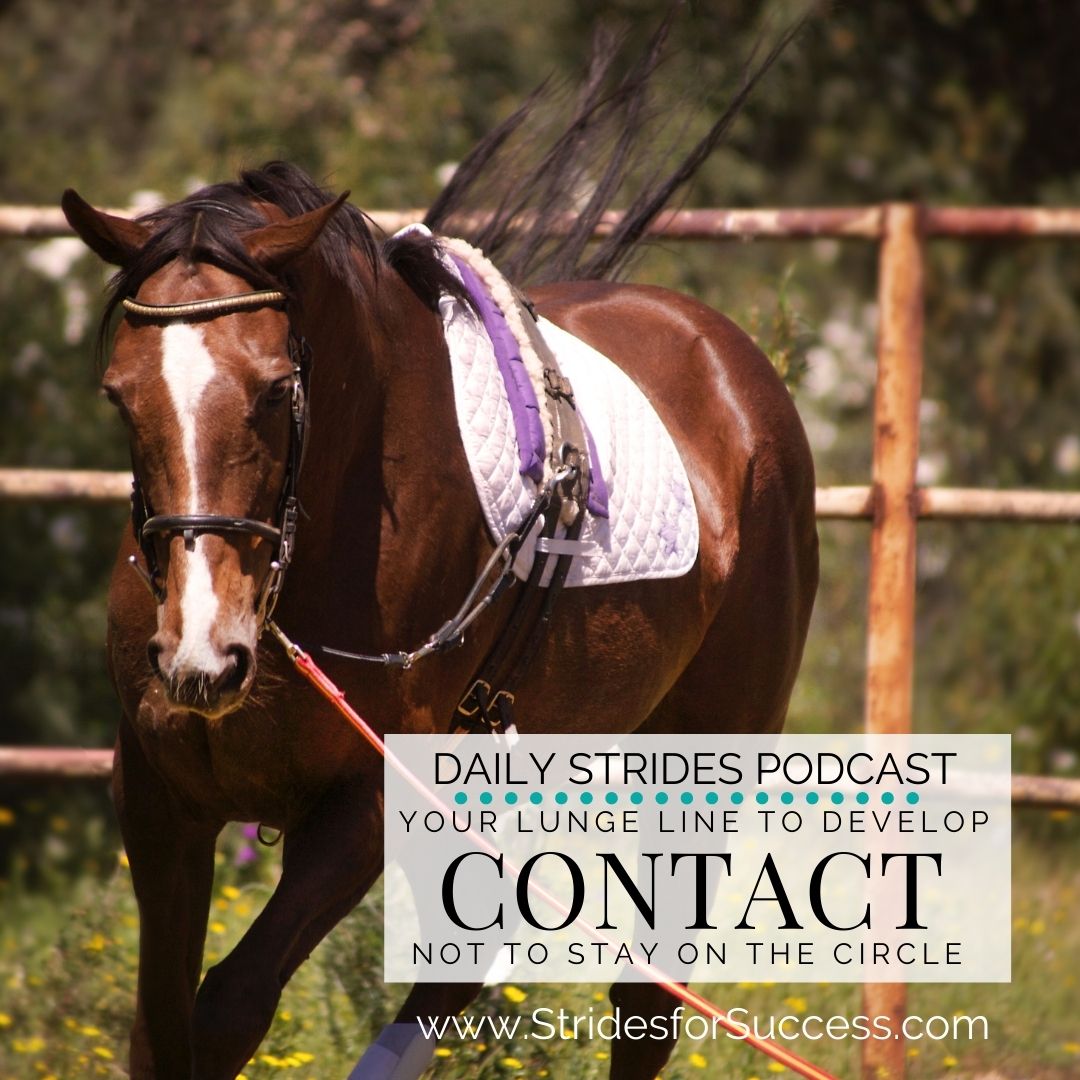
    Both are necessary for working your horse correctly while on the lunge.  The lunge line is to help provide ‘contact’.  Not to ‘steer’ the horse or keep him on a circle.  The lunging whip is to ‘back up’ your natural driving aids. Not to ‘whip’ the horse.
    Used correctly, they really help your horse to understand your aids as they add clarity.
    • Helmet, gloves, and (ideally) body protector

    Okay, the helmet goes without saying.  The gloves, I feel, are important. Especially for lunging and some groundwork.  And the body protector… I realize many riders are against wearing one.  But remember, if you are training your horse alone, you will probably be alone for a lot of the training! Anything that can help prevent further risk to you or your horse is a win.  And a body protector falls into this category.  I feel it is well worth the investment.
    So there you have it. A list of things that I believe you will need when you begin working and training your own horse.  By getting a few basics in place, you will be able to create more consistency and momentum in your training.
    And when you couple this with good, correct training – well it’s a winning formula.
    Happy Riding
    Lorna

    Seeking Founding Riders…

    If you are considering training your horse at home or alone (boarding at a barn, but don’t have a regular coach or trainer), make sure you check out the details of my upcoming brand-new program.

    I’m looking for a limited number of riders to work in-depth with me and my team as we go through this program for the first time.  Get on the waitlist to be the first to find out all of the information… We start in early September. Join the Waitlist HERE (no obligation to join the program, just be the first to know all of the details :) )

    More Training On This:-

  • No Arena? No Problem; Riding in Open Spaces

    No Arena? No Problem; Riding in Open Spaces

    [fusebox_track_player url=”https://op3.dev/e/traffic.libsyn.com/secure/dailystridespodcast/1213_No_Arena_No_Problem_Riding_in_Open_Spaces.mp3″ title=”No Arena? No Problem… Riding in an Open Space” social_linkedin=”true” social_pinterest=”true” social_email=”true” tweet_text=”Here’s how getting out of the arena will actually help your training and your riding…” hashtag=”horsepodcast” twitter_username=”strides_success” ]

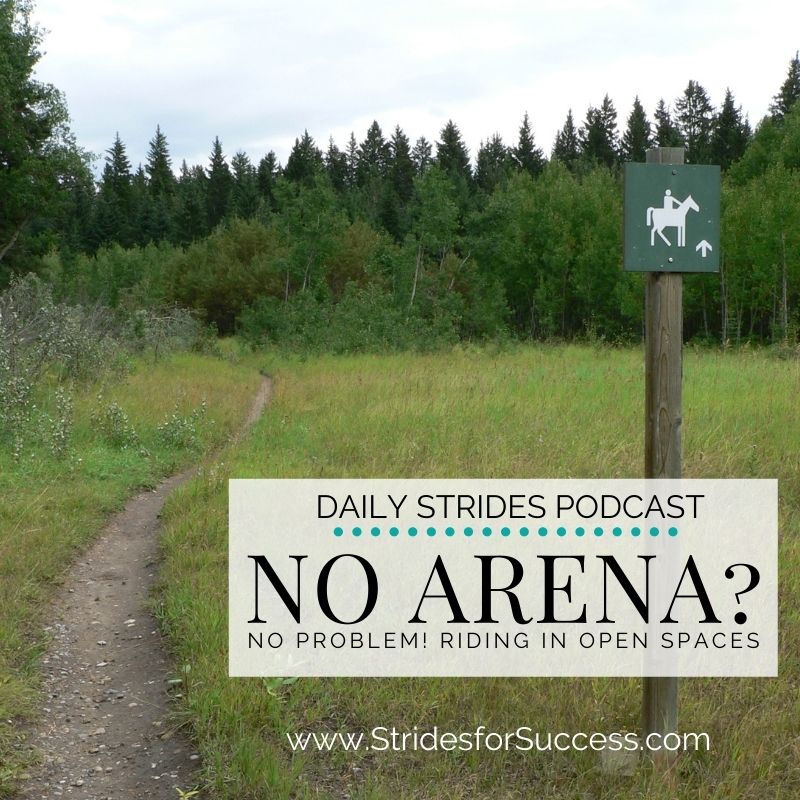
    Not having a designated space to ride in, like an arena, can often feel like a big disadvantage.  If you have been riding in an open field or been confined to roads for any length of time, you’ll probably know what I mean! However, while an arena does help with some aspects of riding, having no arena will also force you to think outside of the box.

    And this literal ‘out of the box’ thinking when applied to your schooling can often be a big plus when it comes to riding your horse as well…

    Arenas are wonderful to ride in, the surface is prepared for optimal performance, the rails and letters remove any guesswork when it comes to accuracy, shapes, and sizes.  The centre line is exactly that – the centre line of the arena.  X is always at the same place…

    Having an arena allows you to focus entirely on the actual riding end of things – or does it?

    While many riders see having no arena as a massive drawback and negative aspect of riding, there are a similar number of riders who will happily tell you the opposite.  In fact, they often chat to anyone who will listen about how their riding improved tenfold once they got out of the arena; whether by choice or necessity.

    Riding in an Open Field

    Now, obviously, you don’t want a field or trail with holes and ‘dongas’ all over.  But riding in a fairly flat field has its merits if you can overcome the initial challenges that will arise when you begin.  These challenges often occur when we have become accustomed to riding in a more enclosed space.  Or when we ‘believe’ that we need a perfectly manicured arena to truly work and train our horses.

    First and foremost riding in the open, whether it be in a field or on the trail, strengthens both horse and riders core a lot more. This is due to the necessity of correcting the balance because the footing is not 100% even.

    Riders who spend their time schooling in fields have the ability to ‘adjust’ a lot quicker to the changes in the horse’s balance underneath them.  From doing this over time, they also notice the subtle shifts that happen when their horse begins to lose its balance.  This allows them to make the necessary corrections BEFORE the movement or gait is ruined due to being unbalanced.

    And just like riders, the horses who are worked in on a less than perfect footing have the advantage of becoming more ‘sure footed’.  They also learn to adjust and re-balance where necessary

    Let’s Talk Straightness

    Riding in the open also teaches both you and your horse to go ‘straight’ without the stabling or ‘hand holding’ effect of hugging the rail.   Riders have to focus more on maintaining the straightness for both themselves and the horse.  This is usually a little challenging at the beginning!  It can feel like both are weaving all over the place.  However, with a little practice and something to focus on, you will find that you will both improve your ability to ride ‘straight lines’.

    And if you are consistent and diligent, this improvement may even develop more quickly than if you rode in an arena.

    The key part to making this work for you is finding something to ride towards.  Focus on something in the distance and work on riding a straight line to it.  Once you have mastered riding towards it, reverse the process.  Do the same this time riding away from it.

    I find that placing a marker on one end of your line and having the focus point on the other really helps you to remain on the track you have chosen. Use a plastic cone, a jacket, a tire, or even a taller weed or tuft of grass!

    Once you feel confident about riding the line in the walk, try it again in trot.  Then later, ride the line in the canter.  You can then begin adding transitions onto your line as well in order to truly test your straightness.

    Out On the Trail

    On the topic of transitions, a narrow trail can often be a great help when riding a horse that is very crooked through transitions.  Moving up and down through the gears while on the trail will force him to remain straight.  Use a narrow path or trail to first explain to your horse what you are looking for.

    Then, once you feel that you and your horse are a little straighter, move into a more open place and ask again.  This can be a field, a wider road or path, or an open space. 

    I am going to suggest transitions between walk, trot, and halt initially.  Start with your own straightness first.  Then, from there, begin assessing your horse’s straightness. Oftentimes, both horse and rider have weaknesses through transitions.  The narrow path will help you to begin strengthening these for both of you.

    Extending Your Exercises…

    Another advantage o the open field or a trail is the fact that you can ‘stay going’ through an exercise.  If for example your three looped serpentines are feeling a little stiff or the loops lack symmetry, why stop at loop three.  Continue on to a 10 or 12 looped serpentine if necessary to really perfect the movement.

    The open space allows you to change things up, not having to stop every 40 or 60m.  Instead, you can rather stay moving forward.  This allows you to ride through the problem, until you have remedied it.

    If you have ridden in a smaller or enclosed space such as an arena before, you will probably have experienced this.  Thoughts like ‘If I could only try for a few strides more before transitioning into something else, or having to turn…”  Having a longer and bigger area to work in can truly help you and your horse to find a flow to what you are doing.

    Including Accuracy in Your Ride

    The one thing that is missing when riding with no arena is accuracy.  Everything can feel wide and open, loose and free.  And while this is great initially, over time it also allows both horse and rider to be a little less diligent and consistent when it comes to questions, responses, and quality of work.

    The good news is that you can easily remedy this.  Begin creating your own ‘corners’ or ‘markers’ from cones, poles, gutters, tyres, even a jacket or two.  Years ago when we (my sister and I) rode at home without an arena, we made use of whatever we had available that day.   ‘Tufts of grass’, weeds, and even piles of droppings in the fields acted as markers for accuracy.

    The choice is up to you. Whether or not you see this as an insurmountable obstacle, or as a novel way of working your horse a little differently to get the same, or even a better, result.

    No Arena = Extra Energy

    The final benefit to getting out of the arena and working in an open space or on the trail is how it all feels.  I know that many riders often become worried or anxious when they feel the difference in their horse.  However, in most cases, I think there is rather an opportunity here for you both.

    Learn to allow any excess energy to flow forward, into the contact. From there, you can then gather it and use it to improve the quality of the work. 

    If you block this energy, intentionally or not, with your seat or your hands, it often results in an explosion of sorts!  Rather than allowing this energy to build, and build… Let it flow forwards, underneath you.  Soften through both your seat, your body, and your hand.

    Once the energy is flowing through your horse from back to front, then being using a combination of your aids to influence it more.  Focus on gathering and connecting it. This ‘excess’ energy is now going to help you to actually develop, strengthen and improve both your and your horse’s overall way of working.

    In fact, this energy is often how you will first experience true self-carriage, lightness, space, and connection while riding your horse.  Embrace it :) 

    Get Out of the Arena This Week

    So, that all being said, the next question you need to ask yourself is how you can begin seeing this as an opportunity, rather than a hindrance.  What changes can you make to your ‘riding space’ that will help you to begin using it as a training ground?  Not just an empty open place to ride…

    You and your horse’s training and development are only limited by what you believe and, from there, the actions you choose to take. 

    Explore and examine how you have been thinking about having no arena.  Then challenge yourself to see things differently the next time you’re with your horse.

    Happy Riding

    Lorna

    Additional Resources:-

  • Developing Contact on the Lunge Using Your Lunge Line

    Developing Contact on the Lunge Using Your Lunge Line

    [fusebox_track_player url=”https://op3.dev/e/traffic.libsyn.com/dailystridespodcast/1168-Correctly_Using_a_Lunge_Line_A_Boundary_will_Help.mp3″ title=”Developing Your Contact on the Lunge using Your Lunge Line” social_linkedin=”true” social_pinterest=”true” social_email=”true” tweet_text=”Your lunge line is not there to keep your horse on the circle…” hashtag=”equestrianpodcast” twitter_username=”strides_success” ]

    Alert… Big statement ahead! Your lunge line is not there to keep your horse on the circle while lunging. I would love for you to take a moment just to consider this statement. Is it at all possible that you have been using your lunge line, in some shape way or form to do this for you?  If lunging is not enjoyable, a tug of war, or just too darn difficult, this could be why.

    Have you been using your lunge line to keep your horse on the circle, rather than to develop contact and connection with your horse?

    Here is my step by step system to turn that around for you in your lunging…

    Embrace Artificial Aids

    Your lunge line is an artificial aid. And artificial aids are fantastic if used correctly. The keyword is “correctly”. Many riders have allowed themselves to be led down a path where the use of artificial aids, such as lunge lines, lunge whips, or lunging arenas, is frowned upon.

    Artificial aids are there to back up or support your natural aids.

    And, you can always refine your natural aids, over time, to the point where artificial aids are no longer needed or used all the time. In fact, this is one of your responsibilities as a rider. Doing the work to refine your aids.

    Setting up a Boundary

    An arena boundary is an artificial aid. Setting one up will take about 30 minutes of your time and the effect will be dramatic in your lunging. Simply mark out a 20m by 20m space using pegs, tape, jumping uprights, jumping poles, or whatever you have to hand. Make sure it is safe, obviously! And that is it visible.

    The boundary fence allows you to put pressure on your horse in order to more clearly communicate what you want him to do.

    In order to help establish the boundary, I first suggest using a helper. Have the helper lead your horse while on the lunge. The helper will position themselves on the outside of the horse and the circle. Not between you and your horse. Once the helper has led the horse around on the lunge once or twice, they can ‘vanish’ and you are good to go with your lunging.

    Applying Pressure with Your Aids

    Once your horse knows the boundary is there, you can use it to begin applying pressure. The pressure is like a squeeze. It is also usually done by applying a combination of aids. Rarely is just one aid used when communicating with your horse.

    You can use a combination of your position, your body language, your lunge whip, and your voice, coupled with the boundary fence to apply the pressure.

    Just like when riding, it is important that you give the horse somewhere to go when you ask a question or apply pressure. Like a funnel or a chute. When riding, you would allow using your seat. When lunging, your body language, position, and voice will allow your horse to move forwards.

    The result of the pressure, and then allowing your horse to respond to the pressure is more energy, and this is where you can begin developing contact.

    Encouraging Contact Using Your Lunge Line

    When the horse is actively moving forward and creating more energy, you can then begin using your lunge line to help gather this energy. The gathering is how the contact is created. And from here, you can really begin developing your horse’s natural abilities to the fullest of his potential.

    Contact is like an agreement. It is when the horse agrees to also begin taking responsibility for his actions and his part in the overall performance.

    Over time you will reach a point where the boundary is no longer needed. Your horse will understand what is expected of him and that the lunge line is for contact, not for ‘holding him in place’. Just like in riding.

    When you ride, your reins are not for holding your horse. They are for developing contact and connection.

    Developing Contact on the Lunge Line

    I would love to help you work on developing this with your horse. We can do this together inside of Connection, my online membership for equestrians. In there we work together using a system that sees you revising the 5 essentials you need to successfully, and happily, work with your horse. Groundwork is one of those essentials.

    Happy Riding
    Lorna

    Additional Resources for Equestrians:-