Tag: arms

  • Lightening Up on Your Inside Rein

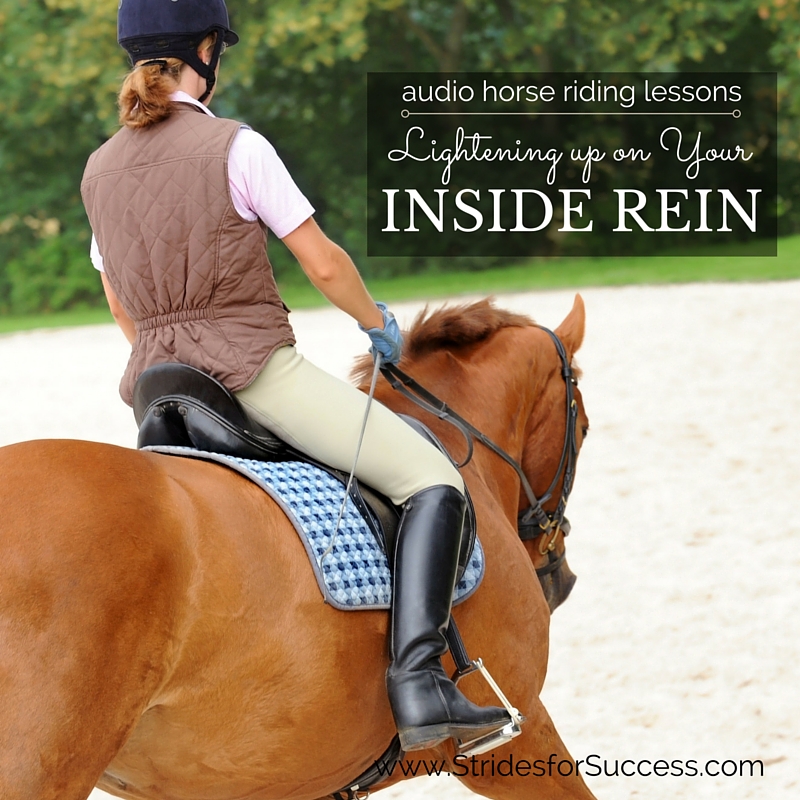
    Lightening Up on Your Inside Rein

    [fusebox_track_player url=”https://op3.dev/e/traffic.libsyn.com/dailystridespodcast/SFA461-Lightening-Up-on-Your-Inside-Rein.mp3″ title=”Lightening Up on Your Inside Rein” social_linkedin=”true” social_pinterest=”true” social_email=”true” ]

    When we first learn to ride, turning is often explained to us as merely a ‘tug’ or pull on one rein or the other to turn our horse’s head. There’s a general consensus being that where his head turns, his body will go…

    However, anyone who has ridden a determined pony or horse will know that this is very often not the case… You can point the head where you ‘want’ to go. But, very often, your horse will crab along sideways, almost following his hindquarters. This is usually in the opposite direction; which 90% of the time is the same direction as the stable!

    Later as we become more accomplished in the saddle, what started out as a simple instruction in our first lesson, has become an ingrained habit.

    Something that we often feel nervous or anxious about giving up control over!

    Early Riding Lessons

    So why are we thought to turn this way if it is indeed incorrect? And why, later when we get into the nitty-gritty details of riding, are we constantly hearing about softening or lightening our inside rein?

    Lightening Up on the Inside Rein

    I think the reason that we are thought this initially is threefold…

    Firstly, we get a quick win under our belts which then leaves us wanting more (translate into booking more riding lessons!).  Secondly, even the best-coordinated person struggles when they first get into the saddle to use their different limbs and body parts in different ways all at the same time to produce the desired result!  And lastly, it’s a control thing and one that we need to learn to let go of!

    The Importance of the Inside Rein

    However, the inside rein is a vitally important part of riding, for flexion, support and balance.   Today I want you to begin thinking of your inside rein as having more of a supporting role rather than being the lead character in your riding performance

    Often we have become so set in our ways of depending completely on our inside rein, that the only way to get out of this habit is to go cold turkey before we can then begin thinking about and practicing lightening up on it.

    So, let’s think about being on a 20m circle to the right in the walk.  If you were to drop your inside rein, what would happen?  You will notice I said ‘drop’ here…  Yes, cold turkey means that – nothing; letting go; surviving and riding on without it!  You would probably think, well my horse will just begin walking large around the arena again… Or, he may even begin to track left!

    And initially, you may be correct, he might just do that.

    The key to getting over your dependency on the inside rein is to start thinking of all the other aids you have at your disposal to help communicate with your horse that you want him to continue tracking right on the 20m circle.

    A Balance of Your Aids

    Firstly, there is your seat and weight aids.  Think of sliding your inside seat bone forward and, in doing so, the inside seat bone becoming a little more weighted.

    Then, shift your attention to what your inside leg is doing…  This is particularly important and often the key to keeping your horse going in the direction you are looking for.  If you are only now holding your outside rein (which in this case is your left rein) your inside leg or right leg is the aid that will balance that strong or leading outside rein.  We can often see this better in action if you were to drop your inside rein while traveling down the long side of the school.

    Without the inside leg, your horse would completely bend to the outside, however your inside leg regulates the ‘pull’ of the outside rein.

    Then we have your outside leg.  This is probably the most forgotten aid of all in your toolbox.  Use your outside leg to indicate to your horse to move around your inside leg.  Again, using our 20m circle to the right, your outside leg being your left leg, it will literally pick up the slack from your inside rein and keep ‘indicating’ to your horse to continue on around the circle, or more to the point, around your inside leg.

    You may initially find that your horse is just wandering around the school or arena, but I really encourage you to keep continuing to try ride the circle without any use of your inside rein.  

    Your Mind is an Aid Too…

    I also advise having a quick ‘check-up’ with what is going on in your head and translating it to your body…  Are you feeling nervous about the ‘lack of control’?  It could be that you’re feeling a little stiff, wondering what will happen?  Or maybe you are trying to influence your horse with your upper body by leaning or shoving – please don’t!

    Or has your outside rein gone on vacation, across the withers, to the ‘other side’ in an unconscious attempt to neck rein your horse to the right?!

    Keep focusing on just asking correctly with your aids; seat, inside leg, outside leg and outside rein, and slowly you will begin to see that your horse begins to pay attention to what you are asking…  He may even begin to walk on a ‘circle’ (of sorts!).

    Remember to keep verbally rewarding your horse when he makes a move in the correct direction.

     Keep in mind that you have trained him to follow your inside rein and retraining him to rather look for other indicators and signals will take time, consistency and patience from your part as a rider.

    Work in Both Directions

    Once you have begun making progress on the right rein, begin working on the left rein.  Swap your inside for your outside and vice versa and then, letting go of your new inside rein (left rein), ask your horse to now pick up a 20m circle to the left.

    Continue to practice this on both reins until you have begun to believe that you can indeed influence your horse to turn without pulling on your inside rein.  I think believing you can do it, is a big part of overcoming your dependency on it!

    You can also, once you have mastered your circles in walk and if it is safe to do so depending on your level of experience and your particular situation, pick up trot and even canter on the circle.  You may notice that initially things may go a little haywire. They can when you factor more speed and movement into the equation!  But, again, stick with it until you can communicate to both yourself and your horse that the inside rein is not what is turning your horse!!

    Re-Introducing Your Inside Rein

    So, we mentioned at the beginning that your inside rein is a vitally important part of your riding.  Now it is time to invite your inside rein back on stage.  But keep in mind all the time that it merely has a supporting role in your whole performance.

    In riding, just like acting, timing is everything and knowing when and how to use your inside rein to influence and support your horse is vitally important.  A badly timed squeeze or softening of the rein can be the difference between your horse staying balanced and your horse falling onto his forehand. 

    This is due to the fact that the inside rein, when used, will affect the inside hind leg and your horse’s inside hind leg is where most of his forward propulsion and balance stems from.

    I would first suggest beginning to practice ‘timing’ this with a very loose inside rein where you really don’t have any contact.  Practice ‘allowing’ with your arm, more notably your elbow, and then taking it back or resisting.

    However with your inside hand, rather than thinking of resisting, think of ‘indicating’.  It is merely a suggestion rather than a hard and fast order.

    Influencing the Inside Hind Foot

    Your aim is to communicate what needs to be said when your horse’s inside hind foot is on the ground.  When he is lifting his inside back foot off the ground and bringing it forward, any pulling or resisting on your inside rein will result in the hind leg not coming as far forward as you would like. This will result in a loss of balance or impulsion for your horse.

    Said differently, your aim is to be soft or light with your inside rein as your horse’s inside hind leg is in the air and moving forward

    Your horse must be schooled, obedient and responsive to then follow through with that suggestion himself in order for your inside hand to truly be effective.  Again, this comes back to consistency on your part. And, also, saying goodbye to the dependency you may have built up on your inside rein.

    Creating Contact with Your Inside Rein

    Once you feel comfortable with giving and taking the loose inside rein, begin to develop a contact by shortening your inside rein.  Make sure you do this slowly, in gradual little increments, so as to not grab it and undo all the work you have just put in.

    Test your effectiveness while riding up the center line.  Can you flex your horse’s poll one way or the other using your inside rein, without losing any forward momentum or your horse stepping to the inside, which will happen if he feels unbalanced?

    You can also go back to your circle and using your other aids to maintain the circle, just use your inside rein to ask for flexion through the poll to the inside.  You should find that your horse will have a more active gait on the circle, have more balance and just be a happier horse overall!

    Remember your inside rein is only the supporting character and without your other aids, the whole performance is pretty much guaranteed to be a flop!

    If, over time, you feel that you are beginning to pull or depend a little too much on your inside rein again, take it back to riding without it for a few minutes in the arena to reassert your other aids again.

    Happy Riding
    Lorna

    Additional Resources for Equestrians

    Lightening Up on Your inside Rein

  • Controlling Your Hands While Riding

    Controlling Your Hands While Riding

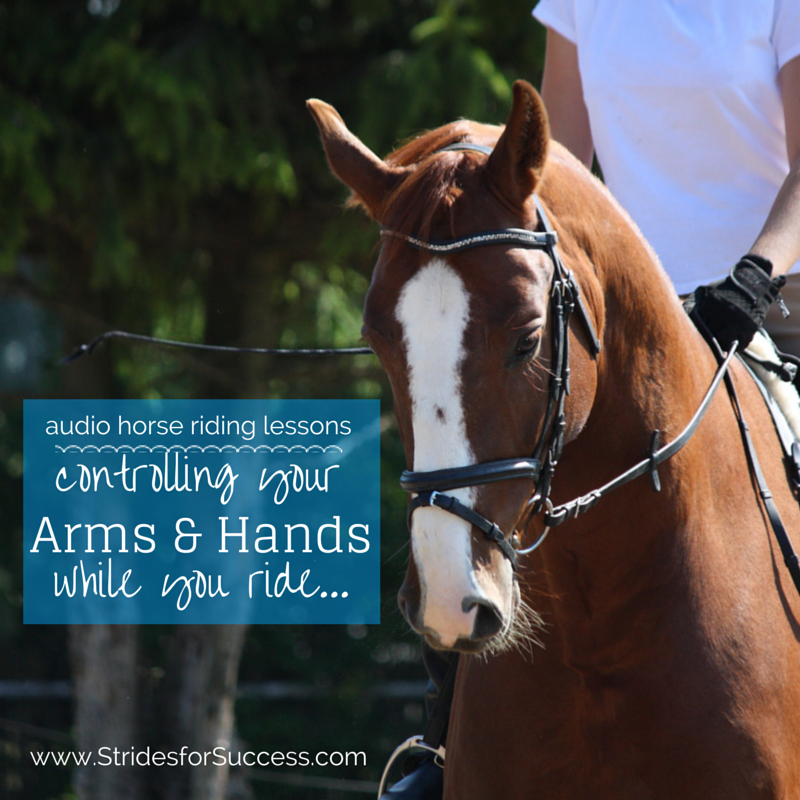
    Do you find that often when you ride, your hands begin to do their own thing?  Waving about, flagging some imaginary air traffic, conducting a symphony, or just bouncing up and down like a jack hammer?!  To make this even more frustrating; it seems like the more you try to ‘quiet’ or ‘still’ your hands the worse the problem becomes…

    [smart_track_player url=”https://op3.dev/e/traffic.libsyn.com/dailystridespodcast/SFA371-Controlling-Your-Arms-and-Hands-While-You-Ride.mp3″ title=”Controlling Your Hands and Arms While You Ride” social_linkedin=”true” social_pinterest=”true” social_email=”true” tweet_text=”Having trouble with controlling your hands in the saddle? This will help…” hashtag=”horseriding” twitter_username=”strides_success” ]

    The uncomfortable truth is that while you might be feeling frustrated about your lack of control, it is often your horse that is taking the brunt of this particular riding challenge. He may begin to fight you for the reins, lean on you or pull you along.

    Or maybe you spend time while riding continuously changing or fiddling with the length of your reins, dropping your hands and straightening your elbows, twisting your wrists so your knuckles are on top.  Or perhaps you are flapping your shoulders and arms in an attempt to ‘relax’ and all the while, that soft, following contact with your horse’s mouth continuously evades you…

    Controlling Your Hands and Arms as you ride

    Steady hands come from a relaxed body that is carrying itself. Relaxed does not mean floppy or loose, but rather supporting yourself without any signs of tension. Relaxation will also allow your body to follow your horses movement, which is the first key to controlling your arms and hands. I realize that it seems almost counter intuitive to focus on your body first when trying to ‘fix’ your hands, however one will not happen without first controlling the other.

    When your body is relaxed, your ‘shock absorbers’ can work optimally, working with the energy from the horse and not against it. Often hands that bounce around are the result of a rigid or tense rider, who is only rigid and tense because they are trying so desperately to control their body! It is a vicious cycle.

    The first thing to do is begin paying attention to your seat and pelvis and how, in walk, they follow your horse. Notice your breathing, and lift your upper body to allow your lungs to fill with air with each breath, to remove any tension from your body. Open your chest, remembering all the while to carry your body, not slouch, and then allow your arms to simply fall from your shoulders.

    Then remember to carry your hands. Don’t just allow gravity and your horses mouth to dicate where your hands are at any given time. In order to become soft through your contact, you must carry your own hands, which means bending your elbows. A good guide line is to try keep your hands around the height of your belly button.

    Once you have your hands where they should be, pay attention to how your shoulders, upper arms, elbows, fore arms, wrists and fingers all work together to follow your horses mouth. If you move your hand forward, move it from the elbow. Supple elbows will allow you to absorb movement and continue to keep a soft contact.

    Pay attention that your fingers are closed on the reins. Also, that you are ‘holding’ the rein with your thumb by pinching the rein between your thumb and index finger, not by squeezing your fingers. This will then free up your fingers to have more subtle ‘conversations’ down the reins to your horses mouth. Holding the reins this way will also prevent your reins becoming long and causing you to drop the contact with your horse.

    Controlling Your Hands adn Arms while you ride

    Begin establishing a following contact by lengthening your reins out, so you initially will have very little connection with your horses mouth. Move your elbows and hands with your pelvis and seat. Think of them being somehow invisibly connected to each other and relaxed enough that the movement of your horse underneath you is enough to quietly influence your body. Don’t force the movement, you must follow your horse, not drive your horse along by pushing with your seat or hands. When you feel that you are now following your horses mouth, you can begin to slowly gather up your reins again and begin establishing a contact with your horses mouth. If you feel any tension coming back, gently lengthen your reins and begin again.

    Another good visualization you can use is to think about carrying cups of hot tea… If your arms are tense, the tea will splash and spill from the cup.  If your arms are floppy, the same thing will happen. Only when your arms are ‘working’ with your moving body, will the tea stay in the cup!

    Remember that you do need to have a contact when riding. However that contact must come from soft, following hands that provide steady, consistent support connection and direction when needed. Sometimes it seems that more emphasis is placed on the leg and getting our horses back end working underneath him while being ridden. And this is true…

    However, there must also be a contact to direct and contain that energy and ask your horse to work in a frame. Be careful not to hang on your horses mouth, but also not to lose the contact either. It is a fine balance, which needs to be continuously re-evaluated and adjusted depending on the work or the results of other aids.

    30 Day Rider Fitness Challenge

    A strong core must be maintained throughout, so you are carrying yourself and are agile enough to follow your horse. When you can begin to confidently carry both your body and your arms, you will find that the tension which was causing the jarring or bouncing will soon dissipate, leaving you with quiet, soft hands from which you can begin direct that wonderful energy.

    Happy Riding
    Lorna