Tag: artificial aids

  • 5 Reasons You’re Struggling with Lunging – Part 1

    Hands up if, at some point in your riding journey, you’ve been guilty of thinking that lunging was a simple matter of your horse going in circles. Don’t feel bad, I’ve been there too. Most riders have, and so many still are!

    Lunging is so much more than just running in circles. It is an amazing way to connect with your horse and compliment or continue with your training when riding. 

    Like most worthwhile things, it takes time, practice, and improving your skills to get the most from lunging. It’s not something that just magically ‘happens’. Between getting tangled in the lines to missed communication between you and your horse, lunging is an art. It’s like riding. So when you approach it that way, you can begin to improve :)

    In this episode and post, I will focus on 10 common challenges that riders have when it comes to lunging. Now, Obviously, I say riders; I mean ‘lungers’, as in you on the ground in the circle with your horse trying to lunge :)

     1. No Plan or Purpose for the Session

    Ah, the old ‘no plan’. Just like riding, if you are hoping to use lunging as a tool to improve your work with your horse or your horse’s training, you need a plan! It’s when you show up in the arena with no clear intention or focus for the session, that it can very quickly become ‘running in circles.

    Just like your riding, if lunging is to benefit your work with your horse, you need to take the time to create a plan that connects to your goals or vision for your horse’s training and your riding. 

     2. Getting All Tangled Up!

    Is there anything as frustrating as trying to explain something to your horse, while also trying to get ‘untangled’ from the lunging line?!  If you are going to use lunging as a tool to help you and your horse improve, you must learn how to use the lunging equipment! And it’s not just the lunge line. This extends to the whip, cavesson or bridle, boots, bandages, and all of the other things you can use to make the experience better and safer for you and your horse. ,

    If you feel awkward and overwhelmed about using the lunge line, it will transfer to your horse through ineffective, stiff, and muffled communication.

     3. Wrong Position & ‘Cues’

    Your position as it relates to your horse when lunging is as important as your seat when riding. It is the foundation for everything. And it is also one of the biggest struggles riders have when lunging! They find themselves blocking the horse by being too far forward, or driving the horse when too far back.

    And because your horse is in almost constant motion when lunging, your position in relation to your horse must be constantly adjusted to reflect what you want to communicate to your horse. One wrong move and you are having an entirely different conversation! 

     4. Struggling with the Whip…

    Before we begin, I STRONGLY believe this artificial aid has the wrong name. It should be called a pointer. Or an ‘extender’. Because that’s what it does. It ‘points’ to areas that you would like your horse to focus on, or it ‘extends’ your aids (which is its primary role when lunging). Unfortunately, there are so many riders who do not know how to lunge correctly and, therefore, rely far too much on the whip or use it incorrectly. And you don’t necessarily need to ‘whip’ the horse to do either of those things…

    Incorrect or overuse of the whip is never a good thing and, however well intended, will usually result in excessive tension, anxiety, or confusion for the horse. It’s an aid that must be used with your other aids for positive results

     5. No Link between Lunging & Riding Goals

    And finally, it all comes back to planning and becoming clear on your vision.  If you want to really strengthen your training and your partnership with your horse, you have to begin seeing everything you do together holistically – instead of lunging being a completely separate activity.

    Almost everything you can work on or work towards while in the saddle can be worked on in some way while on teh ground. And so often, it is the different perspective that really cements the concept for both you and your horse…

    Stop Struggling with Lunging!

    I can go on and on about the things that riders struggle with when it comes to lunging. These are just a few of the ones I hear about from riders on a weekly basis. And the sad part is that these challenges, which can make lunging feel frustrating or unproductive, can all be easily remedied or changed.

    With some clear guidance, you can really transform your lunging experience into something special for you and your horse. I have created a free 3 Days to Successful Lunging audio program you can use today to start you on your journey. Get it for free by CLICKING HERE
    .

    Happy Riding
    Lorna

    More on this Topic:-

    Online Training to Help Your Riding

    Connect with Lorna online:-

  • Using Artificial Aids when Training Your Horse

    Using Artificial Aids when Training Your Horse

    [fusebox_track_player url=”https://op3.dev/e/traffic.libsyn.com/dailystridespodcast/1299_Using_Artificial_Aids_For_Good_in_Your_Riding.mp3″ title=”Using Artificial Aids when Training Your Horse” social_linkedin=”true” social_pinterest=”true” social_email=”true” ]
    I think it’s safe to say that all equestrians use artificial aids when working with and communicating with their horses at some point.  And yet, for some reason, many riders see many of these things as being ‘bad’.  However, for the most part, this is simply not true; especially if they are used correctly.
    If you use a saddle, a bridle, a head collar, a leadrope, a stable, an arena, a round pen, etc. etc. etc. when working with or training your horse, you are using artificial aids.
    And when they are used correctly, they can really be a help when explaining things to your horse and also helping your horse to develop strength through his body.  However, the keyword in that sentence is ‘correctly’…

    What is an Artificial

    The easiest way to think about artificial aids is anything that is not attached to you.  It’s not part of your body or who you are! If it’s part of you, it’s a natural aid. So artificial aids are equipment, fences, etc.
    And artificial aids, when used correctly, clarify, strengthen, or ‘back up’ your natural aids.
    They help your horse to understand what you’re saying and what you expect from him when you say it.  And this is a key part of the conversation… In order for your aids to be effective, your horse must understand your aids.
    It is when we are being a little ‘lazy’ without natural aids and depend too much on our artificial aids that we run into trouble.  This is where your artificial aids can start to become too ‘strong’ or downright incorrect when it comes to training your horse.

    Lead with Your Natural Aids

    One of the key factors when using artificial aids is to ensure that you are always leading or offering your natural aids first.  It is only when they are ignored, responded to incorrectly, too weak, or misunderstood, that you can then, maybe, introduce the artificial aid.
    In fact, the goal as a rider should be to develop your natural aids, and your horse’s understanding so that you no longer need the artificial aids to assist. 
    And yes, while many riders will never reach this point in their conversation with their horses, it does help to keep the ‘why’ you are using artificial aids in perspective when you are training and riding.
    Artificial aids are simply a tool to help you become more effective when using your natural aids.

    Using Artificial Aids

    There are many aids that are not natural and all can be used in different ways in order to clarify, back up, or strengthen your natural aids.  A few of the most common and basic examples are:-
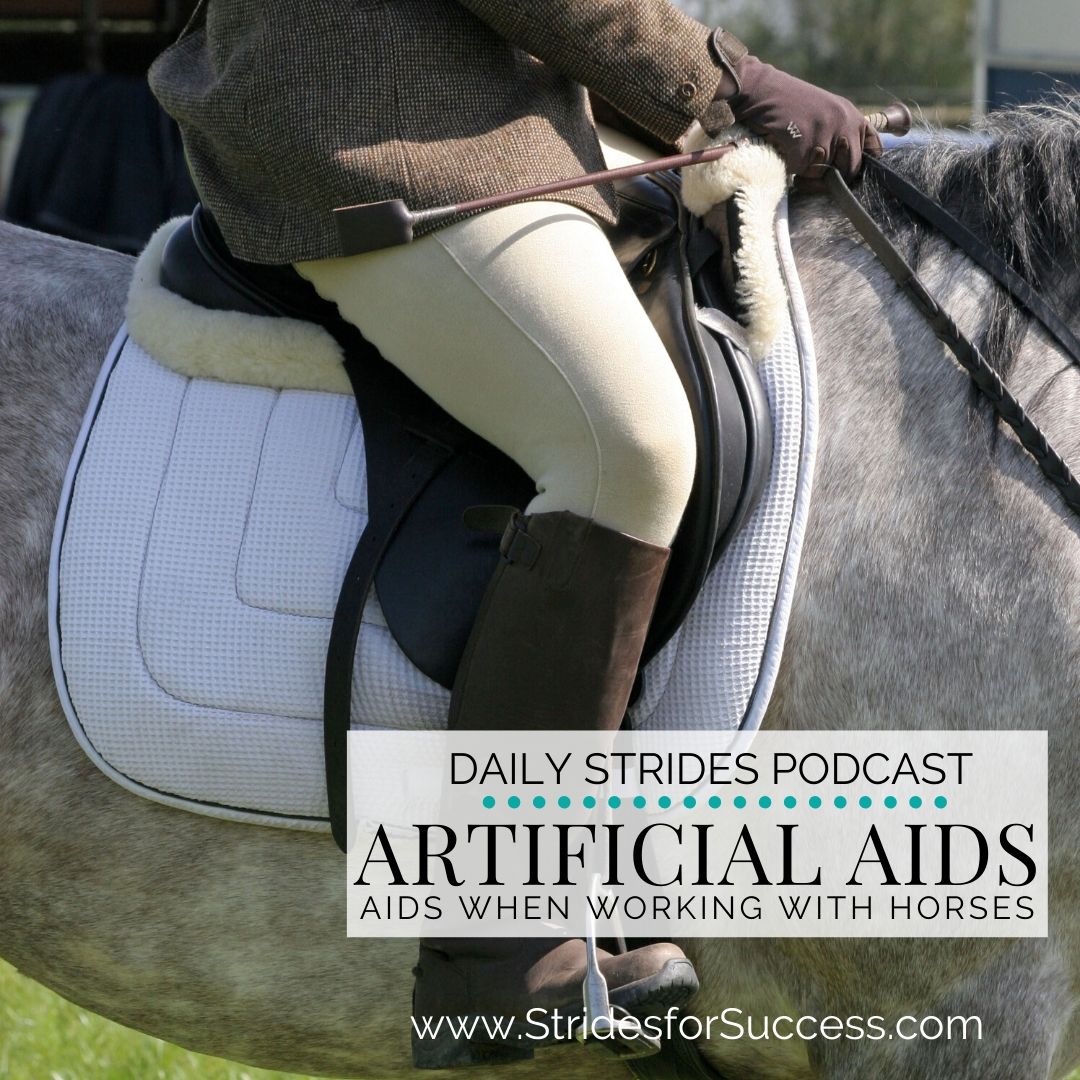
    • Whip (crop, pointer!)
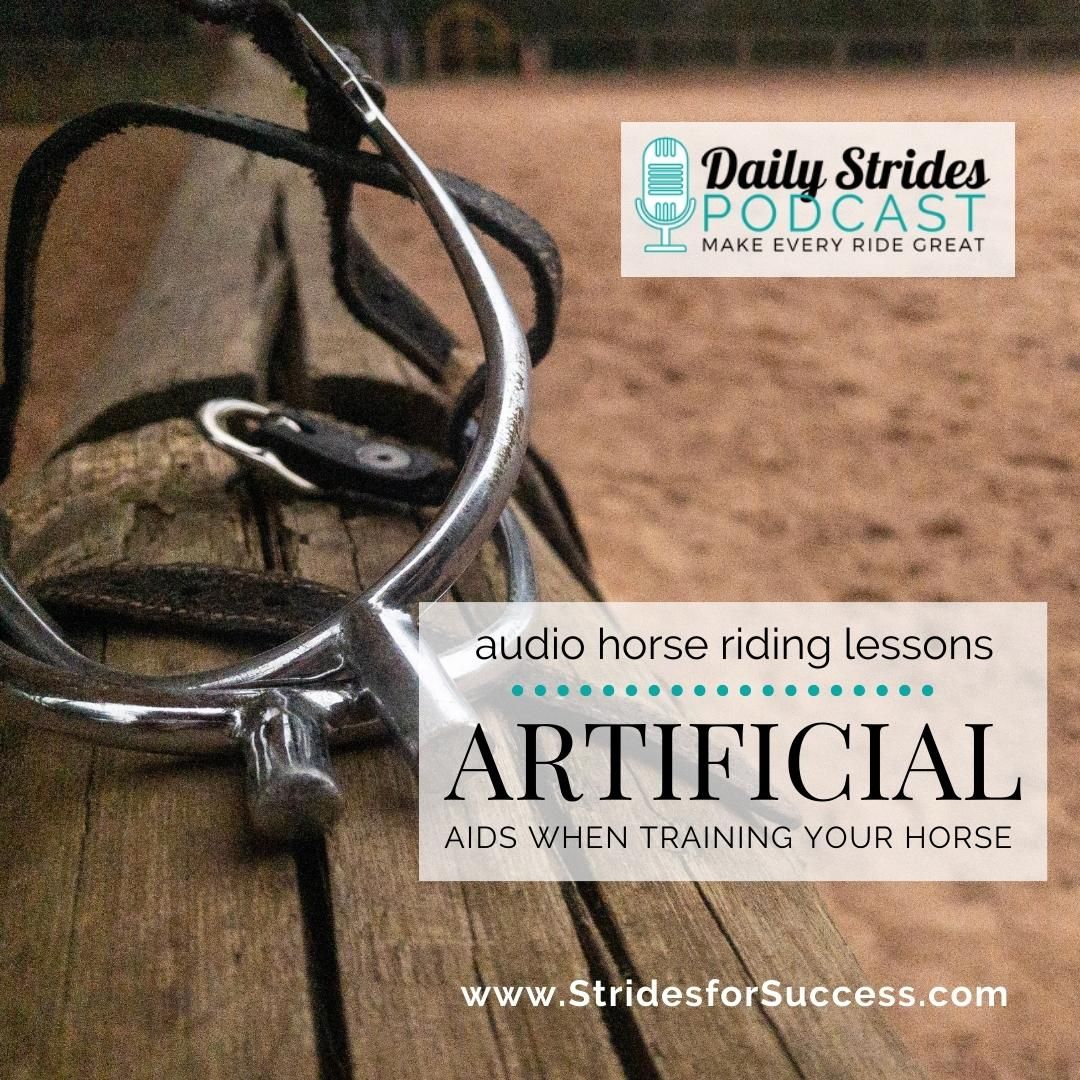
    • Spurs
    • Bit
    • Groundpoles
    • Lunge Line
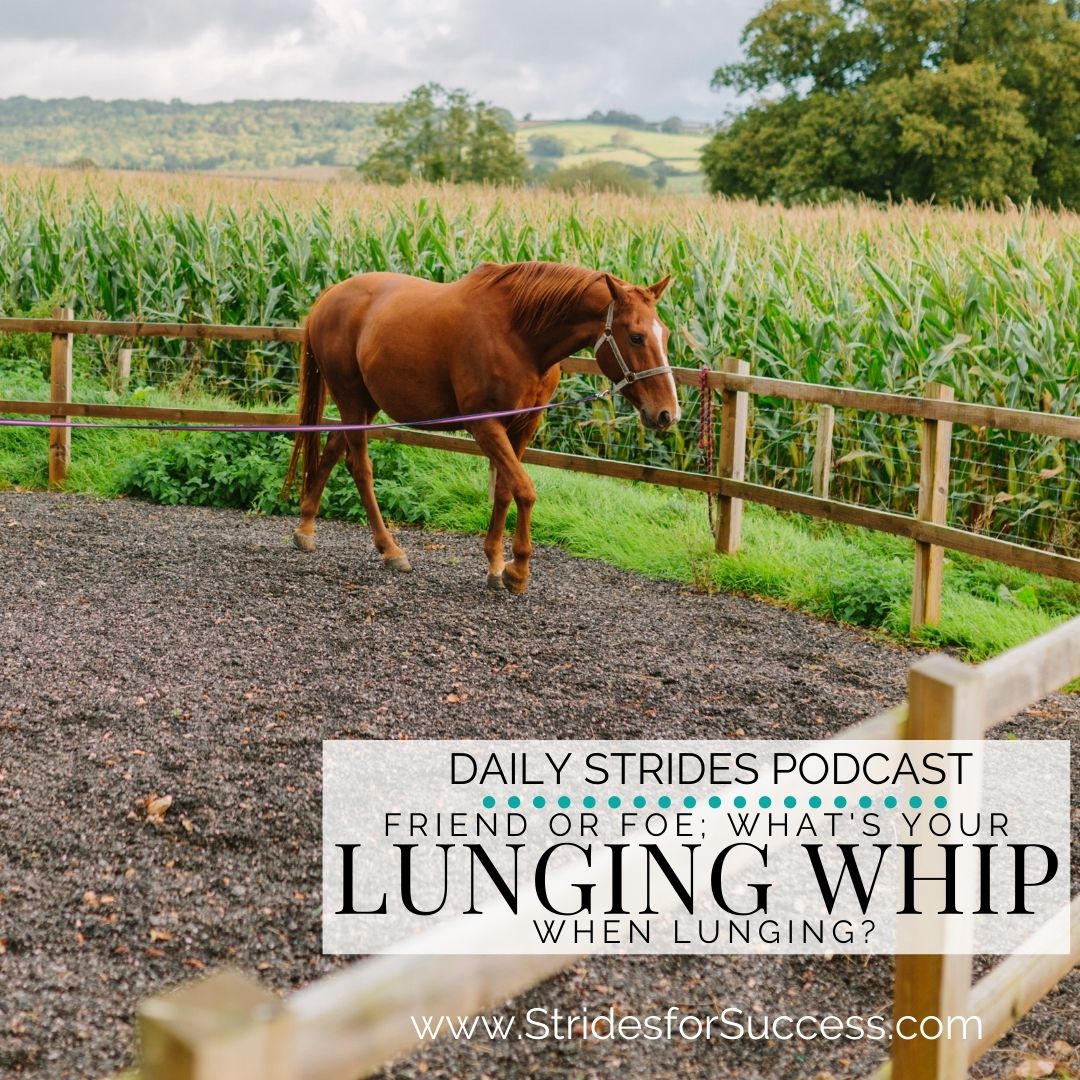
    • Lunge Whip
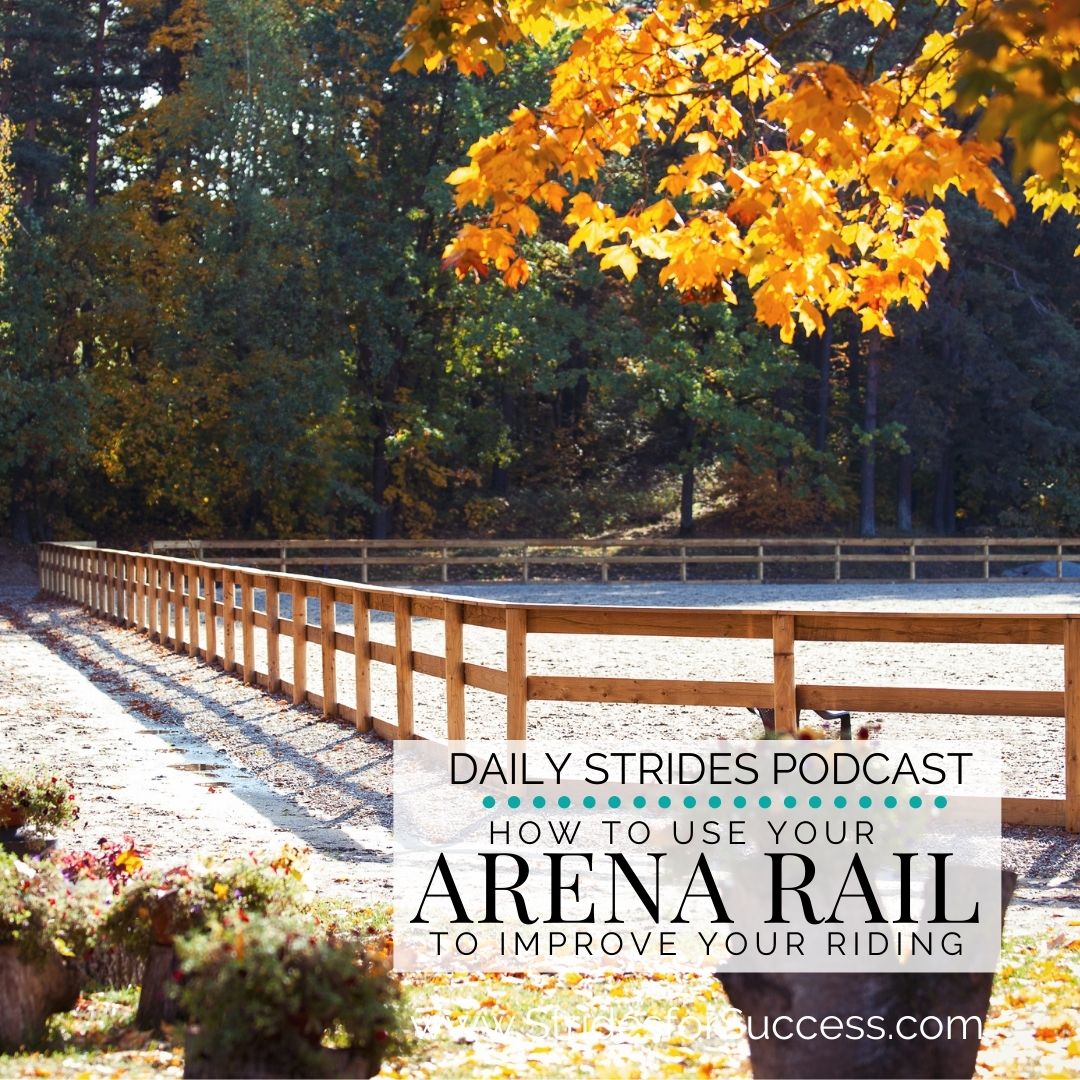
    • Boundary of Arena
    There are so many more, but these are the ones that the riders I work with most commonly use. And, again, when used correctly, there is nothing wrong with these aids.
    When the rider is thoughtful, responsible, and compassionate each one of these aids can make a huge difference in how well the horse understands what is being asked.
    Make sure you listen to this episode of the Daily Strides Podcast where I go further into how you can begin using these sorts of aids in your riding that will help develop your natural aids.
    Happy Riding
    Lorna

    List of Resources on This Topic:-

    Join Our Online Community of Equestrians

  • Friend or Foe? Your Lunging Whip when Lunging

    Friend or Foe? Your Lunging Whip when Lunging

    [fusebox_track_player url=”https://op3.dev/e/traffic.libsyn.com/secure/dailystridespodcast/1191_Positvely_Using_the_Lunging_Whip_when_Lunging_Your_Horse.mp3″ title=”The Lunging Whip; Friend or Foe?” social_linkedin=”true” social_pinterest=”true” social_email=”true” ]

    Have you been using your lunging whip incorrectly? Have you decided not to use it at all?

    Your lunging whip is one of the best aids you have to help you clarify your communication when it comes to lunging your horse. However, in order for it to be of benefit, it must be used correctly.

    And, unfortunately, the lunging whip can often be misused, and often, therefore, misunderstood when it comes to aids in lunging and riding.

    Lunging Whip; What’s in a Name?

    For many riders, their resistance to and incorrect use of the lunging whip is caused by the name we have given this piece of equipment. I have a feeling that if a lunging whip was called a pointer or a demonstrator, it would ‘feel’ different for many riders to incorporate it into their conversation with their horse.

    The lunging whip is a really useful artificial aid.  It just has an unfortunate name! 

    A lunging whip is an inanimate object. It can not do anything itself. It needs someone to be intentional with it in order for it to actually ‘do’ anything. If you feel uncomfortable about using a lunging whip with your horse, this is because of a thought you are thinking. My advice is to identify this thought – and then actively think of a better one!

    You can shape how this artificial aid adds to your conversation with your horse by how intentional you are when using it.

    Re-schooling the Rider

    The second big challenge many riders have with the lunge whip is how they are actually using it. Carrying it too high. Swinging it around. Directing air traffic. Not carrying it at all… These are all ways that we can use this aid without actually ‘using’ the aid in the way it can best communicate with our horse.

    Your lunging whip should be ‘carried’ just like you carry your hands when you hold the reins. The end of the whip pointing towards the horse should be kept down.

    In fact, if you stick to the rule that the end of the whip is kept hock height or lower, it will help you have a better and more consistent conversation with your horse. The end of the whip, in this case, is where the hard part of the whip joins the sash.

    Engaged Versus Neutral

    I like to think of your lunging whip when lunging as having a similar role to your legs when you ride. And, just like your legs, you never want to actually have it ‘off’ the horse. In riding, we don’t want daylight between your legs and your horse’s sides.

    In lunging, we don’t want your whip so open that it is no longer part of the conversation.

    Imagine that the track your horse works on while lunging is a pizza. You, your horse, and your aids create the pizza slice. Your horse is the edge of the slice. Your lunge line is one side. Your lunging whip is the other side. And you are the narrow bit at the center of the pizza.

    If your ‘pizza slice’ is taking up more than a quarter of your pizza, your lunging whip is too ‘open’!

    Re-schooling Your Horse

    Many rider’s greatest challenges with a ‘Long Tom’ (another name for this aid) come from the fact that their horse has unhappy associations with the whip. In this case, it is the job of the rider (lunger) to desensitize and re-school the horse to the lunging whip.

    How your horse reacts to a lunging whip is also just a thought. You can help him to reshape his thoughts on this through retraining and re-schooling.

    It’s a little like a hot or sensitive horse. Riding them without any leg is not the way to work through that. Rather allowing the horse to become comfortable with the leg and using the leg as aid will help both horse and rider going forward.

    Helping your horse to understand and become comfortable with your lunge whip can only help.  You can then use this artificial aid to clarify your natural aids and have better conversations on the lunge.

    Developing Your Aids

    Once you have done the work with yourself and your horse, your lunge whip can really help you to begin developing your overall conversation on the lunge. How you use it can be subtle and also more obvious, depending on you and your horse’s level of training.

    It is important to keep in mind that your artificial aids help either backup or clarify your natural aids. Your lunging line is no different.

    Used alone and by itself, it will be overbearing and work against the overall development of the relationship. However, when used with your other aids, as a blend, it has the potential to really move things forward.

    Happy Lunging
    Lorna

    Additional Bits and Bobs to Help You:-

  • How to Use Your Arena Rail to Improve Your Riding

    How to Use Your Arena Rail to Improve Your Riding

    [fusebox_track_player url=”https://op3.dev/e/traffic.libsyn.com/secure/dailystridespodcast/1186.How_to_Use-Your_Arena_Rail_to_Improve_Your_Riding.mp3″ title=”How to Use Your Arena Rail to Improve Your Riding” social_linkedin=”true” social_pinterest=”true” social_email=”true” ]

    Have you ever ridden in an open space, a large open space? A space with no boundaries, or fences, or hedges, or any natural ‘this is the end of this space’ obstacles. It takes a lot more focus to ride accurate shapes and straight lines. We tend to ‘wander’…

    So many of us forget how beneficial an artificial aid the boundary our arena rail creates. Not only does the arena rail or fence mark the ‘end’ of our riding space, but it also boosts our confidence; “He can’t run away, there’s nowhere to go”

    And it also helps us as an artificial aid. Something that will help us to strengthen and become more focused with our natural aids.

    Size Doesn’t Matter All That Much

    Last week I was working with a rider on another farm, and we didn’t have the luxury of a demarcated arena. We were working in a large paddock, which was wonderful. However, the ‘fence’ was quite a bit away from us. The exercise was to ride a 20m square in the walk.

    What became apparent, very quickly, was that without reference points, the square was not all that square!
    The size was changing, there were curved lines. It definitely lacked right angles at the corners. And, rather than riding the exercise to work on what we actually wanted to work on, all of the rider’s time was devoted to trying to actually visualize the square on the grass in this large paddock.

    Riding straight lines is a difficult thing to do when there’s nothing guiding you and keeping you on track.

    The good news is that the size of your arena is not what’s important here. A 20m x 20m space can be great when working on accuracy and suppleness. What is important is how you use the arena rail to being strengthening your natural aids. This is for those times when you find yourself without an arena rail to follow…

    Your Arena Rail is an Artificial Aid

    I love groundpoles. They help ‘mark’ things out for horses and riders. If you need clarity about where you should or should not ride, a groundpole is a handy thing to have!

    The rail can provide the same clarity. Especially when combined with other aids to apply pressure. A ‘squeeze’ of sorts.

    Think about a time when you were struggling to effectively communicate something to your horse about where you wanted him to go. By riding him closer to the outside rail and then combining the pressure created from that with your inside aids, you were able to successfully apply pressure.

    Pressure is the ask. It is the question. And often, when our natural aids are a little less than clear, an artificial aid is a great way to clarify what we are trying to communicate.

    Riding a Line

    The rail is often a way to train yourself to begin riding straight (or a least straighter) lines on your horse. Think of when you ride down the centerline for example. The only way that you truly know you are still on the centerline is because you are equal distance from each of the ‘long side’ rails.

    As soon as you find yourself closer (or traveling towards) one of the two ‘long sides’ rails, you know that your center line has gotten off track.

    The same applies when riding the quarter line. This one takes a little more concentration as the distance of each boundary is different. It is also a great way to begin becoming familiar with ‘squaring up’ to the ‘short side’ rail of your arena.

    By checking that you’re parallel to the long side. And then noticing if both you and your horse’s shoulders (and later hips) are perpendicular to the short side; you can ride a pretty straight quarter line with your horse.

    Focusing on Your Straightness

    Once you can recognize a straight line, your focus will then shift to you and what you are doing to achieve that straight line. I am saying straight line in the loosest of terms here… Most riders, once they put two or more meters of thin air between them and the rail begin to ‘wander’!

    The good news is that the wandering is less about a lack of focus. It is more about your uneven aids and communication from the saddle. It is also about symmetry and strength.

    I suggest riding the center line again. Notice if your hands are equal distance from your horse’s mouth and your tummy. Many riders travel with one hand further back, or more forward. Also, notice the height. Are they both equal distance from the ground?

    From here, notice your knees. Are they equal distance from your horse’s chest? Or is one knee more forward than the other? How about height; is one leg/hip/heel/ lower than the other? You’ll see it in your knees.
    Now, from here, recognize that your knees are usually a good visual representation of whatever it is that your hips are doing. And that your hands are usually a symptom of your upper body and shoulders. Are you truly straight?

    Working on Your Straightness First

    Once you can begin seeing your own crookedness, you can work on strengthening and straightening. I say strengthening because most crookedness comes from a weakness somewhere. Identifying what needs the work is vital so that you can then put a little more attention on that area as you ride.

    A lot of weakness is actually the result of a bad habit that has been practiced over and over again.

    Let what you can see directly in front of you (your hands and knees) help you identify any crookedness. And once you know it is there, the job becomes to figure out why. A habit? A method or basic you have outgrown in your riding? An actual issue in your body?

    Or a weakness or lack of strength in your horse that you have compensated for?

    I always suggest looking at the rider first. Most riders want to shift all of the ‘work’ to the horse. Be really honest with yourself here. It can sometimes feel like the chicken and the egg! A good way to figure this out is for you to ride a different horse. And to ask someone else to ride your horse…

    The Magnetic Pull of the Rail

    When we first learn to ride, we usually spend a lot of our time on the ‘outside track’. Simply put, we ride close to the rail (sometimes too close and get our legs rubbed). There are a few reasons for this; it is easier to direct novice riders when they know to ‘keep out. And, it allows us to become familiar with certain arena shapes and movements.

    The arena wall acts as an anchor of sorts. Which is great… Until the pull becomes a little too much! Next time you ride, be a little more observant of how you ride on the outside track.

    Notice how, for your horse, there may be a tendency to travel with the outside shoulder a little closer to the ‘wall’ than the outside hip.

    This is because most horses are, generally speaking, more narrow in front. It’s one of those things that, once you see it, there’s no going back! You will be aware of it every time you ride close to an outside rail or track going forward. Which is a good thing, because now you can begin to actually strengthen your natural aids in order to correct this.

    Strengthening Your Natural Aids

    This is where your awareness of your own aids plays a big part. Once you see that the rail might be now hindering your progress going forward, you can begin to wean him from the rail. I believe that artificial aids are a ‘back up’ for natural aids. The rail of the arena is no different.

    Once you are aware of your natural aids; it is important to begin using them more and relying less on the artificial aid that the arena wall provides.

    Start with that common observation of how your horse travels when riding on the outside track. Move 2m in from the track (onto the ‘inside track’) and notice if you can maintain ‘straight’ when there. Then test your aids further by traveling 1.5m from the rail.

    The closer you move to the rail, the stronger the magnetic pull!

    Use this to focus your attention on asking your horse to go where you want using your natural aids, rather than simply letting the arena wall be ‘outside aid’. Also, notice how there is always a balance of the aids. Too much of just outside will not create or maintain straight. The same applies to the inside.

    The Rail as the Boundary

    Over time, you will wean both yourself and your horse off the artificial aid that the arena rail creates. Does this mean that you can now ride all the time in big open spaces? I am going to suggest not…! Once the rail has stopped being an ‘aid’, it can go back to its original use; a marker.

    The rail’s true function is to mark out space you are working in. Using it for that is really helpful when it comes to being accurate and ‘measuring’ your progress.

    However, once you have learned to ride a straight line using your natural aids, it can feel really good to do this regularly in a completely open space.

    Happy Riding
    Lorna

    Other Useful Bits & Bobs to Help Your Riding

  • Using Artificial Aids when Working With Horses

    Using Artificial Aids when Working With Horses

    Using Artificial Aids when Working With Horses
    For some reason, many riders have a negative story around artificial aids. And yet, most riders use artificial ads on a daily basis, whether riding or on the ground with their hose.
    What is important to remember is that artificial aids are neither positive nor negative.  
    They just are what they are.  And you can use them to create a positive or negative reinforcement with your horse.  And, let’s be honest here, you as well.
    So in light of all that, I want you to begin being a little more mindful when using artificial aids with your horse.  This will allow you to begin the process of figuring out when and how you can begin moving away from that aid and towards a more natural aid instead.

    Why Artificial Aids?

    Artificial aids help enforce boundaries.  And boundaries are vital for both horse and rider. They help us to clearly communicate what we want and also allow our horses to clearly communicate back to us.  Having no boundaries results in nobody really understanding what is expected of them.
    Clear Boundaries = Clear Expectations
    Many of your boundaries can be communicated and enforced using your natural aids.  Your own voice, hands, legs seat, position, etc.  However, there are times where an artificial aid is actually more helpful and less confusing for both horse and rider.  A railing or fence around the arena for example.
    I believe that the key to successfully using artificial aids is to realize that they are there to simply ‘back up’ or reinforce your natural aids.
    They are not used on their own.  Similarly, they should not be the lead in the conversation with your horse.  However, they are a powerful tool, when used correctly, to clarify what you want to your horse.

    What are Artificial Aids?

    Simply put, it is something you can use that is not part of your body, to help explain or clarify something to your horse.  Think of them as tools.  You can pick them up and put them down when you want.  Now, what is important to realize is that not all artificial aids can actually be ‘picked up’!
            • Bridle
            • Bit
            • Headcollar
            • Leadrope
            • Lunge line
            • Whip
            • Spurs
            • Arena wall
            • Stable wall
            • Groundpoles
    All of the above are artificial aids.  They are not part of your body, and yet they help you to more effectively communicate with your horse.  This is especially true when your natural aids are being ignored or ‘missed’ by your horse.

    When to Use Artificial Aids

    Most riders will use some form of artificial aids from day 1 of their experience when working with horses. And most horses will see the aids as an extension of the rider and a part of the overall conversation.  Artificial aids work just like your natural aids, in that it is all about pressure and release.
    You can apply pressure using artificial aids and then release it when your horse responds
    The amount of pressure is where many riders can have a negative narrative surrounding using artificial aids in their day to day riding with their horse.
    However, like any aid, natural or artificial, excessive pressure comes down to the rider and how mindful they are when applying the aid.
    Let’s take one of the more misunderstood artificial aid, the whip.  I think that this is simply a case of something having the wrong name!  If we referred to it as a ‘pointer’ or even a simple ‘stick’, would it have as much negativity attached to it?  Either way, it has and because of this many riders refuse to ride with one.
    But, is bruising your horse’s sides because you have to kick so hard any better than whipping your horse?  Neither is right – and yet one is seen as being acceptable by many riders.  This is something I take issue with.  I personally feel that a ‘reminder’ or ‘pointer’ to pay attention to the rider’s leg is a lot nicer than kicking the sides off a horse… What do you think?

    Consistency and Responsiveness

    More often than not, artificial aids are simply there to ‘back up’ your natural aids.  However, consistently is first required from the rider with regards to what they are doing at any given time.  I believe that most responsiveness issues can be traced back to a rider who is ‘wishy-washy’.
    If you are to use artificial aids to back up your natural aids, you must get clear on what you are doing and why.
    So, let’s go to the whip again.  It is important to first of all set things up.  We usually use the half halt to do this.  The half-halt is simply a way of bringing your horse’s attention to you and what you are doing in the saddle.
    Once your horse is listening, you then decide where your aid will be applied and how much pressure is required.  Then the aid must also be applied at the best time for your horse to take action and respond.
    What many riders find is that, even if all of the above are consistently being communicated, their horse either misunderstands or ignores their leg aid.  This is when I feel a schooling whip can add to the conversation.  If used correctly, it simply brings the horse’s attention to the missed or ignored leg aid.  A simple tap.  Not a whip, lash, or strike.  Just a simple tap, directly behind the leg aid, delivered immediately after the leg aid has been ignored.

    Weaning Your Horse Off Artificial Aids

    How long you want to continue to include artificial aids in your conversation with your horse will depend on your unique circumstances.  Some riders feel the need to have a way to bring their horse’s focus and attention back to them immediately.  Maybe while navigating a track of fences.  Other riders want to move away from anything that is not as natural as quickly as possible.  Artificial aids, when used correctly, are not wrong.  They just are.
    Often, if you begin to move away from them, both you and your horse must learn to trust and develop more confidence in yourselves and each other.
    Take the boundary fence of the arena.  If used consistently to help keep you both ‘straight’ when riding on the outside track, it will become a crutch.  In fact, it will actually begin to negatively impact your development and training over time.  But moving away from it requires confidence and trust.
    It requires developing mentally, emotionally, and physically.
    The same goes for the fence of the lunging arena.  Or the arena fence full stop.  On the ground, this can be the difference between begin able to tack up in a stable or out in the open.

    Building Your Natural Aids

    Again, artificial aids are neither good nor bad.  How you use and apply them makes them so.  But what is important is that you are always looking to developing yourself as a rider.  Develop your natural aids.  Your seat and weight aids.  Voice is another important one.  And, of course, legs, hands, body language and position.
    Your most powerful aid, either in or out of the saddle, is your thoughts.  You can use your artificial aids to clarify and improve your thoughts.  doing this will, over time, improve your other natural aids as well.
    Start with setting your boundaries.  Get clear on what you want and your expectations surrounding everything in your riding.  Then look at how you communicate and enforce this with your horse.
    There is always a balance of aids at play in your conversation and it will evolve and change over time…
    Happy Riding
    Lorna

    Additional Resources on This Topic