Tag: basic aids

  • The Click Your Fingers Rule: Putting Your Position on Autopilot in Your Riding

    Imagine if there was something you could actively ‘do’ every moment you’re in the saddle that would almost guarantee that you’re in the ‘right place at the right time’.  There is. It involves abiding by the ‘Click Your Fingers Rule’ regarding your position. And look, I get it: talking about your position is not fun or exciting. But it is 100% one of the BEST ways to improve your skills as a rider.

    When you are in the right place at the right time to effectively and clearly communicate with your horse, it stands to reason that the overall connection and quality of the work will improve. 

    Your position is so important, and applying the Click Your Fingers Rule will help you develop true balance and independence in the saddle. It’s one of the key elements that allows a rider to transition from being a passenger to truly riding their horse.

    What is the Click Your Fingers Rule?

    Well, imagine we (you and I) were in the arena together. You are working on something specific with your horse: walking, trotting, cantering, or even working through grids and over fences. It doesn’t really matter what you are doing. The key point is that you’re riding alone, and I then apply this ‘rule’ to your riding.

    Imagine that I’m with you in the arena and I ‘click my fingers’, whisper ‘abrakedabra’, and your horse vanishes! Gone. Disappears. What we want to focus on is how you land… You ALWAYS want to land on your feet. Always. 

    Now, clearly, I cannot make your horse vanish on demand! However, I hope that by imagining this happening, you will understand how the ‘rule’ works. And when you imagine that your horse is suddenly no longer there, the question becomes ‘where and how would you land?’

    If the answer is on your face or on your bum, it simply means that you are depending on your horse for balance and support rather than being responsible for your own stability in the saddle. And this, if you want to improve as a rider, needs to change.

    Who Are You Depending on for Balance?

    When we start riding, we tend to rely a lot on our horses for balance. Thank goodness for all the school horses and ponies in the world with their endless patience! But in order for your riding to progress, this is something that you have to begin accepting responsibility for.

    You must become responsible for your own balance and stability in the saddle. Applying the ‘Click Your Fingers Rule’ to your riding will help you achieve that by reminding you to correct your alignment – and eventually put it onto autopilot. 

    When you can create your own balance and stability when you ride, you can then begin developing your independent aids. Independent aids lead to clearer communication with your horse. They also lead to an independent seat. The Click Your Fingers Rule will help you start working towards all of these things in your riding.

    Applying the Rule

    There are two simple ‘checks’ you can do every time you’re in the saddle to begin effectively applying this rule to your position and your riding. The first is to make sure that you are indeed sitting correctly in the saddle.  Use your seat bones for guidance. Are they directly underneath you, pointing straight down?

    Many upper body issues and lower leg issues are actually due to incorrect seat issues. If this basic principle is wrong or missing, the ripple effect in your riding is massive. 

    The second ‘check’ applies to the ‘lines’ of your position. Particularly the line that should run through your head, shoulder, hip, and heel. If these elements of your body are aligned, you are usually ‘carrying’ yourself, which means that you are, for the most part, assuming responsibility for your own balance.

    Becoming more aware of, and then regularly applying the Click Your Fingers Rule will allow you to correct your basic position. And after a while, this will become ‘normal’ for you. It will be on autopilot! 

    When To Apply the Rule to Your Position?

    The simple answer is ‘all the time’. Yes, really! Regardless of what you are doing, you should be able to support and balance yourself if your horse were to vanish suddenly or disappear. This means that your basic alignment should be present if you’re walking, trotting, cantering, or even galloping! If you are schooling on the flat, up or down hills, or over fences. It is all the same. If the horse were to vanish at any given point, anywhere in your ride, you should land on your feet.

    You are responsible for your own balance. And when you can apply this most of the time to your riding, you will allow your horse the freedom to begin becoming stronger in his work as well.

    Applying This to Your Position & Riding

    I’ve already mentioned checking your seat. Is it truly ‘underneath‘ you? From here, focus on keeping your legs under you at all times. Often, riders will struggle with a swinging lower leg. A lot of the time, this actually is a symptom of something going on in the seat. So, correct your seat first.

    And if your lower leg is spending too much time at your horse’s shoulders or elbows, if your horse were to vanish, you would land on your backside! Similarly, if your lower leg is swinging too far back towards the flank, you’d land on your face. The rule ALWAYS applies!

    In all of the examples you can think of when it comes to applying the ‘click your fingers’ rule, a strong supple core are absolutely essential. If you find that you’re struggling to maintain your positon or posture, maybe you can focus your efforts here. 

    Making the Transition in Your Riding

    By being consistent with testing yourself using the Click Your Fingers Rule, you bring awareness to your basic position. With time, this will result in you doing what you actually want all of the time without thinking about it. That is autopilot. And when you reach autopilot, you can then focus your attention elsewhere.

    This is where you really begin to make the transition to being a true ‘rider’ in the saddle, rather than a passenger. Now, you can start to pay attention to improving how you and your horse are working together.

    Happy Riding
    Lorna

    More Episodes on This Topic

    Online Training to Help Your Riding

    Connect with Lorna online:-

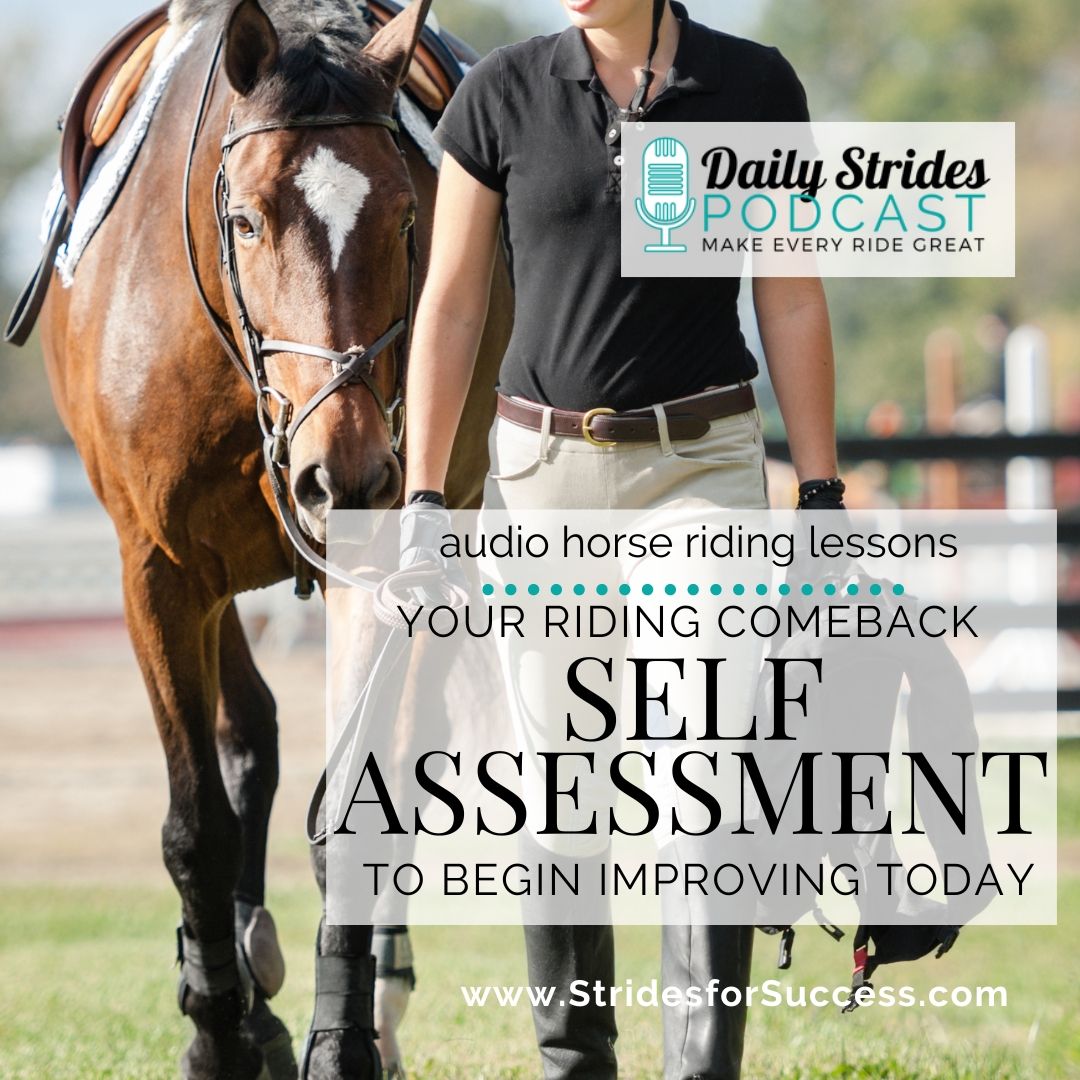
  • Self Assessment and Your Riding – Your Comeback to Riding

    Self Assessment and Your Riding – Your Comeback to Riding

    [fusebox_track_player url=”https://op3.dev/e/traffic.libsyn.com/dailystridespodcast/1317_Self-Assessment_as_a_Rider_Your_Riding_Comeback_to_Riding.mp3″ title=”Self Assessment and Your Riding – Your Comeback to Riding” social_linkedin=”true” social_pinterest=”true” social_email=”true” ]

    So you’re back in the saddle. It feels amazing and you love how each ride is jam-packed with learning new things and rediscovering little things you’d forgotten. However, once the initial excitement begins to wear off, you’ll probably start thinking about how to improve your skills.

    Self-assessment is a skill all riders can practice and improve. And it is essential if you want to improve your riding – and your horse’s overall way of going.

    The challenge can be knowing what to look for.  Being able to identify the root cause of an issue from a symptom of something else. This takes practice. Here’s a few things to look out for in those initial rides to create a solid foundation for your comeback to riding.

    Your Posture and Position

    It all starts here. If you are sitting correctly in the saddle, the chances of everything else working as they should increase dramatically.  From allowing the horse to move, to remaining balanced through transitions.  From your aids and overall communication to being able to help your horse to use it’s body better.

    Start with checking your ‘lines’; ‘head shoulder hip heel’ and ‘elbow, wrist, thumb, rein, bit’. Pay special attention to your shoulders being above your hips – not in front of or behind. 

    From here, think about your posture. Are you modeling ‘self-carriage’ for your horse? Are you creating ‘space’ between your ribs and your hips?  Doing this will allow your seat to open up and more easily communicate with your horse.

    Weight Distribution

    Once you feel like you’re in a good space position wise, think about how you are distributing your weight while in the saddle.  Ideally, you want an equal amount of you on the left as on the right. And then, as you work with your horse, you can begin to notice how your weight might shift and change.

    A great exercise to help with this part of your self assessment is to make sure both of your seat bones are equal distance from an imaginary line from cantle to pommel on your saddle. 

    You will probably find that while this is pretty simple to achieve and maintain in walk, your weight might start shifting in trot and canter. Especially when riding through corners and bends. Spend time in each of your riding sessions working on this.  And then test yourself regularly with how long you can maintain the ‘balance’.

    You can also play with riding without stirrups and notice if this changes your position, posture, and how you distribute your weight…

    Tension and Gripping

    For many riders, there is something strange that often happens when trying to improve riding skills; excessive tension through the body.  This is especially true when a rider, after running through a quick self-assessment, begins trying to either try to ‘hold’ a better position or posture! Relaxation and suppleness are essential for both you and your horse!  This is why I recommend practicing in the walk first and then building slowly from there.

    Remember, if you need to use excessive tension or ‘gripping’ to keep things correct and aligned when riding your horse, those things are NOT correct to begin with! 

    One of the most basic foundational elements of training when it comes to horses is relaxation. In order for this principle to really be present, both horse and rider must embrace and work into it. Excessive tension, such as gripping, being rigid, holding on to the reins, and bracing through the body all work against true relaxation. And this will, over time begin to show up in your horse’s way of going as well.

    Responsiveness

    Finally, I would suggest working on improving the overall responsiveness between you and your horse. This is definitely a trained behaviour.  This means that if your horse is not as responsive as you would like, someone has probably trained him that way, either intentionally or not!

    When working on improving responsiveness, the key is to recognise and put into practice what your role is in the dynamic… You ‘ASK’ and then your horse “RESPONDS’.

    It is not. your job to move the horse or to make the horse move or do anything.  Your job is to make sure you are in the right place (your position), with the correct level of tension through your body (your posture and relaxation), so that when you apply your aids correctly, your horse can respond to those aids. That’s it.  Okay, and I realize this is easier said than done.

    Self Assessment by Asking Questions

    When you begin to ‘ask’ questions and then pay close attention to your horse’s response, you have a baseline that you can now begin working with.  You can now tell where you are both at in your riding so that you can start to identify what needs to stop happening, change, or improve.

    Often, your self assessment will show you that changes are needed for both yourself and your horse; my advice is to focus on what you can control first – YOU!

    Get your basics under more control.  Understand how what you are doing is impacting the overall conversation and how you can begin making those small changes that will create a huge transformation. The basics are essential.  Your position, posture, basic aids, and moving with the horse. When you can start improving these things, the whole ride will begin to improve – you and your horse.

    Happy Riding
    Lorna

    Your Riding Comeback

    Your journey back to riding is as unique as you are. While you can draw inspiration from various plans and advice, remember to tailor them to fit your individual path and circumstances.

    If you’re seeking assistance with your riding comeback, consider our program ‘Returning to Riding.‘ In just 9 weeks, we’ll help you solidify your basics and transition from passenger to confident rider alongside your horse.

    With private 1 to 1 coaching, easy-to-follow audio lessons, and personalized weekly reviews, you’ll see yourself progress from feeling unbalanced to mastering clear communication and improving your horse’s performance.

    Through 9 weeks of private coaching sessions, we’ll provide the support you need via secure video, voice, and text. Plus, our proven program can be revisited with your horse anytime to refine both your skills.

    Explore Returning to Riding today for more details and start your journey back to the saddle!

    Get Going Again in Your Riding:-

    Daily Strides Premium is back! The first and original audio horse riding lessons you can use to improve your riding, train your horse, keep things interesting, have fun… Even if you don’t have a trainer or coach

    Connect with Lorna online:-