Tag: Canter

  • Securing Your Swinging Lower Leg in Trot and Canter

    [fusebox_track_player url=”https://dts.podtrac.com/redirect.mp3/pdcn.co/e/traffic.libsyn.com/dailystridespodcast/1364-Securing-Your-Swinging-Lower-Leg-the-Right-Way-Not-a-Quick-Fix.mp3″ title=”Securing Your Swinging Lower Leg in Trot and Canter” social_linkedin=”true” social_pinterest=”true” social_email=”true” ]

    Have you ever glanced down mid-trot or canter and seen your lower leg doing a full-on windscreen wiper impression? You’re not alone. I see this all the time. Novice riders trying to figure out how to stop that swinging lower leg from distracting their horse (and them!).

    The issue is that so often, trying to ‘fix’ your lower leg won’t work. This is because your lower leg is not the issue… It’s just the most visible side effect of something else that’s going on in your riding… 

    Whether you ride with a sensitive horse who thinks you’re asking for more speed. Or a fairly laid-back horse who simply tunes you out, this issue can quickly throw a spanner in the works. So today, let’s get right to the root of it, and more importantly, figure out how to fix it in a way that works long term.

    What Is a Swinging Lower Leg

    First off, let’s be clear on what we’re talking about here. A swinging lower leg is when your leg below the knee moves excessively while you ride. It often swings or flaps forward and back like a pendulum. Or a windscreen wiper! It usually shows up during trot (especially rising/posting) or canter.

    It might look like:

        • Your leg shooting forward when you rise, then swinging back as you sit.

        • Your lower leg losing all contact during canter and flapping uselessly.

        • Your aids becoming inconsistent—or even unintentionally sending the wrong signals.

    And while it’s easy to focus only on that swinging lower leg, the truth is this: the lower leg is rarely the actual problem. It’s a symptom of something else going on in your riding.

    The Real Reason Your Leg is Swinging

    Here’s the hard truth that most riders miss; your lower leg is swinging because something else is out of sync. It’s not about gripping harder or squeezing your leg tighter. In fact, doing that will very often make things worse.

    Instead, think of your body like a kinetic chain. When one link (your seat, your core, your shoulders) is unstable or misaligned, the result often shows up in your lower leg. So rather than treating the symptom, we’re going to dig deeper and fix the actual cause.

    To do this, first you have to figure out when your leg is swinging…

    Step 1: When Does It Happen?

    Get curious about when this is happening for you in your riding. Become a bit of a detective! If you ride alone, the only way to really know for sure is to capture your riding on video.

    First, check what happens in the trot. Particularly the rising trot. For many riders, the swinging lower leg pops up when they are posting. You’ll see that your lower leg (below the knee) shoots forward every time you rise. Instead of being underneath you (as in the Click Your Fingers Rule), it will be somewhere up at your horse’s shoulder or elbow. Then, as you sit back in the saddle, it will swing back under you again.

    I then suggest testing yourself in the canter. You might find that things are fine for you in the trot, but as soon as you transition into canter, that swinging lower leg makes itself known!  It’s like your leg develops a life and mind of its own! Doing its own thing! And, unfortunately, usually either causing your horse to increase speed or tension, or completely ignore you altogether!

    So grab your phone, whip out your Pivo, or get a friend to record you riding. Look closely. When exactly does the swing begin? Is it the trot? Or maybe it’s the canter for you…

    Fixing the Swing in Rising Trot

    Let’s start with trot. If you’ve got a swinging lower leg here, chances are your rising or posting technique needs to be revisited and updated. Most riders learn to post by being told “up-down, up-down.” Combine that with “heels down,” and what you get is standing up on your stirrups. That forward push causes your leg to swing because you’re using the wrong parts of your body to post.

    Instead, here’s a better way to think about it:

        • Imagine squeezing your glutes (your bum cheeks!)

        • Let your belly button travel forward and slightly upward towards your horse’s ears

        • Focus on moving diagonally with the horse, not up and down like a piston

    This subtle shift changes everything. Now, you’re not standing up on your stirrups, you’re moving with your horse’s motion. Your seat stays connected, and your lower leg stops swinging like it’s trying to escape. This also allows your lower leg to become an effective aid when you need it.

    Fixing the Swing in Canter

    Now, if you’ve got a swinging lower leg in the catner, there are a couple of different reasons this is happening.

    1. Are You Gripping with Your Knees?

    Gripping with your thighs or knees turns you into a human clothes peg! And not only does this cause your lower leg to swing, it can also cause your horse to feel uncomfortable.

    Instead, allow your thigh and knee to stay soft and open. Think of your legs ‘draping’ over the saddle. Let your seat move with your horse. And keep your lower leg gently against your horse’s side. No clamping, just resting against your horse’s side, ready for when you want to use your aid.

    2. What Are Your Shoulders Doing?

    This one surprises a lot of riders. But I’ll say it; your shoulders and your lower leg are very often just doing their own thing in the canter! And this is an issue, because it actually STOPS your seat from moving with your horse.

    If you’re doing any of the following in the canter:

        • Circling your shoulders

        • Rocking back and forth like you’re on a swing

        • Collapsing through your upper body

    …then guess what? That movement is disrupting your balance, and your lower leg is paying the price.

    Instead, keep your shoulders steady and aligned. Think tall, soft, and grounded. Let your seat follow your horse, and trust that you don’t need to ‘ride the canter’ with your shoulders. Let your seat do the talking.

    In the canter, your shoulders and lower leg remain ‘consistent’ while your seat and hands move with or follow your horse… 

    Why Holding Your Leg Still Won’t Work

    A quick reminder here: you can’t force your leg to be still by gripping harder or focusing solely on it.  That approach kills suppleness, flow, and the energy that needs to move through you and your horse.

    Instead, your goal is to create consistency through your upper and lower body, while allowing your seat to follow your horse’s movement.

    How to Train a Secure Lower Leg – Without Burning Out

    Like any new habit, improving your leg position takes time and consistency. But it doesn’t have to be overwhelming.

    Here’s how to start smart:

        1. Break it into short, focused blocks. Choose two 8–10 minute sessions within your ride to specifically focus on your lower leg.

        2. Start in the walk. Then move to trot or canter – not both. If both gaits are an issue, focus on trot first until that improves.

        3. Use video. Every few rides, film yourself again. You’ll be amazed at the progress once you train your awareness and refine your feel.

    This is not about “riding better for the whole ride.” That will come. Riding now, if you have a swinging lower leg, you need deliberate, short bursts of effort. This will help you to rewire the habit. To upgrade this ‘basic’ in your riding so that it serves you as the rider you are now.

    It’s a simple (but not always easy) swap. Change the old basic that got you this far, and replace it with a more refined basic that takes you to the next level.

    If you’re dealing with a swinging lower leg, don’t just accept it as something you have to deal with forever. Your swinging lower leg is simply a signal that it’s time to upgrade some of the foundational skills that got you started – but aren’t serving you anymore.  The good news? This is fixable. And it starts with consistent, intentional focus during your rides.

    3 Action Steps for a Swinging Lower Leg

        1. Record yourself riding this week – identify exactly when and where the swinging leg appears

        2. Tweak your rising/posting in trot – aim diagonally forward with your seat, not straight up

        3. Check your shoulders in canter – be consistent with your shoulders and lower leg, and let your seat follow and move with your horse

    If you’re ready to take the next step and refine all those basics that are holding you back, pop over to www.returningtoriding.com and join the waitlist for my free training. I’ll help you make sense of it all so you can go from frustrated passenger to confident rider.

    Happy Riding
    Lorna

    More on This Topic:-

    Online Training to Help Your Riding

    Connect with Lorna online:-

  • Stop Leaning to the Outside Round Corners when Cantering

    Stop Leaning to the Outside Round Corners when Cantering

    [fusebox_track_player url=”https://op3.dev/e/traffic.libsyn.com/dailystridespodcast/1286_How_to_Stop_Being_Pulled_to_the_Outside_in_the_Canter.mp3″ title=”Stop Leaning to the Outside Around Corners when Cantering” social_linkedin=”true” social_pinterest=”true” social_email=”true” ]

    The challenge is real… And, unfortunately, the momentum is as well! For so many riders, cantering is all well and good until the point where you have to turn! Cantering around corners can be so challenging for many riders for a lot of reasons. Here are 3 points to focus on to help you maintain your alignment and balance.

    1. Understand Momentum

    When cantering around corners, there are certain laws of physics at play!  One of the easiest ways to think about this is to use the example of a children’s merry-go-round.  When the merry-go-round is moving, it is much easier to remain balanced the closer you are to the center of the platform.  The closer you are to the edge, the stronger the force or momentum that feels like it is sucking or pulling you off the merry-go-round. Cantering on your horse is the same.

    If you are not actively positioning your body and your weight to help balance yourself, momentum will ‘suck’ you to the outside.  And with your horse moving to the ‘inside’ – that is not going to end well!

    2. Assess Any Potential Crookedness in Your Body

    If you have a tendency to lean or collapse through your body, this will become more amplified the more energy your horse creates when you ride.  Especially in the canter. Many riders don’t realize how much they collapse or they lean when they ride. Until they are asked to canter. And, even then, it is only really when they find themselves leaning to the outside around corners and through bends that it becomes a problem that urgently needs fixing!

    Start by assessing yourself in the walk. From here move into the trot, and then canter. Notice any height differences between your hands or shoulders.  Your knees as well. And also, how ‘equal’ you are sitting in the saddle…

    3. Correct Your Weight Aids & Position

    Once you have ‘straightened yourself out’ and really worked on developing symmetry through your body as you ride, now is the time to begin putting correct position and weight aids into practice.  So many riders have heard that they must ‘weight the inside seat bone’.  And this is not wrong.  It’s just how they are doing it that’s wrong.  They ‘lean’ to the inside using their shoulders – which only causes their inside seat bone to migrate to the outside of the saddle. Nope!

    Weighting the inside seat bone requires you to elongate and engage the inside of your body. Think of lengthening the inside leg and then, by positioning your upper body to ride through the corner, engaging your core.

    Leaning to the Outside in the Canter

    It is not an enjoyable experience.  However, it is one that can be corrected pretty easily if you are consistent with your approach.  By looking at the overall position of your body as you ride through any corner, in walk, trot, or canter, you will begin to do this without any thought.

    And when you can put the basics of position, weight, and straightness on autopilot, that is when you will find yourself, someday soon, not even thinking about this anymore in your riding.

    Happy Riding
    Lorna

    More on This Topic:-

    Improve Your Canter

    The canter is a big topic for riders. There can be so much pleasure and joy found there. And, often, an equal amount of bumps, flatness, and non-starts! If you are keen on improving your canter in just 4 weeks, make sure you take a look at my program Improve Your Canter.

    You will learn what is happening and how you can best time your aids so that your canter will go from being hit-and-miss to smooth and connected.

    With audio horse riding lessons to listen to 4 days a week while you ride, all filled with different exercises for you to practice, Improve your Canter will help you finally ride the canter the way you want.  Every single time.

    Training For Riders:-

  • Start Rolling & Stop Bouncing in the Canter

    Start Rolling & Stop Bouncing in the Canter

    [fusebox_track_player url=”https://op3.dev/e/traffic.libsyn.com/dailystridespodcast/1285_Start_Rolling_Stop_Bouncing_in_the_Canter.mp3″ title=”Start Rolling and Stop Bouncing in the Canter” social_linkedin=”true” social_pinterest=”true” social_email=”true” ]

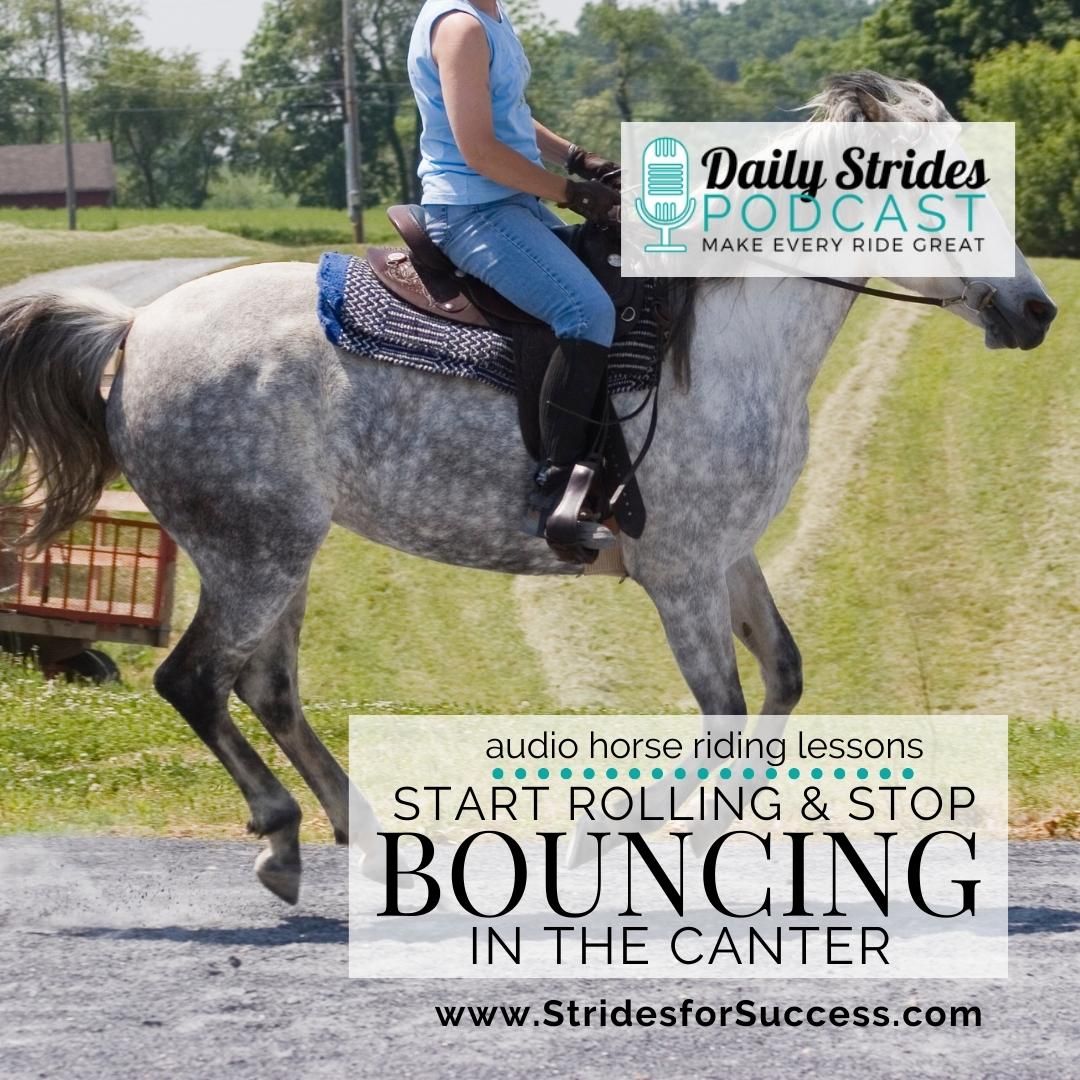
    One of the fun things about canter is the ‘moment of suspension’.  Except when this ‘moment’ applies to the rider, not just the horse!  Yes, there is a moment when the horse will be ‘off’ the ground; suspended in midair.  However, we definitely don’t want you to experience this bouncing in the canter.

    Becoming airborne whenever your horse strides in the canter is no fun!  And the ‘land’ when you connect with the saddle again brings little relief.  Instead of being a safe and reassuring place to ‘come back to earth’; it can feel like the saddle is trying to push you back into ‘thin air’ again.  Never a good feeling!

    In order to truly stop bouncing in the canter, I think you first have to understand the canter. And what your body needs to do in order to stay moving with the horse, rather than against it. 

     1. Start in Walk

    I think the walk is the perfect place to really begin moving your body in a way that will help your canter.  Allow the movement of the walk to move your body. Focus on how loose and supple your lower torso and seat can be.  Once your body has begun moving, you can really go deeper with what is actually happening.

    Instead of just thinking ‘backward and forward’ with your seat, notice the ‘higher and lower’ that goes with it.  Down and forward, up and back, down and forward, up and back…

    The ‘roll’ that we want to use to continue to move with our horse while cantering is just a more ‘advanced’ version of the roll you experience while in the walk. But so many riders are unconscious of this.  They fail to notice all of the little nuances. Spend time in the walk.  Know it with your eyes shut. And then practice some more.  This will truly help you when you canter.

     2. Understand the Canter

    Most of us understand that there is a moment of suspension in the canter.  And it is that moment of suspension that can cause so many hassles for riders! In order for you to really ride a smooth canter, every stride, it’s important to realize what is happening during the moment.

    In canter, you have 1,2,3, roll.  Then it repeats.  The ‘roll’ part, while not an actual beat, is really a silent beat.  It is where the horse resets.  Meaning your horse’s body and the legs pass over the inside front leg (the 3 in the canter stride sequence).  To do this, everything comes ‘up’.  It lifts.

    So, the down and forward happens during the 1,2,3.  And the up and back happen during the ‘roll’. Like a slightly wonky-shaped circle.  Down and forwards, up and back. 1,2,3, roll. 

     3. Self Carriage

    So once you know what is happening and you’ve begun to get to grips with your seat and how it’s moving, the next part is to really carry yourself.  Self-carriage is not just for horses. In fact, as riders, we should ideally be modeling this for our horses.

    One of the easiest ways to really begin carrying yourself while riding is to think about your posture and your position, When you work on your posture, you will naturally engage your core – and begin carrying yourself. 

    And this carrying yourself is key to being able to move with your horse, rather than working against him.  bouncing in the canter happens when we are moving against our horse.  It’s not pleasant for horse or rider, so working on your physical strength, fitness, posture, and position will help both you and your horse in the canter.

     4. Your Seat is a Pendulum

    Now, while I say ‘swing your seat’, I really mean allow your seat to be swung! As you get better at moving with the canter, yes, you can definitely use your seat to influence the canter. But for the start, just to get you out of the ‘bouncing mode’, you must learn to allow your seat to move with your horse.

    One of the easiest ways to think of this is that your seat is like a pendulum.  It is moving backward and forwards, underneath a certain point. And that point is pretty consistent.  In your case, the ‘point’ is your shoulders and upper body.  Your seat is your pendulum.

    Unfortunately, many riders are operating their pendulum upside down!  Their shoulders and upper body is doing all the movement. While the seat is stiff, stuck, and blocking. 

    Being able to move with your horse in the canter will require your body to be supple, elastic, and loose enough to move with your horse through each stride of the canter. And not just the forward and back, but also the down and up.  This truly creates the roll.

     5. Practicing, Correcting, & Practicing

    When you properly understand what is happening and can move your body, in walk, in preparation for ‘greater things’, then it is time to canter. Remember, bouncing in the canter happens on the roll.  So really start to become aware of the 1,2,3,roll. When you know what your body is supposed to be doing at which point in the stride, you can make adjustments.

    If you feel like you are losing rhythm and suppleness, reengage your core and carry yourself again. This will give your seat space to move with your horse.

    Cantering is not easy.  The more energy that is being created by the horse will always cause any weaknesses in the riders to be amplified.  In this case, it’s often a lack of posture, position, and suppleness. However, these can also all be worked on by becoming intentional when you ride.

    Happy Riding
    Lorna

    More on This Topic:-

    Training For Riders:-

  • Tipping Forward while Transitioning into the Canter

    Tipping Forward while Transitioning into the Canter

    [fusebox_track_player url=”https://op3.dev/e/traffic.libsyn.com/dailystridespodcast/1277-Tipping_Forwards_while_Transitioning_into_Canter.mp3″ title=”Tipping Forwards While Transitioning into the Canter” social_linkedin=”true” social_pinterest=”true” social_email=”true” tweet_text=”How to stop tipping forwards through canter transitions” hashtag=”canter #onlinehorseriding” twitter_username=”strides_success” ]

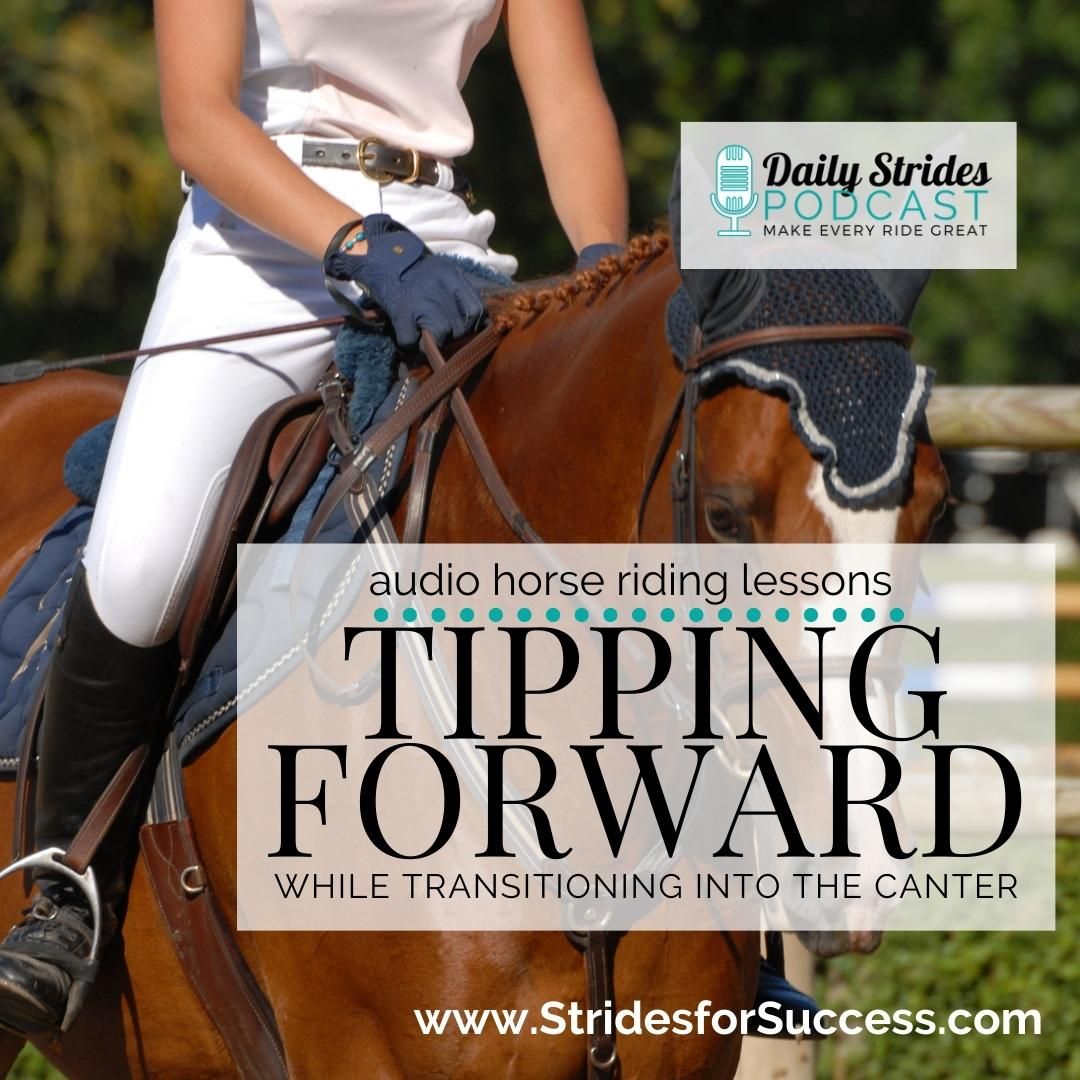
    Have you ever fallen into the trap of trying to actually get your horse to canter? It’s a sneaky one that hides in plain sight. And it is an exhausting one as well. The good news is that you’re not alone! Over the years, I have seen so many riders make this mistake.

    Because trying to make your horse canter, and asking your horse to canter are two completely different things…

    And the latter, asking your horse, is so much easier, balanced, and enjoyable for all involved. It also has a much higher success rate as well ;)

    Tipping Forward while You Transition into Canter

    There are lots of reasons why riders find themselves tipping forward when getting into the canter. Lack of balance, coordination, self-awareness, position, and correct aids, to just name a few. And, as already mentioned, believing it’s your job to ‘make’ your horse canter also causes many challenges.

    Whatever the reason for it, finding yourself tipping forward on entry into canter is often not the best place to be, for the transition and for the canter itself

    And tipping forward not only makes things more difficult for you, but it also really can become a hindrance for your horse as well. It can negatively impact your horse’s ability actually to complete the transition. Just like us, our horses need to try and remain balanced, coordinated, and ‘forward thinking’ during the transition. And on the off chance that he does indeed make it into the canter, the rider tipping forward can make it difficult to establish a good quality, forward-moving, and engaged canter.

    The transition into the canter is an ‘upward’ transition, both between gaits and physically as well. If you throw your weight forward, you are blocking the horse with your body

    The Transition into Canter for Your Horse

    As your horse prepares to move into the canter, whether it is from walk or trot, he has to ‘reorganize’ his body a little. This is due to the canter being completely different from the walk or trot. The footfalls, the energy, the rhythm… All of it changes.

    In an ideal situation, your horse would maintain balance, engage the hindquarters, lighten the front end, and literally ‘step’ into the canter from the previous gait

    If the rider has tipped forward, this becomes close to impossible. The rider’s weight will have shifted onto, usually, their knees and inner thighs. This prevents the seat from connecting through the transition. The rider’s hands will also be affected. Either they will run forwards, up the mane. Or drop downwards, further leaning weight on the withers and shoulders.

    Often you will see horses responding to the rider tipping forward by ‘running’ through the transition. Or failing to transition at all into the canter

    Focus on Your Seat & Posture

    So, let’s say that you have identified that you do, indeed, have a bit of a habit of tipping forward through the transition. The first two things I would suggest to work on this is to try to remain engaged through your seat and aware of your posture.

    Work on trying to keep your shoulders above your hips, not in front or behind, both before, during, and after the transition; this will require self-carriage and engagement of your core

    As your horse ‘steps into’ the canter, notice how your belly button (your seat) will lead the rest of your body into the canter. If your shoulders are ahead of your hips, your seat cannot move with the horse into the canter.

    If you can maintain your posture before, during, and after the transition, it will allow your aids to work freely, independently, and with clarity to communicate with your horse

    Pay More Attention to Timing & Accuracy

    Rather than just seeing the transition into a canter as being random, become more specific. When and where do you want it to happen? From what type of trot or walk? And on which lead are you asking your horse to ‘strike’?

    By investing time and effort to better prepare your transition, you can then also decide when is the best place inside of the stride to ask…

    Asking for the transition at the wrong time in the stride of the current gait can often result in your horse becoming too tense. Losing relaxation will cause both rhythm and balance to also be lost. Also, horses usually want to please, and your horse may feel like he adds a ‘hop, skip, and jump’ just before the transition to get there!

    Any tipping forward of your body can make all of these things worse and cause an even greater loss of balance – for both of you!

    Focus on Your Hands and Legs

    A practical piece of advice is to focus on your hands and legs throughout the transition. Notice if you tend to ‘drop’ one of your hands… Or maybe lift a hand. Also, pay attention to how you move your hands through the transition.

    Your hands are the aids you can actually ‘see’ when you ride, so use them as indicators or guides as to how well you are maintaining your posture and seat before, during, and after the transition

    Remember, all of your aids are connected, so tipping forward will have a domino effect on all of the ways you use to communicate with your horse. Once you have your hands pretty independent through the transition, focus on your legs. Are your heels and lower legs coming up? Maybe just one is due to you tipping to one side – a very common issue, especially to the ‘inside’.

    By noticing if you can maintain the weight into your heels, you can begin to assess what your lower body is doing through the transition

    Your legs are there to both help ‘ask’ for the canter, but also to support your horse, especially if he’s green, into the canter and in the canter itself. This means they need to be in the right place and independent both before and when you ask. They also need to assist with establishing the canter after the transition as well. They cannot do any of this when you are tipping forward through the transition.

    Ask and then Allow

    My final suggestion is the one that I use all the time with riders. I want to simply remind you that it’s your job to ask the question. It is NOT your job to canter!

    Get really clear asking the question, and then get out of your horse’s way and let him respond

    Getting out of the way means positioning yourself in the best possible place for your horse to answer the question. You can do this by maintaining your posture, your own independence, and balance.

    The more you can begin to focus on setting the transition up as best you can, and then creating as much clarity as possible with your aids, the better your transitions into canter will become

    If tipping forward as you transition into canter is a habit that you have had for a long time, it may take a little work to replace. However, I also know that the key to doing this is to become mindful of your body and actions.

    Happy Riding
    Lorna

    More on This Topic

    More Training & Support

  • Could Poor Posture be Ruining Your Transitions to Canter?

    Could Poor Posture be Ruining Your Transitions to Canter?

    [fusebox_track_player url=”https://op3.dev/e/traffic.libsyn.com/dailystridespodcast/1255_Is_Poor_Posture_Ruining_Your_Transitions_Into_Canter.mp3″ title=”Could Poor Posture Be Ruining Your Transitions into Canter?” social_linkedin=”true” social_pinterest=”true” social_email=”true” tweet_text=”Here’s how to get better transitions into canter…” hashtag=”horsepodcast” twitter_username=”strides_success” ]

    The transition into canter is one that always gives us opportunities to develop and improve as riders. And it can do the same for our horses as well. And yet, for many riders, improvement is frustratingly slow! The good news is that it doesn’t have to be this way.

    Canter and transitions into the canter are one aspect of horse riding that can improve quickly, often with just the smallest of tweaks applied.

    The key is to be strategic about what you are tweaking. And be willing to look out for the effect it has on yourself, your horse, and the transition in general. One of the simplest ‘tweaks’ you can apply is around improving your posture when you ride.  By simply ‘sitting differently’ you can transform the transition for the better.

    Self-Carriage as a Rider

    Self-carriage is a big topic when it comes to horse riding. It’s something we are always trying to cultivate and improve in our horses.  And rightly so, as when your horse develops both the understanding and the ability to carry himself a little better, it opens doors to so many new opportunities for you both to work together.

    I think that if you are asking your horse to carry you, and he obliges. Well, the least we can do as a rider is to take responsibility for making that as easy as possible for him to do. Carry ourselves. 

    Unfortunately, terms like ‘shoulders back’ have been shouted for so long to so many riders, that true self-carriage has become a little, well, confused in our heads!  Rather than thinking about ‘shoulders back’, I suggest visualizing ‘opening your chest’.  So from the point of your one shoulder across the front of your chest to the point of your other shoulder. Open this space up.

    Couple this with the feeling of creating ‘space’ between your ribs and your hips.  Elongating your body. This is self-carriage (and engagement) through your body as a rider and it will help your transitions to canter.

    Poor Posture & Its Results…

    When you are in true self-carriage, coordinating and using. your aids become so much easier.  Meaning when we are heavy, slouched, and too relaxed (not enough engagement or tension) through our bodies, things can become muddled up very quickly!

    Your body becomes harder to move. Some aids are impossible to move independently.  And you can no longer move with the energy your horse is creating. 

    When riding, especially transitions to canter, you are either working with the energy or working against it. If your horse, because he is the kind soul that he is, does actually canter when you ‘ask’ we need to be in self-carriage. When we are not, by blocking this energy, you are telling your horse that his response to your ‘ask’ for the canter was the wrong one!

    Horses become confused very quickly when riders say ‘go’ only to quickly follow it with a ‘no’! Poor posture causes your body to say ‘no’ to his doing what you asked him to do… Not a good result! 

    1255 Could Poor Posture be Ruining Your Transitions to Canter

    Lack of Independence

    The other downside to poor posture, especially as you ask for transitions to canter is your lack of independence. This means that you are dependent on either your other aids for balance or support. Or your horse.  Either way, it will cause issues as your horse moves from the walk or the trot into the canter.

    If you are using your hands to balance in the saddle, this will make true contact impossible.  As well as stop the forward flow of energy your horse needs when performing transitions to canter.

    If you are dependent on your horse for support and balance, the upward energy created through transitions to canter will throw you off balance.  Both of these situations will cause both the transition and the canter that happens afterward to become tense for the horse and rider.

    Relaxation is the foundation of everything when riding. Creating excess tension due to a lack of independence through seat and aids will ruin your transitions to canter. 

    Light Transitions to Canter

    Begin by modeling, through your body, what you want your horse to do.  In the transitions to canter focus on carrying yourself. By doing this you will both communicate with clearer aids and create the space and balance necessary for the transition to happen.

    The transitions to canter are ‘upward’.  They feel like a step up into the new gait. If we block that upward movement of the energy, our horses cannot respond as we would like them to. 

    As your horse ‘steps up’ into the canter, allow your seat to follow first. Then your hands, and finally the rest of your body.  Work on strengthening the connection between your seat and your hands.  Whatever your seat does through the transition, and in the canter itself, let your hands do the same.

    By practicing this consistently and preparing your transitions to canter beforehand, you will find that you will not only have a better transition. But you will also your canter will improve as well.

    Happy Riding
    Lorna

    Improve Your Canter

    Improve Your Canter is a 4-week program you can use to help develop both you and your horse in the canter. It is suitable for riders working alone without a trainer or coach. In there you will learn what is happening underneath you and why. You will also put this into practice using audio horse riding lessons. tailored for each day of the program, with your horse.

    CLICK HERE TO JOIN TODAY

    More About Canter Transitions:-

    Get Support & Guidance in Your Riding

  • Getting into Canter on Your Easygoing or Lazy Horse

    Getting into Canter on Your Easygoing or Lazy Horse

    [fusebox_track_player url=”https://op3.dev/e/traffic.libsyn.com/dailystridespodcast/1253_Getting_From_Trot_to_canter_on_an_easygoing_or_laidback_horse.mp3″ title=”Getting into Canter on an Easygoing or Laidback (lazy) Horse” social_linkedin=”true” social_pinterest=”true” social_email=”true” tweet_text=”Check this out to help make getting into canter easier for you!” hashtag=”lazyhorse #horsepodcast” twitter_username=”strides_success” ]

    Getting into canter on an easygoing or lazy horse can be exhausting!  And while we do love our laidback equines… Can we all be honest in admitting how, sometimes, just a little more enthusiasm would change everything?  The good news is that you can quickly begin to change this in your horse.

    You see, often, the trot to canter is often a symptom of a bigger issue – a lack of responsiveness.

    Increasing your horse’s responsiveness is possible. It will take a consistent approach from you – and the transformation can be instant… 

    So, rather than scrubbing, pushing, and shoving into the canter each time, begin working on increasing overall responsiveness first.  Be strict or disciplined with both yourself (it all starts with you) and your horse.  Oh, and did I mention that you also need consistency ;)

    Your Training Goal

    Before you begin working on this with your horse, it is important to have something to aim for.  My suggestion is to have the goal of being able to ask a question with the lightest of aids, and have your horse instantly respond. However, I get that, right now, this may seem impossible.

    Training your horse to respond to light aids immediately is your focus over the coming few rides. And you will also review this regularly going forward in your riding as well. 

    But, in order for your easygoing or lazy horse to begin changing, you must first take responsibility for your actions.  How things are now is a reflection of what you have continued to allow to happen in your training.  A more responsive horse starts with a more responsive rider…

    Your Leg Aids

    Just like most ways we communicate, you can use different methods with your horse to ask similar questions.  So if you have been just asking one way and not seeing results, maybe it’s time to begin experimenting with a wider range of aids?

    Easygoing or lazy horses need to learn to go forward without constantly being encouraged to do so by the rider’s legs. 

    Think of your leg aids now.  How are they being used to ask your horse to step into the canter?  A slight squeeze?  Maybe a squeeze and a small ‘nudge’?  Or do you have to give a few solid ‘kicks’?  Your aim for your training is to have your horse respond to the slight squeeze.

    However, in order to do that, you may need to apply a little more pressure initially using the ‘kick’.  Although, I would rather strongly suggest the correct use of a schooling or long whip. This is because I believe a ‘tap’ behind your leg to bring your horse’s attention to your leg is often a much ‘nicer’ solution than kicking the sides off your horse!

    Moving from Obvious to Subtle

    As you work towards the ‘light touch’, it will be so important to remember that consistency is key when working on responsiveness. So getting on and wandering around for 10 minutes not really focusing on anything while ‘warming up’ will not help your situation! From the moment your bum enters the saddle, your focus will be on responsiveness.

    Most riders overlook the very first transition that happens when begin riding. The one from halt to walk. Rather pay attention to it. This is where you can set the tone for the conversation going forward. 

    Aim for the whole conversation to be ‘I, the rider, ask a question and then you, the horse, respond in a timely fashion’. Ask followed by a quick response.  Repeat this over and over, throughout the ride.  Start in walk and trot.  And only when your horse is truly ‘going forward’, begin to work on the canter.

    Stop Nagging Every Single Stride

    The final key to this is to change the habit of nagging.  When you have ridden an easygoing or lazy horse for any length of time, certain habits can creep into your riding.  Kicking or squeezing every single stride is one of those habits. Now, the irony is that you may feel like you MUST do this to keep him going forward, right?

    It is important to remember that, when riding, the goal is for you to ask a question, and your horse responds until you interupt and ask a different question

    Part of your responsibility, as a rider, is to allow your horse to take responsibility for his role in this conversation.  Your horse must begin to take responsibility for ‘going forward’.  And if you are reminding him of this every single stride, he simply can’t.

    Learn to ask a question.  Repeat if necesary with more pressure.  Let your horse respond. Then wait until you need to make a correction…

    The correction in this situation is asking again for more energy when you feel that he has stopped working forward himself. And going forward is not ‘working forwards’.  True forward feels like moving with a sense of purpose.  Keep that in mind as well.

    Your Easygoing or Lazy Horse

    As you begin working on this the next time you’re in the saddle it is really important to remember one thing.  The struggle you are experiencing while getting from trot to canter with your more easygoing or lazy horse is merely a symptom.  The root cause is a lack of responsiveness.

    Responsiveness is one of the easiest things to correct in your riding.  And it is something you have almost 100% control over the outcome.

    Keep in mind that the key to overcoming this challenge is to be consistent with your training, and how you ‘show up’.  I would suggest short, extremely focused sessions of 20 to 30 minutes initially and then build from there.

    You will be amazed at what you can transform in just one ride!

    Happy Riding
    Lorna

    More About Canter Transitions:-

    Get Support & Guidance in Your Riding