Tag: clear communication

  • Improving Your Effectiveness as a Rider

    Improving Your Effectiveness as a Rider

    [fusebox_track_player url=”https://op3.dev/e/traffic.libsyn.com/dailystridespodcast/1325-REPEAT_Increasing_Your_Effectiveness_as_a_Rider.mp3″ title=”Improving Your Effectiveness as a Rider” social_linkedin=”true” social_pinterest=”true” social_email=”true” ]

    This article was originally published on stridesforsuccess.com in January 2022 by Lorna Leeson

    How many hours do you devote to training your horse each week?  Have you ever considered that you might just be the ‘team member’ that needs more work…?  That you might just be the ‘cap’ on your horse’s progress in his training and his development?

    Regardless of how much training your horse has,  eventually your effectiveness as a rider will determine what your horse can actually do with all that training…

    This week, I want you to begin thinking about, planning, and taking action on your own development. Your own conditioning, training, fitness, nutrition, social time, rest, and all of the things that you meticulously plan for your horse. 

    Why Do You Ride?

    I think to answer this, we first have to get clear on why we are riding our horse, to begin with… Most, if not all, riders are in the saddle because they have a certain outcome in their head that they want to achieve. This could be a feeling, such as relaxation or enjoyment. It could be a certain task, like getting a clear round or qualifying for something.

    Whatever the reason, it is worth remembering that you are taking time from your life to try and produce that outcome each time you mount up.

    Unfortunately, many riders often fall short of reaching the desired feeling, goal, or outcome. And, many times, this can be due to their horse not actually understanding what the outcome is that they are working towards. A lack of communication between horse and rider.

    What is ‘Effectiveness as a Rider’?

    When you know what you want to experience, it then becomes your responsibility to effectively communicate this to yoru horse. We do this, as riders, using our aids. And it is always a combination of aids.

    Your thoughts, legs, hands, body language, voice, position, seat, weight… And these are just some of your ‘natural’ aids.

    You also have a whole toolkit of artificial aids you can use to communicate with your horse. The saddle, bridle, arena, spurs, whip, lunge lines, lead ropes, etc. Most riders use a combination of natural and artificial aids in order to get their message across to the horse.

    The challenge becomes when they lack control over their own actions. This results in sloppy, haphazard, attempts at communication that muddies the message being communicated.

    When Communication Goes Awry…

    It is important to remember that, for the most part, whenever you get a result with your horse that is different to what you initially had in mind, the message probably became muddled. A simple case of you asking for one thing, but your horse hearing another, different, request.

    Retraining can play a big role in closing gaps between the expectations of riders and horses, however training is equally as important

    And training is not just for the horse. You, the rider, must also learn how to ask with more intention, focus, and clarity. It is easy to say that the horse is ‘stupid’ or ‘doesn’t understand’. However, the truth is often that the rider not clearly asking the question…

    There is a common misconception in horse riding that you ‘control’ your horse. You don’t – and never will. You merely influence…

    Your responsibility is to become better at influencing your horse using the aids that are available to you, natural and, when required, artificial.

    Developing Self Control

    The good news is that you can develop more positive influence if you work on improving your control over your body. How it moves. The range of motion you have with it. Your physical and mental stamina…

    Coordination is developed over time through a mix of developing physical strength, focused and intentional thinking, and building emotional confidence.

    I feel that saying ‘I’m not very coordinated’ is the easy way out for many riders. Lack of coordination, in most cases, simply means a lack of dedicated training; physical, mental, and emotional.  Improving effectiveness as a rider requires consistently upgrading yourself and your skills.

    I feel that, in order to truly begin experiencing the outcome you desire every time you get into the saddle, there’s work to be done on the ground as well.

    Taking Responsibility as a Rider

    If you are currently getting less-than-perfect results with your horse, then this work is for you. I think that it’s fair to say this is true of all riders. There will always be ‘more’ that we can do regarding developing our skills as an equestrian.

    Taking the time to develop yourself as a rider will allow you to begin responding rather than reacting when in the saddle.

    It will allow you to use your different aids in a way that is easily understood by your horse. Your mindset will become resilient, positively expectant, and open to new ideas and ways of doing things…

    All of these things will help you to have better conversations with your horse as you consistently improve your effectiveness as a rider.

    Happy Riding
    Lorna

    Equestrian Fitness Challenge ’24

    Let’s walk together for 21 days and have a chat about how you can do much more than you think you can as a rider and an equestrian… I am so excited to bring you along on this journey for the 100% FREE 2024 Equestrian Fitness Challenge
    There will be a daily walk, a 10 minute daily yoga practice, and lots of tips, ideas, exercises, and ways to improve so that you can show up as the best version of you – for you and your horse.
    Sign up today and let’s transform your riding – one stride at a time! 100% FREE 2024 Equestrian Fitness Challenge

    More Help for Riders:-

    Connect with Lorna online:-

    Get Going in Your Riding:-

    Daily Strides Premium is back! You can use the first and original audio horse riding lessons to improve your riding, train your horse, keep things interesting, and have fun… Even if you don’t have a trainer or coach

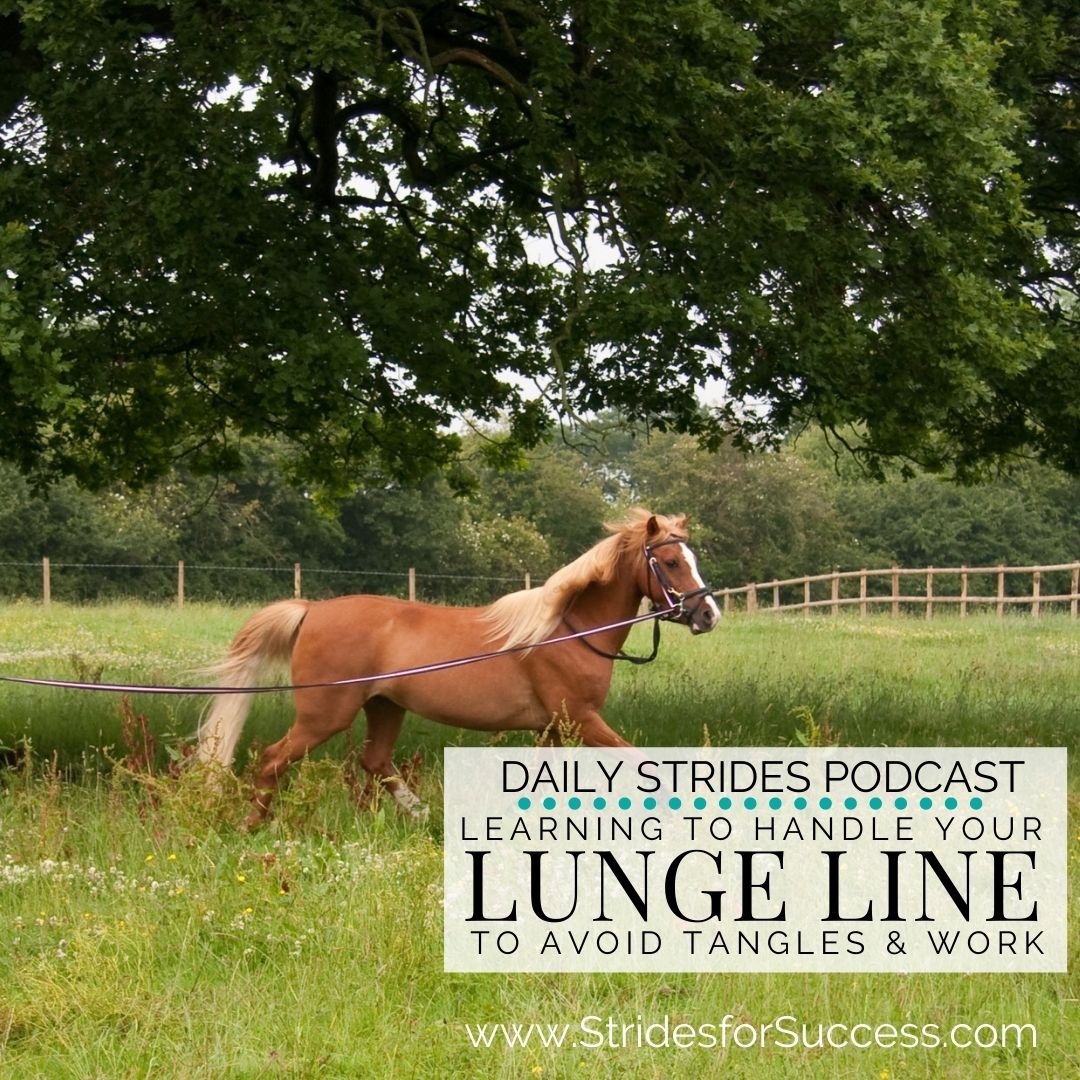
  • Handling Your Lunge Line to Avoid Tangles & Enhance Contact

    Handling Your Lunge Line to Avoid Tangles & Enhance Contact

    [fusebox_track_player url=”https://op3.dev/e/traffic.libsyn.com/dailystridespodcast/1170_Learning_to_Handle_Your_Lunge_Line_without_getting_Tangled.mp3″ title=”Learning How to Handle Your Lunge Line without getting Tangled” social_linkedin=”true” social_pinterest=”true” social_email=”true” tweet_text=”Constantly getting tangled in your lunge line? Try this…” hashtag=”equestrianpodcast” twitter_username=”strides_success” ]

    How many times have you been working with your horse on the lunge, only to have your line end up a tangled mess? Or perhaps your horse did something unexpected. Maybe he turned in or went from 0 to 60 in .5 of a second, and you couldn’t respond quickly enough because of a loopy, knotted, or twisted lunge line?

    Your lunge line is an important artificial aid that you can use to actively encourage contact and connection with your horse.  However, that is pretty much impossible if it is a tangled up mess!  The good news is that with a little practice, you can begin making your lunge line work for you and your horse, rather than against you in your lunging.

    The Type of Lunge Line

    Not all lunge lines are made equal. Before we even begin here, I want you to consider the quality of your current lunge line. Ideally, you want one that has a little weight to it, rather than a flimsy, flappy about one.

    That being said, you also don’t want one that is so heavy, gravity is having a greater influence than you in the conversation! There is a happy medium, play with what you like and what works best.

    Practicing at Home

    Once you have your ideal lunge line, bring it home from the stables with you. Yes, you read that right. You see, I think that learning to work with your line is better done without your horse. Of course, you can then practice and refine your skill every day you are with your horse. But, a lot can be done from the comfort of your home.

    I used a chair. I simply tied the end of my lunge line that would have been attached to my horse to the back of the chair. Then I began ‘playing’.

    Creating Equal Sized Loops

    Most lunge lines have a ‘loop’ at the opposite end to the clip. The loop end is ‘your end’. Begin by pretending that your horse (the chair) will be traveling on the left rein. This means that your lunge line will be in your left hand. It is important to recognize that you must not put your hand through the little loop sewn into the actual line. Simply use it as a reference to ‘start’ your other loops.

    Throw your lunge line on the floor so that you are now positioned between your chair and your lunge line on the floor. This is what you would do to safely sort out your line if your horse was actually attached to the end of it.

    From here, simply use your right hand to help create equal-sized loops. I suggest about 12″ to 18” (30 to 45cm) long. However, this will depend on your height and the line.

    Preparing the Line to ‘Fall Out’ of Your Hand

    Once you have all your loops together, in your left hand, we need to set things up in a way that will minimize the chances of getting tangled when you actually begin lunging.

    To start, transfer all the loops into your right hand.  Find the loop at the end of your line and take it back over to your left hand. Turn your wrist so that the palm of your hand is on top and facing up. Lie the loop flat on your hand with the rest of the lunge line hanging over the little finger side of your palm. It will fall closer to you.

    Then follow the fall of the line down and back up to your right hand. Using your left hand, simply take the top of the loop that is next from your right hand and lie it on top of the original ‘end loop’ already in your left hand.

    Lying it on top is the important part… This will allow your horse to simply take it out of your hand when you are actually lunging.

    Repeat as above, all the way until the full lunge line is lying loop on loop in your left hand. This is when you can begin lunging.

    Practice Letting the Line ‘Fall Out’ of your Hand

    From here, you can practice letting the line out by walking backward away from your chair. Obviously, when you are lunging, you won’t walk backward; your horse will walk away from you out onto the circle. But assuming your chair won’t do the same thing, walking backward will mimic what will happen regarding the distance between you and your horse while lunging.

    As the distance increases, notice the tension on the line. Your goal is to begin maintaining a consistent tension (or contact) with your horse through the lunge line. This is regardless of the distance between you.

    Gathering Your Line Up Again

    Once you have played out your line, you can then practice gathering it back up again. When you lunge, this is useful if your horse ‘falls in’ on your circle. Simply put, he makes the circle smaller and comes closer to you.

    Less distance between the two of you means that less line is necessary. Failing to gather your line up in this situation will result in a ‘loopy line’ or a ‘slack’ line and can also be dangerous if your horse steps on the line. To gather up your line, you will again use your right hand as well.

    This will involve reaching towards the lunge line with your right hand and then placing the line back in your left hand. Practice maintaining the average size of your loops. And placing the line back in your hand so that it can easily fall out again.

    Simply step backward away from your chair to let it out. Then step back closer to your chair to gather up. In and out… Over and over and over again, so that you can literally do it without thinking.

    Once you have this on autopilot, begin practicing again but this time carrying a whip. I’m going to suggest a short jumping crop or a schooling stick if you are indoors. A lunging whip can get a little messy when working indoors in your house!

    Changing Rein

    The example above is for when you are lunging on the left rein. However, we cannot just go left forever! Changing rein is important and you need to learn how to do so in a simple, easy way.

    Assuming you have gathered all of the line back up into fairly regular-sized loops again and it is all in your left hand, you can begin changing over. The safest, easiest way is to simply find the initial small ’sewn in’ loop at the end of your lunge line under all the other bigger ‘created’ loops.

    Use the fingers of your right hand to dig it out and then place it in on your upward facing palm of your right hand. Let it fall over the side of your palm closest to you (or your little finger). From there, again follow the line to the next ‘loop’ in your left hand and just transfer it across to your right hand.

    Go loop, by loop, by loop until all of the loops are in your right hand. Then you are good to go without becoming tangled. This something to practice over and over again using your trusty chair so that it becomes second nature when your actual horse is on the other end of your lunge line.

    Practicing on the Lunge

    Once you feel confident about playing with your line and changing rein, begin practicing with your horse.

    Notice the tension levels. And how you can make adjustments using your shoulder, your elbows, and the height of your hand from the ground.

    These adjustments will be essential when you begin initially as you learn to balance all of your lunging aids together. If you would like more help with this, here is your invitation to join me inside of Connection, my online membership for equestrians.

    Then it is simply a matter of practice, practice, practice… The more confident you become at working with your lunge line, the more enjoyable lunging becomes.

    Happy Riding
    Lorna

    Additional Resources for Equestrians:-