Tag: competition

  • Why Your Riding Falls Apart Under Pressure (and How to Fix It)

    [fusebox_track_player url=”https://dts.podtrac.com/redirect.mp3/pdcn.co/e/traffic.libsyn.com/dailystridespodcast/1378-Why-Your-Riding-Falls-Apart-Under-Pressure.mp3″ title=”Why Your Riding Falls Apart Under Pressure and How To Fix It” social_linkedin=”true” social_pinterest=”true” social_email=”true” ]

    This morning I sat in a big school hall, surrounded by parents buzzing with anticipation, watching my six-year-old son and his classmates step onto the stage for their very first school concert.  And as I was watching them put their weeks of practice into action, I began thinking how we, as riders, can learn a thing or three from these Little People.

    I think as riders, we can often forget that practice is just that. Practice. And the reason we practice is for when we find ourselves in a situation where the pressure is on! 

    The children’s concert reminded me of how important it is to both do the practice and then learn from the experiences when we put that practice into action… Especially when we find ourselves outside of our comfort zone!

    Things Will Go Sideways

    I think the first big takeaway from this is the fact that we need to be open to, and plan for, things going ‘sideways’!. You and your horse, just like those Little People on the stage this morning, are not polished robots!  Meaning that while you can put in the hours and do the work, practicing, and practicing… Still, when you find yourself ‘under pressure’, things can and most likely will go sideways!

    As I sat there smiling (and occasionally giggling quietly to myself), I realized how much this parallels what happens to us as riders, both in our own training and when we’re working with our horses.

    The consistent practice prepares you and your horse – but the added new and different pressure changes the game. And the question then becomes, “Can you adapt?”.

    What is ‘Pressure’?

    Okay, put your hand up if this sounds about right for you and your horse…. When you’re riding, doing your usual day-to-day ‘stuff’, you usually practice in a controlled or predictable environment.  This could be your arena, over the same set of jumps, the same transitions, on the same trail, or over the same cross-country track in the same quiet setting. And that is good. That is where we refine, repeat, and rehearse until things feel pretty solid.

    But the moment we step into a different situation, whether that’s a show, a clinic, or even just riding in a new arena or hacking on a new trail, the ‘pressure’ changes! We (horse and rider) become more ‘aware’…

    And please hear me when I say that ‘pressure’ doesn’t have to mean competition. In fact, you can add more pressure in your day-to-day riding in your usual arena if you want. It’s a change. And it can be as simple as:-

          • Riding in a different part of the farm
          • A wheelie bin suddenly shows up at a neighbour’s gate while out on the road
          • A friend is watching your lesson
          • Your horse suddenly feels ‘more energised’ because you’re riding somewhere different!

    That change can make what, before, felt smooth in practice, suddenly unravel!

    BUT – and this is the important bit –  just like those LIttle People on the stage this morning, it doesn’t mean you’re failing… it means you’re taking action, and now know where the next level of your ‘practice’ needs to begin. 

    A Few Real Life Examples

    Over the years, I’ve seen this play out countless times in the arena and beyond. Here are three examples that highlight the reality and the growth that come when practice meets pressure.

    1. The Jumping Track Nerves

    Okay, I’m using myself as the first example! You see, when I was younger, I used to practice jumping tracks at home with my pony. We were great (if I do say so myself :) ). I could memorize the course easily, and my pony was a great saint of a partner! At home, we were golden.

    But the second we got to a show, that all changed. For me, the ‘pressure’ was the thought that ‘everyone was watching me’! I’d freeze up, even though we’d practiced everything and knew it like the back of our hand!

    Luckily, I had a saint of a woman working with me then, and she gave me the simplest but most effective tool: sing a song while riding the course. For me, it was “Don’t Worry, Be Happy.” And you know what? It worked.

    The singing broke the tension, shifted my focus, and allowed all the practice I had put in to come through. It wasn’t perfect, but it was progress. And my new practice became riding in front of other people. 

    2. The Sitting Trot Struggle

    Here’s another way this can show up – but in the horse this time. So there was a rider I was working with a few years ago, and she was determined to improve her sitting trot for dressage. She practiced tirelessly at home, and things felt good. But at her first show, where the sitting trot was required, she forgot to factor her horses ‘enthusiasm’ into the equation!

    As you probably know, when your horse feels the energy of the occasion, the trot tends to become ‘bigger’. And her carefully practiced sitting trot dissolved under the pressure – and the ‘more’ happening under her!

    The ‘bigger’ the trot became, the more she tensed up! Which resulted in a bigger ‘bounce’ and it was just feeling like a complete lost cause…  But instead of quitting, she relaxed into the moment. She accepted that this was different from home and allowed her body to move with the horse instead of fighting against it. By the end of the test, her sitting trot started to resemble what she’d practiced, and more importantly, she now knew what to expect and how to prepare for next time.

    3. The Plastic Bag Spook

    Another rider was recently out hacking her young horse when they came across the dreaded nemesis of equestrians everywhere: a random plastic bag stuck and fluttering in a tree! Her horse, usually the calmest and compliant soul, was absolutely freaked out. Here they were in a setting that they both knew – but with this absolutely unwanted ‘invader’ in their story!

    As her horse was literally having a heart attack, she too found herself going from 0 to 60 and tried to ‘push’ him past it. But then she realized that this was in complete opposition to everything she had been working on with her horse up to this point.

    In fact, this was the exact moment she had been practicing for! She realigned and ‘modelled’ for her horse what she was looking for.  She chose to remain consistent and calm – and he followed suit. 

    Slowly, her horse mirrored her steadiness, and they got through it. That moment became a huge building block in their partnership, teaching her horse that even when things went sideways, he could trust her lead.

    Mistakes Can Be Confidence Builders

    Okay, all of this to say that I feel more riders need to realise that mistakes under pressure are not evidence that all your practice was wasted! In fact, it’s quite the opposite.  Those children today walked off that stage feeling more confident than they were before.

    Not because everything went perfectly, but because they did it, and in all of the chaos, they realized they survived, even thrived! 

    The same is true for riders and horses. Every “wonky” moment is a chance to grow resilience. Every imperfect ride builds confidence. Every sideways detour teaches you something new.  When you and your horse get through a pressured situation, you come out stronger on the other side.

    So, how do you take this mindset into your own training? How can you begin to see things differently so that you can both feel a renewed sense of enthusiasm about your training – and see a clear path to go forward on?  I feel that these are a few simple, but often forgotten, things to remember:-

          • Expect things to go sideways; that’s not failure, it’s real life.
          • Stay compassionate, to yourself and your horse. Mistakes are learning opportunities – not crimes!
          • Reframe the moment. See it as practice under pressure, not proof you’re failing.
          • Stay consistent and aligned; your horse will look to you for stability.
          • Celebrate effort. Acknowledge what went right, not just what went wrong.

    Just like nobody shouted at the Little People this morning for facing the wrong way or waving when they should have been clapping… Don’t shout at yourself or your horse for mistakes! What matters is showing up and giving it a go.

    Confidence WILL Grow

    If you can remember that this is part of the learning journey, there is a little magic that happens… You become reenergised and even more enthusiastic about working with your horse going forward. I really do believe that the children, helpers, teachers, and parents all left that concert today more enthusiastic about the next one.

    The practice had paid off, not because everything went perfectly, but because the experience was richer for its imperfections. And now there’s a map to work with going forward

    When you embrace the chaos in your riding, you not only grow your skills, but you grow your love for the process. And that enthusiasm will carry you and your horse forward far more powerfully than a “perfect” ride ever could.

    If this resonates with you, I’d love to help you put it into practice. Make sure you sign up and try the Your Signature Ride Challenge. It’s a fun, no-judgment way to practice applying pressure in your rides and learn to stay consistent with your aids.

    And remember, your confidence isn’t built when everything goes right. Neither is your horses. It’s built when things go wonky, and you keep going anyway!

    Happy Riding
    Lorna

    Restart & Reschool

    And if you would like a little more 1-to-1 coaching, explore Restart & Reschool Private Coaching. It is perfect if you’re starting your practice – or if you’re looking to turn your existing practice into something ‘real’ for you and your horse. I’ll guide you step by step on the way! You’ll not only get the full ‘OTTB; From Racetrack to Ready Program’, but also fornightly private lessons with me to move you forward in your riding.

    We can work on anything you would like; from groundwork, to lunging, to riding, to jumping… With the virtual private lessons, we can do all of these things – and more.  If you would like to find out me, you can let me know a little more about you HERE and I will then reach back out and we can chat!

    This is the support, training, and accountability you’ve been missing to finally follow through and start seeing progress. No fluff. No overwhelm. And as flexible as you need for your lifestyle. 

    Online Training & Coaching

    Connect with Lorna online:-

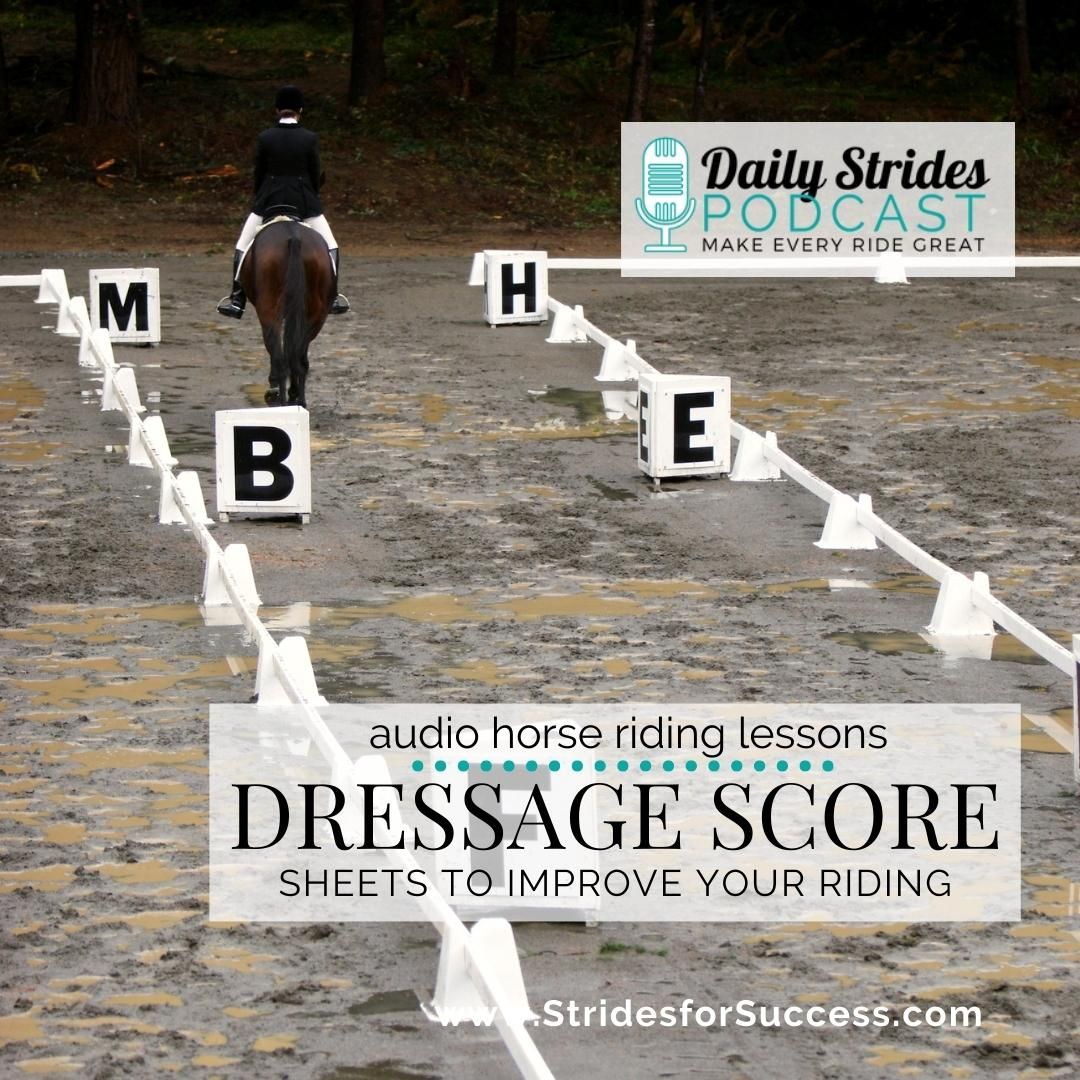
  • Analysing Your Dressage Score Sheets to Improve Your Riding

    Analysing Your Dressage Score Sheets to Improve Your Riding

    Dressage is a funny thing when we really think about it.  Riders pay someone for their opinion on how well they are riding for those few minutes. And how well their horse is responding and performing for those few minutes. And yet, often when riders receive their marks, it can feel like harsh criticism!  Remember, dressage is all about the judge’s opinion.  It is subjective.  Unlike, say, jumping for example.  In jumping, the pole is either up or it’s down.  No in-between and definitely not open to interpretation!

    But, the fact that the comments are subjective allows you to begin analyzing your dressage score sheets and use them as a training tool for you and your horse. And this may require a mindset shift first… 

    In this episode of the Daily Strides Podcast, I want to help you begin using your score sheets as a tool to improve your riding. After all, if shift our thoughts about each dressage test to being less about harsh judgment and more of a mini private lesson, well, it helps us to be more open to the feedback we receive.

    Understanding Dressage Score Sheets

    So let’s begin by saying that each movement is scored between 0 and 10.  0 means it never happened, and 10 is perfect! And, it is also worth noting that judges are only required to comment on any movement that was deemed to be a 5 or under.  So, if you see a fairly empty comments section, well that’s a good thing :)

    The dressage score sheets are a tool used by the judges to evaluate your performance during a dressage test. They include comments, scores, and, sometimes, diagrams or notes regarding specific movements and overall performance. The goal is to help you understand how the overall test went, and pointers to work on for the next time.

    Remember, the judge is not there to train or coach you.  They are merely observing what they see.

    And when this is also coupled with the fact that there’s a lot happening quickly, one movement, then the next, and the next, etc. it makes sense that the judge won’t be able to write a composition for you.  They are, again, simply commenting on what they are observing as you ride your test.

     1. Analyze the Comments Thoroughly

    When you receive your dressage comment sheet, the first step is to read through it carefully. Many riders make the big mistake of only wanting the ‘score’ or the ‘mark’. And, yes, in the moment that is usually what’s most important.  However, going forward…

    Pay close attention to the judge’s comments on each movement and the overall impression. Judges often use abbreviations and shorthand, so make sure you understand their terminology. If you have any questions or uncertainties, don’t hesitate to seek clarification from experienced trainers or judges.

     2. Notice Patterns

    Dressage tests consist of a series of movements which are judged separately. One by one as you ride through your test.  By searching for patterns, both in an individual test and by looking over previous tests as well, you can begin to identify things about yourself and your horse.  What movements you are stronger or more able to ride?  And, similarly, the movements that need more attention and development.

    Look for patterns in the feedback; if several movements received similar comments, it’s a clear indication of an area that requires improvement.

    Remember, dressage judges are not just random riders put there to dish out harsh criticism! Becoming a judge is not something a rider can do on a whim.  Different governing bodies have different requirements, but it is safe to say that most judges will have been successful in their own right as dressage riders. And then also have passed some sort of training, exam, or program. This means that while their opinions can be subjective, they are also guided by well-defined principles.

     3. Begin Creating a Training Program

    Once you’ve identified specific areas that need improvement, now the work begins on improving those individual things.  And this is what can trip riders up.  Things such as relaxation or rhythm are absolute basics, and a lot of riders are not keen to go back to the start again! They rather want to work on the ‘fancier’ movements. Unfortunately, this is why they will remain ‘stuck’ at a certain level without ever really progressing.

    Many of the planned riding sessions in your program can be based on the feedback from your dressage score sheets.

    For example, if the judge (or judges!) pointed out issues with your horse’s impulsion, your goal might be to improve impulsion in your next training sessions.  I also think that it’s important not to get too hung up on only improving the weaker parts of your test.  That will usually result in riding becoming a bit of a chore for you and your horse!  Sprinkle the topics that need work throughout your rides.  And remember to keep it fun for both of you.

     4. Record Yourself Riding the Test

    My final tip for you to make the most of your dressage score sheets is to actually record yourself riding the test.  Now, obviously, this can only be done going forward with future tests.  But if you have the recording on the actual test that was judged and then use that to compare, movement for movement, with your dressage score sheet, you can begin to ‘see’ what is more or less desirable in your work.

    This allows you to visually assess your performance and compare it with the judge’s feedback.  A side by side review or comparision. 

    Instead of seeing your marks, scores, and comments as negative, be realistic about what they really are.  Personalized feedback from an expert on the topic tells you where to focus your attention and energy going forward so that you and your horse can improve.

    And that can be an amazing thing!

    Happy Riding
    Lorna

    More on This Topic

    Join Our Online Community of Equestrians

    Dressage Score Sheets to Improve Your Riding - Connection August 2023