Tag: consistency

  • 3 Shortcuts You NEED to Stop Taking in Your Riding!

    3 Shortcuts You NEED to Stop Taking in Your Riding!

    [fusebox_track_player url=”https://op3.dev/e/traffic.libsyn.com/secure/dailystridespodcast/1200_3_Shortcuts_You_Need_to_Stop_Taking_in_Your_Riding.mp3″ title=”3 Shortcuts You NEED to Stop Taking in Your Riding” social_linkedin=”true” social_pinterest=”true” social_email=”true” tweet_text=”Are you guilty of looking for shortcuts when in the saddle? Here’s why you NEED to STOP!” hashtag=”equestrianpodcast” twitter_username=”strides_success” ]

    Instant gratification.  It is a very real thing in the world we live in.  People see the thing they want and, without doing a whole of anything, expect to have the same thing.  Equestrians often suffer from this same issue.  Instead of being on a path to better riding, they are guilty of taking shortcuts… And then wonder why, after time goes by, they never really get anywhere.

    The shortcuts are more like little circles.  They feel like they’re taking you forward initially, but then you will inevitably end up back in the same place all over again. 

    Following a tried and a trusted path takes time.  Doing the work and putting in the effort also takes time.  And yet, it is the riders who are willing to start slow and then, over time, speed up, that see the results.

    What Shortcuts in Riding Look Like

    There are things that take time to develop and strengthen.  Suppleness, straightness, impulsion, contact…  Now, I realize that these are all steps on the training scale, but many shortcuts are based on trying to short circuit the results when it comes to one of the above.

    The reality is that, when you take a shortcut, you begin crumbling the foundations…

    I believe that the foundations of all horses and riders are relaxation and rhythm.  Take a shortcut, and look for one or both of the above to disappear.  Excess tension, choppy steps, increase in speed, heaviness, and so many other things are the symptoms of lack of rhythm and relaxation.

    Commit to doing the work and taking the time when it comes to improving yourself and your horse

    Shortcut 1:- Wheelbarrowing Around Bends

    A few episodes ago, I created a podcast episode titled “Turning Your Horse Versus Asking Your Horse to Turn“.  If you think you might be guilty of ‘wheelbarrowing’, go back and give it a listen.  For me, the definition of wheelbarrowing is when you use your reins to turn your horse.

    Recently I was in the arena with a rider who tried to do exactly this.  While in canter.  The result? A close encounter with the edge of the arena.  You see, when you use your reins to turn, firstly, you are only focusing on your horse’s head.  You are failing to take into account everything from the withers/shoulders back.

    And, the bulk of your horse is made up of the body mass from the withers/shoulders back; so it makes sense to try and influence the ‘bigger part’, doesn’t it?

    The second part of wheelbarrowing is when riders assume they must actually turn the horse.  Again, the above-mentioned rider was guilty of this.  She physically tried to turn the horse.  Rather than setting things up to ‘ask the horse to turn‘.  They are very different things.  Give THIS EPISODE and blog post a listen for more.

    Shortcut 2:- Forcing Your Horse On the Bit

    Ah, the good old Holy Grail of horseriding; on the bit.  There is this massive misconception that in order to get your horse ‘into a frame’, you must force him there.  I see riders, the world over, sawing their horse’s mouths and pulling the jaws of their horse with all their might.  And it just doesn’t work!

    On the bit is like contact (they are related, after all), in that it is the result of other things happening or being present.  

    Another way of thinking about ‘on the bit’ is to imagine it as being like baking a cake.  There are all these different ingredients (forwardness, responsiveness, consistency, suppleness, relaxation, rhythm, communication, to nae a few) that get mixed together to make the full cake.

    If the ingredients are mixed incorrectly, or if there are any missing, you simply won’t the desired result.  And the only way to get the result is to gather the ingredients, mix them correctly, and then wait for it to bake. 

    I have a Daily Strides Podcast episode & blog post HERE all about contact and another one HERE focusing specifically on ‘On the Bit’.  Both will help you to begin identifying the ingredients you already have, understanding what’s missing.  And, they will also help you then begin to mix it in order to achieve true ‘on the bit’.

    Shortcut 3:- Confusing Impulsion for Speed

    The final shortcut I see all the time is how many riders think ‘faster’ will help.  “Oh, big jump ahead; must go faster”.  “I want to canter in the next corner; must go faster.”  “My horse won’t go past the scary thing up ahead; must go faster”.

    Now, like most things, there are some different times and places in your riding where speed might just be the answer. However, most of the time when you are a novice, it is definitely not!

    There is a reason impulsion is in the ‘top tier’ of the training scale… It takes a great amount of physical, mental, and emotional development from both horse and rider to maintain it for any period of time.  Speed, however, is different.  And, I am willing to say that a lot of the times, the ‘speedier’ things are, the less developed horse and rider usually are.

    If things are not working the way you want, slow down.  Identify exactly what is not working and then work on fixing or improving that thing.  Then speed up again if you must… 

    I have a Daily Strides Podcast episode & blog post HERE about True Impulsion Versus Running In Your Riding that goes deeper into all of this. I also chat (and write) about Developing Strong Hind Quarters HERE, which leads to greater impulsion.

    What Shortcuts Have you Taken?

    Okay, over to you… I can bet that, if you are honest with yourself, there have been times where you took a shortcut, knowing it was a shortcut but did it anyway.  Probably because it gave you the feeling of a quick win.  And you might have even thought afterward, “well that wasn’t too hard!”.

    And yet, if you have been there, you will know that taking this ‘easier route’ rarely leads to long-term success. As soon as more pressure is applied, the wheels begin to fall off and you very quickly end up back at square one. 

    This week, I would love for you to take a little time and identify your shortcuts.  Where are you looking for instant gratification?  And, if you were to change that, what would taking the ‘longer route’ look like for you and your horse?

    Happy Riding
    Lorna

    Additional Links to Help You:-

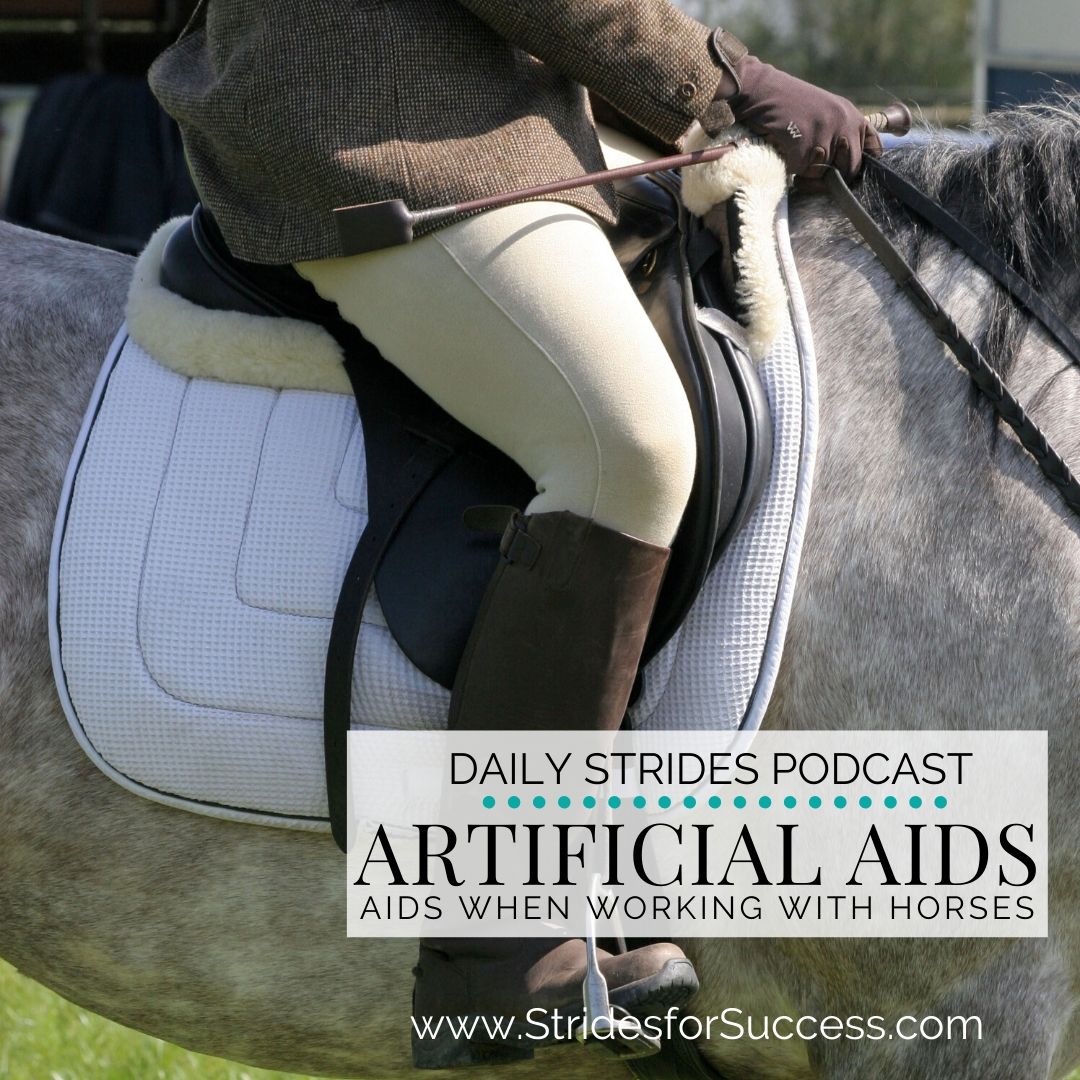
  • Using Artificial Aids when Working With Horses

    Using Artificial Aids when Working With Horses

    Using Artificial Aids when Working With Horses
    For some reason, many riders have a negative story around artificial aids. And yet, most riders use artificial ads on a daily basis, whether riding or on the ground with their hose.
    What is important to remember is that artificial aids are neither positive nor negative.  
    They just are what they are.  And you can use them to create a positive or negative reinforcement with your horse.  And, let’s be honest here, you as well.
    So in light of all that, I want you to begin being a little more mindful when using artificial aids with your horse.  This will allow you to begin the process of figuring out when and how you can begin moving away from that aid and towards a more natural aid instead.

    Why Artificial Aids?

    Artificial aids help enforce boundaries.  And boundaries are vital for both horse and rider. They help us to clearly communicate what we want and also allow our horses to clearly communicate back to us.  Having no boundaries results in nobody really understanding what is expected of them.
    Clear Boundaries = Clear Expectations
    Many of your boundaries can be communicated and enforced using your natural aids.  Your own voice, hands, legs seat, position, etc.  However, there are times where an artificial aid is actually more helpful and less confusing for both horse and rider.  A railing or fence around the arena for example.
    I believe that the key to successfully using artificial aids is to realize that they are there to simply ‘back up’ or reinforce your natural aids.
    They are not used on their own.  Similarly, they should not be the lead in the conversation with your horse.  However, they are a powerful tool, when used correctly, to clarify what you want to your horse.

    What are Artificial Aids?

    Simply put, it is something you can use that is not part of your body, to help explain or clarify something to your horse.  Think of them as tools.  You can pick them up and put them down when you want.  Now, what is important to realize is that not all artificial aids can actually be ‘picked up’!
            • Bridle
            • Bit
            • Headcollar
            • Leadrope
            • Lunge line
            • Whip
            • Spurs
            • Arena wall
            • Stable wall
            • Groundpoles
    All of the above are artificial aids.  They are not part of your body, and yet they help you to more effectively communicate with your horse.  This is especially true when your natural aids are being ignored or ‘missed’ by your horse.

    When to Use Artificial Aids

    Most riders will use some form of artificial aids from day 1 of their experience when working with horses. And most horses will see the aids as an extension of the rider and a part of the overall conversation.  Artificial aids work just like your natural aids, in that it is all about pressure and release.
    You can apply pressure using artificial aids and then release it when your horse responds
    The amount of pressure is where many riders can have a negative narrative surrounding using artificial aids in their day to day riding with their horse.
    However, like any aid, natural or artificial, excessive pressure comes down to the rider and how mindful they are when applying the aid.
    Let’s take one of the more misunderstood artificial aid, the whip.  I think that this is simply a case of something having the wrong name!  If we referred to it as a ‘pointer’ or even a simple ‘stick’, would it have as much negativity attached to it?  Either way, it has and because of this many riders refuse to ride with one.
    But, is bruising your horse’s sides because you have to kick so hard any better than whipping your horse?  Neither is right – and yet one is seen as being acceptable by many riders.  This is something I take issue with.  I personally feel that a ‘reminder’ or ‘pointer’ to pay attention to the rider’s leg is a lot nicer than kicking the sides off a horse… What do you think?

    Consistency and Responsiveness

    More often than not, artificial aids are simply there to ‘back up’ your natural aids.  However, consistently is first required from the rider with regards to what they are doing at any given time.  I believe that most responsiveness issues can be traced back to a rider who is ‘wishy-washy’.
    If you are to use artificial aids to back up your natural aids, you must get clear on what you are doing and why.
    So, let’s go to the whip again.  It is important to first of all set things up.  We usually use the half halt to do this.  The half-halt is simply a way of bringing your horse’s attention to you and what you are doing in the saddle.
    Once your horse is listening, you then decide where your aid will be applied and how much pressure is required.  Then the aid must also be applied at the best time for your horse to take action and respond.
    What many riders find is that, even if all of the above are consistently being communicated, their horse either misunderstands or ignores their leg aid.  This is when I feel a schooling whip can add to the conversation.  If used correctly, it simply brings the horse’s attention to the missed or ignored leg aid.  A simple tap.  Not a whip, lash, or strike.  Just a simple tap, directly behind the leg aid, delivered immediately after the leg aid has been ignored.

    Weaning Your Horse Off Artificial Aids

    How long you want to continue to include artificial aids in your conversation with your horse will depend on your unique circumstances.  Some riders feel the need to have a way to bring their horse’s focus and attention back to them immediately.  Maybe while navigating a track of fences.  Other riders want to move away from anything that is not as natural as quickly as possible.  Artificial aids, when used correctly, are not wrong.  They just are.
    Often, if you begin to move away from them, both you and your horse must learn to trust and develop more confidence in yourselves and each other.
    Take the boundary fence of the arena.  If used consistently to help keep you both ‘straight’ when riding on the outside track, it will become a crutch.  In fact, it will actually begin to negatively impact your development and training over time.  But moving away from it requires confidence and trust.
    It requires developing mentally, emotionally, and physically.
    The same goes for the fence of the lunging arena.  Or the arena fence full stop.  On the ground, this can be the difference between begin able to tack up in a stable or out in the open.

    Building Your Natural Aids

    Again, artificial aids are neither good nor bad.  How you use and apply them makes them so.  But what is important is that you are always looking to developing yourself as a rider.  Develop your natural aids.  Your seat and weight aids.  Voice is another important one.  And, of course, legs, hands, body language and position.
    Your most powerful aid, either in or out of the saddle, is your thoughts.  You can use your artificial aids to clarify and improve your thoughts.  doing this will, over time, improve your other natural aids as well.
    Start with setting your boundaries.  Get clear on what you want and your expectations surrounding everything in your riding.  Then look at how you communicate and enforce this with your horse.
    There is always a balance of aids at play in your conversation and it will evolve and change over time…
    Happy Riding
    Lorna

    Additional Resources on This Topic

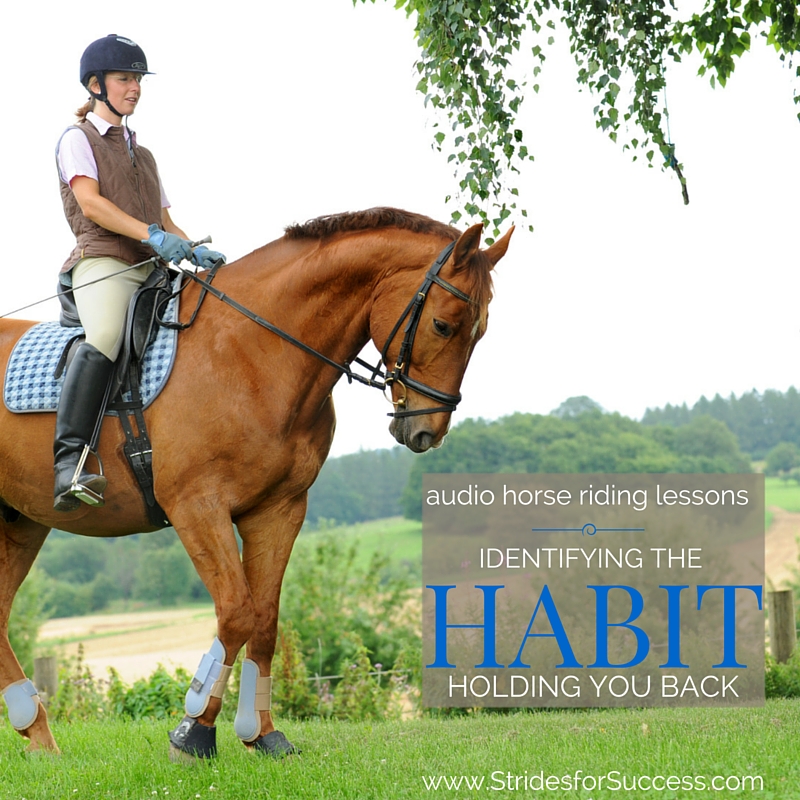
  • Identify the Habit Holding You Back

    Identify the Habit Holding You Back

    [fusebox_track_player url=”https://op3.dev/e/traffic.libsyn.com/dailystridespodcast/SFA496-Identifying-and-Correcting-Your-Bad-Habits-While-Riding.mp3″ title=”Identifying the Habits Holding You Back in Your Riding” social_linkedin=”true” social_pinterest=”true” social_email=”true” ]

    We all have something, right?  That thing we do that every time we catch ourselves doing it, we feel a tinge of guilt… But without fail, regardless of all the beating ourselves up, we will be back doing it again soon.

    Now, I could have been talking about anything there… any number of bad habits that you have cultivated (yes… cultivated) over the years, however today I am referring specifically to the habits we form in the saddle that are less than helpful to us as riders.

    As with anything in life, the more time you spend riding, the more opportunities you have to become complacent about the little things.  Things which, initially might not count for much but that compounding effect can be a real nightmare once it gets going in the wrong direction!

    Consistency will bring you results, regardless of what you are being consistent with.  Meaning that the old saying that practice makes perfect is definitely not always the case.  Rather ‘perfect practice make perfect’ when it comes to consistently improving your riding skills.

    Identifying the Habit Holding You Back

    However, where do we begin?  What do we start with?

    Identify the Habit

    Identifying what you are doing in the saddle is the first step to breaking the habit and overcoming the issue.

    However, before we proceed, a word of caution… Very often what we perceive as riders to be the problem is actually not really the issue at all.  It is merely a symptom of a greater flaw that is manifesting itself as the more obvious thing you are seeing.

    The quickest and easiest way to identify the root bad habit is by asking a professional riding instructor or trainer to evaluate your riding for you.  They should pick up pretty quickly what is happening to cause your problems and then also, give you pointers or exercises on how to improve this aspect of your riding.

    But, I realise that you may not have access to a trainer or instructor to help you solve this.  If this is the case, there are a few ways you can locate the core habit yourself.

        1. Firstly, find a rider that is doing what you want to do correctly.  Keep in mind that a lot of riders, while successful, may not be the best person at that particular thing… So choose wisely!
        2. Once you have found this person you are going to begin comparing yourself in similar situations to this person.
        3.  Photographs or videos of yourself riding will help you, but in order to be really successful, you will have to take quite a few over a period of time in different situations.  Compare them and begin looking for patterns in your riding.
        4. Using the photographs or videos, along with a riding diary which will record how the ride went, you can then begin to find the pattern you are looking for.

    Identify the Trigger

    So, once we have become aware of the habit, we then need to begin working backwards to identify the trigger. This is the circumstance that begins the sequence of events which leads to you falling into this pattern that you want to break in the first place.

    This will involve working backwards a little. From the point where you notice you are indeed doing it again. This is so that you can find the exact point where you transition from a correct way of riding to where you are doing the thing you wish to put a stop to.

    Is there a particular horse, or a particular movement that seems to trigger the habit more so than others?  Does riding in a certain area or with a certain person attribute to your downfall?! Or perhaps the trigger has nothing to do with riding itself and everything to do with the food you ate last night, the glass of wine you drank, the argument you had before you left the house for the stables?!

    As pleasure riders, our emotions and moods are tightly woven and integrated with our riding and time in the saddle, so don’t forget to have a look at this aspect of your life as well.

    What causes the trigger to happen?

    Just like everything else in life, your bad habits in horse riding can probably be traced back to either a perceived fear (or stress) or a lack of knowledge.  It’s hard to know you are doing something wrong if you don’t know what you don’t know!

    With regards to the knowledge aspect, this can be rectified by simply researching the subject, having lessons or classes on the topic and just finding out more about how to do it correctly.  The part that will take time is then reprogramming your habit. It involves removing the wrong way and inserting the correct way for doing that particular thing.

    If you realise your trigger is more fear-based, this may take a little more work on your part.  

    A lot of the time when we feel stressed, whether in the saddle or out of the saddle, we learn to react in a certain way that we think will benefit us.  The downside to this is that our mind is a wee bit clouded by the ‘fear’, so it may not really be the best way at all.  Identifying what is causing your fear and then thinking logically and rationally about it will help to uncover this.  Also, working on how you react in day-to-day life will also help.  Very often merely learning more about the subject that is stressing you will help to shift your mind from fear to more of healthy respect…  Which will allow you to begin acting differently.

    Cultivate awareness in the saddle

    So once you know what your habit is and what is causing you to react this way, you need to begin noticing those points in your ride!  This is easier said than done.  Remember the habit or behaviour is your ‘go-to’ action.  Noticing you are doing it or about to do it will be difficult at first.   However, it can be done.

    By consciously thinking about what you are doing and when you are doing it you will soon be able to notice little things that previously you were unaware of.

    Be aware of your body at all times in the saddle and ride the movement you are riding at that moment.  Stop thinking about 10 steps ahead and what will happen during dinner tonight!

    Instead, for the coming weeks, make your intention for each ride to be really present and in the moment throughout.

    Focus on how you want it to be

    This is where a lot of us get caught up.  We know what we don’t want to do, but ask us what we want to do….  We draw a blank!

    Just like when riding a naughty horse, rather than focusing on the bad habit or behaviour, focus your attention on the opposite.  The good action or behaviour that you want to replace it with.

    By placing your attention here, you will have a far greater chance of making this happen, repeatedly, and thus becoming your new habit.

    Use visualisation to see yourself succeeding

    Did you know that your brain does not know the difference between what you think and what you do?  Use this to your advantage by continuously visualizing yourself successfully riding the way you want to ride.

    Include in there all the good habits you wish to cultivate, all the skills you want to learn.  When you are visualising yourself doing it, don’t just see it, feel it as well.  

    Perhaps you can just sit on a chair and imagine your body moving as you want it to move.  Spend your time travelling to and from the stables thinking about how it will feel to ride that movement correctly and with confidence.

    If you are struggling to even imagine yourself changing your current habit, imagine someone you know of who can easily do what you want to do.  

    Once you have this person in mind, visualise yourself copying or mimicking how they react in a situation or ride a particular movement.  Slowly, it will become easier and easier for you to picture yourself doing the same.

    Safety and Success in Numbers!

    Things are always more fun when done with a friend…  Breaking a habit is no different!  Get a partner or a friend to help you overcome your bad habit, either by pointing it out each time you do it or working on a habit or behaviour of their own that they wish to change.

    Hold each other accountable, support each other and when either of you slips up or revert back be there to offer support and motivation to try again tomorrow.
    Identifying the habits holding you back

    Change the circumstances or situation

    Finally, if you are still struggling to overcome your bad habit I suggest changing things up a little.  Get out of the arena or paddock you usually ride in.  Try that movement in a different place in the arena.  Build up to it with a different exercise.

    The choices are endless with regards to how you can make differences in your ride and often just changing one small circumstance is enough to form a crack that will eventually break the habit.

    Time… Oh, Time… Time…

    Remember not to overdo it at the beginning… It will take time to replace the pattern that you are currently doing with a new and better way, but remember that you can do it.

    Also, what will seem difficult at the beginning will soon become second nature to you as you soon make your new habit the go to one when that trigger occurs.

    Go easy on yourself and acknowledge that you will have some slip-ups along the way.  When they do happen, remember the fact that you are now noticing them happening is half the battle to changing your patterns.

    Then simply set a new rule about how you will react in that situation going forward.

    Happy Riding

    Lorna

    Additional Resources on This Topic


  • Riding In A Small Space

    Riding In A Small Space

    Riding in Smaller Spaces - Daily Strides Podcast - Strides for Success

    There are certain times of the year when regular riding becomes a little struggle; winter can be one of them.  Sometimes summer can be equally as troublesome for many riders.

    Due to this being an issue at some point or another for so many riders around the world, I thought it would be fun to try approaching this seeming ‘drawback’ from a slightly different angle.

    [smart_track_player url=”https://op3.dev/e/traffic.libsyn.com/dailystridespodcast/SFA266-Riding-in-Smaller-Spaces.mp3″ title=”Riding in Smaller Spaces” social_linkedin=”true” social_pinterest=”true” social_email=”true” tweet_text=”Confined to riding in a smaller space? Here are a couple of ideas…” hashtag=”equestrian #horseriding #arena” twitter_username=”strides_success” ]

    This episode of the Daily Strides Podcast is about useful exercises and movements that you can use in a smaller riding area.  When the weather is ‘extreme’ we often have no choice but to ride in smaller outdoors or indoor arenas, or perhaps the floodlights only cover a smaller section of the arena.

    For more details about what to focus on when riding in your smaller arena, I have another episode and blog post HERE.  In there you will learn how to turn this initial ‘constraint’ in your training, into an actual tool to help both you and your horse make progress.

    During these times, it is easy to fall into the trap of thinking that we have no alternative but to sacrifice our horse’s schooling and work; however, this couldn’t be further from the truth.

    Exercise 1 for a Small Arena

    The first exercise I suggest you ride is 10-meter circles and shallow 5-meter loops between those circles.  The whole time you are riding this, either in walk or trot, pay close attention to what your body is doing, particularly that you are not getting ahead of the movement, which is very tempting to do when riding smaller movements and figures.

    I also want you to focus on not allowing your horse’s attention to wander, and you do this by continuously asking different questions and changing the movements and patterns we are riding to keep his concentration on you, the rider

    Exercise 2 for a Small Arena

    Once you have managed to get your horse consistently riding in and out of the circles and loops, begin working on a 20m square.  Start this in walk and, once you have established and can maintain a rhythm, you can add trot.

    If you horse is developed enough mentally and physically, you can also ride this exercise in canter.  

    Again, it is imperative that we are continuously asking a different question so horse horses don’t begin to anticipate, but also don’t become bored and dull.

    You can also begin incorporating a lot of half halts and transitions into your ride, as well as some grids that are specifically created for a smaller working space.

    Happy Riding

    Lorna

    Additional Resources To Help Equestrians:-