Tag: Control

  • You Can’t Control Your Horse – But You Can Influence

    You Can’t Control Your Horse – But You Can Influence

    [fusebox_track_player url=”https://dts.podtrac.com/redirect.mp3/pdcn.co/e/traffic.libsyn.com/dailystridespodcast/1392-You_Cant_Control_Your_Horse_But_You_Can_Influence.mp3″ title=”You Can’t Control Your Horse – But You Can Influence…” ]

    You pick up trot and feel your horse getting a little quick. You can feel a speed wobble coming! So you shorten the reins, maybe squeeze a tad more, hold a little, fix a little, manage a little more… And before you know it, you’re trying to control every second of the ride. Sound familiar? If so, you’re not alone! And, as you probaly know, it’s usually a good feeling to help someone…

    As riders, the temptation is very real to be consistent when helping your horse. But what if all of your help is actually hindering your horse’s training and progress?

    And what would happen if you began to take a step back and see your ‘help’ for what it really is – a need for absolute control!  But, you see, control – when it comes to horses in training and being ridden – is a pipe dream! It is not possible because your horse has a mind of its own, with thoughts that produce emotions and feelings of its own. So, how about we begin calling out this need for absolute control in a way that will actually help you and your horse…

    Instead of micro-managing every little nuance, what if you trusted your horse enough to begin allowing them to take responsibility for their role in your work together? 

    In this episode, I want to help you begin to identify where you may be trying too hard to control. And I will give you some concrete starting points to begin relinquishing the idea of ‘control’, and strengthening your ability to positively influence. Let’s dive in…

    Why Do We Control?

    So before we go any further, let’s chat a little about control and what it can mean for you and your horse. Control can look different depending on where the desire for it is coming from. If you are very fearful, how you will try to ‘control’ your horse will look vastly different to if you are fiercely competitive and want everything ‘perfect’.

    But the key point I want to make here is that we rarely ever actually realise that control is our desired outcome… So often we tell ourselves a different story that sounds better to ourselves and others. 

    I have to support him when he’s training to help keep him going forward. Or I need to protect him from hurting himself or another horse! He struggles to maintain in the canter, so I have to help him. All of these can be true – but are they really? Or is it an absolute need and desire to ‘control’ more about keeping your own brain and mind feeling regulated?! And that is often the key point…

    Control is sometimes more about helping us to feel better in the short term than it is about helping our horses to develop, strengthen, and grow in the longer term – and can completely stop this from happening!

    What Don’t You Trust?

    A few years ago now, I listened to an audiobook that has nothing at all to do with horses, but led me to a big ‘aha’ moment. In the book, Untamed by Glennon Doyle, what really struck me was this one quote:-

    We Only Control What We Don’t Trust – Glennon Doyle (Untamed)

    And I thought – YES! That is exactly it. From years and years of working with riders, it is the lack of trust that seems to lead to this endless desire to control. Some riders don’t trust themselves. They have little to no confidence or faith in their own abilities, and so never really leave the safety of their comfort zone. Other riders don’t trust their horse. And this can come from both a fear (my horse might throw me off) mindset, or a training (my horse can’t do this, so I’ll help him) mindset.

    So, next time you feel the need to control something when working with your horse, instead ask yourself, “What am I not trusting right now?”.

          • Do I not trust my horse to stay balanced?
          • Do I not trust my aids to be clear or coordinated enough?
          • Do I not trust myself to handle it if things go sideways?
          • Do I not trust the process enough to allow for the ‘messy middle’ while learning happens?

    I think one of the biggest breakthroughs you can have in your training and riding is to begin naming what you’re not trusting – and then digging deeper into ‘why’ that is so…

    What Can You Control?

    Now, I am not saying that you simply leave it all up to chance and hack on. We’re talking about working with animals who often outweigh us 10 to 1! But, if you can’t control your horse, what can you control? The answer is you. You are the only thing that you can have any hope of controlling. And, for many riders, that can seem like an impossible task!

    Your thoughts, your emotions, and your actions. They are all, potentially, within the realm of your control – but as riders, we also know that this can be easier said than done! 

    This is why I really do believe that checking yourself at the gate is so important for riders. Before you ever greet your horse, I highly suggest having a quiet moment with yourself just to see how things are. A little personal ‘check in’. And then, from there, some intentional grounding and self-awareness work. I am not suggesting long rituals or meditations. Just a few seconds to yourself so that you can see how you’re about to show up. The more you practice this, the quicker and easier it will become.

    And when you then approach your horse from this more grounded, self-aware place, the chances are that you will actually have more success in controlling the things you can:-

          • your preparation
          • your awareness
          • your intention
          • your timing
          • your emotional state
          • your body
          • your response

    Working Towards Influence…

    So, let’s flip this concept of ‘control’ for a moment. What if, instead of constantly trying to micro-manage every little movement and every single second, you began looking for ways to have a more positive influence? What if you swapped the need to control with a desire to guide or shape the outcome to a more positive one? Without you having to do all of the work.

    Deciding to relinquish the need to ‘control’ and rather committing to being a positive influence requires a certain level of trust. Trust that those you want to influence have the right foundation in place so that they decide to follow your lead. 

    It’s a bit like deciding that you’re happy with free will – and then meeting your horse at that place. Now, we can talk all day about ‘the right foundation’. I do think that so much of this comes from the rider or whoever has been working with the horse. What has been ‘allowed’ (or not), and what is being ‘mirrored’. And, it is when we commit to becoming a more positive influence, I believe, we can then begin to really build and strengthen our horses – physically, mentally, and emotionally.

    Control and the Lunge

    Lunging is such an interesting place to explore this! Even to this day, I can remember how it felt to want to control everything when lunging my horses. If they cantered a little too enthusiastically, my desire to ‘control’ would kick in – and I would 100% react instead of respond. I’ll be the first to put my hand up and tell you that it was not pretty! And, sure, in the moment I would be able to ‘bring’ my horse back to trot (the place where I felt good). But, let’s be honest here, this in no way helped my horses and their training!

    To this day, when I’m lunging, and my horse becomes a little too enthusiastic, I have to remind myself that this is okay – and to trust my horse and myself that things will be okay.

    Once I relax mentally and then physically, I can then guide my horse back to a more balanced way of working. Not by forcing or ‘controlling’, but by becoming self-aware, and then using my presence to gently influence my horse to join me there.  I do feel that this is a self-trust. And I also believe that riders need to develop this before they can then begin guiding their horse to a similar place.

    Being a Positive Influence

    From here, you can then begin to help your horse to do the same. That even on the days when things go sideways, or he loses the run of himself, he can get himself back to balance again. And each time with less and less guidance from you. Helicopter riding and training do not work in the long term. In fact, I am 100% willing to bet that if you are practising this, you will hit a plateau and remain stuck there.

    With lunging, you can begin where you are now – probably more trying to control things. But as your self-awareness grows, so too will your influence. The obvious aids become more subtle – and your horse begins to take more responsibility for himself. 

    That is where the magic lies, and that is where your horse can begin letting go of control and developing the trust that is necessary. Trust in yourself, and trust in your horse. And vice versa. As the trust and confidence grow, so too will the levels of ‘self-control’ or ‘self-carriage’ – one of the things we are always looking to grow when riding and training.

    Happy Riding
    Lorna

    Want Support While You Do This?

    Inside Connection, we are dedicated to working on the 5 essentials, the keys to refining all the training elements we just talked about.  It’s exactly where your progress begins again.

    If this episode made you squirm a little and wonder, “Is she talking about me?”, then Connection will help you put all of this into practice. Join us inside today:- https://stridesforsuccess.com/join

    Online Training & Coaching

    Connect with Lorna online:-

  • Retraining a Horse that Evades Your Contact

    Retraining a Horse that Evades Your Contact

    [fusebox_track_player url=”https://op3.dev/e/traffic.libsyn.com/dailystridespodcast/526-Retraining-a-Horse-that-Evades-Your-Contact.mp3″ title=”Retraining a Horse that Evades Your Contact” social_linkedin=”true” social_pinterest=”true” social_email=”true” ]

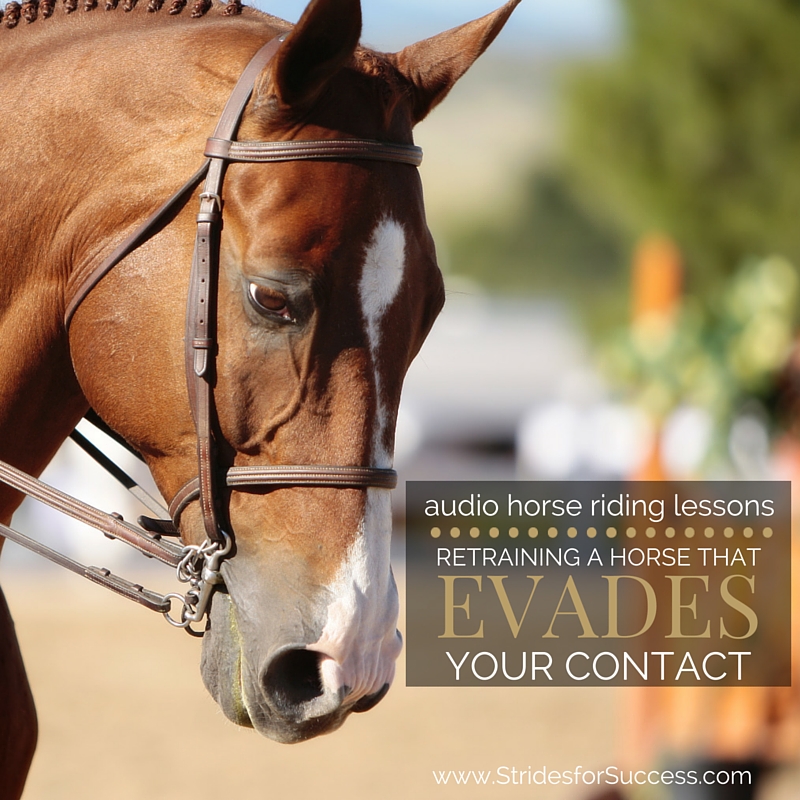
    Are there days where your horse’s camel impression is worryingly accurate?  He lounges along, his back all strung out resembling a cable that’s sole purpose is to work against you.  His neck stretched out in what must be an extremely uncomfortable way, his nose pointing skyward…  And it seems that all your efforts to establish a correct contact are falling on deaf ears?!

    Or perhaps your horse is the other end of the spectrum? As soon as you pick up a contact he curls his head so his lips are close to touching his chest… Leaving you with loopy reins that have no contact at all with said horse’s mouth?!

    The unfortunate fact is that horses evade contact in many different ways and for many different reasons which all have the potential to ruin a good performance or ride.  However before we go any further, let’s get clear on what is correct, ‘true contact when riding a horse…

    What is True Contact?

    Contact is your connection with your horse through your rein aid.  You must offer a stable, consistent contact through your hand and rein, which in turn, your horse will then accept with his mouth.  However, the contact that we can ‘see’ in the above description is merely the end result of a lot of other communications and aids.

    Things that are ongoing and happening between horse and rider. Their culmination is what produces a consistent, soft, and accepting contact.

    In order to create correct contact, the horse must be moving forward from behind.  So the rider must first work on activating the hindquarters, then allowing that energy to connect through to the front, before they can then harness and direct it using their contact.

    Responsibility and Responsiveness

    In order to achieve correct contact you need to be responsible and your horse must be responsive.

    This means that you are conscientious in how you ask for and respond to your horse’s contact that will cause no discomfort or pain to your horse.  He must be perceptive and reactive to your aids when he receives them.

    Very often riders forget or just don’t know about the first, vitally important, responsibility on their part in order to achieve a correct contact. Because of this, they become focused on ‘head carriage’.  Or if their horse is ‘on the bit’.

    Instead, I want you to think of contact as being the result of a carefully set up and orchestrated use of your different aids when in the saddle. And this culminates in your horse accepting your conscientious, soft, and elastic contact.

    How Does a Horse Evade the Contact?

    So, how does a horse evade the bit or contact?  Horses generally do this in a few different ways.  They either become ‘above the bit’. This is where their noses are ‘skyward’ and the whole back, from tail to ears, is hollow.

    Or they can also become ‘behind the bit’. This is when they begin to curl their head and neck back towards their body, nose to chest, which leaves the rider very little options when it comes to contact at all.

    Lastly, there are some horses that when you have ‘closed’ all open doors, will still try to evade by wriggling around, never truly connecting with the rider through the reins at all.  It feels like someone has replaced your horse with an eel!

    Retraining a Horse that Evades Your Contact

    Why Does a Horse Evade the Contact?

    All of the above descriptions lead to a less than pleasant picture to look at. And all also look extremely uncomfortable for the horse!  So what is it exactly that brings them to act like this?

        • The rider is asking incorrectly – This can be due to ignorance or incorrect training on the riders part.  Very often riders will only focus on their horse’s head and where it is, rather than what is happening underneath them that is leading their horse to travel like that.
        • Unsteady contact from the rider – Many riders continue to do this, even though they understand and know about the importance of a steady and ‘safe’ contact for their horse.

    Some riders continue to use the reins as a safety harness rather than work on developing an independent seat.

        • The horse is unbalanced – Young and underdeveloped horses will find it difficult to accept a contact for any great length of time.  This needs to be worked on and developed slowly, over time, using correct aids and techniques, in a way the horse can understand and trust.
        • Over or incorrect use of a gadget or training aid – This is particularly evident with the usage of draw reins, where horses begin to evade the contact by coming behind the vertical or bit.
        • The horse’s conformation makes him more inclined to travel like this initially
        • Physical discomfort – Such as pain in the back due to tack or another disease or injury.  Also problems with teeth and correct fitting of the bit.  All physical discomfort should be ruled out before continuing on with and retraining your horse.

    Contact as a Development Step

    So often we think of contact as being just holding the reins, however the contact that you create is so much more than that.  This is both in terms of communication between horse and rider and also as a vital piece to moving on up the training scale with your horse later.

    It is your job as the rider to create or provide a contact that is consistent, kind, soft, following yet effective.  

    Once you have done this, your horse can then accept this contact and trust you that you won’t catch him in the mouth or drop him by releasing and letting go of the contact.

    Your level of contact will depend on how much energy you are asking your horse to create with his hind quarters.  Contact is merely gathering up and then giving that energy some focused direction of where to go

    Therefore it is impossible to have contact if you horse is not using his hind quarters to push himself forward  and having forward energy.  It is the lack of this forward momentum that causes a horse to begin to lean or become heavy on your hand and essentially evade the bit.

    Reschooling a More Correct Contact

    So assuming that you have an independent seat and your hands are thoughtful and balanced, once a horse has begun to evade how can you then begin to re-school or retrain him to a better way of going? Nne where he is happy to accept your contact?

        • Forwardness & Responsiveness
        • Rhythm
        • Suppleness
        • Straightness

    Begin working on assessing how responsive your horse is to your aids.  If you ask for more, does he respond and begin creating a little more energy into his movement?  Is this response immediate or does he think about it for a few steps?  If his response time is a little ‘wanting’ I suggest carrying a schooling whip and backing up your leg aids with it each time he shows begins to procrastinate or ignore your aids.

    Once he is responsive then make sure he is indeed moving forward, pushing from behind.  It is impossible to direct what is not there, so make sure your horse is using his hindquarters with each stride.

    Then work on creating a rhythm in the gait you have chosen.  I suggest working on a 20m circle, and using half halts and transitions on the circle to further engage the hindquarters as your horse is working.

    Straightness to Enhance Contact

    Straightness is important.  Firstly to correctly channel the energy where you want it to go. But also so you can quickly lock any doors that your horse will try to open once you have blocked his initial ‘evade of choice’!

    Many horses will look for another way of evading when you shut down the initial window of opportunity!

    Finally, don’t be afraid of creating contact with your horse while riding.  Many riders are worried about hurting their horse’s mouth, or pulling on the reins and never truly get to experience and feel how wonderful it is to communicate with their horse in a consistent, safe, following contact.

    Happy Riding

    Lorna

    Additional Resources for Equestrians:-

    Retraining a horse that Evades Your contact

  • Maintaining Balance Between Jumps

    Maintaining Balance Between Jumps

    The bell rings, you set off aiming for the first fence, you pop over it… And suddenly it’s like everything begins to speed up and rather than being the pilot, you have somehow been relegated to passenger status.  All the ‘if this then that’ scenarios you have spent months practicing are just gone and you are hoping that somehow, through the grace of God, you will make it through the two finish flags, still on board!

    [smart_track_player url=” https://op3.dev/e/traffic.libsyn.com/dailystridespodcast/SFA466-Maintaining-Control-Between-Fences.mp3″ title=”Maintaining Balance Between the Fences” social_linkedin=”true” social_pinterest=”true” social_email=”true” tweet_text=”The most important part of jumping? Successfully riding between each of the fences…” hashtag=”truestory #equestrian” twitter_username=”strides_success” ]

    Jumping tracks or courses is what many riders aspire to achieve with their horse . However, the majority of riders who love jumping and want to jump spend so much time focusing on the actual jumping part and so little on polishing up their technique between fences, that when they reach their goal of completing a course of jumps, the fact that they are on the ground, navigating from one fence to the next, for about 95% of the round, results in luck (as opposed to planning and skill) that dictates if the poles stay up or not (and if the rider remains mounted!).

    Maintaining Balance between the jumps

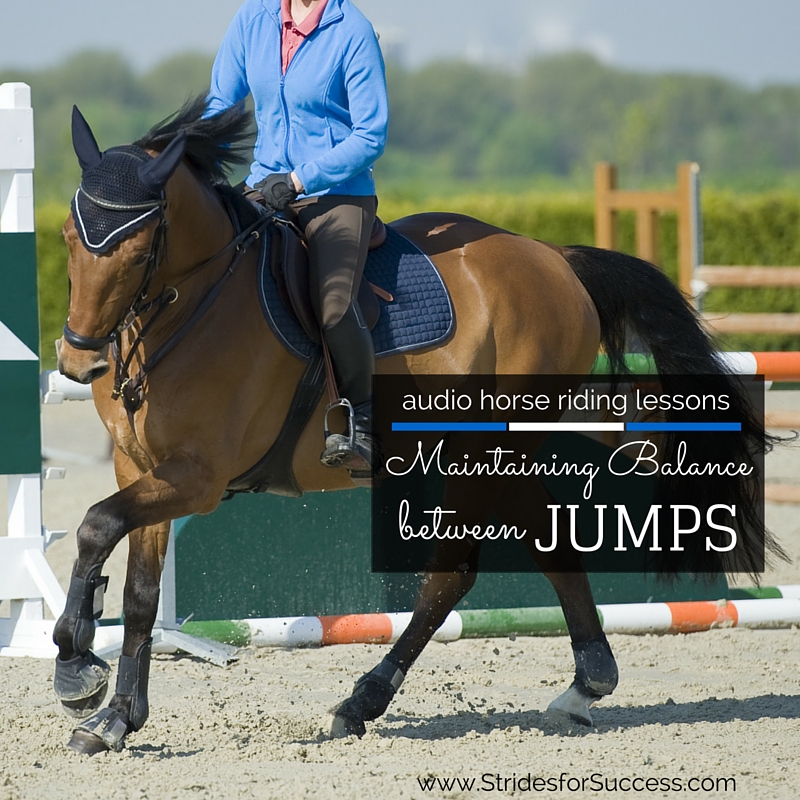
    Much of our success jumping tracks or a course of jumps comes from the quality of flatwork preparation we put in before hand, rather than time spent actually jumping.  Maintaining balance, rhythm and control around the track is what makes the difference between consistent clear rounds and having the odd sporadic moment of success amid usually disappointing rounds peppered with poles down and refusals.

    I believe this must be mastered in two parts. Firstly, perfecting your position over a fence (which I have exercises you can use HERE >> ) and then secondly, once you can seamlessly shift in and out of your jumping position, you can begin working on remaining in control for the entire duration of the ride!

    Courses are made up of jumps that are connected together with either straight lines or turns between them.  The problems begin when your horse begins to speed up on the straight lines which can use you, the rider, to become anxious and nervous. This is also what leads to a lot of run-outs and flattening over fences which can bring the poles down. Riding a course of connected jumps also magnifies problems with bending, turning and suppleness. Any issues here will result in your horse losing balance around corners which often results in a loss of overall control while riding the track and you becoming flustered with just too many things to do to bring it all back where you want!

    One of the reasons that jumping is broken up into different phases or parts is to show riders that each separate piece must be mastered in its own right before being put together. The phases are; the approach, the take off, the jumping, the landing and the getaway. When all pieces are ridden correctly the result is an effortless, graceful jump that sets you up perfectly for the next obstacle on your course.

    As mentioned, today we are chatting about the part between the fences. Many riders just focus on maintaining control between the fences, however they go about achieving this the wrong way. Constant pulling on their horse’s mouth will only result in the horse falling onto the forehand and pulling back. By failing to also factor in balance and rhythm, is often leads to a loss of rhythm and impulsion, which results in a loss of balance.

    Here are some exercises you can do to really establish and then maintain that all important balance and rhythm around your tracks.

    I suggest beginning by working over poles on the ground, and once you have gotten the knack of regulating and maintaining your horse over the poles, only then begin to build small jumps. I also recommend beginning each exercise in trot, so you can focus on your position and how you are riding the line or pole, before cantering the exercises. If you encounter any problems, take it back to trot again and work through the problems.

    Sometimes our desire to ride more complicated and challenging work with our horse results in us rushing over basic training issues. These same problems are easily masked when the stakes (or jumps) are low. However, ignoring basic training flaws will inevitably always result in an even bigger problem later down the line, when more difficult questions are being asked.

    Take the time to correct any basic issues early in your horse’s training; focus on building a strong correct foundation to work from

    Begin by setting up a pole or a jump on the centerline approximately 6 to 8 meters before X. As you ride up the centerline toward the pole, focus on maintaining your rhythm and not allowing your horse to speed up or slow down.
    Also pay attention to how straight your horse is on approach and, how easy it is to keep him on that straight line. If he tends to wander or weave left or right, use your legs to bring him back and then continue to ride the line you have chosen.

    Also consider how well you can continue to preserve the rhythm after the pole and around the bend when you reach the top of the arena. There should be no visible difference in your horse’s stride, energy or your level of control throughout the line, both before and after the pole.

    Once you feel comfortable doing this in trot and canter, you can begin to work in more difficult turns and bends. Ride the same pole on the centerline, pop it and continue on straight again until you reach X or just afterwards. Once there, begin tracking right, in a half 10m circle. When you reach the outside track again (the long side of the arena), immediately track right taking you across the centerline on a diagonal line. As you reach the other side of the arena (just before the corner), track left and if you have continued to maintain the rhythm and balance, when you reach the middle of the short side of the arena repeat the exercise again, instead this time on the other side (track left after X).

    Again, begin in trot and only when you can truly maintain the rhythm, balance and control, practice in canter. If you cannot perform a flying change, ask for trot as you cross the diagonal each time and then pick up the opposite canter lead, in preparation for the next corner.

    There are many variations of this exercise you can do while riding, and of course building an actual jump instead of the ground pole is part of adding to this exercise.

    The second exercise I recommend is focused more on controlling your horse while continuing to create impulsion after the fence. Using the same pole or jump, approach in canter and on landing, allow your horse 7 canter strides, before bringing him back to trot. However, you will only keep the trot for 5 strides, before picking up canter again.

    As you become more in tune with controlling your horse while continuing to create energy, you can ask for the trot at 5 canter strides after the fence. What you are looking to do here is regain control of your body as quickly as possible after the fence, so you can correctly ride the getaway and begin building a good approach to the next fence.

    The last exercise I suggest can be built on from this. Once you have tracked left or right at the top of the arena, after popping your pole or jump, ride a 10 or 15 meter circle in the corner. Again, the focus is on maintaining the rhythm and balance. Your horse should not fall in on the circle, or rush around the circle.

    You can then begin to add a 10m circle in the corner before you begin your approach to the fence as well. It should be a fluid progression all the way, around the circle, down the line, over the fence, after the fence and again round the circle. No speeding up, no breaking into a different gait, no falling out through the shoulders, no swinging of the hind quarters, just a correct, forward going, balanced rhythm throughout the exercise.

    Lastly, I feel it is vitally important to understand how courses are built and the flow that the course builder has envisioned happening as different horse and rider combinations navigate the track. Take the time to study courses of jumps. Look at how they ride, the bends, the turns, the opportunities to rebalance the horse. By doing this, you will subconsciously begin to make subtle changes as you ride the jumps that will, if you have that correct foundation, make all the difference between a clear round and 4 penalties.

    Happy Riding
    Lorna

    Maintaining Balance Between the Jumps

    [wp-tiles post_type=”post” orderby=”date” order=”DESC” grids=”Featured”]