Tag: energy

  • Understanding How You Influence the Channel of Energy

    Understanding How You Influence the Channel of Energy

    [fusebox_track_player url=”https://op3.dev/e/traffic.libsyn.com/dailystridespodcast/1334_Positively_Influencing_the_Channel_of_Energy_for_Your_Horse.mp3″ title=”Understand How You Influence the Channel of Energy” social_linkedin=”true” social_pinterest=”true” social_email=”true” ]

    There is this lovely place that you will reach with your horse in your training where you are working together. Both of you are invested in creating a desired outcome. This point is usually when you can begin to create and maintain consistent contact. It’s like an unwritten agreement between the two of you.

    And once consistent contact is created and can be maintained for longer periods, you can then begin to think about how that energy will work for both of you from this point… 

    Impulsion is a word that is bandied about a lot when it comes to horses and riding. Many riders, incorrectly, associate it with speed. The faster you’re going the more impulsion you’re creating. However, this couldn’t be further from the truth… And how you influence the channel for this energy is where it all begins…

    This episode of the Daily Strides Podcast is the first in a week of 5 lessons about Engaging the Energy in a Correct Channel. If you would like the rest of the lessons for this training, you can get them inside of Daily Strides Premium.

    The Training Scale

    Before we go any further, I do think that it’s important for you to see where impulsion lies or comes in relation to the other training principles. Now, there are lots of different layouts for the traditional training scale, however, let’s take the most basic one (pictured below) and use that to see what’s what.

    Traditional Training Scale - Daily Strides Podcast for Equestrians

    A great way to think of impulsion is as being the channel to help you and your horse achieve more with the energy that you’re creating. It will channel the energy more specifically to where you want it to go and you influence this channel. It will also allow less wastage so energy can work for both of you rather than against you.

    Visiting Each of the Principles

    I am a big believer in visiting places. This is both in my day-to-day life (have passport, will travel!) and when it comes to training riders and horses. So often, riders hold themselves back from working on something because they have not yet 100% mastered something else. I think this hinders and slows down the progress and the understanding of horse and rider.

    I love using the straightness principle to explain this.  I think all horses can work towards straightness from day 1 of their training. Does it mean that they will master it? No, that takes years. But by regularly visiting it, it helps both horse and rider to understand the principle more. This is the same as impulsion. And when getting started with impulsion, I strongly suggest thinking about how you influence this channel of energy.

    If you were to only think about impulsion when you felt ‘ready’ to ride and maintain consistent impulsion, you would never actually get to impulsion…

    Through experimenting and visiting different principles you begin exploring how they work for you and your horse. And how you can work on improving them in your riding and training.  This is true for all horses, whether or not they are OTTBs.

    Feeling Nervous About the Possibilities

    One of the reasons riders shy away from visiting impulsion with their horse is because they worry about the consequences. Especially if their horse is known for having quite a bit of potential energy to work and play with. Ex-racehorses or OTTBs often fall into this category. Even before we explore impulsion, so many riders are afraid to ask for ‘forward’ in their riding.

    When riders either fail to ask for energy or block the energy that is being created by the horse, true forwardness and therefore, impulsion can not happen. Energy is absolutely essential. As too is allowing that energy to flow. 

    This is the same for all of the principles of the training scale. Energy is required. So my suggestion is to work on this first. Notice if you’re feeling any resistance or excessive tension to asking for more energy. And once you are certain that you are happy and able to allow it to flow, continue on with your work.

    Working in the Trot

    I suggest starting in the rising or posting trot. Begin riding an exercise where you travel down the long side of the arena on the outside track.  However, rather than simply going large, you will travel back up the arena on the quarter line.  Pass the middle of the short side first (so this could be the 3/4 line).  You are cutting 5m off the width of your arena.

    You can use the long side to correct and set things up for you and your horse. You can then use the quarter line to ‘test’ or experiment with how well you and your horse can maintain things. 

    You will then use the following principle of the training scale to begin testing if you can really maintain the impulsion while on the quarter line. This is straightness. The only way you can achieve true straightness is if you and your horse can truly channel that energy using impulsion.

    Any horse and rider can maintain everything when they are stopped and stationary. It is in the movement; the relaxation, rhythm, suppleness, contact, impulsion, and straightness that you really get to see what areas need work. 

    What To Look For…

    I’m going to suggest first looking at your hands. How are you carrying them and holding them as you travel down the quarterline with your horse? All of your aids influence the channel.  Many riders do so well until it comes to their hands. They then find that they are blocking the channel there. So open your hands a little wider than usual, maintain that lovely softness through the contact and that steadiness with your horse’s mouth.

    When you ‘straighten out’ your hands (meaning that they are equal and soft) you can engage the contact more.

    From here, open your chest and shoulders. Give your upper body the room it needs to move with the horse and use this energy. And then think about your core. Are you again opening it and allowing the energy to flow? Again, you can only work with the energy once it is flowing. You may notice that your hips and seat can swing more and become more of an active part of the conversation with your horse.

    Symmetry to Influence the Channel

    One of the final places where you can really be guilty of blocking this flow is through your posting. Often riders will twist their upper bodies or shove one hip slightly more forward than the other in the trot. Try and assess yourself to make sure that you are rising and falling equally on both sides of your body.  That your shoulders and seat remain aligned with the straightness at all times.

    By taking the time to really ‘straighten yourself out’ while allowing the flow of the energy, you will then be ready to truly begin to influence the channel. To better direct that energy to work for you and your horse. 

    We go into detail using more exercises on how to begin working on this with your horse in the following lessons to this episode. You can find all of them (and so much more) inside of Daily Strides Premium.

    Happy Riding
    Lorna

    Other OTTB & Impulsion Episodes to Help You

    Online Training to Help Your Riding

    Connect with Lorna online:-

  • Opening Up as a Rider – Practicing Expansion

    Opening Up as a Rider – Practicing Expansion

    [fusebox_track_player url=”https://op3.dev/e/traffic.libsyn.com/dailystridespodcast/1319_Opening_Up_as_a_Rider.mp3″ title=”Opening Up as a Rider – Practicing Expansion” social_linkedin=”true” social_pinterest=”true” social_email=”true” ]

    Have you ever considered how different it could all be if you could open up more as a rider? Specifically around how, physically in the saddle, if you could expand yourself a little bit more, the difference it could have on your riding. And your mindset. Even your horse’s way of going… Over the past few months, I have been running an in-person program on my farm South Africa based on Connection and Groundwork.  It has been such an amazing experience working with all these different riders

    We focused specifically on energy work, and becoming more aware of how we can intentionally use this to connect with our horses. 

    It was so much fun.  And, it got me thinking about riding and how so many riders are blocking the kind of flow with the energy in their riding, especially with their physical body.   So, in this week’s episode of the Daily Strides Podcast, I would love to walk you through a few simple exercises you can do, from the saddle, to begin to identify where you are, potentially, contracting as a rider.

    Noticing What You’re Doing…

    So, you will probably agree with me that, as a rider, once you notice something that you’re doing in the saddle, you can’t ‘unnotice’ it. I mean, you can try to ignore it… However, once it’s out in the open, it’s out in the open!  So today, I would love to help you begin to notice where, potentially, you are contracting through your body, rather than expanding. Where you are blocking rather than allowing ease and flow to happen inside of your conversation with your horse.

    When you are contracting, you are shutting down; making things smaller.  This will usually have a detrimental effect on your riding because it affects your position and posture.

    It will also negatively impact what your horse is doing, especially how well he is working and understanding your communication. And, of course, it impacts the trust and the partnership element of the combination as well. Sometimes, you may begin to notice the tension or contraction because there will be other symptoms or ‘clues’ that show up.  The key is to notice them, and then begin to take steps to dissipate, change, or replace the ‘contraction’ with openness and expansiveness through your body.

    Starting In Walk

    I suggest starting this work while in the walk in the arena with your horse. Now, as I mentioned, we were initially doing this work on the ground.  However, I successfully crossed this over to being ‘in the saddle’ inside of Connection this month, so that is what I want to do today for you. So, as your horse is walking, begin to assess your body and notice where you may be holding any excessive tension.

    Keep in mind that there are the more obvious places, such as lower back or elbows.  And there are also those less obvious places in your body that can hold excessive tension.  Your jaw for example.

    I used to hold a lot of tension in my jaw and I clenched my teeth.  As I’ve mentioned, once I became aware of this unconscious tension, it became something I could consciously begin to ‘undo’ in my riding.  You may notice ‘tightness or ‘squeezing closed’ through your knees. This is a common one, and most riders don’t realize it is happening until it’s pointed out.

    The key is to really bring your awareness down into your own body and feel how it feels to be in the saddle, Notice what your body is telling you… 

    Triggering Words or Thoughts

    So, after a while of simply walking and being aware of your body, you can begin to ask bigger questions.  What I found really interesting when working with riders was the response to the word ‘prepare’. Especially when it was used before any changes or transitions.  As soon as I would tell riders to ‘prepare’ for something ‘new’, a lot of riders began to physically ‘contract’.

    So my second exercise for you to begin working on is to ‘prepare’ to introduce and ride a circle.  Notice how your body changes as you ‘prepare’ to go from straight to circle…

    Maybe it’s a tendency to unnecessarily fiddle with or gather up the reins. It could be a tendency to grip up with the inside leg.  Do you tilt your body? Or shift weight your weight around in the saddle, maybe to the inside? Perhaps your inside shoulder ‘ducks’ or lowers slightly…  The key thing to look out for is where the ‘ease and flow’ gets lost or blocked due to excessive tension and ‘contraction’ becoming a part of your physical body.

    If you can notice or catch yourself making big changes to your body to accommodate or ‘prepare’ the circle, begin to question why… Is it necessary? Or is this a learned habit?

    I suggest continuing to work on this for a day or two.  Stay here until you can feel that your ‘preparation’ is not as contracted as it was before and one movement can simply flow into the next…  Another idea worth mentioning here is how once we notice and begin to shift the ‘blockage’ or contraction in one area of our body, it just might show up again somewhere else!  So spend time practicing…

    Stepping Up a Gear…

    Now, from here, I want you to begin thinking about stepping up a gear into the trot.  Both the trot itself and your transitions in and out of it as well.  With the trot, you might find that all is good when you and your horse are slowly sauntering along.  You will feel open and expansive in your riding.  However, as soon as the energy levels increase a little, the contraction begins…

    Often, as soon as you are aware of ‘more’ in the trot riders can begin to ‘crumple up’ in the saddle. They round their backs, bring their hands closer together, change their lower leg, and tip forwards onto their fork.

    None of these things are very ‘expansive’ and they 100% have the potential to block the ‘ease and flow’ we spoke about for the walk.  Another unfortunate side effect of ‘crumpling’ is that your aids can often agitate or even frighten your horse, which compounds the tension!

    Just like in the walk, begin to notice where you are creating or holding onto any excess tension in your body when trotting.  Start in rising trot, and later work in sitting trot.  Also, use your transitions in and out of the trot as a way to examine this in your riding.  Any place where your body feels ‘smaller’ or tighter, is worth looking at a little more carefully…

    Expansion in the Canter

    When we think of ‘expansion’ and ‘canter’, our minds can (and often do) jump to the conclusion of ‘explosion’! This is, obviously, not what I am referring to here!  One of the most common areas I see the ‘contraction’ coming into the rider’s body when it comes to canter, is the transition to get to canter!  Instead of the rider being in ‘self-carriage’ and allowing the horse the space to canter, a lot of riders ‘collapse and ‘chase’ the horse into the canter… Nope and nope!

    And with the canter, because there is more energy involved, it can often highlight any areas of the body where excessive tension and contraction are showing up for the rider…

    The canter, by its very nature, is ‘upward’ in its trajectory. Therefore it is so important that you remain open, in self-carriage, and ready to allow the ‘ease and flow’ through your body. As you ask for and then ride the canter, allow your awareness to scan your body for excessive tension. What are your hands doing? Are your elbows straight?

    Once you begin to open up you will then find it easier to move your body in a way that feels good and that also allows the energy to flow.

    Applying This When Jumping

    Finally, this concept is not just for flatwork or dressage.  I think that working on creating a consistent state of expansion in your body is important for all disciplines and activities with horses.  When the energy is flowing, there is a good chance that communication is also flowing between you and your horse.

    When jumping, the ‘contraction’ begins around three strides before the jump. It’s important to focus on training yourself to remain ‘open’ all the way to the jump, especially through your chest, shoulders, and upper body. 

    Curling up into a ball and doing your best hamster impression, whether before, over, or after the jump stops you from balancing yourself.  This, in turn, prevents your horse from using himself to the best of his ability over the jump as well.  Start over poles on the ground and work through your body from there.

    Allowing & Letting Go

    Very often, the reason we begin to ‘contract’ or tighten our bodies is due to a response to something.  This can be something that happens in the moment (such as our horse spooking), or it can be something that we have learned to do… A memory or a repeating pattern.

    The key to changing this in your riding is to notice it, and then simply choose to let it go.  Practice opening up and feeling your energy grow

    This expansion is how you can begin to connect with your horse in a whole new way and on a whole new level in your riding. I have linked to similar posts on this topic below.

    Happy Riding
    Lorna

    Similar Posts to Support You:-

    Connect with Lorna online:-

    Get Going in Your Riding:-

    Daily Strides Premium is back! You can use the first and original audio horse riding lessons to improve your riding, train your horse, keep things interesting, and have fun… Even if you don’t have a trainer or coach

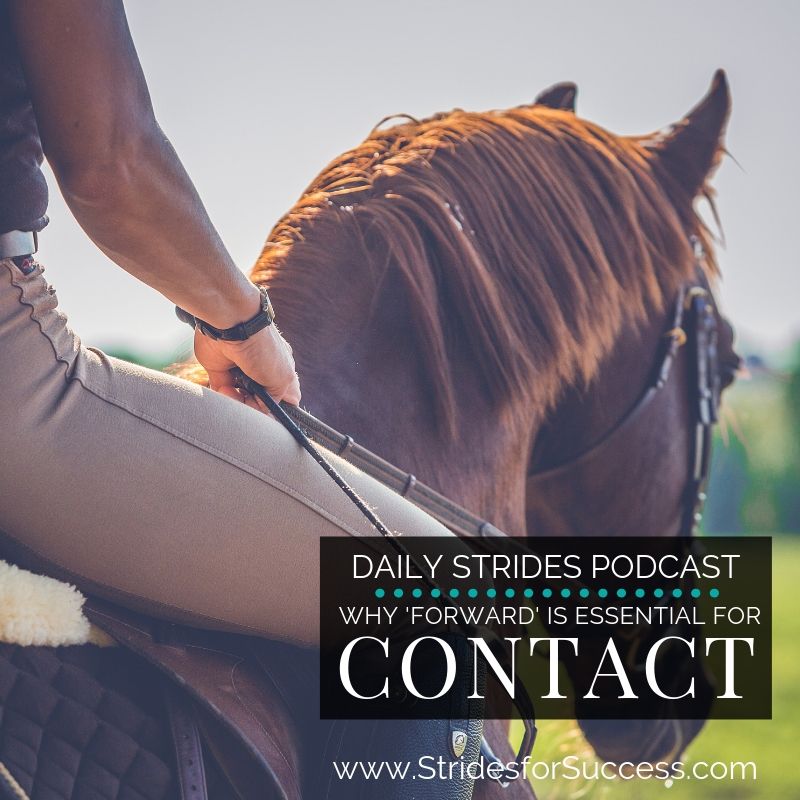
  • Why ‘Forward’ is Essential for Contact

    Why ‘Forward’ is Essential for Contact

    Why 'Forward' is Essential for Contact

    What this episode is all about & how it can help you:-

    • Realise that contact is a result of other things
    • Understand what ‘forwardness’ is and why it is so important
    • See the role you play in the forward and the contact
    • See how it should be present in every element of the ride, even halt

    Contact.  You know how important it is to your overall conversation with your horse.  However, for many riders, contact can be elusive!  It comes and goes without any real impact being made from it.

    Time and again I see riders in the arena, sawing the mouth off their poor horse in a desperate misguided attempt to achieve ‘on the bit’.  However, if ‘on the bit’ is the goal, it is important that we go back to the drawing board first.

    [smart_track_player url=”https://op3.dev/e/traffic.libsyn.com/dailystridespodcast/1103-Forwardness-is-Essential-for-Contact.mp3″ title=”Why ‘Forwardness’ is Essential for Contact” social_linkedin=”true” social_pinterest=”true” social_email=”true” tweet_text=”Is contact between you and your horse feeling a little elusive? This will help…” hashtag=”equestrian #horseriding” twitter_username=”strides_success” ]

    It is important that we first understand what is necessary in order for contact to be present between horse and rider. 

    In this episode of the Daily Strides Podcast you will learn why forwardness is key to creating a consistent contact with your horse.  How, without forwardness, there can’t be a contact.  And without true contact, the conversation will stall. 

    Contact Is a Result of Other Things Being Present

    I want to deal with this first.  There is a common misconception surrounding contact, which tends to make achieving it all the more difficult for riders.  Contact is not just the reins.  It is not just you holding the reins.  Contact is the result that happens when the other necessary pieces are in place.

    When you focus on making sure everything is ‘ready’, the contact will appear as if by magic.  Similarly, if the necessary parts are not in place, contact will remain elusive.  

    The first piece that is necessary to have in place in order to achieve true contact, is forwardness.  It is the foundation of it all. However, it is also the piece that is most often overlooked and missing.  If forwardness is missing, contact in the true sense of the word, cannot occur.

    What is Forwardness?

    Simply put, forwardness is you and your horse moving and thinking with a sense of purpose.  It is both a mental and a physical element in your riding.  Horse and rider must be thinking forward in order to move or actively engage in forwardness. 

    Forwardness is the energy inside the container that is you and your horse.  It is the difference between ‘dilly dallying’ and ‘focused’ movement. 

    I speak a lot about the importance of having an intention with each ride and each interaction with your horse.  Forwardness is the energy that moves you towards that intention.

    Failing to engage in ‘forwardness’ is like forgetting to turn on the engine.  

    What is Contact?

    Contact is also both physical and mental when it comes to your riding.  Many riders only focus on the physical element.  The reins.  Your hands.  The mouth and bit.  However, in order for true contact to be achieved, the mental element must also be engaged.

    Contact is like an unwritten mutual agreement between you and your horse, to move forwards on the journey together.  It is the relationship.  

    Contact is not a stand alone event.  It happens because other things are in place and present.  When all the conditions are present, contact will occur naturally.  When it is forced or when one side is not completely happy or confident in the contact, it is not true.

    Your Alignment in the Saddle

    I have already spoken about forwardness.  It is the foundation for your contact with your horse.  However, from there, the next element you can begin working on is… You!  What are you doing in the saddle?  How are you doing it?  

    How is your alignment?  Both physical and mental.  Position and thoughts. If you can remain aligned, contact becomes so much easier for you and your horse. 

    Physical alignment is your lines; head, shoulder, hip, heel and elbow to bit.  Mental alignment is having an intention that you allow to guide you throughout the ride.

    Relaxation, Rhythm and Suppleness

    The next pieces necessary for true contact is the proceeding steps of the traditional training scale.  Relaxation or, said differently, managing the tension for both you and your horse throughout the ride.

    Rhythm is the sequence of hoofbeats.  I find that trot is a great place to work with this. It has an energy to it and it also, usually, has a great natural rhythm to it as well.  The forwardness and the rhythm are easier to achieve. Suppleness is also essential.  The ‘loosey gooseyness’ of both horse and rider.

    Suppleness is also your approach.  It is a mental as well as physical element to riding.  It is both you and your horses ability to bend and flex, physically and mentally, depending on what shows up.

    Consistency is Another Key Element

    Once you understand all that is required for contact to be present, you job is to begin showing up consistently.  Your focus on the basics will result in your developing the more intricate aspects of your riding.

    If you lead by example, your horse will begin to align with you – and contact will occur!

    The goal is to develop both you and your horse enough that the contact is ever present.  Initially it may feel ‘touch and go’, however, over time if you are consistently practicing the basics, you will be able to maintain contact for longer periods.  Even in the halt.

    Consistent Contact; Even in Halt

    I said earlier that forwardness is essential in everything in riding.  It is the foundation.  However, many riders think that the halt is the exception to this.  It is not!  Forwardness must be present even in the halt.  And this can be seen through the contact when in the halt.

    Imagine a horse that is asked to halt without any attention being paid to ‘forwardness’ through the transition.  The horse will usually look hollow.  Collapsed through his body.  This is where you see riders furiously sawing at the mouth, hoping to get him back ‘on the bit’.

    Now, imagine a horse that is correctly ridden into the halt.  Even though he is stationary, he is thinking forward.  His core is also engaged.  His body contains the forward energy, which is engaged with the rider through the contact. 

    A halt that was achieved through working forward will result in a horse standing with a sense of purpose.  If the halt lacks forwardness, the horse will be almost slouching, hoping for a snooze!

    Engaging the Energy

    My hope is that, going forward, you begin looking at contact from a slightly different perspective.  Think of getting all the small dominos lined up so that, when activated, you can ‘knock’ the big domino that is contact.

    Focus on your intention and allow it to help you create positive energy in your ride. 

    This energy will help you to connect and engage all the necessary elements to allow true contact to happen.

    Happy Riding

    Lorna

    Other posts, episodes and resources that relate to this topic:-

    Daily Strides Premium

    Each and every month inside of Daily Strides Premium I host a live ‘Review and Planning’ call.  In there, you will go step by step through the month that was.  You then take that information and begin planning out the coming month.  When you will ride.  What you will work on.  And of course all aligned with your goals for you and your horse.

    Do you need to be competing? No!  Do you need to have competitive goals or ambitions? No again!

    In fact, I love working with riders who just ‘enjoy’ their horse; helping them to build and strengthen their relationship.  No competitions necessary ;) 

    Couple this with the live Q&As and the members only private group ~ we are here to help you remain accountable as team leader for you and your horse.

    All of the trainings are easily accessed using your phone, meaning that you can take them with you where ever you are going.  These trainings and so much more are available for you immediately when you join Daily Strides Premium. Find out more HERE