What this episode is all about & how it can help you:-
- Stop forcing and be ‘led’
- Notice how it feels underneath you
- Notice how you can begin to influence through your seat
- Are you allowing your horse or are you blocking your horse
[smart_track_player url=”https://op3.dev/e/traffic.libsyn.com/dailystridespodcast/1065-Following-and-Allowing-in-Your-Riding.mp3″ title=”Following & Allowing in Your Ridin” social_linkedin=”true” social_pinterest=”true” social_email=”true” tweet_text=”Struggling to get started using your seat in the saddle? This episode of the Daily Strides Podcast will help…” hashtag=”equestrian” twitter_username=”strides_success” ]
I know that you know how important your seat is as a rider. It is one of the biggest ways we communicate with our horses. However many riders I meet are a little confused as to how they can get started with really using their seat in their riding.
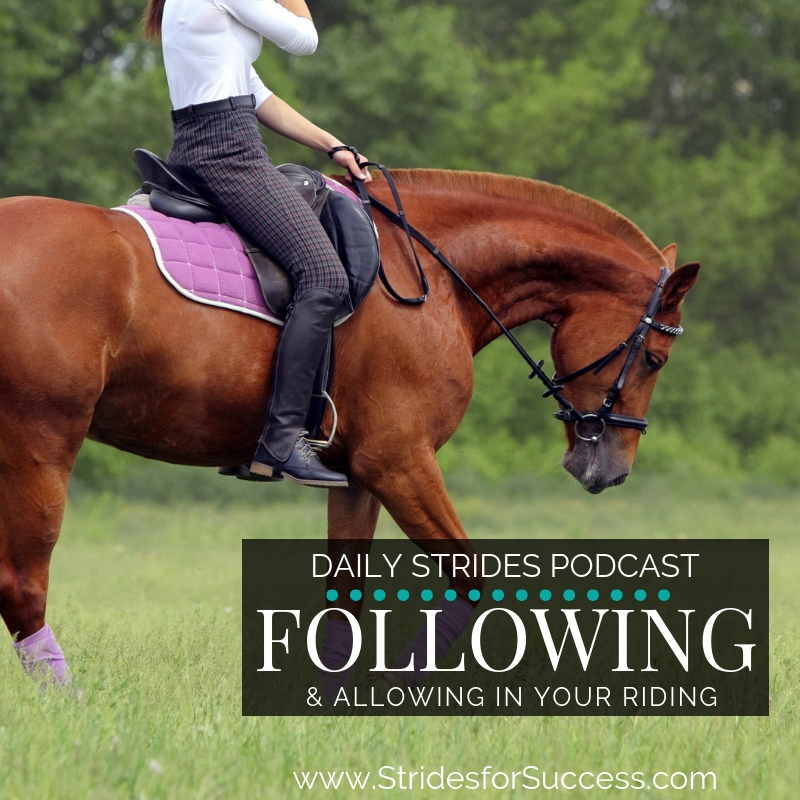
In this episode of the Daily Strides Podcast you will learn all about following and allowing with your seat. I believe this is one of the simplest ways you can begin developing your seat next time you ride.
Stop Forcing and Digging with Your Seat
When it comes to your seat as a rider, one of the most important things to understand is that you ‘influence’ with it. Simply put, this means you need to stop forcing with your seat.
Let go of the idea that you need to push and shove your horse around using your seat
If you push and shove with your seat, it very often has the opposite effect you are looking for. Your horse will probably hollow and duck out-of-the-way of your seat. This is because it is uncomfortable for him; imagine someone applying a huge amount of pressure to specific points on your back!
Be wary of digging with your seat. If you find that you are trying to dictate to the horse with this downward and forward motion, you are indeed digging!
This happens a lot in lateral work. Riders tend to shove the horse across the arena and you end up losing the relaxation and the rhythm, because the horse is no longer moving at ease.
Allowing Yourself to Be ‘Led’
The opposite of forcing is rather allowing yourself to be led. This is difficult for many riders to really do well initially. Simply put it means that you are going to allow the horse to move you, rather than you moving the horse.
What feels like ‘doing nothing’ is a difficult thing to do while in the saddle; but is essential to learn in order to really follow your horse
Sit in the saddle and, simply, allow the horses forward energy and movement to move you. This takes a certain amount of relaxation in the rider’s body, but also takes a certain amount of self carriage.
Meaning you are not really ‘doing nothing’, you are responsible for carrying yourself and balancing the tension in your body. Said differently, you are also responsible for maintaining the correct level of relaxation as you ride
Riders often get into the saddle and just sit there collapsing through their body. Rather think of yourself as ‘standing’ in the saddle. You need to carry your upper body as though you were standing.
Carrying your upper body frees up your lower body to be led by the horse
Notice How it Feels Underneath You
I’m going to be honest with you, if you are used to always trying to ‘move’ your horse with your seat, following will take practice. However, once you can do this, I want you to then begin noticing how it feels.
Timing is a big part of the conversation between you and your horse. You need to ask questions at the correct time in order to give the horse enough time to respond to whatever you have asked
Getting to understand timing comes down to getting to know what is happening underneath you. Notice how each leg is moving in each gait, walk, trot and canter. I always suggest starting in walk. It is slower and easier to really ‘feel’ your seat and hips move with your horse.
If you cannot feel which hoof is where at any given time, work with what you can see. Look at the front legs and use them to figure out where the back legs are at that time. In other words, learn the sequence of your horse’s footfalls. The walk will be a certain sequence, the trot another sequence and the canter as well.
Knowing where the front legs are will tell you exactly where the back legs are at any given time
The reason I focus so much on what the back-end is doing is because the horse’s ‘engine’ is at the back. When you are asking a question you want your horse to respond from behind first. Noticing how it feels and what is happening underneath you with the behind section of your horses body, will help you ask at the correct time.
Notice How You Can Begin to Influence Through Your Seat
Once you can follow and correctly identify what is moving when, you can begin looking at influencing your horse through your seat. I believe a lot of influencing is ‘allowing’ when it comes to riding.
By correctly ‘allowing’ you are going to influence how much energy will be flowing at any given time, and where that energy is flowing to
You could decide to shut down or restrict the flow a little. Or you could decide to allow more to flow through. You could ask for a little more bend or flexion with your seat. You can ask for more energy to be created using your seat.
It all comes down to asking and then ‘allowing’ your horse to follow through with what you asked
Begin with Smaller Requests
I suggest really just getting started. Many riders wait until the ‘perfect’ time to start using their seat to influence. There won’t ever be a perfect time, so begin today. Start playing with the seat and how the horse responds to it.
I suggest starting in the walk and trot first. Remember that your seat on it’s own is not a completely isolated aid. There is the whole balance of aids working together all the time to communicate with your horse.
Initially your other aids may have to be stronger, or louder, while you are training your horse to listen to the more subtle and quiet seat aid
However, as your horse begins to respond to your seat, you can really begin refining your seat. Keep in mind that consistency is essential. Especially as your horse begins to listen for those subtle questions that you are asking. In doing this you will get a better conversation happening between you and your horse.
I suggest starting with your half halt. I have a free audio training you can use for that HERE
. Noticing this as you start working on it with your horse is how you can start to ‘allow’ with your horse.
Are You Allowing Your Horse or Are You Blocking Your Horse
The final thing I want to touch on is that the opposite of allowing is blocking. Often riders tend to block their horse, even though they want to allow. An example of this is the length of the active half halt aid. The split second.
What sometimes happens with riders is that they stop allowing and begin blocking. It is often because the aid becomes a long drawn out constant. The engaging or active use of the aid becomes continuous. They tend to dig down deep and get heavy.
When we ask our horse to do something, what we want is for them to engage their core. In doing this it is almost feels as if they lift their back and lighten
If you are being heavy and using a more blocking motion with your seat, your horse has no space or room to engage and lighten.
Another side effect of blocking is that the energy can no longer move forward. This often occurs just after a transition between gaits. The rider asks for the transition but then ‘blocks’ the horse from moving forward into the newly requested gait.
Forwardness is key to everything in riding. Once you lose forwardness, everything else will fall apart as there is no energy there to maintain the movement
What to Work on Next Time in the Saddle
I suggest you start by allowing yourself to be led. Really feel what is going on underneath you and how one step or foot fall affects the next. Feel where your hips are in relation to your horses hips. From here, begin to take more responsibility for how you are sitting in the saddle. Later, once you can truly ‘follow’ begin working on the ‘allowing’.
It is a continuous work in progress for all riders and something you can experiment and refine on a daily basis in the saddle. Understanding your seat is really the beginning of refining your ‘influence’ over your horse while riding.
Happy Riding
Lorna
Links mentioned in the episode:-
- FREE WEBINAR – What are the Basics in Riding?
- Get your free Half Halt Training HERE
- Your Independent Seat is Everything in Your Riding
- Understanding and Refining Your Half Halt