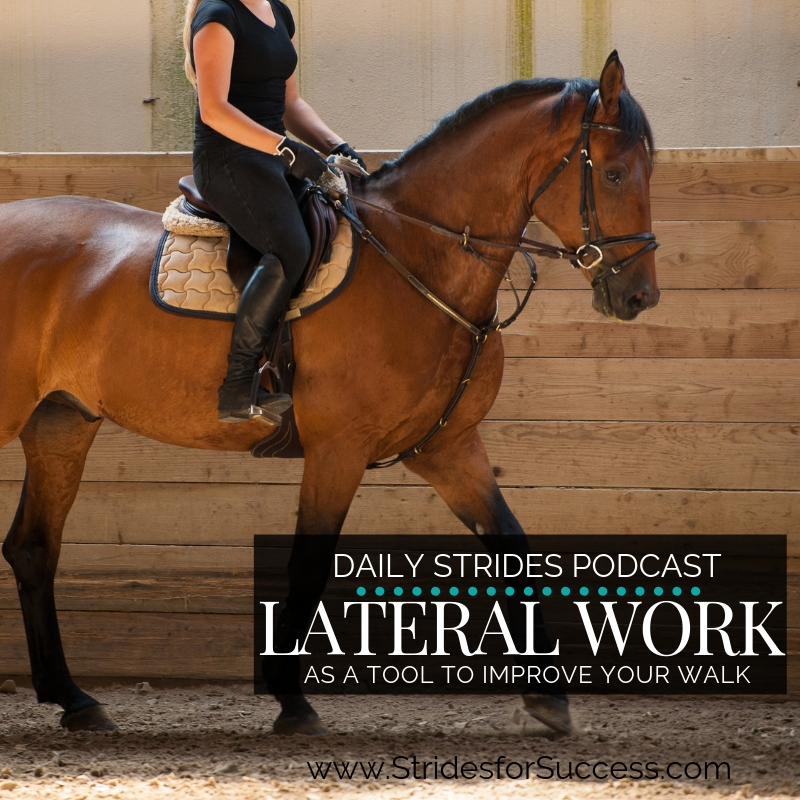
Tag: forward

  • Using Lateral Work to Improve Your Walk

    Using Lateral Work to Improve Your Walk

    Using Lateral Work to Improve Your Walk

    What this episode is all about & how it can help you:-

    • Recognise what a ‘stuck’ walk looks and feels like
    • Understand why the walk can so easily deteriorate in horses
    • See the benefit of using lateral work to begin improving the walk
    • Start to become more aware of how you are asking questions of your horse

    Funny how, sometimes, it is the more basic things that cause us to become ‘stuck’.  The walk is a good example of this!  It is probably the first thing most of us do on a horse, and yet, it often becomes a real ‘sticking point’ for horse and rider.

    [smart_track_player url=”https://op3.dev/e/traffic.libsyn.com/dailystridespodcast/1098-Using-Lateral-Work-to-Improve-Your-Walk.mp3″ title=”Using Lateral Work as a Tool to Improve Your Walk” social_linkedin=”true” social_pinterest=”true” social_email=”true” tweet_text=”Is your horses walk feeling more ‘stuck in the mud’ than graceful and forward? Here is how lateral work can help get you & your horse unstuck” hashtag=”equestrian #horseriding” twitter_username=”strides_success” ]

    Even stranger is that most riders don’t really understand or realise this until it is too late.  Too late for what?  Well, the walk is the one gait that riders have a real ability to negatively impact in their horses training.  Unfortunately this can have long-term repercussions in the horses way of going.  Maybe even long after the rider has began working on improving things. 

    In this episode of the Daily Strides Podcast you will learn how you can use simple lateral work to begin either improving or maintaining the quality of your horses walk.  Simple exercises and movements that will help both you and your horse get ‘unstuck’ in the walk. 

    Why the Walk Can Become Stuck for Many Riders

    I think that many riders fail to see how important it is to ride a good walk.  Usually this is because it was one of the first things they ‘successfully’ managed to do when in the saddle.  However, being able to remain in the saddle while the horse moves is not really a true measure of success as the journey progresses. And yet, we often fail to revisit the walk in our training.

    We forget to include it when assessing how effective we are using the energy.  And we see it as the ‘rest’ between the work, rather than the work itself.

    You probably use the walk to learn a lot of different movements or techniques in your riding.  The walk is also used to ‘practice’ things, in a slower sequence, before trying them out in trot or canter.

    Because of this, the walk is the one gait we tend to make a lot of our mistakes.  Repeatedly.  Mistake after mistake, slower and slower.  All in a bid to get things right in our head and body.

    This is why I feel the walk needs even more of your attention when developing your riding.  Focusing on riding a good quality walk is essential for your horses foundation, and yours as a rider.

    The Walk is Different to Other Gaits

    Okay, so I realise this is pretty obvious!  It is, after all, not the trot, canter or gallop.  However, it is also different because there is no ‘moment of suspension’.  It lacks the same energy that the other gaits have to move them forward.

    Once the forwardness has been blocked or is not included in the horses way of going, the gait itself tends to change – and this is rarely positive.  

    Riders really have to work hard to change the natural rhythm of a horses trot or canter.  If they are successful, any changes are usually only temporary.  The energy within the trot or canter itself will usually result in the horses natural way of going rising to the top when the rider stops interfering .

    This is why it is so important to be mindful that your horse is propelling you both forward in the walk.  Every stride, the hind legs are swinging underneath you and thrusting you both forwards. 

    What a Bad Walk Looks Like

    The walk should include your horse swinging through his back and moving with a sense of purpose.  When these vital elements are missing things quickly become ‘stuck’.  The movement will lack rhythm.

    The steps almost become erratic and ‘pottery’ to watch and listen to.  Often the horse is weaving and wandering.  It just lacks ‘enough’ energy.  

    If we dig a little deeper into the ‘bad walk’ we will see that often the horse is not connected through their back.  Meaning that the hind quarters have fallen out behind the horse.  This is when the horse switches into ‘front wheel drive’.

    The shoulders pull the horse forwards, rather than the hind quarters pushing the horse forwards. 

    The lack of connection leads to a hollow back, due to a lack of strength and development.  And this, in turn, leads to an ineffective and often heavy contact between the horse’s mouth and the riders hands.  It is not a pretty picture and doesn’t inspire anyone!

    Why Lateral Work Can Help Improve the Walk

    There are lots of ways to either begin ‘undoing’ the bad habits that have crept in, or improving things with your horses walk.  However one of the best ways I have found is using lateral work.  It really can be used with riders of most levels, as well as horses at most levels of their training.

    Lateral work literally demands the focus and attention of both horse and rider.

    There are no real half measures with it.  You are either both working together on the movement or you are not.  Also, in order for you to successful ride a lateral movement, the gait leading up to the movement itself must be of a good enough quality.  Meaning that you are already working on the walk before the lateral movement is asked for.

    The second reason I find lateral work to be so beneficial for both horse and rider is down to one simple requirement.  Rhythm.  If rhythm is lost or broken, it was not a correct movement.

    Lateral work NEEDS rhythm to be present in order to be deemed ‘successful’.

    To Move Laterally is to Move Forwards and Sideways

    The third reason that I feel lateral work is often the best way to improve the walk is pretty simple.  Lateral is forwards and sideways.  Not sideways and forwards.  So many riders think of lateral work as being sideways.  Moving across.  It is not lateral work if it is not first moving forwards.

    Forwards is key to successful lateral work and successfully working in the walk. Making them the perfect combination to improve the walk

    This can be confusing because some lateral work, such as turn on the forehand, don’t actually require forward movement.  However, the forwardness here is how the horse and rider thinks. There is a correct sequence that must happen in each movement, in order for it to be successful.  Thinking forwards is the foundation to each of those sequence, whether moving forwards or not.

    Less Shoving, More Asking

    So, lets say you are going to begin by working on turn on the forehand.  The number one mistake riders make is to ‘shove’ their horse over using their seat.  Make sure that your seat bone does not become a shovel digging a hole in your horses back!

    This can often be one of the ways the walk can be negatively impacted to begin with, shoving rather than asking. 

    When you ‘shove’, whether it be in walk or moving laterally, your horse will begin to hollow out through his back.  He does this to get away from the discomfort caused by your overly enthusiastic seat bones digging into his back!

    When your horse hollows his back, the connection between back and front is broken.  The energy ‘leaks out’. 

    The result is a lack of forwardness, which negatively impacts whatever you are doing.  Walking or moving laterally.  As you are working on your turn on the forehand, focus on ‘asking’ rather than shoving your horse around!

    Asking Questions that Allow Responses

    The final thing I want to touch on in this post is how you are asking questions of your horse.  Are you allowing him the room or time to respond?  Or are you asking and then becoming upset when he is not quick enough with a response?

    The reason I ask is that, often, riders are not asking the right questions at the right time.  They are asking when it is practically impossible for their horse to respond. 

    Timing is so important in riding.  Walking is a great place to begin working on your timing.  Become aware of what is moving where underneath you at any given time.   For example, when your horses foot has begun moving is a good time to ask him to ‘change’ or ‘modify’ that movement.  Rather than when his hoof is bearing weight on the ground.

    The walk is perfect for becoming great at feeling what is moving where underneath you at any given time.  Lateral work is perfect for using this information to ask specific questions at the right time.

    Start Small and Build Up Daily

    You spend so much time in the walk.  I am going to suggest that, beginning today, you become a little more intentional with your walk.  It is not just a rest period.  It is a gait that deserves to be worked in just as much as any of the others.

    Each time you are in the saddle, focus on how ‘forward’ your walk is.  Notice if there is a rhythm present.  Are you allowing the energy to flow, or are you ‘shoving’ it somewhere else?

    By consistently working on developing a more active, correct, rhythmic, forward moving walk you can begin improving your horses walk, regardless of how far down the path of ‘stuck’ he has become.

    Happy Riding

    Lorna

    Other posts, episodes and resources that relate to this topic:-

    Daily Strides Premium

    So I mention turn on the forehand quite a bit in this post, however that is just one of many ‘lateral movements’ you can use to begin working on your walk.  If you would like step by step help and reminders (such as ‘don’t shove, ask’) as you begin incorporating these into your riding, I am going to suggest joining Daily Strides Premium today.  In there, you will have instant access to audio trainings on all the different lateral movements, as well as so much more as well.

    Trainings you can use and listen to where ever you can take your phone… And all easy to pop onto your phone.  You can even use them in the saddle. 

    Couple This with Built In Accountability…

    When you join a Daily Strides Premium Member you will get built-in accountability.  A real person from our team will be reaching out to you on a fortnightly basis to help you build and then maintain momentum with your progress in the saddle.

    Couple this with the live Q&As, the monthly review and planning live calls and the members only private group ~ we are here to help you remain accountable as team leader for you and your horse.

    Daily Strides Premium is packed full of step by step trainings for you to use in the saddle. All the trainings are easily accessed using your phone, meaning that you can take them with you where ever you are going.  These trainings and so much more are available for you immediately when you join Daily Strides Premium. Find out more HERE

  • Moving Off Your Leg

    Moving Off Your Leg

    [smart_track_player url=”https://op3.dev/e/traffic.libsyn.com/dailystridespodcast/SFA331-Getting-Your-Lazy-Horse-To-Move-Off-Your-Leg.mp3″ title=”Moving Forward off Your Leg” social_linkedin=”true” social_pinterest=”true” social_email=”true” tweet_text=”Struggling with a horse who ignores your leg? ” hashtag=”Equestrian #Horseriding #deadtotheleg” twitter_username=”strides_success” ]

    Is there a more frustrating and exhausting experience when riding to match that of being on a horse that is not paying you a blind bit of notice?!  You are on board kicking and pumping away.  And all the while your horse is just meandering along.  Ignoring you completely and acting as though he is on a relaxing Sunday outing.

    Training your horse to move off your leg will help you overcome the inertia.  It will also actively improve responsiveness in your horse.  Starting the very next time you ride. 

    Why Is He Ignoring Your Leg?

    It is always a good idea to first take a good, in-depth look at your horse’s health.  Rule out the possibility of there being something physically wrong that may be causing him to be so nonchalant and laid back.   Question whether or not the environment or weather could be contributing factors.  Or perhaps his fitness levels, or lack thereof?  Also, things like tack fit and confidence working on a particular type of surface or ground.

    Moving Forward off your Leg
    Once you have confirmed that he is fit and healthy and able for the level of work you are asking for, you can then begin to look at other factors.

        • Has he been trained to ignore the rider’s questions?
        • Is his rider asking correctly and then allowing him to go forward?

    Inconsistent Riding Aids

    Let’s first look at the fact that he may just be ignoring your aids.  Some horses will only do what is absolutely necessary for them to do. Surprise, surprise!  In a lot of instances, if they are not motivated sufficiently to go the extra mile, they won’t. Simple as!

    As riders, often we ride to enjoy ourselves and relax.  Unfortunately, during these rides, we can be a little ‘too relaxed’.  This is in both our communication and our instance of doing things the correct way.  

    The problem arises when we ask for ‘more’ and then get upset when our horse doesn’t want to actually do ‘more’ for us.  This is a direct result of our inconsistent riding and disciplining!  If this is the case, your horse is simply reacting to how he has been conditioned or trained by you, the rider.

    Nagging Riding Aids

    On the other side of this incorrect training are novice riders who, whether knowingly or not, consistently do too much in the saddle.  Whether it’s due to a lack of awareness, balance, or control over their seat and limbs, the result is the same.  Riders become the ‘dripping tap’ on their horse’s sides… Nag, Nag, Nag.

    Unfortunately, like the dripping tap, your horse will soon learn to completely ignore the leg aids.  ALL OF THE TIME!  So when you actually put your leg on to go forward, he just sees it as another ‘Nag’ and ignores it.

    One of the most important skills we can cultivate with regard to our riding is mindfulness.  Knowing what we are doing, when we are doing it, and why. 

    I also think it is worth mentioning that you must carry yourself, and your horse must carry himself while riding. This will help you to be more effective with your leg aids.  And your horse to become more responsive.  Both are necessary when moving off your leg is what you want to improve in your riding.

    Conflicting Riding Aids

    The last part of the equation is the fact that the rider may be giving conflicting instructions to the horse.  Using their leg while at the same time, using the hand for balance.  This is often due to a lack of independence in their seat.

    It is a common sight in arenas, the knee jerk reaction of the hand moving when the leg is used.

    Alternatively, instead of actually applying the leg when and where you should, riders often ‘polish’.  This is when, to ask a question, the rider allows their leg to swing back along the horse’s side.  It never actually does anything constructive except to shine a 6″ stripe on both sides of the horse’s body!

    The rider gets frustrated.  And their horse becomes confused. Luckily, being the kind soul he is, decides that if in doubt, rather don’t go or move anywhere! This is definitely not moving off your leg!

    In fact, he is now ignoring your leg at all costs… Which is the exact opposite of what the rider actually wanted in the first place! 

    Improving ‘Moving Off Your Leg’

    I have other resources on this topic, which have more detail on how to more effectively use your legs when riding.

    Choose one of the topics, go deeper and see what you can achieve in your riding.

    Happy Riding
    Lorna

    Additional Resources:-