Tag: halt

  • 3 Lunging Exercises to Train Your Horse

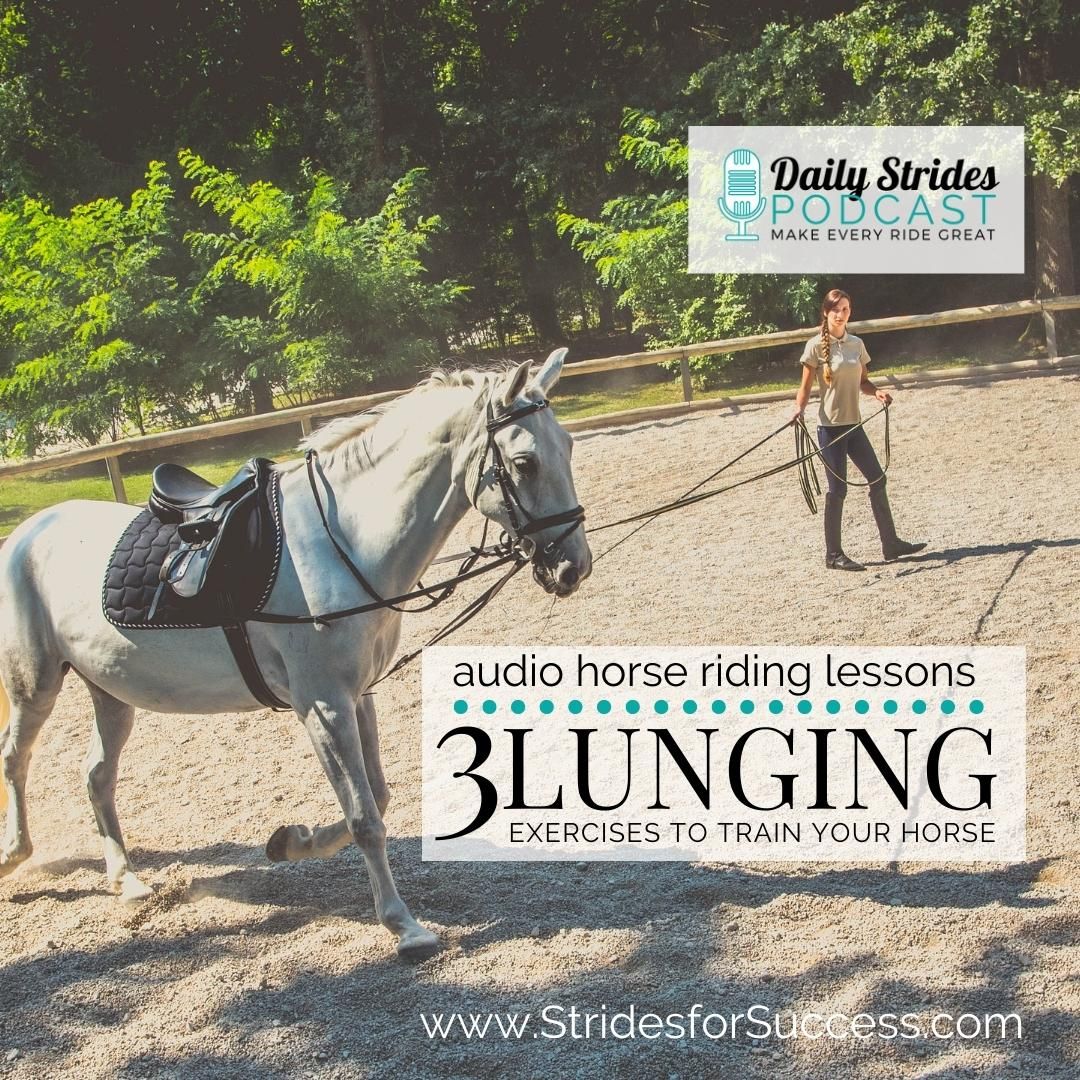
    3 Lunging Exercises to Train Your Horse

    [fusebox_track_player url=”https://op3.dev/e/traffic.libsyn.com/dailystridespodcast/1264_3_Lunging_Exercises_to_Train_Your_Horse.mp3″ title=”3 Lunging Exercises to Train Your Horse” social_linkedin=”true” social_pinterest=”true” social_email=”true” tweet_text=”3 exercises to try when lunging – I think you’ll enjoy this ” hashtag=”horsepodcast” twitter_username=”strides_success” ]

    As a rider, it is important to always look for ways to keep your schooling work interesting; for you and your horse. One of the ways you can do this is by working on different lunging exercises.  And they don’t have to be ‘fancy’ or complex.

    In fact, there are a few basic exercises you can begin working on introducing, or refining today that will help you to really begin utilizing lunging as a training tool for you and your horse. 

    Now, just like riding, it is important that before you dive into ‘working’ your horse, you take the time to warm up correctly.  I enjoy walking my horse (leading my horse) the ‘long way round’ to the arena I will be working in.  I use the 5 or so minutes to do a little groundwork on the way.

    And bonus points if the groundwork sets up, introduces, or relates to what you will actually be working on when lunging your horse.  It is the perfect way to start the conversation. 

    Lunging Exercise 1 – Responsiveness

    The first exercise you can do will help to increase responsiveness in both you and your horse.  Many riders can ‘miss’ more subtle cues from their horse because they are simply not looking for them.  And by intentionally focusing on responsiveness as what you want to improve, you also ‘fine-tune’ what you’re noticing in your horse.

    Notice what combination of aids is most effective to ask your horse to go forwards.  Also, how much pressure is necessary to ask the specific question before you get an immediate and timely response? 

    From here, begin working on refining it all.  Begin expecting your horse to respond to ‘lighter’ or more subtle aids. This will require consistency and focus from you.  And it will require concentration and willingness from your horse.

    Lunging Exercise 2 – Accuracy

    As the level of responsiveness increases, you can then begin working on improving accuracy and again, this is for you and your horse.  Increasing accuracy is a lunging exercise that really requires both the horse and the rider (the lunger) to concentrate on what is happening.

    Increasing accuracy also requires both horse and rider to work together. It requires teamwork and there is a shared responsibility to help improve it. 

    Your horse will learn to wait for and then respond to your aids.  The ‘waiting for’ part can be a challenge for many horses initially, however, it is essential to increase accuracy.  This will also force you to become even more clear and intentional with your aids

    Improving accuracy as a lunging exercise also requires you to work on and improve your timing.  A key part of the answer depends on if the horse can respond at that moment…

    So, instead of simply asking questions, you must begin to pay attention to ‘when’ you’re asking the question. You will begin to time your ‘ask’ with the part of the stride where your horse can actually respond to you. This will take time.  And it will require that you have first worked on and improved responsiveness.

    Lunging Exercise 3 – Halt on the Track

    The third lunging exercise that will really transform your lunging sessions with your horse is the ability to halt on the track.  This means that your horse does not turn into you, walk towards you, fall in from the circle, or fall out of the circle.  And this often takes quite a bit of work initially!  Especially if your horse has been allowed or trained (same thing really) to do any of the above!

    Once you have established the halt, you can begin working on the quality of each and every halt.

    The better the halt, the more energy it will contain inside of it. This can initially feel mentally uncomfortable for your horse and he will probably want to step out of it.  However, by increasing his capacity here to ‘hold’ the energy inside of the halt, you are growing his comfort zone.  This will allow for bigger questions in his overall training.

    Developing Your Lunging Technique

    I love lunging and I am all about using this tool as a way to continue to train and work with our horses, even when time or space is short.  And just like riding, lunging takes time to develop and improve.  It requires coordination from you. And it requires a knowledge of the aids you can use to communicate with your horse.

    Lunging is NOT simply running in circles; it is an active way of schooling and training your horse. And using lunging exercises intentionally will help you to make the most of this tool.

    If you are unsure of where to start, make sure you check out the links below this article for more information and past Daily Strides Podcast episodes on lunging your horse.

    Happy Lunging
    Lorna

    More on this Topic:-

    More Support and Training:-

  • A Square Halt on the Ground

    A Square Halt on the Ground

    Think about the last time you were with your horse. How many times did you ask him to halt while working with him on the ground? Before you mounted up? Was it 4?  Maybe 10? And what about after you dismounted?

    When interacting and working with our horses, so much of it happens on the ground. Beside your horse. Here is how you can begin using this in a way that will help you when you do mount up in the saddle.

    All conversations with your horse start and end on the ground. Before you mount up and when you dismount after each ride. So it makes sense to use this daily interaction to intentionally help your riding.

    A Square Halt on the Ground

    What is a Good Quality Halt?

    It is a halt that holds or contains the energy inside of it. I know, that seems a little abstract, however, imagine this… There are 2 horses halted side by side. One is carrying himself, looking as regal and exquisite as he possibly can and all in a focused, alert, and yet calm manner. He is literally ready to move forward to the next thing, while still happy to remain in the halt.

    [fusebox_track_player url=”https://op3.dev/e/traffic.libsyn.com/dailystridespodcast/1163-A-Square-Halt-on-the-Ground.mp3″ title=”A square halt on the ground” social_linkedin=”true” social_pinterest=”true” social_email=”true” tweet_text=”Something to try with your horse, that doesn’t involve mounting up…” hashtag=”equestrianpodcast” twitter_username=”strides_success” ]

    The other horse is ‘chillin’ like a villain’… It looks like someone dragged him into a halt! Long. Strung out. Half asleep or even asleep! Legs everywhere. His back looks like one of those rope bridges, except this bridge extends from ears to tail. Long and loopy… Can you see the difference in your mind?

    The halt that contains energy and is forward-thinking, even when stationary in the halt is the better quality halt. This horse is ready to move out of the halt.

    Okay, now I want you to begin thinking about your horse and how he halts when you are leading him. Does he resemble Horse A or Horse B? This is where you can begin working on the ground, and in doing so, actually working on improving what’s happening during the actual ride as well.

    Getting Clear on What you Want to Make Happen

    The first part of beginning to improve your halt on the ground is to get clear on what you want to happen. Both of the above examples are technically halting. The horse is stopped and standing stationary. However, they are also completely different. Clarity about what is acceptable and what’s not is the beginning.

    A good place to begin is requiring that your horse be ‘square in front’ in each halt.

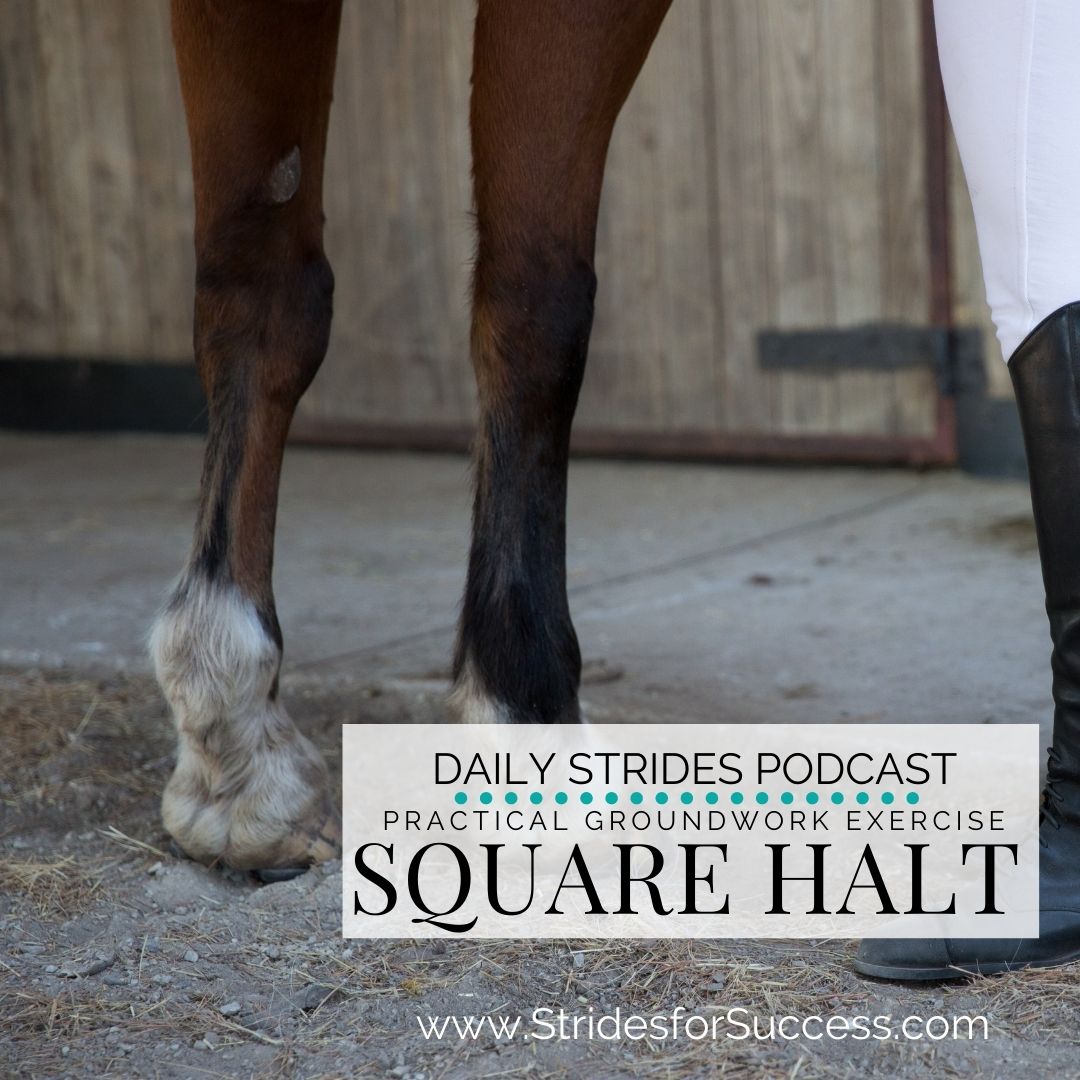
    Basically, this means that his two front feet will be in line with each other when he is standing still. An easier way to describe this is to first understand what completely ‘square’ is. To do this I want you to imagine a rectangle marked out on the ground. When your horse is halted square, each of his hooves will be in a corner of this rectangle.

    Square in front is when his front two hooves are correctly placed in the front corners of your imaginary rectangle for your horse.

    I think is a really ‘do-able’ goal for a single session when working on the ground with your horse. It is simple to make happen and easily understood by your horse. It also translates really well across to your riding.

    Understand What Aids You Are Using

    So many riders never think of their aids for this movement. I think this is due to this being a movement we do with our horses every single day when we are with them. And when we do something all the time, we tend to put those things on ‘autopilot’. Which is great. Except, you need to revisit and update autopilot regularly! This is something I help you to do regularly inside of Connection.

    The less thought that goes into a movement, the fewer aids we tend to use to make that happen!

    This is why, when asking a horse to halt while leading him, most riders overly rely on their hand aids. They pull or lean on the horse’s head, mouth, or nose (depending on what they are leading with) in order to get the horse to stop.

    Your hands are an important aid when leading and asking for the halt, but they should be part of a whole group of aids, which will include your thoughts, your voice, your body language, your position, and your seat (core) to name a few.

    A lot… I know. And this is where you get to really begin refining your aids and your conversation with your horse. By beginning to use more subtle aids, you can literally create a better quality halt, with minimum effort.

    Once You In the Halt…

    Okay, so assuming you have now halted your horse, I want you to rate the halt out of 5.  5, in this case,  is an absolutely perfect example of what a halt should look like and 0 representing ‘he fell into it’!  By being honest with yourself about where you and your horse are right now, you have created a place to begin working from. So be honest 😉

    Are your horse’s front feet ‘square’? If so, you can then begin working on squaring the back hooves. Or perhaps working on straightness through the halt itself. Many horses have a tendency to ‘crunch’ into the halt, which results in a hoof stepping out to the side.

    Falling out or falling in is also a thing to watch for when moving in and out of the halt.

    Your Work Begins; Refining…

    If your horse’s front feet are not square, note where they are. When you ask your horse to walk forward again and then repeat the halt, I want you to think about your aids and how you can begin to be clearer about where you want him to put his feet. For example, if his right front foot has stepped more forward, perhaps you can use the right rein a little more to emphasize a boundary there. Or if his right front foot has not ‘closed’ the halt, you could use your voice to encourage him to do so with a click.

    Refining, in this case, is noticing and then tweaking your aids. The aids themselves, the timing, pressure, sequence, release.

    When you are looking to improve your horse’s way of going, the first step is to improve the communication coming from you. Have more clarity about what you want. Be clear about how you ask. And then assess each response and give feedback to your horse.

    Then simply rinse and repeat. As I said, this can be worked on every single day. And once you have mastered this on the ground, use the same technique to begin working on this from the saddle as well.

    Happy Riding
    Lorna

    Additional Resources on this Topic:-

  • An Engaged Halt

    An Engaged Halt

    An Engaged Halt
    Quick question… If you were to guess, how many times did you halt throughout your last ride on your horse? Was it a ‘one time only’ event? Or perhaps you halted two or three times throughout the ride? Or was it into the double digits?  Once you have that number, here’s another question.  How many of those halts was the actual ‘end’ of the ride?
    So many riders treat all halts the same.  They see the halt as being the end of a moment or a sequence of movements, however, it rarely is.  In fact, there is only one lat that actually signals the end, the last one.  All the others are part of the ride and should be seen as an important exercise.  Yep, every single halt.
    [smart_track_player url=”http://traffic.libsyn.com/dailystridespodcast/1133-The-Engaged-Halt.mp3″ title=”An Engaged Halt” social_linkedin=”true” social_pinterest=”true” social_email=”true” tweet_text=”Start seeing each halt as an opportunity to move things forward for you and your horse…” hashtag=”equestrian #podcast” twitter_username=”strides_success” ]
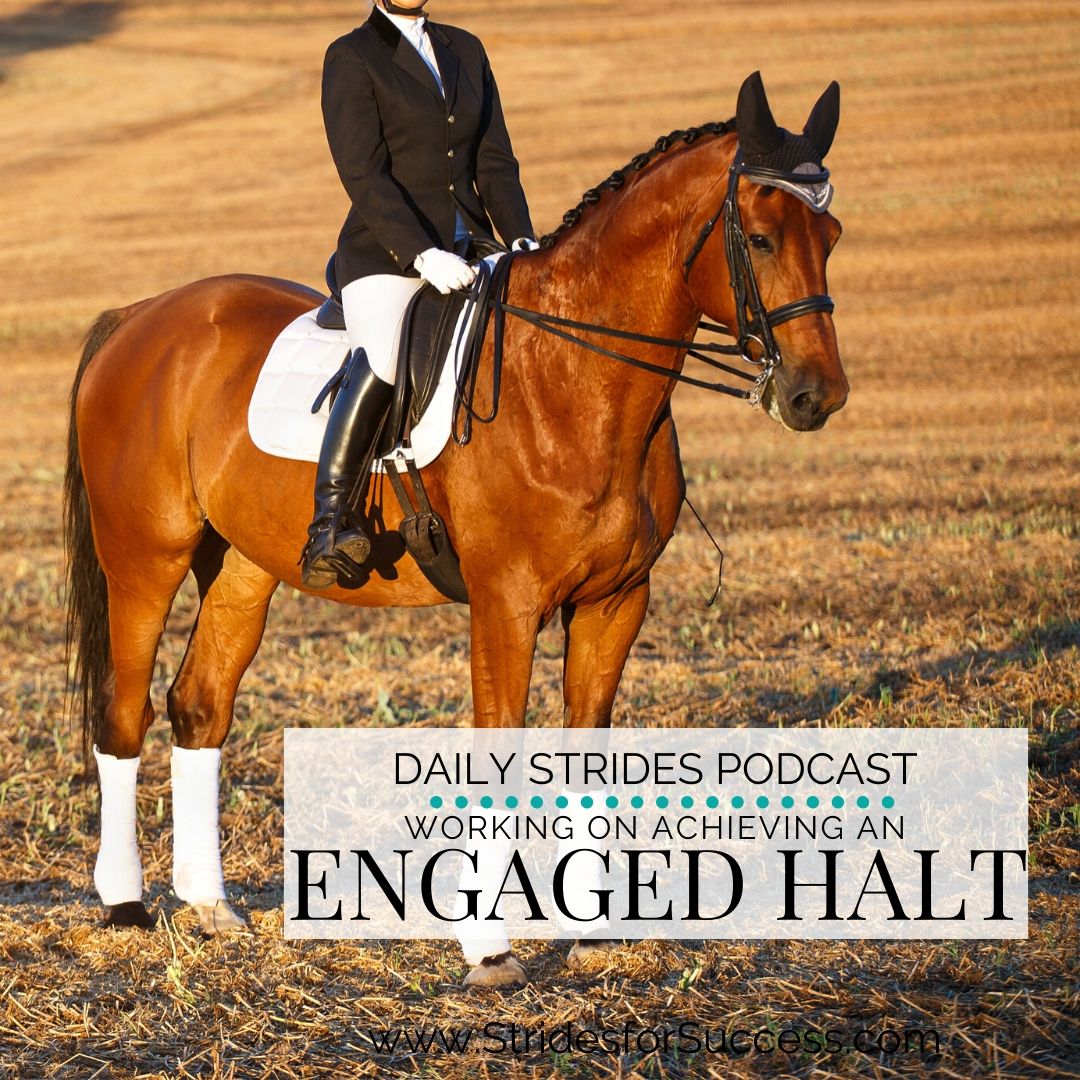
    in today’s episode of the Daily Strides Podcast, we are diving into all things ‘halt’.  But not just any old halt; I want you to use this information, starting on your very next ride, to begin working on developing a more engaged halt for you and your horse.
    I want you to be able to keep the energy you already have as you approach the halt contained through halt and then allow that energy to carry you into your next movement. 

    Why a Good Quality Halt is Important

    We halt a lot every day when we are working with our horses.  This is true regardless of if we are on the ground leading or lunging, or in the saddle riding.  And often we pay a lot of attention to how we are transitioning in and out of the halt.  However, the halt itself also demands attention and focus if it is to truly serve the rest of the ride.
    Allowing everything to collapse or dissipate every time we transition into the halt means that we have to start all over when asking our horse to move out of the halt. 
    We have to reestablish the energy, the forwardness and, because of this, the contact as well.  Transitioning out of a less than great quality halt leaves us with a lot of work to do in the next gait, be that walk, trot or canter. So, it makes sense to begin giving the halt itself the same attention we give the rest of the gaits throughout each ride.
    I suggest that from now onwards in your riding, begin seeing each halt as a separate movement that requires your attention and focus just like every other movement in the ride. 

    What is Engage?

    Engage and engagement is a word we often use in horse riding.  Usually, we are speaking about the hindquarters or the core when we use the word.  However, I want to go a little further with ‘engage’ today.
    I feel that when we are talking horse riding and horses, to ‘engage’ is to agree to participate and show up.  Both horse and rider must engage in order for the engagement to be of any benefit to the overall ride.
    Engagement is a willingness.  It is being intentional and mental about something before it shows up physically.
    The next time you are with your horse, whether that be on the ground or in the saddle, I want you to really get intentional about every halt.  Mentally engage in the process of the halt and invite your horse to join you there.

    An Engaged Halt

    You probably have a good idea in your head about what a ‘nice’ halt looks like.  Horse standing still, without fidgeting, with a foot in each corner of an imaginary rectangle box on the ground.  However, I want you to go a little deeper about what makes a halt ‘good’.
    There is a sense of purpose in both horse and rider when the halt is engaged.  You can see that they are still ‘working’ and that the halt itself is part of the work.  
    The core of both horse and rider is engaged.  They are carrying themselves.  And it is this carriage that really gets to why an engaged halt is so important.  It means that the channel for energy to run, from the back end to the front end, is open and ready for the energy to flow.
    It also means that the energy that was in the channel before the halt is still in there; waiting to be redirected. 
    An engaged halt also will have both horse and rider maintain the contact that they arrived into the halt with.  Neither is being forced to stay there; again, there is an unmentioned but very obvious agreement from horse and rider.  I will continue to maintain this conversation inside of this halt.

    Improving Your Halt

    As always, I suggest starting out by assessing and making small but potentially far-reaching adjustments in your body in the halt.  How are you carrying yourself before and during the halt? There is a tendency for riders to ‘bear down’ with their weight in the halt.  Rather think about what you want your horse to do, and focus on modeling that first.
    You can still apply all of your aids to ask for a halt.  It is just important to realize that there are pressure and release in every aid.  I am reminding you to release when your horse as done what you’ve asked him to do. 
    With regard to your contact, it is important to carry your hands and maintain contact with your horse.  Dropping the contact when in halt is a bad habit that I see so many riders fall into.  Be mindful of what you are asking from your horse, especially in how you are approaching the movement yourself.

    Improving Your Horses Halt

    The first thing I am going to suggest you look at as you begin working on a more engaged halt is straightness. How straight are you and your horse as you approaching the halt.  And, how straight are you both inside of the halt?  It is common for a horse to ‘buckle’ a little as he steps into the halt.  This is usually due to a lack of relaxation.  The tension is not correctly managed or maintained throughout the transition.
    Noticing where there are issues is the key to begin working on the issues.  Does your horse step out with a shoulder or hind leg?  Perhaps he turns or twists his body a little on the last stride before the halt.  
    One of the best ways to help your horse with straightness is to ensure that you yourself are straight.  Then you can go about strengthening any weak points that show up in your horse.  Noticing where he has weaknesses is essential to create a training program that will allow him to develop and improve correctly.

    A Square Halt

    Imagine there was a rectangle marked out on the ground.  Square is when your horse has a hoof in each corner.  From straightness, you find that ‘squareness’ will begin to occur.  I don’t think that asking a horse to be square in front is too big of a challenge, for horse or rider.
    Asking for your horse to ‘square’ in front is something that you can work on and achieve positive results within a relatively short period of time.
    If either you or your horse is struggling with this initially, I suggest beginning on the ground and use groundwork to help you explain what you want to your horse.  A square halt requires your horse to step into the halt.  It requires energy moving into the halt.
    Square behind sees him ‘closing’ the halt by stepping into it with his hindquarters as well.  This may take more time, however, once he has mastered this, it is something you will use always in your riding.
    Happy Riding
    Lorna

    Additional Resources:-

    For more information visit the links below