Tag: hind quarters

  • Developing Strong Hind Quarters in Your Horse

    Developing Strong Hind Quarters in Your Horse

    Developing Strong Hind Quarters in Your Horse

    What this episode is all about & how it can help you:-

    • Understand what strength is
    • Figure out how it relates to suppleness
    • Work on straightness to strengthen your horse
    • Notice when things begin to develop

    [smart_track_player url=”https://op3.dev/e/traffic.libsyn.com/dailystridespodcast/1062-Developing-Strong-Hind-Quarters-in-Your-Horse.mp3″ title=”Developing Stronger Hind Quarters in Your Horse” social_linkedin=”true” social_pinterest=”true” social_email=”true” tweet_text=”Are you trying to develop your horses top line, but getting nowhere?! This episode of the Daily Strides Podcast will help…” hashtag=”equestrian #podcast” twitter_username=”strides_success” ]

    Have you found yourself wondering or wishing about your horses top line or frame?  You probably have heard that they are related to how your horse is working, but struggle to really connect the pieces together in the saddle.

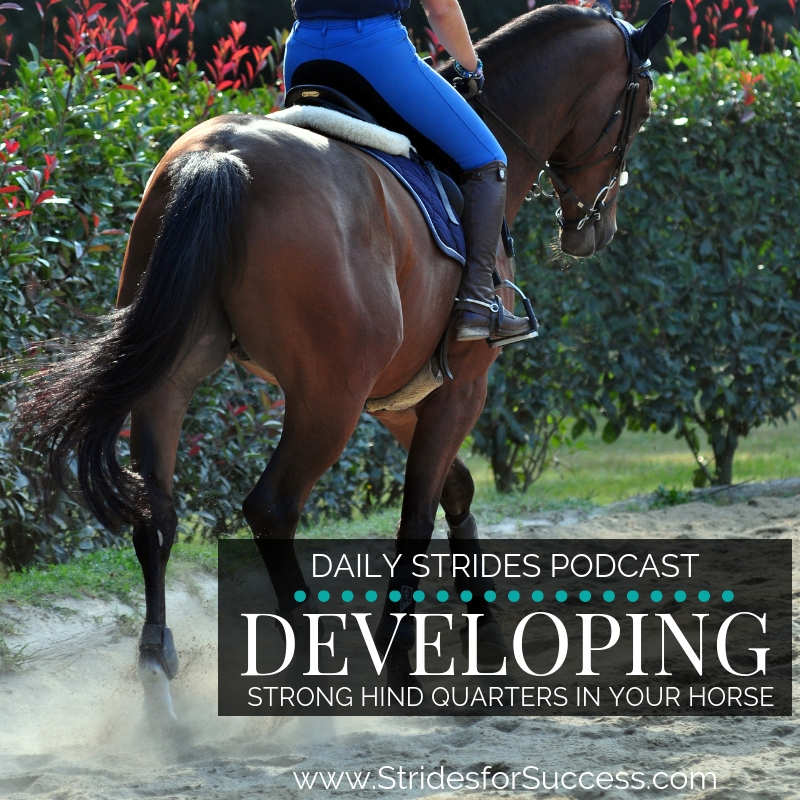
    This episode of the Daily Strides Podcast is all about specifically the hindquarters and building strength in the hindquarters in your horse, which will lead to overall development.

    Time & Consistent Correct Training

    Riders are often looking for quick fixes. They want their horse to be on the bit.  They want the horse to be working in a ‘frame’.   But they are forgetting that strength takes time.

    If I sent you to the gym today, and asked you to do a certain amount of exercises, your success would depend on your current fitness level.   Whether you could do it, or not.  Of course if you push past what you are physically able to do, you are probably going to injure yourself; or wake up the next morning feeling incredibly sore.

    This is the same for our horses. Very often people are asking their horse to work within parameters that the horse is not used to working in.

    When this happens, the horses current level of development will be challenged as well.  It is not comfortable for your horse.  Neither is it enjoyable and there is a high risk of causing injury.  The other ‘outcome’ of pushing too hard or too fast is that your horse may begin to compensate elsewhere, and you will end up training the horse ‘backwards’.

    What is True Strength?

    Strength is your horse’s ability to propel itself forward. When buying a car you will look at the engine of the car. The hindquarters are the engine of your horse, so this is where you need to spend a lot of your time maintaining and developing your horse. So everything you are doing is for the good of the engine – the hindquarters.

    Strength, as well as being your horses ability to propel himself forward, is also his ability to correctly carry himself.

    As he becomes stronger, your training will ask different questions.  These ‘questions’ will require him to carry himself differently.  He needs to be physically strong enough in order to correctly do just that, and then develop further in his abilities.

    How Strenght Relates to Suppleness

    I believe that strength and suppleness are very closely connected, and so too is straightness. I suggest starting with suppleness, which leads to strength, which leads to straightness.

    Suppleness is basically asking your horse to become more ‘limber’.  This increases the overall ease and flow when being ridden. I don’t believe that suppleness is standing still asking your horse to eat a carrot somewhere at its elbow.

    Suppleness when ridden requires movement.  It is your horse is working and moving, and is able to use himself to the best of his ability.

    Working on Straightness to Strengthen Your Horse

    As you begin to correctly build and improve the horse’s suppleness (and your suppleness as a rider) you will find that you both become stronger. That strength then leads to the straightness.

    Straightness is important because if your horse is straight it means that he is pushing or thrusting forward equally from behind. One side is not firing stronger that the other side!

    Obviously straightness is not only to do with the hindquarters, it is also to do with the whole body, as is suppleness and strength. But I am focusing on the hindquarters today.

    As you begin to build this, the horse can begin to carry themselves differently which engages the core. As the core begins to get more engaged, you will begin to see his top line develop and he will begin to naturally carry himself better.

    This simply means that his weight is being carried differently as he is working. 

    The Cycles in Your Horses Development

    You will notice that as he begins to develop more strenght, he will carry himself differently which will lead to him becoming straighter.

    The cycle will keep repeating and developing as his training develops; suppleness, strength, straightness. These three principles keep building on each other.

    You will notice as you begin to invest time working on this that your horse will begin to feel different as he carries himself more correctly.  You will also probably notice that your horse will begin to work into the contact.

    The improvement in the contact is the result of correct development allowing him to carry himself more.  This allows him to take more responsibility for his half of the contact. 

    He will no longer lean or depend on you.  He will truly be able to contribute to the correct development of the contact, which is a little like agreeing to hold hands.  You become equal partners and it is a mutual agreement that the two of you have come to.  He must first of all be physically strong enough to do this.

    Noticing when Things Begin to Develop

    Consistency requires just that, constant attention to detail in your riding and training.   I also believe in applying consistency to how mindful you are about your horses development.

    Notice where your horse is, and notice any weaknesses that show up. Notice if you maybe ask for a bend to the left, is he rather bracing against you or is his head tilting to the side. He may also be struggling to track up one side or the other.

    It is so important to begin noticing things like this, because it is only by noticing them that you can then begin to work on them.

    Developing Symmetry in Your Horse

    Most horses, just like us, tend to favour one side over the other. Next time you ride your horse, begin paying attention to how much ‘ease and flow’ there is doing the same exercise on both reins.

    If you do notice a weakness of one side or a favouring of the other, take a more long term approach when dealing with it. 

    So many riders make the mistake of hammering on the weak side. If someone made you continually do something which you find difficult over and over again,I am sure you would start to feel definite resentment beginning to grow.

    Your horse is no different. Rather sprinkle the ‘difficult’ exercises or questions in between things which he enjoys and finds easier.   Allowing him to do the things that he finds easier right now in his present situation, and rather just sprinkling in these more challenging questions, allows him to feel good about working and developing himself.

    How to Know When Things Begin to Develop?

    Normally one of the first indications many riders get is through a downward transition. As you go down let’s say from canter into trot, you will feel that there is a lovely lightness the first two strides of the trot.  Now, the downside is that it will probably be for just that amount of time, one or two strides, and then it is lost and become a little heavier again.

    But that lightness through that initial transition is where he engaged himself, held himself and carried himself and is the beginning of true strenght in his body. 

    He just was not physically, or perhaps mentally, strong enough to continue.  As part of our OTTB Owners Program and also the Clarity and Confidence Riding Program,  I talk a lot about how the horse has to develop mentally through all the different principles, as well as physically.

    He must not only physically feel that he can carry himself, but also that he has the confidence to continue carrying himself going forward. 

    Celebrate Those Initial Steps

    When you begin to notice those initial couple of strides as they start to happen, your goal as the rider is to try and get more of those ‘feeling good’ moments.  More lightness that lasts longer, and are closer together in frequency.

    Simply put, over time you are lengthening the ‘feeling good’ moments for your horse, so the contrasting not so desirable parts are becoming shorter and less frequent. Over time you will build it from where it is a glimpse every now and then of what you want, to where what you want is the mainstay of the ride

    Happy Riding

    Lorna

    Links mentioned in the episode:-

  • Engaging Your Horse’s Hind Quarters

    Engaging Your Horse’s Hind Quarters

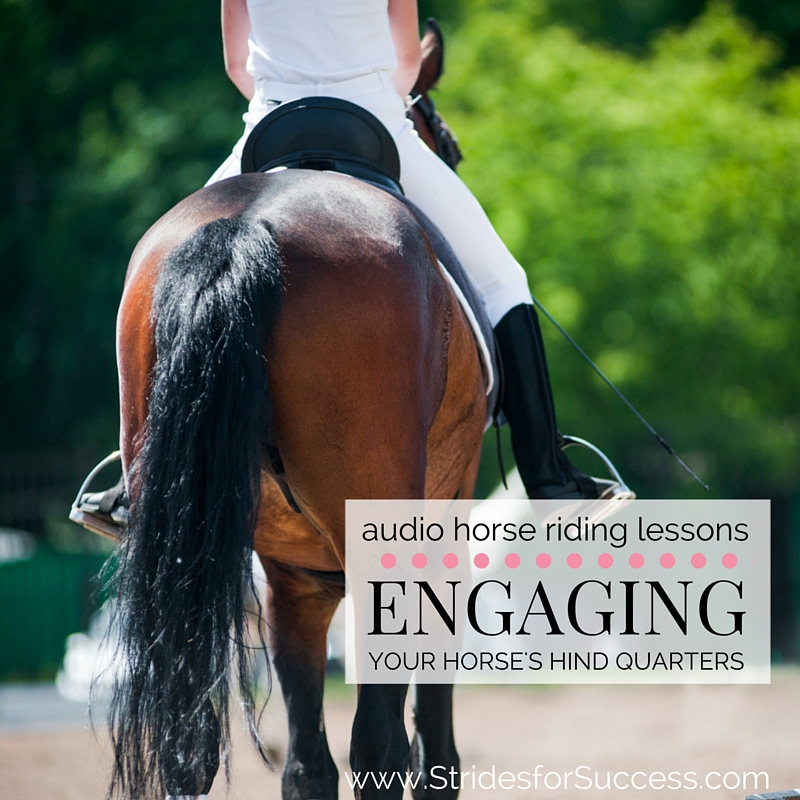
    Have you ever looked at photos or videos of your horse and it looks like his hind quarters are, literally, being left behind? They are dragging out behind him, rather than working underneath him. Or perhaps you have gotten the feeling that when you ask for ‘more’ when in the saddle, there is just no way he can provide ‘more’ without speeding up and becoming long…

    Knowing how to activate and then engaging your horse’s hind quarters is vital to his long-term training and development. However for many riders, it can be a little daunting trying to figure out if he is truly in ‘rear wheel drive’ rather than ‘front wheel drive’ while they are working or schooling their horse.

    [smart_track_player url=”https://op3.dev/e/traffic.libsyn.com/dailystridespodcast/631-Engaging-the-Hind-Quarters.mp3″ title=”Engaging Your Horses Hind Quarters” social_linkedin=”true” social_pinterest=”true” social_email=”true” tweet_text=”Struggling to get the back end working? Engaging the hind quarters – step by step..” hashtag=”equestrian #dailystrides #horseriding” twitter_username=”strides_success” ]

    However taking the time to begin asking your horse to work correctly from back to front will be a key factor in his overall development and training and also, the deciding factor between him becoming stronger when being ridden, or just remaining where he is, effectively capping his progress.

    So, first and foremost when we talk about engaging the hind quarters, we are speaking about activating them or getting them to work while we are riding our horse and then connecting the energy produced to the front of his body. Engaged in this sense means to bind or interlock, so engaging the hind quarters is literally interlocking it with the rest of his body. Like I mentioned earlier, your horse being in rear wheel drive, means that his all the time pushing from behind, using his hind quarters. This is far more favourable when being ridden than pulling from the front with his front legs and shoulders.

    Before we go any further it is also worth mentioning that your horse will need time to develop the necessary strength to truly activate and then engage his hindquarters when being ridden. It is up to you, the rider, to make sure you do not push him beyond what he is capable of for his level of training or schooling. Slow and steady wins the race when working with horses…

    Pushing from behind requires your horse to be moving forward in the first place. Many riders seem to think that their horse merely moving is going forward, but in truth, going forward can more be described as your horse moving forward with a sense of purpose. They must have a little ‘pep in their step’ so to speak, rather than ambling along, hooves shuffling and dragging on the ground, each step looking like a momentous task

    Responsiveness is part of the key to having your horse moving forward. A simple ‘You ask; he responds’ system in place which both you and your horse understand that there is a mutual responsibility from all parties if it is to work effectively. You are responsible for making sure that you are clear in what you ask. Your aids and also where you plan on going from that point are well thought out and executed. Your horse must then become responsible for adhering to your aids and directions in a willing and cooperative way.

    If either side of the team, horse and rider, reneges on their individual responsibilities the result is a lack of forward movement, which will result in an inability to engage the hind quarters

    Once your horse is moving forward, it is then up to you to allow that energy being created from behind to connect with the front of the horse, thus actually ‘engaging’ the hind quarters. There are a few different aspects to allowing this to happen, but again, if any are missing it will result in the hind quarters being ‘disengaged’ and left to their own devices, separate to the rest of the horse’s body working with the forward movement.

    Engaging Your Horse's Hind Quarters

    Think of energy as being a little like water or electricity. It will generally always try to find the shortest and easiest route. If you allow your horse to become crooked through his body, the energy will not flow where you want it and rather ‘shoot out the side door’. An example of this is on a circle, the hind quarters being allowed to swing out wide of the tracks the front feet have created. When this happens the energy, rather than pushing forward from behind and connecting to the front of the horse, will be lost out the side door of the horse, resulting in the horse going into ‘front wheel drive’ again.

    When riding you should think of your aids, particularly seat, legs and arms, as being the banks of a river or canal. They will channel the water / energy that is being created in the hind quarters where you want it to go. This will continue to keep the energy moving forward and connecting, from back to front

    This is why straightness is so important when training a horse and rider. Many times we focus on how straight the horse is, but ignore the obvious twisting or tilting of the rider’s body. Any crookedness in either horse or rider will again result in a disengagement of the hind quarters, which will see the energy dissipate and eventually be lost.

    Another important factor to consider when thinking about this engaging of the back to the front of your horse’s body is the idea of ‘allowing’ that energy to flow underneath you through your horse’s back. Some riders really work hard at activating the hind quarters and getting them to work, but then due to a heaviness or tightness in their body, block this energy from connecting through or engaging with the front of the horse

    When we learn to ride initially, we are often told to ‘sit up’, however we are rarely told why; other than the whole falling off aspect of collapsing through your body. But let’s assume you have indeed mastered staying on, however you are still finding it difficult to truly connect the hind quarters to the front end of the horse (through your contact), it may just be because you are blocking this.

    Just as water can be dammed up, blocked or diverted, so too can energy. Sitting heavy in the saddle is the most common culprit here, but so too are shutting things down with your thighs. They can have a vice like effect on your horse if there is excess tension in your body. Also, leaning forward over your horse’s shoulders or withers will be highly effective in shutting down any engagement of the hind quarters.

    Make sure that when you are riding, you are all the time encouraging your horse to use his back by being ‘light’ in the saddle. This is often as simple as sitting up through your rib cage, carrying your upper torso. This simple change is often enough to allow your pelvis to begin moving with the horse, which will in turn allow your horse to use his back.

    Once you have managed to get your horse moving forward from his hind quarters or from behind and then are allowing that energy to flow underneath or through you in the saddle, the final piece of the puzzle is ready to happen…

    To truly engage means to connect, bind or interlock. In the case of the hind quarters, we want to connect them to the rest of the horse like a gear cog. This allows you to truly direct the energy being created there. We do this through our contact with the horse

    The unfortunate part of this is that most people look at the contact part as Step 1, rather than the final piece of the puzzle, or in this case for simplicity sake, Step 3. Contact is just like the responsiveness, there is a responsibility on both horse and rider to fulfil their end of the contract in order for it to work correctly and be effective.

    If either horse or rider try to force it, it will be lost. Similarly, if either side try to evade it, it will be lost. Many times we blame the horse for evading the contact, but I see many riders who also ‘evade’ through reins that are too loose, or fingers that are wide open and look better suited to playing a piano rather than holding their reins.

    Only when all three steps are in place can your horse truly engage his hind quarters and can you then begin to feel the difference between rear wheel drive and front wheel drive. The difference? Night and day! It feels like there is always energy there to perform what is asked. It feels like your horse moving forward with purpose. It looks so much more pleasing to the eye, as both horse and rider are in true agreement with each other, both maintaining responsibility for their individual part in keeping things together.

    There are many exercises you can do to begin asking your horse to use his hind quarters but none will really be successful until you truly understand what it means to engage and connect the back to the front.

    Happy Riding
    Lorna

    This is the first of 5 audio programs on this topic. In the rest of the programs you can listen to while riding for step by step instructions on how to effectively begin engaging your horse’s hind quarters. The exercises are suitable for all levels of riders and can be worked into your usual schooling routine with your horse.

    For more information on how to download the rest of the lessons and gain access to over 600 audio horse riding programs on a whole range of different topics, visit https://stridesforsuccess.com/join/