Tag: Horse

  • Riding a Serpentine

    Riding a Serpentine

    Do you , like many riders, find yourself overlooking the humble serpentine as being too basic and easy a schooling movement to be of any real consequence to your horses development?  If so, I would love to challenge you that the modest serpentine, if ridden and worked on correctly, can be a fantastic training aid for both your horse;  and for you as a rider…

    [smart_track_player url=”https://op3.dev/e/traffic.libsyn.com/dailystridespodcast/SFA386-Serpentines-for-Straightness-Balance-and-Suppleness.mp3″ title=”Serpentines for Straightness, Balance and Suppleness” social_linkedin=”true” social_pinterest=”true” social_email=”true” tweet_text=”Back to basics with the suppling serpentine… ” hashtag=”horseriding #schooling #equestrian” twitter_username=”strides_success” ]

    The serpentine is the sort of exercise that can be used over and over again, daily if necessary,  to improve your horses balance and rhythm, as well as his straightness, suppleness,  bend, and can also help, later, with lateral movement.

    Serpentines

    They are a great tool that you can use to first assess your horses rhythm, balance and straightness.  Serpentines will often show up any favoring of one side to the other in your horse which, once identified, allows you to develop a solid strategy from where to jump start not only your horses training, but also your own.

    The serpentine is also a great tool that riders to use to improve and develop their own skills in the saddle.   I have found them extremely useful in helping to keep riders looking forward and thinking ahead as to where they are going, and how the movement they are riding now will affect this.   This combination will ensure that are looking up and ahead, while still riding the specific movement you are riding at that moment.

    Unfortunately many riders see the serpentine as being merely a basic riding school movement and not giving it the attention it deserves while being ridden.   This is where the potential is greatest for riders to get this wonderful and helpful movement wrong.

    One of the first steps to riding a correct serpentine is to continuously monitor and feel what is happening underneath you, adjusting all the time to the different requirements of you as a rider, as you and your horse progress through the serpentine.

    I have found that many riders tend to get ahead of the movement while riding a serpentine, both physically with their upper bodies and mentally, in their heads.

    Serpentines teaches control on the riders part, to wait for each aspect of the movement as they ride through.

    I have also seen riders leaning and collapsing through their upper bodies as they ride through a serpentine.  It is almost as though they wish to get through the serpentine as quickly as possible and are physically willing their horses on and forward through the movement.

    Serpentines for Balance, Suppleness and Control

    On the other side of the spectrum, I will find riders taking far too much of a hold on the reins or head and resulting on the horse going or leaning on to the forehand and becoming heavy.  Part of riding the horse through a serpentine involves allowing your horse to carry himself through the movement and

    Lack of preparation will result in late transitions or inaccurate changes of flexion which affect the whole exercise.  It will also show up inconsistencies in tempo, bend and general suppleness of both horse and rider.

    The next time you are in the arena riding, really use the time spent riding through the serpentine movement to, firstly, notice which side you and your horse find easier.  Look out for any differences between the shape, bend and later transitions from one rein to the other.

    I suggest taking the time before you mount up to mark out your serpentine, so you initially don’t have to worry about hitting the correct parts of the arena or figuring out where to go.   Use poles or cones, however bearing in mind that sometimes riding over a pole each time may cause you and your horse to lose concentration… Maybe two parallel poles to ride through may work better.

    Ride the serpentine first in walk and then work up to trot.   Try and keep all of the loops the same size and aim for accuracy throughout the movement.  Ride the serpentine from both directions and begin from both A and C on the arena so your horse does not begin to anticipate the movement.  You can start initially with a large 3 loop serpentine and then, as you and your horse become more balanced over time, look to creating a 4 loop serpentine and even a 5 loop, depending on your arena and experience level.

    Also concentrate on the ‘straight’ part between the loops.  Use this space to half halt and re-balance your horse.  You can initially have as many as 4 or 5 strides of ‘straight’ with a green horse and slowly as balance improves, work to 1 stride of straightness.

    Pay particular attention to your horses shoulders, are they ‘falling out’ or or is maybe your horse using the rail as support?  If so, you can begin by ‘shortening’ the width of your serpentine, by riding the outer most point of each ‘loop’ about 2 to 3 meters before you reach the track of the arena fence.  Again, as you ride through the movement, analyse how well balanced your horse is when the fence or track is no longer there to support him.

    Look for any leaning in from both you or your horse.  Also try and keep the tempo and bend all the way through.  See is your horse is willing to wait for each movement or if he is rushing through.  This can often indicate a lack of balance and is something which should be corrected early in your horses training.

    As always, come back to walk if there are problems and work through them from the walk before trying again in the trot.

    Once both you and your horse are happy and confident riding through the initial 3 loop serpentine,  you can begin to add variations to the exercise.  One of these is to ‘close’ each loop into a circle, which you can ride for 1 or more circuits before continuing on with the traditional serpentine itself.

    This exercise can be used to re-balance the horse, and also, can slow things down if necessary or change things up if your horse is beginning to anticipate the movement and run through it.

    As you are riding each circle, make sure you don’t get ahead of your horses movement and ahead of the vertical with your upper body.  Use your bending aids to correctly to ride the circle and then half halt as you leave the circle before then straightening your horse, crossing the center line and then continue on with your serpentine, bending the other way.

    30 Day Rider Fitness Challenge

    Another variation you can use of the traditional serpentine is flexing your horse away from the direction he is working on each loop and thus asking your horse for some shoulder-fore as you go around each loop.  However, your horse does need to be supple and obedient to the aids, as well as supple and balanced, before attempting to perform this particular movement.

    Finally, you can work transitions into your serpentine, both incorporating different gaits and transitions within the initial gait itself.   This can be built up to cantering your serpentine, crossing the center line and changing bend through trot and later canter itself by performing flying changes.

    Happy riding!
    Lorna

  • Moving Off Your Leg

    Moving Off Your Leg

    [smart_track_player url=”https://op3.dev/e/traffic.libsyn.com/dailystridespodcast/SFA331-Getting-Your-Lazy-Horse-To-Move-Off-Your-Leg.mp3″ title=”Moving Forward off Your Leg” social_linkedin=”true” social_pinterest=”true” social_email=”true” tweet_text=”Struggling with a horse who ignores your leg? ” hashtag=”Equestrian #Horseriding #deadtotheleg” twitter_username=”strides_success” ]

    Is there a more frustrating and exhausting experience when riding to match that of being on a horse that is not paying you a blind bit of notice?!  You are on board kicking and pumping away.  And all the while your horse is just meandering along.  Ignoring you completely and acting as though he is on a relaxing Sunday outing.

    Training your horse to move off your leg will help you overcome the inertia.  It will also actively improve responsiveness in your horse.  Starting the very next time you ride. 

    Why Is He Ignoring Your Leg?

    It is always a good idea to first take a good, in-depth look at your horse’s health.  Rule out the possibility of there being something physically wrong that may be causing him to be so nonchalant and laid back.   Question whether or not the environment or weather could be contributing factors.  Or perhaps his fitness levels, or lack thereof?  Also, things like tack fit and confidence working on a particular type of surface or ground.

    Moving Forward off your Leg
    Once you have confirmed that he is fit and healthy and able for the level of work you are asking for, you can then begin to look at other factors.

        • Has he been trained to ignore the rider’s questions?
        • Is his rider asking correctly and then allowing him to go forward?

    Inconsistent Riding Aids

    Let’s first look at the fact that he may just be ignoring your aids.  Some horses will only do what is absolutely necessary for them to do. Surprise, surprise!  In a lot of instances, if they are not motivated sufficiently to go the extra mile, they won’t. Simple as!

    As riders, often we ride to enjoy ourselves and relax.  Unfortunately, during these rides, we can be a little ‘too relaxed’.  This is in both our communication and our instance of doing things the correct way.  

    The problem arises when we ask for ‘more’ and then get upset when our horse doesn’t want to actually do ‘more’ for us.  This is a direct result of our inconsistent riding and disciplining!  If this is the case, your horse is simply reacting to how he has been conditioned or trained by you, the rider.

    Nagging Riding Aids

    On the other side of this incorrect training are novice riders who, whether knowingly or not, consistently do too much in the saddle.  Whether it’s due to a lack of awareness, balance, or control over their seat and limbs, the result is the same.  Riders become the ‘dripping tap’ on their horse’s sides… Nag, Nag, Nag.

    Unfortunately, like the dripping tap, your horse will soon learn to completely ignore the leg aids.  ALL OF THE TIME!  So when you actually put your leg on to go forward, he just sees it as another ‘Nag’ and ignores it.

    One of the most important skills we can cultivate with regard to our riding is mindfulness.  Knowing what we are doing, when we are doing it, and why. 

    I also think it is worth mentioning that you must carry yourself, and your horse must carry himself while riding. This will help you to be more effective with your leg aids.  And your horse to become more responsive.  Both are necessary when moving off your leg is what you want to improve in your riding.

    Conflicting Riding Aids

    The last part of the equation is the fact that the rider may be giving conflicting instructions to the horse.  Using their leg while at the same time, using the hand for balance.  This is often due to a lack of independence in their seat.

    It is a common sight in arenas, the knee jerk reaction of the hand moving when the leg is used.

    Alternatively, instead of actually applying the leg when and where you should, riders often ‘polish’.  This is when, to ask a question, the rider allows their leg to swing back along the horse’s side.  It never actually does anything constructive except to shine a 6″ stripe on both sides of the horse’s body!

    The rider gets frustrated.  And their horse becomes confused. Luckily, being the kind soul he is, decides that if in doubt, rather don’t go or move anywhere! This is definitely not moving off your leg!

    In fact, he is now ignoring your leg at all costs… Which is the exact opposite of what the rider actually wanted in the first place! 

    Improving ‘Moving Off Your Leg’

    I have other resources on this topic, which have more detail on how to more effectively use your legs when riding.

    Choose one of the topics, go deeper and see what you can achieve in your riding.

    Happy Riding
    Lorna

    Additional Resources:-

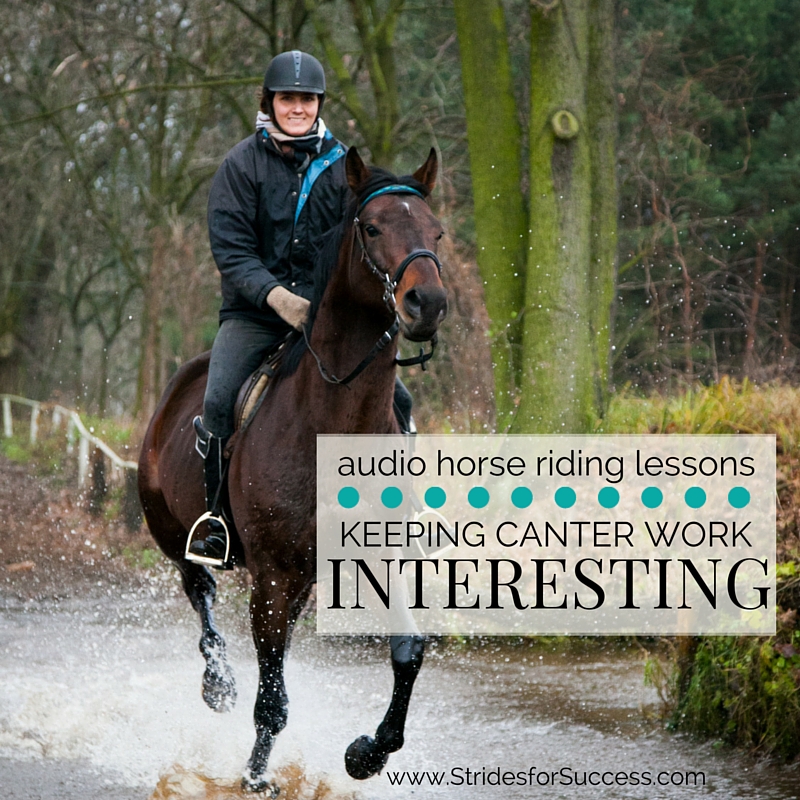
  • Keeping Canter Work Interesting

    Keeping Canter Work Interesting

    [fusebox_track_player url=”https://op3.dev/e/traffic.libsyn.com/dailystridespodcast/SFA316-Keeping-Canter-Work-Interesting.mp3″ title=”Keeping Canter Work Interesting” social_linkedin=”true” social_pinterest=”true” social_email=”true” ]

    I’ve often wondered what it is about the canter that makes riders almost seem to ignore it when schooling in the arena.  I see riders put so much time, care, and attention into the trot and to a lesser degree, the walk…

    But the canter is more often than not relegated to a few ‘laps’ of the arena and then back to more of the same with walking and trotting…

    In this week’s episode of the Daily Strides Podcast, we are focusing on some ways you can incorporate more canter work into your schooling sessions…

    Lateral Movement; Leg Yielding | Audio Horse Riding Lessons

    Canter work can require some serious work from both you and your horse.  It is easy to become tired while we are cantering and with tiredness comes a sense of complacency with the quality of the gait.   During this episode, we are covering four main points that will help keep you on track with your cantering and allow you and your horse to perform at your best.


    1. Establish Rhythm in Your Canter

    When you begin cantering initially I strongly suggest focusing on establishing a rhythm.  From here begin to notice when that rhythm and, later, tempo change and what may be causing this to happen.

    Pay particular attention to when ‘changes’ happen, such as a corner, a pole, or a jump.

    Being able to keep a consistent rhythm and tempo is vital to  good quality canter work.

    Ride a Rectangle or Square (not an oval)

    The second point we cover is when you initially begin canter work, rather than riding a large oval shape around the arena, ride a rectangle. This is obviously when you are going large.

    By making a dedicated effort to ride a rectangle (or whatever shape your arena is), you will use your corners and straight lines on the ‘long and short sides’.  

    This will give you the opportunity to use your half-halt before each ‘corner’.  And also work on your aids to help your horse remain balanced around each bend.

    3. Pay Attention to Your Body Riding Canter Work

    The third focus point is what your body is doing while your horse is cantering.  The fact of the matter is that the bounding feeling that we can get while we canter invites us to get slightly ahead of the movement…

    And as always, we cannot ride our horse while sitting on the neck.  

    So make a consistent effort to keep your position while you are working in the canter.

    4. Your Posture when Cantering

    The final point that we touch on today and to take into consideration is the position of your shoulders, seat bones, and legs while your horse is working in the canter.

    This is particularly important when you are beginning to feel tired…  

    This is when our lower legs can begin to swing backward and forwards.  It is also when we are more prone to collapsing our bodies and becoming ‘heavy’ in the saddle.

    I have included links to other more detailed blog posts and Daily Strides Podcast episodes to help you in your canter. You can also download a FREE EXERCISE to use with your horse HERE

    Happy Riding

    Lorna

    Additional Resources to Help with This Topic

  • Trotting Without Running

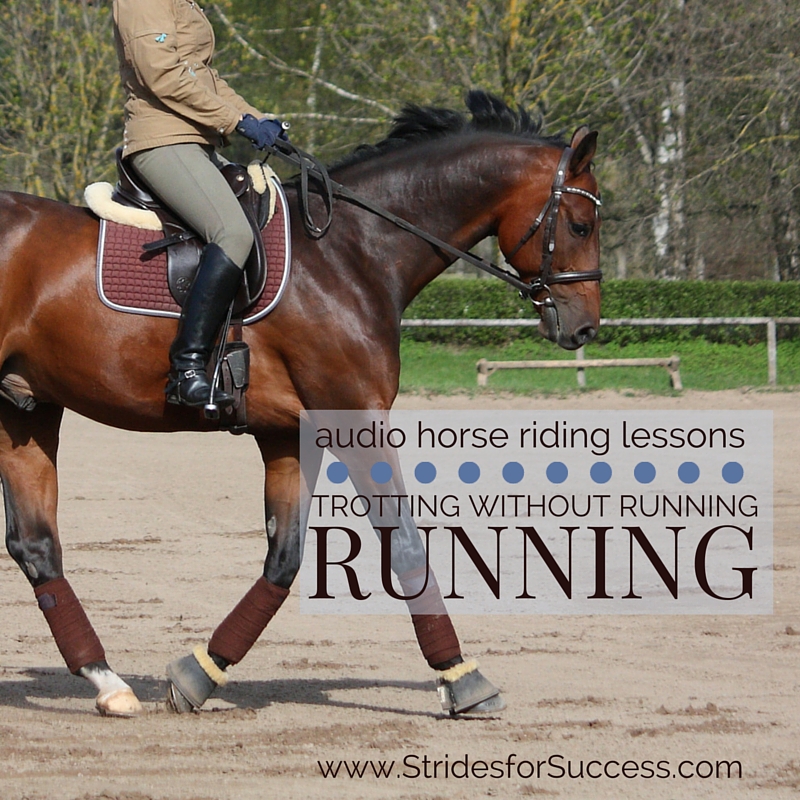
    Trotting Without Running


    Do you find that when you ask your horse for a more expressive trot, he just seems to begin running onto his forehand with you, becoming heavier and heavier with each stride? You’re not alone!

    Many riders set out looking to achieve an active, working trot… But due to lots of different factors, this can end up just ‘running’ around the arena. The horse resembling an arrow of sorts!

    The front end getting lower and lower with each passing stride, while the back end is getting completely left behind!

    Unfortunately, what usually happens next is the one thing that exasperates this ‘effect’ even further and that is hauling on the reins; dropping an anchor if you will.

    The reason this just makes the whole situation worse is by doing this, you and your horse begin to engage in a ‘tug of war’ of sorts. And, quite frankly, being involved in such a game with a 600 kg animal is an exhausting endeavor!

    Trotting Without Running | Audio Horse Riding Lessons


    Speed Versus Impulsion

    Often, as riders, we can confuse speed with impulsion…  We think that by asking for the trot to go 100 mph around the arena, we are really working our horses… Pushing forward with each passing stride.  The truth however is that while we may be creating energy, we are letting it all ‘fall’ out the front end of our horse, never contained and put to use in any form conductive ‘good’ work.

    The first part of mastering trotting without running is imagining in your mind that your horse’s back end is coming more and more underneath him… While his front end is becoming slightly higher and more elevated, as well as light in your hand.

    This is the picture you should work towards continually as you ride.  What is important to remember with this picture, is the ‘lightness in the hand’ part.  This cannot be achieved by hauling on the reins in the eternal tug of war.

    I challenge you to not only change how you think of working trot but also what you are physically doing with your body to ask your horse to begin using himself more.

    Happy Riding
    Lorna

    Additional Links to Help You:-