Tag: impulsion

  • Understanding How You Influence the Channel of Energy

    Understanding How You Influence the Channel of Energy

    [fusebox_track_player url=”https://op3.dev/e/traffic.libsyn.com/dailystridespodcast/1334_Positively_Influencing_the_Channel_of_Energy_for_Your_Horse.mp3″ title=”Understand How You Influence the Channel of Energy” social_linkedin=”true” social_pinterest=”true” social_email=”true” ]

    There is this lovely place that you will reach with your horse in your training where you are working together. Both of you are invested in creating a desired outcome. This point is usually when you can begin to create and maintain consistent contact. It’s like an unwritten agreement between the two of you.

    And once consistent contact is created and can be maintained for longer periods, you can then begin to think about how that energy will work for both of you from this point… 

    Impulsion is a word that is bandied about a lot when it comes to horses and riding. Many riders, incorrectly, associate it with speed. The faster you’re going the more impulsion you’re creating. However, this couldn’t be further from the truth… And how you influence the channel for this energy is where it all begins…

    This episode of the Daily Strides Podcast is the first in a week of 5 lessons about Engaging the Energy in a Correct Channel. If you would like the rest of the lessons for this training, you can get them inside of Daily Strides Premium.

    The Training Scale

    Before we go any further, I do think that it’s important for you to see where impulsion lies or comes in relation to the other training principles. Now, there are lots of different layouts for the traditional training scale, however, let’s take the most basic one (pictured below) and use that to see what’s what.

    Traditional Training Scale - Daily Strides Podcast for Equestrians

    A great way to think of impulsion is as being the channel to help you and your horse achieve more with the energy that you’re creating. It will channel the energy more specifically to where you want it to go and you influence this channel. It will also allow less wastage so energy can work for both of you rather than against you.

    Visiting Each of the Principles

    I am a big believer in visiting places. This is both in my day-to-day life (have passport, will travel!) and when it comes to training riders and horses. So often, riders hold themselves back from working on something because they have not yet 100% mastered something else. I think this hinders and slows down the progress and the understanding of horse and rider.

    I love using the straightness principle to explain this.  I think all horses can work towards straightness from day 1 of their training. Does it mean that they will master it? No, that takes years. But by regularly visiting it, it helps both horse and rider to understand the principle more. This is the same as impulsion. And when getting started with impulsion, I strongly suggest thinking about how you influence this channel of energy.

    If you were to only think about impulsion when you felt ‘ready’ to ride and maintain consistent impulsion, you would never actually get to impulsion…

    Through experimenting and visiting different principles you begin exploring how they work for you and your horse. And how you can work on improving them in your riding and training.  This is true for all horses, whether or not they are OTTBs.

    Feeling Nervous About the Possibilities

    One of the reasons riders shy away from visiting impulsion with their horse is because they worry about the consequences. Especially if their horse is known for having quite a bit of potential energy to work and play with. Ex-racehorses or OTTBs often fall into this category. Even before we explore impulsion, so many riders are afraid to ask for ‘forward’ in their riding.

    When riders either fail to ask for energy or block the energy that is being created by the horse, true forwardness and therefore, impulsion can not happen. Energy is absolutely essential. As too is allowing that energy to flow. 

    This is the same for all of the principles of the training scale. Energy is required. So my suggestion is to work on this first. Notice if you’re feeling any resistance or excessive tension to asking for more energy. And once you are certain that you are happy and able to allow it to flow, continue on with your work.

    Working in the Trot

    I suggest starting in the rising or posting trot. Begin riding an exercise where you travel down the long side of the arena on the outside track.  However, rather than simply going large, you will travel back up the arena on the quarter line.  Pass the middle of the short side first (so this could be the 3/4 line).  You are cutting 5m off the width of your arena.

    You can use the long side to correct and set things up for you and your horse. You can then use the quarter line to ‘test’ or experiment with how well you and your horse can maintain things. 

    You will then use the following principle of the training scale to begin testing if you can really maintain the impulsion while on the quarter line. This is straightness. The only way you can achieve true straightness is if you and your horse can truly channel that energy using impulsion.

    Any horse and rider can maintain everything when they are stopped and stationary. It is in the movement; the relaxation, rhythm, suppleness, contact, impulsion, and straightness that you really get to see what areas need work. 

    What To Look For…

    I’m going to suggest first looking at your hands. How are you carrying them and holding them as you travel down the quarterline with your horse? All of your aids influence the channel.  Many riders do so well until it comes to their hands. They then find that they are blocking the channel there. So open your hands a little wider than usual, maintain that lovely softness through the contact and that steadiness with your horse’s mouth.

    When you ‘straighten out’ your hands (meaning that they are equal and soft) you can engage the contact more.

    From here, open your chest and shoulders. Give your upper body the room it needs to move with the horse and use this energy. And then think about your core. Are you again opening it and allowing the energy to flow? Again, you can only work with the energy once it is flowing. You may notice that your hips and seat can swing more and become more of an active part of the conversation with your horse.

    Symmetry to Influence the Channel

    One of the final places where you can really be guilty of blocking this flow is through your posting. Often riders will twist their upper bodies or shove one hip slightly more forward than the other in the trot. Try and assess yourself to make sure that you are rising and falling equally on both sides of your body.  That your shoulders and seat remain aligned with the straightness at all times.

    By taking the time to really ‘straighten yourself out’ while allowing the flow of the energy, you will then be ready to truly begin to influence the channel. To better direct that energy to work for you and your horse. 

    We go into detail using more exercises on how to begin working on this with your horse in the following lessons to this episode. You can find all of them (and so much more) inside of Daily Strides Premium.

    Happy Riding
    Lorna

    Other OTTB & Impulsion Episodes to Help You

    Online Training to Help Your Riding

    Connect with Lorna online:-

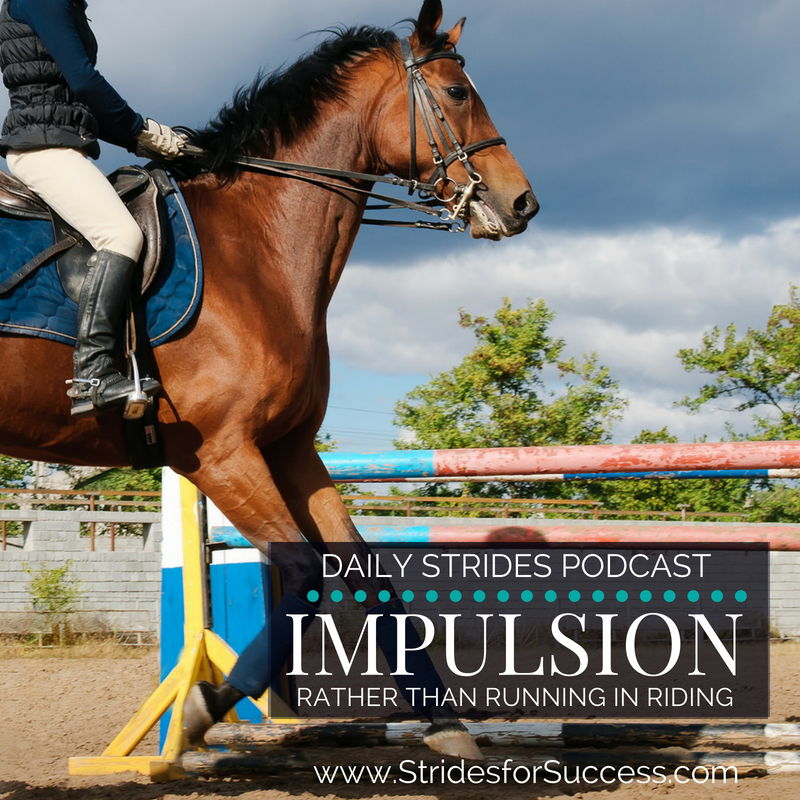
  • True Impulsion versus Running when Riding

    True Impulsion versus Running when Riding

    True Impulsion versus Running when Riding

    What this episode is all about & how it can help you:-

    • What is impulsion
    • What is necessary for you to maintain impulsion
    • How to know if the energy is “falling out”
    • Working towards consistent impulsion

    [smart_track_player url=”https://op3.dev/e/traffic.libsyn.com/dailystridespodcast/1053-True-Impulsion-versus-Running-in-Your-Riding.mp3″ title=”True Impulsion versus Running in Your Riding” social_linkedin=”true” social_pinterest=”true” social_email=”true” tweet_text=”Are you creating impulsion – or just ‘running’ in your riding?” hashtag=”Podcast #Equestrian” twitter_username=”strides_success” ]

    We have all been there…   In the saddle and wanting to do something.  You ask for ‘more’ but instead of being able to harness that energy, it tends to just fall out the front end!

    This episode of the Daily Strides Podcast is all about what impulsion is, and how you can use it in your riding.

    What is Impulsion?

    Impulsion is basically the energy that is created within yourself and your horse as you are riding, in order to do something. If you are moving forward with a sense of purpose, you have created energy.

    However, true impulsion is not just the creation of the energy, but the actual management of the energy.

    Having the energy to work with is not enough.  You must learn how best you can tap into it.  The energy must be a resource which you can use when you need it.  This can be a certain movement.  A specific question you ask your horse.  Maybe a transition or a jump.  A lengthening or shortening. All of these things, if ridden and performed correctly, need to have impulsion present.

    Impulsion versus Running

    Many riders go wrong by forgetting (or not realising) that true impulsion takes quite a bit of training in order to really master it. They create ‘running’, rather than true impulsion.

    Running and impulsion are two very different things.  What is necessary in order to maintain impulsion, the preceding ‘steps’ in your horses training program, are often missing or not well established.  It can feel like your horse is diving forward like an arrow.  The energy is present, however the management of that energy is lacking.

    True impulsion creates a feeling of lightness.  This is due to the presence of self-carriage from your horse.  Self carriage can only be developed with correct training over time…

    What is Necessary for You to Maintain Impulsion?

    One of the simplest ways to understand impulsion is to look at where it ‘resides’ in the steps of the traditional Training Scale.  The principles or steps that come before or underneath it need to be present in order for it to be present. Relaxation, rhythm, suppleness and contact.  Once those steps are present, then you can then begin working on true impulsion.

    However, I personally think that you can begin working on this from the beginning.  Forwardness is key in riding.  It is energy.  The true management that comes with impulsion may not be present, however cultivating forwardness the beginning of it.

    Before you work on anything else, it is important to ensure that both you and your horse are thinking forward. Again, impulsion is the management of forwardness.  In order to begin managing, you need to have something to manage – the energy.

    Recognising When the Energy is ‘Falling Out’

    As already mentioned, running feels very much like everything is falling out the front end. Sometimes it can look and feel like heaviness; carrying the weight of your horse on your shoulders!  Running is exhausting for both horse and rider.

    Running or falling out is your lack of any real influence or impact on what is happening with the energy.

    I hesitate to use the word control, simply because a lot of riders then feel that they need to control the situation. You can only control yourself.  You can never truly control your horse. You influence your horse. Which is why running is a result of not having the required amount of influence over the horse.

    Another way a lack of impulsion can feel is when there is nothing coming through. Sometimes there is not enough energy being created in the first place. There is nothing there to connect through. Falling out can also be through the shoulders, the hind quarters.  Anywhere that there is a lack of energy or management when it comes to the ride.

    How You Can Begin Working on Improving Impulsion

    I’m going to suggest the most obvious and less exciting path; the one of going back to basics! Begin working on the energy today, even if the basics are not in place. Work through your schooling movements with a focus on forwardness, which will eventually become true impulsion.

    Forwardness is to have your horse both moving and thinking forward. The ‘thinking’ part is very important. Many riders forget this, however it is a vital component to the horse moving and working correctly.

    Once you have established forwardness in all you are doing, then you can begin ‘tidying things up’. This is where your rhythm, relaxation, working into the contact, ensuring your horse is nice and supple and make sure he is working through his back all come into play.

    Incorporate transitions up and down.  Be mindful of when and how you apply your half-halt. The key is consistently riding through the basics correctly.

    Correct Management Depends on You

    Impulsion is management, and it is your ability to manage all those things. I believe that the training scale is just as important for riders as it is for the horses. Work on establishing YOUR rhythm, YOUR relaxation, YOUR suppleness.

    There must be a constant progress, building, happening in your riding. Strength comes from true suppleness. Make sure you understand fully what contact is, and that you are showing up each and every ride being the consistent contact.

    When those pieces are in place, you can then begin to effectively manage the energy as it is flowing through. That is true impulsion.

    Think of all the parts of your body that you are using to make a connection with your horse.  It is truly working with all your different aids to build both you and your horse that results in true impulsion.

    Happy Riding

    Lorna

    Links mentioned in the episode:-
    
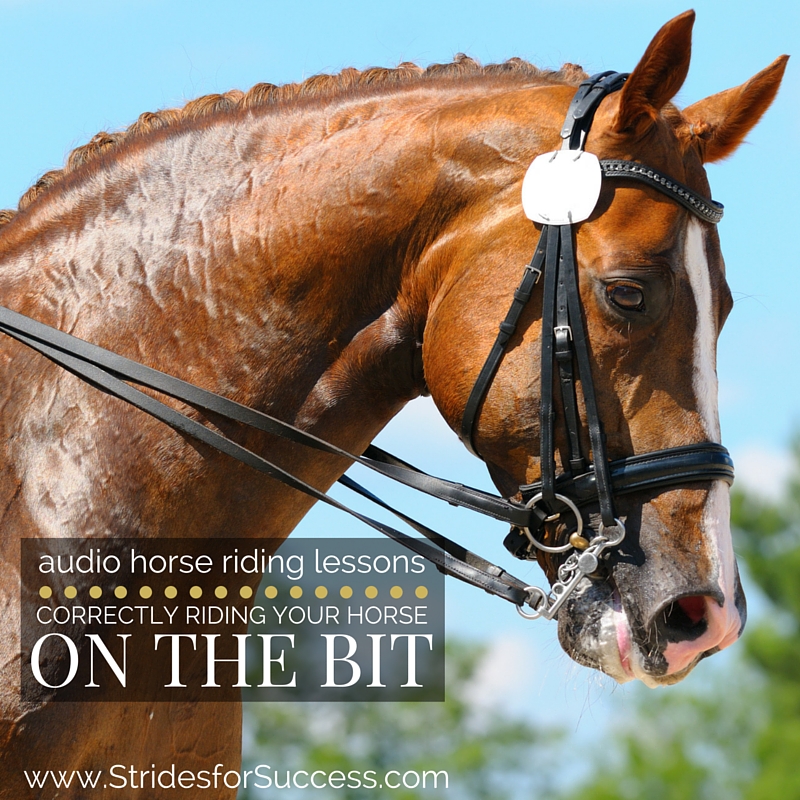
  • Assessing ‘On The Bit’ While Riding

    Assessing ‘On The Bit’ While Riding

    [fusebox_track_player url=”https://op3.dev/e/traffic.libsyn.com/secure/dailystridespodcast/576-Correctly-Riding-Your-Horse-On-The-Bit.mp3″ title=”Correctly Riding Your Horse ‘On the Bit’” social_linkedin=”true” social_pinterest=”true” social_email=”true” ]

    Left – Right – Left – Right – Left – Right…  The horse’s head turning one way and then back the other.  Every single stride.  A misguided attempt by the rider to achieve ‘on the bit’.  Have you ever seen this?   The horse looks like he is auditioning for the role of the bobblehead in the back window of someone’s car.  The rider looks like they are trying to get a ‘swinging’ upper body workout in with their riding… Left – Right – Left – Right – Left – Right…

    On the bit is a little like the holy grail of horse riding.  It is an ideal that most riders aspire to.  However, because it is more a result that is achieved through the culmination of hours of consistent riding; many riders will never truly achieve it because they are not willing to put the work in.

    Unfortunately, just like most highly desired outcomes, the eagerness to obtain it leaves the door wide open for endless counterfeit reproductions being passed off as the real thing.  One of those being that many riders are merrily sawing away at their horse’s mouths thinking they are indeed ‘on the bit’.

    What is ‘On The Bit’?

    It almost becomes easier to define ‘on the bit’ by what it is not, rather than what it is.  However I think we should always try to see the correct picture first and then hold those above-mentioned ‘counterfeits’ against it so we can see the differences.

    ‘On The Bit’ is when your horse is creating energy with his hind quarters, that is being funnelled along, through his back to the front end of his body, where it is ‘channelled’ into the contact with the reins and bit.

    What is vitally important to note is that the reins and bit part can only happen after the energy has been correctly manifested.  After it has been connected through the back.  Reins and bit are the final pieces of the puzzle rather than the starting points. This is what generally trips many riders up.

    No Sawing Required!

    Being ‘On The Bit’ has nothing to do with sawing your horse’s mouth, or pulling his head in (or up, or down, or anywhere for that matter!).

    It has everything to do with your horse using himself to the best of his ability and learning to carry both himself and you.

    The Pre-Requisites for ‘On the Bit’

    So before we even begin discussing how to achieve this contact and connection, let’s first begin by making sure all the prerequisites are in place. This will ensure both you and your horse have the best possible chance of correctly working on the bit.   It goes without saying that your horse must be moving forward.  However, moving forward correctly off your leg, rather than just running aimlessly around the arena is also a vital disparity to make.

    Moving off your leg will ensure that your horse is responsive to your aids and traveling with rhythm and balance.

    You ask, he responds.  If you are having to push for every stride, or if your horse has a little ‘think’ about actually doing what you want each time you ask, I would highly suggest working on his responsiveness first, before you begin anything else in your training.

    Connecting the Energy

    Once you have established forwardness, you can then begin working on allowing that same energy to connect through from the back to the front.  

    Horses should work in rear wheel drive, meaning that they push from behind rather than pull from the front

    However, this energy then needs to connect or move through the horse in order to ‘lift’ and carry the front half of his body along with him.  What a lot of riders don’t realize is that they are the actual cause or reason that connection or transference of energy is not happening.  Simply sitting heavily in the saddle, or slouching through your shoulders or upper body, is enough to shut down that flow of energy.

    Correctly Working Your Horse On the Bit

    Self Carriage for Riders First…

    To prevent this, I want you to think about sitting up through your waist and ribs.  Think of trying to elongate your torso.  Use your muscles to carry your upper body so it does not collapse on your pelvis and hips.

    Once you are carrying yourself, I also suggest paying attention to the distance between the point of your shoulders across your chest.  Notice how when you draw your shoulders together – and shorten this distance – it affects your whole body.  Be aware of keeping your chest open all through your riding.

    Many instructors will teach this as ‘Shoulders Back’, but I find that simply pushing your shoulders back rather makes your body rigid.  Opening your chest is a softer and more flexible movement.

    The Final Piece of ‘On the Bit’

    Once you have your horse moving forward in a responsive fashion, and the energy flowing underneath you connecting the hindquarters to the front end of your horse, you’re ready.

    The final piece of the puzzle is gathering or channelling that energy to where you want it to go. You do this using your contact

    Establishing and maintaining consistent contact with your horse is key to riding on the bit.  The contact should be elasticized and ‘stretchy’; your elbows being pliable and supple enough to literally hold your horse’s mouth in your hands.  Pulling, forcing, sawing or any other use of physical force will not allow the correct use of the contact.

    Developing Over Time

    Through working correctly, your horse will begin to become stronger through his body, and assuming you are carrying yourself while in the saddle, he will begin to lift his back as he works.  This lifting of his back will allow him greater connection from the back-end through to the front end.

    It will also begin to free up his shoulders a little more.  The less the shoulders are ‘pulling’ the more they can begin ‘swinging’ and from here your horse will begin seeking out the connection with your contact.

    It will feel like holding a one end of a skipping rope with another person.  Not gripping or pulling.  There is a mutual understanding. Both are willing to do the necessary to maintain the connection and move the rope where they want it to go

    Don’t make the mistake of becoming obsessed with your horse’s head carriage.  Remember, being on the bit is the result of working correctly over time in order to build and develop the necessary strength and trust with your horse.  Where and how he carries his head will be the result of both of you carrying yourselves correctly.

    Reestablishing On the Bit when Necessary

    Also remember to use your half-halt, both to set up your transitions or different movements.  And also to rebalance and regroup when things fall apart, which they will quite often initially.

    Be consistent with your contact through the outside rein, and soft – almost offering – of your contact through the inside rein.

    As your horse begins to spend more time working on the bit, you can use your inside rein to see his he is truly carrying himself.  Does he continue to move forward when you soften your inside rein?  If so, he is truly moving and working ‘On The Bit’.

    Happy Riding
    Lorna

    Connection for Equestrians

    I have created 5 audio horse riding programs on this subject.  They will take you step by step through working your horse correctly in order to achieve a consistent ‘On the Bit’.

    If you are interested in listening to these programs (and hundreds more) you can visit https://stridesforsuccess.com/join/ to find out more.

    Other Info On this Topic

    Additional Resources To Help Equestrians:-

  • Moving Off Your Leg

    Moving Off Your Leg

    [smart_track_player url=”https://op3.dev/e/traffic.libsyn.com/dailystridespodcast/SFA331-Getting-Your-Lazy-Horse-To-Move-Off-Your-Leg.mp3″ title=”Moving Forward off Your Leg” social_linkedin=”true” social_pinterest=”true” social_email=”true” tweet_text=”Struggling with a horse who ignores your leg? ” hashtag=”Equestrian #Horseriding #deadtotheleg” twitter_username=”strides_success” ]

    Is there a more frustrating and exhausting experience when riding to match that of being on a horse that is not paying you a blind bit of notice?!  You are on board kicking and pumping away.  And all the while your horse is just meandering along.  Ignoring you completely and acting as though he is on a relaxing Sunday outing.

    Training your horse to move off your leg will help you overcome the inertia.  It will also actively improve responsiveness in your horse.  Starting the very next time you ride. 

    Why Is He Ignoring Your Leg?

    It is always a good idea to first take a good, in-depth look at your horse’s health.  Rule out the possibility of there being something physically wrong that may be causing him to be so nonchalant and laid back.   Question whether or not the environment or weather could be contributing factors.  Or perhaps his fitness levels, or lack thereof?  Also, things like tack fit and confidence working on a particular type of surface or ground.

    Moving Forward off your Leg
    Once you have confirmed that he is fit and healthy and able for the level of work you are asking for, you can then begin to look at other factors.

        • Has he been trained to ignore the rider’s questions?
        • Is his rider asking correctly and then allowing him to go forward?

    Inconsistent Riding Aids

    Let’s first look at the fact that he may just be ignoring your aids.  Some horses will only do what is absolutely necessary for them to do. Surprise, surprise!  In a lot of instances, if they are not motivated sufficiently to go the extra mile, they won’t. Simple as!

    As riders, often we ride to enjoy ourselves and relax.  Unfortunately, during these rides, we can be a little ‘too relaxed’.  This is in both our communication and our instance of doing things the correct way.  

    The problem arises when we ask for ‘more’ and then get upset when our horse doesn’t want to actually do ‘more’ for us.  This is a direct result of our inconsistent riding and disciplining!  If this is the case, your horse is simply reacting to how he has been conditioned or trained by you, the rider.

    Nagging Riding Aids

    On the other side of this incorrect training are novice riders who, whether knowingly or not, consistently do too much in the saddle.  Whether it’s due to a lack of awareness, balance, or control over their seat and limbs, the result is the same.  Riders become the ‘dripping tap’ on their horse’s sides… Nag, Nag, Nag.

    Unfortunately, like the dripping tap, your horse will soon learn to completely ignore the leg aids.  ALL OF THE TIME!  So when you actually put your leg on to go forward, he just sees it as another ‘Nag’ and ignores it.

    One of the most important skills we can cultivate with regard to our riding is mindfulness.  Knowing what we are doing, when we are doing it, and why. 

    I also think it is worth mentioning that you must carry yourself, and your horse must carry himself while riding. This will help you to be more effective with your leg aids.  And your horse to become more responsive.  Both are necessary when moving off your leg is what you want to improve in your riding.

    Conflicting Riding Aids

    The last part of the equation is the fact that the rider may be giving conflicting instructions to the horse.  Using their leg while at the same time, using the hand for balance.  This is often due to a lack of independence in their seat.

    It is a common sight in arenas, the knee jerk reaction of the hand moving when the leg is used.

    Alternatively, instead of actually applying the leg when and where you should, riders often ‘polish’.  This is when, to ask a question, the rider allows their leg to swing back along the horse’s side.  It never actually does anything constructive except to shine a 6″ stripe on both sides of the horse’s body!

    The rider gets frustrated.  And their horse becomes confused. Luckily, being the kind soul he is, decides that if in doubt, rather don’t go or move anywhere! This is definitely not moving off your leg!

    In fact, he is now ignoring your leg at all costs… Which is the exact opposite of what the rider actually wanted in the first place! 

    Improving ‘Moving Off Your Leg’

    I have other resources on this topic, which have more detail on how to more effectively use your legs when riding.

    Choose one of the topics, go deeper and see what you can achieve in your riding.

    Happy Riding
    Lorna

    Additional Resources:-