Tag: intention

  • 15 Minutes or Less with Your Horse… For 90 Days?

    [fusebox_track_player url=”https://dts.podtrac.com/redirect.mp3/pdcn.co/e/traffic.libsyn.com/dailystridespodcast/1351-15-Minutes-or-Less-for-90-Days.mp3″ title=”15 Minutes or Less with Your Horse – For 90 Days” social_linkedin=”true” social_pinterest=”true” social_email=”true” ]

    Are you guilty of only looking for longer gaps of time to work with your horse? I mean, what could you possibly do in 15 minutes or less to move things forward, right?!  If this has been your thinking up to now, you’re not alone. I was guilty of this… To be honest, I think we have all been there. However, once I began to reframe what those smaller chunks of time could be, everything changed!

    Get the 50+ Inspiring Ideas to do with your horse when you find yourself with a small gap of timeCLICK HERE

    What would happen if you began seeing the value in finding small gaps of time to connect with your horse? Using short, focused time periods—15 minutes or less—can be a game changer for you, your riding, and your partnership with your horse.

    Here’s why becoming more intentional (and excited) about the odd 15 minutes or so a few times a week can transform everything for both of you.

    The C Word – Consistency…

    So many riders want to become more consistent. And, a lot of them want to swipe some magic wand and make it happen! It won’t. The only way to start becoming consistent is to be intentional. And doing short regular things with your horse are just that.

    Especially when you want to get started with something, the short sessions are easier and often more effective for both of you. And because they are more likely to get done, they create steady progress.

    Your horse probably loves consistency, most horses thrive on it. Use this to your benefit and begin using each of those 15 minutes or less gaps of time to build something together.  These small moments, when repeated, add up over time. It just requires you to have a plan for them.

    GET THE FREE DOWNLOAD, 50+ INSPIRED IDEAS & EXERCISES FOR WHEN YOU’VE 15 MINUTES OR LESS WITH YOUR HORSE BY CLICK HERE

    Focus on Quality…

    I’m going to assume that you have something you and your horse are working towards… If not, you now have your ‘Step 1’ ;) Once you know what you’re longer term vision is for you both, you can then begin thinking about ‘smaller steps’ that will compliment or act as stepping stones to that goal.

    Which activity will make more sense for your 15 minutes or less with your horse; something fun, partnership building, or a training related focus session?

    Keep in mind that shorter training sessions can often result in a breakthrough for you and your horse. We often think that the longer the ride, the better. But fatigue plays a big role in both of your work.  So by keeping the session short and sweet, often you can achieve more. Especially when you’re consistent with them.  This applies to all 3 categories; fun, partnership, or training.

    Get the 50+ Inspiring Ideas to do with your horse when you find yourself with a small gap of time CLICK HERE

    1. Fun

    Fun is enjoying the moment. The process. It is usually not an ‘end goal’ or ‘endpoint’.  We rarely say “I am struggling on through the mud now because I will feel like it was fun when I’m finished”. Fun is the actual activity. And, fun is for both horse and rider.

    It is something that you can do together and that has the single goal of allowing you both to enjoy yourselves and each other’s company.

    And please don’t make the mistake of confusing things that you enjoy  as being fun for all involved! You horse must enjoy the activities as well. I’ve created a free list with some ‘fun’ activities you can enjoy with your horse in 15 minutes or less when you CLICK HERE. Download it and put it somewhere you can quickly access when the next 15 minutes or so of ‘free time’ pops up for you and your horse :)

    2. Partnership

    No matter how long you have been working with your horse, you can always deepen the trust in your relationship. Short, meaningful interactions can really help to improve this bond between you both. And, strengthening the partnership will also help to improve the training. It’s a win, win :)

    By focusing your 15 minutes or less on strengthening the partnership, you can build trust, reduce anxiety, and increase your horse’s willingness to cooperate – especially in those less than ideal moments you encounter later.

    Your horse is always responding to your body language, mood, and energy.  By intentionally showing up with ‘partnership building’ in mind, you can strengthen the emotional connection between you.  I’ve listed some partnership building activities you can do with your horse in 15 minutes or less in a free download CLICK HERE

    3. Training or Developing

    This is exactly what it sounds like; activities that will help you or your horse to improve mentally, physically, or emotionally. And when it comes to training, I am a big believer in keeping things simple. Simple exercises that focus on simple outcomes. Having a time restriction of 15 minutes or less makes this even easier to apply!

    Often, if you are not seeing progress (usually because Fun and Partnership are not included in the plan), it feels ‘right’ to instinctively jump to complicated where training is concerned. Choose simple exercises and rather work on them through the filter of what you want to achieve in your riding.

    I am going to urge you think simple when it comes to training when working with your horse for 15 minutes or less. 

    Get the 50+ Inspiring Ideas to do with your horse when you find yourself with a small gap of timeCLICK HERE

    More Opportunities – and Flexibility!

    When you are planning out the coming week with yoru horse, actively look for those 15 minute or less time ‘gaps’. Shorter time blocks are much easier to make happen, especially if you’ve a busy schedule. And then decide what approach would best help you and your horse make the most of that time together.

    Stop waiting for a large chunk of free time, which for so many riders are few and far between! Rather begin looking for those smaller pockets of time where you can do something valuable with your horse.

    Whether it’s practicing groundwork, working on specific exercises, or simply grooming, you’ll find that you have more opportunities to interact with your horse throughout the week. And because you’re intentional, they will act as stepping stones to your longer term vision.

    Get the 50+ Inspiring Ideas to do with your horse when you find yourself with a small gap of timeCLICK HERE

    Your 15 Minutes or Less List

    Having a list of potential activities is a great way to get started with making the most of those smaller pockets of time. I’ve created one for you that you can download HERE for free. My suggestion is to print it off and then add to it over the coming weeks and months.

    When you begin to see the benefits of intentionally connecting with your horse during those smaller 15 minutes or less time pockets, you will actively begin searching for them in your week!

    Happy Riding
    Lorna

    More on This Topic:-

    Online Training to Help Your Riding

    Connect with Lorna online:-

  • Today’s Riding Plan for You and Your Horse…

    Today’s Riding Plan for You and Your Horse…

    [fusebox_track_player url=”https://op3.dev/e/traffic.libsyn.com/dailystridespodcast/1269_Todays_Riding_Plan_for_You_and_Your_Horse.mp3″ title=”Today’s Riding Plan for You And Your Horse” social_linkedin=”true” social_pinterest=”true” social_email=”true” tweet_text=”Step by Step ‘what to do today’ for exercising your horse” hashtag=”horsepodcast” twitter_username=”strides_success” ]

    “So, what are you planning on doing today?”. It’s a question I ask at least 5 or 6 times a week to different riders.  And, let’s be honest here, so often the answer is not all that great! “I’m not sure.  We’ll see when we start working.”  If that’s you right regarding your next ride with your horse, I am giving you ‘the look’!  The look I reserve for riders who say they want to achieve and do all of the things… But they continue to wing it when it comes to their training and their responsibilities as the trainer for their horse.

    So, rather than just moan, I am going to give you a step-by-step riding plan today that you can follow so you can truly make the most of your next ride with your horse :)

     1. Pick a Filter While Tacking Up

    Now, this may seem a little random, but if this plan is going to work and actually help you and your horse in your riding, you MUST do this part. So, what’s a filter?  This is the overall theme or intention for your session together.  There are many things that this could be, it will really depend on where you are in your training and what you and your horse need right now.

    A few examples of ‘filters’ for your riding are:-

          • establishing and maintaining correct relaxation throughout
          • developing suppleness through staying ‘on track’ (no falling in or out)
          • increasing responsiveness to a split second (I ask, and she/he responds appropriately)
          • improving accuracy in the timing of my aids
          • refining my aids so all become more subtle
          • cleaner transitions
          • maintaining rhythm before and after transitions
          • improving self-carriage and better contact


    The list is endless as to what you want to focus on.  However, it is absolutely essential that you choose something to focus on.  Otherwise, you will just be riding through the motions aimlessly.

    Click here to subscribe

     2. Riding Plan; Minutes 0 – 10

    This is the warm-up.  If you’re really keen to improve things, you will actually have completed a quick ‘stretch’ of your own body BEFORE jumping into the saddle.  But, either way, the goal for the first 5 to 10 minutes is to get the blood flowing in your horse’s body and your body.

    How long you spend warming up will depend on your situation. Some horses need longer and this will depend on many factors. When in doubt, go longer! 

    While warming up, use the time to begin ‘syncing’ your movements to your horse.  Focus on identifying when each of your horse’s hind legs is moving, and where, and notice how this feels in your seat. This will become very important later.

    Also, work on moving forward and, during the second half of this warm-up, begin ‘fine-tuning’ the responsiveness between you and your horse. 

    For this warm-up I suggest:-

          • Walk 2 circuits of the arena on the left rein
          • Walk 2 circuits of the arena on the right rein
          • 20m circle – x2 in the walk on the left rein
          • 20m circle – x2 in the walk on the right rein
          • BEGIN PICKING UP MORE CONTACT WITH YOUR HORSE
          • Walk a figure of 8
          • Go large again on the left rein
          • Walk to halt to walk transitions (10 strides walk to 3 seconds of halt)
          • Change rein across long diagonal
          • Again, walk to halt to walk transitions (10 strides walk to 3 seconds of halt)

     3. Riding Plan; Minutes 10 to 15

    From here, in your riding plan, you can begin to work in trot. I always like to start off in the rising trot (posting to the trot). I feel that it gives both horse and rider more of an opportunity to warm up and begin working together. Focus on both your rise and your ‘fall’ (the ups and the downs).

    When in the rising trot, keep the idea in your head that you are ‘creating space’ under your backside and saddle for your horse’s back to move into. Keep your movements as light as you can…

    Also, remember to keep the energy and thinking moving forwards. Rather have things a little ‘sloppy’ initially but with the energy of ‘forward’ and then tidy it up later as you really begin to engage and work.  Looking for everything to be polished from the start often leads to the energy becoming ‘stuck’.

    So, in rising trot, you can ride a:-

          • 20m circle x3 on the left rein
          • go large on the left rein
          • change rein across the long diagonal
          • on the right rein ride the short side and up the long side of your arena
          • 20m circle x3 on the right rein
          • go large and then at A or C begin a three-looped serpentine
          • on completion go large
          • change rein across the long diagonal
          • track large on the left rein
          • at A or C ride three looped serpentine

    Click here to subscribe

     4. Riding Plan:- Minutes 20 to 30 (or 35)

    Once you are warmed up, this is where you can begin to transition into the ‘work’ part of the session.  This is where you will ask specific questions, and look at what happens as it relates to your theme or focus for the ride.

    So, for example, if the focus was on maintaining rhythm before and after transitions, you can begin asking for intentional transitions between trot and walk, walk and halt, halt and walk, walk and trot, and trot and canter. By working up and down the scale between the different ‘gears’ with a specific focus on maintaining rhythm, you will work on improving each transition you ride or ask for.

    I suggest keeping the exercises as simple as you can; rather let the focus be on the quality of the work.  I also think 2 to 3 different exercises are more than enough during this part of the training. 

    So, you could ride the previous ‘layout’ again, but this time adding transitions or lateral work, or whatever movements you feel will help you reach your intended outcome or goal. The key is having something planned BEFORE you reach this part of the work.  By building to something intentional, you will be more inclined to use the warm-up as a base.

    Remember, there shouldn’t be a marked difference between ‘end of warm-up’ and ‘start of training’. They should just blend together and flow from one into the other. 

    So my suggestion for this part of the ride are:-

          • 3 to 5 minutes on exercise 1
          • A short break for you and your horse
          • 3 to 5 minutes on exercise 2
          • A short break for you and your horse
          • 3 to 5 minutes on exercise 3

     5. Riding Plan:- Minutes 35 – 45

    This is where you transition into the cool-down period.  Now, sometimes, depending on what you are working on, there may be a very definite ‘stop work’ part of your ride.  This often happens if you have been jumping.  You will ride the final exercise, grid, or track, and then finish ‘working’.

    However, if you are working on flatwork, you can actually make more of a gradual transition into the cool down and ask for more stretching from your horse.  Many riders will associate this type of transition with working ‘long and low’. That is also okay. And remember, just like when you were warming up in the trot, think about allowing ‘space’ for your horses back underneath you.

    During the cool-down, you may find that moving out of the arena can help your horse to mentally ‘finish up working’. This can also be helpful for the rider.  

    Regardless of what you choose to do, the goal here is for your horse’s heart rate to return to normal and for him to stretch things out a little.  I also find that this is a great time for the rider to reflect on the training session and make mental notes of what was important.  Of course, all of this information will then be recorded in their riding journal… Nudge nudge!

    1269 - Today's Riding Plan for You And Your Horse

    Adapting This for Your Horse

    Now, obviously, this plan must be adapted for your horse and the level of training he is comfortable with.  This plan assumes that your horse already has achieved a certain level of fitness and is working at a certain level in his training.  Unfit or very young/green horses should not be worked for long periods; slow and steady wins.

    Using this basic riding plan, you can begin to tweak it as needed so that you have a clear focus for working with your horse. It will allow you to focus on the quality of the work, rather than worrying about what you have to do! 

    Make sure you record how it went so that you can begin to see patterns over time. This will further help you to discover what works for your horse – and you.  You will also begin to see what needs to change regarding your training sessions.

    Happy Riding
    Lorna

    Click here to subscribe

    More on this Topic:-

    More Training & Support

  • Have More Success When Training Your Horse Alone

    Have More Success When Training Your Horse Alone

    [fusebox_track_player url=”https://op3.dev/e/traffic.libsyn.com/dailystridespodcast/1254_More_Success_When_Training_Your_Horse_Alone.mp3″ title=”Creating Success When Training Your Horse; Even When Working Aone” social_linkedin=”true” social_pinterest=”true” social_email=”true” tweet_text=”Here’s a step by step to use when training your horse alone” hashtag=”horsetraining” twitter_username=”strides_success” ]

    Are all the months starting to look and feel the same for you and your horse? Especially if you have been training your horse alone! Have you been experiencing a case of ‘same ride again’ on repeat, over and over again?  If so, here are 5 tips to help you to achieve more when training your horse.  Especially if you are working alone without a trainer or a coach to help.

    More Success When Training Your Horse Alone

    Let’s be honest here, we all want ‘more’.  We want to do things in as little time as possible, and in the easiest way possible as well.  And while the following pointers will certainly help you to do this, it is also really important to remember 2 other key ingredients when training horses.

    You must factor in time and consistency when working with your horse. If either one of those is missing, any results you achieve will most likely be short-term.

    So, while you begin working and using the following formula for each training session, make sure you are coupling it with those two most important of important elements as well.

     1. Focus on One Thing

    This is one of those ‘simple to say, but not all that easy to do’ things when it comes to riding. I mean, how hard could it possibly be to focus on one outcome for each ride?  Oh… More difficult than you think!

    Distractions are everywhere when working with your horse. You will notice ‘other things’ that need attention literally crop up around every single corner! 

    One of your greatest responsibilities as your horse’s trainer is deciding if each of those ‘other things’ is something that needs to be worked on immediately when training your horse alone.  Is it something that, without first really working on it, will actually prevent you from whatever it is you do want to achieve in that ride? Or is it something that can be the focus of another training session at another time?

     2. Be Intentional Before You Mount Up

    Regardless if you give your horse a 10-minute’ lick and a promise’ groom, or a 30-minute luxurious make-over, there is always more you can do inside of each session.  When you know what you will work on in the arena, you can begin to incorporate elements into your time before mounting up.

    For example, if your focus for the upcoming training session together is to create cleaner transitions into the canter, you could work on a little responsiveness while grooming.  Things like asking your horse to move ‘over’. Or asking for him to move ‘back’.

    It is worth remembering that you are ALWAYS training your horse, alone or not. From the moment he knows that you are there, the conversation has begun… 

    1254 More Success When Training Your Horse Alone 2

    3. Use Your Warm-Up

    The first 10 minutes of each ride with your horse have the potential to set the tone for whatever follows. So rather than letting it all unfold by chance, it makes sense to become more intentional with it.  If you already know what you will be working on inside of the actual working part of your riding session with your horse, use this time to visualize how it will look and feel when you achieve it.

    One of the best things we can do to support ourselves as riders is to begin taking the actions of someone who has already achieved what we want. 

    Maybe that looks like sitting up taller.  Or use the time to ‘fine tune’ your position and aids. It might involve some breathing exercises.  Closing your eyes and really get to feel what your horse is doing underneath you. The list is endless, and we have not even begun to mention your horse in the list!

    Your warm-up and cool-down periods are valuable time you can work on improving, connecting with, or developing your relationship with your horse, or your skills as a rider. 

    4. Dedicate 15 to 20 Minutes

    I think the biggest mistakes riders make are doing too much in a single session and then losing hope when they cannot sustain or see the results they were after for very long.  As I mentioned at the beginning, when you’re training your horse alone, time is an important part of the process.

    You will achieve more when training your horse alone if you can create more short, quality, focused sessions together. Rather than long, tiring rides that are too far apart. 

    When you know what you want to work on, commit to 15 or 20 minutes of quality work on it.  This will allow both you and your horse to develop your concentration, physical strength, and fitness.

    Regularly doing things will also allow you both to develop your confidence; in yourselves and each other. Both are key when successfully training your horse alone.

    5. Keep Track of Your Training

    Finally, as your horse’s trainer (yes, you are!), it is your responsibility to record and track your rides and your progress.  Relying purely on feelings and emotions when it comes to training is a recipe for disaster.

    It is only when you have actual evidence of each ride, and you review this evidence, that you can begin to see patterns that you can use to make even more progress. 

    It is also worth noticing what happens after you track for a significant period of time; your ideas about what works and what doesn’t become more clear.  You will begin to instinctively know, without even having to think, what to do in most situations you find yourself with your horse.

    The longer you track, the more you can begin to trust your feelings and emotions regarding your riding… And more ‘in tune’ you will become with both yourself and your horse. 

    For me, that makes all of the effort initially required to track worthwhile :)

    Happy Riding
    Lorna

    Find in the Gaps In Your Horse’s Training

    If you are interested in learning more about where you might be missing pieces in your riding, sign up for my new free training “ FIND THE GAPS IN YOUR HORSE’S TRAINING.  This audio training can be listened to, via podcast app, to help you figure out where to begin working with your horse.

    You can sign up and get it, for free, HERE

    More on this Topic:-

    Get Support & Guidance in Your Riding

  • A Warm Up Plan that Gets Results in Your Riding

    A Warm Up Plan that Gets Results in Your Riding

    [fusebox_track_player url=”https://op3.dev/e/traffic.libsyn.com/secure/dailystridespodcast/1215_Creating_A_Warm_Up_that_Gets_Results_in_Your_Riding.mp3″ title=”Creating a Warm Up Plan to Maximise Results in Your Riding” social_linkedin=”true” social_pinterest=”true” social_email=”true” tweet_text=”Make your warm up with your horse go so much further with these simple tips…” hashtag=”equestrianpodcast #horsepodcast” twitter_username=”strides_success” ]

    What would happen to your riding if you began to put a little more effort and intention into each warm up?  Many riders are literally setting a timer for each warm up.  5 minutes of walking, followed by some trotting and maybe a canter or three…

    Your warm up is a way to set the tone of the whole conversation with your horse.  Whether that is a groundwork session, a lunging session, a ride in the arena, or a ride on the trail.  

    By setting an intention and then tweaking your actions based on the results, you can literally change the whole ride.  Here is how I suggest getting started with creating a better warm-up in your riding.

     1. Have a Clear Intention for the Session

    Riding for the sake of riding doesn’t work.  It may be fun in the short term. However, over time, that excitement and fun will wane.  This is where having an intention for each ride becomes so important.  If you are feeling a little lost about this, use this FREE PLANNER to help you.

    Once you know what the desired outcome is for the session or ride, you can begin to tailor a warm up that will help to support that. 

     2. Set the Tone for the Conversation

    Different goals or intentions require different energy levels and rhythms.  I am a firm believer in using every part of the interaction to grow and develop the conversation.

    Your conversation begins with your horse as soon as you become aware of each other. Use this time as an opportunity to set the tone.

    Think about what it is you want to achieve in your ride.  What sort of energy and rhythm would support this? Be intentional with every action you take in order to create a rhythm that will work for you.  Your actions while grooming, your breathing. Also, remember to be consistent with your voice and tone.  All will help to set the next part up in the ride.

    If you fail to be intentional here, very often you will find yourself aligning with your horse’s energy.  And, sometimes, this is not the energy we want for the conversation!  

     3. Your Warm Up

    Riding for 10 minutes on a loose rein is not really warming up.  Yes, things are moving and blood is flowing… However, it is not really working towards anything.  In fact, just riding a specific number of laps or circles in a certain gait while warming up will usually result in the first 10 minutes of ‘work’ being the real warm up!

    Think about what your desired outcome is for the ride or session.  What can you do in those first 10 or 15 minutes to help get you and your horse working together?

    Now, I am not saying that it is wrong to ride four 20m circles on the right rein; and then repeat on the left…  However, I am suggesting having a very specific reason for riding those 4 circles.  Maybe it is to develop forwardness?  Or it could be to work on responsiveness.  Coordination (whether it be the horse, the rider, or both) is also a helpful focus.

    Your warm up is where you and your horse tune things so that you can really ‘play together’ when the actual work begins.  The question is, what will be the most beneficial element of the conversation to tune-up?

     4. Keeping Track of your Warm Up

    Finally, in order to see what is really working for you and your horse, you need to record your warm up.  I am hoping that you are keeping a riding journal?  If not, HERE’S why you should!  But assuming you are, you can begin to see what is helpful, and what’s not.

    Knowing what works for you and your horse will allow you the ability to create a routine. The routine is great to begin helping both of you focus on the upcoming session or work. 

    Be consistent with creating 3 or 4 different types of warm ups, with each leading to a different type of ride. Create a warm up for jumping.  Or a warm up for flatwork.  Lunging, hacking, groundwork, dressage, showjumping, cross country, trails, and all of the things can have different warm ups.

    • The routine of a warm up that works, will help to focus and settle both of you. This is particularly helpful if you are in a strange place (competition, clinic, etc.) or if there is any excess tension present.

    Play with What Works Best for Both of You

    My final piece of advice is to be strategic with any changes you make once you have found something that works.  Notice the result or outcome from each ‘change’.  Anything that improves focus, intention, and overall movement is a bonus.

    Your warm-ups have the potential to transform your rides or session with your horse.  However, you have to first be intentional with what you are doing and asking. 

    I am going to challenge you, this week, to be thinking about each conversation with your horse.  What can you change, become more consistent with, start doing, or stop doing to help improve your warm up?

    Happy Riding
    Lorna

    Additional Resources:-

  • A Plan for 7 Days in Your Riding

    A Plan for 7 Days in Your Riding

    [fusebox_track_player url=”https://op3.dev/e/traffic.libsyn.com/dailystridespodcast/1171_A_Plan_for_7_Days_in_Your_Riding.mp3″ title=”Create a Plan for 7 Days in Your Riding” social_linkedin=”true” social_pinterest=”true” social_email=”true” tweet_text=”What are you doing this week with your horse?” hashtag=”equestrianpodcast” twitter_username=”strides_success” ]

    What will you be doing with your horse this week? Seem’s like an innocent enough question… ‘Ah, a bit of this and a dash of that’…

    And there is the problem. If you committed to actually planning out the answer to this question for the coming 4 weeks in your riding, you can, potentially, change everything.

    The Same Thing = The Same Result

    So many riders are doing the same thing, day in and day out, and then feeling frustrated by the lack of results.

    They go out there, day after day. Clock in their respective rides. For some, it might be 4 a week. Others might be happy with 2 a week. There is a feeling of accomplishment having ‘gotten in’ the two or four rides for that week. But what has really changed? What was intentional? Focused?

    And are your results merely reflecting your lack of doing anything different?

    Is it possible that you are, in fact, seeing results? You are failing to see them because they are simply the same ones you’ve been seeing for quite a while now… Doing the same thing over and over will achieve one result. The same one! Expecting anything different is wishful thinking!

    No Magic Portals

    As I write this, close to the end of October 2020, there are no portals that I know of. No quantum leaps or jumps that will take us from where we are to where we want to go. You cannot click your fingers and magically be at a different level in your riding or your abilities as a rider.

    The only way to get from Point A to Point B is to create a plan and then take action on that plan.

    I think what holds riders back with regards to their plan is the details. We tend to get too caught up in them. This causes two things to happen. 1. We simply stop taking action because it seems too complicated. 2. We put the plan into action because all the details are not yet ironed out.

    Creating CheckPoints

    This is where I believe checkpoints are important. Points that you know you have to reach in order to get to the bigger goal. How you get to those points is open to suggestions. There are many ways. And you must first make it to one point before really committing to how you’re you going to get to the next.

    Have a few key checkpoints identified for you and your horse. Then simply focus on the details regarding getting to the next one.

    One Week In Advance

    Once you have your loose plan and your identified checkpoints, you can then begin looking at the coming 7 days. Yep, only 7. The coming week. Sit down somewhere at the beginning of your week and plan out the next 7 days in your riding.

    Start by identifying what days you can actually work with your horse.

    Have a rough idea of how long you will have on each of those days. If there are days where you can only realistically get 45 minutes, begin thinking about what you can do for those 45 minutes to help you reach that next checkpoint.

    Your whole plan for the coming 7 days should center around two key elements; having fun and reaching your next checkpoint

    That’s it. Nothing fancy and definitely nothing that will only be really useful 4 checkpoints on from now. Keep it all simple and watch how it helps you move forward.

    Consistent for 4 Weeks

    I suggest an initial 12-week plan to all of my riders. However, if you have not done this before, I am going to ask you to give it a go for 4 weeks. If you are consistently doing things for 4 weeks that are moving you towards one specific checkpoint, you will see results in your riding.

    Success is simply doing the right things consistently. The right things are the ‘next steps’ to get you to that very next checkpoint.

    If you would like help with this, join Connection for a month. Connection is my online membership for equestrians. In there you will not only get a riding plan for the month but audio training you can use while riding to keep you focused and moving forward.

    Happy Riding
    Lorna

    Additional Resources for Equestrians

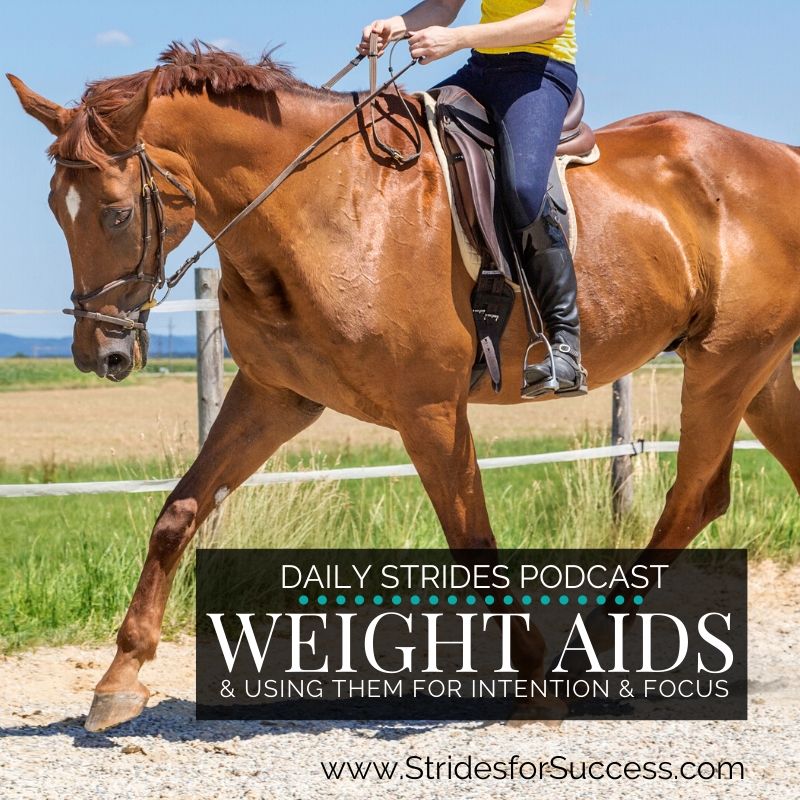
  • Weight Aids & using them with Intention & Focus

    Weight Aids & using them with Intention & Focus

    Weight aids are often overlooked and underused by many riders.  I want to help you begin to see how powerful your weight aids have the potential to be in your riding.  I also want to use your weight aids to see demonstrate how power intention and focus have on your goals as well.
    Less is more where your weight aids are concerned.  Unfortunately, many riders seem to throw everything they have behind a weigh aid when they think they should apply one.  All this serves to do is unbalance both horse and rider.
    [smart_track_player url=”http://traffic.libsyn.com/dailystridespodcast/1126-Weight-Aids-Intention-and-Focus.mp3″ title=”Weight Aids and Using them with Intention and Focus” social_linkedin=”true” social_pinterest=”true” social_email=”true” tweet_text=”I’m going to challenge you here; I want you to see the connection between how you approach your weight aids in the saddle & how you approach your goals…” hashtag=”Equestrian” twitter_username=”Strides_Success” ]
    Your goals are similar.  If you put all your focus and attention on a single goal, you will soon find that life, in general, will become unbalanced.  And this can go against how many of us feel when we set goals.  We get all caught up in the initial enthusiasm of the potential outcome, often to our own detriment.

    Finding Balance

    Balance means that you have a center point where you feel happy.  As everything is moving and you are moving with it, you will make continuous small adjustments to make sure that you return to ‘balanced’ all the time.  Small little ‘course corrects’ that helps everything work together.
    In riding, I call this the ‘balance of aids’.  Yes, there may be a ‘leading aid’, however, all the other aids have supporting roles in order to keep the balance.
    Life is the same.  If you choose a single goal and decide to just focus all of your intention and energy on it, the rest of your life will suffer.  It may be able to sustain for a while, but sooner or later, things will begin to show the strain of this unbalance.

    How Most Riders Apply Their Weight Aids

    Next time you’re in the saddle I want you to do a little experiment…  I want you to ‘weight your inside seat bone’.  This is something most riders will have heard and tried to do at least once or twice in the saddle before.  What usually happens is riders go about weighting that inside seat bone with great gusto!  They literally throw everything they have onto the one seat bone.
    The result is that the now completely disregarded and ignored ’ non-weighted’ seat bone is just that – bearing absolutely no weight at all.
    In fact, I have seen where the ‘unweighted’ side of the riders ‘bum’ has daylight between it and the saddle…  This is definitely not a ‘balance’ of aids.  It is applying too much focus and directing too much attention at one aid.  Resulting in all the others being ignored – until they can’t be ignored anymore…
    The lack of balance caused by this overweighting of the seat bone also usually results in the rider twisting their body in order to remain upright and in the saddle.  They have lost alignment.  Their body will, automatically and without conscious thought, work at keeping them in the saddle and off the ground!

    Versus How You Can Apply Your Weight Aids…

    Okay, once you have experienced the thrown everything bar the kitchen sink approach to your weight aids, I want you to now try the opposite.  Sit back up straight in your seat.  Make sure there is an equal amount of your body either side of the center of the saddle; meaning you’re not crooked or leaning.
    Become aware of how your seat is in contact with your horse.
    Use this to shift your awareness to your core. Pay attention to how, if you engage your core, you can begin having a subtle, but real, effect over your seat bones. Bring your attention to your shoulders and hips.  Keep them aligned and focused on where you are going.  You can also think about your legs and heels.  Feel how the weight is distributed.
    Invest some time playing with how, by engaging specific areas of your body in a conscious, yet subtle way, you can weight your seat bones while still allowing the rest of your aids to play their roles.

    Approach Your Goals the Same Way

    Enthusiasm is great and will often help you gain momentum on specific goals, especially more difficult ones.  However, just focusing on one thing for any prolonged period of time will enviably result in you ignoring or neglecting other areas of your life.  I see this happen with many riders; particularly when the new year rolls around.
    Riders create goals that demand too much of their time, attention and resources if they are to be achieved when and where they want them to be
    This ‘lopsided’ approach ends up in the riders being unable to maintain their focus for any real length of time.  And this is where riders complain that they are not able to ‘make progress’ or ‘reach their riding goals’.  It is important that the goals you are setting are goals that both support and will be supported by the rest of your life. Your current lifestyle, resources, and schedule.
    The key to creating successful goals as a rider is to choose your equestrian goals so that they work with the rest of your life.  Rather than compete with the rest of your life…

    Go Find a Swing to Practice On…

    Here at Strides for Success and on the Daily Strides Podcast, I devote a lot of time helping riders to understand how to channel energy in the saddle.  How to direct the energy they are creating with their horse in a way that gives them the outcome they desire.  It is a pretty basic element of riding and one that must be refined if you are to make progress with your horse.
    Your weight aids are a great way you can begin to more effectively ‘channel’ the energy you and your horse are creating when you ride.
    I would love it if, sometime in the next 24 to 48 hours, you can go sit and ‘play’ on a swing.  A real-life ‘seat with two ropes tied out of something high’ swing. Notice how, first of all, you don’t actually need to ever put your feet on the ground to get you going, stopping or just swinging.  Your body, and more importantly, your weight, can do all of that if used effectively and correctly.
    Also notice how, if you ‘weight’ one of your seat bones, you can twist the swing.  The twist can be a little or a lot depending on how much weight you’re throwing on that seat bone and when you are doing it.  Once you have noticed all of this and you experience firsthand how powerful your weight and focus can be, begin ‘playing’.  Engage your core.  Make the movements more subtle.  Work with energy.  Then work against it.

    Take This Knowledge Back With You In the Saddle

    All of this can also be achieved by you in the saddle.  You just have to first believe it and then actively begin practicing and working on it.   When you’re on the swing, pay attention to how you are using your body to make those changes happen.  What muscles you are engaging in and in what sequence and combinations.
    Play and experiment with how much change you can have over the swing and the energy by just mindfully using your intention and your weight.
    Then do the same thing the next time you are in the saddle.  Play with your intention.  Experiment with your weight.  Notice how your horse responds and look for ways you can refine things with each ride.  Also, keep in mind that if you have been ‘throwing your weight around’ up to this point, your horse might just ignore those more subtle requests initially from you.  He simply won’t know he is supposed to pay attention to them. This is, again, where your balance of aids is so important.
    Use your other aids to tell your horse that the conversation has changed and that you are now focusing on being a little more responsible where your weight aids are concerned!

    Responsible Goal Setting for Your Riding

    My goal with this episode is to show you how, sometimes, being a little too enthusiastic with our riding goals is actually the reason we fail to achieve them.  I want you to think about your weight aids and how less is more.  Apply this same approach to your riding goals and see what happens.
    Maybe you can ‘stretch’ the timeline a little further.  Or it might look like setting a goal of riding 3 days a week, rather than 5.  It could even be a goal for spending one day a week just enjoying your horse’s company.
    Whatever your goals are for the coming year and beyond with your horse, I hope that this will help you to set ones that you enjoy working towards as well.
    Happy Riding
    Lorna

    Resources to help you with this topic