Tag: jumping position

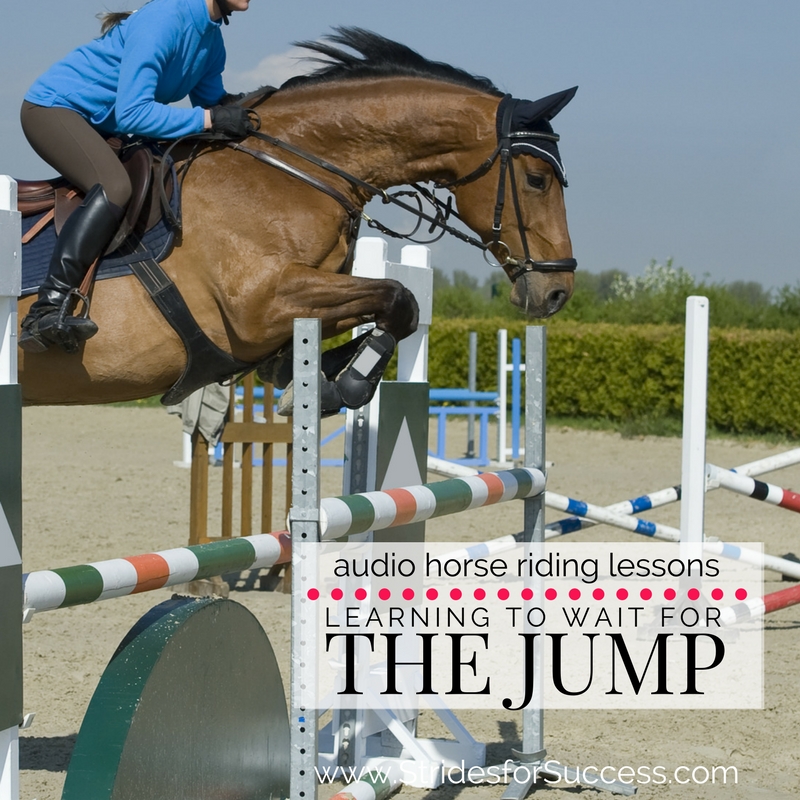
  • Learning to Wait for the Jump

    Learning to Wait for the Jump

    Learning to Wait for the Jump


    What this episode is all about & how it can help you:-

    • Understand why timing matters with regards to confidence
    • Modify your position depending on the jump
    • Working on the ‘wait’
    • Follow, rather than go first

    [smart_track_player url=”https://op3.dev/e/traffic.libsyn.com/dailystridespodcast/1031-Learning-to-Wait-for-the-Jump.mp3″ title=”Learning to Wait for the Jump” social_linkedin=”true” social_pinterest=”true” social_email=”true” tweet_text=”The art of letting the horse go first over the jump!!” hashtag=”jumping #equestrian #horseriding” twitter_username=”strides_success” ]

    The jump is in sight.  You have choosen your line.  However, as you approach, you notice some anxiety creeping in to your mind regarding timing.  Why?  Because, every now and then, you and your horse just don’t seem to go over that fence together!

    Today we are talking timing.  Timing your jumping position when it comes to going over fences.  Specifically, make sure you are not going into your jumping position too early.

    Why Your Timing Matters with Regards to Confidence

    Arriving at the base of the jump already ahead of the movement has a huge impact confidence, for both horse and rider.  It can quickly erode trust and make both sides feel anxious when they see a jump.  The reasons are different for both horse and rider, so let’s look at them one by one.

    We will start with the horse.  Horses, particularly young or green horses rely on the riders guidance and support going over the jump.

    This support is just as much an emotional or mental support as well as physically supporting him through the connection and contact.  All parts of your body that are in contact and communicating with the horse.  Your legs, your seat and of course your voice plays a part.  Obviously, the hands and the reins are also a big part. 

    When the rider goes into the jumping position too early, the horse can feel let down or dropped.  Couple this with the fact that the rider has probably shot up the horse’s neck, makes it not only unnerving for the horse, but also difficult for them to lift their front end off the ground.  This is potentially further complicated due to a young horse not being developed physically enough to enable them to compensate for the rider fault.  The result is a different negative impact on the horses confidence.

    If we flip the coin, and focus on the rider as they approach the jump things are a little different.  An inexperienced rider who goes into their jumping position too early is often paired with a more experienced horse.  As they approach the jump and the rider is too early with their position, many horses see this as an opportunity to duck out the side door!

    Unfortunately for the rider in this situation, the force called momentum then usually comes into play!   This only makes the rider more anxious and tense on the next approach, which will only serve to increase the potential for things to go off plan.

    Your Position will Depend on the Jump

    It is important that you can correctly time your jumping position so that you move over the fence with your horse.  Your position will depend on the jump.  I see many novice riders ‘over doing’ their position over a smaller jump.  They look as though they are jumping 160cm, rather than 60cm!

    Keep in mind that your ‘fold’ will depend on the size and the aspects of each individual jump.  The height, the size, where the jump is, whether it is going up or down hill.  It is important to understand that when the jump is small you don’t have to fold as much.  A lot of riders by overdoing the ‘fold’ end up going into their jumping position too early.

    Think of it this way; the smaller the fence, the less time in the air.  Meaning the less time you have to fold in and out of your jumping position.  

    Rather try to ‘wait’ for the jump and then only do what is necessary, no more, when you get there.

    Working on the ‘Wait’

    Simply put, you must try to wait for the horse to get to the fence.  It sounds really basic, but for many riders they are so focused on what they should do, that they fail to ride where they actually are at any given moment.

    When you are jumping it is very important to try and merge these two things.  Obviously, you are thinking about where you are going to go after the fence, and what is coming up after the next fence – but you also must ride each individual stride getting to the fence.

    One of the ways that you can do this is by counting yourself down into the fence.  For example, as you are approaching the fence, pick a spot and decide how many strides you will get between that spot and the fence.  Then count down from that spot – three, two, one.

    Doing this will allow you to develop a better eye for where your horse is going to take off.  Also by counting it down “three, two, one” it makes it easier because you know that you must wait for “one” to be done before you go over the fence. 

    I normally get my riders to say something as they go over the fence, like “jump” or “land” if we are doing a grid with a couple of fences.  Say anything as you go over the fence – you could even say “now”.  You only allow yourself to go into your jumping position when you are on that word.

    Following, Rather than Going First

    Another way you can train yourself to wait, is by waiting for the horse’s front end to come up to meet you.  This does take a little more experience.  In an ideal situation, on the approach to the jump you will be out of the way and allowing the horse to take you both to the fence.

    Being out of the way means that you will not be perched on his neck!  As the horse goes to take off, his front-end will rise.  This is where you literally wait and then follow him on over.  If you throw all your weight at that front end while he is lifting it, you are making his job incredibly difficult.

    Another way to test this timing is to build yourself a couple of grids, starting off with just poles on the ground.  Then as you are trotting or cantering through – perhaps approach it at a trot and pick up canter as you are going through it – allow yourself to fold in and out of a light seat over the poles.

    Make sure that you are indeed sitting up in between the poles.  Sometimes when people go into their jumping position too early, they also tend to either stay there too long or they come up too early, and get the whole timing wrong.

    Whatever way it is happening with you, you need to work on that timing.  Practicing over ground poles is probably one of the best ways that you and your horse can happily work on this.

    Set up a grid of poles, and start working on folding in and out, all the way.  Allowing your knees to be the shock absorbers, all the while keeping that contact and connection with your horse all the way through.

    Happy Riding

    Lorna

    Links mentioned in the episode:-


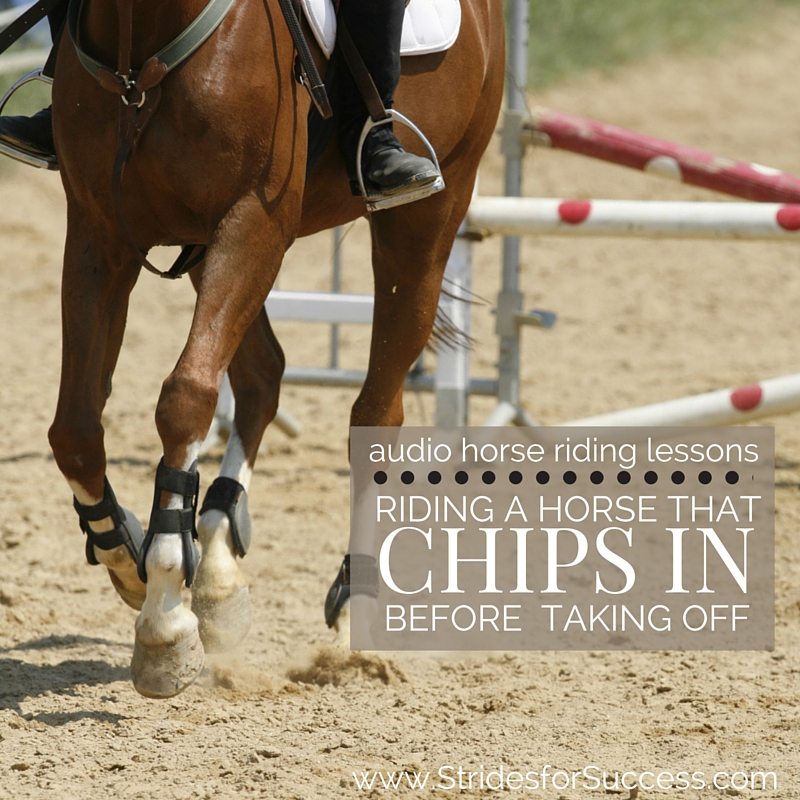
  • Riding a Horse with a ‘Chip In’ Habit at Take Off to a Jump

    Riding a Horse with a ‘Chip In’ Habit at Take Off to a Jump

    You are cantering towards the jump… 3… 2… 1… But instead of the ‘Jump’ that should have followed the 1; you get a chip in.  A moment where your usually trusty horse decides to test both of you by inserting a little ‘half stride’ in there before takeoff!

    The result is you do a great Thelwell impression and your horse does his best helicopter move; straight up and straight down…  Not a good feeling for anyone!

    Riding a horse that regularly includes a chip in or three is not enjoyable for anyone; the rider, the person watching, or the horse.  Of course, it can happen to anyone, we call have days where we get the stride to the fence wrong. However, for some horses, it becomes a habit that can seem almost impossible to break. That extra little half stride…

    [fusebox_track_player url=”https://op3.dev/e/traffic.libsyn.com/dailystridespodcast/636-Ridig-a-Horse-that-Chips-In-Before-Take-Off.mp3″ title=”Riding a Horse That Chips in Before Take Off” social_linkedin=”true” social_pinterest=”true” social_email=”true” ]

    What A Chip In Looks & Feels Like

    This habit is uncomfortable and does little for building confidence to clear a course of fences safely.  However, before we look at how to begin working with a horse who adds a little stride here and there, let’s back up. It is important to first realize what this is and why it might be happening.

    When a horse chips in before a fence, he has literally fitted an extra stride into a space. A space that there was really not enough room for that stride…

    He decided that, rather than taking off where he initially met the base of the fence, he would get creative.  He would add a quick little half stride in there and then take off.  It often results in a ‘cat jump’ which is all four legs really taking off and touching down at the same time, due to the loss of impulsion or energy.  It can also result in a ‘helicopter jump’, which is a jumping effort, but with an extremely steep up followed by an extremely steep down, with just the width of the fence in the middle!

    In both these situations, the horse is not using his back or body to the best of his abilities and it feels really uncomfortable for the rider.   Because of the loss of ‘flow’ in the stride, the rider very often ends up either too far ahead of the movement or left behind.  Both scenarios will usually result in both horse and rider not being correctly prepared for the next, upcoming jump.

    Why Your Horse Might Chip In

    There are lots of reasons your horse may chip in before a jump or fence.  It is also worth remembering that most horses will do this at some point in their training.  However, we are dealing today with a ‘chip in addict’, or a horse that does it more times than not.  In order to identify why we must first look at the horse’s approach to the fence…

    Is it rushed?  Maybe he leaning or pulling on the reins and being heavy on the forehand?  Or is he moving forward? Perhaps are you literally scrubbing and kicking every stride just to get to the base of the fence?  

    With regards to the rushing or leaning, this may be due to a lack of training.  This will often result in a lack of confidence in your horse.  He may be off the mindset that he must ‘just get it done’ as quickly as physically possible.  Unfortunately when this happens, the rider’s reaction and how they deal with it plays a big part in not only the result for that particular fence but also the long-term as well.

    Retracing some basic steps in his training is very often the way to begin overcoming this challenge

    If your horse is on the other side of this coin, he is not taking you to the fence at all, this can also be a training issue.  However, again, it may also show signs of a lack of confidence in his abilities.  I strongly suggest that, whatever the cause, take things back to basics.  It truly is the key to building and developing correctly.  And to show your horse that he can indeed successfully make it from A to B over a fence.

    Could It Be You?

    Sometimes, a horse that chips in is doing so because of how he is being ridden by the rider…  A nervous rider often tends to throw themselves into their jumping position a little early.  This will encourage the horse to ‘chip in’ before the fence.  Unfortunately, this is often a difficult and vicious cycle to break.

    The rider is nervous because the horse is rushing, the horse begins to chip and rush even more because the rider collapses before the fence and ‘drops him’, both emotionally and physically. This causes the horse to rush even more.  And so it goes on and on…

    If you feel that this is the issue, I would strongly suggest working over a single pole and practicing your timing and your balance.  The light seat is wonderful and will help you do this.

    Riding a Horse that Chip In before Take Off at Jumps

    Begin By Improving Flatwork

    So, once we have discovered why your horse chips in before a fence, we can then look at how to begin working through it so we can get a good take-off point and reach each fence in the best possible way.

    A good place to start working with your horse on the flat and improving his general responsiveness and understanding of your aids in the saddle.  Does he listen when you half halt?   Or do you find yourself pulling and hauling to get him to ‘steady’ a little?

    Does he move forward when asked to do so from your leg?  Or do you have to kick and click like a crazy person to get any sort of movement happening?!  These are basic training issues and need to be addressed before we even think of turning our hoof to jumping.  It sounds repetitive, but this is because it is true… You have to have the basics mastered before you can move on to more ‘exciting’ things in the saddle!

    Your ability to balance things with a half halt while keeping your horse moving forwarding is vital to being able to approach any fence successfully.  Keep in mind that a horse who chips in every now and then is a horse who is not so confident in jumping.  He needs a rider who can allow him to build his confidence in a controlled, systematic and patient environment

    Figure Things Out for Himself

    So, once you have the basics working, I suggest beginning to allowing your horse to figure things out on his own, without a rider, in a controlled environment.  This can either be lunging or loose schooling, but the word controlled is the important one in the previous sentence!

    Loose schooling or lunging a horse over fences does not mean chasing them into a frenzy around the arena at dizzying speeds.  

    It is simply creating a situation that is conducive to an optimum jumping effort, either one or two fences.  Then allowing your horse to approach and work things out himself.

    The benefit of loose schooling is that you can have two jumping efforts, 2 measured and correct stride lengths apart from each other.  The first jump, a cross pole, is to set your horse up correctly for the second fence, which can also be a cross pole or an upright or parallel. Due to consistently meeting the second fence at the correct distance, your horse will begin to figure things out himself.

    Distance & Spacing of Poles & Jumps

    It is also important to remember that the ‘correct distance’ is what is correct for him, not trying to force him into a standard jumping distance.  Rather allow him to first build his confidence in his own abilities using a distance that suits his current way of going or current stride.

    Once he is able to begin ‘picking’ a correct take off point, without any anxiety, you can then slowly begin working over adjusted distances

    Also, don’t see the loose schooling or lunging as a once-off occurrence.  Rather, try to incorporate them into his training for as long as necessary.  Very often with horses, it is a lack of balance that causes them to be unsure of the jump, leading to a chip in here and there.  The rider will definitely affect this balance or lack of, so allow him time and space to work it out alone before then adding a rider into the equation.

    Using Groundpoles while Riding

    As well as the above, you can begin working over ground poles in the saddle with your horse.  Laying out a single ground pole and cantering over it can be a helpful exercise for both horse and rider.  With regards to the horse, we are looking for a balanced and rhythmic approach and also, a canter that is taking you to the fence, rather than you having to ask and push for every stride.  Try to keep the rhythm as consistent as possible, and the hindquarters underneath the horse.

    You can also use this to begin training yourself to see a better stride before the fence.  Simply counting backwards from where you think there will be three strides before take off is a fantastic exercise to get you in rhythm with your horse and begin seeing the stride.  Only when you can actually see the stride can you then look at adjusting the stride.  Before that it is just the luck of the draw – never a good idea when there are jumps involved!

    As you canter in on your ‘approach’ to the fence start 3…  2…  1…  Jump.   If you get in wrong the first few times, don’t worry.  Just keep trying to gauge that point where you are three strides away.  Later you can make things a little more difficult for yourself with 5…  4…  3…  2…  1…  Jump.  You will find that the more you ‘tune’ your eye into the approach, the further out you will be able to see if the take-off point is a good one or is a little too far away or close.  This will give you time to adjust the strides in between which will, in turn, allow you to arrive at the jump in a better position to clear it comfortably.

    Related Distances

    From here you can add more poles on the ground at ‘related distances’ to each other.  Work at maintaining the forwardness of the canter while keeping the rhythm and balance all the way through.  Also, work on your timing of the jumping position.  As I mentioned earlier, it is tempting to get into it a little early if your horse is rushing, but this will only make the problem worse.

    Try to use your 3…  2…  1… to steady yourself and only allowing your body to follow your horse at the ‘Jump’ part

    Once both you and your horse are more comfortable and have stopped any added strides or half strides before the pole, you can begin to build some small fences where the poles are.  Remember that if your horse chips in,  a lot of the time it is a confidence issue, so don’t be tempted to push him further than he is comfortable.  Just because he is ‘able’ does not mean he is comfortable doing it!

    Your horse’s ability to see a stride takes time to establish, just like yours.  Give him that time and it will pay dividends later when you are out on the track.  Count yourself down to the base of each fence, 3… 2… 1… at all times initially (in your head when in the company of others if you want!), but use it as a way to balance both of you on the approach to the fence.

    Happy Riding
    Lorna

    Connection for Equestrians

    If you are interested in finding out more about how you can begin re-schooling your horse in all aspects of riding, Connection might just be what you are looking for. Each week you will receive 5 audio ‘lessons’, where I give you step by step instructions.  You can listen using a free app on your phone, on your computer, or via your favorite podcast app.

    This makes it really handy to use and listen to while riding your horse; in the saddle.

    We cover loose schooling, working over single poles, related distances, and also working on improving your eye to see a stride. There are also diagrams with the actual distances for you to replicate in your arena.

    Find out more over at https://stridesforsuccess.com/join