Tag: Lengthening

  • Adjusting the Length of Your Horse’s Stride for Jumping

    Adjusting the Length of Your Horse’s Stride for Jumping

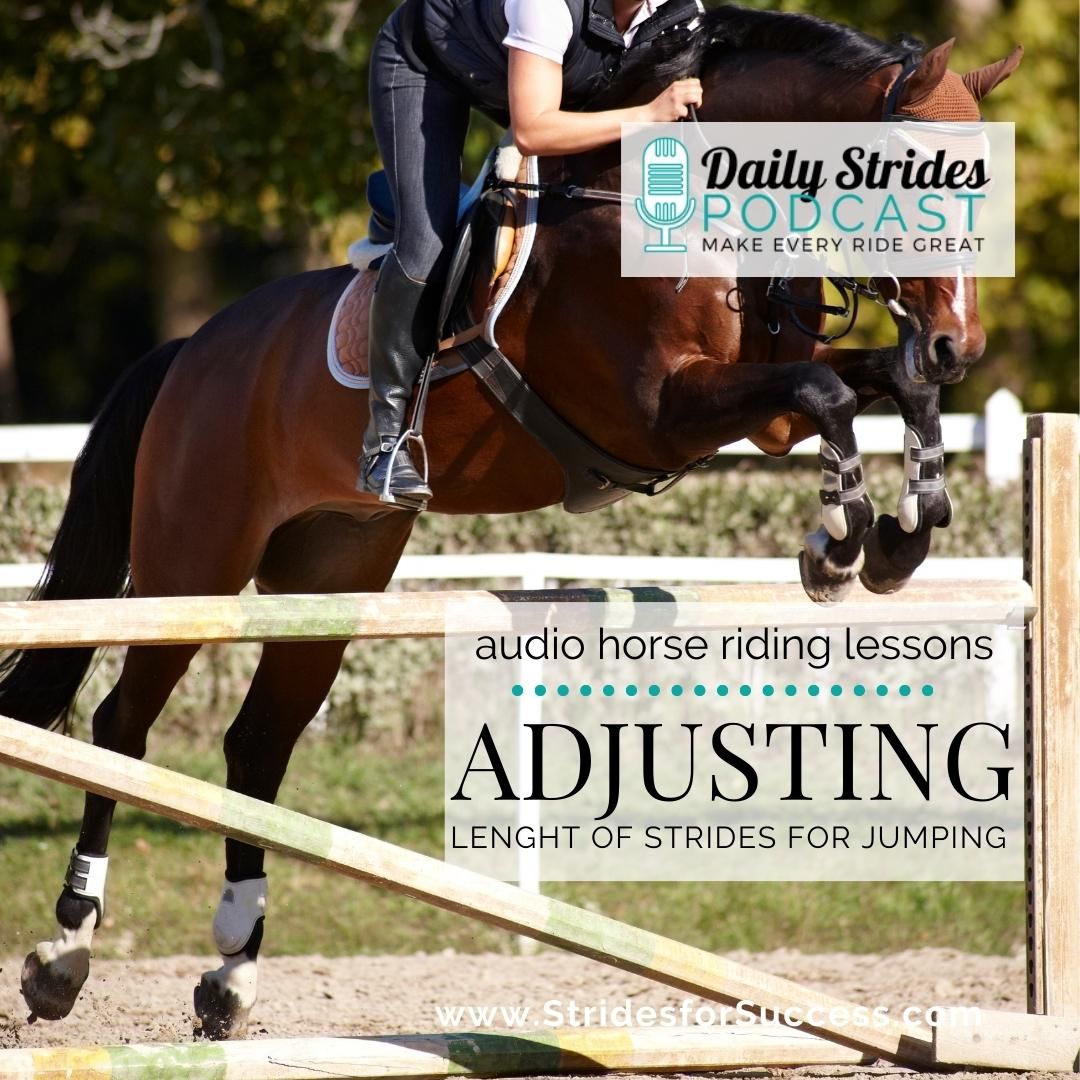
    If you enjoy jumping with your horse, riding that clear round is all important. Luckily there are a few key areas you can work on in your training that will help you to begin seeing more of them.  Adjusting the length of your horse’s strides is just one of those. And it’s also a pretty useful exercise for all horses and riders, jumping or not.
    If you can begin to intentionally help your horse to have either a shorter or a longer stride, it gives you both flexibility and adjustability in your riding
    In this episode of the Daily Strides Podcast, I want to help you to begin to understand just how versatile this exercise is to have in your toolkit when it comes to riding your horse.

    Predicting Your Horses ‘Arrival’ Point

    Like anything, if you can more accurately predict the outcome of something, you can begin to make changes or preparations for how it will be.  Jumping is no different.  When you can begin to ‘see’ the point your horse will actually take off from the fence, from a distance away, you can make decisions based on that.
    In fact, being able to see a ‘point’ for something to happen further on down the line is useful regardless of what you’re doing with your horse.
    And when jumping, remember, that all horses are different.  So when we think about jumping tracks the distances, however well planned, won’t suit all horses.  However, if you can accurately predict where your horse will be 5 or 6 strides from now, and then make adjustments to those 5 or 6 strides; well it won’t really matter, will it?

    Before Adjusting the Length of Your Horse’s Strides

    Like most things, there are a couple of prerequisites that riders and horses will have to develop before they begin adding this to their training program. The first of these, I feel, is the ability to see and then ride a line.  This is often one of those ‘easier said than done’ things.
    And while many riders might be able to ‘see’ the line; riding it is a whole other story!
    Another important element to both understand and effectively ride is the half halt.  Having control over your aids to clearly communicate this to your horse is key to it working for you.  Whether that is to balance, rebalance, correct, or just focus attention and energy.
    Adjusting the length of your horse’s strides is not pulling their mouth or kicking on; it is harnessing the energy to make changes to your horse’s way of going.

    Understanding Impulsion

    Whether you’re shortening or lengthening, maintaining the desired level of impulsion is key to effectively jumping the actual jump!  Pulling too much and slowing things down in a misguided attempt to shorten will not work.  Sure, you might fit more strides in between here and there.  But when you do get ‘there’ your horse won’t be ready to actually jump the jump.  Which, is the whole point of the process.
    Similarly, kicking on and chasing your horse to lengthen will result in your horse flattening and becoming heavy on the forehand; again not a great way to meet a jump!
    Impulsion needs you to really have the correct level of tension present inside of the container that makes up you and your horse.  This tension (relaxation) combined with the actual energy needed (forwardness) and a good and consistent rhythm will help maintain impulsion.  And, when working correctly, impulsion leads to straightness. Another key element when jumping those clear rounds.

    Seeing a Stride

    This is a skill that, as a rider, needs to be developed in order to really get the benefits of adjusting the length of your horse’s strides. After all, it makes little sense adjusting them if you’ve no idea where you really want to be at take-off!
    Seeing a stride simply means that you can accurately predict where your horse will be in a specific number of strides time. 
    It’s being able to say, “in 5 strides from now, all being equal to what we’re doing now, we will be ‘there’.”  And based on where ‘there’ is, you can then decide if adjustments need to be made to the actual length of the strides.  Changing the length of the stride will prevent chipping in or standing off the jump. Neither of these are ideal for clear rounds!
    If ‘there’ is too close or too far away from the ideal take-off point of the jump, you have now 5 strides available to adjust that point.  And this is often the difference between a pole staying up or coming down.

    Counting Yourself Down

    Start learning how to see your stride by playing a game with yourself over a single pole on the ground.  Canter back and forth over the pole and see if you can accurately and correctly predict the point where you will have 3 strides left to go before ‘jumping’ the pole.
    Accountability is key here; say out loud 3, 2, 1, jump. If you get 3, 2, jump or 3, 2, 1, 1, 1, jump – clearly there’s an issue!
    Once you have eventually mastered this skill, you can begin to make it a little more difficult.  Begin predicting where 5 strides between you and the pole will be.  Again, count yourself down.  Counting yourself ‘up’ (1,2,3,4,5) won’t work as you can just keep counting!  I also find that riders who initially count in their heads also struggle!  Their brain wants them to be right, so they can tend to tell themselves porkies!
    When you can accurately predict the point where your horse will fit 5 or even 7 strides in between you and the pole, this is where you can start to see where adjustments should be made. And, this is where you can begin working on making those small adjustments over every stride to result in a big difference.

    Shortening Your Strides

    If you can take 2 inches off each of your 5 strides, it means you can change the ‘take-off point’ by 10 inches.  That is nearly a foot or 30 centimeters.  And that is just shortening by the smallest of margins, 2 inches or 5 centimeters.
    Imagine when you and your horse develop this skill; you can shorten strides by 10 inches per stride (or more).  This will truly give you the flexibility you need to meet each jump at the right place each time.  So that your horse has the best possible chance of clearing the jump.
    Shortening is not slowing your horse down.  It is not pulling his mouth or throwing an ‘anchor’ behind you in the sand! 
    True shortening will allow you to maintain the energy, rhythm, suppleness, impulsion, contact, and straightness in order to reach the jump in the best possible place to clear it from. Sometimes, when we shorten, your horse might not initially have enough strength in his body to maintain the above; this is where your aids will act like boundaries to help your horse.
    Shortening the strides also requires that you maintain a lightness in both how you are riding and your horse’s way of going.  Light and bouncy; not heavy and ‘stuck in the mud’.

    Lengthening the Strides

    So many riders think lengthening and speed are related.  I have honestly watched people and said silent prayers in my head that they get from A to B in one piece!  It can be nerve-wracking watching a rider who has confused rushing or chasing with lengthening.
    To effectively lengthen the stride, you must maintain the energy, the tension, the contact, the forwardness, and – maybe most importantly – the impulsion.
    Chasing your horse on to the point where all of the energy falls out the front door is not lengthening.  In fact, it is just downright dangerous as your horse will find it very difficult to find the ‘lift off’ gear and get his shoulders over the jump!
    As you ask for your horse to lengthen, make sure you’re not getting ahead of or in front of the movement.  If you are leaning your weight in any way on your horse’s shoulders or withers, you make jumping the jump so much more difficult for the horse.  Sit up and remember to ride!

    Adjusting the Length of Your Horse’s Stride

    My big piece of advice when you are beginning to work with adjusting the length of your horse’s stride is to start small.  A couple of inches either way are either longer or shorter.  Being able to have this level of adjustability in your horse can change so much when it comes to your training in general.
    Remember, you are simply ‘asking’ your horse to lengthen or shorten; you’re not doing the work yourself! Don’t lie back and don’t throw your body forward.
    And, as I said at the beginning, this type of suppleness and adjustability through your horse is not just for jumping. You can and will use this in all day-to-day riding.  And it’s a great exercise to work on with your horse as well.
    Happy Riding
    Lorna

    Resources:-

  • Asking Your Horse to Lengthen the Stride in Canter

    Asking Your Horse to Lengthen the Stride in Canter

    [fusebox_track_player url=”https://op3.dev/e/traffic.libsyn.com/dailystridespodcast/581-Asking-Your-Horse-To-Lengthen-the-Stride-in-Canter.mp3″ title=”Ask Your Horse to Lengthen the Stride in Canter” social_linkedin=”true” social_pinterest=”true” social_email=”true” ]

    You turn the corner and ask your horse to lengthen the stride in canter a little.  But, instead of covering more ground with each passing stride, it feels like his legs have begun to move nineteen to the dozen.  Flashbacks to pony riding are flying through your brain…  And the rushing and racing is becoming more intense with each passing stride!

    The result is that, yes sure, you are definitely covering more ground however you also have less control, less energy, and a lot more tension in each stride.  And this is a problem, particularly when there are obstacles to be navigated on a jumping track!

    Why Lengthen the Stride?

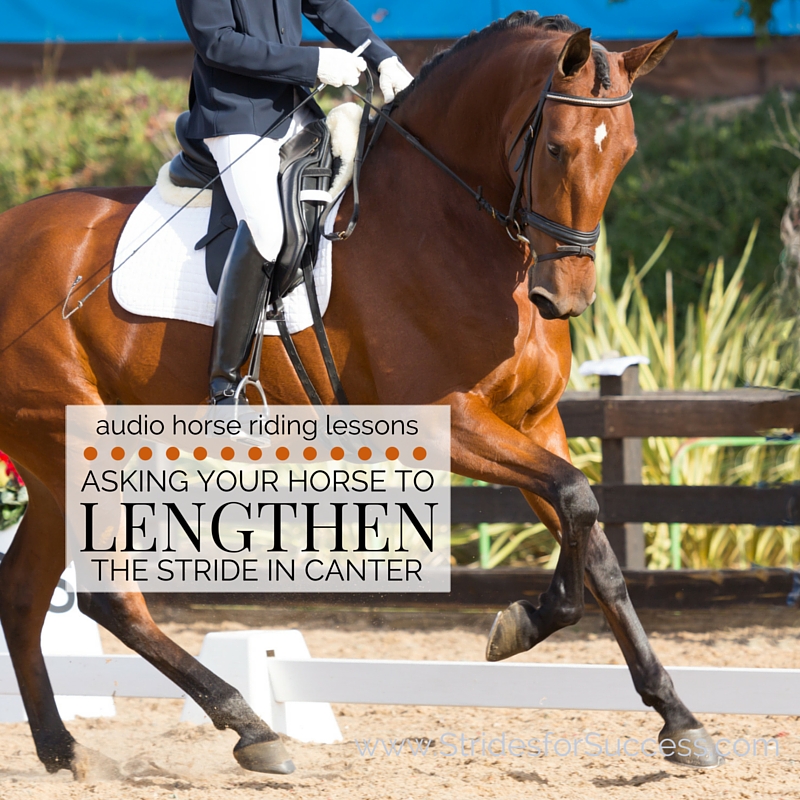
    Being able to effectively lengthen the stride in the canter is important in both flatwork and jumping.  The key is the lengthen throughout the whole body, covering more ground.

    But doing so without losing the energy, connection, balance, and rhythm that is necessary to keep engagement during the movement.

    The stronger and more developed and agile your horse is, the easier he will find it to lengthen and shorten his stride to greater degrees which, particularly in jumping, is often the difference between a successful exercise or not.  It will also allow him to make changes faster with less transition time in between and without sacrificing balance and rhythm.

    Your horse most remain relaxed throughout the lengthening because any shortening will result in the strides actually becoming more ‘choppy’, shorter and quicker rather than longer, flowing and connected

    Lengthening Versus Increased Speed

    Often, lengthening the stride is confused with an increase in speed.  I have found that a simple exercise for riders to do on the ground (on their own two feet) is often enough to allow riders to see the differences between lengthening the rushing.

    Begin by ‘cantering’ on your own two legs on the ground.  Yes, you might look a little silly, but bear with me here.  So, as you are there, merrily skipping along, begin by seeing how little distance you can cover with each ‘stride’ of your skip.  Now, start experimenting with how much distance you can cover with each ‘stride’ of your skip.

    Notice how the longer the stride or distance, the more ‘stretching you are having to do?  Also, notice how you have to bring your initial foot that is pushing off on each ‘stride’ underneath you in order to achieve any forwardness in your skip?  Each stride sets the next up.

    Engaging Your Horses Hindquarters

    Well, it is a similar principle for your horse.  Rather than the hind end being left behind as he works to lengthen the stride in canter, rather think about the hindquarters stretching forward.

    The more underneath him he can engage his hind legs with each stride, the more they can propel him further along in the stride itself

    Straightness Through His Body

    So in order for your horse to correctly be able to lengthen the stride, his body must be straight throughout the canter to begin with.  If his hind quarter tends to drift one way or the other, it stands to reason that the ‘propulsion’ will not be equal through the body.  This will leave him unable to create the energy required to truly lengthen the stride.

    Begin by working on straightness.  Having mirrors in the arena are a great help for this as they allow you to assess your horse is truly correct and straight through his body while working.  Or you can also ask someone on the ground or take some photographs or videos.  Take from both a head-on angle and directly from behind.  These are often the easiest angles to see if there is any tendency to carry the hindquarters a little more to the inside or outside.

    Keep in mind that your horse’s straightness is often very much in relation to your straightness in the saddle

    Make sure that you are symmetric through your body and carrying yourself equally on both sides.  Also assess any tendencies you might have to be a little stronger with one leg over the other.  Perhaps you are a little crooked through your hips, which will almost always affect the quality and straightness of the canter.

    Asking Your Horse to Lengthen the Stride in Canter

    Straightness Through Your Seat

    The reason that your balance and straightness are so important when cantering, and particularly when asking your horse to lengthen the stride, is that a lot of the ‘asking’ is with your seat.  When we canter, our seat moves with the horse in an almost circular, rolling motion.  Being able to identify this movement in your body and then adjust it as you want is key to making transitions up and down within the canter itself.

    It is often described as a ‘scoop’ action and I think this is a good description because a scoop comes ‘up’.  This up part of the movement is necessary to allow the energy to connect through your horse’s back from the hindquarters to the front end.

    Spend time working on isolating the particular muscles in your core that are responsible for this movement in your body.  Then begin experimenting with your horse how modifying the movement translates across to your horse in the canter

    Remain Consistent Through Upper Body

    Also make sure that you are able to follow with your pelvis and lower torso, while making sure your upper body remains balanced and as still as possible.  A lot of riders make the mistake of cantering with their shoulders and chest.

    Rather see your shoulders as being responsible for maintaining a consistent, following, and elastic contact with your elbows.  From here, work on establishing the same connection to your horse’s mouth.  

    This is pretty much impossible if your shoulders are shaking and twisting around in the saddle, while your pelvis is locked and stiff.

    Prepare the Transition

    So, now that we have a better understanding of what our horse actually does when he lengthens and of what we should be doing while it is happening, let’s look at setting the transition up.  When starting out first, it is often easier to lengthen after you have asked for a few shorter strides first.

    Using your half halt, begin rebalancing your horse in the canter.  Think about moving with him and following him in the canter, but also about how you want him to lengthen.  If he lengthens correctly, his hindquarters will come further underneath him, which will in turn, lighten his front end a little more.

    So rather than your horse becoming all strung out with a downward trajectory, think of your horse as an aeroplane.  This bum is low his front is higher.  Keep this in mind as you ask for the half halts and also as you ask him to lengthen.

    Asking for ‘Longer’ Strides

    Once your canter is established and your horse is listening to you, you can begin asking with your seat for a ‘longer’ movement each stride.  Keep in mind that your seat and hands are connected, so it is important to also allow for this ‘stretching’ with your contact as well.   This does not mean throwing the reins at your horse; consistent contact is essential.  Also, continue to use your leg with each stride, to ensure that energy is constantly being created behind to continue to push or propel your horse forward.

    Pay close attention to the tempo; rather than speed up, it should either remain consistent or actually slow down a little as your horse covers more ground – so has more time between each footfall – with the longer stride

    If the tempo speeds up, it usually signals that your horse has excess tension in his body.  Said differently, he is rather doing his best ‘pony’ impression than actually reaching for more length with each passing stride!

    An Inch is Longer…

    Also when you initially begin to lengthen think of each stride as reaching further than the last.  It takes quite a bit of development and strength on your horse’s part to lengthen his body while continuing to work forward with impulsion.  So rather than just pushing him faster, build each stride a few inches longer than the last.  As he becomes stronger and more responsive to your aids, you can ask for a longer stride from the start, but think of it as an initial ‘building blocks’.

    You may find that your horse can ‘hold’ this lengthened stride for only a few strides initially before he begins to lose the forwardness of the movement.  

    This is to be expected initially at this point, half halt again and begin to shorten the stride.  Often a small circle ridden in a working canter can help to rebalance your horse, but remember to maintain the straightness throughout both your bodies all the time.

    Lengthening and shortening of his strides in canter is a great suppling exercise to work into your schooling sessions and will help you to keep your horse fresh, responsive, and agile regardless of what your chosen discipline is.

    Happy Riding
    Lorna

    Connection for Equestrians

    Are you interested in the step by step instructions as to how to ride your horse correctly and influence the length of his canter stride? There are 5 audio horse riding programs dedicated to this topic (along with hundreds of other programs) inside of Connection. You can find out more about it by visiting https://stridesforsuccess.com/join/

  • Lengthening Your Horse’s Stride in Trot

    Lengthening Your Horse’s Stride in Trot

    [fusebox_track_player url=”https://op3.dev/e/traffic.libsyn.com/dailystridespodcast/531-Lengthening-Your-Horses-Stride-in-Trot.mp3″ title=”Lengthening Your Horses Stride in the Trot” social_linkedin=”true” social_pinterest=”true” social_email=”true” ]

    We have all seen the wonderful video clips of horses showing extravagant extensions in the trot and I think most riders dream of being able to perform a similar feat.  However, for most riders, merely asking for a lengthening of the stride in trot results in their horse either breaking into a canter or running on to their forehand, with the hind end being, well, left behind!

    Being able to lengthen and then subsequently shorten your horse’s stride when you want, develops your horse’s responsiveness, suppleness, and balance while being ridden.  

    It also allows you to make adjustments if necessary while in the saddle, without changing from one gait to another.

    However, it takes time for your horse to develop physically and mentally so as to begin holding a lengthened stride for longer periods.  Failure to do so is often a lack of patience from riders, who will try to push and force their horse to lengthen. This results in the horse hollowing his back, shortening the stride, and rushing onto the forehand.

    What is Lengthening the Stride?

    When your horse lengthens, he basically covers more ground in the same amount of strides.  Each stride he takes sees him stretching or reaching more forward.  His hind feet coming more underneath him with every stride and then the front legs stretching out more in front of him with each stride.

    However, when lengthening his stride, he will not change the tempo of the gait.  The 1 – 2 – 1 – 2 – 1 – 2 of the trot will remain the same, regardless of the length of the stride or ground being covered with each passing stride.

    Asking, not pushing is the key to a true lengthening on the stride in trot.  

    In order to lengthen his stride, your horse must lengthen his whole back and topline.  Suppleness is required to do this, and often we only think of suppleness as being lateral, it is also important longitudinal as well.

    Start with Rhythm

    The rhythm and tempo of the trot should remain consistent throughout the gait.  I think that this is often the most simple place and way to begin introducing your horse to this type of work.  Start by becoming familiar with your horses tempo and knowing the length of this strides in working trot.

    Depending on how independent and ‘under control’ your seat is, you can lengthen your horse in trot from either rising trot or sitting trot,

    I strongly suggest working in rising trot initially as it will allow your horses back to lengthen out without you being heavy on it during the longer strides.  

    I also find that using rising trot tends to prevent an overly ambitious ‘seat shoving’ happening from the rider, whether intentional or not!

    So first and foremost, focus on creating and then maintaining or establishing a correct and balanced rhythm and tempo.  

    You can do this through all three gaits, using the transitions to further engage your horse’s hind quarters and also, refine your aids and your horse’s responsiveness to them.

    Pay Attention to Straightness

    It is also important to cultivate straightness in your horse.  Doing this earlier on will make it easier for him later when you begin asking for the lengthened strides.  If you horse is straight, he will push equally from both hind legs, propelling him correctly in the gait.

    If he is crooked or falling out, he will find it hard to maintain a rhythm, as one side will literally be moving more forward than the other.

    Spend quite a bit of time on transitions, using your half halts, and circles, particularly smaller ones, such as 12 or 10 meter circles.  Work between shortening your horse slightly and then returning back to working trot as well.  Don’t attempt to lengthen until you have truly established and can maintain a good balance throughout the above mentioned exercises.

    Begin By Shortening First…

    I find that riders often find lengthening the canter easier than the trot, particularly when there are canter poles involved.  However, you can use a similar principle in the trot when starting out at first.  Pick two fixed points in the arena or on the trail where you are riding.  Ride between these two points quite a few times in working trot, counting each time the amount of strides your horse fits between the two points.

    Use your body passing the first point as the ‘go’ or ‘start’ and then again, your body passing the second point as your ‘stop’ or ‘end’.  Continue to do so until you have a regular amount of strides each time as you ride through this movement.

    Think of it almost as having two ground poles with 5 or 6 canter strides in between, but use the points you have chosen as the poles and trot rather than canter.

    Once you know the amount of strides in a ‘normal’ working trot, then ask for a slight shortening of the stride between the two points.  If you can get an extra stride in there, then your horse has truly shortened. However remember the tempo or recurrence of the 1 – 2 – 1 – 2 – 1 – 2  must remain the same throughout.

    The shortening of the stride can be thought of as your horse lifting his legs more ‘up’ rather than ‘out in front’.

    Lengthening Your Horses Stride in Trot

    Asking for Lengthened Strides

    Once you and your horse have established a balanced transition between the working trot and a slightly shorter more collected trot, you can then begin to think about asking for a few lengthened strides in the trot.  It is really important to maintain the contact between you and your horse throughout the movement.

    Lengthening the stride does not mean throwing the reins at your horse and kicking on.  It simply means that you are allowing your horse more space to move within each stride.

    You may find, particularly if it is your horse’s first time, that initially there will be very little difference.  This is fine, your horse has to first understand what you are asking and then also, begin to understand how he can move his body to achieve this new lengthening of it.

    Remember, when you horse lengthens his stride, he will use his muscles, tendons, ligaments and joints differently. Slow and steady, taking plenty of time to learn this correctly, is key to maintaining a sound horse that enjoys his job.

    Noticing the Increased Lenght

    If he does begin to lengthen the stride, you will count less strides between your ‘start’ and ‘end’ points than what you were counting while in working trot or whatever you are using as your ‘control gait’.   I say ‘control gait, as in order to know if your horse is lengthening rather than running, you need something to measure it against.  Use your working trot as the measure or the control.

    Keep in mind that your horse cannot move or ‘extend’ his shoulders if you are leaning or jiggling around on top of them.  

    Pay attention to your position and posture throughout the exercise, and again, take things slowly.  The better your horse understands and the more confident he feels about his ability to perform the movement, the greater it will eventually be.

    Happy Riding

    Lorna

    Additional Resources for Equestrians:-

    Lengthening Your Horses Stride in Trot

    [wp-tiles post_type=”post” orderby=”date” order=”DESC” grids=”Simple”]