Tag: Re-Schooling

  • Going Slow to Speed Up – Your Riding Questions Answered

    Going Slow to Speed Up – Your Riding Questions Answered

    [fusebox_track_player url=”https://dts.podtrac.com/redirect.mp3/pdcn.co/e/traffic.libsyn.com/dailystridespodcast/1387_Going_Slow_To_Speed_Up_Your_Riding_Questions_Answered.mp3″ title=”Going Slow to Speed Up – Your Questions Answered” social_linkedin=”true” social_pinterest=”true” social_email=”true” ]

    It can feel frustrating when you realise that you have to steady up a little in your rush to get somewhere! And, when riding, going slow to speed up is often what’s required to really allow the concept to sink in; mentally and physically. Last week’s episode about what riders are often not willing to do seems to have hit a nerve for many riders!

    Riders reached out with questions, worries, queries about resistance that had shown up, and a healthy dose of “But do I really have to go that slow?”.

    So in this episode I answer a lot of the questions I received. I chose the ones that I feel, for the majority of riders, might crop up when working on this topic! And look, let’s be honest here. Intentionally slowing things down usually doesn’t feel great – especially when you’ve a bee in your bonnet to get somewhere else! But you can’t argue with the proof that it’s the riders who invest in the slow, steady, correct work, that make the long term progress in their riding and training. So, on that note, let’s crack on ;)

    Q1. Where do I begin? And doing what?

    “I don’t know where to start. In the episode, you say to begin on the ground, but I don’t know what to do there”

    This was, in one form or another, hands-down the most common question! Many riders hear “start on the ground,” and instantly freeze. They’re wondering about what they should do on the ground. And how long should they do it. And what happens if their horse doesn’t understand?…

    Here’s the simple version; start with leading your horse in a deliberate, connected way. Then take this opportunity to begin weaving your voice into the mix and allowing it to become a powerful aid.  

    If your horse doesn’t understand your voice aids yet, don’t worry. Horses learn through association. So pair your existing aid (usually pressure through the halter or reins) with the new voice cue. Over time, the new cue becomes clear enough that you can gradually reduce the old aid.

    It’s like building a bridge; your old aid, paired with new aid, which overtime allows the new aid to become clearer and more understood. And then you can begin to phase the old aid out.

    And yes, this works with your voice to seat and weight aids too. The order doesn’t matter nearly as much as consistency does. Use your voice in the arena, in the field, at the gate, and even walking up the driveway. The more consistent you are, the faster the association forms. But, take my advice here and start on the ground first :)

    Q2. Thinking Forward v’s Rushing?”

    These two can look similar at first glance, especially if your horse is a bit ‘hot’, ‘goey’, or easily distracted. But the feeling is completely different.  A horse who is thinking forward moves with a ‘sense of purpose’. They seem to have an intention and enough energy (and tension) to do the work they’re doing – without it spilling over! The level of tension they have is right for the movement or work they are doing at that exact moment.

    This contrasts completely with the horse who is rushing… This horse will often seem to carry a little too much tension in their bodies. They may be experiencing anxiety or unable to focus, so constantly distracted or unbalanced…

    Thinking forward does not mean rushing. It means working with a sense of purpose – which is both mental and physical. And it’s a great indicator that your ‘slowing down’ is beginning to produce great results! 

    Relaxation is a really misunderstood concept when it comes to training and working with horses. It doesn’t mean floppy, sleepy, slow, or dragging  themselves (or you) along. It simply means the tension present through both the horse and rider is appropriate for the job at hand.

    When thinking forward, both you and your horse’s body and mind are focusing themselves toward the work; not away from it! 

    Q3. It Didn’t Work!

    “I tried the walk to halt to walk work today and it was awful. When can I trot again?”

    Okay, my first response to this is for the rider to just breathe for a second, step away from the fast-forward button and be realistic about the situation; you tried it once! Instant-gratification really has no place when it comes to riding or training horses! However, unfortunately, that is the world we live in right now.

    So, if your first attempt felt messy, stiff, or downright awful, it often points to one of two things… You skipped the groundwork. Or your position might be blocking what you’re asking for. 

    Regarding the groundwork, it is common to believe that because you work with your horse every day, you can skip this bit. But reinforcing the thing that is holding you back will only result in you both staying stuck. And, skipping the groundwork, as so many riders do, is where so many issues stem from.  Regarding your position potentially blocking the energy; alignment matters so much  when you’re going back to the basics. When you’re doing going slow to later speed up.

    My suggestion is to whip out your phone and video yourself. Watch your posture and alignment. Practice curiosity – not judgement. Self-assessment is one of the quickest ways to speed up when you don’t have a trainer on the ground.

    And no, you won’t be stuck either on the ground or in walk forever! A few dedicated sessions on the basics, plus a commitment to revisiting them in warm-ups and cool-downs, is usually enough to transform things…

    Q4. My Horse Is Bored with ‘Slow’!

    “My horse is bored doing this slow work. What else can I do?”

    When I read this, the first thought that popped into my head was “Is your horse bored; or are you bored?!”. And this is all said with love – because 98% of the time, it’s the rider who’s ‘bored’! I’ll admit, there was a time when I believed this as well. However, a great trainer I had the opportunity to work with thought me to think differently about it.

    Walking work can be endlessly interesting if you show up as the trainer and create intention within the session. Add lateral work. Add poles. Change your focus. Look at your straightness, your bend, your rhythm, your timing.

    I know for a fact that you can ride the exact same exercise, let’s say a three-looped serpentine, with a different focus every day and never run out of things to refine. Hence why this trusty ‘basic of basic’ school movements is one of my all time favourites.

    Boredom is rarely a horse problem. It’s a rider creativity problem. And if you want to begin showing up as a trainer, it becomes your responsibility to think differently so that your work together remains interesting. 

    Q5. Help, I’m a Helicopter Rider!

    “I’ve realised that I’m doing everything for my horse – but when I stop helping, it all falls apart!”

    Ah, the club that no-one wants to find out that their a part of! Helicopter Riders (who are a lot like Helicopter Parents). What I mean here is that you are hovering around, simply waiting for something to go wrong so that you can swoop in and save the day! It’s micromanaging at it’s worst – and it’s absolutely exhausting!

    When you’re micro-managing everything in your riding and training, you’re really trying to prevent any mistakes from happening… BUT, in doing so, you’re also preventing any learning from taking place! 

    Mistakes are not a sign that something is wrong; they’re the sign that the learning process has begun. You need to begin shifting how you see your role when working with your horse. Instead of ‘minding’ everything, your new ‘job’ is to set everything up as well as you can… Then get out of the way so that your horse can ‘do’ what you’ve asked. And when he inevitably hits a bit of a speed wobble, simply correct, set it up and try again.

    A key part of moving away from ‘helicopter mode’ is to do all of this from neutral. No grudges! No matter how many times you feel you have to correct the same thing! Reset yourself and your horse – and then try again from neutral.

    Q6. We’ll Lose Fitness!

    “Won’t spending so much time ‘going slow’ cause my horse to lose fitness?”

    Okay, let’s get honest here – it might. But usually, this is actually more of a mindset fear, not a reality!  A horse with a solid fitness base doesn’t lose it overnight. And even if your horse does step down a level, fitness returns far more quickly in a horse who has been fit before than one who has never reached that stage, or has done so years before.

    The important thing to consider here is that if your current training isn’t built on a solid foundation, then you will eventually hit a roadblock that will require you to ‘go back’. Rather do this now!

    Fixing the foundation doesn’t take months of walking in circles.  It takes intention and a few weeks of re-calibration.  And this ‘slow work’ pays off for years afterwards.

    Q7. How Long to Go Slow?!

    “How long should I stay in each stage before moving on?”

    Okay, there are so many questions to do with horses, riding, and training that I answer with “it depends” – and this is one of them!  It will depend; on you, your horse, your consistency, and your willingness to let go of the aids you’ve been leaning on for years. Aids and training methods that may have got you to where you are right now, but are the very things that are blocking you from moving forward now.

    Revising the basics should feel like a blend of the old with the new. You’re slowly and consistently reducing reliance on the outdated aid as the new one becomes clearer.

    If you feel completely stuck at one stage, that’s a sign that something else, usually communication, understanding, or your position, needs attention. Forward momentum should feel fluid, not stalled. And this leads me to the next question I received…

    Q8. How Will I Know If It’s Working?”

    “I’m not sure what I should be on the look out for to know if my approach is working or not”

    This is a great question. And I get it that when you’re starting out, it can be difficult to see progress – especially when you’re in the vacuum of just you and your horse! But, as the popular meme says.; “There will be signs”!

    Progress will look like the basics showing up more consistently. Rhythm, relaxation, balance, responsiveness… And they will become more easy to maintain. 

    Also, you won’t just feel it, I strongly suggest you do something so that you can actually see it. And this is where trusty lunging is 100% the best approach you can take. You will actually be able to see the contrast between “before” and “after” you ask something or make an adjustment. And because horses don’t lie, this is often the most honest mirror you can give yourself.

    This is exactly why inside Connection, we spent an entire month refining the half halt on the lunge. When you can see the transformation before you even get into the saddle, your confidence skyrockets and your communication becomes clearer.

    It really and truly will pay you so much in the long run to take time now to slow down. Revisit, rework, and re-engage the basics – so that you can speed up in your progress and training later.

    Happy Riding
    Lorna

    Get Your Riding Questions Answered…

    So, hopefully I have answered the majority of questions I received regarding last week’s episode (you can listen to it HERE if you missed it). However, maybe you have encountered something different or you’re wondering about something I have not addressed here. This is where Connection really helps riders just like you.

    If you’re feeling ready to walk the full A to B to C path with your horse, all of the details are HERE.

    Also, if this work is speaking to you, or your foundations feel shaky! And, especially if you’re ready to turn “going slow” into “real progress,” then Connection is where we do all of this step-by-step, with coaching, structure, and community. You can find all the details here:- https://stridesforsuccess.com/join

    Online Training & Coaching

    The Your Signature Ride Challenge

    Here’s the idea: you use only your seat and leg aids to “write” your name in the arena. Sounds simple, right? But what it really does is sharpen your awareness of timing and clarity.  You’ll learn when your aids actually make a difference.  And you’ll have fun doing it.  All while creating a pattern that’s uniquely yours!

    You can sign up by CLICKING HERE

    It’s free to join, and every rider who participates gets access to a guided audio lesson to help them through the challenge. Plus, you’ll have a chance to win 3 months inside Connection (a $66 value)

    Restart & Reschool

    And if you would like a little more 1-to-1 coaching, explore Restart & Reschool Private Coaching. It is perfect if you’re starting your practice – or if you’re looking to turn your existing practice into something ‘real’ for you and your horse. I’ll guide you step by step on the way! You’ll not only get the full ‘OTTB; From Racetrack to Ready Program’, but also fortnightly private lessons with me to move you forward in your riding.

    We can work on anything you would like; from groundwork, to lunging, to riding, to jumping… With the virtual private lessons, we can do all of these things – and more.  If you would like to find out me, you can let me know a little more about you HERE and I will then reach back out and we can chat!

    This is the support, training, and accountability you’ve been missing to finally follow through and start seeing progress. No fluff. No overwhelm. And as flexible as you need for your lifestyle. 

    Connect with Lorna online:-

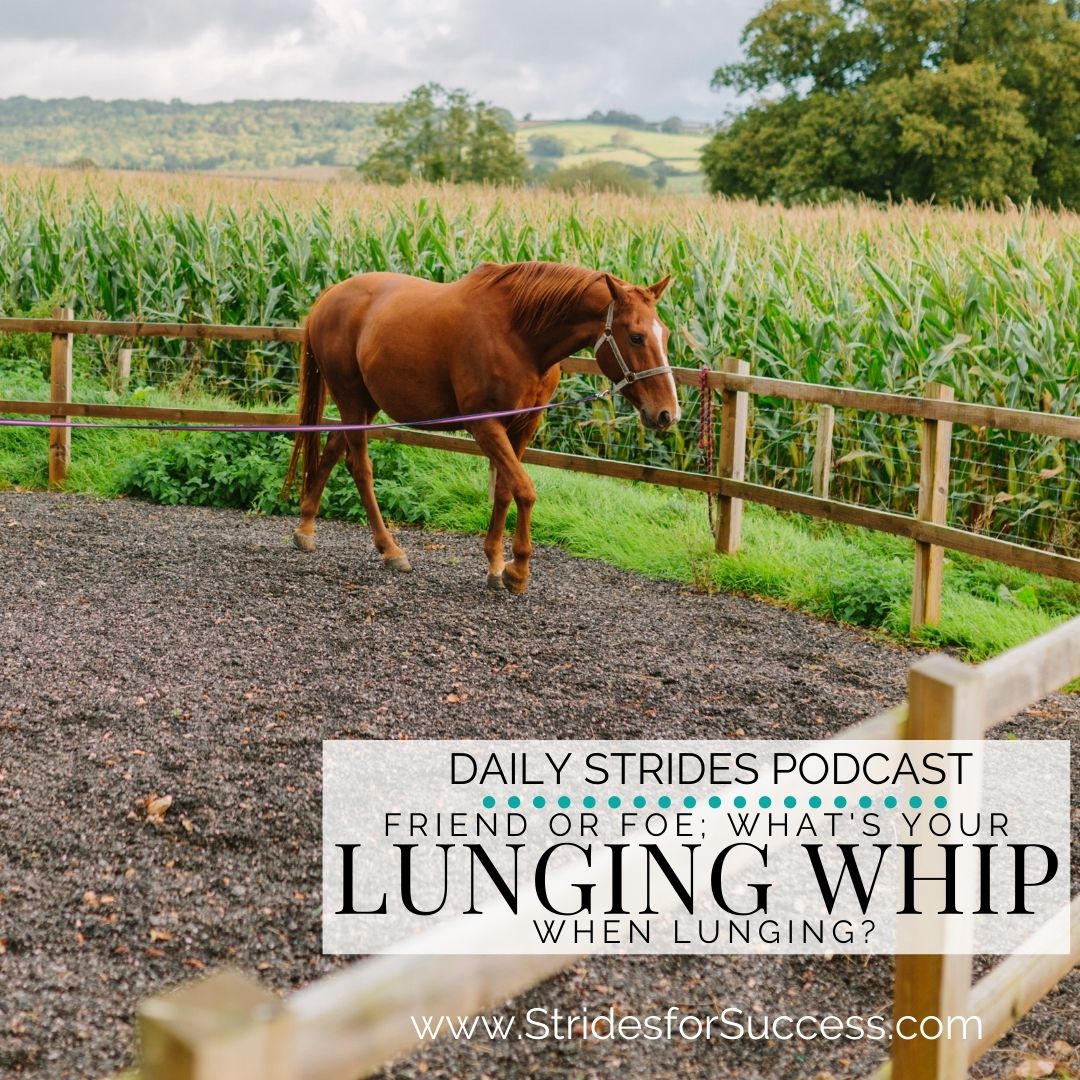
  • Friend or Foe? Your Lunging Whip when Lunging

    Friend or Foe? Your Lunging Whip when Lunging

    [fusebox_track_player url=”https://op3.dev/e/traffic.libsyn.com/secure/dailystridespodcast/1191_Positvely_Using_the_Lunging_Whip_when_Lunging_Your_Horse.mp3″ title=”The Lunging Whip; Friend or Foe?” social_linkedin=”true” social_pinterest=”true” social_email=”true” ]

    Have you been using your lunging whip incorrectly? Have you decided not to use it at all?

    Your lunging whip is one of the best aids you have to help you clarify your communication when it comes to lunging your horse. However, in order for it to be of benefit, it must be used correctly.

    And, unfortunately, the lunging whip can often be misused, and often, therefore, misunderstood when it comes to aids in lunging and riding.

    Lunging Whip; What’s in a Name?

    For many riders, their resistance to and incorrect use of the lunging whip is caused by the name we have given this piece of equipment. I have a feeling that if a lunging whip was called a pointer or a demonstrator, it would ‘feel’ different for many riders to incorporate it into their conversation with their horse.

    The lunging whip is a really useful artificial aid.  It just has an unfortunate name! 

    A lunging whip is an inanimate object. It can not do anything itself. It needs someone to be intentional with it in order for it to actually ‘do’ anything. If you feel uncomfortable about using a lunging whip with your horse, this is because of a thought you are thinking. My advice is to identify this thought – and then actively think of a better one!

    You can shape how this artificial aid adds to your conversation with your horse by how intentional you are when using it.

    Re-schooling the Rider

    The second big challenge many riders have with the lunge whip is how they are actually using it. Carrying it too high. Swinging it around. Directing air traffic. Not carrying it at all… These are all ways that we can use this aid without actually ‘using’ the aid in the way it can best communicate with our horse.

    Your lunging whip should be ‘carried’ just like you carry your hands when you hold the reins. The end of the whip pointing towards the horse should be kept down.

    In fact, if you stick to the rule that the end of the whip is kept hock height or lower, it will help you have a better and more consistent conversation with your horse. The end of the whip, in this case, is where the hard part of the whip joins the sash.

    Engaged Versus Neutral

    I like to think of your lunging whip when lunging as having a similar role to your legs when you ride. And, just like your legs, you never want to actually have it ‘off’ the horse. In riding, we don’t want daylight between your legs and your horse’s sides.

    In lunging, we don’t want your whip so open that it is no longer part of the conversation.

    Imagine that the track your horse works on while lunging is a pizza. You, your horse, and your aids create the pizza slice. Your horse is the edge of the slice. Your lunge line is one side. Your lunging whip is the other side. And you are the narrow bit at the center of the pizza.

    If your ‘pizza slice’ is taking up more than a quarter of your pizza, your lunging whip is too ‘open’!

    Re-schooling Your Horse

    Many rider’s greatest challenges with a ‘Long Tom’ (another name for this aid) come from the fact that their horse has unhappy associations with the whip. In this case, it is the job of the rider (lunger) to desensitize and re-school the horse to the lunging whip.

    How your horse reacts to a lunging whip is also just a thought. You can help him to reshape his thoughts on this through retraining and re-schooling.

    It’s a little like a hot or sensitive horse. Riding them without any leg is not the way to work through that. Rather allowing the horse to become comfortable with the leg and using the leg as aid will help both horse and rider going forward.

    Helping your horse to understand and become comfortable with your lunge whip can only help.  You can then use this artificial aid to clarify your natural aids and have better conversations on the lunge.

    Developing Your Aids

    Once you have done the work with yourself and your horse, your lunge whip can really help you to begin developing your overall conversation on the lunge. How you use it can be subtle and also more obvious, depending on you and your horse’s level of training.

    It is important to keep in mind that your artificial aids help either backup or clarify your natural aids. Your lunging line is no different.

    Used alone and by itself, it will be overbearing and work against the overall development of the relationship. However, when used with your other aids, as a blend, it has the potential to really move things forward.

    Happy Lunging
    Lorna

    Additional Bits and Bobs to Help You:-

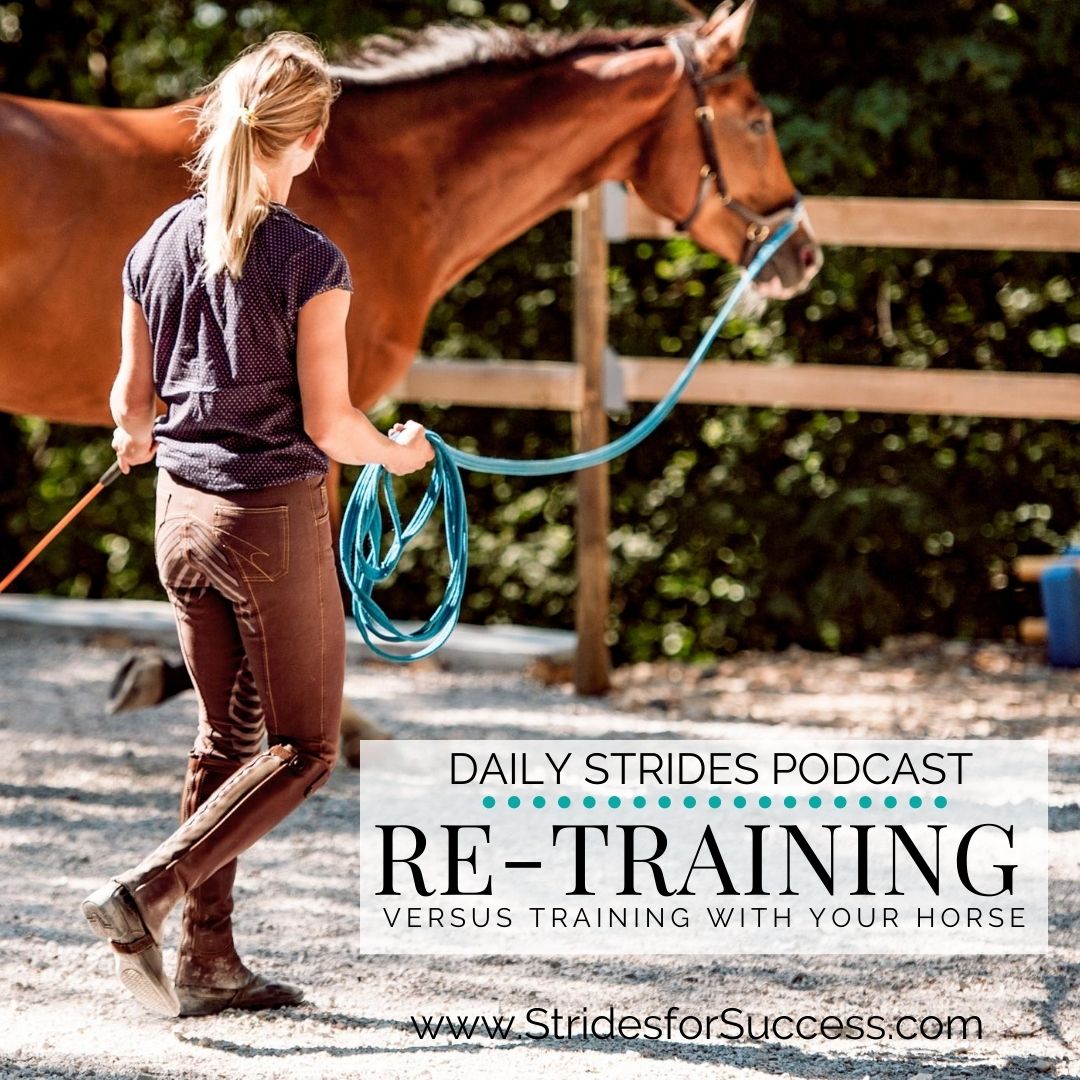
  • Retraining Your Horse Versus Training Your Horse

    Retraining Your Horse Versus Training Your Horse

    You have a unique language as a rider. A unique way that you do things when you are with your horse, both on the ground and in the saddle. In fact, every single other rider in the world also has their own unique language. Which is great; special snowflakes and all that.

    The trouble starts when your horse learns someone’s unique language; someone other than you…

    Once a horse has learned to do something or to associate a specific action with a specific response, it requires consistent diligent attention from the rider to retrain the horse. Retrain the horse to their way of doing things. And this is important. Failing to retrain your horse will result in mixed results, frustration, and eventual resentment for both horse and rider.

    [fusebox_track_player url=”https://op3.dev/e/traffic.libsyn.com/dailystridespodcast/1158-Re-Training-Your-Horse-Versus-Training-Your-Horse.mp3″ title=”Retraining Your Horse Versus Training Your Horse” social_linkedin=”true” social_pinterest=”true” social_email=”true” tweet_text=”Are you struggling with training your horse – because you should be ‘retraining’? Here’s how to find out…” hashtag=”ottb #equestrianpodcast” twitter_username=”strides_success” ]

    Retraining versus training your horse

    You have your own unique way of doing things. It is not your horse’s fault when he does not understand your unique way. It is your responsibility to teach him how to understand your unique way.

    Different Languages

    Have you ever tried to communicate with someone who does not speak your language? No comprehension at all of what you are saying. If you have, you will know that you can, on some level, get the basics across. Gestures, grunts, wild charade movements, and the odd shared word or two. It’s not perfect, but if it is something basic, you can find ways to get your point across.

    One of the easiest ways to imagine this is to think about your horse speaking a different language to you. You have the language that you are fluent in. And he has his, which is very different from yours.

    And the challenge with different languages that neither person understands the other one comes down to one simple fact. With enormous effort, you might just be able to get the basics understood, but that is as far as you can go. It is simply impossible to get more detailed aspects or nuanced points communicated in any sort of fluid or timely way.

    Failing to retrain your horse to your language and ways will result in you both remaining stuck on the basics for a very long time; sometimes forever.

    1 . Identify Your Rules for Retraining

    I know, it sounds so strict! However, whether you realize it or not, you have rules when it comes to working with and begin with your horse. I can bet him not standing on your toes is one of them! However, unfortunately, many riders don’t clearly define their rules. In fact, they only really begin to think about rules when someone (or some horse) pushes up against them or breaks them!

    Every single frustration you have with your horse is because your horse is breaking a rule you have created in your head. EVERY SINGLE FRUSTRATION.

    When you become clear on what you want and what’s allowed, you can begin thinking about how you can clearly communicate this to your horse. Remember, your horse has a different set of rules that, up to this point, he has been trained to adhere to. That list (if you can imagine them as a list) will NOT be the same as your list!

    Knowing what you want is key to then begin retraining your horse to respond to your cues in order to make it happen.

    2 . Use What Your Horse Already Knows

    A horse is a horse, is a horse, is a horse… Meaning that most disciplines, training, and methods will have some similar touchpoints which you can use to really begin communicating with your horse. As soon as your horse has been trained by someone to do something, basic aids have been used. You can use this to your advantage when retraining your horse.

    Use what he already knows to reframe how he responds to your unique aids

    Most horses are accustomed to pressure (and, maybe even release). Meaning when you apply pressure, he must respond. I would suggest supporting pressure with your voice aid. This is something you can begin working on from Day 1. On the ground or in the saddle.

    Use your basic aids, including your voice, to reward or correct everything you ask of your horse

    3 . Begin Training Your Horse

    Once you have the basics established with regards to your unique language, you can begin turning your attention to training. This is introducing new questions that your horse has never been asked before. This is where you want to take the conversation with your horse.

    Training is refining the basics of your unique language so that both you and your horse can begin developing together

    In order for you to move from re-training to training, your horse must become fluent in your basics. If not, you will soon see that while you might be able to duct tape a few things together initially, as soon as pressure is applied things soon begin falling apart.

    Which is why investing time correctly retraining your horse to your ways is essential if you want a long term, happy and fun partnership

    And remember, as you work on training your horse, there will be times when something shows up and needs retraining, either for the first time, again or further. It is a process that is ongoing with all horses because your skills should be improving and upgrading over time as well.

    Happy Riding
    Lorna

    Additional Resources on This Topic:-

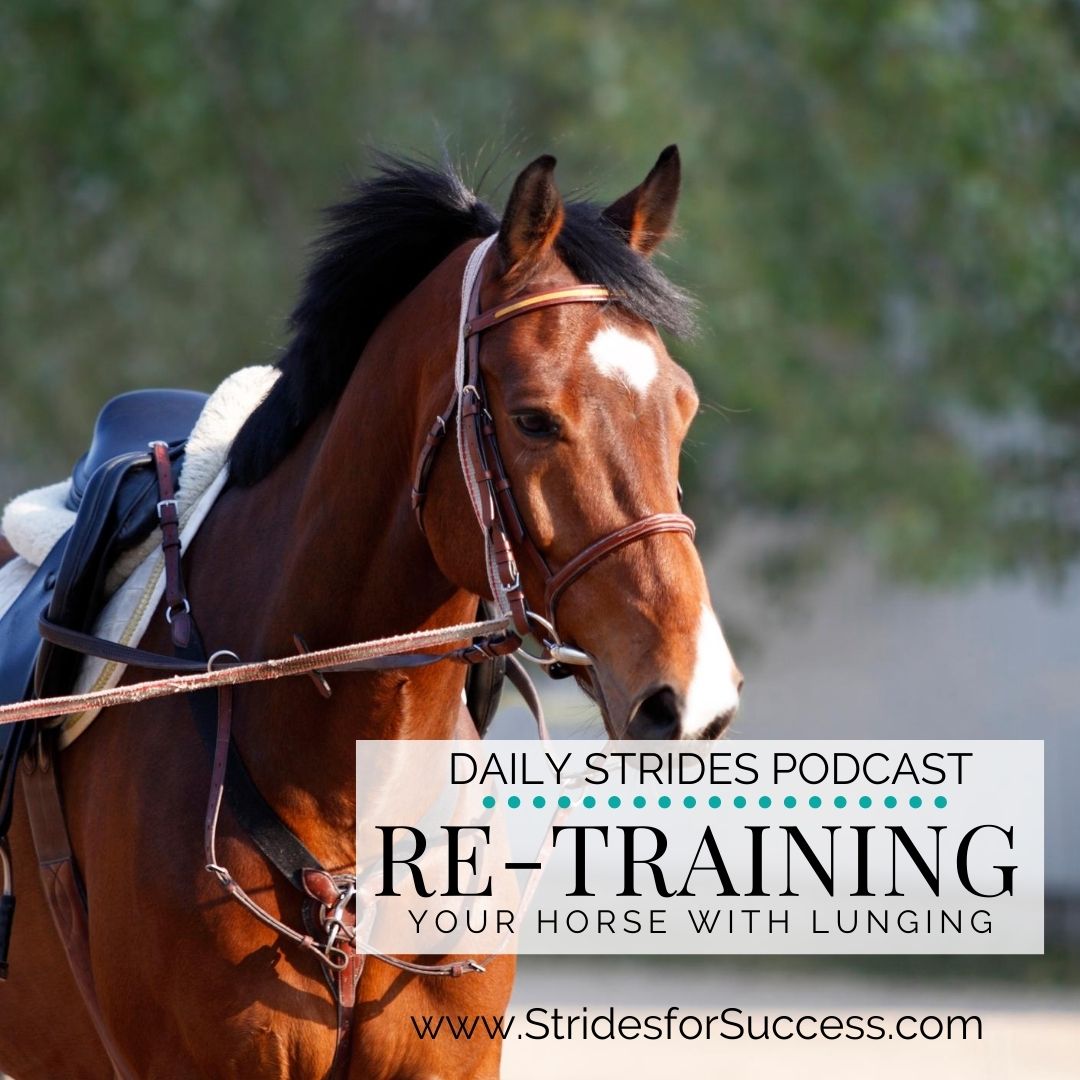
  • Re-Training Your Horse Using Lunging

    Re-Training Your Horse Using Lunging

    Did you know that almost anything you can do from the saddle, with your horse, you can do from the end of the lunge line? And the words lunge line there are important. I often chat with riders who believe in free lunging or loose lunging. They are not lunging! Lunging is when you are using your aids, both natural and artificial, to actively improve your conversation with your horse through your aids.

    And correct lunging is one of the best ways to begin re-training or re-schooling your horse, regardless of your abilities (or lack of abilities) when in the saddle.

    [fusebox_track_player url=”https://op3.dev/e/traffic.libsyn.com/dailystridespodcast/1156-Re-Training-Your-Horse-Using-Lunging.mp3″ title=”Re-Training Your Horse Using Lunging” social_linkedin=”true” social_pinterest=”true” social_email=”true” tweet_text=”Lunging might just be one of the best ways to retrain your horse, here’s why…” hashtag=”ottb #ex-racehorse #equestrianpodcast” twitter_username=”strides_success” ]

    Re-training Your Horse with Lunging

    So many riders struggle with re-training because their aids lack consistency when riding. They ‘think’ they are saying one thing to their horse, but meanwhile, their horse is hearing something completely different! Lunging removes this challenge.

    When you lunging, you can clearly see – in real-time – how your horse responds to your aids. Not how you think he is responding. You take on the perspective of a trainer.

    And you can do this in a few simple steps…

    1 . Get Clear on What You Want to Improve

    Do you find your head filled with what can seem like a million ideas when working with your horse? Every time you ask a question, you notice something else that needs ‘fixing’. And, being the diligent rider you are, off you go about ‘fixing’ that thing.

    You’re jumping from thing to thing throughout the ride. And in the end, you actually have no idea what you were working on for the full 30 minutes…

    Confusing, eh?! Now imagine how your horse feels when he doesn’t actually understand the first thing you set out to achieve, to begin with! When riding a horse who needs some re-training,  it is important to have a clear intention for each interaction.

    Figure out what you want to show your horse today? Then stick to that thing for the full session together!

    2 . How Can You Effectively Communicate This to Your Horse on the Lunge?

    So I’ve already said that anything you can say to your horse in the saddle, you can say on the lunge. Yes, it may take you time to refine your aids to the point where you can clearly communicate this to your horse, but it can be done. The trick is to begin thinking about ‘all’ of your aids.

    It is tempting to rely on just one or two aids that work well. However, I am going to challenge you to begin thinking about all of your aids. Natural and artificial.

    Some horses prefer a specific aid or combination of aids, others will differ. Your responsibility as the trainer is to identify what your horse currently understands and responds well to. Then using these aids to effectively communicate what you want from your horse.

    3 . Ask the Question and Allow the Response

    Once you have identified what you want and how best to ask that, the next part is to ask! Take action and ask the question of your horse as clearly and best you can. However, it is not enough to just ask. You have to give your horse time to respond to your question.

    There is a big difference between a monologue and a conversation; listening for your horses response creates the conversation.

    If it is not what you want, keep in mind that responsiveness can be an issue. If so, this is on you… Keep in mind that the response might be subtle. And often the lack of a response is the actual response.  What is key here is that you are mindfully watching for and waiting for your horse to respond to your question. You are actively creating a space in the conversation for his response. This is a vital part of re-training your horse.

    4 . Allow or Correct

    From here, you have two choices regarding what to do next. You can allow your horse to do what it is he is doing. This is assuming that you are happy with his response and it is the one you wanted! Or you can correct him. What is important with both of these actions from you is the timing. It must be relevant.

    Allowing can be enhanced with a positive response from you. A softening or releasing. A verbal response. Let your horse know that he was right and that was what you were looking for.

    Remember, when you’re retraining your horse, he doesn’t really know what you want and what you don’t want. It is your responsibility to tell him when he gets things right. Consistently doing this will help produce the same results over and over again.

    Correction is important if the response was not what you wanted. You have to tell him when it is not what you want. This way you then set everything up to ask the question again, differently and then again watching and either allowing or correcting again.

    Simple corrections done in a timely fashion are the key to explaining to your horse what you want and what you don’t want. There is an example of this in the Daily Strides Podcast Episode for this post. You can play the episode at the top of this post.

    5 . Rinse and Repeat

    From here, you simply take note of what happened and repeat. What is important in the repeating is that you care mindfully changing your approach if your horse’s response was not what you wanted it to be. Think about what aids you are changing or how you can change the pressure you applied.

    Your responsibility as a trainer is to continually refine your aids so that your horse can more clearly understand what you are saying.

    This can only happen when you are present and conscious of how you are asking each question, and of how your horse is responding to everything you say.

    Retraining your horse does not have to be difficult. In fact, the more simple the better.

    Happy Lunging
    Lorna

    Additional Resources on This Topic

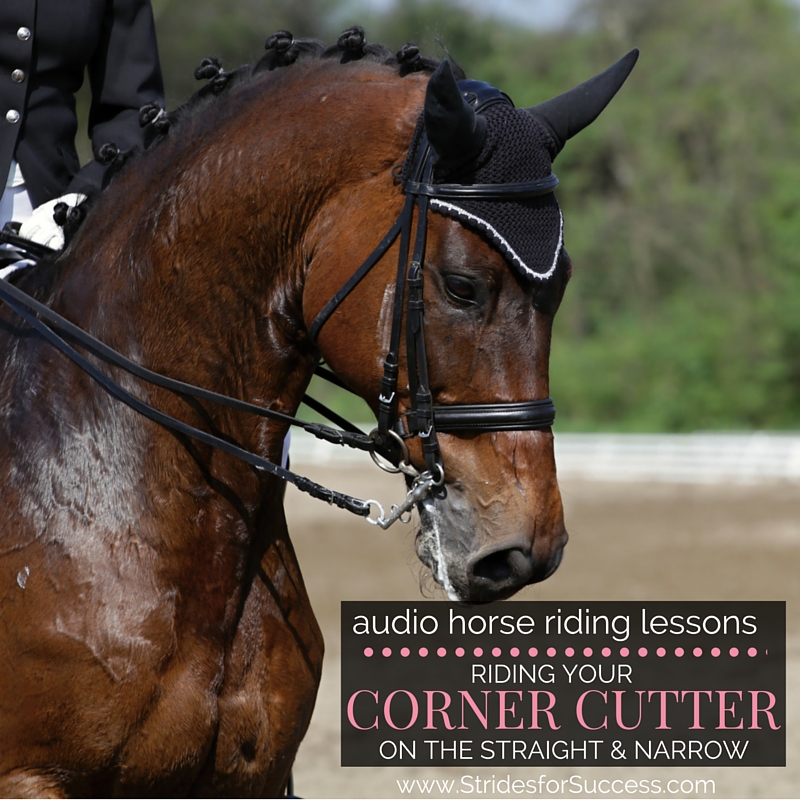
  • Re-Schooling a Corner Cutter

    Re-Schooling a Corner Cutter

    [fusebox_track_player url=”https://op3.dev/e/traffic.libsyn.com/dailystridespodcast/556-Riding-Your-Corner-Cutter-on-the-Straight-and-Narrow.mp3″ title=”Riding Your Corner Cutter on the Straight and Narrow” social_linkedin=”true” social_pinterest=”true” social_email=”true” ]

    Have you discovered that your horse is a bit of a maths whizz?  He has somehow figured out that if he shaves just a few meters or yards here and there off of the odd corner or three, he has to do less overall in each lesson or schooling session.  He seems to have a strong understanding of distance and how to make it shorter – much to your frustration and annoyance!

    Cutting corners is something that, the mere mention of, takes us back to that one riding school pony in our past. The pony who, no matter what you did, insisted on taking shortcuts every circuit of the arena

    However, unfortunately, any horse has the potential to become a corner cutter.  It is one of those niggling issues, that if it is not straightened out correctly once and for all with correct re-schooling, will plague almost all activities you choose to do with your horse.

    Poles on the ground throughout your jumping rounds due to a crooked approach, marks dropped in dressage due to no difference between a circle and going large, lack of bend, lack of flexion, etc…

    What Causes a Corner Cutter?

    So, the question is; once a horse has really become a genuine, bona-fide corner cutter, how can we begin to correct this?

    Well, let’s first take things back to the beginning of the issue, where the problem first began to become noticeable.  Usually, it is caused by a rider that is, well, less than accurate on how they are planning to ride a corner.  A lot of riders, particularly novice riders, tend to see corners as a means to get to the next ‘straight part’ of the arena.  Little attention is paid to actually riding the corner.  And, of course, when ridden badly will affect the quality of the ride on the same said ‘straight part’ of the arena.

    Truly Riding a Corner

    To begin remedying a corner cutter, the rider needs to first become really clear on how exactly they want to ride the corner and what that would look like

    It is important to keep in mind when planning this that your horse has a much longer back than you.  Meaning that where you can literally pivot on your ‘inside leg’ and turn the corner, he will need to take the corner more like a train would.

    It is also worth keeping in mind that with a train, the shorter the carriages, the tighter an angle or arc it could technically round a corner on… The same principle applies to your horse, the greater collection, the deeper into a corner or the smaller the angle will be that he can also round the corner with.

    Identifying the Track

    Of course, this does not mean that you need collection before riding a corner.  However, your horse does need to be balanced and the chosen track must be a suitable match for how your horse is going before riding into the corner.

    Looking at your own horses unique situation, where he is in his training and how developed is he physically and mentally, will dictate the track you can expect to follow when riding the corner correctly.

    Telling your Horse Where to Go

    Once you have an exact and realistic plan in your mind of where you want to go, the next step is to communicate this to your horse.  This means you must get clear on is your aids both before the corner.  You must set things up and then ride through the corner.

    If you have learned to drive a car you will most likely know that when driving around a corner or bend, the general rule is to break before and then accelerate through.  When you are told to break, it really means to check your speed and ‘rebalance’ the car before each corner.

    A similar principle applies to your horse. However rather than ‘breaking,’ your half halt is vitally important to firstly communicate that something is about to happen. And then to rebalance him before attempting to ride the corner.

    Using the Half Halt

    Just like the train we spoke of earlier, if your horse is long and ‘strung out’, he will not be able to ride deep into the corner. This may make your circles and corners look similar!  Use your half-halt to begin shortening things up a little and engaging the hindquarters, so as you can ride deeper into the corner and avoid any corner cutting!

    You may find that if your horse is a true and true corner cutter, you will need to ride quite a few half halts to really begin seeing the results that you desire, but the half halt, coupled with a lot of transitions, will soon have him more responsive to your aids and listening to you more…

    Re-Schooling a Corner Cutter

    Your Aids when Riding a Corner

    This leads us on to the next point – becoming really clear on your aids while riding through the corner.  Once you have half halted sufficiently and your horse is listening to you, you must then apply the aids to ask your horse to begin bending around your inside leg.

    He must continue to move forward at all times through the corner, all the while bending and flexing his body around your inside leg

    To maintain the rhythm, it is your responsibility to keep consistent contact with the outside rein, and only using the inside rein to flex the head and neck in the direction you are traveling.

    Don’t Pull the Outside Rein!

    Many riders make the mistake of pulling with the outside rein to try to keep their horse ‘out on the track’, but what almost always happens is the horse cocks his head to the outside, but then continues to shift to the inside.  This can look like bulging out or bracing his body against your inside leg.  Or, it can feel like moving the shoulders to the inside with each step, almost side passing around the corner.

    In both cases, the rider inevitably gives up and the horse merrily continues on, readying himself for the next battle of wills at the next corner!

    If you find this is the case, re-schooling your horse to become more responsive to your aids is essential if you are to successfully eradicate the corner-cutting from your horse’s habits.

    Forwardness & Responsiveness

    Spend time working on your horse moving firstly off your leg and forward, and once you have established that, he must also learn to come back when asked.  Then turn your mind to your horse moving away from your leg, or yielding to your leg.

    Begin by riding on a 10m circle in one of the corners in your arena.  Stay in the walk for the duration of the exercise, but make sure your horse is moving forward at all times.  Not dragging his feet or becoming ‘sticky’ with his front end rather than stepping out on each stride.

    Focus on the quality of the bend, is your horse really bending around your inside leg.  Do you truly have consistent contact with the outside rein?  Is your horse’s hind legs on the same track as his front legs at all times on the circle?

    Think of your horse’s tracks as train tracks, the back hoof must follow the corresponding front hoof on both sides, equal even and remaining parallel to each other as he travels around the circle.

    Using Transitions to Build Responsiveness

    From here, begin working large around the whole arena, but still riding a 10m circle in each corner.  Use the long sides of your arena to ask for some transitions, whether it be between walk and halt or walk and trot, or all three.  However, make sure you are back into a relaxed, rhythmic, and forward going walk approximately 5 meters before each corner.

    Once you and your horse can consistently maintain the correct bend in each corner, on the track you have decided on each time, change rein and work on the opposite rein.  

    Notice any differences your horse might show between the two directions and, if you do pick up on any stiffness, create a plan with each ride to begin helping your horse to loosen up.

    Paying Attention to the Trot…

    Finally, once your horse is truly responsive and listening to you on the circle at each corner, just go large, no circles.  See if you can continue to maintain the bend in each corner as you ride through it, and if so, begin working in trot.

    You may find that once you add a little more speed, things become a little harder to control and maintain.  

    If so, begin the same exercise, with the circles, in trot.  However, you may need to ride a larger circle depending on your horse’s level of training.

    Consistency, as always, is the key to banishing your horse’s corner cutting habits for good.  

    Remember to ride each corner as its own separate movement and then you should begin to see a continuous improvement in how well your horse can ride a bend and also, the quality of the work as you ride out of each corner.

    Happy Riding!

    Lorna

    Additional Links to Help You:-