Tag: re-training

  • 5 Reasons You’re Stuck when Training or Retraining Your Horse

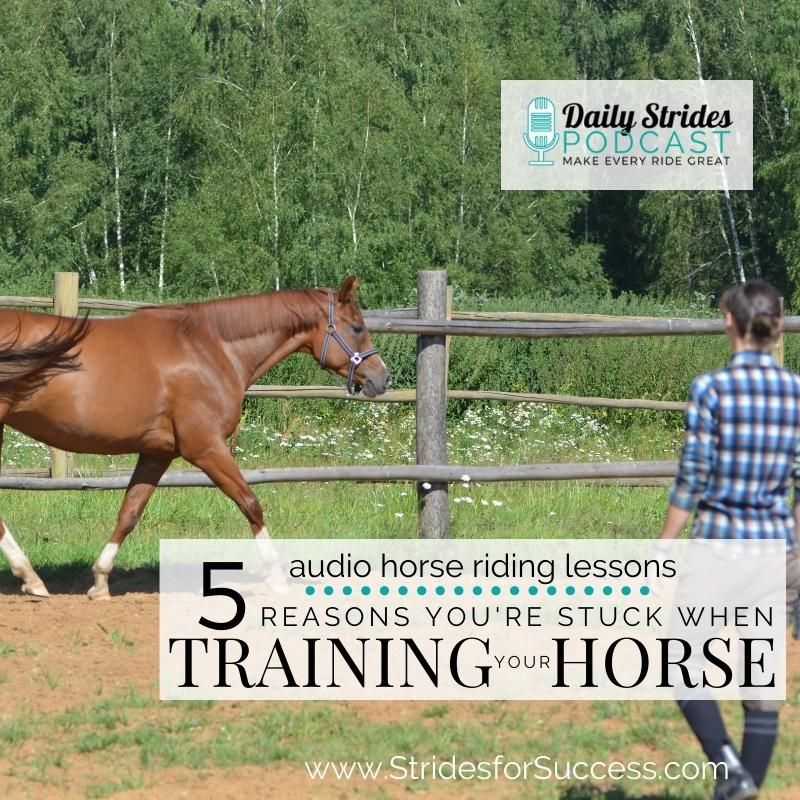
    5 Reasons You’re Stuck when Training or Retraining Your Horse

    [fusebox_track_player url=”https://op3.dev/e/traffic.libsyn.com/dailystridespodcast/1242_5_Reasons_Youre_Stuck_when_Training_or_Retraining_Your_Horse.mp3″ title=”5 Reasons You’re Stuck when Training or Retraining Your Horse” social_linkedin=”true” social_pinterest=”true” social_email=”true” tweet_text=”Find out what’s keeping you stuck when training or retraining your horse…” hashtag=”equestrian #podcast” twitter_username=”strides_success” ]

    It can be frustrating when you know exactly what you want to achieve when training or retraining your horse, but it seems to be taking ‘forever’!  It seems that no matter how much you explain your horse, he’s not ‘getting it’.

    Training or retraining your horse is something that takes time.  And, sometimes, it is our own impatience or actions that actually keep things stuck where progress is concerned. 

    Today I want to cover the 5 most common causes that may cause you to become a little stuck when training or retaining your horse.

     1. Lack of Consistency

    When we first think about consistency in our riding, we often think about our actual riding schedule.  How many days a week or month we are working with our horse.  And, yes, this is important.  However, what’s far more important in my opinion is what’s happening in each of those individual sessions.

    You are always training or retraining your horse. On the ground, in the field, on the trail, and in the arena.

    Practice is important.  However, only practicing specific things when the mood takes you will not get you the results you want.  How you are doing one this is how you must do everything.  Simply ‘practicing’ won’t make perfect.

    The key is to make sure you are consistent with your communication, your expectations, and your responses through all that you do. 

     2. Confusing Training and Re-Training

    Training and retraining your horse are two very different things.  And when we are working with our horses, it is really important to know the difference between the two. You can download a free printable article CLICK HERE
    that goes into more detail on this.

    Training is creating an expectation or an outcome to a certain question. Retraining is changing the expectation or outcome when the same question is applied. 

    When your horse already knows to do a certain thing a certain way that you want to change or modify, this is retraining.  And, just like us, when a certain expectation or habit has been in place for a while, it can sometimes be a challenge to change!

    Many riders fail to truly understand ‘retraining’. They don’t invest enough time in truly changing the associations or responses their horse has. This will often become really clear when pressure is applied to the situation and the horse reverts back to the ‘old way’ of behaving or responding.

    Equally as common is the rider who forgets that their horse does not understand the question.  Rather than becoming frustrated or annoyed, reframe this with ‘how can I better explain this to my horse.

    3. Differences Between ‘Thinking’ and ‘Doing’

    Have you ever watched a video of yourself doing something? Riding, dancing, running…? The thing that strikes most people when they do this is the vast difference between how they ‘think’ they are doing the thing, and how they are actually doing the thing!

    I regularly work with riders who really do need video evidence that I am not imagining seeing their lower leg constantly swing or their inside hand drop. That is the difference between ‘thinking’ and ‘doing’.

    If you have hit a bit of a plateau when training or retraining your horse, check yourself and what you are doing. 

    I strongly suggest videoing yourself.  I think that in this day and age, it’s as simple as using your phone propped on something and riding past it a few times.  It can be truly eye-opening.  Review your video and really look for any possible ‘mixed signals’ in the communication.

    Lack of coordination, your aids not being as independent as you thought, and just doing the wrong thing can all cause your training to stall and plateau. 

     4. Lack of Knowledge

    The final mistake you could be making when training or retraining your horse is simply not knowing enough.  Make sure you don’t fall into the trap of seeing someone else do something and then assuming you can do the same.  I see this happen a lot with regards to riders watching videos or ‘tutorials’ online.  If someone can do something well enough to create and post a video about it, there’s a pretty good chance that they have been practicing that thing for quite a while!

    Many riders are trying different methods or techniques with their horses without actually really knowing ‘why’ and ‘how’ it produces the result it does. 

    When training or retraining your horse, it is vital to understand as much as you can about the topic you’re working on.  The pre-requisites, preparation, aids, what it will feel or look like (especially at first), and how to develop it further.

    Knowing the aids to the canter is not enough when training or retraining your horse to perform a more timely, clean, and correct transition into the canter! 

    If you are trying to train or retrain your horse, begin scheduling an hour or two each week to actually LEARN more.  Going deeper into each topic and understanding how it fits in.  This will lead to more lasting success for you and your horse.

    5. Not Enough Time…

    You would never expect to go for a 3km run today and then be fit enough to run a full marathon tomorrow, would you?! And yet, as riders, we can often expect this of our horses!  This actually really ties all of the things we have already spoken about today together.

    Time is essential to build lasting results when training or retraining your horse. Physically, mentally, and emotionally.

    If you are not seeing results, could it be that you have not yet allowed enough time? Development, especially when correct, takes time. This can seem boring and long-winded.  And yet, this is often the difference between a horse that develops and a horse that stagnates in its training.

    The good news is that if you can couple time with consistency and correct actions, you will soon begin to see changes in both your skills as a rider. And your horse’s way of going.

    Happy Riding
    Lorna

    Download a printable version of this article when you CLICK HERE

    More on This Topic

    More Training & Support

  • Why Enforcing Your Boundaries on the Ground will Improve Your Riding

    Why Enforcing Your Boundaries on the Ground will Improve Your Riding

    Are you a pushover? So many riders describe themselves this way. And this is unfortunate because what’s happening between you and your horse on the ground, is a good reflection of whats going on in the saddle.

    [fusebox_track_player url=”https://op3.dev/e/traffic.libsyn.com/dailystridespodcast/1164-Why-Enforcing-Your-Boundaries-on-the-Ground-will-Improve-Your-Riding.mp3″ title=”Why Enforcing Your Boundaries on the Ground will Improve Your Riding” social_linkedin=”true” social_pinterest=”true” social_email=”true” tweet_text=”Have you rules when it comes to your horse?” hashtag=”equestrianpodcast” twitter_username=”strides_success” ]

    Groundwork is so important. Every single conversation you have with your horse starts and ends on the ground. Failing to pay attention to what is happening there is simply setting you both up for frustration and maybe even anxiety.

    Why Enforcing Your Boundaries on the Ground will Improve Your Riding

    What Are Boundaries

    Boundaries are the rule book between you and your horse. They are where you define what’s ‘okay’ and what’s not. And it is the lack of a boundary that causes issues when the arise between horses and their riders.

    Often you won’t even recognize you have a boundary until your horse has overstepped it.

    Think back to the last time you felt a ‘negative’ or less than desirable emotion when working with your horse. I can bet it was because he either did something or didn’t do something, you expected of him. You see, you had a rule. A boundary. And your horse broke it.

    The good news is that once you begin noticing your boundaries, or your rules, you can begin actively enforcing them.

    Your Electric Fence System…

    Imagine having an electric fence around you. I say this because most horse owners and riders understand how effective this is when managing horses in paddocks and fields. If someone was to push up against your fence, your boundary, would they be shocked? Or would they be able to continue pushing until maybe the fence breaks?

    It is really important to realize that it is your responsibility to turn your electric fence on

    This is enforcing your boundary. There is a clear and definite point where you won’t tolerate the other person (or your horse’s) pushing. And what’s nice is that once they know where the fence is and that it is turned on, they begin respecting it.

    Are Boundaries Boring?

    It can feel that way initially, especially if you are used to the ‘free to do what you want when you want it’ style of horsemanship that many people now tout as being ‘natural’. However, I’m going to go out on a limb here and say that if you have read this far, you’re having issues with your horse. So, maybe it is time to try tweaking things a little?

    Riders who have strong and clear boundaries can truly enjoy their time with their horse.

    They don’t experience the anxiety, nerves, worry, or trepidation that other riders do on a daily basis. This is because they are not always wondering what their horse will do if a ‘mood’ takes him. They are also very aware that these boundaries are first put in place when on the ground with their horse. They are then later carried over to when they are in the saddle. It all begins on the ground.

    Knowing The Limits

    Think about your horse in his usual paddock or field. He knows where those boundaries are. He feels safe when inside of those boundaries. Now, think about when he is put into a strange place he’s never been before. Often the very first thing he will do is figure out the new boundaries.

    Horses like to know where they can and cannot go. They thrive when the ‘limit’ or the boundary has been clearly defined for them.  This allows them to settle in and really begin to get to know the space they are in.

    Your job, as ‘team leader/trainer/rider’ for your horse, is to clearly define your boundaries. Then explain and show them to your horse. From here, you must enforce them. A boundary is not a boundary until it is enforced.

    Knowing the limits allows your horse the space to step into his own confidence and begin taking responsibility for part of the teamwork

    Clear Expectations & Rules

    A boundary is basically a rule. If there is anything in your riding, or in your interactions with your horse on the ground that is causing you to feel frustration, anxiety, or any other negative feels, it is because a rule is being broken. There is something there that you would like to happen differently.

    Noticing what we don’t want is often the first step to begin inning to define what we do want.

    Every time you ask your horse something, you have the desired outcome already imagined or mapped out in your head. It is when you don’t get this outcome that the negative feelings begin to show up. For example, if you put your outside leg back and expect canter, but your horse turns in or bucks. Or if you stop while leading your horse and he doesn’t. He runs you over as he walks on past you. It could be that you want him to lift his foot when you tap it in a certain place or a certain way. But he stubbornly refuses to budge, maybe even leans over onto said foot!

    Next time you feel yourself tensing up over something your horse did or did not do, celebrate! You have now been given a clear opportunity to begin redefining your rules and your boundaries

    Horses Have Boundaries Too…

    Think of a horse who become anxious or nervous. This is probably happening because a boundary he believes exists has been broken…

    Your horse also has his own set of rules. “If I feel or sense this, I must do that”. Or “if my ‘person’ does this, it means I must do that”. The trouble begins when the rules don’t align! Which is really common when you get a new horse or a horse that has been worked with by someone else.

    Re-training or re-schooling horses is simply redefining the rules or the boundaries to where you want them.

    A lot of negative feelings that are expressed by horses happen when the horse’s boundaries have been crossed. When the horse’s expectations of the rules have not been met or been broken. A conversation is two ways. Meaning that your horse must also have input and a say.

    When your horse feels comfortable, heard, and understood regarding boundaries, he will begin to express this in how he shows up. His confidence will grow and this results in a physical change in his way of going.

    Being Consistent and Fair

    Boundaries require consistency in order to be fair. I have helped so many riders transform their relationship with their horse by simply applying consistency to their rules. Rules on the ground and when in the saddle.

    It is unfair to the horse when the rider allows their current mood to dictate the rules.

    They flip from one day being absolutely hell-bent on doing ‘the thing’ the ‘right’ way. No wiggle room at all in their approach. It must be this – nothing else is acceptable. There is nothing wrong with this approach until the rider ‘flips’. Maybe they are tired or feeling rushed. Either way, this ’thing’ that they so diligently enforced the previous day is now no longer important. The rules change with their mood.

    In order for a boundary to be fair, it must be consistent. Even when it is uncomfortable or awkward to do so.

    If you do want to change the goalposts, I’m going to suggest creating a different playing field for you and your horse. A different arena. Or different tack. Maybe it’s the time of day. Things can change, but there must be a definition of the change.

    Clearer Boundaries = Better

    So many riders want to become ‘better’ when working with their horse. A better rider, or a better leader. You can do this today by becoming clearer on your boundaries. By simply showing up and deciding what is allowed and what’s not, you are already better than the last time you worked with your horse.

    And if you’re unsure of where to begin… Think about the last time you felt frustrated, angry, nervous, anxious when with your horse.

    Negative feelings are a clear indicator that a boundary has been either pushed up against or crossed. You might not have actually defined the boundary yet, but the feeling you are experiencing is telling you it is there and it needs reinforcing.

    Happy Riding
    Lorna

    Additional Resources on this Topic:-

  • Re-Training Your Horse Using Lunging

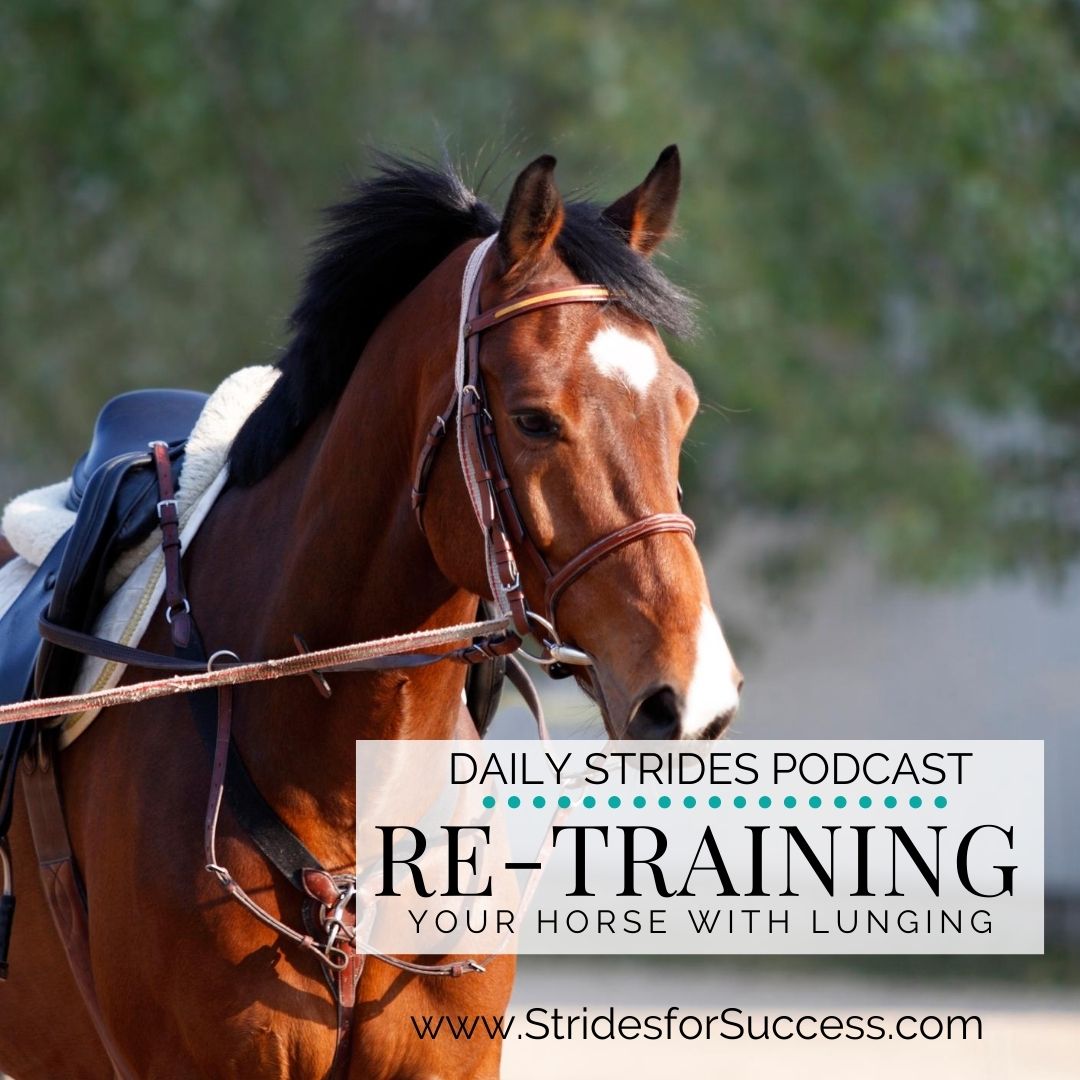
    Re-Training Your Horse Using Lunging

    Did you know that almost anything you can do from the saddle, with your horse, you can do from the end of the lunge line? And the words lunge line there are important. I often chat with riders who believe in free lunging or loose lunging. They are not lunging! Lunging is when you are using your aids, both natural and artificial, to actively improve your conversation with your horse through your aids.

    And correct lunging is one of the best ways to begin re-training or re-schooling your horse, regardless of your abilities (or lack of abilities) when in the saddle.

    [fusebox_track_player url=”https://op3.dev/e/traffic.libsyn.com/dailystridespodcast/1156-Re-Training-Your-Horse-Using-Lunging.mp3″ title=”Re-Training Your Horse Using Lunging” social_linkedin=”true” social_pinterest=”true” social_email=”true” tweet_text=”Lunging might just be one of the best ways to retrain your horse, here’s why…” hashtag=”ottb #ex-racehorse #equestrianpodcast” twitter_username=”strides_success” ]

    Re-training Your Horse with Lunging

    So many riders struggle with re-training because their aids lack consistency when riding. They ‘think’ they are saying one thing to their horse, but meanwhile, their horse is hearing something completely different! Lunging removes this challenge.

    When you lunging, you can clearly see – in real-time – how your horse responds to your aids. Not how you think he is responding. You take on the perspective of a trainer.

    And you can do this in a few simple steps…

    1 . Get Clear on What You Want to Improve

    Do you find your head filled with what can seem like a million ideas when working with your horse? Every time you ask a question, you notice something else that needs ‘fixing’. And, being the diligent rider you are, off you go about ‘fixing’ that thing.

    You’re jumping from thing to thing throughout the ride. And in the end, you actually have no idea what you were working on for the full 30 minutes…

    Confusing, eh?! Now imagine how your horse feels when he doesn’t actually understand the first thing you set out to achieve, to begin with! When riding a horse who needs some re-training,  it is important to have a clear intention for each interaction.

    Figure out what you want to show your horse today? Then stick to that thing for the full session together!

    2 . How Can You Effectively Communicate This to Your Horse on the Lunge?

    So I’ve already said that anything you can say to your horse in the saddle, you can say on the lunge. Yes, it may take you time to refine your aids to the point where you can clearly communicate this to your horse, but it can be done. The trick is to begin thinking about ‘all’ of your aids.

    It is tempting to rely on just one or two aids that work well. However, I am going to challenge you to begin thinking about all of your aids. Natural and artificial.

    Some horses prefer a specific aid or combination of aids, others will differ. Your responsibility as the trainer is to identify what your horse currently understands and responds well to. Then using these aids to effectively communicate what you want from your horse.

    3 . Ask the Question and Allow the Response

    Once you have identified what you want and how best to ask that, the next part is to ask! Take action and ask the question of your horse as clearly and best you can. However, it is not enough to just ask. You have to give your horse time to respond to your question.

    There is a big difference between a monologue and a conversation; listening for your horses response creates the conversation.

    If it is not what you want, keep in mind that responsiveness can be an issue. If so, this is on you… Keep in mind that the response might be subtle. And often the lack of a response is the actual response.  What is key here is that you are mindfully watching for and waiting for your horse to respond to your question. You are actively creating a space in the conversation for his response. This is a vital part of re-training your horse.

    4 . Allow or Correct

    From here, you have two choices regarding what to do next. You can allow your horse to do what it is he is doing. This is assuming that you are happy with his response and it is the one you wanted! Or you can correct him. What is important with both of these actions from you is the timing. It must be relevant.

    Allowing can be enhanced with a positive response from you. A softening or releasing. A verbal response. Let your horse know that he was right and that was what you were looking for.

    Remember, when you’re retraining your horse, he doesn’t really know what you want and what you don’t want. It is your responsibility to tell him when he gets things right. Consistently doing this will help produce the same results over and over again.

    Correction is important if the response was not what you wanted. You have to tell him when it is not what you want. This way you then set everything up to ask the question again, differently and then again watching and either allowing or correcting again.

    Simple corrections done in a timely fashion are the key to explaining to your horse what you want and what you don’t want. There is an example of this in the Daily Strides Podcast Episode for this post. You can play the episode at the top of this post.

    5 . Rinse and Repeat

    From here, you simply take note of what happened and repeat. What is important in the repeating is that you care mindfully changing your approach if your horse’s response was not what you wanted it to be. Think about what aids you are changing or how you can change the pressure you applied.

    Your responsibility as a trainer is to continually refine your aids so that your horse can more clearly understand what you are saying.

    This can only happen when you are present and conscious of how you are asking each question, and of how your horse is responding to everything you say.

    Retraining your horse does not have to be difficult. In fact, the more simple the better.

    Happy Lunging
    Lorna

    Additional Resources on This Topic

  • Where is the Beginning with Your OTTB / Ex-Racehorse?

    Where is the Beginning with Your OTTB / Ex-Racehorse?

    Where is the Beginning with Your OTTB or Ex-Racehorse

    Where should I start? Have you ever found yourself wondering about this with your horse? The beginning is the obvious answer. However, sometimes the beginning is not as simple to pin-point. This is especially true with it comes to your ex-racehorse or OTTB.

    Your retired racehorses beginning when he gets to you is not the same as the beginning with other horses. They have already ‘begun’. However, now we are asking them to perform a ‘re-do’. To re-start. At a new beginning…

    [smart_track_player url=”https://op3.dev/e/traffic.libsyn.com/dailystridespodcast/1112-Where-is-the-Beginning-with-Your-OTTB-ex-racehorse.mp3″ title=”Finding the Beginning with Your OTTB or Ex-Racehorse” social_linkedin=”true” social_pinterest=”true” social_email=”true” tweet_text=”Where is the ‘beginning’ when it comes to working with an OTTB or ex-racehorse? Here’s my thoughts on it…” hashtag=”equestrian #horseriding” twitter_username=”strides_success” ]

    Thoroughbreds can come to us at so many different points in their careers and lives. They may just be fresh off the track. He might be off a year or two, but was left to his own devices in a field. Possibly he has been worked and ridden by someone else since leaving the track.

    Or, your beginning might just be today. You have been working with your ex-racehorse for a while now, and running up against ‘road-blocks’. You want to find a new beginning…

    Groundwork & Your Ex-Racehorse

    I honestly believe that we can start any conversation with our horses, from scratch, on the ground. It is a place where we can be a little more observant as to what is happening and how we are being understood.

    There are so many things you can work on from the perspective of being on the ground, that will then compliment your efforts in the saddle.

    Groundwork and lunging will support what is going on in the saddle. This is regardless of whether or not your horse is backed and riding. In order for it to be effective, it must be consistent. Consistent with regards to your expectations, your aids and actually ‘doing the work’.

    Your Voice as a ‘Crossover’ Aid

    While working on the ground with your horse, you can begin to strengthen your voice aids with your horse. Your voice has the ability to help your horse understand things. It is also a great aid to help settle and instil confidence in your horse as well.

    When it comes to your voice, it is not what you say, but how you say it that makes the impact.

    Be mindful of your tone and the ‘feeling’ you are putting behind your words. By using your voice to back up your driving aids on the lunge, you can then help your ex-racehorse to better understand those same aids in the saddle.

    The same applies with slowing down, steadying and relaxing. Your voice is a powerful aid that you can use to really help your horse to better understand your other aids from the saddle.

    Re-Shaping the ‘Contact Conversation’

    Lunging is also an excellent way to begin re-training the concept of contact with your OTTB or retired racehorse. So many riders or ex-racehorses really struggle with this. Complaints of arms feeling like they are a couple of inches longer after each ride are common!

    It is important to remember that in his previous career, contact was a signal to ‘push harder’.

    Your OTTB has learned to ‘take a pull’ where the contact is concerned – and your job is to change this approach for him. However, pulling against the pull is counter productive! It only reinforces what he has already learned.

    Allowing Contact to be Neutral

    I think that lunging your horse with a bit in his mouth can help to shift how he thinks and feels about the bit. Lunging using a basic bridle, minus the reins and even the noseband, can help this to happen. I also feel that the lunge rope must not initially be attached to the bit. The bit must just ‘be’ there; rather than have any job or meaning.

    All horses are different, however you will find that your horse will soon begin to stop ‘fighting’ the bit. Once your horse has accepted the bit as ‘neutral’, you can begin to add contact.

    Contact on the lunge can begin as side reins. Good quality side reins have a little ‘stretch’ in them – they soften. Yet, they are also very consistent, which is what you want, especially with an ex-racehorse.

    As a rider, we want to create energy and then gather it in the contact. You can do this same thing from the ground, on the lunge.

    Using Lunging with Your Riding

    All horses are different; therefore different approaches are often needed. However, generally I don’t believe that you only have to lunge your horse when retraining or re-schooling. The lunging is there to compliment and support your riding.

    The simple truth is that for most riders, the possibility that their aids are less than crystal clear in the saddle is very high.

    Investing a little time lunging each week will help you to continue training your ex-racehorse, even if your aids could do with a little ‘fine-tuning’! Lunging also allows your horse the space to figure things out on his own.

    Balance is a key word when working with horses, and working on the lunge allows him to learn this himself. Without the hinderance of a rider being on board…!

    So, Where is the Beginning?

    It is where ever you want it to be. It is today. Wherever you are right now on your journey with your retired racehorse, groundwork and lunging can only help and benefit you both.

    Of course, the work itself has to be correct and right. Personally I don’t believe that ‘loose lunging’ has much benefit for horse or rider. When I say lunging, I mean really learning how to lunge your horse correctly.

    Take the time, learn how to work with your horse on the ground and it will really begin to move the conversation forwards for you both.

    Happy Riding

    Lorna

    Other resources, episodes and trainings to help you:-