Tag: Refining

  • A Square Halt on the Ground

    A Square Halt on the Ground

    Think about the last time you were with your horse. How many times did you ask him to halt while working with him on the ground? Before you mounted up? Was it 4?  Maybe 10? And what about after you dismounted?

    When interacting and working with our horses, so much of it happens on the ground. Beside your horse. Here is how you can begin using this in a way that will help you when you do mount up in the saddle.

    All conversations with your horse start and end on the ground. Before you mount up and when you dismount after each ride. So it makes sense to use this daily interaction to intentionally help your riding.

    A Square Halt on the Ground

    What is a Good Quality Halt?

    It is a halt that holds or contains the energy inside of it. I know, that seems a little abstract, however, imagine this… There are 2 horses halted side by side. One is carrying himself, looking as regal and exquisite as he possibly can and all in a focused, alert, and yet calm manner. He is literally ready to move forward to the next thing, while still happy to remain in the halt.

    [fusebox_track_player url=”https://op3.dev/e/traffic.libsyn.com/dailystridespodcast/1163-A-Square-Halt-on-the-Ground.mp3″ title=”A square halt on the ground” social_linkedin=”true” social_pinterest=”true” social_email=”true” tweet_text=”Something to try with your horse, that doesn’t involve mounting up…” hashtag=”equestrianpodcast” twitter_username=”strides_success” ]

    The other horse is ‘chillin’ like a villain’… It looks like someone dragged him into a halt! Long. Strung out. Half asleep or even asleep! Legs everywhere. His back looks like one of those rope bridges, except this bridge extends from ears to tail. Long and loopy… Can you see the difference in your mind?

    The halt that contains energy and is forward-thinking, even when stationary in the halt is the better quality halt. This horse is ready to move out of the halt.

    Okay, now I want you to begin thinking about your horse and how he halts when you are leading him. Does he resemble Horse A or Horse B? This is where you can begin working on the ground, and in doing so, actually working on improving what’s happening during the actual ride as well.

    Getting Clear on What you Want to Make Happen

    The first part of beginning to improve your halt on the ground is to get clear on what you want to happen. Both of the above examples are technically halting. The horse is stopped and standing stationary. However, they are also completely different. Clarity about what is acceptable and what’s not is the beginning.

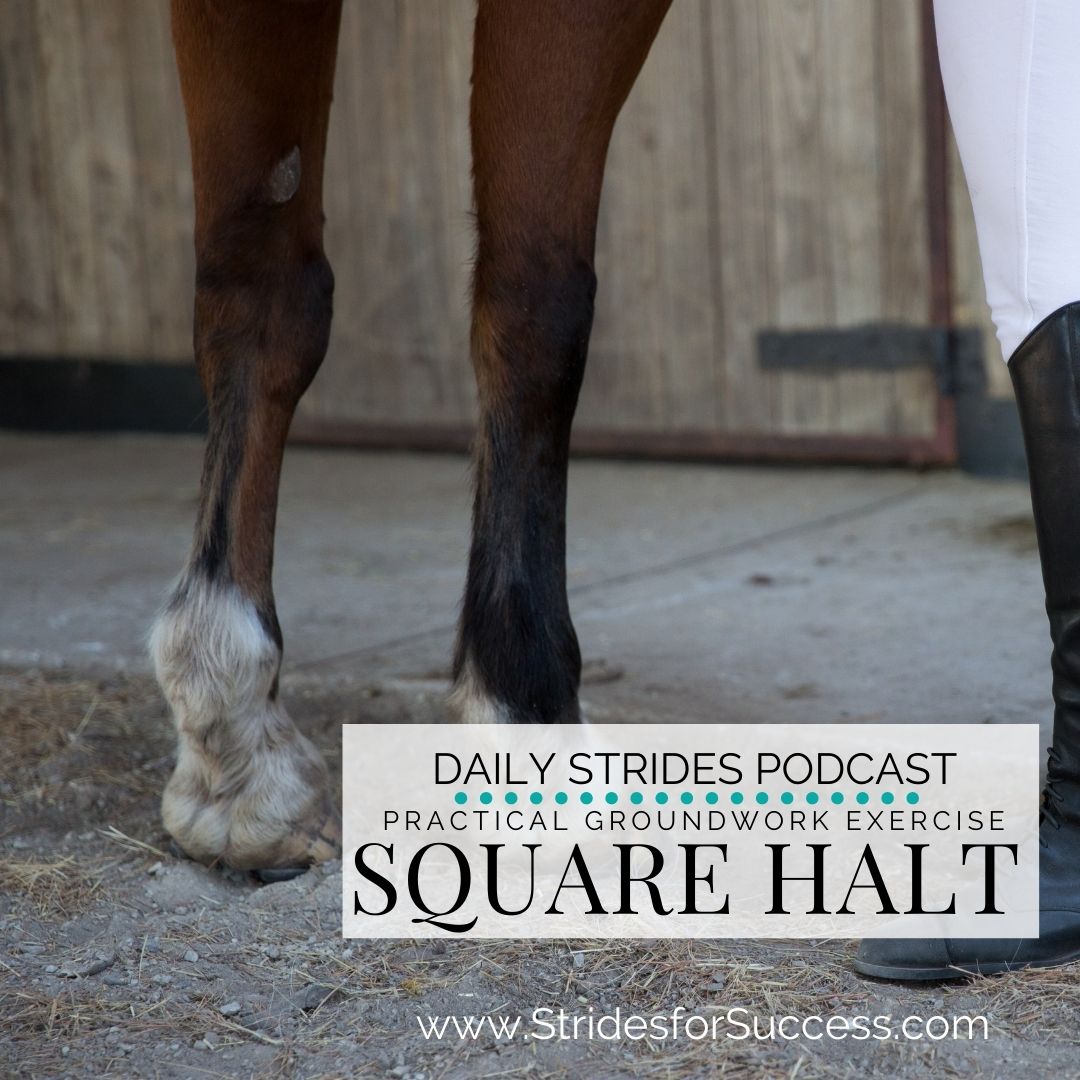
    A good place to begin is requiring that your horse be ‘square in front’ in each halt.

    Basically, this means that his two front feet will be in line with each other when he is standing still. An easier way to describe this is to first understand what completely ‘square’ is. To do this I want you to imagine a rectangle marked out on the ground. When your horse is halted square, each of his hooves will be in a corner of this rectangle.

    Square in front is when his front two hooves are correctly placed in the front corners of your imaginary rectangle for your horse.

    I think is a really ‘do-able’ goal for a single session when working on the ground with your horse. It is simple to make happen and easily understood by your horse. It also translates really well across to your riding.

    Understand What Aids You Are Using

    So many riders never think of their aids for this movement. I think this is due to this being a movement we do with our horses every single day when we are with them. And when we do something all the time, we tend to put those things on ‘autopilot’. Which is great. Except, you need to revisit and update autopilot regularly! This is something I help you to do regularly inside of Connection.

    The less thought that goes into a movement, the fewer aids we tend to use to make that happen!

    This is why, when asking a horse to halt while leading him, most riders overly rely on their hand aids. They pull or lean on the horse’s head, mouth, or nose (depending on what they are leading with) in order to get the horse to stop.

    Your hands are an important aid when leading and asking for the halt, but they should be part of a whole group of aids, which will include your thoughts, your voice, your body language, your position, and your seat (core) to name a few.

    A lot… I know. And this is where you get to really begin refining your aids and your conversation with your horse. By beginning to use more subtle aids, you can literally create a better quality halt, with minimum effort.

    Once You In the Halt…

    Okay, so assuming you have now halted your horse, I want you to rate the halt out of 5.  5, in this case,  is an absolutely perfect example of what a halt should look like and 0 representing ‘he fell into it’!  By being honest with yourself about where you and your horse are right now, you have created a place to begin working from. So be honest 😉

    Are your horse’s front feet ‘square’? If so, you can then begin working on squaring the back hooves. Or perhaps working on straightness through the halt itself. Many horses have a tendency to ‘crunch’ into the halt, which results in a hoof stepping out to the side.

    Falling out or falling in is also a thing to watch for when moving in and out of the halt.

    Your Work Begins; Refining…

    If your horse’s front feet are not square, note where they are. When you ask your horse to walk forward again and then repeat the halt, I want you to think about your aids and how you can begin to be clearer about where you want him to put his feet. For example, if his right front foot has stepped more forward, perhaps you can use the right rein a little more to emphasize a boundary there. Or if his right front foot has not ‘closed’ the halt, you could use your voice to encourage him to do so with a click.

    Refining, in this case, is noticing and then tweaking your aids. The aids themselves, the timing, pressure, sequence, release.

    When you are looking to improve your horse’s way of going, the first step is to improve the communication coming from you. Have more clarity about what you want. Be clear about how you ask. And then assess each response and give feedback to your horse.

    Then simply rinse and repeat. As I said, this can be worked on every single day. And once you have mastered this on the ground, use the same technique to begin working on this from the saddle as well.

    Happy Riding
    Lorna

    Additional Resources on this Topic:-

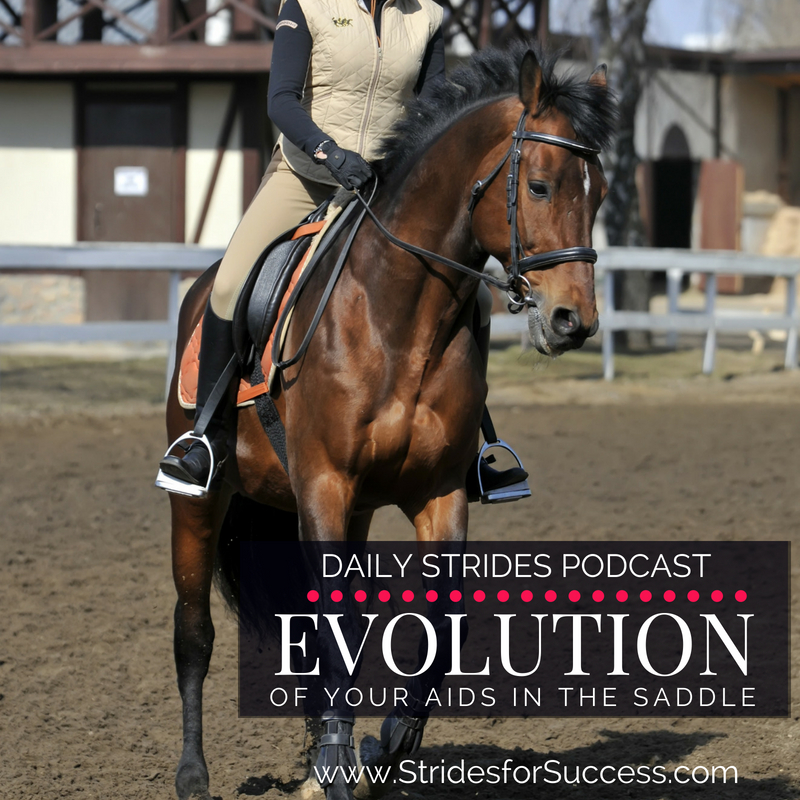
  • The Evolution of Your Aids in the Saddle

    The Evolution of Your Aids in the Saddle

    The Evolution of Your Aids in the Saddle for Better Conversation with Your Horse

    What this episode is all about & how it can help you:-

    • Understand why your aids are always a work in progress
    • Start on the ground and work up
    • Transitioning groundwork to under the saddle
    • Application, pressure, timing and sequence

    [smart_track_player url=”https://op3.dev/e/traffic.libsyn.com/dailystridespodcast/1049-The-Evolution-of-Your-Aids-in-the-Saddle.mp3″ title=”The Evolution of Your Aids in the Saddle” social_linkedin=”true” social_pinterest=”true” social_email=”true” tweet_text=”The always evolving conversation between you and your horse… Find out how to improve it on this episode of the Daily Strides Podcast ” hashtag=”#horseriding #equestrian #lovinghorses” twitter_username=”strides_success” ]

    Have you ever noticed how you feel when you walk away after participating in a good conversation with someone?  There was a natural flow to it. Both of you were present and interested. Both open to hearing what the other person said.

    Good conversations more often than not result in both participants walking away feeling great. Which brings us to the topic of this episode of the Daily Strides Podcast. The evolution of your aids in the saddle and the impact it has on your conversations with your horse.

    Your Aids are Always a Work in Progress

    One of your greatest responsibilities, as a rider, is to try and ensure that you are refining your aids.  A consistent ‘bettering’ of how you are showing up in the saddle.  For many riders, the seeming lack of any ‘quick wins’ can make this process often feel a little tedious.

    However, just like becoming a great conversationalist, improving your aids requires practice in order to make perfect. 

    But the thing is, that when it comes to riding, there never really is such a thing as ‘perfect’.  Your aids are a constant work in progress.  A constant evolution as you change as a person, as a rider.  

    It is also worth remembering that the same is true of your horse as well.  A conversation is a two way street.  Both sides have to be as committed to it in order for it to really work.  Your horse must also be constantly learning.  Willing.  Open to how the conversation will evolve between both of you in the saddle.

    Start on the Ground and Working Up

    Starting today, become more mindful about what and how you are communicating with your horse before you ever get into the saddle.  The mundane, general day to day routine you and your horse go through before, and after, each ride.

    One of your more useful, but unfortunately most overlooked, aids is your voice.  You can use it anywhere, at any time and it can convey a lot of different things to your horse.  It can also be really helpful for you, the rider, as well.

    I feel it is important to recognise is the versatility of your voice as an aid.  This is especially true in the early days of your relationship with your horse.

    Begin by experimenting how your horse listens to you.  How he responds to you.  Different tones, different words, different rhythms. 

    Many riders worry about the impact of using the voice aids if they have their sights set on dressage.  I honestly don’t believe this will cause any harm.  As your aids and the conversation evolves, you can slowly make your voice less and less a part of it.

    Working with Rein Aids on the Ground

    Rein aids work on the ‘pressure and release’ principle.  You can begin refining this today, on the ground, with your horse whether green or more experienced.    You can use either a head collar and lead rope and use the lead rope to apply the pressure and the release.

    You can also use an actual bridle and lead the horse using your reins.  Again, pressure and release.  This is also a great way of seeing how the bit actually ‘works’ in and around your horses mouth.

    When coupled with your voice, such as ‘woah’ with applied pressure to slow down, steady or stop, it now becomes easier to see how it can transfer over into the saddle. 

    In fact, the more ‘subtle’ aids in the saddle, such as your seat, can then be refined by adding them to the reins and voice which were learned from the ground. 

    Your Seat and Your Legs

    Your rein and voice aids, when worked on from the ground, also help open the conversation using your legs in the saddle.   Unfortunately many riders make the mistake of starting with the seat, rather than the legs when it comes to this.

    While starting with your seat is not ‘wrong’… Very often riders are a little too ‘busy’ with their seat without realising it.  It leads to a lot of confusion between horse and rider.  Hence my suggestion of starting with your legs first.

    Work on refining the conversation you are having with your horse with your legs first.  Where your legs are positioned.  How you are applying the aids.  The passive and active leg aids.  Becoming quiet through your legs when you want to…

    When you become more mindful about your legs and how you are communicating with them, the seat will naturally join the conversation. 

    Focusing on your seat before it is truly independent will only cause the lines of communication between you and your horse to become, well, twisted. Rather pay attention to your hands and your legs and allowing them to then influence your seat position.

    If your hands are level, chances are your shoulders are level.  If your legs are where they should be, chances are your seat bones will be where you want them to be.  This is the beginning of building that all important feel.

    Focus on first refining the more obvious aids and then later, shift across to the more subtle aids. 

    Sometimes ‘Exaggerated’ Communication is Necessary…

    Think of a time when you spoke with someone you didn’t understand.  A person who spoke a different language.  Once you both, quickly, figured out that language was not going to help either of you communicate, you would have begun looking for alternative ways.  Those alternative ways were probably not very subtle!  Hand gestures, grunts, exaggerated facial expressions…

    Your conversation with your horse may be, or have been, a little like this initially.  Obvious.  ‘Loud’.  There may have been a lot of back tracking due to miscommunication.  It was not fluent.

    However, over time and by consistently committing to improving the conversation with your horse, things improved, or will improve.

    Application, Pressure, Timing and Sequence

    There are four different ‘filters’ you can view the use of your aids through.  When they are all put together, you will get the overall feel of the ride for both you and your horse.

    The application of your aids is all about the ‘how’ and they ‘why’.  If you can get clear on those, you will be able to apply your aids in a more clear way for your horse to understand.

    The varying degrees of pressure create different outcomes with your horse.  It works like the tone in your voice when speaking to a person.  Soft. Hard. Gentle. Urgent. 

    Timing is important in any good conversation.  It allows things to flow.  It means not butting in, or speaking over the other person.  It also means warming the conversation up before asking more probing or difficult questions.

    The sequence is simply how you put it all together.  For example, perhaps the more ‘expressive’ or ‘obvious’ aids are necessary at the beginning.  They lead the more subtle aids.

    You have to start with the end in mind; but you cannot start at the end!

    The piece in the middle is the ongoing evolution of your aids in the saddle so that both you and your horse can have better conversations together.

    Happy Riding

    Lorna

    Links mentioned in the episode:-