Tag: rein

  • Applying the Rein Aids while Riding

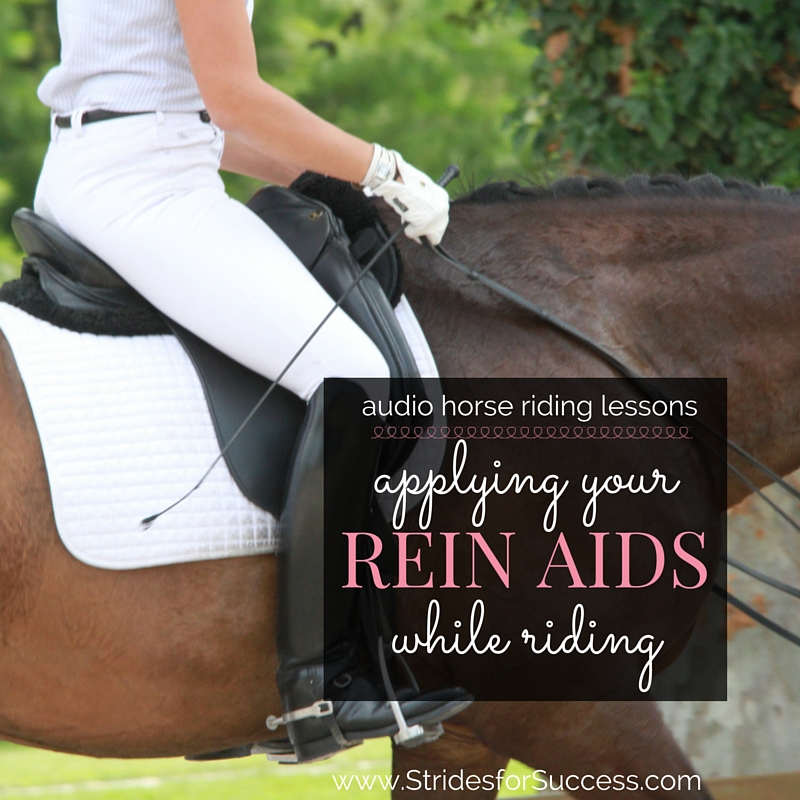
    Applying the Rein Aids while Riding

    .. This[fusebox_track_player url=”https://op3.dev/e/traffic.libsyn.com/dailystridespodcast/SFA471-Applying-the-Rein-Aids-as-You-Ride.mp3″ title=”Applying the Rein Aids as You Ride” social_linkedin=”true” social_pinterest=”true” social_email=”true” ]

    Do you find yourself becoming confused and frustrated about how you are supposed to be using your rein aids while riding?  Do terms such as soften your rein, fill up your rein, hold with the rein, lighten the rein leave you baffled?  Not to mention how much pressure is good and how much is too much?!

    I want you to take a quick trip down memory lane and back to your first ride on a horse…  Chances are that back then, before you knew any different, you thought of your reins as the means to steer and stop your horse.

     However, you soon began to realize that while your reins make up part of the system to do this, in order to really have a happy contact with your horse, you needed to reframe how you think of your reins. And what you use them for.

    Applying Your Rein Aids while Riding

    What are Rein Aids For?

    Your reins are, first and foremost, the way that you collect the energy your horse creates in his hindquarters and back, so you can then channel it where you want it to go.

    This is done through you have a consistent contact on the rein. This allows your horse to build trust in you that you won’t catch him or drop him while he is working into that contact.

    However, before you can even begin thinking about this, we must first discuss how your hand will come to meet the rein and the effect this has on you and your horse.

    An Extension of Your Core

    While your hands are holding the actual reins, it is good to keep in mind that they are merely acting on behalf of your body.  

    This means that any aids happening through your core are connected to the conversation you are having with your horse down the rein with your hands.

    A practical example of this is a pony trying to eat grass while being ridden.  Riders that depend on the strength of their arms to apply rein aids will be pulled forward out of the saddle when the horse puts his head down.  However, a rider that is connected through their seat and core, merely using their arms and hands as an extension of this, will sit tight as their core will come into play rather than their arms.

    Your Hands and Arms

    It amazes me that so many riders still believe they are strong enough through their arms to ‘win’ a pulling match against their horse.  The sad part is that the pulling match should never happen to begin with.

    Your hands have an important job of gathering up the energy created by your horse, however, this can only be achieved if your horse trusts your hands enough to connect that energy with them

    Next time you are in the saddle, become aware of the fall of your arms as you ride.  Is it a natural fall?  Are you perhaps overarching your back? Is this resulting in your elbows being slightly behind your body?  Or maybe you are collapsing your upper body causing your elbows to be in front of your body?  How supple and flexible are your elbows?

    Your arms should fall from your shoulders in a natural position.  

    Being supple and soft means that there will be little tension in them, just enough to carry your hands, which should be on a straight line between your elbow and your horse’s mouth along the rein.  Your wrists should be straight, never clawed or bent.  In fact, if you have to claw your wrist to ‘activate’ the rein, your reins are too long!

    Your fingers and hands should also be soft and supple.  Try not to clench your fingers into a fist.  Rather use your thumb as a ‘clamp’ to hold the reins which will allow your fingers to follow and communicate with the rein and your horse’s mouth.  Keep the pads of your finger tips as the touch point with the palm of your hand.


    Suppleness Through Your Body

    If your horse trusts you to be consistent and considerate with the rein, he will ‘seek’ the rein by moving his poll forward and down into the contact.  A horse trying to evade or get away from a sharp hand will rather move his head up and back, causing his back to hollow.

    Focus on keeping your hand and elbow supple and elastic.  Move with your horse

    So often horses that have been labeled as lazy or not very forward are this way because of a rider that failed to follow with their hand.  Turning your knuckles on top, rather than your thumb, causes a similar scenario.

    When you think of giving with your hand, think of allowing through your fingers first and then, if necessary through your elbows.  It should be a slight, subtle communication with your horse.  Work on how you can ‘allow’ using your fingers and next time you ride see if your horse responds to this more subtle direction.

    The same applies when you think of taking or restraining; imagine moving the pads of your fingers closer to your wrist or ball of your thumb, gently closing your fingers rather than stiffening or clamping your fist.

    Building Responsiveness

    As you are practicing this, pay attention to how much pressure you are applying and how your horse responds.  This can be a confusing principle for many riders.  And it is often compounded by the fact that their horse may have already become a little hard or unfeeling through his mouth due to being ridden with hard hands before.

    I suggest that rather than thinking about applying pressure, reframe that into what is necessary to ride your horse at that time in order to achieve or maintain the desired outcome.  Then, over time, make adjustments and refine how you are applying the aid

    The amount of pressure in your hand will directly correlate to how your horse is going. From the hindquarters through the back. And then resulting in where his head and neck are positioned due to this way of going.

    Rein Aids & Self Carriage

    The more true collection your horse has achieved, the lighter he will be in your hand. This is because he is now carrying himself. The result is that his poll having lifted up and is now situated closer to your hand.  When working in a more relaxed outline, there will be a more consistent pressure.

    Your job, as the rider, is to maintain that balance between your hand and your horse’s mouth through the rein.

    However, if your horse is heavy on the forehand or leaning, you will feel a distinctly heavy and uncomfortable amount of pressure or weight down the rein.  This is due to your ‘carrying’ him, rather than, as we just mentioned with the collection example, him carrying himself.

    Consistent Contact (versus ‘Piano Fingers’)

    The final point I want to talk about is ‘piano fingers’!  Many riders think that by opening their fingers completely on the reins, they are somehow being nicer to their horse.  Bear in mind that contact through the rein is a conversation.  And conversations are a two-way street…  Opening your fingers stops you from hold up your end of the chat!  Rather work on being more supple and following through your hand, elbow and shoulder.

    From there, when your horse learns to trust your contact, you can begin refining the pressure and movements in your communication.

    I also feel it is important to note that this consideration of your horse’s mouth should colour all aspects of your time in the saddle.  From gathering up the reins initially. To shortening and lengthening the reins (which we have a video on). And even to rewarding your horse by softening or giving with your inside rein.

    Subtlety is the key to success where your horse’s mouth is concerned…  Be gentle, soft and kind at all times.

    Your Responsibility…

    It is worth repeating again that in order for your horse to truly accept the contact you are providing down the rein, you must first guarantee him that you are going to provide a steady, soft, consistent contact to begin with.

    And just like your horse having to strengthen himself in order to build up to a more collected way of going, you will too.  This means finding ways to develop an independent seat. And practicing on making changes and adjustments gently and softly

    Happy Riding
    Lorna

    Additional Resources for Equestrians:-

    Applying Your Rein Aids while Riding

  • Retraining a Horse Who is Heavy on Your Hand

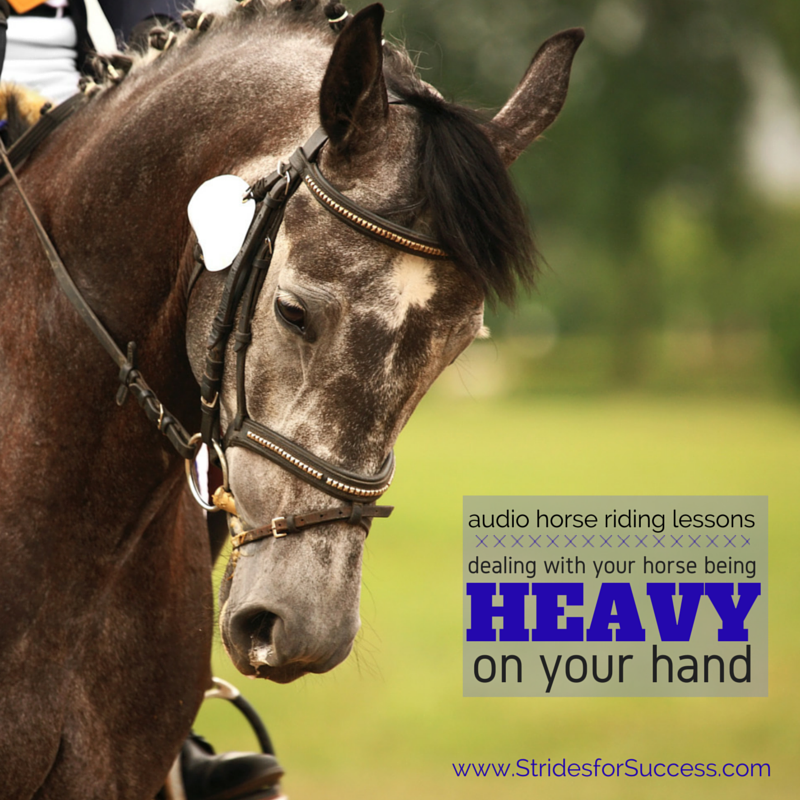
    Retraining a Horse Who is Heavy on Your Hand

    Dealing with a Heavy Horse
    Have you ever had the experience of riding a horse who was so heavy on the forehand, it felt as though your arms were a couple of inches longer by the time you dismounted?!

    [smart_track_player url=”https://op3.dev/e/traffic.libsyn.com/dailystridespodcast/SFA436-Dealing-with-Your-Horse-being-Heavy-on-Your-Hand.mp3″ title=”Retraining a Horse who is Heavy on Your Hand” social_linkedin=”true” social_pinterest=”true” social_email=”true” tweet_text=”Does your horse tend to get a little heavy in the hand? This may help…” hashtag=”equestrian #podcast #makeeveryridegreat” twitter_username=”strides_success” ]

    The whole experience is exhausting!  It feels as though you are literally carrying the horse’s head and neck by bracing your shoulders and arms against him the whole time…  Not a fun ride!

    Horses that are heavy or lean on your hands are unfortunately more common than not.  It is usually the result of the horse not been thought to yield to the pressure of the bit.  Or a horse who has been wrongly trained or retrained by a rider to lean on the bit.

    Why This Doesn’t Work for Your Horse Either

    When your horse is heavy in front, he will find it difficult to perform correct, balanced transitions.  He will have trouble bending consistently throughout his body.  His lateral work will usually be stiff and ‘jerky’ and his jumping abilities will also suffer as more weight than usual is on the forehand and shoulders.

    You will also find it difficult to engage the hind quarters and bring them ‘underneath’ your horse.

    In fact, when you are riding, it will feel as though all the energy is falling out the front end of your horses body.  Plus the fact remains that no amount of pulling on your part will actually go towards fixing the problem!

    The lack of balance that is a result of this leaning will become even more evident later, when more difficult questions are asked of your horse.  ‘Heavy’ horses, generally, end up beginning to rely on the riders hands for support and balance throughout the ride.  This, of course, just exaggerates the problem even further!

    Is it a Bit Problem? Nope, Not Usually!

    Most riders will try to remedy the problem by shoving a stronger bit into the horse’s mouth.  The thinking is that it will give them more ‘leverage’ to haul on the horse even further…

    However, this will generally will only worsen the problem as the true cause for the leaning has not been dealt with.

    The Most Common Reason for This Happening

    Horses being heavy or leaning on the hand often become like because of their rider.  More specifically being ridden by a rider who lacks an independent seat or lacks confidence.  The unstable rider will use the horse’s mouth for balance and support.  This then trains the horse to firstly ignore the rein aids and, even worse, lean into in the contact.

    Anxious or nervous riders will tend to hang on to the reins often as reassurance that they are ‘in control’ of the situation.  

    Again, this leads to the horse’s mouth becoming hardened to the hand aid.  The result often being that the horse moving more and more onto the forehand.

    Very often the stiffness and dependency of the rider carries through and is passed to the horse.  This creates a similar stiffness and co-dependency in the horse.  The horse begins to use the riders hands for physical and mental support.

    The Never Ending Battle

    After being ridden like this for a while, the horse will learn to begin to ride into the pressure.  This will soon transition to pulling against it.  Which is what makes this such an exhausting experience for the rider who encounters a horse like this…  The rider will never win against a 600kg horse!

    The cycle is self-perpetuating.  The heavier the horse becomes, the more the rider hangs on trying to bring their head and neck up.  Which causes the horse to pull more; causing the rider to haul more… 

    Other Reasons for this Occurring

    Heaviness can also manifest itself in the horse becoming over bent through the poll.  This causes the horse to become ‘locked’ in an unnatural frame, behind the vertical.  This is often the result of too harsh a bit having been applied to the mouth.

    It can also be due to a rider who is obsessive about being ‘on the bit’ without actually using their legs and seat correctly to first engage the hind quarters.

    A horse that moves like this may ‘look pretty’ to an uneducated eye.  But really they are just forced into, and learn to hold, a shape which inhibits their natural movement.  This results in their training stalling and going stagnant.

    Due to horse being fixed in this unnatural shape, he learns to brace against his riders hands to hold himself there.

    Starting Your Re-Schooling of Your Heavy Horse

    Re-schooling a horse to lighten up in front takes time and consistency from a rider.

    Before you begin focusing on your horse, make sure your seat is indeed truly independent.  Especially that you are not dependent on the reins for support or confidence.   Also, begin paying more attention to your aids.  The ‘how, when and where’ you are applying them.

    Confusion on either you or your horses part will almost always result in a loss of balance.  This will only ‘tip’ your horse further onto his forehand.

    Working With All of Your Aids

    Each time when you are asking your horse for something, begin to apply and use your aids in a sequence.  Seat, then legs and finally hands…  There are many different situations and circumstances that we find ourselves in while riding.

    Doing things this way will allow you to prepare both yourself and your horse in a way that will interfere the least with the natural flow of energy and balance.

    Schooling Using the Walk to Halt Transition

    Start by working in walk and begin asking for halt using your seat and core muscles.  Then use your legs to support your horse and make him ‘close’ the halt with his hind quarters.

    Your horse must step into a halt, not fall into one! 

    Finally, close your ring fingers on the rein, resist with your hand.  Many riders will have been advised at some point to lift up their hand as they give the rein aid.  Rather think about closing your ring finger and as you do, allowing a little movement in your wrist which will bring your finger nails ‘up’ more.

    As soon as the horse responds, even a step, reward by softening the rein.  Softening does not mean throwing the reins at your horse or dropping the contact.  It merely has you softening the pressure by relaxing your ring finger again and ‘allowing’ a little with your arm.

    Understanding the Balance of Your Aids

    If your horse insists on walking through your hand and ignoring you, apply a stronger aid, asking for a very firm ‘stop’.  Be sure to reward as soon as he does so.  Sometimes you will have to be quite stern on your horse, particularly if he has become quite good at ignoring you!

    Make sure that while you are being firm, you are also holding your correct position and asking correctly for the halt – just applying more pressure as you do so.

    Once your horse has halted, ask him to stand for a few seconds.  Use this time to reevaluate your position and correct it if necessary.  Your horse should not need you to keep applying the ‘hand brake’ while he is halted.  He should merely wait patiently for your next question and then respond accordingly in a timely fashion.  No dilly dallying!!

    Repeat as Necessary

    When you are satisfied that you are sitting correctly, ask him to walk on again, using your seat and legs. Make sure that although you have a contact, you are allowing him to step into the walk, not resisting with hard hands or arms… Soft, Soft, Soft.

    Walk for 5 strides and again, using sequence of the seat, then legs and finally hands, ask for halt again.

    Be firm if necessary, but make sure that you are not leaning back and hauling.  Let the firmness come from your core, with your legs underneath you, rather than having a tug of war leaning backwards and hauling for all your worth!

    Working on Suppleness

    Once you have established a good baseline for halt, using the seat, legs then hands sequence, ask for halt again.  Once there, open your right hand away from your horse’s neck and ask him to bend his head and neck a little to the right by ‘having a conversation’ with your ring finger.  You can do this by squeezing the ring finger two or three times.

    As soon as your horse yields to the pressure and bends the head and neck reward him.  Do this softening the rein and using the voice if necessary to reward.


    Repeat to this same exercise to the left.  If you horse is more hesitant one way or the other, make a note of this.  I suggest working some suppling exercises into his schooling sessions to begin remedying the problem.  Also, some horses can become so stiff through their heads and necks because they are leaning so much that only the slightest of ‘gives’ is all you will see.

    Reward any small step in the correct direction.  Then use this as your measuring stick to gauge how much progress you are both achieving over time.

    Balance in the Halt Itself

    Your horse should continue to remain in a square halt while he does the above exercises.  You may find that he wants to move his shoulders to try counter balance himself.  Use your legs to hold him in a square halt.  Again, remember to only ask for small movement in the head and neck to begin with.

    You can also begin to add some trot in to the schooling, particularly transitioning between walk and trot.  Choose an amount of trot strides you want to ride, perhaps 5 or 6, each time and make sure it is an active working trot that you are riding.  Use the same downward aids that you applied in asking for halt to ask for the walk.  Walk for 5 or 6 strides and then forward to trot.

    Consistency and Time are Essential

    Continue to move up and down between the gaits, focusing all the time on not participating in any tug of wars or leaning matches.

    It will take time to retrain your horse and also you the rider, however it is essential if you want to move forward and progress with your training.  A horse that resembles an arrow aiming for the ground while being ridden will never achieve the lightness and self carriage in front that is essential to them becoming the best version of themselves.

    Happy Riding
    Lorna

    Links to Related Articles & Freebies Which You May Find Useful:-

  • Rewarding Your Horse While Riding

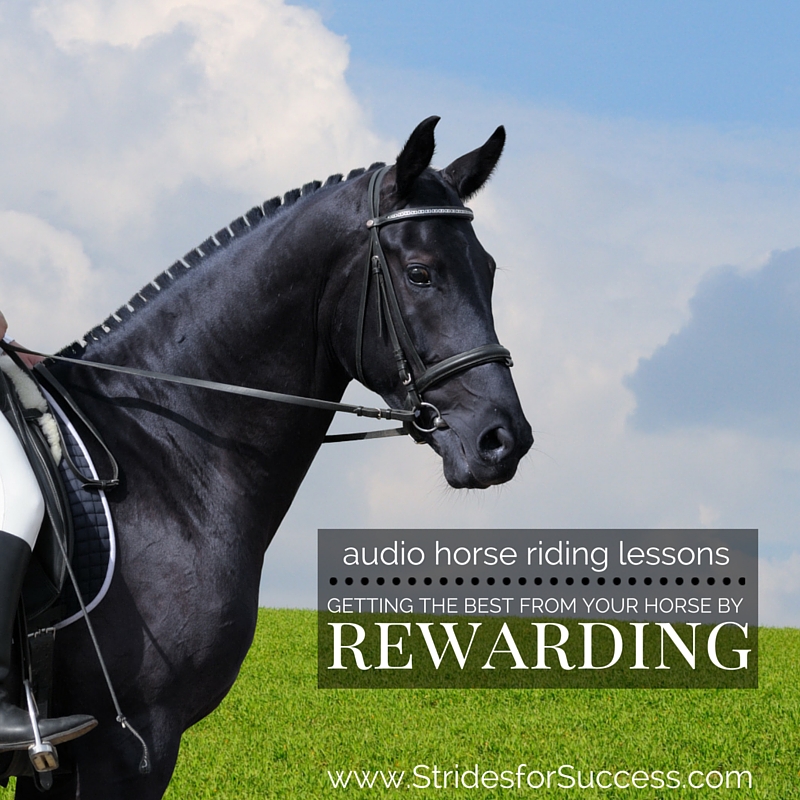
    Rewarding Your Horse While Riding

    Think back to a time when you were in the midst of learning something new…  We know that when we learn, different feelings come up.  Some are positive and others are not so much… However a simple well done when you make even the tiniest progress can be a game-changer.  In fact, it is often all the fuel that is needed to power through the obstacles or difficulties and keep trying.

    It is a wonderful thing when someone gives us recognition for our attempts and efforts. A simple well done goes a long way to helping us push through the frustrations which might otherwise cause us to give up

    Well, the same can be said for your horse. Do you make a point of rewarding your horse for every small step in the direction?  How, maybe it wasn’t perfect, but it was a good attempt or try.   Do you make a fuss, or make much of him when he really tries and reaches for something new and difficult?

    Rewarding Your Horse While Riding

    Rewarding Your Horse

    It is incredibly easy to become so laser-focused on the end goal, that we often miss those small opportunities along the way to ‘refill the happy tank’ for our horse. Rewarding your horse will encourage him to persevere and continue trying. Often when we think of rewarding our horse, the picture of patting your horse on the neck comes to mind. Or a comforting, encouraging word or three.

    However, all efforts to reward your horse are not the same.  And one of our responsibilities is to find a way that works for you. 

    For example, if you are in the middle of a difficult movement; halfway through a dressage test, or even have 5 fences left in your showjumping round, a pat on the neck is not always an option. The same applies in dressage;  encouraging words will not go down well!

    Offering The Inside Rein

    My suggestion is to begin working towards using your inside rein to communicate a reward with your horse.  You can train your horse to understand a softening or offering of the inside rein to be the reward itself.

    Now, it takes time for your horse to grasp that this softening of the rein on its own, with no voice, or pat or scratch, is the actual reward. However, investing the time to teach your horse the meaning of your actions, is one that will pay back dividends in the long run.

    I have found that there is a process to doing this.  If practiced consistently, this will lead your horse to the eventual realization that the offering of the inside rein is the actual reward.  From there, begin to have all the positive effects that we spoke of earlier.

    Start with Your Voice

    The first part of training your horse to understand this starts with being aware of the tone of voice you use with your horse in different situations. We use a higher pitch when we are rewarding our horses.

    I have found that what you say is not half as important as how you say it in your horse’s eyes

    So the next time you are rewarding your horse, maybe with a gentle rub on the neck or a well-placed scratch, for a job well done both on the ground and from the saddle try this. Begin using a higher pitch to your normal ‘Good boy’ or ‘Good girl’ or whatever it is that you say to your horse when they please you!

    As I mentioned, consistency is the key.  The only way your horse will really begin to make the connection to your voice and the ‘reward’ is that it happens every single time.  Together and simultaneously.

    Once this is established, which can be as quick as a few days with some horses and as long as a few weeks with others, you can begin to while riding, use your ‘reward’ voice coupled with an offering of the inside rein while riding.

    It is important to keep in mind that you are merely using your voice initially to build the association.  Over time, your horse won’t need to hear your voice to understand the reward.  Just the softening.

    Consistent with Softening

    The offering of the inside rein is something that also needs to be done correctly and with thought…  You will move your inside hand, from the elbow, gently and softly in the direction of your horse’s mouth.  I think it is important to note the use of your inside hand, not your outside hand.

    The reason being that your outside hand will still hold everything together.  It will ensure that all that wonderful energy you are creating in the back-end does not fall out the ‘front door’ while you offer the inside rein.

    Once the rein has ‘slacked’ a little, you can gently begin to take the contact back. In the beginning, it is important to use your voice to back up the intention of a reward from your horse’s perspective. It is also important to note that both the offering and the retaking of the rein are very subtle and gentle movements.  No snatching at the rein, and with it, your horse’s mouth!

    Over time, your horse will again, begin to associate the softening of the inside rein as a reward, and slowly you can begin phasing out the ‘vocal’ reward.  Once you have thought your horse to understand this simple yet effective reward, it is of paramount importance that you use it at every given opportunity.

    By letting your horse know that he is on the right track with regards to what you are asking, no matter how small the progress, it goes without saying that your chances of actually getting to where you want to go increase exponentially.

    Creating a Secret Conversation

    What is fantastic about this is that you can use it mid-movement, mid-jumping round, mid-dressage test. Basically anywhere while you ride.  And all without losing your contact with your horse. And without anyone noticing. Think of it as a silent nod of approval; a secret language between you and your horse when he has ‘done good’ :-).

    I would love to hear your thoughts on the above, particularly any success you have had with this method.

    If you would like to learn more about this, you can subscribe to my podcast, The Daily Strides Podcast for Equestrians where Episode 226 | Getting the Best from Your Horse Through Rewarding, deals exclusively with this.

    Happy Riding
    Lorna

    Additional Resources for Equestrians:-