Tag: rider suppleness

  • Are You Blocking a Better Trot with Your Seat?

    Are You Blocking a Better Trot with Your Seat?

    [fusebox_track_player url=”https://hwcdn.libsyn.com/p/9/9/4/994f57b1c63c3c6a/1228_Are_You_Blocking_a_Better_Trot_with_Your_Seat.mp3?c_id=120043262&cs_id=120043262&expiration=1643183595&hwt=4d05493255573da0c5346dde60113de4″ title=”Are You Blocking a Better Trot with Your Seat?” social_linkedin=”true” social_pinterest=”true” social_email=”true” tweet_text=”Horse podcast that helps you ride better…” hashtag=”horseridingpodcast” twitter_username=”strides_success” ]

    Let’s be honest; many riders don’t really long for a ‘better trot’ in their riding.  In fact, most are quite happy to simply work with what they already have right now and see the trot as a filler.  A part of the ride that gets you from one thing to the next.

    And trotting, by its very nature, doesn’t really help change this! The rhythm can often have a slightly hypnotic effect on riders.  Lulling them into a contented 1,2,1,2,1,2,1,2, regardless of how good the trot is – or isn’t.

    In this episode, I want to begin helping you to turn your mind towards a better trot.  What would it look like for you and your horse? And how would it feel for you and your horse?  Finally, how prepared are you to actually allow this better trot to happen underneath you?  Will you be able to move with it? Or will you begin to block it with your seat?

    Rhythm & Tempo

    It is easy to simply accept standard 1,2,1,2,1,2, that you feel and move with every time you trot.  Believing that, after finally mastering the whole posting or rising, your work in the trot is complete.   Thinking that your sitting trot is as good as it is going to get right now – and not paying attention to it anymore.

    Being able to stay with your horse while posting, rising, or in the sitting trot is merely the beginning of your work to encourage a better trot.

    And I think becoming more aware of the rhythm and tempo you have right now will then help you know where to focus your attention going forward.  Start by really noticing each distinctive hoof beat inside of each stride.

    By paying attention to each individual beat, the 1 or the 2, you can then begin to notice what is between those beats – the space. 

    Creating More Space for a Better Trot

    How do you think having more ‘air’ within each of those strides will help you and your horse?  It will allow for slightly more time.  A bigger movement perhaps.  More energy. Which will all contribute to ‘more’ of a trot.  A better trot.

    Creating space begins with you, the rider.  If you lose your balance at the slightest change in tempo or rhythm, this is where your work will begin. 

    Focus on using your core in a way that positively impacts you in the trot.  Whether you are posting or sitting, assess if you’re carrying yourself, or being carried along by your horse’s energy.

    Two great exercises to begin testing this are ‘up,up,down’ and ‘down, down, up’.  Basically, you are either sitting or rising for an extra beat each time.  Two downs, followed by one up.  And two up’s (with no down in between) followed by one down.  Doing this will allow you to see if you are supporting yourself, or relying on your horse for support.

    Blocking with Your Seat

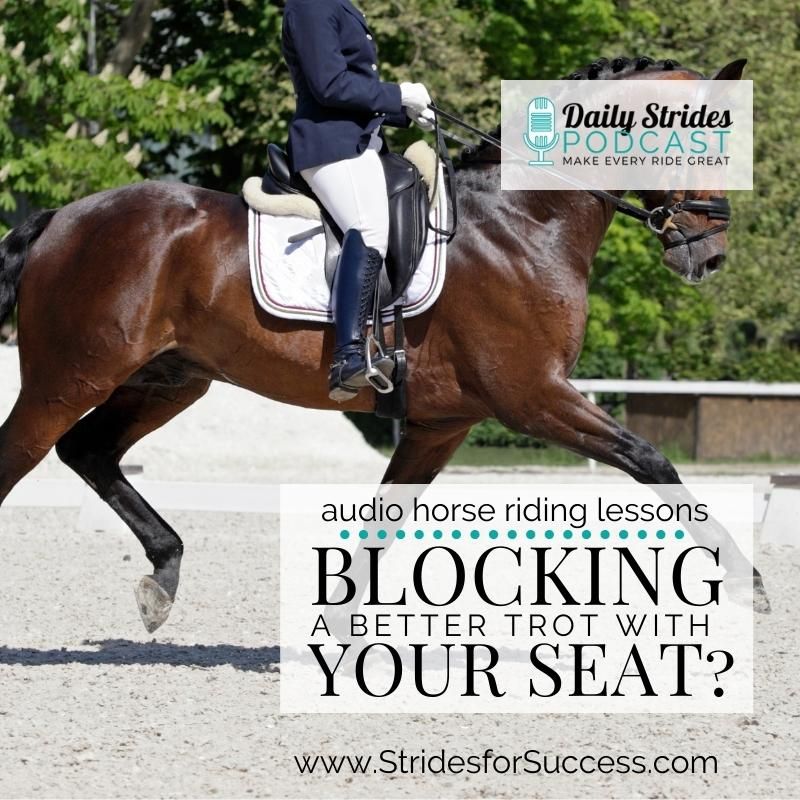
    Once you have the basics in place, begin asking bigger questions of your skills by adding more energy into the trot.  More energy will require more suppleness – from you and your horse.  And it is this lack of suppleness in the rider that often causes the seat to block the flow.

    If you feel like you cannot keep up with your horse’s movement, you’re probably right! This is caused by a lack of suppleness (or swing) through your seat. 

    In sitting trot, the result will be more bouncing.  The ‘trampoline effect’ of the horse’s back comes up to meet your bum as it comes down.  This causes that uncomfortable ‘double bounce’.

    When you’re posting, unable to ‘keep up’ will feel like either being left behind the movement or being bounced out of the movement. Both are caused by the rider depending on the horse to move them – rather than taking responsibility for their own body.

    Many riders find that they can do quite well when their horse is ‘slow and steady’ – but as soon as more  energy is made available inside of the trot – they are no longer in sync with each other through the movement. 

    Developing Your Suppleness

    Your suppleness needs just as much attention and work as your horses.  It truly irritates me when riders spend HOURS working on their horse – and then completely fail to work on themselves!  And I believe that riding alone, (unless you are riding all day long, all of the days, the right way), is not enough.

    Just like you use different exercises to develop your horse, find different ways to begin developing yourself too as a rider. 

    The trot requires a ‘hinge-like’ movement through your lower body.  And this movement can be difficult if there is any excessive tension or stiffness through the body.  Particularly the lower back and pelvis. Exercises that work on stretching this area can be of great benefit to riders.

    It is also good to pay attention to symmetry.  Is there a side you favor? Or do you find it easier to do things on one rein over the other?

    Trotting is very much ‘equal’ from a movement perspective, so it is worthwhile working on developing symmetry through your body.  Symmetry and strength.  This will then allow you to have more control over your body inside of the trot itself.

    And by having more control over your body, you can have a more positive influence on the trot itself.

    Happy Riding
    Lorna

    Extra Help for Riders

  • A Map for Progress in Your Riding

    A Map for Progress in Your Riding

    Having a map often simplifies the journey.  It helps plan a clear route from A to B.  Riding is a journey.  And so many riders want a map or a plan to follow for progress in their riding.
    [smart_track_player url=”http://traffic.libsyn.com/dailystridespodcast/1121-A-Map-For-Progress-In-Your-Riding.mp3″ title=”A Map for Progress in Your Riding” social_linkedin=”true” social_pinterest=”true” social_email=”true” tweet_text=”Hit a plateau in your riding? You need a map…” hashtag=”equestrian #horseriding” twitter_username=”strides_success” ]
    Well, hold your horses!  What if I was to tell you that there is a map available for equestrians.  Oh yes, and it is loosely called the training scale or the traditional training scale.  So many riders discount this because they think that they have to be riding at a certain level in order to use it.  Or that the training scale is only for riders of a certain discipline, usually dressage.
    Many riders also believe that the training scale is only for the horse.  And a certain ‘type’ of a horse at that. This couldn’t be further from the truth.
    Horse riding is a team sport.  Your horse’s long term success depends on your abilities in the saddle.  Improve your riding skills and you will have improved conversations with your horse.  It is as simple as that.

    What is the training scale and how can you use it as a map in your riding?

    The training scale is a basic system many trainers use when working with horses.  There are certain principles or ‘steps’ which, when followed, ensure that the horse and rider have the mental, emotional and physical ability to progress in their training and riding.
    What often happens is that, without even being aware of the training scale, you are working on some of the principles.  However, when one piece is ‘missing’ or weak, you’ll find that progress stalls.  This is where so many horses and riders then become stuck. 
    Understanding what the training scale is and how you can begin using it today will help you with this.  It means you will clearly see what’s missing or needs work.  Which will inevitably lead to fewer gaps in your training.  Fewer gaps mean that momentum can really begin working for you where your training and progress are concerned.
    By following the principles, step by step, you can really make sure you have a full education in riding.  You can also ensure that your horse is being correctly developed, so he will have the physical and mental abilities necessary to progress in his training.

    Training Scale Foundation:- Relaxation

    Relaxation.  It is a big concept for so many riders.  And the fact that is has nothing to do with ‘doing nothing’ is what confuses so many!  Relaxation should rather be called ‘tension management’.  This is what you must do in order to fully understand and implement relaxation.  Manage your tension in the saddle.
    When you try something new in your riding, often relaxation is the foundational piece that needs attention again.  All new principles must be worked through from the perspective of relaxation.  Can you manage your tension levels as you move up and down through the gears or gaits?  How about if you switch from moving straight to moving laterally?  Or if you decide to pop a fence or jump?
    Different tension is needed for different tasks or work when riding.  Relaxation is your ability to manage your tension, so that it appears smooth throughout the ride. 

    Training Scale Step 1:- Rhythm

    Relaxation is the foundation.  This means that rhythm is the first actual ‘step’ on the ladder or scale.  Rhythm with horses, in my opinion, is that your horse is as close as possible when being ridden to how he naturally moves, in the field alone.
    I believe that your natural rhythm is how you feel when you are ‘doing you’.  When you are doing something you love to do that you find easy to do.  The thing that makes 3 hours feel like 3 minutes.  
    The trick is to work on bringing that same feeling across to the saddle with you. That same openness, flow, and energy.  Your natural rhythm.  This will take time to develop, however it is essential to make progress in your riding.

    Training Scale Step 2:- Suppleness

    The loosey gooseyness that is essential for both horse and rider.  I believe that in most cases where riders are ‘stuck’ are due to a lack of suppleness.  This is often seen when the contact is an issue.  It is a lack of suppleness from the rider that is causing the block through the horse’s energy.

    Suppleness is a mental, emotional and physical development.  It is the ability to move and flow, while still remain strong and true. 

    I am going to ask you to really consider this if you are having issues with, for example, contact with your horse.  If it is ‘fleeting’, you have it for a stride or 4 only to lose it again, take a look at your suppleness. Working on this has the potential to really and truly get you unstuck – without having to actually do anything ‘different’ in the saddle.

    Training Scale Step 3:- Contact & Connection

    Ah, the part everyone wants.  The holy grail; ‘on the bit’.  However, this cannot be correctly or consistency achieved if the other parts we have mentioned are not strong and active in both horse and rider.   I often think of contact as being the step of the training scale where both horse and rider ‘graduate’.
    It is where the horse begins to take responsibility for their own actions and way of going.  it is also where the rider must be confident enough to allow the horse to do this. 
    Contact is a little like a contract that both horse and rider are entering into.  I am agreeing to trust you if you meet me halfway.  This is why sawing, pulling, pushing and shoving will not produce correct contact.  The steps we spoke about before are the only way to actually achieving true, lasting contact in the ride.

    The Traditional Training Scale – Steps 4 to 6

    I have created a free mini-course for you where I go into detail far more detail about the training scale.  I really feel that if you can understand these basic principles, it will move your riding forward.  Even the most basic of conversations with your horse has these things woven through it.
    You can find the 5 Days to Clarity HERE.  I hope that you take the 5 to 10 minutes each day to give it a look or listen and really and truly move things forward in your riding.
    Happy Riding
    Lorna
    Other Resources to Help You in Your Riding:-