Tag: skills

  • Improving Your Riding Coordination And Aids While Lunging

    Improving Your Riding Coordination And Aids While Lunging

    Improving Your Riding Coordination And Aids While Lunging
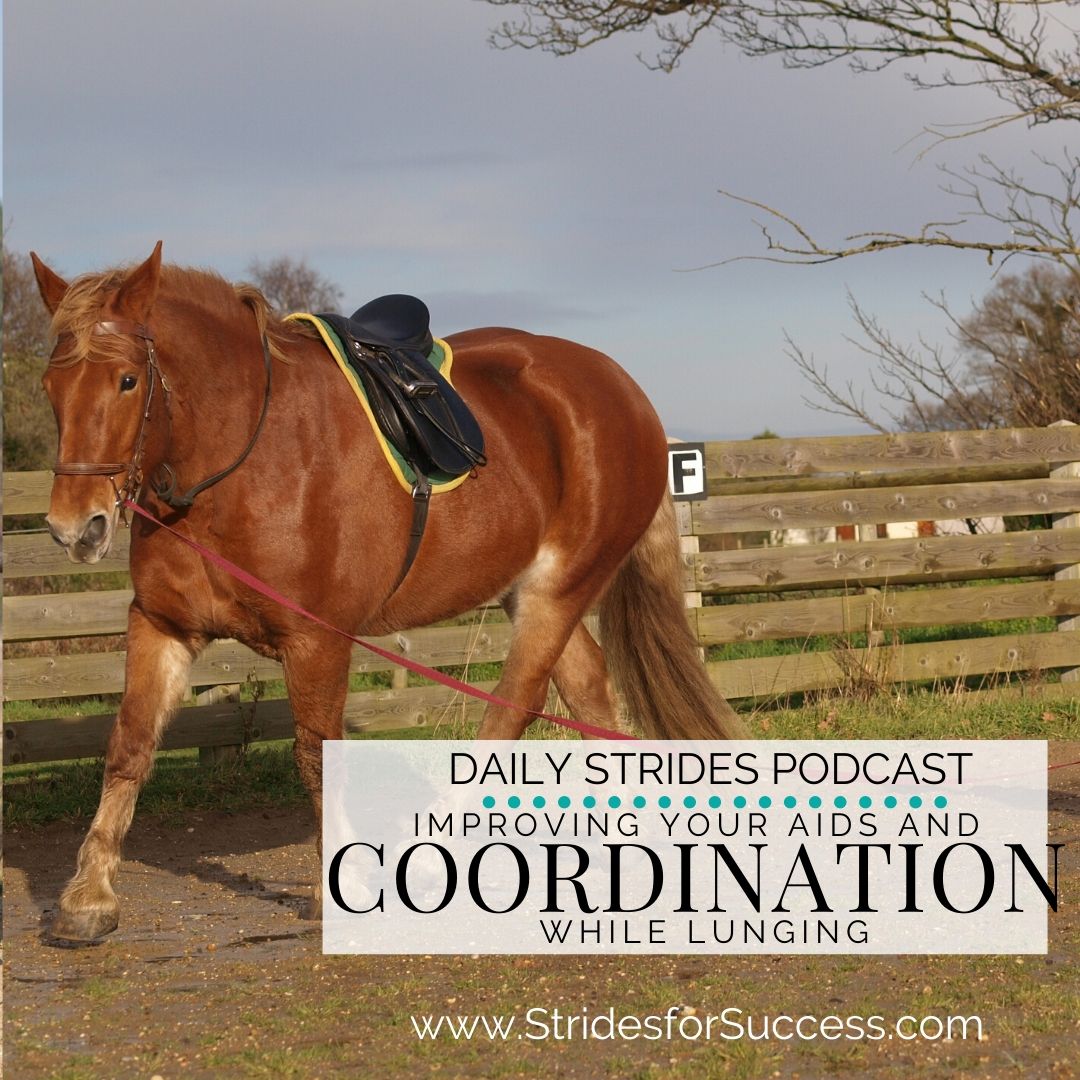
    As a rider, it can be easy to think that the only way you can improve your skills is to ride.  And yes, riding is important; obviously! However, you can also use lunging as a way to develop your coordination and aids. And not just on the ground, but also to benefit you and your horse when you’re in the saddle as well.
    [fusebox_track_player url=”https://op3.dev/e/traffic.libsyn.com/dailystridespodcast/1153-Improving-Your-Riding-Coordination-And-Aids-While-Lunging.mp3″ title=”Improve Your Riding Aids and Coordination while Lunging” social_linkedin=”true” social_pinterest=”true” social_email=”true” tweet_text=”Try this week with your horse…” hashtag=”equestrian” twitter_username=”strides_success” ]
    Lunging gives you a different perspective when you ride.  And often, this one simple change can be enough to burst through limitations in your riding.  You see, when you are riding, it is easy to believe that things are happening a certain way.  That things ‘look’ a certain way.  However, if you have ever watched a video of yourself riding, you will know that this is often not true.
    Lunging gives you second by second feedback on how your horse is actually responding to your aids; not how you ‘think’ your horse is responding to your aids. 
    And it is so easy to get started with, even if you have never lunged before. I have a step by step system HERE you can use.

    Natural Aids & Artificial Aids

    Just like in riding, you have different aids at your disposal when lunging your horse.  All aids are merely simply ways of communicating what you want, your ask, to your horse.  No one aid will stand alone or be used singularly.  There is always a balance happening in your riding.
    Natural aids are the ones that are part of your body. You’re attached to them! 
    Your thoughts, voice, position, and body language are the most used and effective natural aids when lunging.  All are used in different combinations and timing in order to communicate different messages to your horse.
    Artificial aids are used to ‘back up’ or clarify your natural aids. They are external to you and usually in the form of equipment. 
    When lunging, the most commonly used artificial aids are the lunging line, the lunging whip, the arena fence or railing, and also ground poles.  No artificial aid should cause pain or physical discomfort to your horse.  They are merely ways to clarity or support your natural aids, especially when your horse does not understand.  Again, they are used in all manner of combinations and sequences.

    The ‘Ask’ and the ‘Reward’

    All aids are used the same, whether they are natural or artificial.  There is initial pressure applied.  This is the ask.  Then, when the horse responds, the pressure is released.  This is the reward.  It is the continuous cycle of ask and reward that makes up the conversation between riders and their horses.
    This is also the place where you get to begin refining your coordination and aids in order to produce different results. 
    Pressure can be as simple as a change in the tone of your voice.  Or it can be as obvious as moving your position in relation to the horse.  It can be a subtle shift in your shoulders or a disengaging of eye contact.  As you begin to work on developing your coordination and aids on the lunge, you will find that your aids will become more refined.
    Refined simply means that you get a more accurate response with less movement or effort on your part. 

    Mindful Application of Your Aids

    However, in order for your horse to become more responsive, it first begins with you and your initial dedication to your aids.  Again this is much easier to work on from the ground.  You can actually see the results of your actions.  You can notice the smaller shifts in your horse’s way of going.
    And you can then repeat this with slight tweaks and notice the differences. 
    Over time, your aids will become more refined.  Just as in riding when you move from your more obvious aids being the biggest part of the conversation to your more subtle ones, your aids on the lunge will also improve.  From a greater reliance on artificial aids to clearer communication using your natural aids.
    It begins with your commitment to learning.  And your ability to respond rather than react.
    Happy Riding
    Lorna

    Additional Resources on This Topic:-

  • How Well Does Your Horse Understand Your Aids?

    How Well Does Your Horse Understand Your Aids?

    Have you ever become frustrated when someone is failing to understand and respond appropriately to your requests and communications?  Have you ever experienced this in the saddle? For many riders, they noticed that, even more frustratingly, this often occurs when they feel their riding should actually be improving.

    You’re not alone.  Many riders begin to feel this way after they have taken action to improve their skills in the saddle.  It could be that you invested in extra lessons, attended a clinic, joined Daily Strides Premium, completed the 30 Day Rider Fitness Challenge…  Perhaps you have studied a little more deeply as to the hows and whys of particular aids and the timing of them.  Whatever it is, you will have recently done something to take your skills in the saddle to the next level, but it actually seems that things are going backwards!

    The first thing that comes to mind for many riders is their horses responsiveness, or the lack thereof, when they apply their aids.  However, I want you to ask yourself, is it a responsiveness issue or a basic language breakdown you are experiencing?

    Often we improve our riding, but fail to update our horse on the fact that the situation has changed

    Now before we go any further, firstly I think it is fantastic that you are working towards better communication with your horse.  But remember, your knowing what to do and then you doing it is only one half of the equation.

    Your horse has not attended the same ‘study group’ and, if we think of our aids as a language, he has no idea that the dialect has changed…

    Part of improving your skills in the saddle is to effectively communicate with your horse in order to update his ‘responsive’ and ‘listening’ skills as well.  However, before you rush out and begin ‘retraining’ your horse, you need to first figure out exactly what he understands, and what has gotten lost in translation.

    I suggest starting at the beginning with the basics.  How effective are the simple ‘stop / go’, ‘steady’ and ‘turn’ commands working?  Very often we learn how to better control our seat when directing our horse, however our horse is still listening for the ‘old aids’.

    Next time you are in the saddle, work on establishing the basics again:-

    • Half halt
    • Moving forward and slowing down
    • Bending and turning

    From here, you will need to test how well your horse is truly understanding your aids.  Knowing what he understands and what is being ‘lost’ will give you a good starting point to move on from.

    • Test the walk to halt
    • Test the walk to trot
    • Test the canter transitions
    • Test the ability to adjust the length of the stride
    • Test how your horse understands the lateral aids

    Once you know where you stand with your horse, you can then look at how you can begin to educate or train your horse to understand your aids, giving you both clearer communication in the saddle.

    To help you with this process, I have created audio programs for you to download, for free, that will take you step by step through this process.