Tag: Stability

  • Fixing Your Position for Less ‘Bump’ When Riding Over Groundpoles

    Fixing Your Position for Less ‘Bump’ When Riding Over Groundpoles

    [fusebox_track_player url=”https://op3.dev/e/traffic.libsyn.com/secure/dailystridespodcast/1187.Taking_The_BUMP_Out_Of_Riding_Over_Groundpoles.mp3″ title=”Fixing Your Position for Less ‘Bump’ When Horse Riding Over Groundpoles” social_linkedin=”true” social_pinterest=”true” social_email=”true” ]

    It can feel bumpy, right? A little more space than what you’re used to feeling. And, if there are two or more poles, well, it can all get a little unbalanced! For you and your horse.

    I preach all the time about the benefits of groundpoles when used correctly. And, one of those benefits comes from riders learning what to do when navigating them.

    Groundpoles are, well, Poles!

    One of the first issues riders come up against when working over groundpoles is that they treat them like they’re not there. They are. And all of the bumpy, unbalanced, sometimes discomfort, you are feeling when you ride over them is evidence of that! Expecting to initially ride over groundpoles and not do a thing differently is simply setting both you and your horse up for an uncomfortable experience.

    As your horse steps over the pole, he will use his body differently.

    He has to lift his legs higher. Yes, 4 to 5 inches is still higher. He will also have to step under himself a little more to propel himself forward. This is especially true if there are two or more poles for him to navigate. He will engage his core. A little like ’tightening up his tummy’ as he moves over them. And he will stretch down and forward with his head and neck to see what he is doing, to balance, and to allow the freedom of movement the rest of his body needs.

    All of the above is one of the reasons groundpoles are so beneficial for your horse, regardless of discipline or training level.

    Who Are You Relying On?

    The biggest challenge riders face when moving over the poles is that they are relying on their horse for balance and support. And while, generally speaking, this may be acceptable for the first few rides in the saddle, every rider must begin taking responsibility for their own support as early as possible in their riding.

    Simply put, it means that you begin to carry yourself and are aware of your body as you ride.

    When you and your horse are moving in a straight line on a flat piece of ground, this can feel relatively simple and easy. However, as soon as we begin to include bends, circles, and corners into the equation, more demands are made of the rider’s independent seat in the saddle. Which is good. This is the progress we make as riders.

    Learning to ride over poles while maintaining balance and self-support is the next step to really developing an independent seat as a rider.

    The key is to position yourself in a place that allows your horse to do what it is you asked him to do AND allows you to remain balanced and ready to use your aids if and when needed.

    Weight Into the Heels

    Heels down is a concept we are all familiar with as riders. It is the thing (along with ‘sit up’) that we probably heard most in our first few months of riding. And for good reason. Being able to weight your heels is literally the key to the kingdom when it comes to riding horses. That is a big statement, however, it is true.

    When your weight is into your heels, you are in charge of your own support. You are standing on your own two feet (even though you might be sitting!).

    When you begin working over groundpoles, start with this. Push the weight into your heels. I use the word ‘push’ because, initially, it will feel like that. It will feel forced. After all, who walks around all day long with their heels pushed down?!

    When you are preparing to ride groundpoles, let the first thing you do be to make sure your weight is flowing towards your heels…

    Standing on Your Own Two Feet

    Now, you don’t always need to stand to have your weight into your heels. However, when you’re initially learning to travel over groundpoles, it is the most comfortable way for both you and your horse. But it is not standing as we would do it while dismounted.

    As your backside rises out of the saddle, think ‘back’. Literally, reverse your bum so that while you are moving it up out of the saddle, you are also moving it backward. Closer to your horse’s tail.

    Up and back. When you first do it, it will feel a little odd. But, when coupled with your heels down, you will instantly feel more balanced in the saddle. It’s a little like a squat, but on horseback. When you squat, your bum moves backward. When you are getting ready to ride over groundpoles, I suggest your bum do the same ;)

    Also, remember the first, key piece to all of this; as you stand up, ‘stand on your heels’.

    So many riders will shift their weight at this point to the ball of their foot and try to stand on the stirrup irons. This is the equivalent of squatting while on your tippy-toes. Not very balanced. Focus on keeping the weight into the heel as you move your rear end up and back.

    Counter Balance with Your Upper Body

    As you move your bum up and back, while standing on your heels, you will feel that your upper body will naturally fold down. This is correct and it will help you to maintain balance. Again, think of the squat. Instead of your back being vertical, your shoulders move in front of the vertical.

    It is at this point that many riders will look for the easy way out; they ‘lie’ on their horse’s neck.

    This is incorrect for a few reasons. It prevents your horse from moving as you have asked him to and it stops you from supporting yourself. And yet, it feels so easy! Especially if you are using your horse’s mane or a neckstrap for a little extra support…

    Your upper body can only balance out your lower body if you engage your core and carry yourself.

    This means keeping your back straight and keeping a lot of daylight between your chest and your horse’s neck! Think of not going below a 45-degree angle from your hips to your shoulders. The less ‘down’ you go, the easier it is for you to maintain your own balance and support.

    Also, focus on keeping your chest ‘open’ and wide. Imagine how it feels when you take a deep breath and let your chest remain open as you ride over the poles.

    Following with Your Hands

    As your horse moves over the poles, he will stretch his head and neck down and forward. If you are balancing with your reins, you make this uncomfortable and, sometimes even, impossible for him to do. Blocking this movement over long periods of time will result in hollowness in your horse.

    We often only think of our hands when it comes to the reins. However, when you follow here, I want you to think about your shoulders. Allowing through them in order to give your horse the space to move his.

    The simplest way to think of this is to just follow your horse’s mouth. Where it goes, allow your hands to follow a little.

    If you are struggling with balance, you can also grab a piece of mane. Just make sure that you have moved your hands forward a little first; about a third of the way between the withers and the poll is usually a good rule of thumb to follow. I also think that most horses would prefer a tug on their mane to a stab on their mouth when a rider is trying to rebalance!

    Your Head and Symmetry

    The final piece is your head. Again, think back to advice you probably received in your early lessons on a horse. “Look where you’re going”. Good advice, heed it! Remember to keep your head up and looking forwards. Looking down as you travel over the poles is an easy habit to fall into and one that can be difficult to break.

    Look up and think about riding your line as you ride towards, over, and after the groundpoles.

    Also, use your head as a warning signal for the rest of your body. Your chin should remain centered over your horse as you travel over the poles. Not more to the left or the right. If you do realize that it is slightly more to the left or right, the issue is probably to do with your body rather than your head.

    By keeping your head centered over your horse, you can remind yourself to keep your body equally positioned as well.

    Practice Makes Perfect

    I would suggest first practicing all of the above in a walk while on the flat with your horse. You can even begin at a halt if there are too many moving parts in the walk. From there, work in trot a little. Again, while on the flat. No poles.

    Working on moving in and out of the light seat without losing balance or jabbing your horse. It should be a soft, fluid motion.

    And only do as much as you need to do in order to remain balanced and give your horse the space he needs to work over the poles unhindered by you in the saddle.

    Happy Riding
    Lorna

    Other Useful Bits & Bobs to Help Your Riding

  • Applying the ‘Click Your Fingers Rule’ to Your Position While Riding

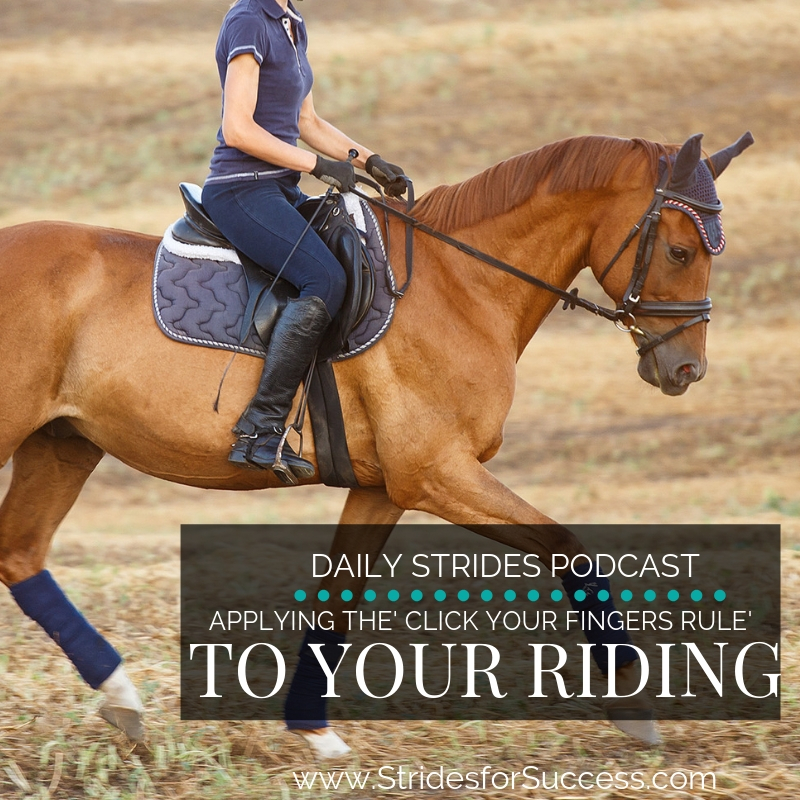
    Applying the ‘Click Your Fingers Rule’ to Your Position While Riding

    Applying the Click Your Fingers Rule to Your Position While Riding

    What this episode is all about & how it can help you:-

    • Use this simple ‘rule’ in your day-to-day riding
    • Know ‘when’ to apply this rule in your riding
    • Begin to take responsibilities for your own balance in the saddle
    • Make the necessary transition in your riding, from passenger to rider

    [smart_track_player url=”https://op3.dev/e/traffic.libsyn.com/dailystridespodcast/1085-Applying-the-Click-Your-Fingers-Rule-to-Your-Riding.mp3″ title=”Applying the Click Your Fingers Rule to Your Riding” social_linkedin=”true” social_pinterest=”true” social_email=”true” tweet_text=”The simple ‘rule’ involving your position that will help you in your riding’” hashtag=”equestrian” twitter_username=”strides_success” ]

    Imagine if there was something you could actively ‘do’ every moment you’re in the saddle that would almost guarantee that you’re in the ‘right place at the right time’..  There is. And it involves abiding by a non written ‘rule’ regarding your position.

    This episode of the Daily Strides Podcast is all about that rule and how you can use it, beginning today, in your riding.  Your position is so important

     What is the ‘Rule’

    Well, imagine we (you and I) were in the arena together. You are travelling along on your horse, whether that be in walk, trot or canter.  In fact, you could even be jumping, halfway through a transition – it makes no difference what you are doing.  So, there you are, riding along and then I apply this ‘rule’ to you and your riding…

    I ‘click my fingers’ and make your horse vanish.  Yes, disappear into thin air from underneath you.  Gone.  The question you have to ask yourself is: “would I land on my feet?”.

    Now, obviously this is not going to happen.  I’m good, but I’m not that good!  However by imagining the horse is suddenly not there, the questions becomes ‘where and how would you land?’.

    If the answer is on your face or on your bum, it simply means that you are depending on your horse for balance, rather than being responsible for your own balance.

    Who Are You Depending on For Balance?

    When we start out riding initially, we do tend to rely a lot on our horses for balance. Thank goodness for all the school horses and ponies in the world with their endless patience! But in order for your riding to progress, this is something that you have to begin accepting responsibility for.

    You are responsible for your own balance in the saddle.  Applying this ‘rule’ to your riding will help you achieve that.

    Relying on your own body, and therefore your own actions and responses, for balance will allow you to begin developing independent aids.  Independent aids lead to clearer communication with your horse.  They also lead to an independent seat.  This ‘rule’ regarding your position will help you start working towards all of these things in your riding.

    Applying the Rule

    There is are two simple ‘checks’ you can do every time you’re in the saddle to begin effectively applying this rule to your position and your riding.  The first to make sure that you are indeed sitting correctly in the saddle.

    Use your seat bones for guidance. Are they directly underneath you, pointing straight down? Many upper body issues and lower leg issues are due to this basic principle being wrong or missing.

    The second ‘check’ applies to the ‘lines’ to your position. Particularly the line that should run through your head, shoulder, hip and heel.  If these elements of your body are aligned, you are usually ‘carrying’ yourself, which means that you are, for the most part, assuming responsibility for your own balance.

    Being aware of the ‘rule’ will allow you to consistently reminding yourself to apply it to your riding, regardless of what you’re doing.

    When Does This Rule Apply to Your Position?

    The simple answer is ‘all the time’. Yes, really! Regardless if you are walking, trotting, cantering and even galloping.  Or if you are riding on the flat, up or down hills.  It is all the same. You are responsible for your own balance.  Even when you are approaching a jump, starting the jumping effort, landing or a stride or two after the fence, this rule will apply.

    If the horse was to vanish at any given point, anywhere in your ride, you should land on your feet.

    Applying this to your Position & Riding

    I’ve already mentioned checking your seat.  Is it truly ‘underneath‘ you?  From here, focus on keeping your legs under you at all times. A weak lower leg will swing, meaning that it can often be too far ahead of you, closer to your horses elbow or shoulder. Or too far behind you, closer to your horse’s flank area.

    Neither of the above scenarios would result in you landing or standing on your own two feet if your horse was to vanish!

    The final suggestion I have for consistently implementing this ‘rule’ in your riding regards your body when in the jumping position or two point seat.  Think of your torso as being almost like a traditional weighing scales. Your shoulders are one end and your ‘bum’ is the other. Use your bum to keep your shoulders balanced.

    A straight back is essential for this to happen, and this is where your core strength will really be essential to your overall balance.

    Making the Transition in Your Riding

    The ‘click your fingers rule’ is one that will, when applied consistently, change your riding.  You will literally go from being dependent on your horse for support, to being able to actually support your horse when he needs it.

    That is where you really begin to make the transition to being a true ‘rider’ in the saddle.

    I am hosting a free, live online training for riders looking to begin making that transition in their riding; from passenger to rider. You can find out more and register HERE

    Happy Riding
    Lorna

    Other Posts and Episodes that Relate to This Topic:-

  • Stability Over Jumps for Rider & Horse

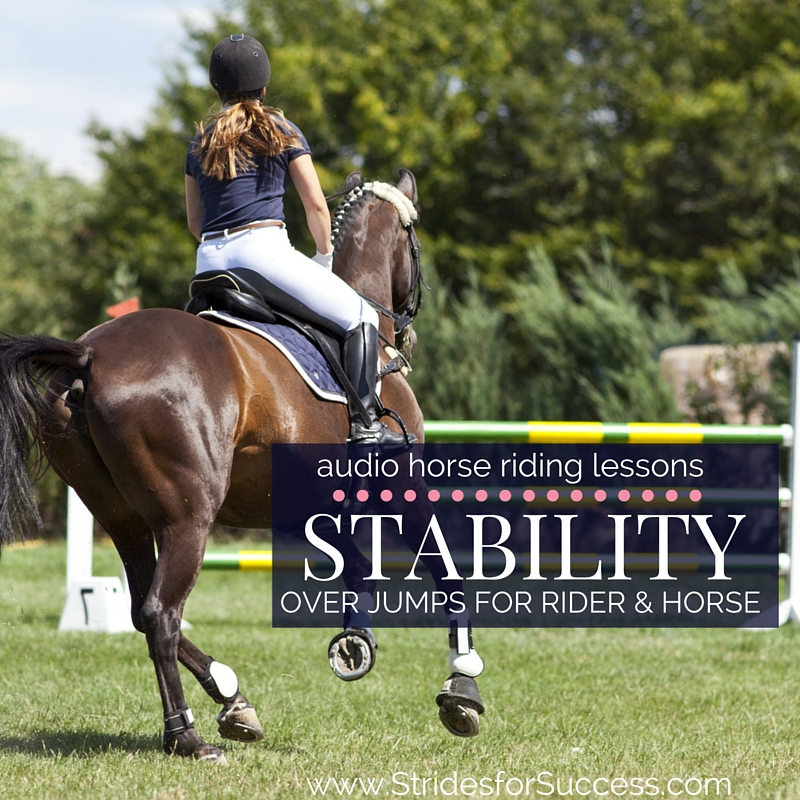
    Stability Over Jumps for Rider & Horse

    More stability in the saddle – as riders we are all guilty of being a little like Oliver Twist when it comes to it; we want more, please sir! This is none more true than when it comes to jumping as it is often the activity that makes us feel most unbalanced and ‘wobbly’ in the saddle.

    As riders we want to be as effective as possible in the saddle. We are working towards having aids and general communication that cannot be confused or misunderstood by our horse.

    [smart_track_player url=”https://op3.dev/e/traffic.libsyn.com/dailystridespodcast/691-Improving-Stability-over-Jumps-Rider-and-Horse.mp3″ title=”Increasing Stability over Jumps for Horse and Rider” social_linkedin=”true” social_pinterest=”true” social_email=”true” tweet_text=”Struggling to remain balanced over the fences?! This will help… for horse and rider” hashtag=”Horseriding #jumping #stayingon” twitter_username=”strides_Success” ]

    One of the most rewarding results of developing better stability is that riders find their effectiveness and overall application of their aids increases dramatically.  This is due to  the rider being ‘quieter’, which allows the horse to distinguish better between an actual aid and a random move or shift.

    An easy way to see the benefits of a stable load is to imagine having a schoolbag or backpack strapped over both shoulders; and then going for a jog. If the bag does not fit correctly, perhaps the straps are too loose or there is too much play inside the bag itself, it is going to bounce around quite a bit as you run. This is going to have a direct effect on how you run and also your balance while running. Imagine trying to jump a fence or jump with this same loose, moving backpack – pretty difficult, right?  This is similar to how it feels for your horse when you are unstable or unbalanced in the saddle.

    However, when it comes to riding, there is the added problem of your horse having to try to decipher between your actual aids and your ‘speed wobbles’

    He is also going to become more unbalanced himself, as he struggles to keep both of you upright while working through certain movements while being ridden, regardless of if they include jumps or not.  This is often very obvious through corners and transitions.

    Very often when riders progress plateaus it can be traced back to the rider being less balanced in the saddle than they should. The impact of which, as mentioned, is very often muddled and conflicting aids being given to the horse.

    So it goes without saying that these challenges are compounded where jumping is concerned. It is not unusual to see riders who have a somewhat secure seat when working on the flat experience a major lack of stability when fences are introduced.  All balance and stability is completely undone as soon as a pole or jump is attempted.

    Become familiar with your 2 point seat

    One of the best ways riders can begin to develop more stability in general in the saddle is to work in a correct 2 point seat. It is difficult for many riders initially to hold and ride.

    However, the 2 point seat will allow you to become very secure in the saddle, through literally standing on your own two feet. It requires a secure and correct lower leg in order for it to work; which overtime will strengthen.

    The 2 point seat is also a great way to both see and feel the relationship between different parts of your body. For example, how an open chest can directly influence your backsides position in the saddle. Or how the position of your lower legs will dictate how balanced the rest of the body is while the horse moves underneath.

    Your chest area will basically balance out your backside when in the 2 point seat. If you don’t have the correct ratio of balance between the two, you will lose your balance in the saddle

    Your brain needs time to ‘recalibrate’ the factors needed to keep your body balanced when in the saddle. Riding in the 2 point seat helps this process to happen a little faster; and for the rider to understand the process as well.

    Improving Stability over Jumps for Horse and Rider

    Realising ‘Cause and Effect’ is Happening

    When we are jumping we need to be in complete control of our body, so we do not feel like the loose backpack to our horse. A lot of riders make the mistake of relying on the horse for balance over the fences.  They will lean on the horse’s neck or ‘hunker down’ into the saddle, which will inevitably hinder how the horse can use himself over the jump.

    Of course, the added problem with using the horse for balance is if the horse stumbles, runs out or perhaps has a refusal at the fence. The rider is completely ineffective to help; and often ends up on the ground because their balancing aid – the horse – suddenly stops working!

    Developing a secure lower leg is key to beginning to take responsibility for your own stability and balance when riding your horse. The 2 point seat, and the ‘burn’ that often accompanies it, is a fantastic way of working this part of your body in the saddle.

    Knowing how to adapt the use and position of your lower leg when in the saddle, will directly affect what happens to the rest of your body in the saddle.

    The difference between ‘secure’ and ‘fixed’

    When initially beginning to work on this particular aspect of riding, many riders mistakenly try to ‘fix’ themselves in the saddle. They become rigid and stiff. This, unfortunately, will result in a marked decrease in their overall stability and balance.

    You definitely don’t want your leg doing the ‘hokey pokey’ when you are riding – but fixing your leg in one place will not work either.

    You need to rather focus on suppleness through your body and leg. When you are supple in the saddle, you will be able to move with your horse, all the while remaining in the best possible position for your body to make the micro adjustments needed to stabilise and balance you in the saddle.

    You need to allow and move with your horse, rather than fix and bump against your horses motion

    This suppleness comes from your joints; ankles, knees and hips. Working in the 2 point seat will help you notice and then begin to use your joints to stabilise your position and body in the saddle as your horse moves underneath you.

    I think it is also worth mentioning at this point that your contact is important when working in the 2 point seat. Many riders seem to think that the 2 point seat is rather a jumping position on the flat. It is not!

    Your contact will remain consistent with your horse throughout your 2 point seat, which will allow you to, again, effectively communicate with your horse while you ride

    Once you have begun to master the 2 point seat on the flat, through walk trot and then canter, you can begin adding some ground poles to your exercises.

    Becoming more secure on the flat is the key to being able to move with your horse in a balanced way, rather than relying on, your horse over fences. The ground poles will allow you to work up to some jumps later; but I strongly suggest waiting to move forward with your training when you have mastered this on the flat initially.

    Happy riding
    Lorna

    This podcast episode is the first in a series of 5 on the topic, available for you inside of Daily Strides Premium. The remaining 4 lessons will take you step by step through different exercises that will help you become more secure and balanced in the saddle.

    Those audio programs can be downloaded onto your phone and then listened to as you ride your horse. They are filled with reminders on what to do, step by step instructions on how to do it – can have the added bonus of being replayed over and over again! You can find out more about Daily Strides Premium by visiting www.stridesforsuccess.com/join/.

    [wp-tiles post_type=”post” orderby=”date” order=”DESC” grids=”Simple”]