Tag: the basics

  • Going Slow to Speed Up – Your Riding Questions Answered

    Going Slow to Speed Up – Your Riding Questions Answered

    [fusebox_track_player url=”https://dts.podtrac.com/redirect.mp3/pdcn.co/e/traffic.libsyn.com/dailystridespodcast/1387_Going_Slow_To_Speed_Up_Your_Riding_Questions_Answered.mp3″ title=”Going Slow to Speed Up – Your Questions Answered” social_linkedin=”true” social_pinterest=”true” social_email=”true” ]

    It can feel frustrating when you realise that you have to steady up a little in your rush to get somewhere! And, when riding, going slow to speed up is often what’s required to really allow the concept to sink in; mentally and physically. Last week’s episode about what riders are often not willing to do seems to have hit a nerve for many riders!

    Riders reached out with questions, worries, queries about resistance that had shown up, and a healthy dose of “But do I really have to go that slow?”.

    So in this episode I answer a lot of the questions I received. I chose the ones that I feel, for the majority of riders, might crop up when working on this topic! And look, let’s be honest here. Intentionally slowing things down usually doesn’t feel great – especially when you’ve a bee in your bonnet to get somewhere else! But you can’t argue with the proof that it’s the riders who invest in the slow, steady, correct work, that make the long term progress in their riding and training. So, on that note, let’s crack on ;)

    Q1. Where do I begin? And doing what?

    “I don’t know where to start. In the episode, you say to begin on the ground, but I don’t know what to do there”

    This was, in one form or another, hands-down the most common question! Many riders hear “start on the ground,” and instantly freeze. They’re wondering about what they should do on the ground. And how long should they do it. And what happens if their horse doesn’t understand?…

    Here’s the simple version; start with leading your horse in a deliberate, connected way. Then take this opportunity to begin weaving your voice into the mix and allowing it to become a powerful aid.  

    If your horse doesn’t understand your voice aids yet, don’t worry. Horses learn through association. So pair your existing aid (usually pressure through the halter or reins) with the new voice cue. Over time, the new cue becomes clear enough that you can gradually reduce the old aid.

    It’s like building a bridge; your old aid, paired with new aid, which overtime allows the new aid to become clearer and more understood. And then you can begin to phase the old aid out.

    And yes, this works with your voice to seat and weight aids too. The order doesn’t matter nearly as much as consistency does. Use your voice in the arena, in the field, at the gate, and even walking up the driveway. The more consistent you are, the faster the association forms. But, take my advice here and start on the ground first :)

    Q2. Thinking Forward v’s Rushing?”

    These two can look similar at first glance, especially if your horse is a bit ‘hot’, ‘goey’, or easily distracted. But the feeling is completely different.  A horse who is thinking forward moves with a ‘sense of purpose’. They seem to have an intention and enough energy (and tension) to do the work they’re doing – without it spilling over! The level of tension they have is right for the movement or work they are doing at that exact moment.

    This contrasts completely with the horse who is rushing… This horse will often seem to carry a little too much tension in their bodies. They may be experiencing anxiety or unable to focus, so constantly distracted or unbalanced…

    Thinking forward does not mean rushing. It means working with a sense of purpose – which is both mental and physical. And it’s a great indicator that your ‘slowing down’ is beginning to produce great results! 

    Relaxation is a really misunderstood concept when it comes to training and working with horses. It doesn’t mean floppy, sleepy, slow, or dragging  themselves (or you) along. It simply means the tension present through both the horse and rider is appropriate for the job at hand.

    When thinking forward, both you and your horse’s body and mind are focusing themselves toward the work; not away from it! 

    Q3. It Didn’t Work!

    “I tried the walk to halt to walk work today and it was awful. When can I trot again?”

    Okay, my first response to this is for the rider to just breathe for a second, step away from the fast-forward button and be realistic about the situation; you tried it once! Instant-gratification really has no place when it comes to riding or training horses! However, unfortunately, that is the world we live in right now.

    So, if your first attempt felt messy, stiff, or downright awful, it often points to one of two things… You skipped the groundwork. Or your position might be blocking what you’re asking for. 

    Regarding the groundwork, it is common to believe that because you work with your horse every day, you can skip this bit. But reinforcing the thing that is holding you back will only result in you both staying stuck. And, skipping the groundwork, as so many riders do, is where so many issues stem from.  Regarding your position potentially blocking the energy; alignment matters so much  when you’re going back to the basics. When you’re doing going slow to later speed up.

    My suggestion is to whip out your phone and video yourself. Watch your posture and alignment. Practice curiosity – not judgement. Self-assessment is one of the quickest ways to speed up when you don’t have a trainer on the ground.

    And no, you won’t be stuck either on the ground or in walk forever! A few dedicated sessions on the basics, plus a commitment to revisiting them in warm-ups and cool-downs, is usually enough to transform things…

    Q4. My Horse Is Bored with ‘Slow’!

    “My horse is bored doing this slow work. What else can I do?”

    When I read this, the first thought that popped into my head was “Is your horse bored; or are you bored?!”. And this is all said with love – because 98% of the time, it’s the rider who’s ‘bored’! I’ll admit, there was a time when I believed this as well. However, a great trainer I had the opportunity to work with thought me to think differently about it.

    Walking work can be endlessly interesting if you show up as the trainer and create intention within the session. Add lateral work. Add poles. Change your focus. Look at your straightness, your bend, your rhythm, your timing.

    I know for a fact that you can ride the exact same exercise, let’s say a three-looped serpentine, with a different focus every day and never run out of things to refine. Hence why this trusty ‘basic of basic’ school movements is one of my all time favourites.

    Boredom is rarely a horse problem. It’s a rider creativity problem. And if you want to begin showing up as a trainer, it becomes your responsibility to think differently so that your work together remains interesting. 

    Q5. Help, I’m a Helicopter Rider!

    “I’ve realised that I’m doing everything for my horse – but when I stop helping, it all falls apart!”

    Ah, the club that no-one wants to find out that their a part of! Helicopter Riders (who are a lot like Helicopter Parents). What I mean here is that you are hovering around, simply waiting for something to go wrong so that you can swoop in and save the day! It’s micromanaging at it’s worst – and it’s absolutely exhausting!

    When you’re micro-managing everything in your riding and training, you’re really trying to prevent any mistakes from happening… BUT, in doing so, you’re also preventing any learning from taking place! 

    Mistakes are not a sign that something is wrong; they’re the sign that the learning process has begun. You need to begin shifting how you see your role when working with your horse. Instead of ‘minding’ everything, your new ‘job’ is to set everything up as well as you can… Then get out of the way so that your horse can ‘do’ what you’ve asked. And when he inevitably hits a bit of a speed wobble, simply correct, set it up and try again.

    A key part of moving away from ‘helicopter mode’ is to do all of this from neutral. No grudges! No matter how many times you feel you have to correct the same thing! Reset yourself and your horse – and then try again from neutral.

    Q6. We’ll Lose Fitness!

    “Won’t spending so much time ‘going slow’ cause my horse to lose fitness?”

    Okay, let’s get honest here – it might. But usually, this is actually more of a mindset fear, not a reality!  A horse with a solid fitness base doesn’t lose it overnight. And even if your horse does step down a level, fitness returns far more quickly in a horse who has been fit before than one who has never reached that stage, or has done so years before.

    The important thing to consider here is that if your current training isn’t built on a solid foundation, then you will eventually hit a roadblock that will require you to ‘go back’. Rather do this now!

    Fixing the foundation doesn’t take months of walking in circles.  It takes intention and a few weeks of re-calibration.  And this ‘slow work’ pays off for years afterwards.

    Q7. How Long to Go Slow?!

    “How long should I stay in each stage before moving on?”

    Okay, there are so many questions to do with horses, riding, and training that I answer with “it depends” – and this is one of them!  It will depend; on you, your horse, your consistency, and your willingness to let go of the aids you’ve been leaning on for years. Aids and training methods that may have got you to where you are right now, but are the very things that are blocking you from moving forward now.

    Revising the basics should feel like a blend of the old with the new. You’re slowly and consistently reducing reliance on the outdated aid as the new one becomes clearer.

    If you feel completely stuck at one stage, that’s a sign that something else, usually communication, understanding, or your position, needs attention. Forward momentum should feel fluid, not stalled. And this leads me to the next question I received…

    Q8. How Will I Know If It’s Working?”

    “I’m not sure what I should be on the look out for to know if my approach is working or not”

    This is a great question. And I get it that when you’re starting out, it can be difficult to see progress – especially when you’re in the vacuum of just you and your horse! But, as the popular meme says.; “There will be signs”!

    Progress will look like the basics showing up more consistently. Rhythm, relaxation, balance, responsiveness… And they will become more easy to maintain. 

    Also, you won’t just feel it, I strongly suggest you do something so that you can actually see it. And this is where trusty lunging is 100% the best approach you can take. You will actually be able to see the contrast between “before” and “after” you ask something or make an adjustment. And because horses don’t lie, this is often the most honest mirror you can give yourself.

    This is exactly why inside Connection, we spent an entire month refining the half halt on the lunge. When you can see the transformation before you even get into the saddle, your confidence skyrockets and your communication becomes clearer.

    It really and truly will pay you so much in the long run to take time now to slow down. Revisit, rework, and re-engage the basics – so that you can speed up in your progress and training later.

    Happy Riding
    Lorna

    Get Your Riding Questions Answered…

    So, hopefully I have answered the majority of questions I received regarding last week’s episode (you can listen to it HERE if you missed it). However, maybe you have encountered something different or you’re wondering about something I have not addressed here. This is where Connection really helps riders just like you.

    If you’re feeling ready to walk the full A to B to C path with your horse, all of the details are HERE.

    Also, if this work is speaking to you, or your foundations feel shaky! And, especially if you’re ready to turn “going slow” into “real progress,” then Connection is where we do all of this step-by-step, with coaching, structure, and community. You can find all the details here:- https://stridesforsuccess.com/join

    Online Training & Coaching

    The Your Signature Ride Challenge

    Here’s the idea: you use only your seat and leg aids to “write” your name in the arena. Sounds simple, right? But what it really does is sharpen your awareness of timing and clarity.  You’ll learn when your aids actually make a difference.  And you’ll have fun doing it.  All while creating a pattern that’s uniquely yours!

    You can sign up by CLICKING HERE

    It’s free to join, and every rider who participates gets access to a guided audio lesson to help them through the challenge. Plus, you’ll have a chance to win 3 months inside Connection (a $66 value)

    Restart & Reschool

    And if you would like a little more 1-to-1 coaching, explore Restart & Reschool Private Coaching. It is perfect if you’re starting your practice – or if you’re looking to turn your existing practice into something ‘real’ for you and your horse. I’ll guide you step by step on the way! You’ll not only get the full ‘OTTB; From Racetrack to Ready Program’, but also fortnightly private lessons with me to move you forward in your riding.

    We can work on anything you would like; from groundwork, to lunging, to riding, to jumping… With the virtual private lessons, we can do all of these things – and more.  If you would like to find out me, you can let me know a little more about you HERE and I will then reach back out and we can chat!

    This is the support, training, and accountability you’ve been missing to finally follow through and start seeing progress. No fluff. No overwhelm. And as flexible as you need for your lifestyle. 

    Connect with Lorna online:-

  • Are You ‘Sitting There’? How To Know if You’re Stuck in Passenger Mode!

    You hop into the saddle, ready for a great ride. But before you know it, you’ve spent most of the session adjusting your hands, correcting your position, and just ‘fixing’ yourself. All while your horse just plods along! Sound familiar? Don’t worry, you’re not alone…

    Ask yourself this: Where is the majority of your attention or focus when you ride? Think back to the very last schooling session with your horse with you in the saddle. Maybe you had a lesson, or perhaps it was just you and your horse working together alone. Who did you focus more on: you and your position, aids, tension, etc., or your horse and how well he was working?

    There comes a point for most riders when they realize that they spend more time focusing on themselves in each training session. Fixing, correcting, reminding themselves to do or be a certain way…

    This is the ‘passenger’ phase of your horse-riding journey. And while all riders must initially go through it, the challenge comes when they unknowingly get stuck there! It’s when you’re focusing so much of your energy in ‘fixing’ yourself that you’re not actually riding the horse! You’re simply ‘sitting there’.

    So, if you’ve been feeling like 80% of your time in the saddle is spent ‘fixing’ and correcting yourself – this article and episode will help you to begin making the shift from passenger to rider.

    Signs You’re Stuck in Passenger Mode

    So there are a few ways you can begin to identify this in your riding. The first and most obvious one is becoming aware of how you spend your time when you’re riding…

      • You spend most of your time in the saddle ‘fixing’ or adjusting your hands, seat, or legs – instead of focusing on your horse’s way of going
      • You actually feel like a passenger the majority of the time in the saddle – your horse is leading you, rather than the other way around, or working together as a team
      • Corners, bends, circles, or transitions seem to happen TO you – rather than because of how you set things up and asked for them!
      • You spend a lot of time trying to find your balance – instead of using your weight aids to positively influence your horse’s way of going

    The ‘Stuck in Passenger Mode’ Test

    Think back over the past 5 rides you’ve had where you wanted to work on something and achieve something with your horse. Where did your focus go for the majority of those rides? If you worked with an instructor or a trainer, what did they spend most of the time working on? You or your horse? And if they had to keep ‘fixing’ or correcting you to work on your horse – the answer is ‘you :)

    Another way to think about this is by assessing your basics in the saddle. If the majority of your time is spent correcting, fixing, stabilizing, or any of the other ‘ings’ your basics, then you are in passenger mode.

    And keep in mind that is not a ‘bad’ thing. Once you realize that this is a very real part of the journey of becoming a more skilled rider, you can start to actively work on transitioning out of it!

    The basics that you will find yourself focusing on are:-

        • Your Position
        • Your Posture
        • Your Aids
        • Bending (and creating a channel with your aids)

    Passenger Versus Rider

    Of course, when you’re stuck in passenger mode, you might wonder, ‘What else is there to actually focus on?’  And the answer is, ‘Oh, lots!’. ‘Riders’ are not spending their time worrying about and ‘fixing’ their position. Or their aids, or posture, etc. They are not obsessing over carrying their hands or keeping their heels down.

    The difference between passengers and riders is that riders are thinking about the best way to communicate and support their horses to get the desired outcome. 

    If they don’t spend the majority of their ride or training session worrying about their position. They are wondering if the horse understands what they are trying to explain. And if they think that maybe there’s a little confusion going on, they are thinking about how to clarify that. How to USE their position or aids to get the most out of their work with their horse. Not just keeping the horse between themselves and the ground!

    Passengers focus most of their energy on fixing their position or aids. Riders don’t have to think about their position; they focus on understanding how the horse is interpreting what they are trying to say…

    Transitioning from Passenger to Rider

    So the first part of creating this transition for yourself is to actually become aware that something has to change! And, hopefully, after reading this post or listening to this episode, you’re already there! The next part will be a little more time-consuming. This is because working through this transition in your riding skills requires putting your basics onto autopilot…

    ‘Riders’ don’t have to worry about their position or aids because they have already invested the time in putting the right basics onto autopilot – they just happen by themselves now and no longer need constant management

    That is a key part of the process to move away from being stuck in passenger mode and move into ‘rider’ mode. Putting the ‘right’ things onto autopilot. This is why riding instructors the world over go on and on about a good position. About good posture and self-carriage. Or can be heard shouting ‘heels down’ all of the time! These things matter.

    If you are in passenger mode now, you can begin carefully curating what you want to put onto autopilot so that you get the best possible results for you and your horse further down the road. 

    Flipping the 80/20 in Your Riding

    So, if right now, you are spending 80% of your time focused on ‘fixing’ or ‘correcting’ your basics (position, posture, aids, and bending), this is leaving only 20% of your time to focus on your horse. This needs to flip if you want to get unstuck and begin actually ‘training’ your horse the way you want.

    Moving away from being stuck in passenger mode requires you to become more aware of what you are doing so that the 80% of time you’re spending focused on ‘you’ now pays off in the long run.

    You want to turn each ride into the opposite of the ‘Passenger 80/20’:-

      • 20% self-awareness → A little time invested intentionally adjusting your alignment, position, aids…
      • 80% riding your horse → So that you can focus on supporting your horse to do his best work

    If 80% of your ride is spent fixing yourself, you’re not riding – you’re just sitting there, often stuck in passenger mode

    Where Should You Begin?

    This will vary for every single rider. Often, it can be worth getting an expert opinion on this initially if you’re unsure. I say this because you might begin to fixate on a specific thing, let’s say a swinging lower leg. When really that is merely a symptom of a forked seat. If you don’t have the knowledge or experience to identify a symptom and a cause, investing in a riding lesson with a knowledgeable instructor will be worth it’s weight in gold.

    Once you’ve figured out the root cause, start there. Spend 3 to 5 minutes at the beginning of every ride intentionally correcting this. Then, build checkpoints throughout your ride to check in on how you’re doing. 

    You will have to correct a lot initially. This is absolutely normal and to be expected. And this is often the work many riders are not willing to do! Again, this is also why riding instructors keep repeating the same things over and over. They are doing the ‘checking in’ for the riders!

    Only when you’ve been consistently doing the correct thing for a length of time will that then become a habit. Your body and brain will put it on ‘autopilot’. And this is what frees you up to focus on something else.

    Putting Your Basics on Autopilot

    If you want to move out of being stuck in passenger mode and begin transitioning into being a ‘rider’ for your horse, I can help. I truly believe that spending 9 to 12 weeks focusing on this is long enough to create a transformation in your riding.

    I can help you do this by putting the correct things onto autopilot in your riding, inside of the Returning to Riding Program. You can find more details over at https://returningtoriding.com

    The Returning to Riding Program is designed to move you out of the passenger seat and into confident, intentional riding. Join us and start riding with purpose!

    Happy Riding
    Lorna

    More Episodes on This Topic

    Online Training to Help Your Riding

    Connect with Lorna online:-

  • Back to Riding? Improve Your Seat, Hands & Balance on Day 1

    [fusebox_track_player url=”https://dts.podtrac.com/redirect.mp3/pdcn.co/e/traffic.libsyn.com/dailystridespodcast/1356_Back-To-Riding-Improve_Seat-Hands_and-Balance-on_Day1.mp3″ title=”Back to Riding? Improve Your Balance, Seat, and Aids on Day 1″ social_linkedin=”true” social_pinterest=”true” social_email=”true” ]

    So you desperately want to get back in the saddle on the regular again. And you definitely feel excited. But you’re also feeling more than a little overwhelmed! The big looming question is “What do I do on that first ride?!” Stop panicking because today, I will guide you through exactly what to do on that first ride… Step by step with your horse. Remember, whether it’s been months or years, your body and mind need time to adjust.

    For your first few rides back, I want you to focus on increasing your awareness, rather than questioning if you’re ‘doing it right. Awareness over perfection! 

    Today, as we ride together, you will make some small but mighty shifts in how you sit, move, and connect with your horse. These strategic adjustments will make all the difference in rebuilding your confidence and comfort. And they will also help to keep your mind from wandering too much!

    So, obviously, this can be listened to while you are riding. But you can also listen before you mount up and then use what you learn to make your first or next ride really count in your journey back to regular riding.

    Settling Into the Saddle: Find Your Balance

    Once you are mounted up, and before you start making changes, let’s take a moment to pause. Take a deep breath and simply notice what’s happening in your body. Can you feel an excess tension creeping into specific areas?

        • Seat & Weight Distribution – Do you feel ‘even Steven’ in the saddle, or is one side heavier?
        • Legs – Are your legs resting naturally or gripping? Let them drape softly like curtains
        • Hands & Reins – Are you holding tension in your fingers? Keep your contact elastic, imagine holding a sponge and wanting to keep some water in the sponge!
        • Breathing – Are you breathing deeply, or are you holding your breath? Talking or singing to your horse can really help here…

    “Your first ride back isn’t about fixing—it’s about noticing. So often you will bring old habits back to the saddle with you. This is the perfect opportunity to make lasting changes to those!”

    Moving With Your Horse: Feel the Rhythm

    From here, ask your horse to begin to walk forward. Use these initial first few steps to first of all congratulate yourself for mounting up! And then, begin to scan your body. Your only job right now is to become aware of how you feel. As your horse walks, tune in to their movement. Are you following the motion or blocking it? Are you syncing or sinking the whole ship?!

        • Your Seat and Lower Back – Is your seat moving freely with your horse, or are you stiff and blocking the movement? Let your horse move your hips and seat. Think of a bicycle peddling backward.
        • Upper Body & Chest– Are you collapsing through your upper body? Or are you focusing on the feeling of ‘standing’ rather than ‘sitting’ through your upper body while in the saddle?
        • Shoulders & Arms Are your shoulders creeping up towards your ears?! Are your elbows sticking out in front of you (like a sleepwalker!)?  Do you have enough (or too much) bend in your elbows?
        • Balance & Symmetry – Are you centered, or are you more to one side or the other? How does the weight feel in your stirrups? And your knees; are they symmetrical? How about your hands…?

    “Your body is constantly giving signals to your horse—make sure they’re the right ones. Too much or too little tension in your body can have a massive impact on your horses way of going”

    The goal is to move with your horse, not against him. It’s like dancing. You want your horse to ‘lead’ you at this point in your riding. Don’t shove, or resist. Just relax, find neutral, and allow your body to be led. When you do, your horse will feel more relaxed and willing. It will feel like the energy is flowing. Rather than riding with the handbrake on!

    Small Adjustments for a Big Difference

    Once you’ve become more aware of what you’re doing in the saddle, you can begin to make small adjustments to how you are riding and interacting with your horse. I am going to suggest beginning with evening out tension levels throughout your body, correcting your posture, and aligning your position to where is best for the application of your aids. When you’re in the right place, it makes ‘talking’ to your horse so much easier!

        • Head, Shoulder, Hip, Heel Line – If I could magically click my fingers causing your horse to disappear, would you land on your feet? Or would you end up on your face or your bum?! This line is IMPORTANT!
        • Elbow, Wrist, Thumb, Rein, Bit Line – Have you got a lovely straight line from your elbow to your horse’s mouth? Or do you have a V or a lightning bolt going on?! Your hand, wrist, and lower arm are extensions of the rein – no bends or angles, please!
        • Symmetry & Weight Distribution – Are you sitting on your seat bones? And are each of your seat bones an equal distance from the middle of the saddle? Adjust your seat bones so that they point directly below you (click your fingers rule), and that there is an equal amount of your body on both sides of the saddle. If you do feel off-center, try shifting your weight slightly to rebalance yourself

    “The smallest adjustments often create the biggest improvements. And by starting off with making sure the basics are right, you are creating a strong foundation to build from in future rides…”

    Awareness of Your Horse & Your Habits

    As you make these changes, check in with your horse. Is he responding differently? How about relaxation; how are the tension levels in his body? And responsiveness? When you’re in the right place, he has a much better chance of understanding what you’re trying to say.

    The more aware you become, the more effective your riding will be. And the stronger your basics are, the more quickly and effectively you can build your skills as a rider. 

    It is always worth remembering that a lot of the ‘bad habits’ we cultivate as riders are actually symptoms of something else going on. Try to focus on ‘tweaking’ the cause, rather than drive yourself mad trying to treat the symptom! It won’t go away completely until you address the cause!

    Cooling Down & Reflection

    As you finish your ride, take a moment to reflect. Ask yourself:

        • What did I notice about my position and balance?
        • Where did I feel excessive tension?
        • How well did I carry myself – especially my hands and my upper body?
        • Where did I feel the most connected to my horse through our movements together?
        • What small changes made the biggest difference?
        • Are there any habits from before that have followed me back into the saddle again?

    “Every ride is a chance to learn something new about yourself and your horse… It’s your level of self awareness that allows you to make each ride an opportunity to improve”

    And, if you’re feeling up to it, you can try all of this again, but at the trot. I’m going to suggest listening to this episode again and applying the same awareness to your rising trot. Think of the basics, position, posture, weight distribution, and your ‘lines’.

    What’s Next? Choose Your Focus…

    Okay, so the first ride is done and dusted. However, now you need to build a little momentum. Choose one of the three following suggestions to work on for your next ride so that you can keep improving and truly make the most of this opportunity to be back in the saddle again.

        1. Learn to Begin Controlling Your Seat – Neutral, Go, and Whoa are all real ways you can influence your horse using your seat. I have an episode on this topic HERE
        2. Applying the Click Your Fingers Rule – Those lines are really important for both keeping you in the saddle and also how well your horse can listen to and understand your aids. I have got an episode on this HERE
        3. Developing Your Riding Fitness – Maybe you felt that you lacked the suppleness to move with your horse… If so, I strongly suggest diving into walking and yoga-based free 21-day Equestrian Fitness Challenge HERE

    Finally, I would love to hear from you… Which one of the above exercises felt the most impactful for you in your ride today? Pop over to the Daily Strides Podcast Online Community on Facebook and let me know! I’d love to hear about your experience.

    “Progress isn’t about doing everything at once – it’s about improving one small thing at a time.”

    And if you’re looking for more ways to make the most of your time with your horse, grab my free 80+ Ideas to Do with Your Horse in 15 Minutes or Less by CLICKING HERE

    Everything is neatly divided into categories for you to choose from depending on your vision, intention, or focus for your riding.

    Happy Riding
    Lorna

    More Episodes on This Topic

    Online Training to Help Your Riding

    Connect with Lorna online:-

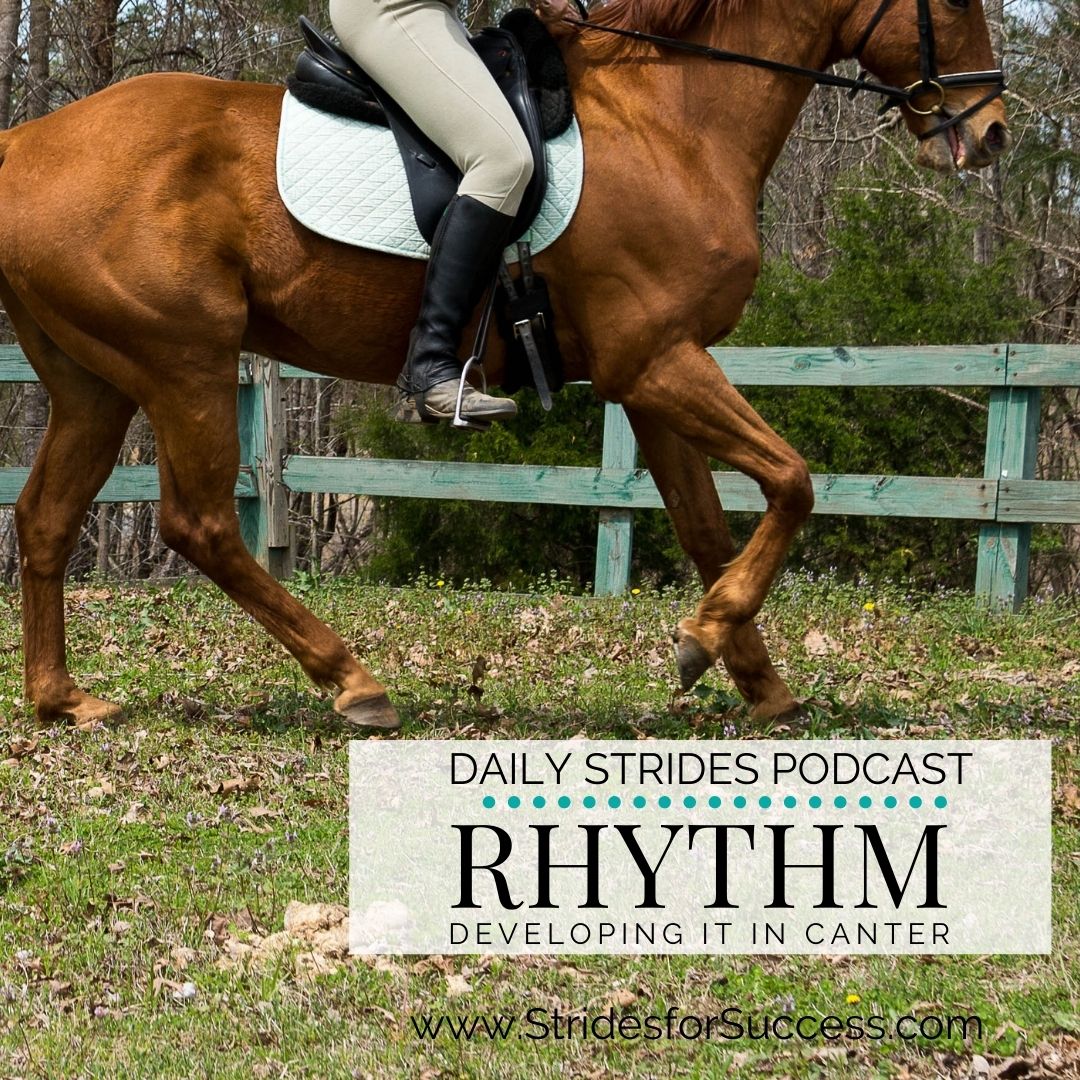
  • Rhythm; Learning to Identify and Develop it in Canter

    Rhythm; Learning to Identify and Develop it in Canter

    [fusebox_track_player url=”https://op3.dev/e/traffic.libsyn.com/secure/dailystridespodcast/1182.Developing_Rhythm_in_the_Canter.mp3″ title=”Rhythm; Establishing and Developing it in the Canter” social_linkedin=”true” social_pinterest=”true” social_email=”true” ]

    It can often sound like a jackhammer… Rrrrrrrrrrrrrr.  Instead of the 1,2,3…1,2,3…1,2,3… that the canter should produce when you listen for the rhythm.  And once either a horse or a rider has become ‘used’ to a different way, it can be a real challenge to get things back on track.  Or on beat, as the case is when the rhythm is lost in the canter.

    Some things are taken for granted when we ride horses.  Rhythm is very often one of those things.  And many riders think that, if there is a regular enough repeating sound, rhythm is good.  But sometimes, the rhythm itself is not right.  And when this happens, no further development can happen within the gait until this is corrected.

    The Rhythm in Canter

    I am sure that you are well aware of the fact that your canter should have a 3 beat rhythm.  I am going to also assume here that you understand what causes this gait to have 3 beats (as opposed to 4 or 2 like walk or trot).

    However, what many riders fail to realize is that rhythm in the canter can be lost without your horse becoming disunited behind!  I mention the disunited behind because this is one of the most talked-about and common ways for the canter to develop a 4-time beat.  However, let’s assume here that your horse is indeed united in the canter.

    All feet are moving where they should be.  And yet, you’re just not hearing that distinctive 3-time beat…  Now what? 

    Click here to subscribe

    Canter Lacking Forwardness

    One of the most common challenges when it comes to maintaining a rhythm in the canter is to do it while keeping things, well, slow, and steady!  Horse riding and equestrian sport, like all things, have trends and fashions.  The popular or ‘cool’ thing to be able to do with your horse at that point in the game.

    A slow canter is one of these… Whether it is because of a nervous rider, or just to get that s l o w canter, I don’t know.  However, the challenge comes when riders slow things to the point where each foot is moving individually and separately from the others.

    The diagonal pair of hooves that the inside hind foot and outside front foot make up, are no longer in sync with each other.  One, usually the inside hind, is touching down before the other.  

    This creates a 4 time beat in the canter.  Many riders won’t want to hear this. However, I believe that this is caused by a rider not asking for enough energy.  And then, at the same time,  ‘holding on’ too much to the energy that is being created.

    Recreating the 3 Time Beat

    The remedy for this type of loss of rhythm is often to simply put ‘more’ into the container.  Asking for and allowing more forwardness in the canter itself.  Many riders feel that if they do this, they will lose everything they have worked for.  Maybe this is the horse traveling in a certain ‘frame’.  Or it could be losing ‘on the bit’.

    It’s good to realise and remember that if your horse is creating 4 beats in the canter due to a lack of forwardness, he won’t progress from there!  

    The reason collection is at the top of the training scale is that it requires everything else to be balanced and developed in order for it to happen.  Rhythm is at the bottom of the training scale.  By removing the rhythm, there cannot be collection.  It is a false outcome and one that will cap both horse and rider going forward.

    The Jackhammer Canter

    On the other side of the coin, is the canter where all legs appear to be moving at the same time!  It is quite the sight to behold and, often, it is also a little more difficult to work on.

    The ‘jackhammer’ canter usually happens when the horse learns to move his legs REALLY quickly.  And yet, is not actually covering a whole lot of ground!

    Rrrr…Rrrr…Rrrr…Rrrr…Rrrr.  On and on it goes.  No real indication of what hoof is ‘starting’ to each stride.  And, no real ‘ending’ hoof falls to each stride. In this canter the horse often becomes disunited.  However, this can be just as hard to identify when riding.  None of it feels particularly balanced. Rrrr…Rrrr…Rrrr…Rrrr…Rrrr!

    Begin By Identifying Hoof Sequence

    The important thing to remember is the connection between your seat and your horse’s hind feet.  By directly using your seat to ask your horse to ‘wait’, you can influence the canter itself. 

    This can be a tricky one to correct.  The natural tendency for riders is to pull the reins and resist more with their seat to ‘slow’ the horse down.  However, it is not so much that the horse is traveling fast, as it ‘sounds’ like the horse is traveling fast!

    Start by identifying when the outside hind leg is on the ground.  The ‘1’ of the canter stride.  When it is there, use your outside seat bone to ask your horse to keep it there a fraction longer.  ‘WAIT’ by weighting. More on that HERE

    As this happens (and this is where rider suppleness becomes essential), continue to allow your inside seat bone to move with the canter. This allows the diagonal pair of legs to move for the 2 beats of the canter.  Finally, make sure you create space for your horse’s inside shoulder to move and create the 3 beats. You can do this by softening or opening your inside hand and rein a fraction.

    Developing the Rhythm in Canter

    Once you can begin to hear a more distinctive 1,2,3..1,2,3..1.2.3.. you can begin to play with making each beat more singular.  Like you want to identify each individual beat within the canter rhythm itself.  This is where the real work begins.

    When a horse has become a master of the 4 time canter or the ‘jackhammer’ canter, he will find it quite tiring to stay in a more ‘true’ canter for any length of time.

    He must develop more in order to hold this.  Start with asking for 3 to 5 strides. Pay attention to the quality of the strides.  Also, pay attention that you are not ‘holding’ him there.  You will know when you are if there’s a lot of shoulder movement happening in your body!  Or if you are twisting yourself in order to ‘hold’.

    Your job is to set everything up for him to the canter.  When (not if) he begins to revert to his ‘old’ ways, correct and then set things up again.

    Holding him or doing it for him will not help him in the long run…

    Happy Riding
    Lorna

    Additional Resources:-

  • Returning to Riding – Focusing on the Basics

    Returning to Riding – Focusing on the Basics

    Returning to Riding - Focusing on the Basics
    You’ve decided to refocus your attention on your riding.  You’re back in the saddle and rearing to go (well, maybe not quite rearing!).  But knowing what to do and where to focus your attention can seem a little daunting.  In fact, maybe it’s feeling like there is just too much to do and too little time to do it in…
    [smart_track_player url=”http://traffic.libsyn.com/dailystridespodcast/1131-Returning-to-Riding-Focusing-on-the-Basics.mp3″ title=”Returning to Riding – Focusing on the Basics in Your Riding” social_linkedin=”true” social_pinterest=”true” social_email=”true” tweet_text=”Back in the saddle and feeling a little overwhelmed?” hashtag=”equestrian” twitter_username=”strides_success” ]
    If we were working together, either online or in-person, there are a few essentials that I would begin asking you to give your full attention to.  Now, obviously this would vary depending on your unique situation.  However, there is a foundation that you build in your riding which is centered on a few specific principles.  Today I want to share those with you…

    Focusing on the Basics is for Novice Riders…

    My ‘definition’ of a novice rider is if you spend the majority of the time in the saddle focusing on yourself and trying to maintain what you are doing.  
    Now, obviously we all focus on ourselves in the saddle.  However, it is the intention behind the focus that shifts and changes.  When I say that novice riders focus on themselves, it is to try and get a few things on autopilot initially.  If this is you, you are possibly trying to get your position right.  Or trying to coordinate your aids. Maybe even the timing of those aids or the sequence of them…
    I feel that riders ‘graduate’ from a novice when the majority of the time in the saddle becomes about how the horse is going and what they can do to better influence that.
    If you feel that you are more in the second category of riders, I am going to suggest this episode on ……….. which will better suit you right now in your riding.

    1 .  Choose One Source of Advice and Opinion

    This may seem like a no brainer, however, this one piece of advice has the potential to either help you jump start your riding or stall…  When I first became pregnant, a good friend gave me a ‘golden nugget’ with this same piece of advice.  She basically told me to choose one person who I trusted or admired with regards to parenting – and, this is the important part, only seek their advice. At the time, I glossed over it, however, 3.5 years later, I now realize that this advice was GOLDEN!
    Different riders and instructors have different approaches.  Most are good and will give similar results at the end of the day.  However, it is when we begin mixing techniques and strategies, things becoming confusing very quickly.  This is for both the horse and the rider.
    Choose a rider, instructor or coach that you trust and admire.  Then remember to seek their opinion or advice whenever you feel unsure or ‘stuck’ in your riding.
    As you become more experienced, you can then begin ‘blending’ advice from different sources. In fact, I highly recommend that you do.  The reason I suggest waiting is that you are surer of your own perspective and how this different advice applies to you.  However, if you are a novice right now – pick one person or source.  Just one.  Trust me, this one golden nugget made ‘parenting’ a whole lot easier for me!

    2 .  Get to Know Your Aids

    I realize that you probably know what your aids are.  As in, if I asked you to list them, you probably could.  When I say ‘know’ your aids, I am asking you to take things one step further.  I want you to begin really understanding your aids and why they work the way that they do.
    I see so many novice riders become stalled by focusing just on one aid.  A  place where I see this happen over and over is the transition between trot and canter. Novice riders put too much effort into either the outside leg or the inside seat bone.  Yes, they are important.  But they work ‘with’ the other aids.
    How your aids interact together is really how your aids work .  No aid will ever be a ‘stand alone’ event; there are always supporting roles when it comes to your other aids and the overall communication and message
    Your aids work together.  Coordination plays a big part in how they interact and play together. I am going to suggest spending time ‘figuring out’ how your body works.  The simple things are often the very things that get overlooked. Start with ‘when I move my leg like this, my seat does that’ mindfulness and then begin adding your horse’s response into the mix.
    My advice is to devote 3 months to really learning about your aids and how they ‘work’.  Three months is a small investment when you realize that this will change everything for you and your riding going forward

    3 .  Your Position

    I know, again, so basic we often forget.  But your position is vital if you are to be understood correctly by your horse.  You can talk and talk until the cows come home.  Your aids are how you speak to your horse.  However, if you are in the wrong position, you will either not be heard, or be misunderstood.
    There are a few basics you can adhere to.  The simple ‘lines’ is always a great way to quickly assess how you are doing.  So too is the ‘Click Your Fingers Rule’.  Simple but powerful.  However, it is when things begin moving, that I find most riders really begin struggling with their position.
    Work on assessing your position as you prepare yourself and your horse for an upcoming change.  Associating a quick ‘check’ of your position to your half-halt is one way of ensuring this is working for you. 
    Notice where you struggle to maintain your position.  And realize that bad posture is a position issue.  Work on ways outside of the saddle that you can use to strengthen what is going on when you are riding.
    Your communication will always be ‘jumbled’ as long as you are struggling to carry yourself in the saddle. 

    4 .  Begin Assessing Your Horses Way Of Going

    The reason so many riders never really graduate on from being a novice rider, is often because they are unsure as to what they are moving on to.  Where is the conversation going to?  This is especially true if they have no ambition to compete, sell or jump their horse.
    Developing the horses way of going is a really worthwhile project for all riders.  
    I feel that, regardless of how ‘novice’ you are, if you approach things with a sense of how it is impacting the horse, you will find the transition from passenger to rider a far smoother one. Start small with something noticeable and easy to recognize such as rhythm.
    Questions like ‘if I apply this aid, does it have an impact on my horse’s rhythm in trot?’ are really valuable questions to begin asking yourself when in the saddle. 
    You are never too ‘green’ to take how your horse is going into consideration.  I also find that this encourages compassion in riders as well.  ‘Oh, my horse doesn’t seem to enjoy that’.  Or, ‘gosh, when I lean like this my horse responds by doing this’…
    Once you begin thinking this way, it will inspire you to up your game where your riding is concerned.  It will motivate you to do ‘uncomfortable things’ to really show up as a better version of yourself in the saddle.

    The Coming 3 Months in Your Riding

    I am going to challenge you, today, to choose something and create a project around it for the coming 3 months.  Whatever today’s date is, as you read this, simply go on three months – and there is your ‘finish date’.  Allow all of your rides between here and there to move you in some way towards a specific outcome or goal.
    This is also possible if you are only riding once a week.  Do some literal ‘home-work’ before each ride so that you have a better idea when you are in the saddle of what is happening.  
    You can also work on your physical and mental conditioning over the 3 months as well.  What limitations are you setting for yourself, whether intentionally or not?  Are there patterns that may be served you in the past, but are now holding you back from moving forward?
    If you would like more help with this, I am going to suggest considering joining me inside of the Returning to Riding program.  You can find out more about it HERE
    Happy Riding
    Lorna