Tag: trail

  • Have Fun Hacking; Halt & Go…

    Have Fun Hacking; Halt & Go…

    [fusebox_track_player url=”https://op3.dev/e/traffic.libsyn.com/dailystridespodcast/1337_Have_Fun_Hacking_Halt_and_Go.mp3″ title=”Have Fun Hacking; Halt & Go” social_linkedin=”true” social_pinterest=”true” social_email=”true” ]

    It’s always great to get out of the arena, so let’s do it today – together! And not just to relax and chill, I want to help you use the energy of being out of the arena to improve the quality of your halt. The halt is a movement that many riders fail to use in their training. And yet it is so versatile and, when ridden well, has so many benefits to the overall training for horse and rider.

    And of course, being able to stand still while outside of the arena is also really important for both safety and practical reasons… Is there anything as bad as being stuck trying to open or hold a gate?  Or waiting for traffic to pass and your horse is refusing to stand still?!

    This audio horse riding lesson comes straight from Daily Strides Premium. Meaning you should listen while mounted up and 

    It’s the first of a week of lessons titled “Fun Exercises to Ride While on a Hack”. So if you’re looking for something different to try with your horse, check out the rest of the lessons at Daily Strides Premium.

    So mount up and enjoy the lesson! And, as mentioned at the end, the following 4 audio horse riding lessons that accompany this one are available for you, right now, inside of Daily Strides Premium.

    Happy Riding
    Lorna

    More on This Topic

    Online Training to Help Your Riding

    Connect with Lorna online:-

  • Socialising Your Horse to Riding in a Group

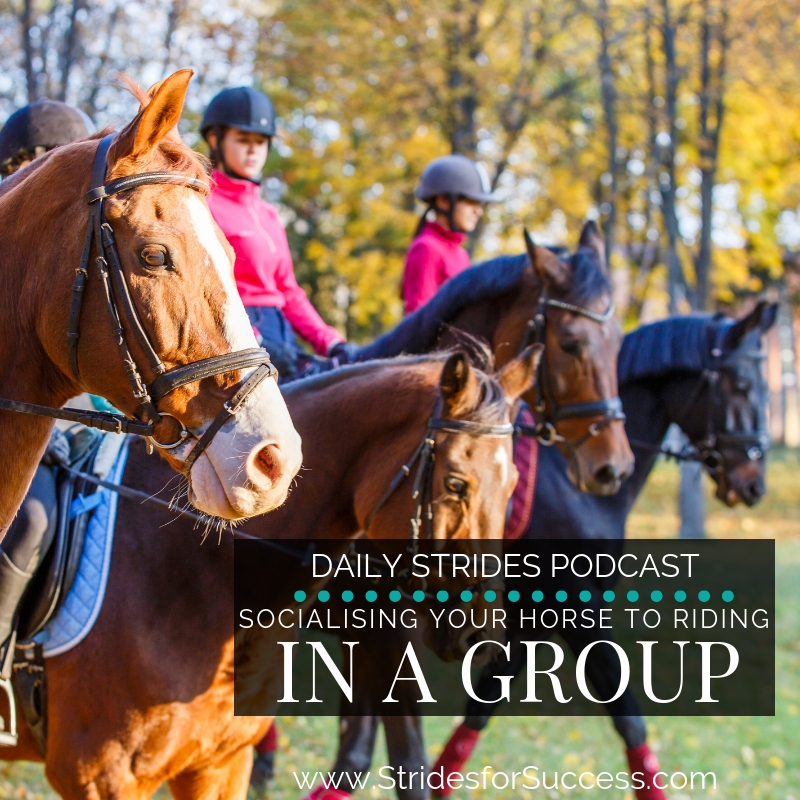
    Socialising Your Horse to Riding in a Group

    Socialising Your Horse to Riding in a Group

    What this episode is all about & how it can help you:-

    • Realise how important it is to choose your friends wisely
    • Figure out how to initially ‘practice’ with your horse
    • Not worry about ‘where’ you are in the group
    • Keep things slow and steady initially

    [smart_track_player url=”https://op3.dev/e/traffic.libsyn.com/dailystridespodcast/1078-Socialising-Your-Horse-To-Riding-In-a-Group.mp3″ title=”Socializing Your Horse to Riding in a Group” social_linkedin=”true” social_pinterest=”true” social_email=”true” tweet_text=”Do you want to ride with your friends, but worry how your horse will react? This episode of the Daily Strides Podcast will help you create a plan…” hashtag=”hacking” “equestrian” twitter_username=”strides_success” ]

    Most things in life are better when shared with friends.  Riding on the trail or hacking out is no different.  However, for many riders, the uncertainty of how their horse will respond ‘out in the world’ with other horses can be enough to stop them from experiencing this.

    In this episode of the Daily Strides Podcast I want to chat about how you can begin to prepare yourself and your horse for hacking out in company.  A few simple ‘dos’ and ‘don’ts’ will make all the difference when it comes to enjoying your time out of the arena.

    Getting out of the arena with a group of friends is often one of the top things on their ‘must do’ lists concerning their riding.  We dream about going for leisurely, fun and enjoyable rides with our friends – humans and horses 

    However, for many riders the reality is filled with more anxiety than anticipation.  How will my horse react?  How will my horse react to the other horses reactions?

    The good news is that, with a couple of simple steps, you can help ensure a positive experience for all involved, so that your ‘social ride’ is all that you dreamed it would be.

    Choose Your Friends Wisely

    Who you choose to ride out with on those first few rides has the potential to leave a lasting impact on you and your horse for years to come.  Choose wisely!  This pertains to the horses and the riders.

    Look for horse and rider combinations who are confidence, self-assured, relaxed and remain calm under pressure.

    Pay attention to how the rider and the horse respond to situations.  Respond rather than react.  Being on a ride with a group of other equestrians who are just reacting to everything that shows up is no fun and often a recipe for disaster!

    Practice in an Enclosed Space Initially

    When we think of enclosed spaces, we think of arenas.  However when practicing for riding in a group you can also practice in fields and paddocks.  I am going to suggest that you begin in an arena if you can at the very beginning. 

    Get into the arena with your horse and a few others who, again, you have chosen wisely.  What your horse needs to learn is that while the other horses are there, he must listen to you – the rider – for instructions.

    Often horses, particularly younger horses or OTTBs, will look to the other horses to feel safe and confident.  The ‘herd’ instinct.  Rather begin training your horse to look to you and to respond to you. 

    When riding in a group, anything can happen.  Being on a horse who will spook or bolt because the horse in front of him did, is no fun.  Your horse needs to begin to build confidence in you.  Yes, they are aware that the other horses are there and that they are riding in a group.  But they are responding to you, the rider and team leader. 

    Developing his Response to You – Not to the Herd

    I suggest working with the other horses in the arena, but doing so in a way that your horse is never dependent on them.  Practice riding two or three a breast.  You can also ride in a line, single formation.  What is important here is that you are all the time changing and he begins to become comfortable with the changes.

    From here, practice having the other horses walk, trot and even canter past you while in the arena.  Again, your horse must learn to respond – and wait – for you.  Don’t allow him to merely follow the herd. 

    Once you are both happy and confident in the arena, try the same exercises with some grass under his hooves!  An enclosed field or paddock works well.  Very often horses react differently when they feel grass under their hooves, rather than sand from the arena!

    Keep It Simple – and Make Sure It Is A Non-Event

    In my experience, this is a rider issue; not a horse issue.  When preparing to go out riding in a group, riders can ‘dilly dally’ before they ever get going.  Try not to procrastinate about actually setting off on the ride.

    ‘Hanging around’ leads to jumpy, over excited horses.  Talk and plan as you walk – but get walking as soon as you can!  

    Lay out all of your plans before you begin.  Know exactly where you are going, who is going, when you are going etc.  Don’t allow ‘fuffing and faffing’ to start a chain of events that, if left unchecked, will lead to unhappy horses and riders.

    Where Is He Comfortable While Riding in a Group?

    Horses, just like us, have different comfort zones.  Some like to lead.  Others prefer to follow.  A good example of this which often occurs is when a new horse is with the group and he wants to lead.  The rider, for whatever reason, is not confident with him being out in front and a battle of wills begins.  

    Forcing a horse to ride in a position where he is uncomfortable will lead to a frustrated and tense horse.  This also leads to a nervous and unhappy rider!  Allow the horse to go where he feels comfortable within the group for the first few rides (if it is safe to do so, obviously!)

    Wherever your horse is happy, let him stay there for the first few rides.  After those initial rides, you can then focus on re-schooling your horse to ride where you want him to ride.

    The whole aim of those first few rides with the group should be to settle and socialize your horse to riding in a group. These are ‘his’ rides.  Allow him to be where he is comfortable. 

    If you’re not sure where your horse is most comfortable, I’m going to suggest riding in the middle of the group.  Behind a horse who doesn’t mind others riding up his ‘backside’ a little.  Also, in front of a horse who won’t run up your horses backside.

    Slow & Steady Wins the Day

    Once you get going on the ride, there is often a temptation to ‘test things out’ a little.  Especially if things are going well.  I’m going to strongly suggest that you rein this in for those first few rides!  

    Try to keep those first few rides as ‘non-events’.  They won’t be the sort of rides that will be spoken about in years to come.  However, they will be the foundation for those more thrilling rides later.

    This, again, comes back as well to choosing your friends wisely.  The last thing you want is the horse in front or behind you being egged on into a gallop by a rider who is just overly excited to see an open patch of ground!

    The riders who are with you should realise that you need to keep things slow and steady for those first few rides.  When both you and your horse are feeling more confident later, then you can all have that thrilling canter across the country.  However I advise to makes sure that comes later…

    Happy Riding

    Lorna

    Other Posts and Episodes that Relate to This Topic:-

  • Exercises to Improve Your Horses Coordination

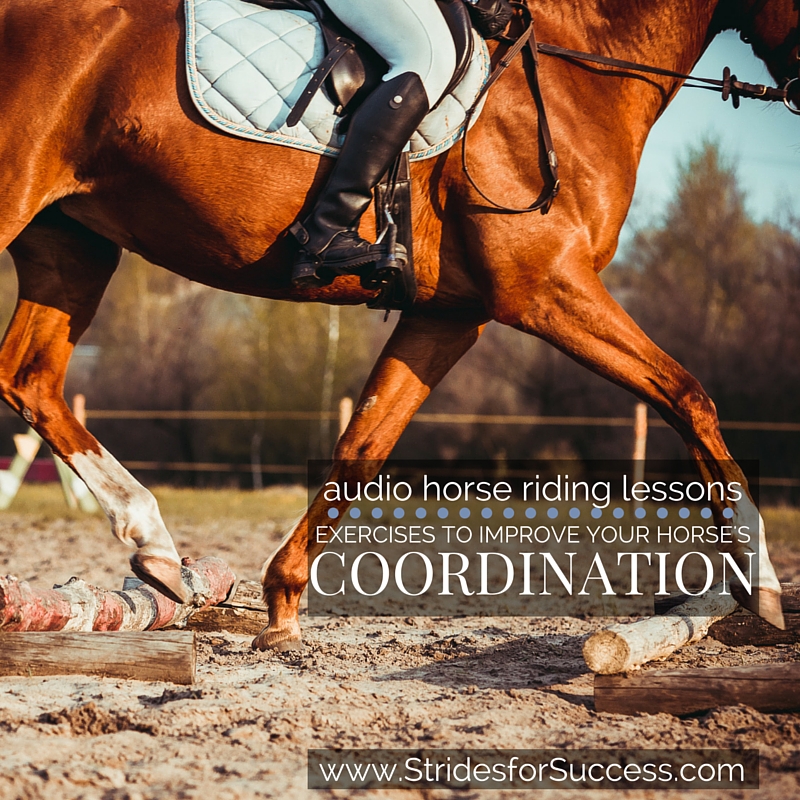
    Exercises to Improve Your Horses Coordination

    Have you ever experienced moments when ‘lack of coordination’ seems to be the best description for you while in riding  your horse?  It often leads to feelings of clumsiness and a general lack of confidence in your abilities, right?  Well, imagine how it feels when your horse suffers a similar lack of coordination; lack of balance leading to an uncomfortable ride for both of you.

    This lack of coordination in horses is often associated with fitness and general conditioning, and this is partly true.  Your horse’s general fitness levels, or lack thereof, can play a large part in his overall ability to remain in a balanced way of going.  However, there are other factors that also play a large part in how well your horse can use his body, particularly when in a different or unfamiliar situation.

    [fusebox_track_player url=”https://op3.dev/e/traffic.libsyn.com/dailystridespodcast/646-Exercises-to-Improve-Your-Horses-Coordination.mp3″ title=”Exercises to Improve Your Horses Coordination” social_linkedin=”true” social_pinterest=”true” social_email=”true” ]

    Take your own coordination as an example; if you were to do a task that you do regularly, such as making a cup of tea or coffee in your own kitchen, you would find that your actions happen as though your body is on autopilot.  However, if I asked you over to my house to make some tea; you would find it much more difficult to do pretty simple tasks.

    The same principles apply to your horse, if it is something he does a day in and day out, his body has already figured out the best and most effective way for it to do that particular movement or task.  It is smooth and probably looks graceful and simple because it is done in balance in a way he feels comfortable.   However, just like your own tea making capabilities, when you begin to add different factors to your horse’s schooling, or change scenarios, things can become rather wobbly quite quickly!

    You have to agree that most young horses look wonderfully coordinated while in the field however, as soon as a rider is placed on their back it suddenly seems becomes a rather large effort to continue with one foot in front of the other without falling over!  This is the horse having to learn or adapt to a different situation – this particular one being having a rider on board

    We also see older horses struggling with coordination.  Particularly when they are ridden all the time in a beautifully manicured and maintained arena.  They are used to having perfect footing underneath.  But if you take them out of the arena, maybe on the trail or into an appropriate paddock or field; well things are very different.  The rhythm and balance are suddenly lost and it almost feels like the horse has forgotten all his past training.  Sure, you will have moments where it feels good, but for the most part, it is a disjointed effort that pales in comparison to when he is working in his comfort zone.

    When we are in the saddle, it is always a great advantage when your horse can adapt immediately to different situations you may find yourself in, quickly and without a break in balance or rhythm

    So the first step in improving your horse’s coordination is highlighting the quality of your transitions. This is something you can begin working on immediately when riding your horse the next time.  Focus on the balance and consistent rhythm of each individual transition.  Pay attention that your horse is not speeding up the tempo of the gait he is in before the transition.  Also, work on establishing the new gait as quickly as possible after the transition.   By becoming more concise and specific about how you prepare, and then ride each individual transition, you can begin conditioning your horse to balance himself better and adapt to different situations with greater ease.

    Don’t make the mistake of only working in the more exciting transitions, such as trot to canter and canter to trot.  Transitions that include halt, walk, and trot are equally as beneficial and often easier for the rider to be more consistent through.  Again, focus on the quality of the gait leading up to the transition, maintain that gait right the way until the transition occurs.  The transition itself should be coordinated, straight and smooth, and then followed by a good quality gait afterward as well.

    Imrpoving Your Horses Coordination

    The second thing you can do is working some lateral movement into his schooling routines.  Think of the transitions as really working him while moving in a straight line, tail to head.  The lateral movement then works him sideways, so working his body differently and forcing him to balance differently.  Very often horses that can adapt and who have good coordination are able to remain in balance while moving sideways.  Practicing this in the arena will begin to develop your horse’s ability to do this as well, with you on his back.

    One of the other ways to improve your horse’s coordination is to work him over ground poles.  He must become very aware of how he is moving his body and where he is placing his hooves.  Groundpoles also helps coordination by improving the physical strength of your horse’s back.  They ask more of his joints, his back, and his whole topline in general.  All this while remaining balanced and moving forward in a rhythmic manner is excellent for him.

    You can use single groundpoles placed randomly around the arena, with your horse having to ride different shapes to reach.  You can also use basic trotting poles, either flat on the ground or raised, and later you can build simple grids.

    Regardless of how you use the poles, they will definitely help your horse to become more aware of his feet and legs while being worked in the arena and build muscle and strength while doing so

    The final suggestion I have for you to begin improving your horse’s coordination is hill work.  I am not talking about steep, grueling inclines that exhaust your horse; rather mild inclines that ask him to use himself slightly differently, but in doing so, strengthen and condition his body.   You can work up and down the hills, and later once you are both happily walking and trotting up and down, you can begin asking different questions by introducing transitions into his hill work.

    Maintaining the rhythm of the gait while working and down hills is difficult for many horses.  It is also different because most hills will be either on the trail or in a paddock or field, making the footing or terrain a little less accommodating as well

    So improving your horse’s coordination won’t happen overnight, it will take time.  By working some of these exercises into your daily schooling, or warming up and cooling down, you will help your horse reach a greater level of coordination throughout his body, which will make riding more enjoyable for both of you in the long run.

    Happy Riding
    Lorna

    This blog post and podcast episode is an introduction to 5 audio programs on this specific topic, taking you step by step through exercises you can ride that will improve your horse’s coordination. The other programs are created with riding in mind and listening to them is literally like having a riding instructor with you while you school your horse. The lessons are easy to download onto your phone and then use when in the arena.

    To find out more about how you can get this week’s lessons, as well as over 600 others, you can visit www.stridesforsuccess.com/join/.


    [wp-tiles post_type=”post” orderby=”date” order=”DESC” grids=”News”]