Tag: Conversation

  • Tailoring Your Aids to Your Horse

    Tailoring Your Aids to Your Horse

    [fusebox_track_player url=”https://op3.dev/e/traffic.libsyn.com/dailystridespodcast/1331_Tailoring_Your_Aids_to_Your_Horse1.mp3″ title=”Tailoring Your Aids to Your Horse” social_linkedin=”true” social_pinterest=”true” social_email=”true” ]

    Just like us, all horses are different. They all interact with the world in their unique way. Their reactions and their responses. What would happen if you tailored your interactions with your horse specifically so that your horse can best understand and follow along? If each ‘horse conversation’ was a special one? If you could tailor your aids to your horse?

    When you begin to become mindful about tailoring your communication to your horse; your training, partnership, and skills will improve much more quickly

    So it makes sense to begin studying your horse – and figuring out what he really listens to in your riding. Especially if you’re noticing that your horse is not focused when working together. Or you’re just not getting the results you want in your riding.

    Become Self Aware

    The only thing you can control or really change is yourself. And then by controlling or changing yourself, you can have a different influence over your horse. So start with you.  What are you ‘doing’ that your horse is responding to, and what are you ‘doing’ that he is not?

    When you pay close attention to what you’re doing – and what your horse is telling you based on that – you can begin to tailor your communication to what your horse responds to. 

    The Balance of Aids

    So you know that you have a whole host of aids at your disposal when it comes to working with your horse.  You have your natural aids (they are part of you and go with you everywhere you go!). And you have your artificial aids (you can leave these down or behind in the yard).

    From here you also have ‘obvious aids’ that anyone can see you use or interact with your horse.  And you have subtle aids, which are either ‘invisible’ or can only be noticed by someone who knows what to look for…

    Imagine a pie chart, and each individual aid having a portion of that chart. These portions will differ in size depending on your horse, what you’re asking, the circumstances, etc. One of your responsibilities as a rider is to figure out what is the best proportions of the aids for that exact moment with your horse. This is the ‘balance of aids’. 

    Notice What Works

    Once you can start to see what your horse responds to, you can start using your aids in different ways that put more emphasis on what your horse currently responds to. In order to truly ‘train’ or ‘develop’ your horse, you need to begin in a place where you can both ‘speak’ to each other. You must really adapt your aids for your horse.

    Try actually speaking out loud what is working for your horse. Actually talk to your horse… It helps to bring your awareness to your own actions and helps you hone in on your horses responses. 

    By noticing what works, you can then set a foundation. And from that foundation, you can refine things even more.  You may find that your horse doesn’t really respond to your voice aids for example. But is very responsive to your position (whether on the ground or in the saddle).  As you discover more about your horse, you can ‘balance’ or adjust your aids and approach accordingly.

    Tailoring Your Aids to Your Horse

    So if all horses are different, you’ll often find individual horses who just don’t enjoy being ‘spoken to’ in a certain way.  And rather than forcing a conversation that the horse has no interest in being part of… Learn what that horse does respond to and become ‘good’ at conversing that way.

    Your horse is an individual, just like you. And I can bet that when someone takes the time to focus and speak to you in a way you respond to, the conversation flows. Your horse is the same…

    Start today by noticing what you’re doing, and if it gets a response or not.  From there, simply notice and tweak as you learn more about you and your horse.

    Happy Riding
    Lorna

    More Help for Riders:-

    Equestrian Fitness Challenge ’24

    Work on improving your overall strength, fitness, and stamina as a rider. The all-new and free 2024 Equestrian Fitness Challenge is a great place for you to do this.  It is walking and yoga-based (no workouts), so it will ease you into becoming a better version of yourself in the saddle gently. You can sign up HERE or by visiting https://equestrianfitnesschallenge.com/24 
    There will be a daily walk, a 10 minute daily yoga practice, and lots of tips, ideas, exercises, and ways to improve so that you can show up as the best version of you – for you and your horse.
    Sign up today and let’s transform your riding – one stride at a time! 100% FREE 2024 Equestrian Fitness Challenge

    Connect with Lorna online:-

  • Groundwork: Take a Walk with Your Horse…

    Groundwork: Take a Walk with Your Horse…

    Groundwork; Take Your Horse for a Walk
    Have you ever considered all the different ways you communicate with your horse, every day?  All of the aids you have at your disposal to ask your horse to do things the way you want him to do things.  Imagine if you could become a little more mindful about what you are doing and how you are doing it…
    [smart_track_player url=”http://traffic.libsyn.com/dailystridespodcast/1128_Take_a__Walk_with_Your_Horse.mp3″ title=”Groundwork; Take a Walk with Your Horse” social_linkedin=”true” social_pinterest=”true” social_email=”true” tweet_text=”When walking is not just walking with your horse…” hashtag=”equestrian” twitter_username=”strides_success” ]
    When you are with your horse, there are so many different aids you can use, such as:-
          • Thoughts
          • Body Language
          • Position
          • Voice
          • Seat
          • Legs
          • Hands
          • Artificial aids
    Each time you begin working on a new aid, it has to learn how to blend with all of the aids you have been previously using.  You have to learn how to blend it, and your horse has to learn how to understand it.

    Learning Takes Time

    So many riders expect to be able to begin using a new aid or applying an older aid in a different way and for it to just ‘work’.  They become discouraged when they meet the enviable resistance, both from the horse and their own other aids, towards this ‘new aid’.
    As you develop as a rider, you must be open to learning new things and new ways of doing things.  Different horses will require different approaches.  Understanding that there is a Balance of Aids and it is your job to try and keep it actually alive and well in your riding is key.
    I am going to suggest that, in order to really see how this balance plays out, begin playing with your new (or different application) of aids while on the ground with your horse.

    Groundwork

    So many riders see groundwork as being ‘with’ your horse.  Yes, you can use groundwork as a way to build your relationship with your horse, particularly natural horsemanship.  However, I would love for you to begin playing with groundwork in a way that will encourage more conversation in your riding as well.
    Using what you are doing on the ground, while beside your horse, to really enhance the conversation you then have in the saddle, while riding your horse. 
    Becoming mindful regarding what you are saying and how you are saying it when on the ground has the potential to literally change everything in your riding.  Remember, this is something you do every single time you get in and out of the saddle.  It is also something you do on the days your not even riding your horse.

    Start with Bringing Your Horse for a Walk

    Think about when you are leading your horse, there is a mutual agreement in place.  You are walking and expecting your horse to walk with you.  Hopefully, you’re not having to pull or drag your horse along and your horse is also not pulling or dragging you along!  It cuts both ways.
    Just having that simple unwritten agreement in place is a foundation you can build on in your riding.  If this is not the case, I strongly suggest you give THIS EPISODE a listen and start there.  
    But assuming that you and your horse are happy to walk with each other, why not begin playing and experimenting with your aids there?  Soft, gentle and subtle changes in your aids can make a huge difference in your overall conversation with your horse.
    Turning your shoulders slightly can either invite your horse to ‘walk on’ a little more, especially if he is not feeling very confident.  And, similarly, a twist of your shoulders the opposite direction can have a ‘whoa’ effect on your horse’s walk and energy as well.

    Pay attention to Your Position and Language

    Your eyes and where you are looking can have a huge influence over your horse’s way of going.  The same with your core.  If you apply a little ‘half-halt’ to your core, in the walk on the ground beside your horse, begin looking at how your horse notices and responds.
    You can only begin refining your aids when you truly commit to becoming mindful about your aids themselves
    Look at how your horse responds and then play with how you can influence that response by approaching the conversation a little differently.  Try a different aid.  Or change the balance of the aids you are applying.  Play and experiment and then commit to being consistent enough that your horse can actually begin taking part in this new, more refined conversation.
    Your horse is literally waiting to have a conversation with you; let groundwork be the place where you can really begin taking that conversation to the next level. 

    Groundwork for Riding

    I would love to help you to take this to the next level with your horse.  I have a program ‘Groundwork for Riding’ which will give you exact exercises you can begin applying today with your horse.
    The exercises are for use before or after your usual riding, so that you can really begin complementing what you are working on in the saddle with what you are doing before you get into the saddle. 
    If you are looking for fun ways to engage your horse, without having to spend more hours in the saddle, this program will do just that for you.
    Happy ‘working with your horse from the ground’
    Lorna

    Other Episodes, Posts, and Resources on This Topic

  • Using Your Voice as an Effective Aid in Your Riding

    Using Your Voice as an Effective Aid in Your Riding

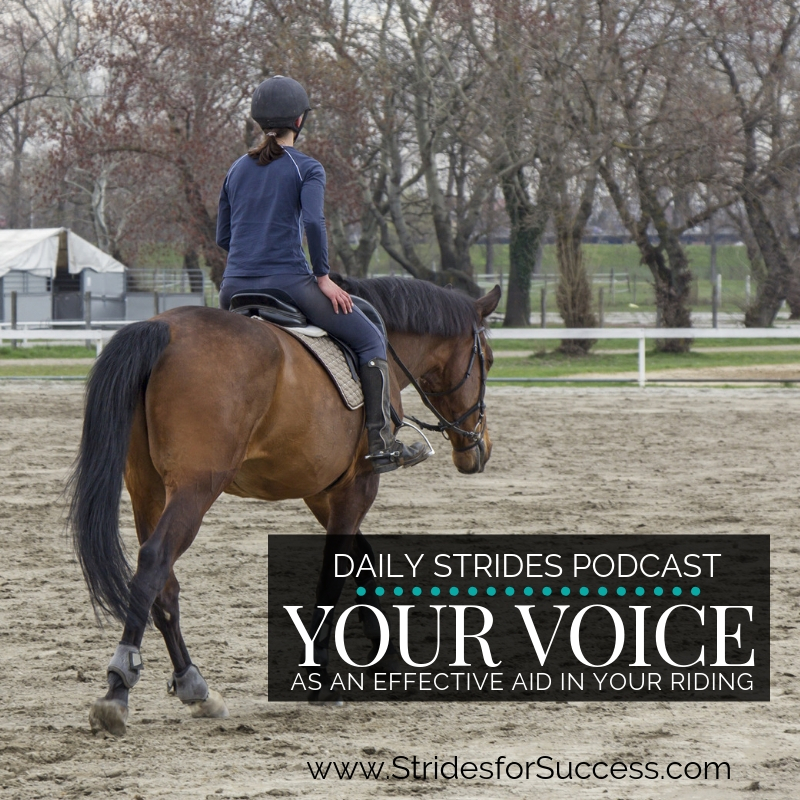
    Your Voice as an Effective Aid in Your Riding

    What this episode is all about & how it can help you:-

    • Understand why your voice works, regardless of discipline
    • Begin using tone to help convey your message
    • Use your voice to reward your horse
    • Understand how to ‘wean’ your horse off of your voice

    Imagine if you could use your voice as an effective, accurate aid when communicating to your horse from the saddle…  I’m going to assume that you, just like most other riders in the world, talk to your horse regularly.  Actual words.  And that is great…

    But there is a big difference between just babbling on and your voice becoming an actual effective aid in your riding communication.

    [smart_track_player url=”https://op3.dev/e/traffic.libsyn.com/dailystridespodcast/1096-Using-Your-Voice-as-an-Effective-Aid-in-Your-Riding.mp3″ title=”Using Your Voice as an Effective Aid in Your Riding” social_linkedin=”true” social_pinterest=”true” social_email=”true” tweet_text=”We all talk to our horses… But your voice can become a solid aid to help you communicate when riding as well…” hashtag=”equestrian #horseriding” twitter_username=”strides_success” ]

    In this episode of the Daily Strides Podcast I want to explain how I suggest you can begin using your voice to actively ‘talk’ to your horse in a way that he understands.  Your voice can become a great asset in moving your conversation forward. 

    Your Voice Works for Your Horse

    A lot of riders shy away from using their voice as an active aid.  This is often due to either misunderstanding how and when to use the voice aid.  But also, it is due to certain disciplines penalizing riders for using a voice aid; dressage for example.

    However, your voice is something you can use to communicate with your horse from Day 1 of your conversation together. It doesn’t involve much practicing and it can be both the pressure and the release in your communication

    I suggest that riders begin using their voice on the ground.  So you will use it when you are grooming, tacking up, actively working on groundwork and, of course, lunging and long lining.

    Your voice is particularly useful as an aid to bring your horses attention back to you at any given time.  Especially if you find that his attention is wandering to something other than you and what you are both trying to achieve!

    It can be the gentle reminder, “Excuse me, we were working on this together” that is often needed to help your horse focus on the job at hand. Your intention and your goals.

    Your Voice Works for You, the Rider

    When it comes to you, the rider, the voice works equally as well.  Again, if we take the situation that your horse is not concentrating or focusing on you, it can lead to you feeling vulnerable in the saddle.  It is easy to allow worry and excessive tension to creep into your body when your horse suddenly stops listening to you!

    When you use your voice to bring your horses attention back to you, you have to breath.  It sounds so simple, but your breathing helps to dissipate excess tension in your body.

    Your voice also helps you to remain focused on the goal or your intention.  By ‘reminding’ your horse, literally speaking to him and telling him what you are trying to achieve, you remind yourself.  

    “Hey there Buddy, we are actually trying to work on a balanced trot on this 20 meter circle.  I need you to focus on moving around the track on our circle.  Come on, keep moving forwards.  1… 2… 1… 2… 1… 2…  Good Boy, remain focused…”

    So, just from the outset, before we even get into using it as an active ‘riding aid’ your voice has its benefits.  It allows your body to work better, and it helps you both to focus on the job at hand.  I think that is an aid worth improving.  What do you think?

    It’s Not What You’re Saying, It’s How You Say It

    Many riders make the mistake of getting too caught up in ‘talking’ to their horse.  They expect their horse to understand their words, and therefore the meaning behind them.  Horses don’t really seem to care about language!  I have experienced this first hand on the farm in South Africa; it doesn’t matter if the words are English, Afrikaans or Xhosa!

    What matters is HOW the words are spoken.  The tone of the riders voice.  Soft and gentle?  Slow and steady?  Low and slow? Loud and quick?  Short and loud?  Or monotone?

    A good example of riders getting confused between what they are saying and how they are saying it is when a horse is going too fast. “Whoa…, whoa.., whoa, WHOA!, WOO!, WO!” Hmmmm…..

    The trouble with whoa is that it sounds a lot like go, doesn’t it?!  And the trouble with roaring whoa at the top of your lungs in short bursts is that it sounds very much like you want things to go faster.  You want an increase in energy.  

    Your Tone Must Match the Desired Energy Level

    Think of how what you are saying would be understood by someone who cannot speak the same language as you.  Is your tone urgent and quick; a sharp tone?  Or is it relaxed and slow; a comforting tone?  This is what is important when using your voice aids with your horse.

    When you can begin to control the tone of your voice effectively, you can then begin to use your voice aid to communicate with your horse from the saddle. 

    An easy way to begin is by experimenting with the pitch of your voice.  A higher pitch for reward, for example, is often effective.  ‘Good boy” or “Good girl” said in a high pitch voice.  A lower pitch to ask your horse to become or remain steadier.  “S.t.e.a.d.y….”  “W.h.o.a.   b.o.y…”

    You can also use the rhythm of your voice to help convey what you are looking for.  I find a simple ‘1…2…1…2…1…2’ said out loud in a sharp tone is often enough to help a horse to balance in the trot.  Your ‘clicking’ can be used in the same manner.

    Getting Started with Your Voice Aids is Simple

    So, hopefully by now, you understand a little more about how your voice can be used as an aid.  However, for many riders the trouble is to actually get started, effectively.  Meaning your voice becoming something your horse actually understands!

    And this is where I am going to suggest start with what feels good.  A reward. 

    From the very first time you meet your horse, you will have probably told him on numerous occasions how ‘good’ he is.  This is usually accompanied by a rub on the neck or shoulder.  Maybe a scratch but almost always some sort of physical contact.

    By becoming consistent with the tone of your voice as you are dishing out these frequent words of love, you can begin to make your voice work for you in the saddle.

    Your Voice, There From The Very Beginning

    When I am starting horses or ponies, the ‘reward’ is one of the first things that I make sure the horse is clear on.  I want him to know every single time he takes any step in the direction I am looking for him to step into.  

    This begins on the ground, usually in the stable.  A simple ‘over’ when I am grooming accompanied by a gentle pressure on his side.  A pressure that will later be felt by a rider’s leg asking a similar question.

    Then, when he yields to the pressure, accompanied by my consistent voice aids, he is rewarded.  The physical pressure is released and this coincides with a high-pitched ‘Good Boy’.  I often use the scratch or rub as well if I can to really get the point across.

    What counts is how consistent I show up with my voice and how I am using it.  Also, just like all my other aids, timing is vitally important.  The reward must be instant.  There must be a direct association between him taking action and the release of the pressure accompanied by my voice.

    Transitioning from Ground to Saddle

    From here, I will usually start lunging the horse.  Again, my voice is a vitally important tool in how I communicate to the horse.  Especially when the time comes for a rider to mount up.

    When starting young horses, your voice can work as ‘dual controls’ for both the person on the ground and the rider. 

    The same high-pitched, well-timed ‘Good Boy’ accompanied with the release of whatever pressure was applied will convey the message to the horse.  It will tell the horse ‘Yes, that is the correct way to respond to that particular aid”.

    Weaning Your Horse Off Your Voice in the Saddle

    The final point I want to touch on is specifically for dressage riders worried about being penalised for using their voice.  You can use your voice in your initial training.  In fact, I highly recommend it.  For all the reasons I have already spoken about.

    However, you need to find a way for your horse to get the same message, without you having to verbally communicate this to him.

    If you are consistent with the application and timing of your aids, this will naturally occur.  Remember, you are using your voice to convey to your horse that he has responded correctly to your aid.  Your aid is actual physical pressure.  Overtime, the release of the physical pressure itself will be enough to be the ‘reward’.

    The ‘Lightbulb’ Moment

    As your horse becomes more and more clear on specific physical aids meaning specific actions must be taken, your voice will become less necessary.  It is often not needed later in your training…

    Keep in mind that your horse, like everyone, enjoys being spoken to.  He likes to be acknowledged. 

    Using your voice, if you can, in your day-to-day riding will add an extra layer to your communication and overall conversation.  So I think, if you can, go do it :)

    Happy Riding

    Lorna

    Other posts, episodes and resources that relate to this topic:-

    Daily Strides Premium

    If you are interested in learning how I suggest using your voice more in your riding, join me today inside of Daily Strides Premium.  I have created a 6 week series in there which will take you through the whole process I use to ‘start’ young, unbacked horses.

    The voice aids are a vitally important piece of this starting process.

    Couple This with Built In Accountability…

    Also, when you join a Daily Strides Premium Member you will get built-in accountability.  A real person from our team will be reaching out to you on a fortnightly basis to help you build and then maintain momentum with your progress in the saddle.

    Couple this with the live Q&As, the monthly review and planning live calls and the members only private group ~ we are here to help you remain accountable as team leader for you and your horse.

    Daily Strides Premium is packed full of step by step trainings for you to use on the ground and in the saddle. All the trainings are easily accessed using your phone, meaning that you can take them with you where ever you are going.  These trainings and so much more are available for you immediately when you join Daily Strides Premium. Find out more HERE

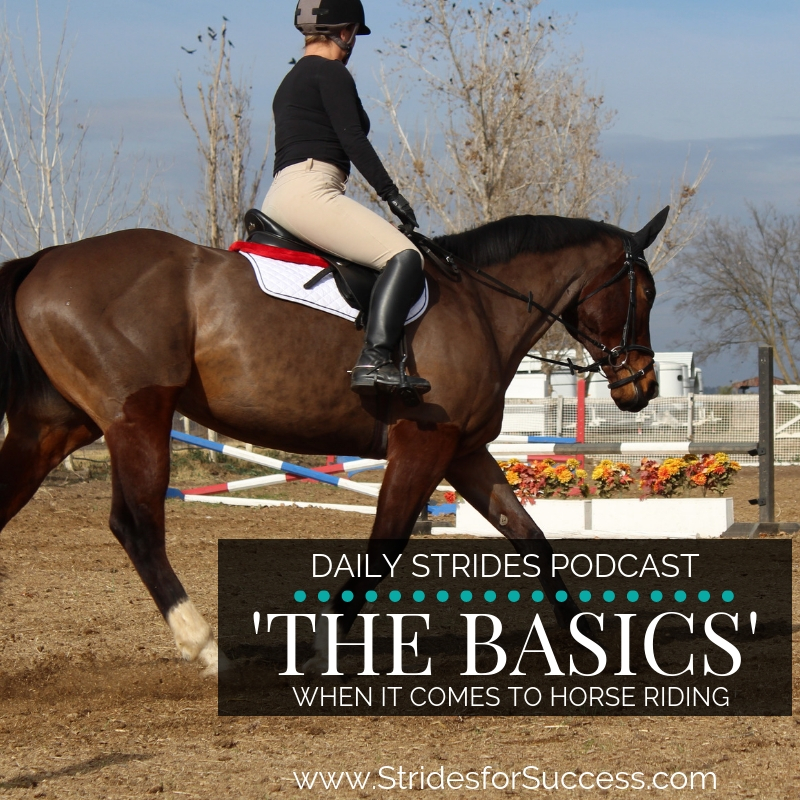
  • What are ‘The Basics’ When It Comes to Riding?

    What are ‘The Basics’ When It Comes to Riding?

    What are the Basics when it Comes to Riding

    What this episode is all about & how it can help you:-

    • Understanding the conversation is always happening
    • Your position
    • Your Aids
    • Understanding how your horse ‘goes’

    [smart_track_player url=”https://op3.dev/e/traffic.libsyn.com/dailystridespodcast/1067-What-Are-‘the-Basics’-When-it-Comes-to-Riding.mp3″ title=”What Are The Basics When it Comes to Riding” social_linkedin=”true” social_pinterest=”true” social_email=”true” tweet_text=”Feeling overwhelmed trying to figure out the basics in riding? This episode of the Daily Strides Podcast will help…” hashtag=”podcast #equestrian” twitter_username=”strides_success” ]

    The ‘basics in riding’… It sounds like a bit of a list for riders to master before they move on.  And I suppose in a way, they are.  Like most things, there are a few foundational pieces that, once you understand how they work, can be used to create a foundation for you & your horse going forward.

    CLICK HERE to register for the free online live training on

    In this episode of the Daily Strides Podcast we will chat about 4 of those ‘basics’ and also, where you will transition to after the basics have truly been mastered.

    Understand that the Conversation is Always Happening

    The first thing to remember is that the conversation is always happening. Always.  It is on-going and not only when you are in the saddle. As the ‘Team Leader’, you need to set the tone of the conversation.

    The conversation starts when you and your horse first begin interacting.  When you are aware of the others presence. 

    You build on the conversation all the time. Each day you build on the conversation you had the previous day.

    Many riders make the mistake of thinking that the only time they are communicating with their horse is when they mindfully ride an active aid.   However, for most novice riders, they are talking all the time to their horse.

    The constant shifts and movements in the saddle unintentionally adding to (and confusing) the overall conversation between horse & rider.

    Ask yourself, ‘How am I leading this conversation?’, and ‘How am I contributing to this conversation?’.  The answers to these questions are something you can continually try to improve.

    Your Position

    If you have ever had a formal horse riding lesson, this is something your trainer or instructor probably devoted quite a bit of time to.  And for good reason.  Your position is a vitally important part of the basics.

    A correct, supple and strong position puts you in the best possible place to have the most impact when you do activate your aids.  You are in the right place at the right time. 

    You are not having to readjust all the time and you are not giving muffled instructions to your horse. It means that things are clearer from you, and your horse has a better chance of understanding.

    Of course, another big advantage of having the correct position is that there is a better chance of you staying in the saddle!

    A correct position results in a balanced rider.  A balanced rider relies on their own body to balance themselves, rather than relying on the horse, the stirrups or the reins.

    One of the easiest ways to check your position is to make sure ‘the lines’ are present.  Head, shoulder, hip and heel is the first line. Elbow, hand, through the rein to your horses mouth is the second line.

    Get those two lines right all the time, and you will have a much better chance of sitting pretty in the saddle.  You will also be far more successful in your overall communication with your horse. 

    Your Aids

    An obvious but oh so important part of the overall conversation you are having with your horse.  The problem occurs when you are ‘going through the motions’ with your aids, but failing to truly understand your aids.

    One of the issues I see come up a lot is active versus passive.  There is a lot of confusion surrounding an engaged and active aid versus a disengaged aid.  A good example of this is the leg aids and ‘taking the leg off’.

    It is really important that you understand your aids and how those aids work when asking your horse a question.   A good example is the transition to canter.  You probably have been told to put your outside leg back – but do you really know why you are doing that?

    Begin trying to understand why you are doing what you are doing.  This way, you can begin to ‘weave’ aids together depending on the different situations you find yourself in.

    The Basics also Include the Balance of Aids

    Aids are not static.  They are consistently evolving and changing.  This is the balance of aids. How they change is in the proportion that you are using them with each other in different circumstances.  The pressure will also vary as well as the sequence.

    In order to truly begin improving the overall conversation between you & your horse, you need to understand why a particular aid is being used in a particular way. It is knowing how that aid influences the horse that allows you to become more effective & of greater influence in the saddle.

    As I mentioned, the aids are constantly evolving and part of that is then taking the next step.  Focusing on the timing of a particular aid.  Asking a question at the right time, allows your horse to respond in a timely manner.  It allows the smooth grace of the ride to continue.

    You can use your aids in different sequences.  They can be grouped together differently to mean different things. Once you have mastered the basics aids, you can then begin refining things further.  Making adjustments within the gait itself or even within the stride itself.

    Understanding How Your Horse ‘Goes’

    “Goes”…  It is a fairly basic word in and of itself, isn’t it?!  However so many riders I meet just fail to really and truly understand how their horse is moving underneath them.  I feel that it is important to understand how your horse goes, and not just in the basic walk, trot, canter and, if you’re brave, gallop.

    It means understanding how he moves his body. What it looks and feels like when he is moving correctly and how he is moving it when things are less than what we want them to be.

    It is begin able to see and feel the differences between the version we don’t want and the version that we do.

    For example would you notice if he began lifting his legs higher during each stride.  Would you feel the extra flexion, energy and suppleness through his joints and, consequently, throughout his whole body?

    Knowing how he is ‘going’ means that you understand how he is achieving a certain way of moving – so you can influence him in repeating it. 

    Building a Correct Foundation of Knowledge

    One of the bane of many trainers and horses lives is the ‘quick fix’!   So many riders try to find a quick fix to issues that they don’t really understand to begin with.  Going on the bit by sawing his mouth. Or putting him in a frame using a gadget to hold him there.

    It is so much better to begin figuring out what is causing the horse to do whatever he is doing that you are having an issue with.  The ‘undesirable’ action.

    It is also worth noting there that, a lot of the times if you don’t fully understand ‘why’ he is or is not doing something, you are probably a large contributing factor to that something!

    As a rider, you need to understand the mechanics of each situation.  If your horse needs to move a certain way, you will then begin to see how you can either assist him or hinder him with how you try to influence him.

    Identifying Your ‘Basics’ that Need Attention

    It can feel a little overwhelming initially trying to figure it all out.  Go easy on yourself and start at the beginning with your seat, your position & your aids.

    To summarise, remember that the conversation is always ongoing, both on the ground and in the saddle. It is constant and does not stop.

    A good position is very important because it leads to more effective aids. Understanding your aids and noticing how your horse is responding to them. If he is not responding you need to know how to tweak your aids.

    Finally you need to understand the mechanics of how your horse works.  Moving from being a passenger to being a team leader for your horse means that you begin influencing.  Knowing what is going on underneath you will allow you to begin positively influence the horse by what you are doing in the saddle.

    Happy Riding

    Lorna

    If you are feeling a little overwhelmed and find that you are stuck in your progress, I would love you to join me on a free online live training called ‘The 6 Basics to Focus On when Riding”.

    CLICK HERE to register for the free online live training on

    Links mentioned in the episode:-

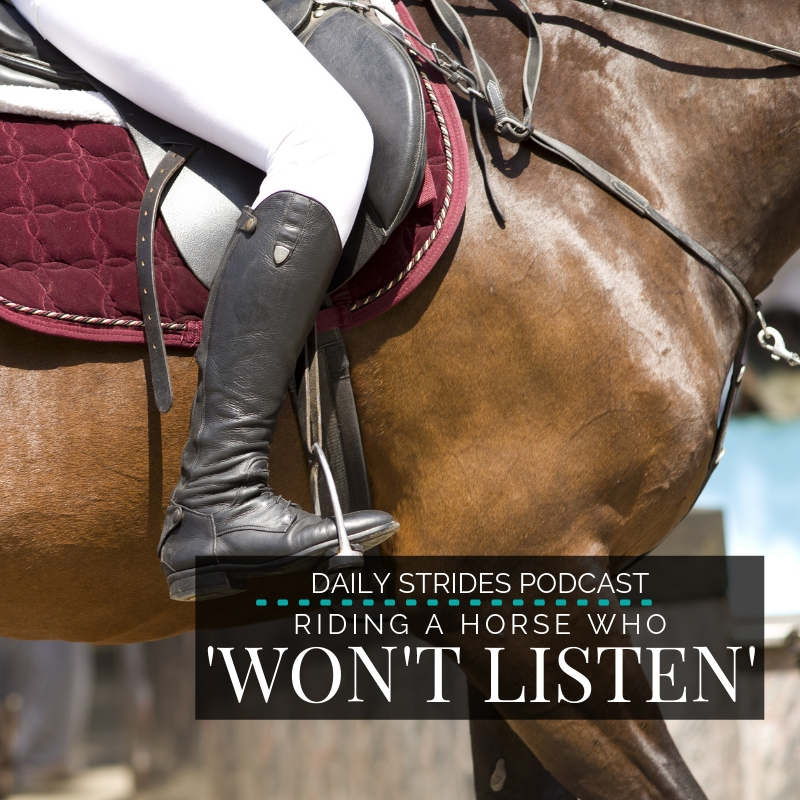
  • Riding a Horse Who ‘Won’t Listen’

    Riding a Horse Who ‘Won’t Listen’

    Riding a Horse who 'Won't Listen'

    This episode will explain how:-

    • Looks can be deceiving this type of a horse
    • And why I suggest bringing the whole conversation back to basics
    • To create a channel for the ‘forwardness’
    • You can identify any ‘weak spots’ in your channel

    [smart_track_player url=”https://op3.dev/e/traffic.libsyn.com/dailystridespodcast/1061-Dealing-with-the-Horse-Who-Won’t-Listen.mp3″ title=”Riding a Horse Who ‘Won’t Listen’” social_linkedin=”true” social_pinterest=”true” social_email=”true” tweet_text=”Are you having trouble getting your horse to listen to you? This episode of the Daily Strides Podcast can help…” hashtag=”Podcast #Equestrian” twitter_username=”strides_success” ]

    We all know one… The horse who makes you question everything about your riding abilities and knowledge.  The horse who, when you get on, just seems to invite you to ride as though you began yesterday!

    It can be such a frustrating place to be for any riders trying to improve themselves.  It can cause a confidence crises.  However, rather than just giving up and accepting it, I want to give you a few ideas on how to begin making this more positive.  Positive for you and positive for the horse as well.  

    This episode of the Daily Strides Podcast is about how you can begin reframing the conversation with this horse, so you can both walk away feeling good afterwards.

    Looks Can Be Deceiving with a Horse who ‘Won’t Listen’…

    If you are currently working with a horse like this, you might feel even worse because of how the horse ‘seems’ to be.  He is calm. People might even comment that he is ‘easy’.  This of course only adds to your frustration, and negative self talk, because you know first hand that he is anything but!

    Very often a horse who is ‘easy and safe’ can be a huge struggle to get going forward.  And if, by some miracle, you get them going forward it is exhausting to keep them going!

    You might notice how issues that you corrected years ago, or lessons ago, in your riding are now all of a sudden cropping up again.  Things which you thought were put on that all important ‘autopilot’ have, as if by magic, been brought back into play.

    This of course only compounds the whole problem.  Now, you have to deal with ‘fixing’ yourself, as well as dealing with the horse who ‘won’t listen’.

    Often, because your position or basics have reverted to an earlier version, you end up not even asking the correct question any more!  All of this gives your horse a great excuse to ignore you further…

    This is where I am going to suggest you stop what you are doing, and bring everything back to the absolute basics.

    Bringing the Conversation Back to the Basics

    In my experience, usually the big missing piece in this sort of situation is forwardness.  I think that if you can focus on just that one thing initially, it can have the power to change everything else.

    Work on consistent forwardness in the walk and trot.  Don’t worry about the canter right now.  If you can lay down a few ‘rules’ in the slower gaits, they will carry over to everything else. 

    Another reason I suggest leaving canter out of your schooling initially is due to it being a big contributing factor to this issue.  Have you noticed that the trot to canter transition is often the one that causes everything to come apart at the seams?!

    Forwardness is Both Physical and Mental

    You and your horse must ‘think’ forward as well as ‘go’ forward.  If the mental forwardness is missing, there will be no consistency in the ride later. 

    When a horse is thinking forward, he is open to listening to what you are saying.  He is actively part of the conversation that is happening between both of you.  A lack of forwardness can often be the physical manifestation of a lack of basic respect.  He literally ‘won’t listen’ to you.

    There are some links to past episodes and blog posts that deal with this problem at the bottom of this episode.  I strongly suggest having a read or listen if you are struggling with this in your riding.

    Creating a Channel for that Forwardness

    Now, you’re possibly wondering what is a channel?  Think of it like a river flowing.  The banks create the channel that keeps the water inside and, well, flowing in a particular direction.  You can also think of it like train tracks.  Anything that dictates where the ‘thing’ is travelling to.

    If your channel is weak, or has weak parts or areas, it will be very difficult to put more energy in there without it leaking or bursting out somewhere. The horse we are chatting about right now is a master at figuring out those weak spots. 

    When he can figure out where there are those weak spots or areas, he will try to take advantage of them.  Why?  Well, because he can then distract you and not have to worry about applying himself too much to doing what you are asking him to do!

    If he can make the energy ‘leak out’, there is less engagement, less carriage and less ‘working’ all round required from the horse.  There is also a lot of ‘managing’ required from the rider – which is why you feel so exhausted and frustrated! 

    Identifying Any ‘Weak Spots’ in Your Channel

    If this is all sounding familiar, great!  It means that now you can begin identifying those weak spots and actively ‘reinforcing’ them where necessary.

    A stronger channel, coupled with a horse who respects you and goes forward are the keys to turning things around when in this situation. 

    I want you to think about something you do with your horse, where it ends up being a battle of wills.  Perhaps it is the transition I mentioned earlier, from trot to canter.   Think of how you normally get everything up the right way.  In this case, half halts and asking for a little flexion.  However, when you ask for the transition itself, that is where things begin to break down.

    Where do you find yourself three or four strides out from this? Are you remaining centred?  How does your contact look?  What about noticing how the ‘flexion’ is looking now?  Things were probably great when you initially ‘asked’.

    However, as more pressure was applied – that is where those leaks begin showing up. Being open and honest with yourself as to how far away from the ideal you are, is the key to begin identifying the weak points in your channel. 

    Bracing or Resisting can also mean ‘Won’t Listen’

    For many riders, this is where they begin to feel that their horse is really bracing against them.   This is another reason I am suggesting that you keep things in walk and trot initially.  Work on asking for a little flexion from your horse.

    Make sure you are correct in how you are asking – and remain correct even if he ignores or braces against you.  Horses can brace through their barrel, their shoulder or their neck.

    I would suggest making sure you are correcting him, while making sure you are focused on what you want to do and where you want to go. 

    Notice when it is happening and, then be quick to correct him.  You will begin to notice the difference between him being a little stiff and him becoming a little defiant and ‘rude’ in response to your questions.

    Now, obviously it goes without saying, but let’s just add it here anyway, that you want to make sure your horse is physically able to do what you are asking…

    Your Forward Thinking Can Change Everything

    We have already covered how forwardness is a mental as well as physical aspect for your horse.  But many riders fail to see that this is also true of them, the riders.

    Your ‘thinking forward’ plays a huge part to resolving this issue for both you and your horse.  Allowing yourself to become ‘stuck’ on the issue is not thinking forward. 

    Yes, you must notice what is happening, but don’t allow it to derail you regarding to what you want to achieve.  This is one of the biggest factors in overcoming this ‘battle of wills’ for many riders.

    You must ‘think’ forward all the time.  I also strongly suggest having a theme or a specific goal or topic for each ride which you can come back to when you find things are getting a little ‘off track’.

    Remember, this horse is literally inviting you to ride badly – don’t give in and RSVP to him! 

    Final Piece of Advice

    The final piece of advice I’m going to give you today is to focus on becoming more supple.  both you and your horse.  Yes, bending and flexion is part of it, but it is not the whole picture.   Work on moving the shoulders or the hind quarters.

    Become incredibly accurate in your head about what you want to happen.  Then see how close to perfect you can get to it when actually making it happen. 

    When both you and your horse are finally ‘thinking forward’ everything else becomes so much easier.  He will literally be waiting for your next input to your conversation together.  You will become more relaxed and able to ‘feel’ more, which will also only add to the over all experience for both of you.

    Happy Riding

    Lorna

    Links mentioned in the episode:-
    
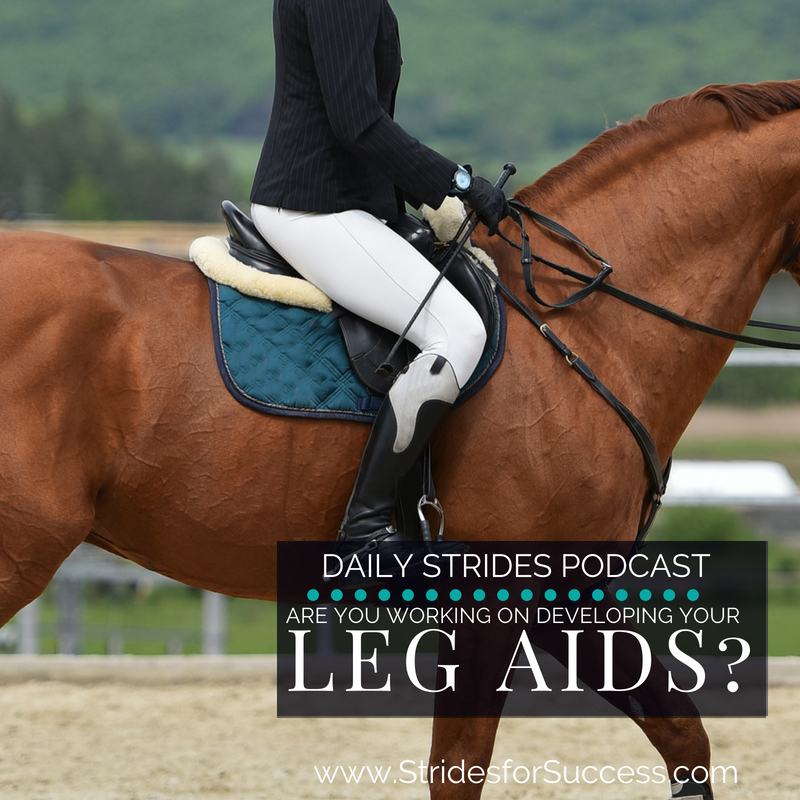
  • Are You Working on Developing Your Leg Aids?

    Are You Working on Developing Your Leg Aids?

    Are you working on Developing Your Leg Aids?

    What this episode is all about & how it can help you:-

    • Become more respectful with your legs & how it will help the overall conversation
    • Understand why how you apply the aid is so important
    • The difference between ‘loud aids’ and ‘quiet aids’
    • Develop your leg aids as a guide – not a crutch

    [smart_track_player url=”https://op3.dev/e/traffic.libsyn.com/dailystridespodcast/1058-Are-You-Working-on-Developing-Your-Leg-Aids.mp3″ title=”Are You Working on Developing Your Leg Aids?” social_linkedin=”true” social_pinterest=”true” social_email=”true” tweet_text=”How much time do you devote to improving how you communicate with your horse using your legs while riding? This will inspire you to invest more…” hashtag=”Podcast #Equestrian” twitter_username=”strides_success” ]

    Your legs make up such a huge part of the active conversation that happens between you and your horse when you’re in the saddle.  You can use them to ask questions.  They can be used to guide or direct your horse.

    Yet, so many riders fail to recognise how important their legs are to the whole conversation; and how improving your overall control of your legs, can have a huge positive effect on everything else.

    In this episode of the Daily Strides Podcast I will give you some ideas on how you can begin improving your leg aids, starting the very next time you are in the saddle.

    “My horse is not responsive”…

    One of the first statements riders say when we are working on their leg aids usually sounds a little like this.  They bemoan the fact that their horse is either a little slow to respond to their leg aids – or blatantly disregards them!

    I truly believe that responsiveness begins with the rider – and it begins when the rider shows respect to the horse in how they communicate with their aids. 

    Becoming more Respectful of Your Leg Aids

    I feel it is really important as the rider that you show up as the team leader.  Are you being respectful with your leg aids to begin with?  Or are you using them to stay in the saddle (the vice grip effect!).

    Or perhaps you are nagging.  On and on and on and on.  Horses, just like us, tend to begin ignoring the ‘dripping tap’ after a while.  The ongoing ‘drone’ that never really has anything constructive to add to the conversation.  This can often be described as ‘dead to the leg’.

    I also respectful means becoming more thoughtful about how you are applying the aid.  Huge kicks are not enjoyable for anyone involved.  

    If you horse is ignoring your leg aids, I suggest using a schooling whip directly behind the ‘ignored aid’ (your leg).  It will help bring your horses attention to the missed aid, without the unpleasantness of big, awkward, rhythm breaking kicks!  A simple ‘tap’ is a lot nicer than a huge kick.

    Respectful also means only speaking when you have something to add to the conversation.  Think of this next time you are in the saddle with regards to how you are using your leg aids. 

    How You are Applying Your Leg Aids

    There are a lot of different ways you can communicate with your horse using your legs.  If we think of asking your horse to move forward, it will almost feel like wrapping your legs around your horses tummy and lifting it up using your legs. 

    It is a ‘lift’ motion, which means that you also need to create space for that lift.  This is where your seat aid connects with your leg aids.  An allowing seat will create the space for your horse move into as he responds to your legs. 

    Turning your horse requires a different leg aid.  Think of your legs rather being the guide as to where you would like your horse to go.  The parameters that your horse can work within.

    Loud Aids Versus Quiet Aids

    I personally think that all aids can either be described as being loud or quiet.  Some can fall into both categories depending on how they are used and who uses them.

    Loud aids are the equivalent of ‘shouting’ at your horse.  They are obvious – to the point where they are visible to people who are watching from the ground.

    Quiet aids are the whispers.  The secret conversation that goes on between horse and rider.  Your seat is a good example of this – it should only really be ‘felt’ by you and your horse – not seen by other.

    Overtime the conversation between you and your horse will become more refined and more quiet.  Your leg aids will become quieter as your seat plays a bigger role. They will become more subtle.

    The Relationship Will Change as You Both Develop

    As you and your horse practice the conversation more and more together, it will improve.  It has to.  

    It is just like the people in your life.  The more time and energy you invest in building and developing the relationship, the more subtle you can communicate with those people.  A glance or a shrug can mean so much if the person knows you and your way of communicating with them.

    As you and your horse become more familiar and comfortable with each other, the conversation will develop further.

    Your Legs as a Guide Rather than a Crutch

    I really think that horses who ‘need’ the riders legs are created by riders who lack confidence to begin with.  The rider feels that they can and have to control every little thing when it comes to riding and being in the saddle.

    Please realise that as a rider, the only thing you can truly work on controlling is yourself.  The greater control you have over yourself, the greater influence you will have over your horse. 

    Gripping with your legs in order to stay on, or to ‘keep the horse going’ or anything else for that matter is not what your legs are for as a rider.  Focus on remaining balanced and equal in teh saddle and then ‘draping’ your legs around your horse.

    Riders who want to control will end up literally holding the horse up, using their inside leg, through corners, bends, turns – and even on the straight.

    Your Leg Aids Can Be Training Wheels Initially

    Training wheels, or stabilizers as we called them, are the two additions put on the back wheel of a bicycle when someone is initially learning to cycle.

    They only come into play when the bike leans or tips to a point where it is no longer stable and balanced.  They force the bike back to centre, and allow the new cyclist to continue cycling.

    Your legs should initially be the training wheels for your horse.  They don’t keep him upright or balanced – but when he wanders off track a little, they help bring things back to where they should be.

    Use your leg aids to ask the question.  Then allow your horse to respond and only when he goes a little off track, rejoin the conversation again to bring things back where they should be.

    This is how your horse learns to take responsibility for himself – and that is one of your biggest responsibilities as team leader :)

    Next Time You Are in the Saddle…

    Think about how you are using your legs to communicate with your horse.

    • Are you being respectful?
    • What about how you are adding to the conversation?
    • Are you applying the aids themselves correctly?
    • What about the timing, are you asking the right questions at the right time?
    • Finally, are you consistently working on developing and refining your leg aids to take them from being ‘loud’ to subtle and quiet?

    If you are interested in working with me further on this topic, here is your invitation to join me inside of Daily Strides Premium.  You can begin today for just $19 and get instant access to a whole collection of lessons focusing on your leg aids.

    Happy Riding

    Lorna

    Links mentioned in the episode:-