Tag: core strength

  • How Engaged is Your Horse’s Core?

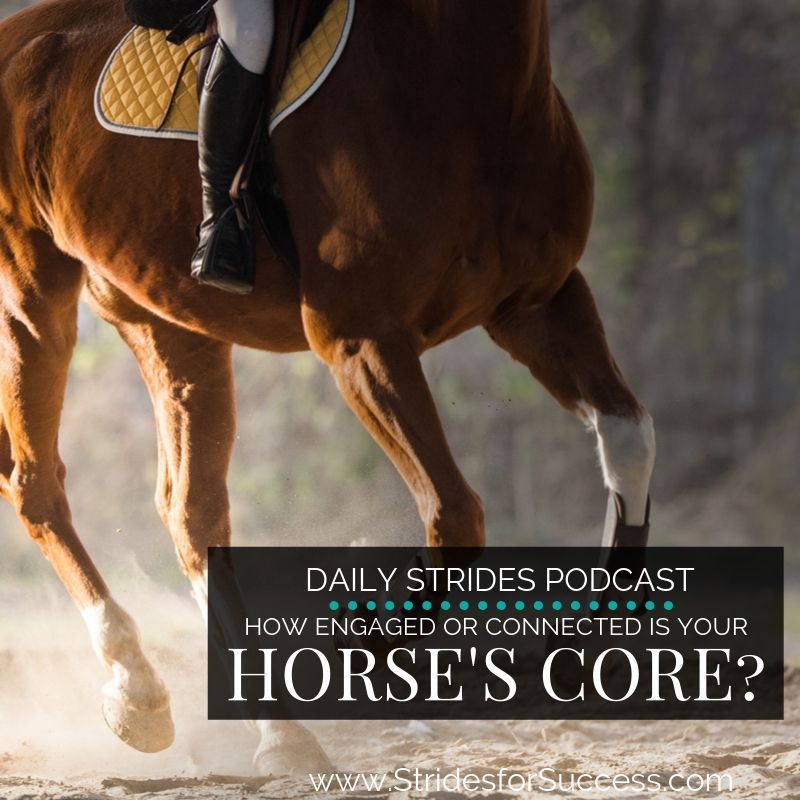
    How Engaged is Your Horse’s Core?

    How Engaged is Your Horses Core?

    So how do you know if your horse is really engaged? If he is using his body to the best of his abilities at that moment in time. For many riders, we know that it is important, however, we struggle to make it happen consistently.

    Being able to successfully and correctly engage your horse’s core is essential for ‘good’ work to happen when your horse is being ridden. I know, ‘good’ is a little generic, however, it is true!

    In order for your horse to successfully connect through the energy, he must be engaged. And in order for that to happen, you the rider, need to understand what it means when it is done right.

    [smart_track_player url=”https://op3.dev/e/traffic.libsyn.com/dailystridespodcast/1118-Engaging-Your-Horses-Core.mp3″ title=”Engaging Your Horses Core” background=”#ffffff” social_linkedin=”true” social_pinterest=”true” social_email=”true” tweet_text=”Is your horse really engaged when you’re riding? Find out here…” hashtag=”podcast #equestrian” twitter_username=”Strides_Success” ]

    The Flow of Energy

    When your horse’s core is engaged, it means that energy is able to flow through your horse’s body. Through the container that is you and your horse when you are riding. This energy flows from back to front. From the hindquarters, through to the front end of the horse. Rear-wheel drive.

    Your horse’s core strength will determine how much energy can flow through the channel or container at any given point.

    Your horses core must be engaged if the energy is to flow correctly. If your horse is going to use himself to the best of his abilities. He will be pushing, propelling or thrusting himself forward.  The energy will be carrying through.

    Engaging your horse’s core is absolutely foundational to correct training and long term functionality in your horse.

    Forwardness is Key

    Unfortunately, so many riders only look for the end result. The finished product. They will short cut the process of getting the result so that it ‘looks’ right. The obsession with ‘on the bit’ is all about this end result. Rather make sure that your horse is moving forward and thinking forward.

    Think of your horses back being like an electrical cable or water pipe. This cable or pipe will only be able to deliver the capacity of what that particular size can carry. In order to deliver or move more, the pipe or cable will have to expand or multiply.

    With your horses back, he must strengthen or develop in order for his body to successfully deliver more energy from back to front. In order for him to remain ‘engaged’ and moving forward.

    Removing ‘The Blockage’…

    In my experience, blockages can show up in two different ways.  A lack of consideration from the rider with regards to what it takes for the horse to truly ‘engage’ and carry himself.  And also, too much interference, whether intentional or not, from the rider!

    Most riders understand this concept of energy, strength and development.  Unfortunately many make the mistake of expecting too much too soon. You know that one day in the gym, no matter how many hours you spend, it will not suddenly result in you being able to lift enormous amounts of weights. Your horse is the same.

    One or two days of training will not suddenly result in your horse being able to engage and carry himself for prolonged periods when being worked and ridden. It will take time.

    As mentioned, the second way energy can be blocked is due to the riders blocking it!. This is often due to fidgeting, shuffling, twisting, turning, digging holes with their seat bones… All of the things that cause the energy to leak out and fail to flow through.

    When the energy fails to flow through, the horse never improves or strengthens his core.

    Start with Short Periods

    So, to develop your horse correctly and begin building his core strength, you will have to start somewhere. Start small. A stride or two initially. Many riders think ‘short periods’ and 20 minutes is their idea of short… I challenge you to try ‘planking’ for 20 minutes when you have never really planked before.

    Depending on what you’re doing, 20 minutes can sometimes feel like a lifetime! The same applies to your horse.

    Asking for too much too soon will result in your horse’s body looking for short cuts. Easier ways to do the things that he is doing. Unfortunately for you, these easier ways are rarely the correct or right ways. So, keep things short and sweet and focus on riding a few correct strides at a time. Then learning to string those ‘good’ strides together in order to create longer periods of engaged work.

    Start with the Halt

    I am going to suggest that you begin paying more attention to each halt. The quality of each halt that happens when you are riding. Earlier I mentioned how important forwardness is, both physically moving forward and thinking forward. The halt is no different.

    When a horse is thinking forward in a halt, the energy remains ‘engaged’ within his body. It is there, ready and waiting to be directed when the rider chooses to do so.

    That, of course, is a ‘good’ halt (there’s that word again!). The horse looks focused on the task. He looks eager. The contact between horse and rider has in no way diminished. Which brings me to the rider of the horse who has halted so nicely. They, too, are carrying themselves. Being responsible for their own body and their own contribution to this wonderful halt which has occurred…

    This is very different from the horse who ‘falls’ into the halt. The energy has left, usually leaked out or, sometimes, spilled out somewhere while getting into a halt. The back end is ‘open’. The front end is in fierce resistance to the rider’s efforts towards the contact.

    And the rider… Oh, the rider is bearing down, usually crooked as an S hook. Lost in a pointless tug of war they cannot win because there is no one even holding the other end of that imaginary rope…

    You Can Try This Yourself…

    Wherever you are right now, I want you to engage your core. You can do this if you are standing or sitting. Lying down is not a great example, so if you are – please sit up! But standing or sitting, when you engage your core, can you feel how you ‘grow’ a little? Can you also feel how you become a little more present and focused?

    Your horse has a similar result when he engages his core. He ‘grows’ a little, meaning he carries himself better. He also becomes more focused on what he is doing.

    The stronger and more developed your horse becomes, the longer he will be able to maintain a more engaged core. Which means the energy can flow more ‘unhindered’. It also will allow more energy to flow.

    I mentioned earlier how, often, it is the rider who gets in the way of the energy flowing. The rider causes the horse to ‘disengage’ through is core. So I am going to suggest that when you are initially working on this, you do so from a place that allows your horse to feel this for himself. Unhindered.

    Working on the Lunge

    On the lunge is the perfect place for this to happen. You are influencing using your aids. Your horse is responding to your aids, however, he now has space to really explore how it feels in his body. Without the rider tainting the end result!

    But there is one caveat to this; you must be lunging your horse correctly and consistently in order for it to work.

    You have to lunge your horse in a way that uses your aids to communicate just like you would in the saddle. Your aids on the ground literally take over from your aids in the saddle… The lunge line is the reins. Your lunge whip becomes your legs. And no, you don’t whip or hit your horse just like you don’t kick his sides black and blue with your legs! Your body position and language become your seat.

    Correct lunging will allow you to work specifically on engaging your horse’s core, without you getting in the way. It also allows you a different perspective. The perspective of the trainer or coach, rather than the rider.

    Just like I said at the beginning, steady and consistent work done correctly will develop your horse in a way he can learn to use his core. Once he has figured out what is expected of him, you can simply get into the saddle and then begin working from that perspective.

    Happy Riding
    Lorna

    Lunging For Riding

    If you are interested in go further with your horse on the lunge, I am going to encourage you to check out my digital program, Lunging for Riding – Results with Just 10 Minutes a Day. In there I will guide you through different exercises you can do, on the lunge, that will benefit both you and your horse when you are in the saddle.

    And don’t worry if you’re not great at lunging; I take you step-by-step through the process. You will learn how to lunge correctly and how, in the coming weeks months and years, you can use this fantastic tool to continue working with your horse in a way that will only enhance your communication in the saddle.

    This really affordable program is one that I want as many riders as possible to use and take action on. I want you to get the results that you are looking for. This program will help you do just that. It is fully digital and online, meaning you can do it from anywhere in the world. All you need is a horse, a small ‘flattish’ piece of land, a lunge line, a lunge whip, and an open mind. Find out more about Lunging for Riding – Results With Just 10 Minutes a Day HERE

    Other episodes, posts, and resources similar to this one:-

  • Weight Aids & Seat Bones for Turning & Bending

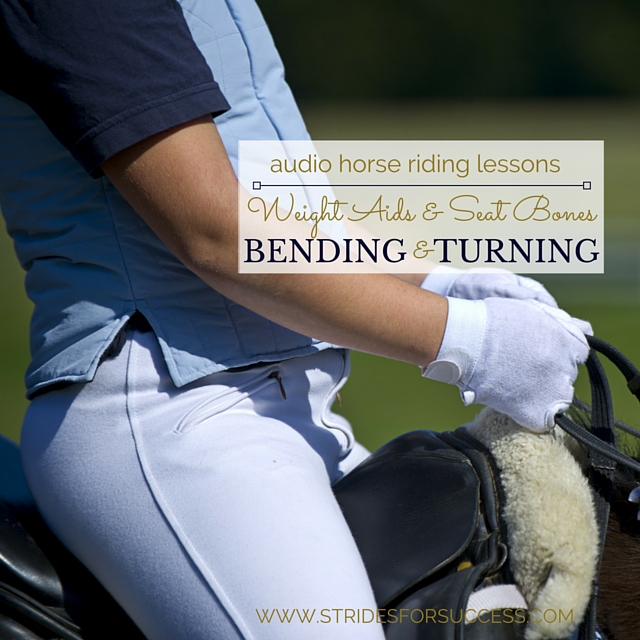
    Weight Aids & Seat Bones for Turning & Bending

    The bend is approaching and you begin preparing both you and your horse to ride straight and accurately through the turn. However, as you ‘shift’ your seat bones into ‘position’ your horse begins, well, almost side stepping… The further you get through the turn, the further your horse is from the path you had planned; in fact, he has derailed altogether from the ideal ‘train tracks’ you had intended to stay on as you rounded the bend.

    As riders we learn early on about how important our weight distribution is to our horses way of going. We learn about positioning our seat bones, so we can indicate to our horses what exactly the next movement should be. We also learn that our weight aids are fundamental to all aspects of successful communication with our horses in the saddle.

    [smart_track_player url=”https://op3.dev/e/traffic.libsyn.com/dailystridespodcast/591-Weight-Aids-and-Seat-Bones-in-Relation-to-Turning.mp3″ title=”Weight Aids and Seat Bones for Bending and Turning” social_linkedin=”true” social_pinterest=”true” social_email=”true” tweet_text=”Weight Aids and Seat Bones for Bending and Turning Your Horse” hashtag=”Podcast #equestrian #horse” twitter_username=”strides_success” ]

    What we don’t learn is awareness of how the other parts of our body directly or indirectly affect how and where our weight aids are applied with our horse. There is also not a lot of time spent on figuring out how loud or how quiet we can communicate with our horses through our weight aids. In fact, most riders seem to think that a ‘one size fits all’ approach is sufficient regardless of the circumstances, situation or horse involved.

    Learning to correctly feel and then master your weight aids in the saddle is key to developing good feel as a rider. Those subtle shifts and movements, which happen when you direct your muscles to move, rather than your actual weight or bones themselves. This is very much apparent when turning your horse and that is what I want to focus on today.

    So let’s begin with focusing on how your carry yourself in the saddle. Many riders make the mistake of going a little too overboard when told to ‘relax’ through their body.

    Relaxation is key to good riding, however the level of relaxation is also important to consider; particularly when it comes to how it affects your weight aids and seat bones in the saddle when riding

    Ideally you want your muscles to ‘carry’ you in the saddle, enough that your hips and seat are free to move with your horse and follow the motion. Following when riding is a little like following when dancing. The dancer that is following must remain in control of their body, walking that fine line between too relaxed or ‘slack’ and too tense or ‘rigid’. All the while they are looking for cues from their partner and then taking the responsibility on themselves to respond to those cues in the agreed manner.

    Riding is the same. Following does not mean you slouch in the saddle, looking like you have had one too many before you mounted. It rather means you carry your upper body, so your hips and seat are then willing and able to follow the horse’s motion as he crosses the ground.

    Bending and Turning Your Horse Using Your Weight Aids and Seat Bones

    Think about it, your hips and seat bones can not possibly be free to perform a full range of motions if your upper body is heavy and slouching on top of it. Many riders mistake this for ‘shoulders back’, which is unfortunate as this only serves to increase the excess tension and therefore rigidness in the body, rather than simply carrying yourself, through your ribcage and positioning your body in the best possible place from which to begin asking your horse to turn using your weight aids.

    Once you are sure that you are indeed carrying yourself and, as a result, correctly following your horse wiht your seat, you can then begin looking at how subtle changes in different areas of your body will affect your weight aids and therefore what you communicate to your horse through your seat.

    So to begin with, let’s focus on the half halt.  One of the reasons we apply the half halt is to bring your horse’s attention back to you and let him know something is coming up.

    In fact, you can almost think of your half halt as being a big flashing arrow, directing your horse’s focus to your seat so he can begin to get further directions on what to do next

    Not using your half halt will probably result in your horse’s attention being elsewhere and therefore, any subtle movements with your seat to communicate with your horse will have a good chance of being ignored.

    That being said, it is also worth noting that applying the half halt and then following it up with an incorrect, overly exaggerated or heavy use of the seat and weight aids is just as ineffective as not using the half halt at all.  Think of your half halt as the opening part of the sentence which will then, in turn, lead up to the actual question you wish to ask your horse.   Become clear on what you want to ask, before you draw your horse’s attention to your seat to begin with!

    Once you have his attention, think about what you want of your horse as he rounds the bend.  Ideally, your horse’s spine should replicate the arc of the bend or circle.

    Your horse’s spine will stay on the arc all the way through, from his poll or ears to his tail or dock.  Similarly, your spine will too stay centered over your horses, not leaning one way or the other, not twisting and not collapsing to either the inside or outside.

    His hips will travel along parallel either side along this arc, however his inside hip will come slightly forward or ahead of his outside hip.  Your hips or seat bones will be in this same position.  Then look at the shoulders; again, they should remain parallel to the central arc or track as he moves along (like train tracks), however the outside shoulder will have to move a little more forward in order to do so and, therefore, so must your shoulders.

    It seems like an awful lot to remember, and when starting out, it is!  I have found it easier for some riders to rather remember where their legs should be through the turn.  Because your legs are connected to your hips, by moving them into the desired position, your seat bones will generally follow suit and automatically also ‘slot’ into position.  However, as you become used to the inside and outside being dictated by your horse, regardless of where you are in the arena, you can begin rather making the subtle shifts with your seat bones, and then allowing your legs to follow suit.

    So back to how we can use our muscles, either for good or bad, to influence our weight in the saddle.  Find a hard chair or stool and sit down with a hand under each of your seat bones.  Now, begin by moving your shoulders, the right one forwards the left one back and then vice versa.  Notice how a very small movement of only an inch or so, will change how the pressure being exerted on your hands from your seat bones feels.  Similarly, think about ‘weighting’ one of your seat bones.  Many riders will literally ‘bear down’ on that particular seat bone, shifting their upper body to do so.  However, feel that when this happens, your seat bones actually begin ‘sliding’ towards the opposite side.

    Now, rather think of ‘weighting’ that seat body through a combination of elongating the muscles on that side of your torso, and sending a tiny bit more weight or pressure to the heel of that leg.  Notice the subtle change in the pressure being applied on your hand.  It only takes small but precise adjustments with your muscles to ‘weight’ the seat bone.  The more you can learn to control your muscles, the clearer your communication will become with your horse.

    Very often riders use their weight aids in the wrong way; namely leaning with the upper body while will result in their seat shooting to the outside

    The result is that your horse will move completely differently to how you had planned, because he is trying to remain balanced and, literally, stay underneath you.  If you find this happening a lot, go back to making sure you are symmetrical, balanced and straight in the saddle and, once you are sure of that , begin insisting on it from your horse also. Always think about your own body and what you are communicating with your horse while riding  through the corner.

    I really think that being a little ‘picky’ or obsessive about riding in the correct position will help you to make sure that your body is in the best possible place to apply the correct aids for any given movement or direction.  It will take concentration and consistent effort on your part initially, but as your ‘feel’ increases, you will find that merely thinking about it will result in your body shifting slightly in the saddle – and the more consistent you are with always riding in the correct way, the more effective your horse will be at reading the small, subtle changes in your weight and position.

    Happy Riding

    Lorna

    I have written another blog post on applying your weight aids HERE >>

    Get to know your core muscles better which will give you more control over them by joining the FREE 30 Day Rider Fitness Challenge…

  • Building Your Riding Fitness

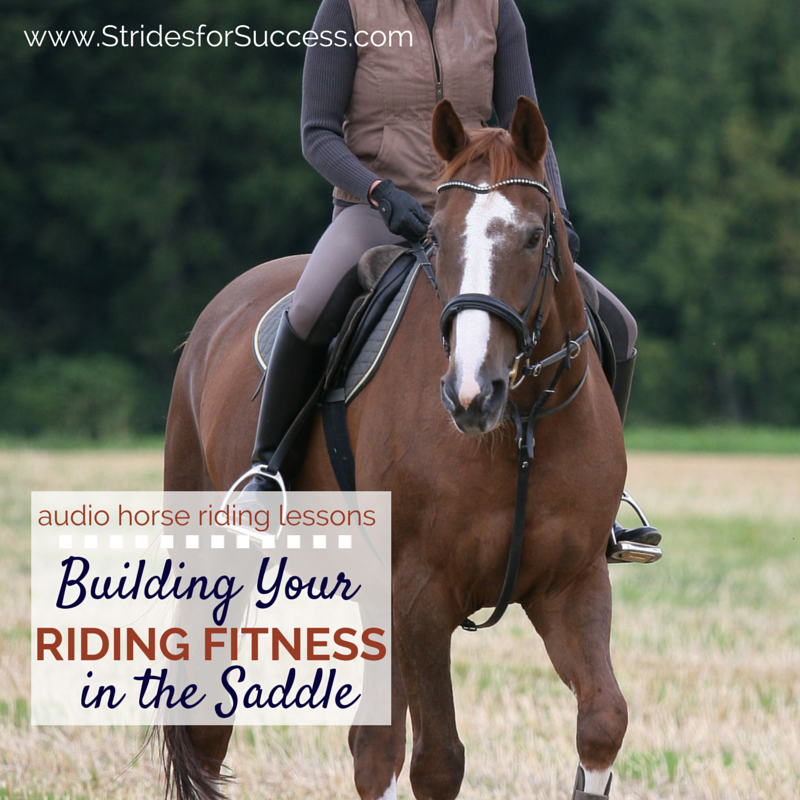
    Building Your Riding Fitness

    [fusebox_track_player url=”https://op3.dev/e/traffic.libsyn.com/dailystridespodcast/SFA421-Building-Your-Riding-Fitness-While-in-the-Saddle.mp3″ title=”Building Rider Fitness in the Saddle” social_linkedin=”true” social_pinterest=”true” social_email=”true” ]

    Do you find yourself huffing and puffing after a few strides of canter?  Have you been riding less recently and find that now your back in the saddle, you’re less effective than before?  Are you spending hours schooling your horse but seeing little to no difference in his way of going…

    It often amazes me how much time, effort, planning, and work riders put into conditioning and increasing the fitness levels of their horses. And yet completely fail to invest even a little of that towards their own fitness levels!

    Contrary to popular belief, riding is a team sport… You and your horse!  So it leads us to the fact that, as with any team sports, it is essential that all members of the team are doing their best to contribute to the team’s success.

    How Will Increasing Your Riding Fitness Help?

    Increasing your level of fitness with regard to horse riding has numerous positive consequences on your overall performance in the saddle.

    You will find that you become increasingly better able to communicate with your horse. And your aids will become easier to apply and clearer for your horse to understand

    You will also develop a more independent seat as your core strength grows. This, again, will increase your effectiveness in the saddle. Another huge positive result is that any stiffness and rigidness that you are holding within your body will begin to dissipate as you both physically and mentally begin to have more faith in your abilities. And, of course, your stamina levels will increase too…

    Meaning you can enjoy your more canters and for longer periods!

    Building Your Riding Fitness while in the Saddle

    Setting Yourself Up for Success

    Before we go any further, it is important that in order to ride these exercises, you are on a trustworthy horse. I also strongly suggest riding in a safe or enclosed area.  A young horse or a strange place is not the best time to try out new exercises. Especially ones that will test your balance and strength!

    If your horse tends to ‘wander’ when you are not directing him, perhaps creating a small chute in the arena using jumping uprights and poles will help. This will allow you to focus on what you are doing. And ensure that you get the most out of the exercises.

    These exercises are also excellent to do while warming up or cooling your horse down.  It is you that must do the work, not your horse!  

    Getting Started; Your Position

    I suggest beginning with giving your position a quick once over, and check that you are in a correct alignment.  Simply put, you’re sitting correctly in the saddle.

    Take your feet out of the stirrups, and start with some light stretches.

    After this, you can begin the first exercise. This involves drawing up your knees, one at a time, to your horse’s withers.  While you are doing this, pay close attention that your upper body remains straight and upright.  It is tempting to ‘curl’ your lower back and shoulders when performing this exercise but don’t.

    Focus on identifying your legs individually and then lifting them using only your leg to do so.  

    Use your core muscles to help you keep your balance while your knee is raised.  Hold it for a few seconds and then gently replace your leg and repeat on the other leg.  If you are feeling brave, you can raise both knees at the same time (jockey style), however again, make sure you are not crouching with your back and shoulders.

    Legs & Core Strength & Fitness

    This is a super exercise not only for your legs and core muscles, but also to help you make sure you are indeed sitting on your seat bones.  It also helps to relax the pelvis which will help with the other exercises and your riding in general.

    If you find that you are feeling unbalanced or concerned about ‘tipping over’ out of the saddle, rather ask your horse to halt and, having someone hold him still if necessary, complete the exercises while your horse is standing still.  

    With your feet still out of your stirrups, begin stretching your legs down nice and long.  Then one at a time lift your leg away from your horse’s side. There should be daylight between your leg and the saddle.

    Try to lift your lower and upper leg. But, make sure that while you lift, you are not leaning your body weight to the opposite side to lift your leg for you!

    The lift must come from the muscles on the outside of your hips and the sides of your torso.  Pay attention that your body remains upright and not collapsing down.  

    After you have managed to lift each leg individually, you can then try lifting both legs together.  Again, it is tempting to lean forward and curl your upper body. But try to continue carrying yourself as you perform the exercise.

    Introducing Sitting Trot

    You can also incorporate some sitting trot work into this initial warm-up.  Pay attention that you are keeping your pelvis and thighs open. Not gripping up, but rather stretching your leg down around your horse.

    Focus on allowing your lower body to move with your horse in almost a back and forward motion rather than an up and down motion.  You can also work some circles into your school movements, all the while maintaining a good basic position.

    Posting in the Walk

    Another great exercise you can work on to increase your fitness levels is posting in the walk.  Obviously you will need to take your stirrups back for this exercise, and once your feet are in…  Yes, you guessed it; Check your position!

    Posting or performing the up-down movement from the rising trot while walking can be quite a challenge. This is due to the fact that your horse’s natural momentum in the trot is not there to help you.

    Keep in mind that when you post or stand, you are doing so on your heel, not your toes.  

    Also, that your lower leg remains underneath you.  Many riders will try to use their upper bodies to ‘pull’ themselves up and whether or not they use the reins, this is incorrect.  Rather think of pushing yourself up using your legs.

    Once up, it will require your core muscles to help you maintain your balance and lower yourself back into the saddle with the sufficient ‘grace’ that is required!!  Do not allow your body to fall back into the saddle as you come down as it will be uncomfortable, and may even hurt, your horse’s back.

    FREE 30 Day Rider Fitness Challenge

    Standing in the Stirrups

    Developing on from the highest point of this exercise, you can begin to ‘stand’ in your stirrups as you walk around the arena.  When standing, keep in mind that your knees will have to keep a slight bend in them in order to help you absorb the movement of your horse underneath you.

    It is, again, worth mentioning that you should not use your reins for support and balance while performing this exercise…  

    Rather hold a martingale strap or even a stirrup leather that is secured around your horse’s neck for support if necessary.  Also, make sure you do not collapse down into the saddle when you have finished.  Gently lower yourself into the saddle…

    Or remain ‘standing’ in to the trot and even the canter.  This will use your legs and also your core muscles to achieve it correctly.  Start off slow and for short bursts, working over time to longer periods at faster paces.  

    Additional Exercises to Increase Fitness

    Other exercises you can use, which we cover step by step in this week’s Daily Strides Premium are changing the variation of your posting while trotting.  Rather than the usual up, down, up, down, up, down; rather begin sitting or posting/rising for an extra beat.

    This would look like up, up, down, up, up, down, up, up, down, or the other way around; down, down up, down, down, up.

    All variations of this will firstly create mindfulness around what you are doing while you post or rise. And, secondly, require your core muscles to shift from sitting to the rising trot more frequently than your normal up, down, up, down does.

    You can also work in the two-point seat…

    In fact, this is a great way to initially test your riding fitness levels by seeing how long you can hold the position, independently, before sitting down.  Work at increasing this time period on a weekly basis.  Make sure, again, that the weight is down in your heel and that your back is straight, not rounded or arched.

    Your Riding Fitness Is Your Responsibility

    As you can see there are numerous ways to incorporate a mini-workout into your everyday riding and schooling.

    Very often with adult riders, time is the greatest challenge when it comes to fitness, however as before, all these exercises can be performed while you are warming up and cooling down.

    Happy Riding
    Lorna

    Additional Resources for Equestrians

  • Using Your Core Muscles To Correctly Follow Your Horse

    Using Your Core Muscles To Correctly Follow Your Horse

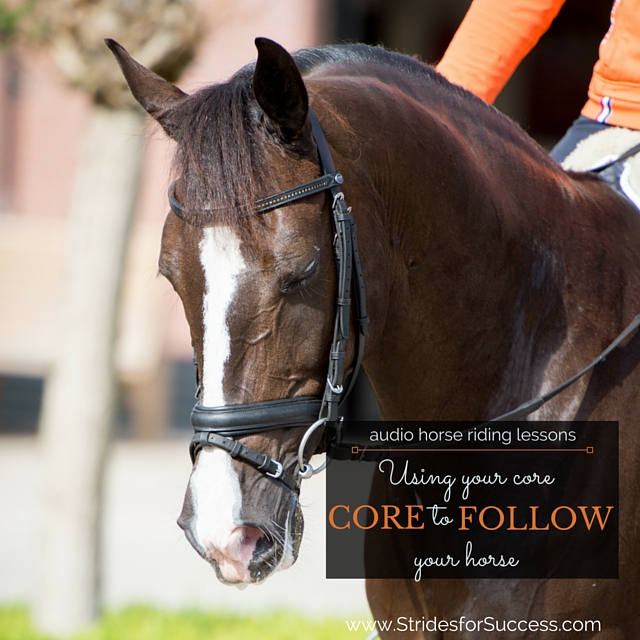
    Using Your Core to Follow Your Horse

    Horse riding is really one long conversation between horse and rider.  One of the ways that we look to improve our riding is by being in constant harmony with our horses.

    The ability to ‘follow your horse’ and be a balanced, conscientious rider comes from our ability to balance and control our own bodies… Core strength.

    [smart_track_player url=”https://op3.dev/e/traffic.libsyn.com/dailystridespodcast/SFA276-Using-Your-Core-Muscles-Correctly-To-Follow-Your-Horse.mp3″ title=”Using Your Core to Follow Your Horse” social_linkedin=”true” social_pinterest=”true” social_email=”true” tweet_text=”Following your horse is not as difficult as it seems…” hashtag=”equestrian #horseriding” twitter_username=”strides_success” ]

    The Ability to Carry Yourself While Riding Your Horse

    It seems strange to think about this, but carrying yourself while in the saddle is essential for becoming a balanced, effective rider.  Many riders will bemoan the fact that they have ‘no core’ or a weak core.  They allow this perception to hold them back from improving.

    However if you can walk over to your horse, before you mount up, you already have the necessary core strength to carry yourself in the saddle. 

    It may not be a strong or developed as you would like, however carrying yourself simply requires that you engage your core. If you can walk to your horse unaided and unassisted, you can begin to follow your horse today.

    Think of Standing Up Rather than Sitting Down

    For most riders, as soon as their bum makes contact with the saddle they ‘sit down’.  Unfortunately for most of us, sitting down means that we are slouched.  Bad posture and completely relaxed.

    One of the simplest ways to carry yourself when in the saddle is to engage your core as though you are ‘standing’ rather than sitting.  

    Yes, you are still sitting in the saddle.  However, your core will feel and act as though you are standing.  This way you will remain aligned, your posture will become more correct.  There will also be the necessary ‘space’ between your ribs and your hips that is necessary for your seat to follow your horse’s movements.

    Working to Follow Your Horse While in the Saddle

    I suggest beginning to work on improving your ability to follow your horse in the walk.  Keep the emphasis on relaxing through your body, and allowing your horse to move underneath you.

          1. Relaxing our hips and pelvis
          2. Relaxing our leg, without tension or gripping
          3. Sitting up through your body, making sure your rib cage and upper body are not ‘crushing’ your organs and pelvis.

    If all these points are in place, in harmony, with each other, you can then begin to concentrate on following your horse.  Doing so will help you to become a more independent and skilled rider

    Following Is Different Than Driving or Shoving!

    Keep in mind that when you follow your horse, it does not mean that you are driving, shoving, or pushing!  So many riders confuse ‘digging a hole’ with their seat bones, and just being supple enough to follow.

    Relax enough that your horse can bring you along with him.  Then, simply allow the movement to happen.

    Happy Riding

    Lorna

    Articles & freebies that Relate to this Topic:-