Tag: fitness

  • Developing Steady Hands as You Ride Your Horse

    [fusebox_track_player url=”https://dts.podtrac.com/redirect.mp3/pdcn.co/e/traffic.libsyn.com/dailystridespodcast/1365-Steadying-Your-Hands-While-Riding.mp3″ title=”Steady Hands When You’re Riding” social_linkedin=”true” social_pinterest=”true” social_email=”true” ]

    Do your hands sometimes seem like they develop a mind of their own when you’re riding?  You tell them to stay quiet, steady, and soft…  But they just seem committed to waving about. In fact, they feel miles away from being the ‘steady hands’ that you want as a rider!

    Trust me, you’re not alone! Steady hands are a sore spot for so many riders, with the added frustration of as soon as you recognise it as a problem, it can often get worse before it gets better!  Today we’re going to unpack how to begin developing steady hands that are more consistent and will improve communication with your horse.

    Why Steady Hands Matter

    Having steady hands isn’t about your hands being ‘fixed’ or ‘rigid’. Far from it actually. Steady hands is all about creating a consistent, gentle connection between you and your horse. It improves your horse’s trust in your contact and makes your aids clearer – and kinder.

    Ironically, the harder we try to force our hands to stay still, the more exaggerated their movements often become. It’s like being aware of them makes them become even more animated! 

    So let’s dive into practical ways to address this issue once and for all…

    What’s Really Happening?

    Before fixing a problem, you need to know exactly what’s causing it. There are generally two big reasons your hands may move too much. The first is that you’re actually moving your hands! I know, you might think ‘No Way!’, but it’s true! Especially if you’re always fiddling with and shortening/lengthening your reins.

    If your reins keep slipping so that you have to keep shortening them, you’re probably holding your reins wrong. Get that issue sorted first… Then move on from there :)

    The other way your hands can be moving about is far more unintentional.  It often comes down to you relying far too much on your hands for balance or support. This really shows up in trot, canter, turns, and bends. It can also show up as you post to the trot.

    Get Clear on Your Hands First

    Grab a whip or stick and hold your reins normally, thumbs on top. Lift your thumbs slightly and lay the whip horizontally across your fingers, then gently clamp your thumbs back down to hold it in place. As you ride, glance down occasionally to check if your whip remains ‘still’ or is it moving about all over the place! You will also be able to quickly see if you’re tilting or dropping one hand using this method as well.

    The other way to assess what your hands are doing is to film yourself riding with this setup. Bonus points if you wear bright white gloves! This makes your hand movements glaringly obvious, helping you clearly see what’s going on.

    Identifying the Root Cause

    So, if you’ve looked back over the videos and seen your hands merrily dancing all over the place, you need to find out why that is happening! Ask yourself: Is this simply a habit? Or is something deeper affecting your balance and stability?

    Often, unsteady hands signal balance and position problems. For example, riders frequently use their hands to balance, similar to how you’d extend your arms if you were walking on a narrow plank.

    Another thing to keep in mind is how incorrect posting to the trot can also be causing your issues. If you’re pulling yourself up, instead of using your core to rise ‘forward’, you will see hard, moving hands. If you see this as an issue, keep in mind that you were probably told to go ‘up-down’ when you initially learned to post.

    Also keep in mind that improving your core strength, along with correct posting techniques, will often help resolve this issue. 

    Practical Solutions to Steady Hands

    1. Relax and Check Your Elbows

    Believe it or not, your elbows play a huge role in hand stability. Some riders lock their elbows straight, causing their hands to bounce. If you see from your video that you’re doing that, rather gently let your elbows drape softly by your side.  Naturally bent and relaxed as though you were carrying two cups of tea.

    And just like if you were carrying cups of tea while walking, your elbows gently absorb the horse’s movement while riding. This helps to keep create steady hands that are soft and connected. 

    2. Strengthen Your Core

    Core strength is crucial for horse riding and creating steady hands!  If your core is weak, you will be far more likely to rely on your hands for balance. You probably know if this is an issue for you… You know, those ‘wobbly’ feelings that come up when you trot without stirrups, bend or circle in trot or canter, etc.

    Begin incorporating simple exercises into your daily routine, like planks, balance ball workouts, and the Equestrian Fitness Challenge (FREE HERE). These off-horse exercises help build core strength and stability, which will result in steadier hands for you in the saddle.

    3. Connect Your Seat to Your Hands

    Your seat and hands should work together seamlessly, with your hands following the subtle movements of your seat – not the other way around. Unfortunately, a lot of riders depend too much on their hands, so they end up leading the seat!

    If you are a little too ‘handy’ when riding, consider lunge lessons where someone else lunges you on your horse. They can direct your horse, which will allow you to focus on you :)

    If lunging with a helper isn’t possible, create a small, safe area to practice riding without reins at walk and trot, helping you strengthen your seat and core without relying on your hands for balance.

    4. Off-Horse Exercises for Better Stability

    There’s so much you can do out of the saddle to improve your riding. Get yourself a large exercise or Pilates ball and use it to improve your balance and hand steadiness.  Plus, it’s so much fun as well! Sit on the ball, create makeshift reins (or use your own reins fixed to something sturdy), and practice posting, sitting trot, and even canter motions.

    This type of exercise and practice will help your body develop muscle memory, enabling better coordination between your seat and hands when you’re back on your horse.

    Important Reminders as You Improve

    When you begin down the path to create steady hands in the saddle, be prepared for it sometimes getting worse before it gets better! It can feel that initially focusing intensely on your hands can cause tension, making your movements temporarily stiffer and more exaggerated. Don’t worry – this is completely normal! The key is to remain patient and consistent. Steady improvement will follow.

    Instead of aiming for absolute stillness (which isn’t realistic or helpful), aim for “steady” hands. Hands that softly and smoothly follow your horse’s movements, maintaining gentle contact without rigidity.

    Take Regular Videos

    Make video analysis a regular part of your practice. The visual feedback helps you notice subtle improvements and identify lingering issues. Wearing white gloves or using the whip technique periodically is also a great way to gauge your progress.

    Bringing it All Together

    At the end of the day, creating steady hands is not an overnight thing. It will require a combination of awareness, targeted practice, patience, and consistency, both in and out of the saddle. Strengthening your core, stabilizing your seat, and keeping relaxed, flexible elbows will lead you toward more stable, soft hands that genuinely improve communication with your horse.

    Remember, because your hands are at the ends of your arms (like your feet at the end of your legs) they often are a telltale sign of movement and tension happening in other areas of your body. 

    Want extra support? Join me over at ReturningtoRiding.com. Get on the waitlist to start mastering the basics and build your riding confidence.

    Happy riding
    Lorna

    More on This Topic:-

    Online Training to Help Your Riding

    Connect with Lorna online:-

  • Breaking the Habit of Poor Posture in Your Riding

    Breaking the Habit of Poor Posture in Your Riding

    [fusebox_track_player url=”https://op3.dev/e/traffic.libsyn.com/dailystridespodcast/1320_Breaking_the_Habit_of_Poor_Posture_in_Your_Riding.mp3″ title=”Breaking the Habit of Poor Posture in Your Riding” social_linkedin=”true” social_pinterest=”true” social_email=”true” ]

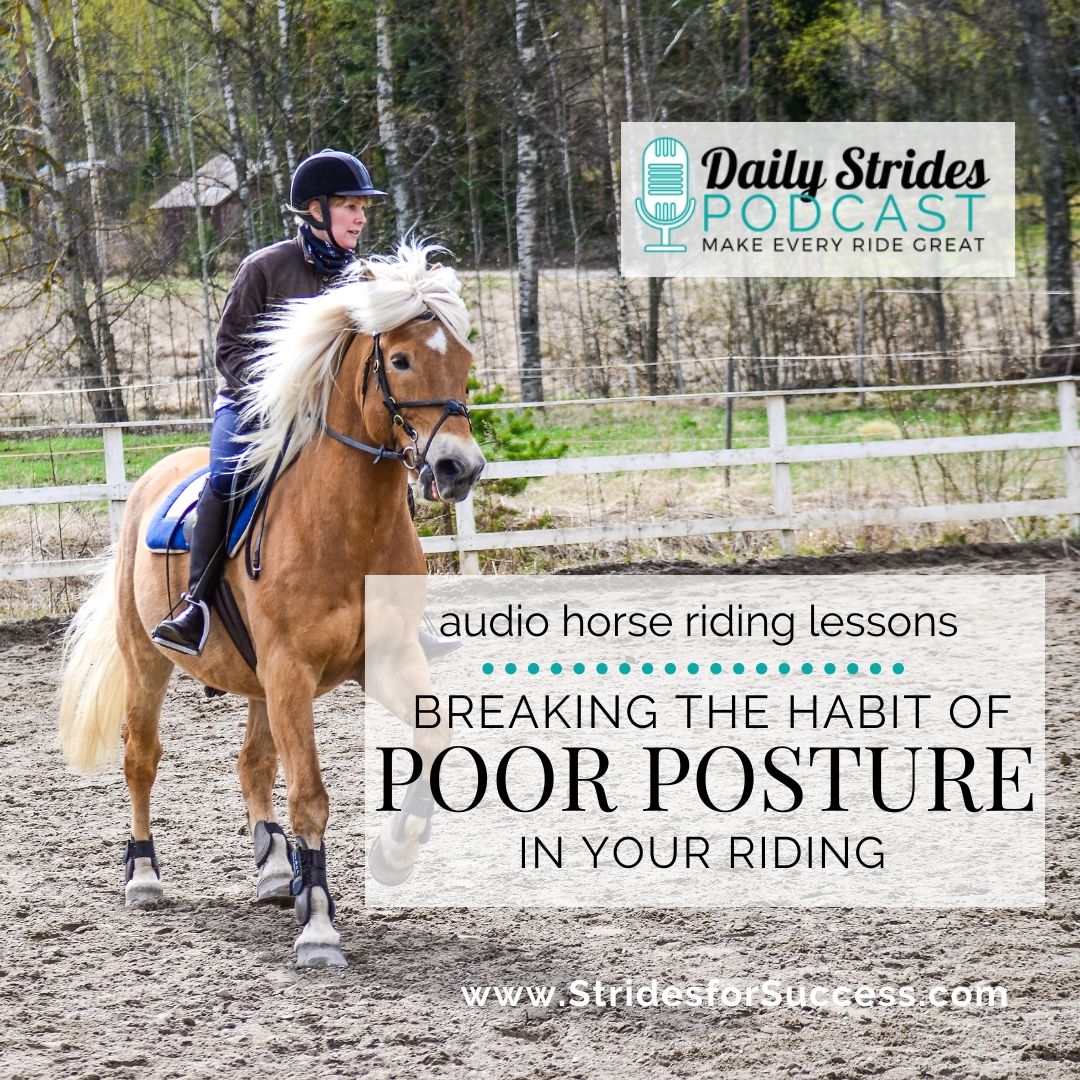
    Whether you realize it or not, incorrect or bad posture is hurting your riding. And your horse’s way of going. And this habit will usually continue unchecked for sometimes years.  I don’t believe that riders ever initially set out to ride in a way that will negatively impact things. Usually what happens is that riding a certain way either produces a certain outcome or solves a particular challenge at some point… And then turns into a habit!

    But, what happens if you get stuck there?  Stuck with thinking the thoughts that cause you to use or carry your body a certain way…  Usually never good things!

    There are lots of reasons why you might have developed less than great posture when in the saddle.  Luckily, there are also lots of ways you can begin to both identify what’s going on – and how to begin remedying it in your riding.

    Symptoms of Poor Posture in Riding

    If you have started to ‘slip’ a little where posture is concerned in your riding, there will be signs!  Definite and obvious signs.  This is good because when you know what to look for, it makes it easier to begin to make those small tweaks that can make all the difference for you and your horse.

    Lack of Balance in the Saddle:

    It stands to reason that if you are struggling to carry yourself in the saddle, your balance will be affected.  You may feel yourself tipping or tilting.  This can be to the front, so tipping forward… Or it can be tipping backward, which then feels like you are being left behind.  You may also notice this around bends, corners, or circles as a sideways tilt or collapse.

    Whatever way you are tipping or tilting, you will also most likely notice that your horse will struggle with this as well.  Your lack of balance can really negatively impact your horses own balance. 

    He may speed up (especially through transitions or bends/corners).  Or he may slow down.  He can also fall in or fall out to try and compensate for your tilting to the side.  Finally, if you are regularly tilting back, he may being to hollow through his back to avoid any associated discomfort…

    Tension and Stiffness

    Poor posture will inevitably create issues with tension, and maybe stiffness in certain areas of your body.  And of course, your horse’s body if allowed to go uncorrected for any length of time. Many riders notice this in their shoulders, lower back, or hips.  However, this can also show up across your chest, your elbows, knees, and even calves.

    Last week I spoke about ‘opening up’ and practicing expansion as a rider.  This can really be helpful for this, especially if you focus on your posture as well. And, keep in mind that incorrect tension can go both ways; excessive tension OR a lack of tension… Both can lead to poor posture in your riding and block or prevent your horse from moving and working forward.

    Closed Down or Shut Down Position

    Otherwise known as the hamster effect we least expect…! This is the reason I actually wanted to really address this topic today; too many riders are resembling hamsters while in the saddle! So what do I mean by this?   Well, if you are crumpled, contracted, hunched over, closing your shoulders and chest, riding with your hands touching each other, gripping with your knees, and overall ‘rolled up’, you are riding like a hamster!

    Often this starts as a defense mechanism – although it only makes things worse, so it’s incredibly ineffective!  Maybe there was a time when you felt fear or anxiety when riding.

    The natural thing to do is ‘play small’, roll into a ball, and wait it out.  Except, when we are riding, this is ineffective – and often downright dangerous.  Again, I am going to point you to last week’s episode on Opening Up and Practicing Expansion in the Saddle.

    Ineffective Aids and Communication

    If poor posture is something you’ve been struggling with, you are also most likely having communication issues with your horse.  Responsiveness, or the lack thereof, is something that is most likely showing up.  Coupled with your horse understanding your aids. Unfortunately, this often then increases the initial problem of poor posture and tension issues as the rider ‘doubles down’ on ‘making’ their horse do whatever it is they are trying to communicate… Frustration can run high; for both horse and rider… Not an ideal situation.

    Back and Muscle Discomfort

    Did you realize that your lack of posture can actually be contributing to muscle fatigue in your riding?  When you are not setting your body up to use itself in the best way, it gets tired – very quickly!  And then continual poor posture can even result in back pain or injuries over time. This will 100% take away from how much you enjoy your time in the saddle – and can even cause you to eventually stop riding!

    Unable to Effectively Use Your Core

    We all know how important your core is when it comes to riding.  It really does impact EVERYTHING.  Good and correct posture requires core strength and engagement. And, without this, you will find it difficult to be independent through your seat and aids.  This can lead to confusion between you and your horse – and can actually set you up for a fall or an accident in the long run.

    Improving Your Poor Posture

    Okay, so there are so many ways this can show up and none of them are beneficial when it comes to improving your skills as a rider or training and developing your horse. So, let’s work on actually improving your posture in the saddle.  Investing time here will both enhance your riding experience and help you more effectively train your horse.

    Body Awareness

    Again, we chatted about this last week HERE.  When you begin to become more aware of your body’s alignment and position while riding, you will begin to feel and notice when things are not ‘right’. This is also where practicing exercises off the horse can help.  Especially those that promote body awareness, such as yoga or Pilates.  And they have the added bonus of strengthening your core muscles and improving your flexibility.

    The 100% FREE 2024 Equestrian Fitness Challenge will help you with this.  This year’s challenge includes a daily yoga practice from Emma-Jane Leeson (yep, my sister), a qualified yoga teacher.  And an equestrian just like you :) Make sure you get signed up for the 2024 Equestrian Fitness Challenge HERE

    Riding Lessons with Focus on Posture

    Get help when you need it most by investing in lessons with a proven instructor or trainer who can assess your posture and provide corrective feedback. I realize that this can be a challenge for many riders, especially when time/schedules and location are an issue.  If this is the case, think about video reviews or live virtual online lessons.  Both of these are available for riders inside of Connection; My Online Membership for Equestrians.

    Regular riding lessons with a focus on proper alignment in the moment and balance can significantly improve your posture over time.

    Using Mirrors or Video

    I know, in an ideal world, we would all have mirrors strategically placed around the arena.  If you do have, make use of them by paying attention to your posture and alignment.  If you don’t; use video.  You can either invest in something like a PIVO – use THIS LINK to get $20 off your purchase (this is an affiliate link and we will receive a commission on your purchase but it won’t affect how much you pay).

    Being able to watch back over your work will allow you to begin to see where things are falling out of alignment, and where you can make improvements. 

    Of course, you can also use the PIVO (affiliate link) to have virtual lessons in real-time online with a coach or trainer (again, this is part of the Connection Membership with me)

    Increasing Fitness & Stamina

    Do you walk? Walking is one of the easiest and most effective ways of moving your body and improving your overall well-being and fitness.  I LOVE walking.  Whether it’s on the road, on the trail, hiking, or just out to the fields to collect or turn out the horses. It helps to keep my body toned, and move my hips, and it is hands down amazing for my mental health and well-being.

    If you would like to walk a little more and see where it takes you and your riding; the 2024 Equestrian Fitness Challenge is ALL about walking.  Join me for 21 days as we take a daily walk together and chat about all things riding and training horses related :) It’s 100% free and it has the potential to transform your riding. CLICK HERE
    to sign up


    Mindfulness & Connection Techniques

    Recently, I ran an in-person program on my farm here in South Africa all about connection and energy techniques on the ground with your horse.  The results were amazing.  The difference then in the rider’s and horses’ performance when being ridden afterward was mindblowing.

    Just a simple practice of grounding before working with your horse can be transformational for both of you.  Couple this with the power of intention…

    I have packaged up this full program into a short email course that you can use with your horse.  The Connection Partnership Program Mini-Course lays out all of the techniques in step-by-step audio episodes.  And all delivered via your email.  You can get more details HERE

    Improving Your Poor Posture

    Phew, that was a lot.  I would love for you to take just one of these resources this week and begin working on it to help change any habits you may have in the saddle.  Remember, improving your overall posture and alignment in the saddle will not only help you but also have a positive impact on your horse as well.

    And, over time, improving your posture will result in better communication, clearer aids, and increased understanding between you and your horse when working together.

    Happy Riding
    Lorna

    List of Resources for This Episode:-

    Connect with Lorna online:-

    Get Going in Your Riding:-

    Daily Strides Premium is back! You can use the first and original audio horse riding lessons to improve your riding, train your horse, keep things interesting, and have fun… Even if you don’t have a trainer or coach

  • Identifying Why You’re Struggling with Coordination as a Rider

    Identifying Why You’re Struggling with Coordination as a Rider

    [fusebox_track_player url=”https://op3.dev/e/traffic.libsyn.com/dailystridespodcast/1282_Idenifying_Your_Coordination_Issues_when_Riding.mp3″ title=”Identifying Why You’re Struggling with Coordination when Riding” social_linkedin=”true” social_pinterest=”true” social_email=”true” ]

    Horse riding is essentially about how we can communicate with our horses – while riding our horses. However, as riders, in order to be effective we need to first master some basic coordination. And therein lies the challenge! It is often this part of communication, the one between our brains and our bodies, that can cause the greatest issues when it comes to our effectiveness when in the saddle.

    Resulting in our lack of effective coordination creating havoc with our communication when riding our horse! 

    The lack of coordination really has a knock-on effect on all of the other parts of riding a horse.  From our balance to our confidence.  How we ask questions of our horses. And how we can respond when they answer.  If any one of these elements is negatively impacted by poor coordination, it will cause challenges for both the rider – and their horse.

     1. Identify the Trigger

    This is a big part of beginning to successfully improve your coordination as a rider.  In my experience, most riders are pretty okay with their coordination up to a certain point.  And it is at that point (which is unique to every rider) that things tend to begin going a little (or a lot) off plan!

    A trigger, for you, could be something physical, mental, or emotional. Meaning it could be a certain gait (like canter itself), a certain thought (I have to ask for canter), or a certain feeling (the fear of cantering). 

    The physical trigger shows up when your horse reaches a certain point with how much energy they are creating and using. Maybe a slow trot is fine, and you can still coordinate your aids effectively.  However, as soon as there is more energy inside of that trot, oh the issues, they come knocking!

    The mental and emotional triggers are often a little more challenging to identify, as it requires self-awareness regarding thoughts, beliefs, and feelings. However, they are just as disruptive to the overall flow of communication between you and your horse.

     2. Notice What Coordination is Affected

    Now, saying ‘I struggle with coordination’ is a little like saying ‘I struggle with confidence’ (something I hear so often from riders). It is just too open-ended and broad for anyone to give any real specific advice on how to improve coordination.  By being more specific, you can start working on certain movements where you can practice and improve your skills.

    Poor coordination can be knowing what you want to do, but not being able to do it.  Or struggling to move one limb – without moving another. It can be shifting your weight to compensate for weak muscle tone or strength.  Or even struggling to apply one aid without unintentionally doing something with another.

    Just like the triggers, there are so many different types of a lack of coordination when it comes to your riding.  Get really clear on what exactly or when exactly you struggle and start there. 

     3. Exercises to Help Strengthen & Improve

    Once you know where the issue with your coordination lies, you can now easily begin to work on it.  I am a big believer in creating situations where you get to ‘test’ yourself and practice the outcome you want.  Think about this in your riding.  What school moments can you ride that will require you to do something that you find a little challenging coordination-wise?

    It’s also worth noting that physical strength, fitness, and stamina play a huge role in coordination.  Even when the triggers are mental or emotional.  

    I would definitely advise you to do exercises outside of riding that will help you when you are in the saddle.  I personally love hiking over rough terrain and yoga.  They are both great for suppleness, stamina, strength, and overall fitness.

    4. Revisit and Refine

    Unfortunately, most riding issues are not a ‘fix one-time’ event!  They will repeat themselves a lot.  This is especially true when we ask new or bigger questions about ourselves or our horses in our riding.  This is why, again, I really do believe setting these situations up for yourself intentionally is the most effective way of improving.

    By intentionally putting ourselves in situations where our coordination may be questionable, we get to practice and become more effective.  

    This will also mean that when you find yourself being ‘tested’ unintentionally, there is a better chance of your body doing what you want and your horse understanding.  This is exactly what we want in these situations. This can always be improved by revisiting and refining the basics of your riding.

    Happy Riding
    Lorna

    Other Resources on This Topic:-

    Training For Riders:-


  • Feeling More Confident Cantering In Open Spaces

    Feeling More Confident Cantering In Open Spaces

    Feeling more Confident Cantering in Open Spaces

    What this episode is all about & how it can help you:-

    • Learn how to practice remaining balanced on the transition
    • Understand the importance of a good lower leg position
    • Make small adjustments to help with allowing the canter to happen
    • Figure out how to get started the very next time you are in the saddle

    [smart_track_player url=”https://op3.dev/e/traffic.libsyn.com/dailystridespodcast/1079-Feeling-More-Secure-About-Cantering-In-Open-Spaces.mp3″ title=”Feeling More Confident Cantering in Open Spaces” social_linkedin=”true” social_pinterest=”true” social_email=”true” tweet_text=”Does the thoughts of cantering across an open field thrill you – or fill you with terror? Here are a few practical tips to make sure it is the thrill you’re feeling…” hashtag=”equestrian” “canter” twitter_username=”strides_success” ]

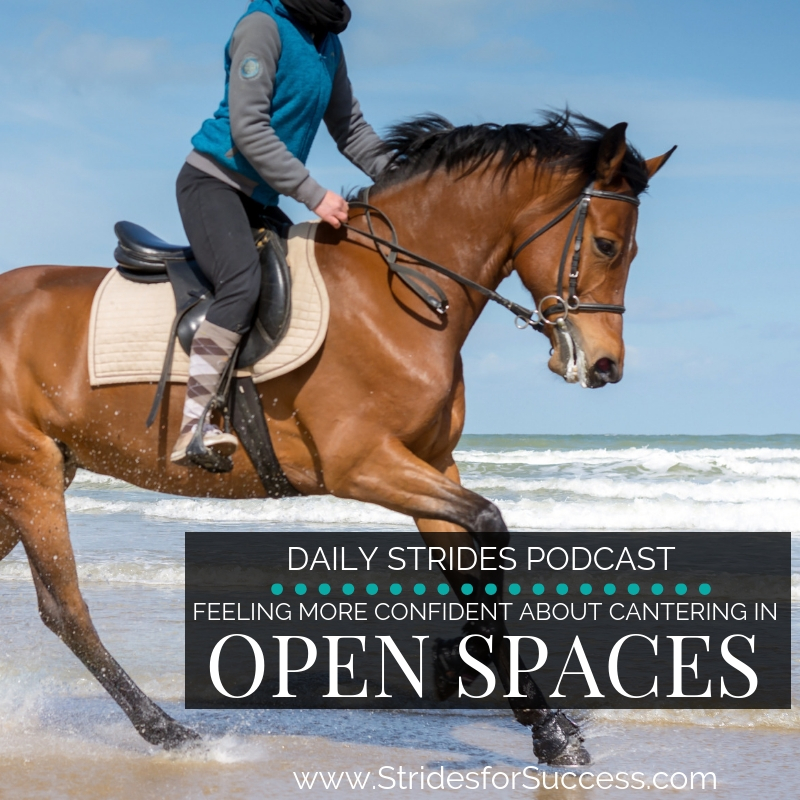
    One of the most thrilling and exciting experiences we can have on horse back can be cantering in open spaces.  There is a feeling of freedom, of ‘two hearts’, of just pure unbridled joy…

    Except when it’s not… For many riders, cantering in open spaces conjures up feelings of anxiety, fear and just all round lack of confidence and control.  However, I believe all riders can work towards having an enjoyable canter in the great outdoors – in a safe and, dare I say, controlled manner.

    In this episode of the Daily Strides Podcast I will give you a few simple exercises that you can begin working on today, to fulfil your dream of that open field canter in the near future.

    It is important to realise that the only thing you can truly control is yourself.  By learning how to better control your thoughts, emotions and actions, you can have more influence over your horse.  Influence – not control…

    I could give you a list of stronger bits and ’emergency brake’ techniques that will definitely give you greater influence over your horse.  However, I am a strong believer that it must be enjoyable for horse and rider in order for it to be a true ‘win’.

    So, we are going to focus on what you can control and improve. You.

    Practice Your Transition into the Canter

    The transition into canter. It often amazes me how some riders seem to think, or at least demonstrate, that they must do the cantering.  No.  Your horse must canter. Keep this in mind the next time you ask for a canter transition.

    Your job as the rider is to set both yourself and your horse up to the best of your abilities for the canter.  Once you have done this, simply ASK for the canter. Then get out-of-the-way and actually allow your horse to canter… 

    It all sounds like common sense, however I see every day how riders throw themselves into the canter. The go from being riders, directing the horse, to being passengers, perched up on the horses withers!  Your horse cannot effectively strike into the canter if you are blocking the movement of the shoulders – which is what ‘perching’ is doing!

    Work on remaining where you should be in the saddle before, through and after the transition. This goes for ‘leaning’ one side or the other as well in order to strike the lead. You don’t strike the lead – your horse does.

    It is amazing what can happen when we are willing to simply ask the question and then wait for the reply…

    Develop the strength in Your Lower Leg & Core

    Cantering is a physically demanding, for both horse and rider. Developing your core strength will go a long way to helping you remain balanced and actively moving with the horse in canter. A stronger core will also help you to feel more confident when applying your aids; particularly those to ask your horse to slow down again!

    The great thing about developing your core is that you can do it out of the saddle. This puts less pressure on your horse and also, gives you far more opportunities to actually improve this part of your riding.  

    Along with a strong core, I believe that a strong lower leg is equally as important.  Many riders, when they feel anxious or stressed, squeeze with their knees.  This effectively blocks your lower legs from doing their job which is namely supporting you and communicating with your horse. 

    No support and a lack of communication are a recipe for disaster, especially when cantering in open spaces. Work at developing the strength and effectiveness of your lower leg by practicing a correct position at all times in the saddle.

    Practice the ‘click of the fingers’ rule which is that if someone could click their fingers and make your horse vanish from underneath you, you should always land on your own two feet. 

    You can join the FREE Equestrian Fitness Challenge HERE to help get you started on improving your core strength.

    Adjust Your Stirrup Length

    Your core and lower leg will only be as effective as your overall position in the saddle.  One of the biggest influencers in your position is your stirrup length and also, how your foot is positioned in the stirrup.

    Ideally, when cantering in open spaces, riding in the light seat or two point seat is the most ‘economical‘ for both horse and rider.

    It allows you to move with the horse while also allowing the energy being created in the hind quarters to move underneath you and connect to the front end, unblocked and unhindered.

    Adjust Your Stirrup Position

    A strong core and lower leg position are necessary for a correct light seat.  However, what is equally as important is the position of your foot in the stirrup.  If your foot is in too deep, or if the stirrup is not angled correctly across your foot, it will result in your ankle joint becoming ‘locked’.

    A flexible ankle joint is essential to a balanced light seat. It is an important part of your ‘shock absorbing system’

    Turn the front of your stirrup (the side closest to your horse’s nose as it falls down the saddle) towards the toenail on your little toe.  Allow the back of the stirrup (the side closest to your horse’s flank) to be just behind, or under, the ball of your foot.

    This will result in the stirrup being angled more diagonally across your foot, rather than at right angles to your foot.  A diagonal stirrup, positioned not too far down your foot will allow for your ankle, and therefore your knees and hips, to move with the energy.

    Start by Cantering ‘Laps’ in an Enclosed Space

    My final piece of advice for developing confidence for cantering in open spaces is to practice in a more confined and enclosed area.  An enclosed arena is perfect.  However, a small paddock or field with good footing will do equally as well.

    Pretend you are out in the open.  Work on improving your initial transition.  Pay attention to how your body is moving with the horse.  Work on developing a solid position and then, finally, on building fitness and mental confidence. 

    Begin with working on the rhythm and trying to maintain a good quality rhythm for a specific period of time or length of canter.  From here, begin noticing how you can influence the energy using your aids.  Practice your half halts.  Make sure you are maintaining contact and also, pay attention to the talk going on in your head. 

    Confidently cantering in open spaces really comes down to how much faith you have in your own abilities as a rider.  The great news is that by following a few simple principles, you can begin building that confidence starting at your very next ride.

    Happy Riding

    Lorna

    Other Posts and Episodes that Relate to This Topic:-

  • The Direct Relationship Between Your Fitness and Your Riding

    The Direct Relationship Between Your Fitness and Your Riding

    The direct relationship between your fitness and your riding

    What this episode is all about & how it can help you:-

    • How your fitness impacts your enjoyment levels when riding
    • The whole ‘staying on the horse’ element
    • Why it improves your communication with your horse
    • Fast-tracking your progress and breakthroughs

    [smart_track_player url=”https://op3.dev/e/traffic.libsyn.com/dailystridespodcast/1323-REPLAY-The-Direct-Relationship-Between-Your-Fitness-and-Your-Riding.mp3″ title=”The Direct Relationship Between Your Fitness and Your Riding” social_linkedin=”true” social_pinterest=”true” social_email=”true” tweet_text=”Still on the fence about improving your fitness levels? This will inspire you” hashtag=”horseriding #fitness” twitter_username=”strides_success” ]

    Do you find yourself huffing and puffing after a couple of rounds of canter with your horse?  Or perhaps you feel exhausted after only 20 minutes into a lesson?  You find yourself wanting to do or give more effort, but you just can’t…

    My goal for this episode today is to inspire you to have even better communication with your horse by improving your overall fitness in the saddle.  It really has absolutely nothing to do with your horse at all.  This is all down to you, and what you can do to become a better team leader, for “Team You and Your Horse”!

    Rider fitness is a topic that a lot of people seem to avoid or overlook its importance to the overall effectiveness of how the horse goes.  Many riders spend hours planning out fitness, feeding, and conditioning programs for their horse, but fail to pay attention to their own fitness.

    Riding is a team sport, you and your horse.  I believe it is unfair and irresponsible, for you as the rider not to try to be the best version of yourself in the saddle.  The best version of you is one that can respond quickly and effectively and this comes down to your fitness levels.

    Focusing on improving your riding fitness levels will have benefits in so many areas of your riding.

    1.  You Will Enjoy Yourself More

    Have you ever experienced physical tiredness when riding?  It causes a slight lag in the relationship between your brain thinking something and your body doing it.

    When I returned to riding after a break, I both understood and experienced this a lot.  There were days when I felt mentally fine after riding, but physically I was exhausted.  That next day and the John Wayne Walk that it brought with it was not fun!

    In order for me to fully enjoy riding, I realised that I had to begin focusing on my personal fitness journey.  

    2. The Whole ‘Staying On’ Element

    One of the biggest benefits for many riders, when they begin improving their fitness levels, is the fact that they usually feel they can stay on a little easier!  Who doesn’t want that?

    The fitter you are, the better you will be able to cope with any unexpected movements that your horse may throw at you.  As riders, we know that when it comes to horses, things can sometimes be unpredictable.   The fitter you are, the better able you will be to control your body.

    Improved fitness simply means you can control your response; as opposed to just reacting, and trying to hang on for dear life.

     3. Improved Rider Fitness Improves Communication with Your Horse

    Personally, I feel that this is the most important reason for improving a rider’s fitness levels.  As an instructor, I often see how after twenty minutes into a lesson (usually the warm-up), tired riders begin to carry or hold themselves differently.

    A further ten minutes into the actual lesson, where real focus and concentrating are called for, they are pretty much exhausted.  The riders become frustrated because they want to do more, and mentally their brain is telling them to push on through.  But the reality is that their body is just not able to respond.

    Those slow responses, and sometimes even wrong responses ends up muffling the whole communication between the rider and the horse.  This in turn leads to even more frustration – not only for the rider, but for the horse as well.

    Imagine, if you were riding fit, how much more you could accomplish in your schooling time.  Physical fitness also lends to mental fitness.  So, when you are physically fit you will find that mentally, your concentration levels also improve.

    Again, from my personal experience, when I returned to riding I often found that my mind would start to wander after a while – obviously from fatigue.  It led to me being less than one hundred percent focused on what I was doing.  But as my fitness improved – so did my focus and my concentration.

     4.  Fast Tracking Your Progress and Breakthroughs

    Which do you think would help you and your horse get quicker and more consistent results?  An hour of ‘so-so’ work or twenty to thirty minutes of focused, quality work?  When it comes to riding horses, quality definitely outweighs quantity.

    Building your riding fitness will ensure that when you are finished, both you and your horse have enough in the tank to actually enjoy the cool-down, and enjoy each other’s company.  It feels like ‘celebration time’ together; you achieved a good quality workout.

    Imagine finishing each riding knowing that you both gave it your best, you gave it your all, and you had breakthroughs.

    Your becoming a better version of yourself fitness-wise, is going to directly impact the breakthroughs that you have in your riding.  The truth is that when a rider is unfit, they spend so much of their time in the saddle playing catch.

    When you are fit, you can focus on what you are communicating to your horse and how you are communicating it to your horse.  This allows you to respond in such a way that your horse is able to gauge exactly what you are looking for from him in the saddle.  It is only natural that this ‘better communication’ will have a direct positive impact on your progress and the speed of that progress.

    Now, bear in mind that I am all for having relaxing rides on your horse, the two of you enjoying yourselves together.  But wouldn’t it be great if you could get the same point across to you horse in, for example, 7 minutes rather than hammering away for 30 minutes and perhaps still being unsure whether the communication was clear?

     5.  Imagine What Your Horse Would Say…

    Hopefully, I have inspired a little something inside of you today to make your personal fitness a priority in your riding and your life.  If not, here is one final ‘nudge’ that might just help get you off the fence and onto the exercise mat…

    Imagine this … you are finished riding, and you put your horse either in the field or in his stable – either way back with his friends (the other horses).

    What would your horse say about you and about the ride as he experienced it? 

    If you are thinking (even a little), ‘oh thank goodness he can’t speak, or even if he can, thank goodness I can’t hear him’ – perhaps that is a sign that you should be doing a little bit more on focusing on your fitness.

    Happy Riding
    Lorna

    Links mentioned in the episode:-

    Equestrian Fitness Challenge ’24

    Let’s walk together for 21 days and have a chat about how you can do much more than you think you can as a rider and an equestrian… I am so excited to bring you along on this journey for the 100% FREE 2024 Equestrian Fitness Challenge
    There will be a daily walk, a 10 minute daily yoga practice, and lots of tips, ideas, exercises, and ways to improve so that you can show up as the best version of you – for you and your horse.
    Sign up today and let’s transform your riding – one stride at a time! 100% FREE 2024 Equestrian Fitness Challenge
    Have a super day
    Happy Riding
    Lorna


    Connect with Lorna online:-

    Get Going in Your Riding:-

    Daily Strides Premium is back! You can use the first and original audio horse riding lessons to improve your riding, train your horse, keep things interesting, and have fun… Even if you don’t have a trainer or coach