[fusebox_track_player url=”https://op3.dev/e/traffic.libsyn.com/dailystridespodcast/1341-Retraining-Rushing-Jumps-Starting-with-the-Rider-First.mp3″ title=”Retraining Rushing Jumps; Focus on the Rider First” social_linkedin=”true” social_pinterest=”true” social_email=”true” ]
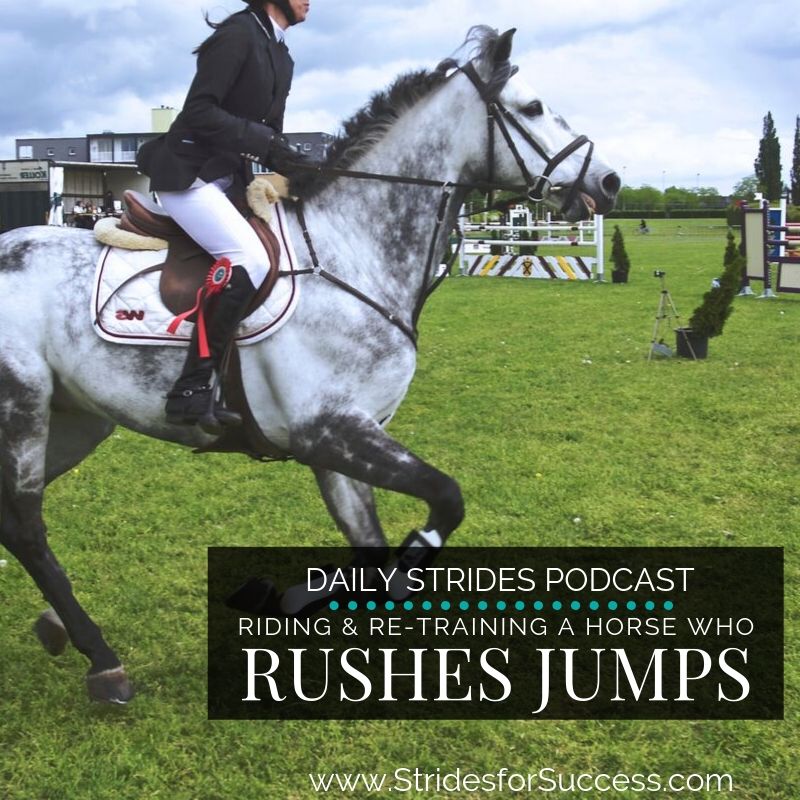
Being on a horse who is determined to run as fast as he possibly can towards every pole, fence, or jump that he sees is nerve-wracking! There are many reasons your horse might do this. And assuming that you have ruled out discomfort or pain, then retraining can begin.
Unfortunately, retraining a horse who has become practiced in rushing jumps is a long and slow process. It requires time and consistency. And often requires the rider to make some changes as well.
In this episode, plucked directly from Daily Strides Premium, we will focus on you, the rider. My goal here is to help you identify where you might just be ‘enabling’ or even encouraging your horse’s tendency for rushing jumps! I know this sounds a little bananas, but it happens more often than you think!
This is an audio horse riding lesson and can be listened to as you ride your horse to help you become more aware of what you are doing in the saddle and how this may be influencing your horse.
Retraining Rushing Jumps – 3 Areas to Work On
I honestly believe that retraining on this particular issue will require a holistic approach if you want to achieve long-term results. Any ‘quick fixes’ that you use (even the ones that seem to work initially) are simply bandaids, Meaning they will slip right off at the first sign of pressure.
1. Basic Training on the Flat
The basics I’m referring to here are half halts, responsiveness, relaxation, rhythm, forwardness, and just overall clarity between horse and rider regarding communication, expectations, and desired outcomes.
2. The Riders Mindset & Reactions
The challenge for many riders in this situation is that it’s so easy to fall into bad habits when your horse is rushing jumps. You must be aware of what you are doing, when you’re doing it, and how you’re doing it. Bringing awareness to your own behavior and reactions will allow you to more easily help your horse.
3. Ground Poles to Retrain Your Horse
The final step is to start small. This can feel really difficult for many riders, especially if they are used to and love jumping more ‘substantial’ jumps! But it is 100% necessary if you want to really help your horse with this challenge. Poles allow for mistakes and don’t require a whole lot to get over. They also give you both the perfect place to begin replacing those habits that have not been serving you both.
Re-schooling Rushing Jumps on the Flat
If you have been struggling with this challenge, the month of October 2024 in Daily Strides Premium is dedicated to working on this. This episode is the first lesson from a week of audio horse riding lessons titled “Re-Schooling the Basics for Both Horse & Rider on the Flat”.
In this group of lessons, we begin working towards re-training a horse who is rushing fences by working on the basic aids, responsiveness and, equally as important, how the rider thinks.
Remember, re-shooling a horse usually involves also re-training the rider to think and act differently as well. The horse will respond better if the rider changes their approach and is consistently correct in what they are doing and asking…. These lessons will help you to develop better habits and responses.
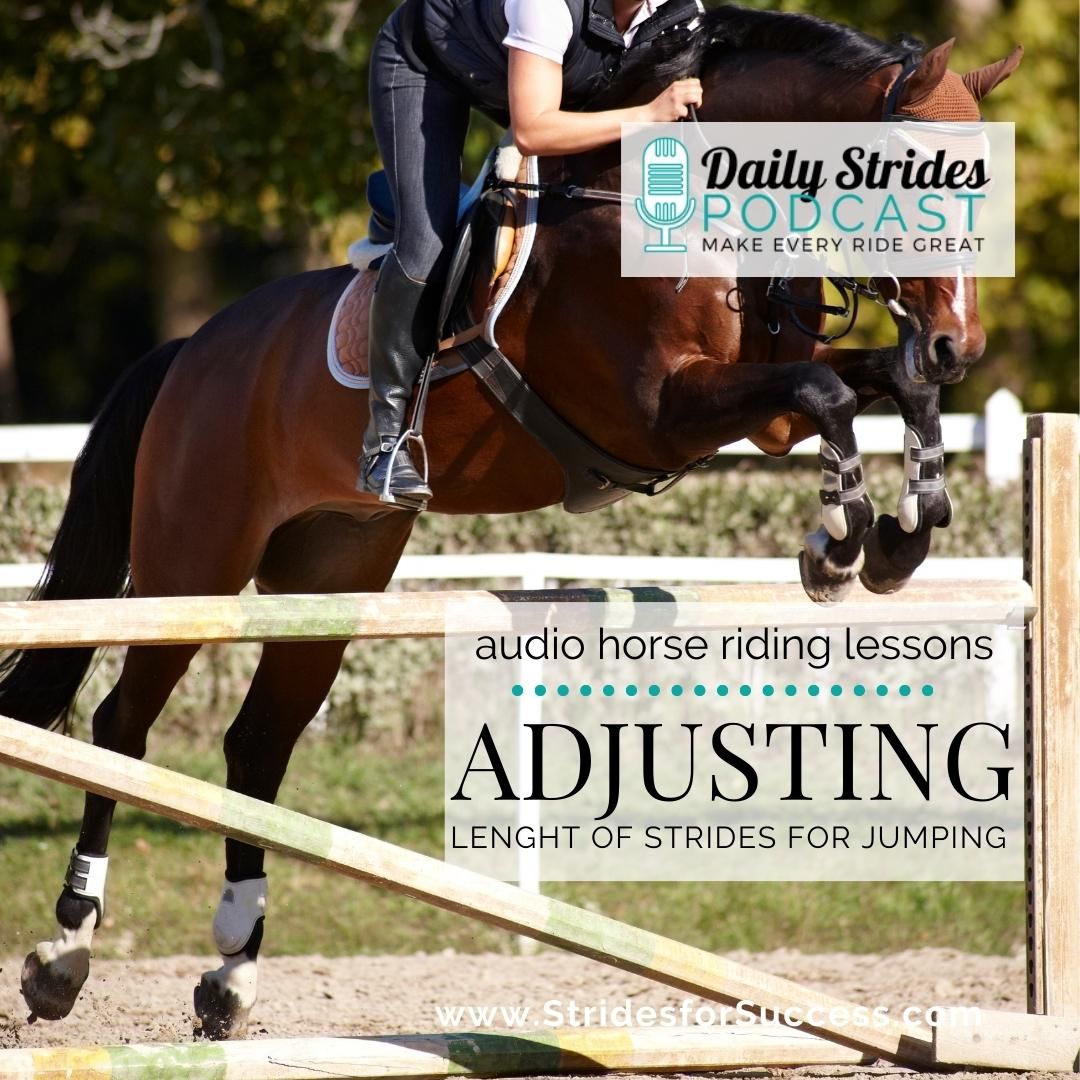
If you enjoy jumping with your horse, riding that clear round is all important. Luckily there are a few key areas you can work on in your training that will help you to begin seeing more of them. Adjusting the length of your horse’s strides is just one of those. And it’s also a pretty useful exercise for all horses and riders, jumping or not.
If you can begin to intentionally help your horse to have either a shorter or a longer stride, it gives you both flexibility and adjustability in your riding
In this episode of the Daily Strides Podcast, I want to help you to begin to understand just how versatile this exercise is to have in your toolkit when it comes to riding your horse.
Predicting Your Horses ‘Arrival’ Point
Like anything, if you can more accurately predict the outcome of something, you can begin to make changes or preparations for how it will be. Jumping is no different. When you can begin to ‘see’ the point your horse will actually take off from the fence, from a distance away, you can make decisions based on that.
In fact, being able to see a ‘point’ for something to happen further on down the line is useful regardless of what you’re doing with your horse.
And when jumping, remember, that all horses are different. So when we think about jumping tracks the distances, however well planned, won’t suit all horses. However, if you can accurately predict where your horse will be 5 or 6 strides from now, and then make adjustments to those 5 or 6 strides; well it won’t really matter, will it?
Before Adjusting the Length of Your Horse’s Strides
Like most things, there are a couple of prerequisites that riders and horses will have to develop before they begin adding this to their training program. The first of these, I feel, is the ability to see and then ride a line. This is often one of those ‘easier said than done’ things.
And while many riders might be able to ‘see’ the line; riding it is a whole other story!
Another important element to both understand and effectively ride is the half halt. Having control over your aids to clearly communicate this to your horse is key to it working for you. Whether that is to balance, rebalance, correct, or just focus attention and energy.
Adjusting the length of your horse’s strides is not pulling their mouth or kicking on; it is harnessing the energy to make changes to your horse’s way of going.
Understanding Impulsion
Whether you’re shortening or lengthening, maintaining the desired level of impulsion is key to effectively jumping the actual jump! Pulling too much and slowing things down in a misguided attempt to shorten will not work. Sure, you might fit more strides in between here and there. But when you do get ‘there’ your horse won’t be ready to actually jump the jump. Which, is the whole point of the process.
Similarly, kicking on and chasing your horse to lengthen will result in your horse flattening and becoming heavy on the forehand; again not a great way to meet a jump!
Impulsion needs you to really have the correct level of tension present inside of the container that makes up you and your horse. This tension (relaxation) combined with the actual energy needed (forwardness) and a good and consistent rhythm will help maintain impulsion. And, when working correctly, impulsion leads to straightness. Another key element when jumping those clear rounds.
Seeing a Stride
This is a skill that, as a rider, needs to be developed in order to really get the benefits of adjusting the length of your horse’s strides. After all, it makes little sense adjusting them if you’ve no idea where you really want to be at take-off!
Seeing a stride simply means that you can accurately predict where your horse will be in a specific number of strides time.
It’s being able to say, “in 5 strides from now, all being equal to what we’re doing now, we will be ‘there’.” And based on where ‘there’ is, you can then decide if adjustments need to be made to the actual length of the strides. Changing the length of the stride will prevent chipping in or standing off the jump. Neither of these are ideal for clear rounds!
If ‘there’ is too close or too far away from the ideal take-off point of the jump, you have now 5 strides available to adjust that point. And this is often the difference between a pole staying up or coming down.
Counting Yourself Down
Start learning how to see your stride by playing a game with yourself over a single pole on the ground. Canter back and forth over the pole and see if you can accurately and correctly predict the point where you will have 3 strides left to go before ‘jumping’ the pole.
Accountability is key here; say out loud 3, 2, 1, jump. If you get 3, 2, jump or 3, 2, 1, 1, 1, jump – clearly there’s an issue!
Once you have eventually mastered this skill, you can begin to make it a little more difficult. Begin predicting where 5 strides between you and the pole will be. Again, count yourself down. Counting yourself ‘up’ (1,2,3,4,5) won’t work as you can just keep counting! I also find that riders who initially count in their heads also struggle! Their brain wants them to be right, so they can tend to tell themselves porkies!
When you can accurately predict the point where your horse will fit 5 or even 7 strides in between you and the pole, this is where you can start to see where adjustments should be made. And, this is where you can begin working on making those small adjustments over every stride to result in a big difference.
Shortening Your Strides
If you can take 2 inches off each of your 5 strides, it means you can change the ‘take-off point’ by 10 inches. That is nearly a foot or 30 centimeters. And that is just shortening by the smallest of margins, 2 inches or 5 centimeters.
Imagine when you and your horse develop this skill; you can shorten strides by 10 inches per stride (or more). This will truly give you the flexibility you need to meet each jump at the right place each time. So that your horse has the best possible chance of clearing the jump.
Shortening is not slowing your horse down. It is not pulling his mouth or throwing an ‘anchor’ behind you in the sand!
True shortening will allow you to maintain the energy, rhythm, suppleness, impulsion, contact, and straightness in order to reach the jump in the best possible place to clear it from. Sometimes, when we shorten, your horse might not initially have enough strength in his body to maintain the above; this is where your aids will act like boundaries to help your horse.
Shortening the strides also requires that you maintain a lightness in both how you are riding and your horse’s way of going. Light and bouncy; not heavy and ‘stuck in the mud’.
Lengthening the Strides
So many riders think lengthening and speed are related. I have honestly watched people and said silent prayers in my head that they get from A to B in one piece! It can be nerve-wracking watching a rider who has confused rushing or chasing with lengthening.
To effectively lengthen the stride, you must maintain the energy, the tension, the contact, the forwardness, and – maybe most importantly – the impulsion.
Chasing your horse on to the point where all of the energy falls out the front door is not lengthening. In fact, it is just downright dangerous as your horse will find it very difficult to find the ‘lift off’ gear and get his shoulders over the jump!
As you ask for your horse to lengthen, make sure you’re not getting ahead of or in front of the movement. If you are leaning your weight in any way on your horse’s shoulders or withers, you make jumping the jump so much more difficult for the horse. Sit up and remember to ride!
Adjusting the Length of Your Horse’s Stride
My big piece of advice when you are beginning to work with adjusting the length of your horse’s stride is to start small. A couple of inches either way are either longer or shorter. Being able to have this level of adjustability in your horse can change so much when it comes to your training in general.
Remember, you are simply ‘asking’ your horse to lengthen or shorten; you’re not doing the work yourself! Don’t lie back and don’t throw your body forward.
And, as I said at the beginning, this type of suppleness and adjustability through your horse is not just for jumping. You can and will use this in all day-to-day riding. And it’s a great exercise to work on with your horse as well.
[fusebox_track_player url=”https://op3.dev/e/traffic.libsyn.com/dailystridespodcast/1266_Safely_Including_Jumping_In_Your_Training_Program.mp3″ title=”Safely Including Jumping in Your Horses Training” social_linkedin=”true” social_pinterest=”true” social_email=”true” tweet_text=”Safely getting started with jumping” hashtag=”jumping #horse” twitter_username=”strides_success” ]
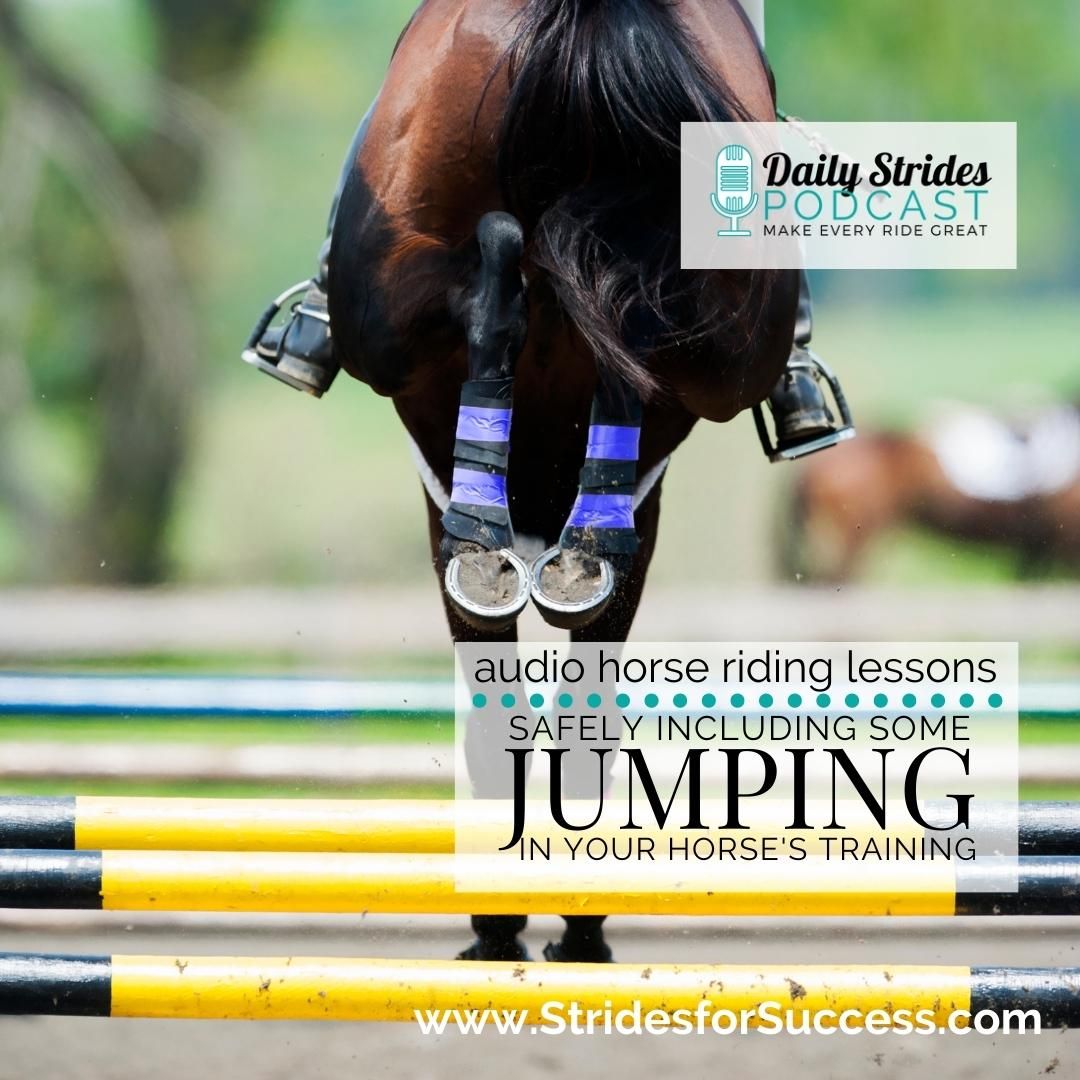
Whether you enjoy jumping or not, the fact of the matter remains… When approached correctly and consistently, jumping can greatly benefit both horses and riders in a long-term training program. Even if there is no intention of actually ‘jumping’ competitively. And this is true regardless of discipline, training level, and experience.
When introduced the right way, and then strategically used jumping is a great way to add diversity to the training – and physically and mentally develop the team.
So, here are three simple ways you can get started and begin using jumping this week in your current training program with your horse. And, keep in mind, nothing has to be ‘higher’ or ‘bigger’ than 30cm (12 inches), deal? ;)
Exercise 1 – Pole on the Ground
This is exactly how it sounds, a simple pole on the ground between two uprights or ‘wings’. Now, if you don’t have any fancy uprights, you can use pot plants or something else to create the ‘wing’ for your ‘jump’. Poles on the ground are a great way to include jumping in your horse’s training – without the risk of injuries. They also allow both you and your horse to develop your abilities and confidence before tackling a ‘pole off the ground’! ;)
Focus on the line you take and make sure it remains straight before, over, and after the pole. Pay attention to the rhythm on the approach and the get away from the pole as well.
The line is important as this will begin to ‘train’ both of your eyes to ‘see a line’. And the ability to ‘ride a line’ is vital in all forms and disciplines when training horses and riders. Notice the turn onto the line; are you overshooting it, or maybe undershooting it? And what about the getaway from the jump? By consistently using jumping in your horse’s training you will develop greater rhythm and flow to your overall ride.
Work over your pole on the ground in walk, trot, and canter. Then begin to add more poles to your ‘track’. Test your ability to stay on the track and maintain rhythm between the poles.
Exercise 2 – Working Over a Cross Pole
Who doesn’t love a nice cross pole?! They are so helpful, inviting, and friendly to both the horse and rider. Cross poles come in all sizes. From the center of the jump (the cross) being just 15cm (6 inches) in height, to the center being closer to 90cm in height (3 feet). Regardless of size, most of the benefits remain the same, which is what makes this a super addition when including jumping in your horse’s training.
A crosspole will help to develop you and your horses straightness further by inviting you both to the centre of the jump.
When you couple this with your training over the poles on the ground, it will allow you and your horse to really being developing strength and suppleness. Cross poles also ‘seem’ smaller or lower than uprights. It makes me laugh how often a rider will happily jump a 45cm (18 inches) cross pole, but balk at riding an upright of the same height! Looks can truly be deceptive when it comes to cross poles, which is why they are great for building confidence.
Focus on establishing a rhythm before the approach, such as on a 20m circle. Then work on maintaining that rhythm as you ride the straight line to your crosspole.
Then work on your straightness after the fence. And finally, transition onto another 20m circle – this one on the other side of your jump. The goal will be to keep the same rhythm and forwardness throughout the exercise. Simple and can be worked over quite a few times without the risk of injury, and effective :)
Exercise 3 – Adding Another Fence
Have you ever noticed how your interactions with your relations, in general, can often encourage (force) you into growing and developing as a person?! True story! Well, jumps that are related to each other can do a similar thing for you and your horse. They encourage you to take what you have and what you can do and then develop it further.
The key to safely adding another fence when using jumping in your horse’s training is to figure out what your horse is comfortable with right now. How much ground does he comfortably cover each canter stride…?
Comfortable is a keyword here. Yes, later in your training you can use distances that don’t quite suit your horse to ask him to lengthen or shorten. However, when you are just getting started with introducing jumping to your horse’s training, it is vital that your horse decides the distances.
Again, start with a cross pole to a single pole on the ground. Find out what distance really feels comfortable for your horse. Then begin to build the pole on the ground into another cross pole. Once you and your horse are happily and comfortably jumping the two fences, you can begin to refine what you are doing. The options are endless here. And the key is to build slowly.
Try Some Jumping in Your Horse’s Training
So, regardless of what your chosen discipline is, working over small fences can really help both horse and rider improve their connection and their training. From developing more feel for timing, to actually trusting each other more, riding over fences can be an amazing experience for all involved.
[fusebox_track_player url=”https://op3.dev/e/traffic.libsyn.com/dailystridespodcast/1240_Effectively_Riding_the_Space_Between_Jumps.mp3″ title=”Establishing Flow in the Space Between Jumps” social_linkedin=”true” social_pinterest=”true” social_email=”true” tweet_text=”How to use the space between the jumps to improve your riding overall…” hashtag=”horsepodcast” ]
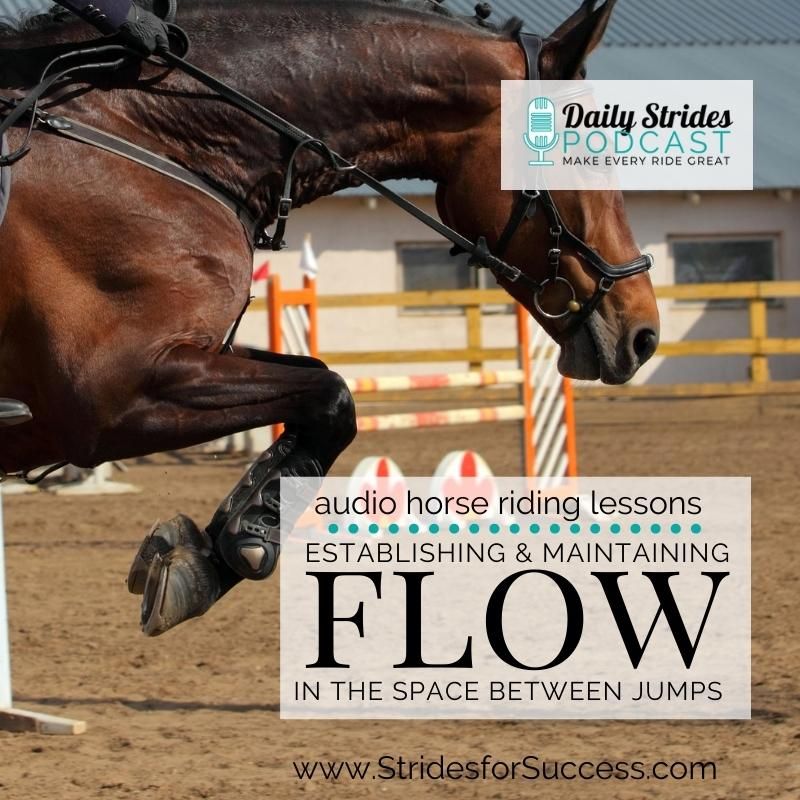
Jumping is one of those things most riders love or hate. In my experience, their personal preferences depend on how well they can use the space between jumps. If every jumping track feels like a tug of war from start to finish, it’s easy to see how jumping itself won’t be all that enjoyable. The same applies if the rider feels like they are doing the work for both themselves and their very uninterested, laid-back, and uninspired horse!
One of the best ways to improve your jumping is to work on the space between jumps. This will improve the overall experience for both horse and rider…
But simply saying the space between jumps can sound a little overwhelming. After all, we really are only ‘jumping’ for a tiny amount of time. The rest is spent working inside of this ‘space’. I think there are a few key areas you can begin to improve, to help both you and your horse get more out of working over fences.
1. Get Clear on Your Track
Riding a line is something that I believe all riders need to know how to do. This is regardless of if they are riding on the flat (doing flatwork) or riding over fences. Without the ability to both see and line and remain true to the line, things will ‘wander’.
Riding a line allows you and your horse to remain focused, stay on track, reach where you want to go in the best possible way and keep energy flowing.
This is really something worth practicing. Start on the straight, and simply work on being able to ride between two points without wandering. From there, work on remaining on track both before, through, and after each corner, you ride. Finally, work on both creating a curved track and riding a curved line.
Once you feel confident riding a line, simply put poles or jumps to mark the A and B of your line, and practice using them as well.
2. Notice Weak Points
As you begin to work on your lines and make them more accurate, you might notice leaks. These leaks are where energy is being lost through the horse, rider, or both. It could be an outside shoulder that doesn’t want to connect the energy through (falling out) or maybe an inside hind leg that is finding it difficult to stay on track.
By figuring out where you and your horse are losing energy, you can work on strengthening those weaker points and, because of this, create more flow.
A good way to assess this is to first ‘feel’ the energy. Is there a corner or bend where, once you have ridden through, you find you have to do a lot to reestablish things again? Or is all the energy flowing too fast out of the front end, rather than being recycled and contained?
Once you have identified the issue (and almost all horses and riders have weak points), find exercises to help strengthen and correct this. Remember this process will take time.
3. Develop the Rhythm
When you know where you’re going and you can maintain a certain amount of energy getting there, the next step is to develop your rhythm. Whether you are working in trot or canter, maintaining a rhythm in the space between jumps can be a challenge.
Many riders experience changes in the tempo, especially on the approach to the fence. There is a quickening of the footfalls… And this can often lead to a loss of relaxation.
I think that practicing over ground poles is a great way of getting started when trying to establish and maintain rhythm. It allows the rider to simply work on the space, without actual jumps complicating the issue for them. I also like to use unrelated distances when doing this exercise. As in, two poles on either side of the arena that the rider must ride a half oval shape between.
This is also a great way to notice how relaxation (the level of tension present in horse and rider) can affect rhythm. And vice versa. By becoming keenly aware of these smaller changes, you can begin to create a more fluid, consistent, rhythm around the whole course of fences.
4. Become More Aware
The final point I want to make today is regarding you, the rider. Very often, it is actually us and what we are doing while riding in the space between jumps that are causing things to go a little awry. Getting ahead of the movement is a big issue I see many riders struggle with. Also, too much tension is present in the rider’s body. This one is often due to thoughts or beliefs that the rider has.
As you begin to more consistently model to your horse what you actually want from your horse – your horse will improve.
So, instead of worrying about what your horse is doing and ‘fighting’ him on it. Rather focus on yourself and improve your responses. Are you moving with your horse? How about tension; is the amount in your body right for the task at hand? And also position; are you in the best possible place to both communicate and support your horse?
By tidying up your riding style and basics, you can have a huge positive influence on your horse. You can also much better use the space between jumps to school and train your horse – and to get clear rounds!
Does your horse go from 0 to 120 in half a stride whenever he sets his sights on a jump? If so, you will probably agree with me that jumping is definitely not the thing you find most enjoyable to do with your horse! In fact, very often it can feel terrifying!
And I agree. Jumping with a horse who is rushing at the fences is not just scary, but also dangerous and frustrating. I don’t think the height of the obstacles or jump really matters here. Whether you’re jumping 30cm or 1.30m; hurtling towards a fence feeling completely out of control is no fun for anyone.
[smart_track_player url=”https://op3.dev/e/traffic.libsyn.com/dailystridespodcast/1116-Riding-A-Horse-That-Rushes-Jumps.mp3″ title=”Re-Training a Horse who is Rushing Jumps” social_linkedin=”true” social_pinterest=”true” social_email=”true” tweet_text=”Does your horse approach jumps like a rocket? Here are a few ideas on how to change this…” hashtag=”equestrian #horseriding” twitter_username=”strides_success” ]
It is also, as I just mentioned, really dangerous. Rushing causes horses to flatten over fences, which basically affects both the ’take-off gear’ as well as the ‘landing gear’. Rushing and the said ‘flattening’ also prevents your horse from making a good bascule, basically the arc he makes with his body as he goes up and over. This leads to poles being rubbed and 4 faults littered all over the arena.
This episode of the Daily Strides Podcast will hopefully give you some ideas on how you can begin reshaping jumping in your horse’s head. Re-training or re-schooling is going to be essential in order to completely ‘cure’ your rusher.
It is also important to note that these things usually take time; be willing to be patient while being consistent in order to get results.
Why is Your Horse Rushing at Jumps?
Firstly, I am going to assume that you have made 100% certain that pain or discomfort is not the reason your horse is rushing. I am also going to assume that your horse does not have an anxiety issue. This can often show up with a horse who has been over faced or a horse who simply does not trust the rider. I feel that this is a separate issue and today’s advice is not really tailored towards that type of horse…
There are lots of reasons horses rush at jumps. Usually, it is a training issue, basic training or the lack thereof to be precise.
Very often when rushing has really become an established habit or reaction, it is because it has actually been ‘allowed’.
How the rider responded when the horse initially began rushing often sets the scene for what occurs going forward from that point. A rider who remains calm and goes back a few steps will result in a very different outcome to a rider who pulled, ‘hunkered down’ or became overly tense.
Increasing the rider’s confidence is key to actually overcome this issue. As the rider’s confidence in their own abilities grows, so too with the horse’s confidence in the riders abilities. This can change everything where rushing is concerned.
The ‘Over-Enthusiastic’ Horse
Often horses who are deemed to be naturally ‘hot’ or ‘sensitive’ will start rushing at their jumps. There are lots of reason why this happens. However, the riders response to the ‘excess enthusiasm or rushing is key. Many riders ride horses like this using no or the absolute minimum of leg aids.
They keep their leg ‘off’ the horse because they think that their leg will encourage the horse to go faster. Or to become hotter.
This all works well; until it doesn’t! And it doesn’t where jumping is concerned. Your legs are essential to not only create energy on the way to the fence but also to help direct this energy. You cannot effectively direct the energy if your leg is off; which causes a big problem for a horse who only knows the leg when the rider is in crisis mode!
Couple this with the fact that the rider is probably feeling a little stressed at this point. It is not too far of a reach to suppose that they are clamping a little with their legs as well…
The Tug of War…
Another way riders can worsen an already fast and rushing horse is by puling against the horse using the reins. it is natural to want to slow and steady – or even stop – something that is hurtling out of control towards something else. Particularly when you are on that somethings back!
However, the pulling out of the reins and saying three Hail Marys approach only serves to give your horse something to pull against. Something to ‘lock in to’.
Let’s be honest here; you are never going to win a tug of war singlehandedly against something that potentially weighs 10+ times your own body weight. This is especially true when your horse has a boatload of momentum on his side as well. It’s the proverbial stopping the freight train.
The only way to really begin to slow down a horse that rushes is by addressing the problem before there is ever a jump in sight. Working on your horses basic training.
Start with Basic Training
I know, it all seems so, well, basic! But this is truly the only way that you will really and truly re-train or re-school a horse who has developed the habit of rushing at fences or jumps. I also feel that it is really important to note that this doesn’t involve any actual jumping! Working on the flat is your key to correcting a horse who is rushing over jumps.
The half-halt is key to re-training your horse to ‘wait’. Play with it in both trot and canter.
It is also important to make sure that your horse understands your leg aids. Fine-tuning responsiveness will go a long way to helping to slow things down a little on the way to a jump or fence. I also feel that the quality of the trot or canter is a really important consideration.
Perfecting your half-halt in a trot or canter that is going no-where slowly will not really help you when your horse locks his eyes on an upcoming jump! You must make sure that the gait you are working in is one that your horse could technically jump a jump from. The jump, in this case, would be a 90cm to 1m (3’ to 3’6”) jump. Big enough to respect but not too big to really cause any issues in and of itself.
Do you need to jump a jump? No, of course not. Just keep a check that while working in the gait you are riding and working in, if you needed to, you could.
Responsiveness & Straightness
I also think that it is important to, as I mentioned, fine-tune your responsiveness. This is both up and down in your gaits and speed. You need your horse to be attentive and listening for any directions you are going to give him.
By building your responsiveness on the flat, you will increase your chances of your horse actually listening to you when a jump appears.
Straightness is another element that can have a large impact on steadying up your Ferreri when a jump is firmly in his sights. Straightness is one of those things that has the potential to be overlooked when working on the flat. A speed wobble here or there is not going to cause too many issues for most riders.
However, being able to keep your horse straight and keep the energy directed where you want it to go is essential for jumping. It should not only be practiced when actually jumping itself!
It is often when the rider puts their leg on in order to straighten the horse for a jump, that the horse responds by shooting off like a rocket at the said jump. Your horse needs to understand basic principles of riding such as your leg aids, half halt and straightness long before he ever sees a jump.
Make Your Horse Think
Once you have a little more understanding between you and your horse happening on the flat, you can then look at beginning to ‘build’ things. one of the best ways to slow a horse down is to make him think. Anything that requires a little concentrated effort, will usually result in him naturally steadying things up himself.
Groundpoles are great at getting horses to think. They require a horse to actually consider where they are going to put their feet – which usually has the result of slowing things down a little.
You can use groundpoles both on their own, before a jump and after a jump. It is the ones after a jump that I find have the greatest impact on a horse who likes rushing over his fences. They make him look at where he is landing, which has the knock on effect of taking a moment to actually consider the landing.
Horses who rush fences often jump very flat over the jump itself. They are a little like an arrow, with a downward trajectory.
The ground pole after the fence usually results in your horse raising their head and neck a little, which helps you to remain a little more ‘in control’ and able to influence more.
Cross Poles rather than Uprights
I am a huge fan of cross poles for so many different reasons. One of the big ones, especially when working through challenges like this, is that they build riders confidence. For some reason, riders tend to think that horses jump the height of the X in the center of the cross pole. They don’t, they jump higher as they wouldn’t fit in where the X is.
Remember I said at the beginning how important the rider’s confidence in their own abilities is when re-training a horse who has an ingrained habit of rushing? Well, anything that builds confidence is good.
Cross poles not only build confidence, but they also help with that all important straightness which is essential for good jumping. Trust me, they are the jump to work with initially when re-schooling a rushing horse!
Then place the groundpoles both before and after your jump. How far the groundpoles are from your jump depends on your horse. However, 3m is a good distance to start working with. Keep in mind that, as with all poles, you may need to adjust the distance to suit your horse. Not the other way around.
The Riders Position
The final point that you should work on when working with a horse who is rushing their fences is you. You the rider. What are you doing on the way to, over and then after the jump? In order to truly re-school your horse out of rushing, you need to be able to remain balanced and secure all the way to, over and away from each jump.
Now, I get it that speeding flat out towards a solid obstacle has the potential to change your reaction a little. Meaning that perhaps you are not doing what you usually do when jumping…
Many riders of a horse that rushes jumps tend to ‘hunker in’. It is a hamster impression. The curved back, chin to chest. A lack of any engagement of core – or anything else for that matter. Basic survival is the name of the game! And I can understand why if you are caught off guard.
However, if you are riding a horse who regularly tackles jumps at 120mph, you really need to pay attention to what you are doing on the approach, over the jump, and as your horse lands and leaves the jump.
Do As Little As Possible
Many riders seem to think that they have to fold flat down onto their horse’s neck when jumping every single fence. I want you to keep in mind that the degree of bend in your hip should be dictated by lots of different circumstances. An important one is the height of the fence.
If you take my advice, you won’t be popping over any ‘substantial’ fences for a while. Small jump requires minimal folding from the rider. Rather wait and only do what is absolutely necessary over the jump. This leaves you in a perfect position to better influence your horse on landing.
And landing is important because one jump usually leads to the next. You aim should be to feel ‘in control’ and have the horse nicely balanced and working before you reach a corner or bend after each fence.
It Will Take Time
As I said at the beginning, this is not something which you will completely re-train or re-program overnight in your horse. it will require consistent correct training, a lot of which will have nothing to do with jumping, in order to un-do or replace this tendency in your horse.
However, being able to approach a jump without having to worry about flipping over, crashing through or skidding around the corner afterwards is important.
So if you enjoy jumping, this is definitely something that is well worth your time working on.
What this episode is all about & how it can help you:-
Understand the importance of a solid position to begin with
Realise that timing is everything when it comes to jumping with your horse
Feel motivated to learn ‘how’ your horse jumps
Get started improving your skills over fences today
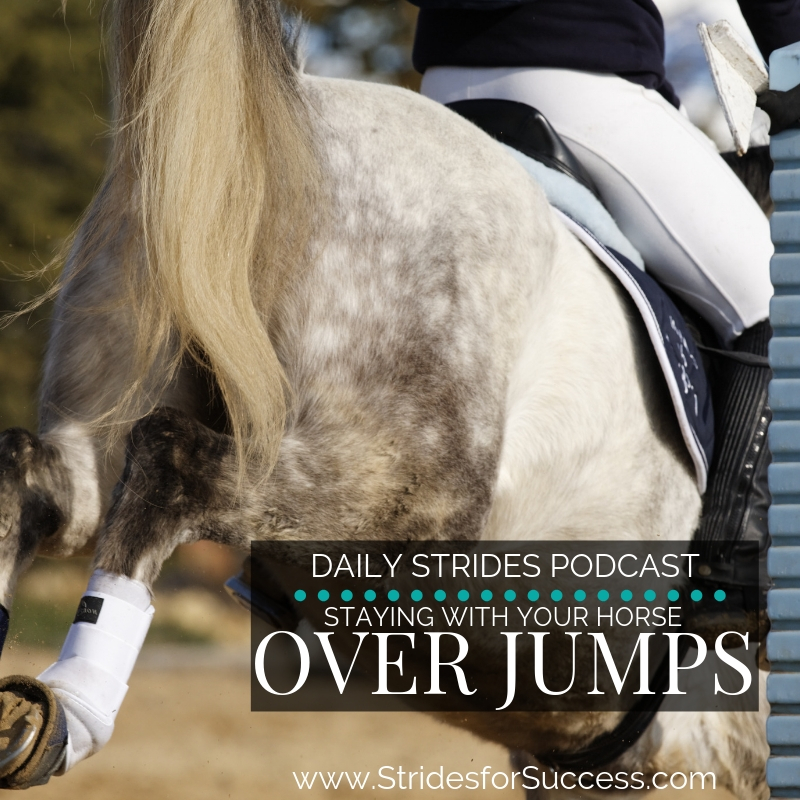
[smart_track_player url=”https://op3.dev/e/traffic.libsyn.com/dailystridespodcast/1083-Staying-with-Your-Horse-Over-Jumps.mp3″ title=”Staying with Your Horse Over Jumps” social_linkedin=”true” social_pinterest=”true” social_email=”true” tweet_text=”This weeks podcast episode is focused on ‘Goldilocksing’ your jumping – getting it ‘just right’” hashtag=”equestrian” twitter_username=”strides_success” ]
Do you find that your jumping is a little ‘touch and go’? Some days you are great at staying with your horse over the fence. However those other days are showing up a little too often for you to be truly confident and positive about your jumping.
Staying with your horse while he jumps helps you both to feel confident and relaxed. It allows your horse to use himself fully and correctly. And it allows you to remain balanced and ride a great ‘get away’ from each jump
In this episode of the Daily Strides Podcast I want to give you some simple tips and instruction regarding how you can become more ‘hit’ and less ‘miss’ where your jumping in concerned.
I am going to give you a few ideas to work on when you are in the saddle with your horse, along with some that can be done from the comfort of your home.
Your Jumping Position is Constantly Shifting
I want to begin by pointing out something which I feel is pretty obvious, but often overlooked by many riders when it comes to jumping. Your jumping position is not ‘fixed’. There is no ‘plug in and play’ when it comes to your jumping position.
Think about your position when you are walking, trotting or cantering. There are subtle shifts and changes happening all the time.
Every second of each stride involves a slight shift or change in your position in order to remain ‘with the horse’.
While most riders apply this to their riding ‘on the flat’, so many riders approach their jumping position differently. They ‘fix’ themselves in it. Brace themselves for the jump. Often this happens long before the horse has every actually jumped. And they remain motionless there until the horse has all 4 feet safely back on the ground, sometimes a stride or four later!
Developing a Strong Yet Supple Position for Jumping
While there is a ‘position’ for jumping, this in no way means that you must ‘fix’ yourself in this position. The more supple you are, the stronger you are and therefore the more you can move with your horse as he jumps.
Your joints must remain supple enough to make the required small shifts as your horse moves over the jump itself. Simultaneously, your position must remain strong enough to carry your body throughout the movement as well.
Strong, yet supple… We have heard that before when it comes to riding, haven’t we?! However so often it is applied to the horse. I want you to begin applying it to yourself and your abilities in the saddle.
I believe the ‘click your fingers’ rule when it comes to your position applies just as much to jumping as it does to flat work. Basically, at any point before, during or after the jump, if your horse was to magically ‘vanish’ (by someone clicking their fingers) you would land on your feet.
You are responsible for your own balance throughout the jumping effort.
If you are depending on your horse to support or balance you, you have work to do! I suggest working on the flat initially before starting working over jumps.
Timing is Everything when Jumping
As riders, we know that timing is important. It is necessary for clear communication between horse and rider. In jumping timing is also essential to allow your horse to actually use himself correctly over the jump.
One of the most common reasons riders struggle to stay with their horse over a jump is due to ‘ducking’. Ducking basically means that the rider has transitioned into their jumping position before it was necessary to do so. This can be a half a second too early, or two strides too early!
In order for your horse to use himself correctly over fences, you need to get out-of-the-way and allow him to jump!
This means waiting until he begins moving up and over the fence before you follow him there. The important word in that sentence is ‘follow’.
Set Things Up – Then Follow Him Over
Your job is not to jump the jump! Your job is to set things up so that your horse has the best chance of successfully jumping the jump.
I see riders throw themselves at fences (and therefore, their horses necks) as though the further up the neck they can get, the better the jump. The irony is that the opposite is true.
In order for your horse to jump, he has to ‘lift’ his front end. Having all the rider’s weight been flung onto the very thing he is being asked to lift, makes his job so much harder!
Rather think of sitting tall in order to give your horse the space he needs when lifting his front end. As he begins to lift, over the jump, you simply follow. Let your horse come up to you and then follow him over.
Learn How Your Horse Jumps
How much you need to do in order to remain balanced while you follow him will depend on your horse, the jump itself and your abilities as a rider. I think that one of the most basic things you can do as a rider is learn how your horse moves over fences. Study his body. And the great news is, you can do this from the comfort of your couch!
Having a clear picture in your head about how your horse is moving over jumps will allow you to feel more confident about how to best move with him while he jumps.
Look at his body as he approaches the fence. Pay attention to the changes in his overall frame, especially on the final stride as he transitions to actually jumping. Look at how he uses his body over the jump. How he goes from the approach side to the landing side. Pay attention to how he lands, particularly his head and neck at this point. Finally, look at the first few strides after the fence.
If you don’t have the opportunity to study your own horses jumping technique, through videos or photographs, look at other horses.
Go online and find YouTube videos. Watch jumping competitions on the TV or go in person and watch them live. You will begin to see similarities and patterns. Study how the horses use themselves. Understand what helps and what hinders. Then take this knowledge and apply it to your riding and your position over the jump.
Start Working On It Today
Jumping is really just a big canter stride. This is great news if you are feeling less than capable of staying with your horse over each jump. The reason is, you can actually begin working on it while on the flat.
The two point seat or light seat is your friend when it comes to developing suppleness and strength for jumping. Work in it daily when in the arena. Keep in mind that you are responsible for balancing you. Your balance is not your horses concern!
From here, begin working over a single pole. Practice transitioning in and out of a jumping position over the pole. Work on your timing and your strides.
Begin merging what you are feeling through your body in the saddle, with what you know your horse is physically doing underneath you
Once you are confident walking, trotting and cantering over the single pole, you can begin ‘building’ your jump. As your jumping becomes more ‘hits’ than ‘misses’ both you and your horses confidence will grow. So too will both of your enjoyment about jumping.
Learning to stay with your horse over fences is not a difficult task. Consistency is key and, like most things in riding, my number one piece of advice is to start small and get the basics right.
Happy Riding
Lorna
Other Posts and Episodes that Relate to This Topic:-