Tag: leg yielding

  • Leg Yielding to Refine Your Asking Aids in the Saddle

    Have you ever considered that, when riding, you have been thinking about things all wrong? You have been trying to move your horse; rather than asking your horse to move. One of the areas I see riders trying to move their horse is when working laterally. Leg yielding is a great example. Riders will try to push and shove their horse across the arena.

    [fusebox_track_player url=”https://op3.dev/e/traffic.libsyn.com/dailystridespodcast/1165_Leg_Yielding_to_Refine_Your_Asking_Aids_in_the_Saddle.mp3″ title=”Leg Yielding to Refine Your Aids in the Saddle” social_linkedin=”true” social_pinterest=”true” social_email=”true” tweet_text=”Have you been trying to move your horse, rather than asking your horse to move? ” hashtag=”equestrian” twitter_username=”strides_success” ]

    You don’t move the horse. You ask your horse to move. If you began to actually implement this in your riding, it has the power to change everything.

    Efforting does not equal results. Especially where lateral work is concerned. The key is to have built responsiveness to a point that you can ask a question of your horse, and your horse will simply respond.
    Leg Yielding to Refine Your Asking Aids in the Saddle

    Loss of Forwardness

    It is easy to spot a rider who is trying to move their horse. The physical effort it requires to move the mountain results in any forwardness being lost. And leg yielding, as I teach it, is ‘forward and sideways’. Notice the forwards comes first in that sentence.

    When you begin shoving or pushing your horse sideways, you mentally stop focusing on moving forwards

    This then physically manifests in your horse’s way of going. Yes, maybe your horse will continue to edge up the arena or along the road, but the rhythm and sense of purpose that was taking you there are lost. In fact, most horses become resistant and overly tense because of the change in how the rider is riding.

    Shoving, pushing, jabbing, or kicking your horse anywhere does not show a whole lot of respect, and your horse will probably respond accordingly!

    Opening Doors

    I really believe in using doors, particularly open doors, to demonstrate where we would like the energy to flow. It helps riders get things clear in their head about what they are asking. And it helps horses to understand where the rider would like them to move.

    With leg yielding, it is easy for riders to get all caught up on their inside aids, while completely forgetting about their outside aids.

    Yes, your inside aids are important for flexion and asking. However, if you could use your outside aids to more clearly express where you would like your horse to go, that would really support the work of the inside aids. Opening doors using your outside aids is easier than you think. However, it does require you to be intentional and mindful initially.

    You can use your outside seat bone and your outside rein to open two obvious doors for your horse when leg yielding

    Part of the aids for leg yielding requires you to ‘weight’ your inside seat bone. If done correctly, you will naturally open a door with your outside seat bone. This will allow your horse to step over or across more naturally. It makes things clearer for him. You can also open a door with your outside rein by simply putting more distance between it and your inside rein. Literally opening it to allow his shoulders to step ‘over’.

    When you open doors, you are allowing your horse to actually respond to your ‘ask’ to move over

    Timing Your Questions

    It is so important to consider that when you ask your horse to do something, such as move over, there is a good time to ask. So many riders are asking questions when the horse simply cannot respond. The riders take this feedback of delayed or late response to mean that their horse is not listening. And that can often be when the forcing or shoving begins.

    Start noticing what is moving when underneath you. Learn how your horse moves and then begin asking the right questions at the right time in order to allow your horse to respond.

    For example, if you ask your horse to move ‘over’ with his inside back leg, but he has just put his inside back leg on the ground, he won’t be able to respond. Similarly, if you ask him to balance the movement by weighting his outside back leg on the ground a little more when that leg has just been picked up to swing forward, he cannot respond.

    Get clear on what you’re asking, how you’re going to ask, and when you’re going to ask.

    Allowing Space for Your Horses Response

    Once you are clear that you are asking the right questions, at a time when your horse can take action on them, you can begin looking for your horse’s responses. Are they what you want or do they need to be changed or tidied up a little? Often things will have to be worked on before they will be exactly what you want them to be. That is fine. In fact, that is the natural progression when working with horses.

    The key thing to remember is that you are not moving your horse. You are simply asking your horse to move.

    You can begin working on the answers your horse is giving you by offering feedback. “Yes, that is exactly what I wanted, keep going”, or “No, that’s not quite it, let me explain a little better”.

    When you begin taking responsibility for your lack of clarity when asking questions, you can begin changing the outcome of the answers you receive.

    Over time, when you are consistently taking responsibility for the quality of the questions you are asking, your horse will begin to feel more confident about his ability to give clear answers. Clear, correct answers. This is how the relationship develops. It all begins with you understanding your role in the saddle and taking action based on that.

    Leg Yielding is a Team Effort

    When you claim responsibility for everything that happens in the ride, there is no space for other players. It’s not teamwork; it’s a dictatorship! Teamwork is when each of you is clear on the different responsibilities that you are bringing to the movement. And each of you is confident in taking action on those things.

    When you begin riding from a place of asking rather than shoving or pushing, you give your horse the opportunity to really respond.

    Less efforting on your part results in a much more enjoyable experience in the saddle. And let’s be honest, expecting your body to actually physically move another body that outweighs you by 10 to 1 using sheer force is a really big expectation! And exhausting!

    Happy Riding
    Lorna
    Additional Resources on this Topic

  • Solving Leg Yield Problems

    Solving Leg Yield Problems

    [fusebox_track_player url=”https://op3.dev/e/traffic.libsyn.com/dailystridespodcast/SFA491-Correcting-Your-Leg-Yielding-Problems.mp3″ title=”Solving Your Leg Yielding Challenges” social_linkedin=”true” social_pinterest=”true” social_email=”true” ]

    How many times have you asked your horse to leg yield, moving forward yet sideways, only for it to become frustratingly obvious a few steps into the moment that what is happening underneath you is definitely not what you had in mind?!

    Asking our horses to leg yield is one of the first introductions they will have to lateral movement.  It introduces our horse to the concept of not just going in straight lines and moving forward, but also adding in some lateral or sideways movement as well.


    It is a wonderful exercise for supplying our horses and has the added benefit of being easy enough to introduce to younger or less schooled and developed horses who have not yet achieved collection in their gaits.

    What is Leg Yield?

    A true and correct leg yield happens when your horse moves forward and sideways, along a diagonal line, keeping their back straight with a slight flexion of the poll away from the direction you are travelling.

    So, if we were traveling down the center line and wanted to leg yield to the right, back to the track…  Your horse will flex his poll to the left. Your left leg and hand will be your inside. While your right leg and hand will be your outside.

    Leg yield is when your horse is moving forwards AND sideways.  While maintaining rhythm, tempo, balance, and forward impulsion or energy in a consistent way throughout the movement. No change…

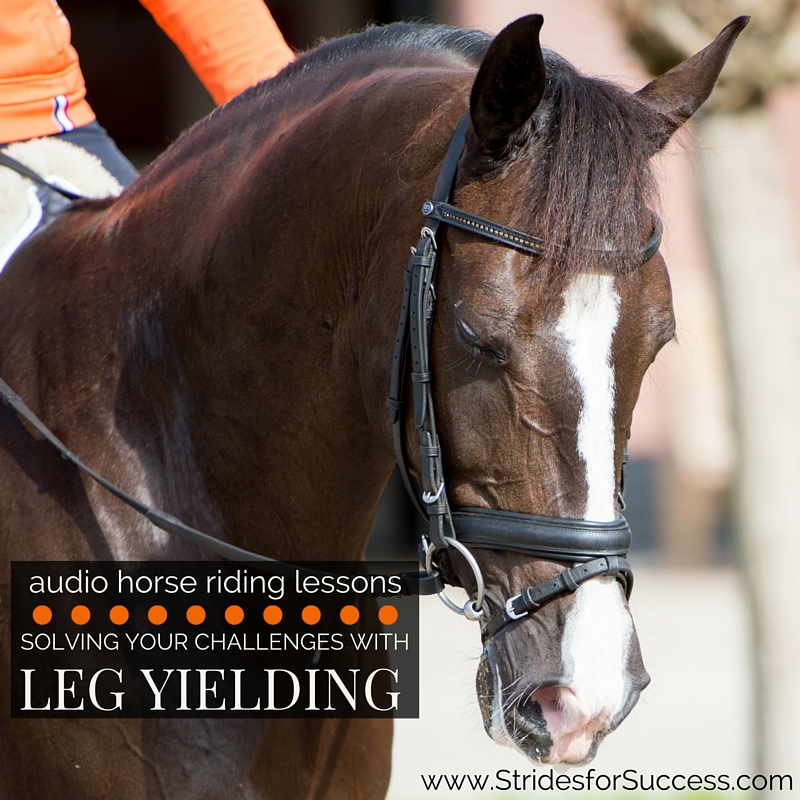
    Solving Your Leg Yielding Challenges

    What Can Go Wrong?

    While the leg yield is seen as a basic movement and, as mentioned, an introduction to more advanced and challenging lateral movements, there are many factors that can go wrong both before, during, and then after the movement.

          • Your horse’s hindquarters may trail or lead the shoulders
          • Too much bend through his neck or back
          • Loss of rhythm and tempo
          • Loss of forward movement or impulsion
          • Lack of preparation by rider before the movement
          • The rider leaning or ‘shoving’ the horse using shoulders or hips
          • The rider’s reins being too long

    Does Your Horse Understand?

    Before we get into how to solve each of these problems, I think it is important to first make sure your horse understands what is being asked of him as he is performing the movement.  You can do it on the ground. Simply ask for sideways movement.

    For example, in the stable, while grooming, you will ask him to move ‘Over’. As you ask, apply pressure with your hand on the area that you will later apply similar pressure with your leg while riding.

    You can also take your horse into the arena or schooling area and again, using pressure from your hand with the simple ‘Over’ command, ask him to move away from that pressure.  This then translates well into the saddle, when you can again ask for ‘Over’ and apply the pressure with your leg where you have been training your horse to move away from with the same voice command using your hand.

    I have a full program Groundwork for Riding that teaches you how to do this and more HERE

    Improving the Quality of the Leg Yield

    Once your horse begins to recognize and understand what ‘Over’ is and what you require of him to perform the movement, you can then begin focusing on the quality of the movement.

    As mentioned, one of the big challenges is keeping your horse straight throughout the movement.  Simply put, his shoulders must remain square in front of his hind quarters throughout the leg yield.

    It will be your horse’s natural inclination to rather have his hindquarters trailing his shoulders, which will mean that he is either bending through his back or that he is falling out through his outside shoulder.  Keep in mind that your horse must remain straight through his back at all times.

    One of the easiest ways to keep focused on where you are going is to keep your horse’s shoulders square to something while keeping his back parallel to another marker.  This way, you have a reference point of sorts by which to measure the quality of the forward and sideways movement.  

    I suggest beginning on the quarter line, shoulders square to the end of the arena, and then asking for a leg yield back to the track, all the while keeping his back parallel to the outside track while the shoulders remain square to the end.

    Begin in Walk

    Start your preparations in the walk, as like many riding movements, it is easier to perform the leg yield in the walk first and then work up to trot.  Focus on establishing a rhythm that has your horse moving forward in the walk.   Pay attention that you are moving with your horse, following the movement and that you are sitting correctly in the saddle, weight equally distributed across both seat bones.

    As you ask your horse to yield to your leg, keep this phrase in mind…  “Leg yield, not rein yield!”  

    Often we become so focused on our horse moving sideways that we forget it is primarily off the leg rather than the hand or rein. Remember to use your inside rein to merely ask for a slight bend through the poll, a small flexion to the inside (which will be in this case the side your horse is yielding to).  For example, when leg yielding from the left to the right (a leg yield to the right), your left side will be your inside.

    Engage Your Outside Rein

    Also, remember that your outside rein is there to help regulate the rhythm. And also ‘gather up’ the movement created from your inside leg.  Very often when riders are asking their horse to leg yield, they overuse the inside rein. This creates too much bend to the inside, while at the same time completely forget about the outside rein.  This results in a loss of rhythm, perhaps even a break in the gait, and generally allows the energy to fall out through the outside shoulder.

    Your outside rein will help hold the work you have put in during the preparation all together while your horse leg yields

    Another important point to keep in mind is the reason you are asking your horse to leg yield, to begin with.  It is not just a means to an end, but rather an exercise which when ridden correctly will improve your horse’s overall way of going.   This means that while the quality of the leg yield itself is important, so too is how your horse finishes the movement and, even better, if it has improved his overall way of going afterward.

    Your Outside Leg

    Correct use of your outside leg will ensure you reach the end of the leg yield movement with the same impulsion and energy you had created and prepared while going into it.  Very often riders are so focused on their horses yielding to their inside leg, that they completely forget about the outside leg. They only apply it to ‘end’ the leg yield and the sideways part of their horse’s direction.

    Your outside leg is much more than this.  It should be used to make sure your horse’s outside back leg remains engaged, pushing off and creating energy.  

    The inside back leg will cross over in front of the outside back leg each stride if the leg yield is being performed correctly.

    However if the outside back leg is not then coming forward and underneath the horse with each stride, the horse will begin to move more exclusively sideways, rather than forward and sideways… Which is what’s necessary for a true leg yield

    Rhythm; Step by Step…

    Focus on riding the movement step by step.  Rather ride two or three strides of correct leg yield than ten steps of mediocre or even bad quality.  Make sure you are carrying your body, your hands and that your hips and pelvic area are relaxed and supple enough to allow both you and your horse to move.

    Finally, make sure you are not leaning to one side or the other.  

    You should aim to remain perfectly upright, poised, and light in the saddle.  Therefore allowing that improvement in your horses’ way of going that the leg yield will cultivate when prepared and ridden correctly.

    Happy Riding

    Lorna

    Additional Resources on this Topic

    Solving Leg Yielding Challenges

  • Lateral Movement; Leg Yielding

    Lateral Movement; Leg Yielding

    Leg yielding is generally most riders’ first introduction to lateral movement.  Lateral moving, when we’re talking horses, means sideways.  It is a great movement to ride as it allows you to work your horse’s body in a different, yet equally beneficial way.

    Leg yielding, and lateral movements in general, are a test of our abilities as riders to move each individual limb independently at the same time.  

    Think of it like this; each part has it’s own equally important job which when applied together, give your horse the directions and support he needs to perform the movement.

    Leg Yielding and Shoulder In

    Become Clear on What You Want…

    To ask your horse to leg yield, you must first become clear in your mind as to what you want your horse to do and where you want him to do it.

    With regards to the ‘where’, I suggest coming in from the outside track to perhaps the quarter line. This is the line halfway between the center line and the outside track on the long side of the arena.

    This way you are using your horses natural tendency to want to return to the outside track to your favor.

    Setting up the Movement

    The next part is setting the movement up.  Your horse needs to be straight, meaning that his hips are following directly behind his shoulders.  This will remain a key part of correctly performing the leg yield.

    Ask for a slight flexion in the poll area (perhaps where you can just see the inside eyelid) but his body should remain straight.

    The final part of setting up the movement is the all-important half halt.  It will help to balance things, but also give your horse the heads up and that you are about to ask for something different.  Don’t limit your half-halt to just one.   In fact, usually, 3 or 4 or more will be necessary to give you the desired results.

    Make sure you keep your leg on throughout the half halt.

    Asking your horse to yield to your leg

    So the word ‘Yield’ means to give way to, in this case, pressure.  You must create pressure with your inside leg. This is the leg your horse must move away from.  Where you place your leg to ask will depend on your horse’s level of training.

    Younger or greener horses will require your lower leg to be slightly behind the girth, as they will often have the tendency to move over with their shoulders and leave their hindquarters trailing or following behind.

    Remember, in order to perform the movement correctly, your horse’s hips and shoulders must remain straight… Not one trailing diagonally across the arena after the other.

    Your outside leg will help to maintain consistent impulsion and also act as a ‘blocker’ should either your horse’s hips or shoulders get ahead of the other.  Your outside leg will also help to ‘end’ the leg yielding movement when you have reached your desired destination and asking your horse to go straight forward again.

    Asking for Flexion

     Begin with flexion.  Use your inside hand to ask for the slight flexion in your horse’s poll area. This must remain soft and all the while aware that you’re not asking for too much bend.

    Your outside hand, as always, holds everything together. It also helps to prevent too much bend in the head and neck of your horse.

    Also, your outside hand can also be ‘opened’ slightly away from your horse’s neck which may encourage your horse to move over into the rein.

    Remain Light and Soft…

    One of the biggest mistakes I see riders doing when first attempting this movement is an over-enthusiastic ‘shoving’ movement with their hips and seat…  This will not help!   In fact, sitting tall and quietly is vital to your horse being able to move in this manner.

    Your ‘pushing’ motion with your hips will only unbalance your horse and cause him to be unable to successfully yield to your leg.

    I have written (and recorded Daily Strides Podcast Episodes) in far more detail on this topic HERE and HERE. I will also link to more resources to help with this below.

    Happy Riding

    Lorna

    Additional Resources on this Topic